
the Creative Commons Attribution 4.0 License.
the Creative Commons Attribution 4.0 License.
 | 11 Mar 2026
Evaluation of representation of seasonally frozen ground characteristics in Land Surface Models: JSBACH and CLM
Abstract. Land surface models (LSMs) differ in simulating winter soil conditions due to complex freeze-thaw processes and snow-soil interactions, leading to uncertainties in spring and summer soil moisture and runoff. This study evaluates standalone simulations from two LSMs, JSBACH and CLM, driven by ERA5 data (1986–2022), compares them with ERA5-Land to study model differences across cold regions, and then examines all three models against the reference RIHMI-WDC observational dataset at 26 sites to better understand how SFG characteristics (timing, duration, and freeze depth) are represented in these models. The research aims to identify biases in simulated seasonally frozen ground (SFG) characteristics, investigate their causes, and assess how snow cover errors propagate into frozen ground biases using site-level evaluation over Russia. The importance of snow parameterization is highlighted in this study through an improvement to the snow density scheme in JSBACH, which reduced its cold bias in soil temperature by up to 10–20 °C, and this improved version was used for the comparative analysis. Among the models assessed in this study, JSBACH reproduces frozen ground extent most realistically, closely matching reference estimates of SFG and permafrost (PEFT) extent, but it simulates reduced snow depth (mean bias = −14.2 cm), leading to weaker insulation, enhanced soil cooling (mean bias = −3.7 °C), and deeper seasonal freezing, whereas CLM simulates soil temperatures comparatively close to observations (+0.1 °C) under colder air temperatures (−3.4 °C) and excessive snow (12.2 cm), indicating overestimated snow insulation. Site-level freeze-thaw evaluation reveals systematic biases across models, including premature autumn freezing and delayed spring thaw, leading to longer frozen ground duration (16 to 19 days) associated with contrasting snow insulation effects in CLM and JSBACH. Soil freezing in JSBACH responded too strongly to surface thermal forcing, whereas ERA5-Land and CLM showed an overestimated relationship between SFG and snow characteristics. This discrepancy indicates that LSMs differ in how control of soil freeze-thaw is partitioned between air temperature and snow processes. The study highlights that improving model performance requires better snow representation and a detailed assessment aimed at enhancing the parameterization of soil thermal and hydraulic properties.
-
Notice on discussion status
The requested preprint has a corresponding peer-reviewed final revised paper. You are encouraged to refer to the final revised version.
-
Preprint
(18079 KB)
-
The requested preprint has a corresponding peer-reviewed final revised paper. You are encouraged to refer to the final revised version.
- Preprint
(18079 KB) - Metadata XML
- BibTeX
- EndNote
- Final revised paper


Journal article(s) based on this preprint
Interactive discussion
Status: closed
-
RC1: 'Comment on egusphere-2026-381', Anonymous Referee #1, 07 Apr 2026
-
AC1: 'Reply on RC1', Mittal Parmar, 21 May 2026
The comment was uploaded in the form of a supplement: https://egusphere.copernicus.org/preprints/2026/egusphere-2026-381/egusphere-2026-381-AC1-supplement.pdf
-
AC1: 'Reply on RC1', Mittal Parmar, 21 May 2026
-
RC2: 'Comment on egusphere-2026-381', Anonymous Referee #2, 08 Apr 2026
This manuscript evaluates the representation of seasonally frozen ground (SFG) in two land surface models (JSBACH and CLM) using ERA5 forcing and in situ observations over Russia. The topic is relevant and timely, and the study provides useful diagnostics of snow–soil interactions. However, there are several critical issues in experimental design, methodological consistency, and interpretation of results that limit the robustness of the conclusions. Major revisions are required before the manuscript can be considered for publication.
Major Comments
- In the Section 2.2 (Lines 141–147), the manuscript states that CLM uses a two-phase spin-up (preindustrial + historical), whereas JSBACH is run continuously from 1941 to 2022 without equivalent spin-up. This inconsistency may lead to non-comparable initial states, especially for deep soil temperature, soil moisture, and freeze–thaw memory, directly affecting key variables such as maximum freezing depth (MFD) and SFG duration.
- In the Section 3.1, the study introduces an updated snow densification scheme for JSBACH and then uses only the improved version for intercomparison. I am curious whether CLM and ERA5L have this optimized parametrization. Also, what are the simulated results from the old setups? If it is possible to clearly frame the study as a model development and evaluation paper rather than a pure intercomparison?
- In the Section 3.3.2, the manuscript attributes many biases primarily to snow insulation effects. The attribution lacks sensitivity experiments to provide a robust evidence.
- In the Section 3.3.1, the study compares grid-scale model outputs (~30–50 km) with point observations at 26 stations. There is a large mismatch between the two scales. So, how the grids were selected? How the magnitude of the results may be influenced by this mismatch? A discussion may be needed to show the uncertainties.
- In the Section 3.3.4, the manuscript tries to interpret how the factors affect SFG by correlation analysis. In fact, these factors have close correlations, it is preferable to use partial correlation analysis or machine learning–based approaches for attribution analysis.
Detailed comments
- Abstract. SFG should be defined when it first appears.
- In many Figures, the labels (a), (b), and (c)… are not indicated.
- It is hard to get the core information from the Figure 6. A more concise Figure is needed to summarize the results.
Citation: https://doi.org/10.5194/egusphere-2026-381-RC2 -
AC2: 'Reply on RC2', Mittal Parmar, 21 May 2026
The comment was uploaded in the form of a supplement: https://egusphere.copernicus.org/preprints/2026/egusphere-2026-381/egusphere-2026-381-AC2-supplement.pdf
-
RC3: 'Comment on egusphere-2026-381', Anonymous Referee #3, 19 Apr 2026
The manuscript by Parmar et al. compares and evaluates the performance of ERA5-Land and two land surface models (JSBACH and CLM) in simulating seasonally frozen ground (SFG), and further investigates how model structure and internal processes influence the results. The study provides a detailed intercomparison across models; however, several aspects would benefit from further clarification.
Major concerns:
-
Differences in soil depth and vertical discretization can substantially affect heat and water transport in soils. Given that the three systems adopt different soil layering schemes, it remains unclear to what extent the simulated differences in soil thermal and hydrological processes arise from physical process representations versus structural differences in vertical discretization.
-
Soil ice plays an important role in regulating soil thermal properties and heat transfer. Although ERA5-Land does not explicitly represent soil ice, a more direct comparison between JSBACH and CLM in terms of soil ice processes could provide additional insight.
-
While JSBACH appears to perform better in simulating SFG, it lacks an explicit coupling between snow and soil water processes. This missing process may be important, particularly as the manuscript emphasizes the role of snow. Beyond albedo and insulation effects, snowmelt dynamics at high latitudes may also significantly influence soil thermal regimes. There is a concern that compensating errors among missing or simplified processes could lead to apparently improved performance. These limitations should be more explicitly acknowledged, potentially in the Conclusions.
-
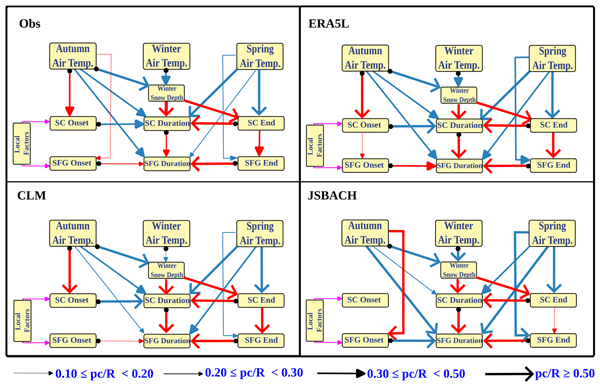
In Sect. 3.3.4, the authors provide a detailed analysis of controlling factors. However, a schematic diagram illustrating how these factors influence soil temperature and, consequently, SFG would greatly improve clarity, especially given the extensive use of abbreviations.
Minor comments:
-
Lines 91–92: What quantities are aggregated to the grid scale (e.g., energy, hydrology, carbon)?
-
Line 146: Why was JSBACH run without the two-phase spin-up?
-
Line 112: Please specify the version of CLM used.
-
Section 3.1: Is this section better suited to the Methods rather than Results?
-
Figure 6: Showing results for all individual sites may reduce readability. Consider presenting site-averaged results or aggregating sites based on a classification scheme.
-
Figure 7: It may improve clarity to show observations as solid black lines and model results as colored dashed lines.
Citation: https://doi.org/10.5194/egusphere-2026-381-RC3 -
AC3: 'Reply on RC3', Mittal Parmar, 21 May 2026
The comment was uploaded in the form of a supplement: https://egusphere.copernicus.org/preprints/2026/egusphere-2026-381/egusphere-2026-381-AC3-supplement.pdf
-
Peer review completion


Interactive discussion
Status: closed
-
RC1: 'Comment on egusphere-2026-381', Anonymous Referee #1, 07 Apr 2026
In this manuscript, the authors evaluate the seasonally frozen ground features in two land surface models, among which JSBACH is the land surface model for the ICON model and CLM is the land component model of the CESM2. Both models are forced by the ERA5 reanalysis data, and the comparisons between models takes the ERA-land reanalysis data, as well as site observations as the reference.
As the result, authors claim that JSBACH models a better extent of frozen ground, but its soil temperature has a cold bias due to its underestimation of snow depth and therefore less insulation. CLM, on the other hand, has a better performance in simulating soil temperature but under the overestimation of snow depth and insulation. Both models have some systematic biases in the relationship between the dynamics of snow processes and freezing-thaw of the ground. In this way, the authors suggest further model developments should take more care of the interactive dynamics of snow and frozen grounds.
Overall, this manuscript offers useful information on the model performance comparison regarding the territory of frozen grounds. Before it can be considered for acceptance, some issues must be fixed on the scope and technical details of this study. The details are as follow.
Main issues:
The initial condition and spinup
To me, the spin-up configuration has flaws. The initial condition of soil, including the thermal and hydrological state of soil, especially for the seasonally frozen soil with water phase change in it, are critically important. According to the manuscript, the authors use a historical simulation from 1850 to 1940 forced by GSWP3, which is a different forcing dataset from the ERA5. The spin-up is basically a transient simulation, so that to me there is no way to judge if the spin-up is completed. Authors should provide additional information on whether the thermal state of soil and atmosphere has reached the equilibrium by the end of the spin-up, otherwise the simulated soil temperature, as well as the snow accumulation manners, are not comparable to the observation/ERA-land. Furthermore, the author mentioned that the JSBACH simulation is run without the two-phase spin-up like the CLM5 simulation did. I am wondering how the initial conditions used by JSBACH and CLM5 differ from each other. The difference in initial condition could make the soil state totally different. Additionally, to my knowledge the GSWP3 data covers the period of 1901-2014 (https://svn-ccsm-inputdata.cgd.ucar.edu/trunk/inputdata/atm/datm7/atm_forcing.datm7.GSWP3.0.5d.v1.c170516/TPHWL/). So how exactly do authors uses for the spin-up from 1950 to 1899?
Soil layer structure for JSBACH
According to Table 1, the JSBACH model only has 5 soil layers. To me it is a little bit too few to present the soil temperature profile in permafrost area. Authors should consider add the information of soil layer structure (the depth and thickness of each soil layer) of the two models in the manuscript. Also, the CLM model offers a detailed soil layer structure tuned for permafrost modeling (49 soil layers for 0-9.85 m of soil and 5 bedrock layers). By the way, the definition of permafrost is deviated from that by the International Permafrost Association (the soil with a temperature colder than 0 °C (32 °F) continuously for two or more years). Authors should explain and verify the validity of this definition and how this definition leads to frozen ground extent in the JSBACH model.
Solid precipitation partitioning
Regarding snow depth, it should be noted that it is closely related to how the model deals with solid precipitation. The GSWP3 forcing only has total precipitation (rain+snow), and it is the land surface model that deals with the precipitation partitioning. In this way, other than the snow accumulation modeling, authors should also elaborate on the difference, if any, of precipitation partitioning between the two models in the methodology section.
Minor issues:
Section 3.1 This part should be moved to the methodology section.
Figure 10: I suggest adding significance test on top of these linear correlation coefficients.
Citation: https://doi.org/10.5194/egusphere-2026-381-RC1 -
AC1: 'Reply on RC1', Mittal Parmar, 21 May 2026
The comment was uploaded in the form of a supplement: https://egusphere.copernicus.org/preprints/2026/egusphere-2026-381/egusphere-2026-381-AC1-supplement.pdf
-
AC1: 'Reply on RC1', Mittal Parmar, 21 May 2026
-
RC2: 'Comment on egusphere-2026-381', Anonymous Referee #2, 08 Apr 2026
This manuscript evaluates the representation of seasonally frozen ground (SFG) in two land surface models (JSBACH and CLM) using ERA5 forcing and in situ observations over Russia. The topic is relevant and timely, and the study provides useful diagnostics of snow–soil interactions. However, there are several critical issues in experimental design, methodological consistency, and interpretation of results that limit the robustness of the conclusions. Major revisions are required before the manuscript can be considered for publication.
Major Comments
- In the Section 2.2 (Lines 141–147), the manuscript states that CLM uses a two-phase spin-up (preindustrial + historical), whereas JSBACH is run continuously from 1941 to 2022 without equivalent spin-up. This inconsistency may lead to non-comparable initial states, especially for deep soil temperature, soil moisture, and freeze–thaw memory, directly affecting key variables such as maximum freezing depth (MFD) and SFG duration.
- In the Section 3.1, the study introduces an updated snow densification scheme for JSBACH and then uses only the improved version for intercomparison. I am curious whether CLM and ERA5L have this optimized parametrization. Also, what are the simulated results from the old setups? If it is possible to clearly frame the study as a model development and evaluation paper rather than a pure intercomparison?
- In the Section 3.3.2, the manuscript attributes many biases primarily to snow insulation effects. The attribution lacks sensitivity experiments to provide a robust evidence.
- In the Section 3.3.1, the study compares grid-scale model outputs (~30–50 km) with point observations at 26 stations. There is a large mismatch between the two scales. So, how the grids were selected? How the magnitude of the results may be influenced by this mismatch? A discussion may be needed to show the uncertainties.
- In the Section 3.3.4, the manuscript tries to interpret how the factors affect SFG by correlation analysis. In fact, these factors have close correlations, it is preferable to use partial correlation analysis or machine learning–based approaches for attribution analysis.
Detailed comments
- Abstract. SFG should be defined when it first appears.
- In many Figures, the labels (a), (b), and (c)… are not indicated.
- It is hard to get the core information from the Figure 6. A more concise Figure is needed to summarize the results.
Citation: https://doi.org/10.5194/egusphere-2026-381-RC2 -
AC2: 'Reply on RC2', Mittal Parmar, 21 May 2026
The comment was uploaded in the form of a supplement: https://egusphere.copernicus.org/preprints/2026/egusphere-2026-381/egusphere-2026-381-AC2-supplement.pdf
-
RC3: 'Comment on egusphere-2026-381', Anonymous Referee #3, 19 Apr 2026
The manuscript by Parmar et al. compares and evaluates the performance of ERA5-Land and two land surface models (JSBACH and CLM) in simulating seasonally frozen ground (SFG), and further investigates how model structure and internal processes influence the results. The study provides a detailed intercomparison across models; however, several aspects would benefit from further clarification.
Major concerns:
-
Differences in soil depth and vertical discretization can substantially affect heat and water transport in soils. Given that the three systems adopt different soil layering schemes, it remains unclear to what extent the simulated differences in soil thermal and hydrological processes arise from physical process representations versus structural differences in vertical discretization.
-
Soil ice plays an important role in regulating soil thermal properties and heat transfer. Although ERA5-Land does not explicitly represent soil ice, a more direct comparison between JSBACH and CLM in terms of soil ice processes could provide additional insight.
-
While JSBACH appears to perform better in simulating SFG, it lacks an explicit coupling between snow and soil water processes. This missing process may be important, particularly as the manuscript emphasizes the role of snow. Beyond albedo and insulation effects, snowmelt dynamics at high latitudes may also significantly influence soil thermal regimes. There is a concern that compensating errors among missing or simplified processes could lead to apparently improved performance. These limitations should be more explicitly acknowledged, potentially in the Conclusions.
-
In Sect. 3.3.4, the authors provide a detailed analysis of controlling factors. However, a schematic diagram illustrating how these factors influence soil temperature and, consequently, SFG would greatly improve clarity, especially given the extensive use of abbreviations.
Minor comments:
-
Lines 91–92: What quantities are aggregated to the grid scale (e.g., energy, hydrology, carbon)?
-
Line 146: Why was JSBACH run without the two-phase spin-up?
-
Line 112: Please specify the version of CLM used.
-
Section 3.1: Is this section better suited to the Methods rather than Results?
-
Figure 6: Showing results for all individual sites may reduce readability. Consider presenting site-averaged results or aggregating sites based on a classification scheme.
-
Figure 7: It may improve clarity to show observations as solid black lines and model results as colored dashed lines.
Citation: https://doi.org/10.5194/egusphere-2026-381-RC3 -
AC3: 'Reply on RC3', Mittal Parmar, 21 May 2026
The comment was uploaded in the form of a supplement: https://egusphere.copernicus.org/preprints/2026/egusphere-2026-381/egusphere-2026-381-AC3-supplement.pdf
-
Peer review completion
Journal article(s) based on this preprint
Viewed
| HTML | XML | Total | BibTeX | EndNote | |
|---|---|---|---|---|---|
| 959 | 673 | 138 | 1,770 | 112 | 120 |
- HTML: 959
- PDF: 673
- XML: 138
- Total: 1,770
- BibTeX: 112
- EndNote: 120
Viewed (geographical distribution)
| Country | # | Views | % |
|---|
| Total: | 0 |
| HTML: | 0 |
| PDF: | 0 |
| XML: | 0 |
- 1
Mittal Parmar

Kristina Fröhlich
Antonella Sanna
Tobias Stacke
Marianna Benassi
Zhicheng Luo
Daniele Peano
Bodo Ahrens
The requested preprint has a corresponding peer-reviewed final revised paper. You are encouraged to refer to the final revised version.
- Preprint
(18079 KB) - Metadata XML
In this manuscript, the authors evaluate the seasonally frozen ground features in two land surface models, among which JSBACH is the land surface model for the ICON model and CLM is the land component model of the CESM2. Both models are forced by the ERA5 reanalysis data, and the comparisons between models takes the ERA-land reanalysis data, as well as site observations as the reference.
As the result, authors claim that JSBACH models a better extent of frozen ground, but its soil temperature has a cold bias due to its underestimation of snow depth and therefore less insulation. CLM, on the other hand, has a better performance in simulating soil temperature but under the overestimation of snow depth and insulation. Both models have some systematic biases in the relationship between the dynamics of snow processes and freezing-thaw of the ground. In this way, the authors suggest further model developments should take more care of the interactive dynamics of snow and frozen grounds.
Overall, this manuscript offers useful information on the model performance comparison regarding the territory of frozen grounds. Before it can be considered for acceptance, some issues must be fixed on the scope and technical details of this study. The details are as follow.
Main issues:
The initial condition and spinup
To me, the spin-up configuration has flaws. The initial condition of soil, including the thermal and hydrological state of soil, especially for the seasonally frozen soil with water phase change in it, are critically important. According to the manuscript, the authors use a historical simulation from 1850 to 1940 forced by GSWP3, which is a different forcing dataset from the ERA5. The spin-up is basically a transient simulation, so that to me there is no way to judge if the spin-up is completed. Authors should provide additional information on whether the thermal state of soil and atmosphere has reached the equilibrium by the end of the spin-up, otherwise the simulated soil temperature, as well as the snow accumulation manners, are not comparable to the observation/ERA-land. Furthermore, the author mentioned that the JSBACH simulation is run without the two-phase spin-up like the CLM5 simulation did. I am wondering how the initial conditions used by JSBACH and CLM5 differ from each other. The difference in initial condition could make the soil state totally different. Additionally, to my knowledge the GSWP3 data covers the period of 1901-2014 (https://svn-ccsm-inputdata.cgd.ucar.edu/trunk/inputdata/atm/datm7/atm_forcing.datm7.GSWP3.0.5d.v1.c170516/TPHWL/). So how exactly do authors uses for the spin-up from 1950 to 1899?
Soil layer structure for JSBACH
According to Table 1, the JSBACH model only has 5 soil layers. To me it is a little bit too few to present the soil temperature profile in permafrost area. Authors should consider add the information of soil layer structure (the depth and thickness of each soil layer) of the two models in the manuscript. Also, the CLM model offers a detailed soil layer structure tuned for permafrost modeling (49 soil layers for 0-9.85 m of soil and 5 bedrock layers). By the way, the definition of permafrost is deviated from that by the International Permafrost Association (the soil with a temperature colder than 0 °C (32 °F) continuously for two or more years). Authors should explain and verify the validity of this definition and how this definition leads to frozen ground extent in the JSBACH model.
Solid precipitation partitioning
Regarding snow depth, it should be noted that it is closely related to how the model deals with solid precipitation. The GSWP3 forcing only has total precipitation (rain+snow), and it is the land surface model that deals with the precipitation partitioning. In this way, other than the snow accumulation modeling, authors should also elaborate on the difference, if any, of precipitation partitioning between the two models in the methodology section.
Minor issues:
Section 3.1 This part should be moved to the methodology section.
Figure 10: I suggest adding significance test on top of these linear correlation coefficients.