
the Creative Commons Attribution 4.0 License.
the Creative Commons Attribution 4.0 License.
 | 25 Jun 2026
A Multi-Angle and Polarization-Based Retrieval Algorithm for Aerosol Layer Height of Smoke and Dust
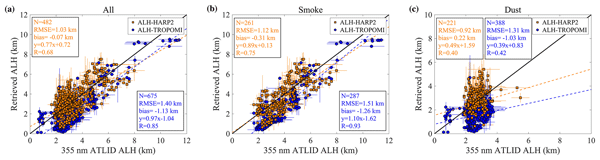
Abstract. The vertical distribution of aerosols governs their interactions with solar radiation and clouds, making it a key factor in their climatic and environmental effects. Existing passive methods for retrieving aerosol layer height (ALH) largely rely on a single observational dimension, such as spectral or multi-angle information, which provides limited constraints under complex aerosol conditions. To address this, we extend conventional spectral approaches by incorporating multi-angle polarimetric observations. Leveraging the high sensitivity of polarization signals to differences between molecular Rayleigh and aerosol scattering, along with broader scattering angle sampling, sensitivity to aerosol vertical structure is significantly enhanced. Using a vector radiative transfer model and information content analysis, we evaluate the contributions of multi-angle and polarimetric information to ALH retrieval. Results show that, compared with radiance-only observations, multi-angle polarimetric measurements substantially increase the degrees of freedom for signal, thereby improving ALH accuracy. An optimal estimation method is developed using HARP2 multi-angle polarimetric observations aboard PACE. Retrieved ALH values are validated against ATLID lidar observations on EarthCARE. For all collocated samples, HARP2 retrievals achieve a root mean square error (RMSE) of 1.03 km, significantly lower than the 1.40 km from TROPOMI, with a near-zero bias (−0.07 km). For smoke, the RMSE is 1.12 km, and for dust it further decreases to 0.92 km. In a typical dust transport event, 84.5 % of retrieval errors are smaller than 1 km, highlighting the marked accuracy advantage of multi-angle polarimetric observations in ALH retrieval.
-
Notice on discussion status
The requested preprint has a corresponding peer-reviewed final revised paper. You are encouraged to refer to the final revised version.
-
Preprint
(5231 KB)
-
The requested preprint has a corresponding peer-reviewed final revised paper. You are encouraged to refer to the final revised version.
- Preprint
(5231 KB) - Metadata XML
- BibTeX
- EndNote
- Final revised paper


Journal article(s) based on this preprint
Interactive discussion
Status: closed
-
RC1: 'Comment on egusphere-2026-3503', Anonymous Referee #1, 26 Jun 2026
-
AC1: 'Reply on RC1', Yong Xue, 16 Jul 2026
The comment was uploaded in the form of a supplement: https://egusphere.copernicus.org/preprints/2026/egusphere-2026-3503/egusphere-2026-3503-AC1-supplement.pdf
-
AC1: 'Reply on RC1', Yong Xue, 16 Jul 2026
-
CC1: 'Comment on egusphere-2026-3503', Ralph Kahn, 30 Jun 2026
The comment was uploaded in the form of a supplement: https://egusphere.copernicus.org/preprints/2026/egusphere-2026-3503/egusphere-2026-3503-CC1-supplement.pdf
-
AC2: 'Reply on CC1', Yong Xue, 16 Jul 2026
The comment was uploaded in the form of a supplement: https://egusphere.copernicus.org/preprints/2026/egusphere-2026-3503/egusphere-2026-3503-AC2-supplement.pdf
-
CC2: 'Reply on AC2', Ralph Kahn, 16 Jul 2026
Thank you for considering my suggestions, Yong. This is important work. After reading over your notes, I have a couple of additional thoughts, in case they are of use:
- I think it might be worth emphasizing the point you make about using intensity and polarization in the ALH retrieval, rather than a purely geometric approach, because the HARP-2 pixel resolution is relatively coarse. This contrasts with MISR, which lacks polarization, but includes steeper view angles and has higher pixel resolution.
- A surface contribution, due to some combination of low AOD and bright surface, can limit our ability to perform an ALH geometric retrieval at all with MISR. But unlike radiance retrievals, this does not really contaminate the retrieval, because we can perform an ALH retrieval only if we can see contrast features at multiple angles in the aerosol layer itself. The steeper-angle views enhance the aerosol-layer contribution relative to the surface contribution, which helps improve aerosol-layer contrast-feature visibility. As such, the 60˚ and 70˚ view angles make important contributions to the MISR ALH retrievals.
- With MISR, we perform the ALH retrievals with each of the red and blue spectral bands. The red band is reported at ~250 m at all nine view angles, so if the aerosol is sufficiently visible in this band, the red retrieval provides results with the highest vertical resolution. However, the AOD is generally greater in the blue band, especially when small smoke or pollution particles dominate, and in such cases, the blue channel, reported at 1.1 km at all MISR angles except nadir, sometimes offers greater sensitivity.
Citation: https://doi.org/10.5194/egusphere-2026-3503-CC2 -
AC4: 'Reply on CC2', Yong Xue, 28 Jul 2026
The comment was uploaded in the form of a supplement: https://egusphere.copernicus.org/preprints/2026/egusphere-2026-3503/egusphere-2026-3503-AC4-supplement.pdf
-
CC2: 'Reply on AC2', Ralph Kahn, 16 Jul 2026
-
AC2: 'Reply on CC1', Yong Xue, 16 Jul 2026
-
RC2: 'Comment on egusphere-2026-3503', Anonymous Referee #2, 16 Jul 2026
This manuscript investigates theoretically the information content of multi-angle polarimetric measurements for ALH retrievals in the UV, using a Degrees of Freedom for Signal (DFS) analysis. It demonstrates that polarisation measurements adds information, especially at geometries that are relevant for satellite observations. Subsequently, an ALH retrieval algorithm is applied to multi-angle polarimetric PACE/HARP2 observations at 441 nm and compared to independent ALH retrievals from EarthCARE/ATLID, using active lidar measurements, and TROPOMI ALH using the O2-A band.
The paper is relevant and interesting, and the analysis is generally of good quality. However, for publication a number of issues need to be addressed, mainly to better explain what has been done and provide concise information.
Details are listed below:
l64-67
"Specifically, more photons are scattered back to space at higher altitudes, thereby reducing their probability of penetrating into the lower atmosphere and being absorbed by O₂. As a result, higher aerosol layers lead to stronger Top-of-Atmosphere (TOA) reflectance within the absorption bands."suggest to reformulate something like:
Specifically, for scattering layers at higher altitudes, the probability for photons to penetrate into the lower atmosphere and be absorbed by O₂ reduces, leading to shallower absorption lines in within the absorption bands for higher altitude aerosol layers.
l77
It has shown -> It has been shownl107-108
Moreover, the quantitative contributions of multi-dimensional observations to ALH retrieval have not yet been systematically assessed, highlighting the need for further investigation.I do not agree here. There is a large body in literature, some of which are already ilisted.
The GRASP consortium has shown quite systematically that they can use multi-dimensional observation to improve the ALH and other aerosol parameters.Another reference is
Hasekamp, O. P., P. Litvinov, and A. Butz (2011), Aerosol properties over the ocean from PARASOL multiangle photopolarimetric measurements, J. Geophys. Res., 116, D14204, doi:10.1029/2010JD015469.l170
"which further improves the reliability of the data."This is a rather empty statement. The ALH product is for cloud-screened pixels only. Period.
Section 3.
The theoretical treatment needs improvement. The relationship between eq (1) and (2) is not given. S_epsilon (3) is diagonal, which means that the errors are assumed to be independent, this needs to be mentioned.
The Stokes parameters were mentioned in section 2, but only here treated formally. Better to remove the introduction in section 2, and treat it here properly. Same for DoLP (change all DOLP to DoLP).
l244 "radiance III" is unclear.
I also suggest to move eq (13) and its discussion on l632 to section 3. The extinction-weighted height is used in the text before it is defined.
l250 Mie scattering is proper for small and/or spherical particles only.
Table 1: Where are the numbers coming from? The table lists 3 references, the text says Lee et al (2015). Please, be concise and consistent.
l271 MCD43A1 product is a MODIS product, which is not described. Please add.
l287
"Under typical aerosol loading conditions (AOD = 0.3–1)"It is unclear what aerosol type is used in Fig 1 and what the AOD is, since it wavelength-dependent. This should be specified properly and consistently throughout the text. Also see next item.
Fig 1.
The AOD is a wavelength-dependent parameter. In Fig.1 the AOD ranges from 0-5 for all wavelengths, representing markedly different ranges, since the AOD at 441 is 2-3 times higher that at 873 for smoke. It is not clear what is used and the figures should be scaled to the same ranges to be compared as they are in the text now.l336
Same as before: aerosol optical depth (AOD = 0.3) is ambiguous. Please, describe exactly how Fig. 2-6 were produced.Fig. 2-6. The captions should describe what's in the figures: I guess relative azimuth from 0-180 degrees? The axis from 0-10 is unexplained.
l370
"DFS exhibits a pronounced enhancement with viewing geometry. "
I do not understand this. Viewing geometry in this sense is ambiguous. Please rephrase.
l372-274:
Under large viewing angles, the intensity-only observations are not so bad. I think the conclusion is that for small viewing angles the additional information form polarisation measurements is largest.l428-430: Repetition, move theoretical treatments to section 3.
l475.
The reference Fromm et al from 2010 is a strange reference to describe the transport of a 2025 smoke plume. Please, rephrase. I guess the idea is that this happens more often or happened before.Citation: https://doi.org/10.5194/egusphere-2026-3503-RC2 -
AC5: 'Reply on RC2', Yong Xue, 28 Jul 2026
The comment was uploaded in the form of a supplement: https://egusphere.copernicus.org/preprints/2026/egusphere-2026-3503/egusphere-2026-3503-AC5-supplement.pdf
-
AC5: 'Reply on RC2', Yong Xue, 28 Jul 2026
-
RC3: 'Comment on egusphere-2026-3503', Anonymous Referee #3, 19 Jul 2026
The vertical distribution of aerosols plays significant roles in solar radiation transfer and climate change. The authors use a vector radiative transfer model and information content analysis and evaluate the contributions from key factors, including multiangle and polarimetric information to ALH retrieval. The authors also do some case and sensitivity studies and found that multiangle polarimetric measurements substantially increase the degrees of freedom for signal and improve ALH accuracy. An optimal estimation method is developed. Retrieved ALH values are validated against observations and showed reasonable estimations, such as HARP2 retrievals achieve a root mean square error of 1.03 km. Generally, this manuscript is well organized, written and explained. Some minor comments and suggestions are given.
L143, please explain I, Q, and U.
L145, please rewrite “I represents total radiance intensity ……”.
L149-150, “while Q and U denote the linear polarization components that characterize the polarization state of the scattering field” could be removed to L143.
L237, “Conversely” could be improved by using another word.
L286-287, “the information content of ALH shows a clear decreasing trend with increasing wavelength, i.e., 441 nm > 549 nm > 669 nm > 873 nm”, more explanations about the information content of ALH and the mechanism of this sentence are suggested.
L465, “This study selects three representative smoke transport events over North America on May 28, May 30, and June 1, 2025” can be removed and combined to L444-445. Please explain why the selected 3 and 6 events is representative.
6 Conclusion, is a little longer and should be shortened. Please report the key conclusions.
Citation: https://doi.org/10.5194/egusphere-2026-3503-RC3 -
AC6: 'Reply on RC3', Yong Xue, 28 Jul 2026
The comment was uploaded in the form of a supplement: https://egusphere.copernicus.org/preprints/2026/egusphere-2026-3503/egusphere-2026-3503-AC6-supplement.pdf
-
AC6: 'Reply on RC3', Yong Xue, 28 Jul 2026
-
CC3: 'Comment on egusphere-2026-3503', Meng Gao, 24 Jul 2026
The manuscript by Pei et al. presents a comprehensive analysis of retrieving aerosol layer height (ALH) using observations from NASA's PACE HARP2 instrument. The authors provide a thorough information content analysis of the contributions from spectral, polarization, and angular measurements under different surface brightness conditions and aerosol layer heights. The proposed retrieval algorithm, based on the HARP2 blue band and the full Stokes components (I, Q, and U), demonstrates encouraging performance when compared with TROPOMI and EarthCARE observations. Overall, I found this to be a well-executed and valuable study.
I would also like to draw the authors' attention to the current NASA operational HARP2 aerosol products (FastMAPOL), which include an aerosol layer height (ALH) product derived from HARP2 multi-angle polarimetric observations. These products may be useful for comparison in future studies. The product description is available at https://pace.oceansciences.org/data_table.htm?id=1, and the data can be accessed through the NASA Earthdata Cloud (DOI: https://doi.org/10.5067/PACE/HARP2/L2/MAPOL_OCEAN/3.0). The expected ALH uncertainty is discussed in Gao et al. (2023; https://doi.org/10.5194/amt-16-5863-2023), where the theoretical RMSE is approximately 0.94 km (Figs. 5 and 6), which is very close to the ~1 km validation uncertainty reported in the present study. In addition, this study showed that the ALH uncertainty decreases with increasing aerosol optical depth (Fig. 7), which is also consistent with the findings presented in this manuscript.
As I can gather here, the algorithm presented in this study differs from the operational algorithm in several aspects, including the selection of one key spectral band, direct use of the I, Q, and U Stokes components, the incorporation of external aerosol information, and the focus of one retrieval parameter rather than a dozen of aerosol microphysics. These design choices appear to simplify the retrieval process while making it more robust to current calibration uncertainties. Based on the reported validation results, the retrieval performance appears reasonable and robust. You may also make this clear.
A few more comments below:
- Abstract (Line 25), Table 4, and Conclusion (Line 757):
As mentioned above, the reported ALH RMSE of 1.03 km is in excellent agreement with the theoretical HARP2 retrieval uncertainty reported by the PACE team (Gao et al., 2023). This is very encouraging. It would be worthwhile to mention the agreement. - Line 56, Line 90, Line 107: For the polarization-based retrieval approaches, it would be more complete to mention existing HARP2 algorithm and product.
- Line 136:
Xu et al. (2024) is an important reference for ALH retrieval, but it may not be sufficient to describe the HARP2 instrument itself. You may also consider:
Martins, J. V., Fernandez-Borda, R., McBride, B., Remer, L., and Barbosa, H. M. J.: The HARP hyperangular imaging polarimeter and the need for small satellite payloads with high science payoff for Earth science remote sensing, IGARSS 2018, Valencia, Spain, 22–27 July 2018, 6304–6307, https://doi.org/10.1109/IGARSS.2018.8518823.
- Line 140:
As mentioned previously, It is interesting to see the retrieval directly using the I, Q, and U Stokes components. The current operational HARP2 Version 3 data still experience some polarimetric calibration challenges. From the operational product, retrievals based only on total intensity and degree of linear polarization (I and DoLP) often exhibit positive AOD biases and large ALH biases. Using the full Stokes vector (I, Q, and U) in this study, which also retains polarization orientation information, may help mitigate some of these calibration-related issues. The use of externally constrained AOD may also improve retrieval robustness by decoupling mutual dependencies between ALH and other aerosol properties. - Line 144:
Please note that the PACE Level-1C spatial resolution is approximately 5.2 km, rather than 3.5 km. - Line 220:
Retrieval uncertainty propagation has also been investigated for HARP2 observations (Gao et al., 2023). That study found that the theoretical ALH uncertainty agrees well with retrieval uncertainties derived from simulations (see Fig. 9). That means the retrieval uncertainty of 1km may also approach to the optimal performance constrainted by measurement uncertainty itself.
Citation: https://doi.org/10.5194/egusphere-2026-3503-CC3 -
AC3: 'Reply on CC3', Yong Xue, 28 Jul 2026
The comment was uploaded in the form of a supplement: https://egusphere.copernicus.org/preprints/2026/egusphere-2026-3503/egusphere-2026-3503-AC3-supplement.pdf
-
CC4: 'Reply on AC3', Meng Gao, 28 Jul 2026
Dear Yong, thank you for addressing my questions and comments. The revised sections make it clear on the strength of this paper.
Just one more note, in your following revised paragraph, you may like to update one of the references which reflect the ALH retrieval performance from HARP2 (Gao et al 2023, https://doi.org/10.5194/amt-16-5863-2023).
Lines 124-130: Meanwhile, polarization observations provide an additional dimension of
information for aerosol vertical structure retrieval. Using data from the Research Scanning
Polarimeter (RSP), Wu et al. (2016) found that polarization signals in the near-ultraviolet and blue
spectral bands exhibit strong sensitivity to ALH. Recently, the NASA operational FastMAPOL
product has provided aerosol properties, including ALH, from HARP2 multi-angle polarimetric
observations (Gao et al., 2023). These developments demonstrate the potential of multi-angle
polarimetric measurements for aerosol characterization.Citation: https://doi.org/10.5194/egusphere-2026-3503-CC4 -
AC7: 'Reply on CC4', Yong Xue, 28 Jul 2026
Dear Meng,
Thank you for this valuable suggestion. We have incorporated the recommended reference and updated the relevant paragraph to mention the NASA operational FastMAPOL product and its demonstrated ability to retrieve aerosol properties, including ALH, from HARP2 measurements. The changes can be found in Lines 124–130 of the revised manuscript.
Yours etc.
Yong
Citation: https://doi.org/10.5194/egusphere-2026-3503-AC7 -
AC8: 'Reply on CC4', Yong Xue, 28 Jul 2026
The comment was uploaded in the form of a supplement: https://egusphere.copernicus.org/preprints/2026/egusphere-2026-3503/egusphere-2026-3503-AC8-supplement.pdf
-
AC7: 'Reply on CC4', Yong Xue, 28 Jul 2026
-
CC4: 'Reply on AC3', Meng Gao, 28 Jul 2026
- Abstract (Line 25), Table 4, and Conclusion (Line 757):
-
RC4: 'Comment on egusphere-2026-3503', Anonymous Referee #3, 28 Jul 2026
The authors revised the manuscript. Now, it is much improved.
Citation: https://doi.org/10.5194/egusphere-2026-3503-RC4 -
AC9: 'Reply on RC4', Yong Xue, 13 Aug 2026
Thank you for your careful consideration of our manuscript entitled “A Multi-Angle and Polarization-Based Retrieval Algorithm for Aerosol Layer Height of Smoke and Dust” (Manuscript ID: egusphere-2026-3503). We sincerely appreciate the constructive comments and suggestions during the open discussion phase. These comments have been extremely valuable in improving the scientific quality, clarity, and completeness of our manuscript.
Citation: https://doi.org/10.5194/egusphere-2026-3503-AC9
-
AC9: 'Reply on RC4', Yong Xue, 13 Aug 2026
Peer review completion


Interactive discussion
Status: closed
-
RC1: 'Comment on egusphere-2026-3503', Anonymous Referee #1, 26 Jun 2026
General Comments
This manuscript presents an aerosol layer height (ALH) retrieval algorithm based on PACE/HARP2 multi-angle polarimetric observations using an optimal estimation framework. The authors first investigate the information content of multi-angle polarization measurements for ALH retrieval using Degrees of Freedom for Signal (DFS) analysis and subsequently develop an ALH retrieval scheme based on HARP2 observations at 441 nm. The retrieval results are validated against EarthCARE/ATLID lidar observations and further compared with the TROPOMI ALH product.
Overall, the topic is scientifically important and timely. With the advent of next-generation multi-angle polarimetric satellite missions, such as PACE and 3MI, retrieving aerosol vertical structure from multi-angle polarization measurements has become an active and important research area in atmospheric remote sensing. The manuscript is generally well organized, and the results demonstrate that polarization measurements can effectively improve ALH retrieval capability. However, several aspects of the manuscript require further clarification and improvement, particularly regarding the algorithm description, uncertainty characterization, validation strategy, and discussion of the results. In particular, the retrieval framework strongly relies on externally provided AOD products and prescribed aerosol models, while the impacts of these assumptions on the retrieved ALH are not sufficiently discussed. Therefore, I recommend that the manuscript undergoes minor revision before it can be considered for publication.
Major Comments / Suggestions for Improvement
- Please clarify whether any quality control procedures or filtering criteria were applied to the ATLID lidar observations used for validation. Since ATLID retrieval quality may vary under different atmospheric conditions, it is important to describe how the ATLID data were screened prior to the intercomparison analysis.
- The collocation strategy among HARP2, TROPOMI, and ATLID observations is not sufficiently described. The manuscript should clearly specify: the maximum spatial collocation distance; the temporal collocation window; the spatial averaging strategy; the quality control criteria applied to each dataset. These details are essential for reproducibility and for properly interpreting the validation results.
- The retrieval algorithm relies on externally supplied VIIRS AOD products. Since AOD is a key parameter governing atmospheric radiative transfer, uncertainties in AOD are expected to propagate into the retrieved ALH. It is suggested that the authors clarify: the sensitivity of ALH retrievals to AOD uncertainties; whether retrieval errors increase significantly under low-AOD conditions. A simple sensitivity analysis would greatly strengthen the robustness assessment of the proposed method.
- The authors selected the 441 nm channel for ALH retrieval. Although shorter wavelengths generally exhibit stronger sensitivity to aerosol vertical distribution due to enhanced molecular scattering, it remains unclear why 441 nm was ultimately chosen instead of other available HARP2 wavelengths. It would be beneficial if the authors could provide quantitative evidence supporting this choice, for instance by conducting ALH sensitivity analyses at different wavelengths, comparing DFS across channels, and examining Jacobians with respect to ALH. These analyses would strengthen the justification for selecting the 441 nm channel.
- Only six case studies are used for validation in this manuscript. Although these cases appear to be representative, the sample size is relatively limited. Please clarify: the criteria used to select these six cases; whether only favorable observational conditions were considered. In addition, the authors should discuss the extent to which these selected cases are representative of global aerosol conditions.
- The forward simulations in this study assume a single aerosol layer. However, multilayer aerosol structures are frequently observed in real atmospheric conditions, especially during biomass burning and dust transport events, where elevated aerosol layers often coexist with boundary-layer aerosols. It is recommended that the authors clarify: what physical quantity is actually retrieved under multilayer aerosol conditions; whether the retrieved ALH is more representative of an extinction-weighted height, centroid height, or dominant aerosol layer height; the potential biases introduced by multilayer aerosol structures. Furthermore, this limitation should be explicitly discussed in the Conclusions or Discussion section.
- Additional literature must elaborate on the issue of: (i) aerosol particle size spectra collected at 2.5-min time resolution with a Scanning Mobility Particle Sizer at various height levels. See, for example: https://doi.org/10.1016/j.atmosenv.2012.05.015; (ii) the fact that the aerosol vertical distribution plays a crucial role in shaping the ozone vertical profile and strongly influences the biologically effective radiation that reaches the Earth’s surface. See for example: Journal of Geophysical Research: Atmospheres 106.D14 (2001): 14843-14854.
Minor Comments / Typographical / Formatting
- Page 2, line 64: "CALIOP provide" should be "CALIOP provides".
- Suggest clearly and consistently define ALH throughout the manuscript. Different studies may define ALH as extinction-weighted height, aerosol centroid height, or aerosol layer top height. In addition, it should be clearly stated whether all ALH values reported in this study are referenced to mean sea level or to the local surface.
- Suggest carefully check all equations and ensure that every symbol and variable is explicitly defined when first introduced.
Citation: https://doi.org/10.5194/egusphere-2026-3503-RC1 -
AC1: 'Reply on RC1', Yong Xue, 16 Jul 2026
The comment was uploaded in the form of a supplement: https://egusphere.copernicus.org/preprints/2026/egusphere-2026-3503/egusphere-2026-3503-AC1-supplement.pdf
-
CC1: 'Comment on egusphere-2026-3503', Ralph Kahn, 30 Jun 2026
The comment was uploaded in the form of a supplement: https://egusphere.copernicus.org/preprints/2026/egusphere-2026-3503/egusphere-2026-3503-CC1-supplement.pdf
-
AC2: 'Reply on CC1', Yong Xue, 16 Jul 2026
The comment was uploaded in the form of a supplement: https://egusphere.copernicus.org/preprints/2026/egusphere-2026-3503/egusphere-2026-3503-AC2-supplement.pdf
-
CC2: 'Reply on AC2', Ralph Kahn, 16 Jul 2026
Thank you for considering my suggestions, Yong. This is important work. After reading over your notes, I have a couple of additional thoughts, in case they are of use:
- I think it might be worth emphasizing the point you make about using intensity and polarization in the ALH retrieval, rather than a purely geometric approach, because the HARP-2 pixel resolution is relatively coarse. This contrasts with MISR, which lacks polarization, but includes steeper view angles and has higher pixel resolution.
- A surface contribution, due to some combination of low AOD and bright surface, can limit our ability to perform an ALH geometric retrieval at all with MISR. But unlike radiance retrievals, this does not really contaminate the retrieval, because we can perform an ALH retrieval only if we can see contrast features at multiple angles in the aerosol layer itself. The steeper-angle views enhance the aerosol-layer contribution relative to the surface contribution, which helps improve aerosol-layer contrast-feature visibility. As such, the 60˚ and 70˚ view angles make important contributions to the MISR ALH retrievals.
- With MISR, we perform the ALH retrievals with each of the red and blue spectral bands. The red band is reported at ~250 m at all nine view angles, so if the aerosol is sufficiently visible in this band, the red retrieval provides results with the highest vertical resolution. However, the AOD is generally greater in the blue band, especially when small smoke or pollution particles dominate, and in such cases, the blue channel, reported at 1.1 km at all MISR angles except nadir, sometimes offers greater sensitivity.
Citation: https://doi.org/10.5194/egusphere-2026-3503-CC2 -
AC4: 'Reply on CC2', Yong Xue, 28 Jul 2026
The comment was uploaded in the form of a supplement: https://egusphere.copernicus.org/preprints/2026/egusphere-2026-3503/egusphere-2026-3503-AC4-supplement.pdf
-
CC2: 'Reply on AC2', Ralph Kahn, 16 Jul 2026
-
AC2: 'Reply on CC1', Yong Xue, 16 Jul 2026
-
RC2: 'Comment on egusphere-2026-3503', Anonymous Referee #2, 16 Jul 2026
This manuscript investigates theoretically the information content of multi-angle polarimetric measurements for ALH retrievals in the UV, using a Degrees of Freedom for Signal (DFS) analysis. It demonstrates that polarisation measurements adds information, especially at geometries that are relevant for satellite observations. Subsequently, an ALH retrieval algorithm is applied to multi-angle polarimetric PACE/HARP2 observations at 441 nm and compared to independent ALH retrievals from EarthCARE/ATLID, using active lidar measurements, and TROPOMI ALH using the O2-A band.
The paper is relevant and interesting, and the analysis is generally of good quality. However, for publication a number of issues need to be addressed, mainly to better explain what has been done and provide concise information.
Details are listed below:
l64-67
"Specifically, more photons are scattered back to space at higher altitudes, thereby reducing their probability of penetrating into the lower atmosphere and being absorbed by O₂. As a result, higher aerosol layers lead to stronger Top-of-Atmosphere (TOA) reflectance within the absorption bands."suggest to reformulate something like:
Specifically, for scattering layers at higher altitudes, the probability for photons to penetrate into the lower atmosphere and be absorbed by O₂ reduces, leading to shallower absorption lines in within the absorption bands for higher altitude aerosol layers.
l77
It has shown -> It has been shownl107-108
Moreover, the quantitative contributions of multi-dimensional observations to ALH retrieval have not yet been systematically assessed, highlighting the need for further investigation.I do not agree here. There is a large body in literature, some of which are already ilisted.
The GRASP consortium has shown quite systematically that they can use multi-dimensional observation to improve the ALH and other aerosol parameters.Another reference is
Hasekamp, O. P., P. Litvinov, and A. Butz (2011), Aerosol properties over the ocean from PARASOL multiangle photopolarimetric measurements, J. Geophys. Res., 116, D14204, doi:10.1029/2010JD015469.l170
"which further improves the reliability of the data."This is a rather empty statement. The ALH product is for cloud-screened pixels only. Period.
Section 3.
The theoretical treatment needs improvement. The relationship between eq (1) and (2) is not given. S_epsilon (3) is diagonal, which means that the errors are assumed to be independent, this needs to be mentioned.
The Stokes parameters were mentioned in section 2, but only here treated formally. Better to remove the introduction in section 2, and treat it here properly. Same for DoLP (change all DOLP to DoLP).
l244 "radiance III" is unclear.
I also suggest to move eq (13) and its discussion on l632 to section 3. The extinction-weighted height is used in the text before it is defined.
l250 Mie scattering is proper for small and/or spherical particles only.
Table 1: Where are the numbers coming from? The table lists 3 references, the text says Lee et al (2015). Please, be concise and consistent.
l271 MCD43A1 product is a MODIS product, which is not described. Please add.
l287
"Under typical aerosol loading conditions (AOD = 0.3–1)"It is unclear what aerosol type is used in Fig 1 and what the AOD is, since it wavelength-dependent. This should be specified properly and consistently throughout the text. Also see next item.
Fig 1.
The AOD is a wavelength-dependent parameter. In Fig.1 the AOD ranges from 0-5 for all wavelengths, representing markedly different ranges, since the AOD at 441 is 2-3 times higher that at 873 for smoke. It is not clear what is used and the figures should be scaled to the same ranges to be compared as they are in the text now.l336
Same as before: aerosol optical depth (AOD = 0.3) is ambiguous. Please, describe exactly how Fig. 2-6 were produced.Fig. 2-6. The captions should describe what's in the figures: I guess relative azimuth from 0-180 degrees? The axis from 0-10 is unexplained.
l370
"DFS exhibits a pronounced enhancement with viewing geometry. "
I do not understand this. Viewing geometry in this sense is ambiguous. Please rephrase.
l372-274:
Under large viewing angles, the intensity-only observations are not so bad. I think the conclusion is that for small viewing angles the additional information form polarisation measurements is largest.l428-430: Repetition, move theoretical treatments to section 3.
l475.
The reference Fromm et al from 2010 is a strange reference to describe the transport of a 2025 smoke plume. Please, rephrase. I guess the idea is that this happens more often or happened before.Citation: https://doi.org/10.5194/egusphere-2026-3503-RC2 -
AC5: 'Reply on RC2', Yong Xue, 28 Jul 2026
The comment was uploaded in the form of a supplement: https://egusphere.copernicus.org/preprints/2026/egusphere-2026-3503/egusphere-2026-3503-AC5-supplement.pdf
-
AC5: 'Reply on RC2', Yong Xue, 28 Jul 2026
-
RC3: 'Comment on egusphere-2026-3503', Anonymous Referee #3, 19 Jul 2026
The vertical distribution of aerosols plays significant roles in solar radiation transfer and climate change. The authors use a vector radiative transfer model and information content analysis and evaluate the contributions from key factors, including multiangle and polarimetric information to ALH retrieval. The authors also do some case and sensitivity studies and found that multiangle polarimetric measurements substantially increase the degrees of freedom for signal and improve ALH accuracy. An optimal estimation method is developed. Retrieved ALH values are validated against observations and showed reasonable estimations, such as HARP2 retrievals achieve a root mean square error of 1.03 km. Generally, this manuscript is well organized, written and explained. Some minor comments and suggestions are given.
L143, please explain I, Q, and U.
L145, please rewrite “I represents total radiance intensity ……”.
L149-150, “while Q and U denote the linear polarization components that characterize the polarization state of the scattering field” could be removed to L143.
L237, “Conversely” could be improved by using another word.
L286-287, “the information content of ALH shows a clear decreasing trend with increasing wavelength, i.e., 441 nm > 549 nm > 669 nm > 873 nm”, more explanations about the information content of ALH and the mechanism of this sentence are suggested.
L465, “This study selects three representative smoke transport events over North America on May 28, May 30, and June 1, 2025” can be removed and combined to L444-445. Please explain why the selected 3 and 6 events is representative.
6 Conclusion, is a little longer and should be shortened. Please report the key conclusions.
Citation: https://doi.org/10.5194/egusphere-2026-3503-RC3 -
AC6: 'Reply on RC3', Yong Xue, 28 Jul 2026
The comment was uploaded in the form of a supplement: https://egusphere.copernicus.org/preprints/2026/egusphere-2026-3503/egusphere-2026-3503-AC6-supplement.pdf
-
AC6: 'Reply on RC3', Yong Xue, 28 Jul 2026
-
CC3: 'Comment on egusphere-2026-3503', Meng Gao, 24 Jul 2026
The manuscript by Pei et al. presents a comprehensive analysis of retrieving aerosol layer height (ALH) using observations from NASA's PACE HARP2 instrument. The authors provide a thorough information content analysis of the contributions from spectral, polarization, and angular measurements under different surface brightness conditions and aerosol layer heights. The proposed retrieval algorithm, based on the HARP2 blue band and the full Stokes components (I, Q, and U), demonstrates encouraging performance when compared with TROPOMI and EarthCARE observations. Overall, I found this to be a well-executed and valuable study.
I would also like to draw the authors' attention to the current NASA operational HARP2 aerosol products (FastMAPOL), which include an aerosol layer height (ALH) product derived from HARP2 multi-angle polarimetric observations. These products may be useful for comparison in future studies. The product description is available at https://pace.oceansciences.org/data_table.htm?id=1, and the data can be accessed through the NASA Earthdata Cloud (DOI: https://doi.org/10.5067/PACE/HARP2/L2/MAPOL_OCEAN/3.0). The expected ALH uncertainty is discussed in Gao et al. (2023; https://doi.org/10.5194/amt-16-5863-2023), where the theoretical RMSE is approximately 0.94 km (Figs. 5 and 6), which is very close to the ~1 km validation uncertainty reported in the present study. In addition, this study showed that the ALH uncertainty decreases with increasing aerosol optical depth (Fig. 7), which is also consistent with the findings presented in this manuscript.
As I can gather here, the algorithm presented in this study differs from the operational algorithm in several aspects, including the selection of one key spectral band, direct use of the I, Q, and U Stokes components, the incorporation of external aerosol information, and the focus of one retrieval parameter rather than a dozen of aerosol microphysics. These design choices appear to simplify the retrieval process while making it more robust to current calibration uncertainties. Based on the reported validation results, the retrieval performance appears reasonable and robust. You may also make this clear.
A few more comments below:
- Abstract (Line 25), Table 4, and Conclusion (Line 757):
As mentioned above, the reported ALH RMSE of 1.03 km is in excellent agreement with the theoretical HARP2 retrieval uncertainty reported by the PACE team (Gao et al., 2023). This is very encouraging. It would be worthwhile to mention the agreement. - Line 56, Line 90, Line 107: For the polarization-based retrieval approaches, it would be more complete to mention existing HARP2 algorithm and product.
- Line 136:
Xu et al. (2024) is an important reference for ALH retrieval, but it may not be sufficient to describe the HARP2 instrument itself. You may also consider:
Martins, J. V., Fernandez-Borda, R., McBride, B., Remer, L., and Barbosa, H. M. J.: The HARP hyperangular imaging polarimeter and the need for small satellite payloads with high science payoff for Earth science remote sensing, IGARSS 2018, Valencia, Spain, 22–27 July 2018, 6304–6307, https://doi.org/10.1109/IGARSS.2018.8518823.
- Line 140:
As mentioned previously, It is interesting to see the retrieval directly using the I, Q, and U Stokes components. The current operational HARP2 Version 3 data still experience some polarimetric calibration challenges. From the operational product, retrievals based only on total intensity and degree of linear polarization (I and DoLP) often exhibit positive AOD biases and large ALH biases. Using the full Stokes vector (I, Q, and U) in this study, which also retains polarization orientation information, may help mitigate some of these calibration-related issues. The use of externally constrained AOD may also improve retrieval robustness by decoupling mutual dependencies between ALH and other aerosol properties. - Line 144:
Please note that the PACE Level-1C spatial resolution is approximately 5.2 km, rather than 3.5 km. - Line 220:
Retrieval uncertainty propagation has also been investigated for HARP2 observations (Gao et al., 2023). That study found that the theoretical ALH uncertainty agrees well with retrieval uncertainties derived from simulations (see Fig. 9). That means the retrieval uncertainty of 1km may also approach to the optimal performance constrainted by measurement uncertainty itself.
Citation: https://doi.org/10.5194/egusphere-2026-3503-CC3 -
AC3: 'Reply on CC3', Yong Xue, 28 Jul 2026
The comment was uploaded in the form of a supplement: https://egusphere.copernicus.org/preprints/2026/egusphere-2026-3503/egusphere-2026-3503-AC3-supplement.pdf
-
CC4: 'Reply on AC3', Meng Gao, 28 Jul 2026
Dear Yong, thank you for addressing my questions and comments. The revised sections make it clear on the strength of this paper.
Just one more note, in your following revised paragraph, you may like to update one of the references which reflect the ALH retrieval performance from HARP2 (Gao et al 2023, https://doi.org/10.5194/amt-16-5863-2023).
Lines 124-130: Meanwhile, polarization observations provide an additional dimension of
information for aerosol vertical structure retrieval. Using data from the Research Scanning
Polarimeter (RSP), Wu et al. (2016) found that polarization signals in the near-ultraviolet and blue
spectral bands exhibit strong sensitivity to ALH. Recently, the NASA operational FastMAPOL
product has provided aerosol properties, including ALH, from HARP2 multi-angle polarimetric
observations (Gao et al., 2023). These developments demonstrate the potential of multi-angle
polarimetric measurements for aerosol characterization.Citation: https://doi.org/10.5194/egusphere-2026-3503-CC4 -
AC7: 'Reply on CC4', Yong Xue, 28 Jul 2026
Dear Meng,
Thank you for this valuable suggestion. We have incorporated the recommended reference and updated the relevant paragraph to mention the NASA operational FastMAPOL product and its demonstrated ability to retrieve aerosol properties, including ALH, from HARP2 measurements. The changes can be found in Lines 124–130 of the revised manuscript.
Yours etc.
Yong
Citation: https://doi.org/10.5194/egusphere-2026-3503-AC7 -
AC8: 'Reply on CC4', Yong Xue, 28 Jul 2026
The comment was uploaded in the form of a supplement: https://egusphere.copernicus.org/preprints/2026/egusphere-2026-3503/egusphere-2026-3503-AC8-supplement.pdf
-
AC7: 'Reply on CC4', Yong Xue, 28 Jul 2026
-
CC4: 'Reply on AC3', Meng Gao, 28 Jul 2026
- Abstract (Line 25), Table 4, and Conclusion (Line 757):
-
RC4: 'Comment on egusphere-2026-3503', Anonymous Referee #3, 28 Jul 2026
The authors revised the manuscript. Now, it is much improved.
Citation: https://doi.org/10.5194/egusphere-2026-3503-RC4 -
AC9: 'Reply on RC4', Yong Xue, 13 Aug 2026
Thank you for your careful consideration of our manuscript entitled “A Multi-Angle and Polarization-Based Retrieval Algorithm for Aerosol Layer Height of Smoke and Dust” (Manuscript ID: egusphere-2026-3503). We sincerely appreciate the constructive comments and suggestions during the open discussion phase. These comments have been extremely valuable in improving the scientific quality, clarity, and completeness of our manuscript.
Citation: https://doi.org/10.5194/egusphere-2026-3503-AC9
-
AC9: 'Reply on RC4', Yong Xue, 13 Aug 2026
Peer review completion
Journal article(s) based on this preprint
Viewed
| HTML | XML | Total | BibTeX | EndNote | |
|---|---|---|---|---|---|
| 312 | 125 | 91 | 528 | 76 | 88 |
- HTML: 312
- PDF: 125
- XML: 91
- Total: 528
- BibTeX: 76
- EndNote: 88
Viewed (geographical distribution)
| Country | # | Views | % |
|---|
| Total: | 0 |
| HTML: | 0 |
| PDF: | 0 |
| XML: | 0 |
- 1
Pei Li
Yong Xue

Davide Dionisi
Huihui Li
Shuhui Wu
Xingxing Jiang
Botao He
Peng Wang
Liying Han
The requested preprint has a corresponding peer-reviewed final revised paper. You are encouraged to refer to the final revised version.
- Preprint
(5231 KB) - Metadata XML
General Comments
This manuscript presents an aerosol layer height (ALH) retrieval algorithm based on PACE/HARP2 multi-angle polarimetric observations using an optimal estimation framework. The authors first investigate the information content of multi-angle polarization measurements for ALH retrieval using Degrees of Freedom for Signal (DFS) analysis and subsequently develop an ALH retrieval scheme based on HARP2 observations at 441 nm. The retrieval results are validated against EarthCARE/ATLID lidar observations and further compared with the TROPOMI ALH product.
Overall, the topic is scientifically important and timely. With the advent of next-generation multi-angle polarimetric satellite missions, such as PACE and 3MI, retrieving aerosol vertical structure from multi-angle polarization measurements has become an active and important research area in atmospheric remote sensing. The manuscript is generally well organized, and the results demonstrate that polarization measurements can effectively improve ALH retrieval capability. However, several aspects of the manuscript require further clarification and improvement, particularly regarding the algorithm description, uncertainty characterization, validation strategy, and discussion of the results. In particular, the retrieval framework strongly relies on externally provided AOD products and prescribed aerosol models, while the impacts of these assumptions on the retrieved ALH are not sufficiently discussed. Therefore, I recommend that the manuscript undergoes minor revision before it can be considered for publication.
Major Comments / Suggestions for Improvement
Minor Comments / Typographical / Formatting