
the Creative Commons Attribution 4.0 License.
the Creative Commons Attribution 4.0 License.
 | 24 Feb 2026
Benchmarking ozone stress parameterizations in CLM5: a global mechanistic assessment of thresholds and memory effects
Abstract. Tropospheric ozone remains a critical but uncertain driver of terrestrial productivity loss, and land surface models (LSMs) diverge markedly in how they represent vegetation ozone stress. We conduct a global, mechanistically consistent evaluation of three prominent ozone stress parameterization schemes – Sitch, Lombardozzi, and Li – within the Community Land Model version 5 (CLM5). Using unified meteorological and ozone forcing from CAM-chem and GSWP3.1, we designed five experiments to isolate the roles of ozone flux threshold selection and response function form. Model output is benchmarked against MODIS and FLUXNET gross primary production (GPP) across spatial gradients, biomes, and among plant functional types (PFTs). All parameterizations capture the ozone–induced reduction in GPP relative to the ozone-free baseline, but their accuracy varies widely. The Li scheme – featuring PFT-specific thresholds and separate nonlinear responses for photosynthesis and stomatal conductance – best agrees with observed GPP patterns across scales. In contrast, the Lombardozzi scheme produces much larger reductions in high-flux regions. Analysis reveals that the structures of ozone response functions and memory-decay mechanisms primarily determine improvements in GPP simulation. Our results support a shift toward ozone parameterizations that couple stomatal flux with canopy phenology, dynamic water constraints, and regionally calibrated thresholds. These findings provide a transferable framework for quantifying ozone–carbon coupling in LSMs and highlight priorities for improving terrestrial biosphere models under atmospheric change.
-
Notice on discussion status
The requested preprint has a corresponding peer-reviewed final revised paper. You are encouraged to refer to the final revised version.
-
Preprint
(8043 KB)
-
The requested preprint has a corresponding peer-reviewed final revised paper. You are encouraged to refer to the final revised version.
- Preprint
(8043 KB) - Metadata XML
- BibTeX
- EndNote
- Final revised paper


Journal article(s) based on this preprint
Interactive discussion
Status: closed
-
RC1: 'Comment on egusphere-2026-350', Anonymous Referee #1, 03 Apr 2026
-
AC1: 'Reply on RC1', Peng Zhou, 22 May 2026
We sincerely thank you for your thorough review, constructive comments, and positive evaluation of our manuscript. We greatly appreciate your recognition of the scientific significance, modeling framework, and mechanistic analysis presented in this study. Your insightful suggestions have helped us substantially improve the clarity, completeness, and scientific rigor of the manuscript.
Our detailed point-by-point responses are provided in the supplement, and the manuscript has been revised accordingly.
-
AC1: 'Reply on RC1', Peng Zhou, 22 May 2026
-
RC2: 'Comment on egusphere-2026-350', Anonymous Referee #2, 01 May 2026
I enjoyed reading this manuscript providing a deep dive into alternative ozone damage functions and their performance. The original difference between the Sitch and Lombardozzi approach principally related to whether there is a decoupling in the impact of ozone on photosynthesis and stomatal conductance, e.g. there was empirical evidence of a decoupling under water stress, i.e. sluggish stomata. In the Sitch model the global parameter “a” (eqn 4) was calibrated for that DGVM and monthly chemistry-modelled concentration fields to reproduce the empirical dose-response function for a high and low sensitivity species within a plant functional type grouping. I would anticipate implementation of Sitch et al. scheme into another DGVM would require a recalibration of this parameter (can you confirm whether or not this was done?). For example, what was really done in the runs: Li + Lombardozzi thresholds and functions and Li+Sitch thresholds and function? (any retuning?) I like the Li approach as it considers the effect of cumulative dose on phenology/leaf turnover. Given Li “adopts a data-driven optimal threshold Y” and best form of equation to fit the data, one would anticipate its best performance (especially as the combination approaches may not have been retuned)? Nevertheless, it is interesting to see the comparison of performance against multiple datasets (the comparison was thorough). Given the above I am particularly interested in the comparison of Li and Lombardozzi parameterization schemes. Overall there are some interesting elements to this study and warrants publication although the justification and explanation around inclusion of the mixed schemes should be elaborated.
Citation: https://doi.org/10.5194/egusphere-2026-350-RC2 -
AC2: 'Reply on RC2', Peng Zhou, 22 May 2026
Dear reviewer, we sincerely thank you for your careful review, insightful comments, and highly positive evaluation of our manuscript. We greatly appreciate your thoughtful questions regarding parameter recalibration and the rationale for the mixed parameterization experiments. Your suggestions have helped us clarify the interpretation of the mixed schemes and strengthen the mechanistic discussion and overall clarity of the manuscript.
Our detailed point-by-point responses are provided in the supplement, and the manuscript has been revised accordingly.
-
AC2: 'Reply on RC2', Peng Zhou, 22 May 2026
Peer review completion


Interactive discussion
Status: closed
-
RC1: 'Comment on egusphere-2026-350', Anonymous Referee #1, 03 Apr 2026
This manuscript compares global-scale simulation results of different ozone stress parameterization schemes in CLM5. The research topic is of strong scientific significance and value for model development. Using consistent meteorological and ozone forcing data, the study conducts a mechanism-consistent evaluation of three representative schemes—Sitch, Lombardozzi, and Li—and performs multi-scale validation against GPP data from MODIS and FLUXNET. Overall, the research framework is relatively comprehensive, and the results are reasonably convincing. In particular, the analysis of how ozone flux thresholds, response function forms, and memory effects influence simulation outcomes has practical significance for improving ozone stress processes in land surface models. However, the manuscript still has room for improvement in terms of the following aspects. The authors are therefore encouraged to revise the manuscript further to enhance its completeness and persuasiveness.
Specific comments:
- It is recommended to further clarify the significance and scientific basis of adopting ozone stress parameterization schemes.
- The current analysis mainly focuses on differences among the various ozone stress parameterization schemes. However, the results suggest that simulations without ozone stress sometimes exhibit higher accuracy. Therefore, it is recommended to include a comparative analysis between results “with ozone stress” and “without ozone stress.”
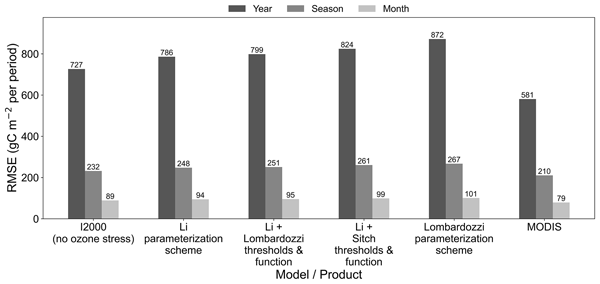
- The zonal mean results are currently presented mainly as line plots (Figure 3), lacking quantitative comparisons among the schemes. It is suggested to add bar charts with quantitative metrics to more clearly illustrate and quantify performance differences across schemes.
- It is recommended to further incorporate differences among biomes and potential directions for improvement into the discussion to enhance its depth.
- In addition, the Li scheme does not consistently perform best for crop types and under autumn conditions. This should also be reflected in the results and discussion to ensure that the conclusions are more comprehensive and objective.
Citation: https://doi.org/10.5194/egusphere-2026-350-RC1 -
AC1: 'Reply on RC1', Peng Zhou, 22 May 2026
We sincerely thank you for your thorough review, constructive comments, and positive evaluation of our manuscript. We greatly appreciate your recognition of the scientific significance, modeling framework, and mechanistic analysis presented in this study. Your insightful suggestions have helped us substantially improve the clarity, completeness, and scientific rigor of the manuscript.
Our detailed point-by-point responses are provided in the supplement, and the manuscript has been revised accordingly.
-
RC2: 'Comment on egusphere-2026-350', Anonymous Referee #2, 01 May 2026
I enjoyed reading this manuscript providing a deep dive into alternative ozone damage functions and their performance. The original difference between the Sitch and Lombardozzi approach principally related to whether there is a decoupling in the impact of ozone on photosynthesis and stomatal conductance, e.g. there was empirical evidence of a decoupling under water stress, i.e. sluggish stomata. In the Sitch model the global parameter “a” (eqn 4) was calibrated for that DGVM and monthly chemistry-modelled concentration fields to reproduce the empirical dose-response function for a high and low sensitivity species within a plant functional type grouping. I would anticipate implementation of Sitch et al. scheme into another DGVM would require a recalibration of this parameter (can you confirm whether or not this was done?). For example, what was really done in the runs: Li + Lombardozzi thresholds and functions and Li+Sitch thresholds and function? (any retuning?) I like the Li approach as it considers the effect of cumulative dose on phenology/leaf turnover. Given Li “adopts a data-driven optimal threshold Y” and best form of equation to fit the data, one would anticipate its best performance (especially as the combination approaches may not have been retuned)? Nevertheless, it is interesting to see the comparison of performance against multiple datasets (the comparison was thorough). Given the above I am particularly interested in the comparison of Li and Lombardozzi parameterization schemes. Overall there are some interesting elements to this study and warrants publication although the justification and explanation around inclusion of the mixed schemes should be elaborated.
Citation: https://doi.org/10.5194/egusphere-2026-350-RC2 -
AC2: 'Reply on RC2', Peng Zhou, 22 May 2026
Dear reviewer, we sincerely thank you for your careful review, insightful comments, and highly positive evaluation of our manuscript. We greatly appreciate your thoughtful questions regarding parameter recalibration and the rationale for the mixed parameterization experiments. Your suggestions have helped us clarify the interpretation of the mixed schemes and strengthen the mechanistic discussion and overall clarity of the manuscript.
Our detailed point-by-point responses are provided in the supplement, and the manuscript has been revised accordingly.
-
AC2: 'Reply on RC2', Peng Zhou, 22 May 2026
Peer review completion
Journal article(s) based on this preprint
Viewed
| HTML | XML | Total | BibTeX | EndNote | |
|---|---|---|---|---|---|
| 932 | 546 | 103 | 1,581 | 86 | 155 |
- HTML: 932
- PDF: 546
- XML: 103
- Total: 1,581
- BibTeX: 86
- EndNote: 155
Viewed (geographical distribution)
| Country | # | Views | % |
|---|
| Total: | 0 |
| HTML: | 0 |
| PDF: | 0 |
| XML: | 0 |
- 1
Peng Zhou
Jieming Chou
Li Dan

Jean-François Lamarque
Muhammad Bilal
Mengting Sun
Rebecca Buccholz
Desneiges Murray
Zhaoxiang Cao
Jing Peng
Kai Li
Fuqiang Yang
Wei Pan
Jinyan Chen
Liwen Xing
The requested preprint has a corresponding peer-reviewed final revised paper. You are encouraged to refer to the final revised version.
- Preprint
(8043 KB) - Metadata XML
This manuscript compares global-scale simulation results of different ozone stress parameterization schemes in CLM5. The research topic is of strong scientific significance and value for model development. Using consistent meteorological and ozone forcing data, the study conducts a mechanism-consistent evaluation of three representative schemes—Sitch, Lombardozzi, and Li—and performs multi-scale validation against GPP data from MODIS and FLUXNET. Overall, the research framework is relatively comprehensive, and the results are reasonably convincing. In particular, the analysis of how ozone flux thresholds, response function forms, and memory effects influence simulation outcomes has practical significance for improving ozone stress processes in land surface models. However, the manuscript still has room for improvement in terms of the following aspects. The authors are therefore encouraged to revise the manuscript further to enhance its completeness and persuasiveness.
Specific comments: