
the Creative Commons Attribution 4.0 License.
the Creative Commons Attribution 4.0 License.
 | 10 Feb 2026
ICON coupled to HAM-lite 1.0 in limited-area mode: an efficient framework for targeted kilometer-scale simulations with interactive aerosols
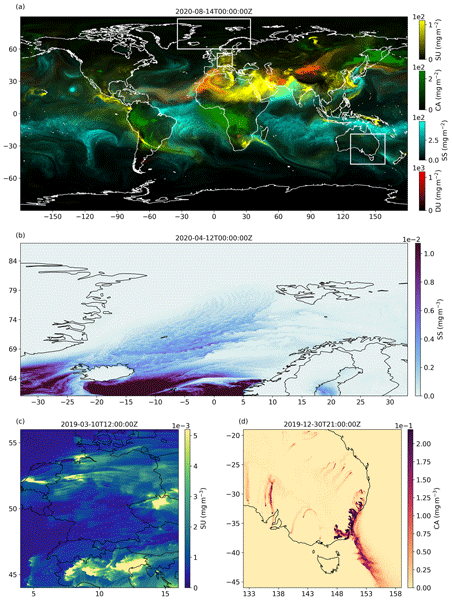
Abstract. We present a new limited-area version of the aerosol–climate modeling system ICON coupled to HAM-lite. This new version is capable of simulating anthropogenic and natural aerosols and their climate effects in specific target regions. We demonstrate its flexibility and applicability through three case studies covering distinct aerosol regimes and processes: air pollution episodes in Central Europe, the emission and transport of sea salt aerosol in the Altantic Arctic, and the simultaneous formation of smoke and desert dust plumes during the 2019–2020 Australian bushfire season. These case studies show the ability of the model to capture the regional-scale patterns and diurnal variability of the predominant aerosol types. They also indicate, however, systematic biases related to the simplified representation of aerosol emission, microphysics, and chemistry. The insights that we gained from these regional simulations will guide future developments of HAM-lite.
-
Notice on discussion status
The requested preprint has a corresponding peer-reviewed final revised paper. You are encouraged to refer to the final revised version.
-
Preprint
(11407 KB)
-
The requested preprint has a corresponding peer-reviewed final revised paper. You are encouraged to refer to the final revised version.
- Preprint
(11407 KB) - Metadata XML
- BibTeX
- EndNote
- Final revised paper


Journal article(s) based on this preprint
Interactive discussion
Status: closed
-
RC1: 'Comment on egusphere-2026-328', Anonymous Referee #1, 07 Apr 2026
-
AC1: 'Reply on RC1', Bernd Heinold, 23 May 2026
The comment was uploaded in the form of a supplement: https://egusphere.copernicus.org/preprints/2026/egusphere-2026-328/egusphere-2026-328-AC1-supplement.pdf
-
AC1: 'Reply on RC1', Bernd Heinold, 23 May 2026
-
RC2: 'Comment on egusphere-2026-328', Anonymous Referee #2, 26 Apr 2026
This study develops and introduces a new limited-area version of the ICON-HAM-Lite model, enabling higher-resolution regional simulations with interactive aerosol representation while maintaining minimal computational cost. The authors further evaluate their simulations against observations and demonstrate generally good performance.
Overall, I consider this a valuable contribution to the community. In particular, using insights from LAM simulations to improve the global ICON-HAM-Lite model appears to be a very promising direction, given their seamless coupling framework. The manuscript is well written and well strucurted. I only have minor comments below and recommend the manuscript for publication in GMD once these have been addressed.
L74–76: Please also clarify the volume fractions used in the four-mode setup. Although they appear in Table 2, a brief mention or cross-reference here would improve readability.
Table 1: Are the nucleation and Aitken modes not considered in the model? If so, it would be clearer to remove them from Table 1 to avoid confusion.
L107: It would be helpful for general readers to specify which intermediate transformation steps are missing here.
The model offers good flexibility to adjust modal radii, volume fractions, and densities. However, this also raises a question: should the same setup be adopted in both the global and LAM versions of ICON-HAM-lite, especially if the LAM is intended to inform development of the global version?
L191: The LAM model is run at 2.5 km resolution. It would be very interesting to clarify which key processes are still parameterized and which are explicitly resolved at this scale.
Table 3: The time periods listed in the table do not appear to be consistent with those in the main text. Please check and correct if necessary.
L207: Are the biogenic emissions also taken from CEDS? If not, does it also provide data for the simulation year?
L229-232: Have you tested how the results change if CAMS lateral boundary conditions are also applied to the Arctic and Australian cases?
L261-263: The ICON-HAM-lite model uses accumulation and coarse modes; I wonder how PM2.5 is calculated here. Typo: μor μm
L304: I’m not sure if nitrates and ammonium are good example here as HAM-lite doesn’t consider these species. This also partially contributes the underestimation of PM2.5 by model.
Citation: https://doi.org/10.5194/egusphere-2026-328-RC2 -
AC2: 'Reply on RC2', Bernd Heinold, 23 May 2026
The comment was uploaded in the form of a supplement: https://egusphere.copernicus.org/preprints/2026/egusphere-2026-328/egusphere-2026-328-AC2-supplement.pdf
-
AC2: 'Reply on RC2', Bernd Heinold, 23 May 2026
Peer review completion


Interactive discussion
Status: closed
-
RC1: 'Comment on egusphere-2026-328', Anonymous Referee #1, 07 Apr 2026
Review of “ICON coupled to HAM-lite 1.0 in limited-area mode: an efficient framework for targeted kilometer-scale simulations with interactive aerosols” by Bernd Heinold, Philipp Weiss, Sadhitro De, Anne Kubin, Jason Müller, Fabian Senf, Philip Stier, and Ina Tegen
The manuscript describes the first application of the HAM-lite aerosol microphysics model coupled to ICON in a limited area mode for computationally efficient high-resolution simulations on a regional scale. The model results are evaluated against various observations for three different regional case studies.
The paper is a relevant contribution to the field of scientific modelling and is well suited for GMD. It presents novel development and model applications of aerosol modelling on the regional scale that can serve as a basis for future studies with this model system. The methods and model description are well documented and the conclusions are well supported by the presented results. The manuscript is very well written and organized and there are, in my opinion, only a few issues that should be addressed or clarified.
General comments:
- Please provide some representative quantitative metrics to describe the model’s ability and performance when comparing against observations. The authors often mention a “good agreement” between model results and observations. While this is surely the case from looking at the respective comparisons, it should be underlined by providing some quantitative metrics (e.g. standard deviation, correlation coefficient, etc., see specific comments below). Maybe some representative numbers on the model performance could also be added to the abstract.
Specific comments:
- Line 37: “… HAM-lite needs only one prognostic variable for each mode …”. It could be stated already here that this is the number concentration.
- Table 1 provides not much information by itself and could potentially be combined with Table 2
- Section 2.5.1 “Model configuration”:
- Line 191: Please also provide the resolution of the global ICON grid.
- Lines 205f: Please provide the information on how the different emissions are attributed to the respective aerosol modes (or refer again to the previous publication of Weiss et al., 2025)
- Section 2.6 “Computational performance”: Could you compare the computational cost of an ICON-HAM-lite LAM simulation with that of an ICON-HAM LAM? This would highlight the necessity for the simplified scheme regarding the aspect of computational efficiency also for the case of regional model simulations.
- Section 4.1 “PM2.5 pollution over Germany”:
- The observed PM2.5 values may also contain a contribution from e.g. NH4 and NO3 aerosol species, which are, however, not represented in the HAM-lite aerosol mode structure used here. The authors should discuss this bias in more detail. Is it possible to estimate the contribution of these missing aerosol components for the station comparisons, e.g. from a simulation with the full aerosol scheme HAM or from the observations itself?
- The authors should add some quantitative metrics to Fig. 3 and to the text, e.g. standard deviation, correlation coefficient, etc. An overall metric considering all German stations (Fig. 2) would also help to address the model performance in this case study.
- Section 4.2 “Sea salt aerosol in the Atlantic Arctic”:
- Why is this evaluation performed on a daily-mean basis (i.e. with a lower temporal resolution than in the previous section)?
- Again, the evaluation would benefit from additional quantitative metrics in Fig. 5 and in the text.
Technical corrections:
- Line 79: Add “geometric” in front of “standard deviation”
- Line 158: Typo “… properties properties …”
- Line 216: Typo “… kW,m-2”
Citation: https://doi.org/10.5194/egusphere-2026-328-RC1 -
AC1: 'Reply on RC1', Bernd Heinold, 23 May 2026
The comment was uploaded in the form of a supplement: https://egusphere.copernicus.org/preprints/2026/egusphere-2026-328/egusphere-2026-328-AC1-supplement.pdf
-
RC2: 'Comment on egusphere-2026-328', Anonymous Referee #2, 26 Apr 2026
This study develops and introduces a new limited-area version of the ICON-HAM-Lite model, enabling higher-resolution regional simulations with interactive aerosol representation while maintaining minimal computational cost. The authors further evaluate their simulations against observations and demonstrate generally good performance.
Overall, I consider this a valuable contribution to the community. In particular, using insights from LAM simulations to improve the global ICON-HAM-Lite model appears to be a very promising direction, given their seamless coupling framework. The manuscript is well written and well strucurted. I only have minor comments below and recommend the manuscript for publication in GMD once these have been addressed.
L74–76: Please also clarify the volume fractions used in the four-mode setup. Although they appear in Table 2, a brief mention or cross-reference here would improve readability.
Table 1: Are the nucleation and Aitken modes not considered in the model? If so, it would be clearer to remove them from Table 1 to avoid confusion.
L107: It would be helpful for general readers to specify which intermediate transformation steps are missing here.
The model offers good flexibility to adjust modal radii, volume fractions, and densities. However, this also raises a question: should the same setup be adopted in both the global and LAM versions of ICON-HAM-lite, especially if the LAM is intended to inform development of the global version?
L191: The LAM model is run at 2.5 km resolution. It would be very interesting to clarify which key processes are still parameterized and which are explicitly resolved at this scale.
Table 3: The time periods listed in the table do not appear to be consistent with those in the main text. Please check and correct if necessary.
L207: Are the biogenic emissions also taken from CEDS? If not, does it also provide data for the simulation year?
L229-232: Have you tested how the results change if CAMS lateral boundary conditions are also applied to the Arctic and Australian cases?
L261-263: The ICON-HAM-lite model uses accumulation and coarse modes; I wonder how PM2.5 is calculated here. Typo: μor μm
L304: I’m not sure if nitrates and ammonium are good example here as HAM-lite doesn’t consider these species. This also partially contributes the underestimation of PM2.5 by model.
Citation: https://doi.org/10.5194/egusphere-2026-328-RC2 -
AC2: 'Reply on RC2', Bernd Heinold, 23 May 2026
The comment was uploaded in the form of a supplement: https://egusphere.copernicus.org/preprints/2026/egusphere-2026-328/egusphere-2026-328-AC2-supplement.pdf
-
AC2: 'Reply on RC2', Bernd Heinold, 23 May 2026
Peer review completion
Journal article(s) based on this preprint
Viewed
| HTML | XML | Total | BibTeX | EndNote | |
|---|---|---|---|---|---|
| 1,225 | 1,006 | 130 | 2,361 | 283 | 273 |
- HTML: 1,225
- PDF: 1,006
- XML: 130
- Total: 2,361
- BibTeX: 283
- EndNote: 273
Viewed (geographical distribution)
| Country | # | Views | % |
|---|
| Total: | 0 |
| HTML: | 0 |
| PDF: | 0 |
| XML: | 0 |
- 1

Philipp Weiss
Sadhitro De
Anne Kubin
Jason Müller
Fabian Senf
Philip Stier
Ina Tegen
The requested preprint has a corresponding peer-reviewed final revised paper. You are encouraged to refer to the final revised version.
- Preprint
(11407 KB) - Metadata XML
Review of “ICON coupled to HAM-lite 1.0 in limited-area mode: an efficient framework for targeted kilometer-scale simulations with interactive aerosols” by Bernd Heinold, Philipp Weiss, Sadhitro De, Anne Kubin, Jason Müller, Fabian Senf, Philip Stier, and Ina Tegen
The manuscript describes the first application of the HAM-lite aerosol microphysics model coupled to ICON in a limited area mode for computationally efficient high-resolution simulations on a regional scale. The model results are evaluated against various observations for three different regional case studies.
The paper is a relevant contribution to the field of scientific modelling and is well suited for GMD. It presents novel development and model applications of aerosol modelling on the regional scale that can serve as a basis for future studies with this model system. The methods and model description are well documented and the conclusions are well supported by the presented results. The manuscript is very well written and organized and there are, in my opinion, only a few issues that should be addressed or clarified.
General comments:
Specific comments:
Technical corrections: