
the Creative Commons Attribution 4.0 License.
the Creative Commons Attribution 4.0 License.
 | 23 Jun 2026
Impacts of South Asian aerosol inflow over Mount Qomolangma on downstream cloud–precipitation processes through a long-range ice-crystal "seeding" effect
Abstract. Mount Qomolangma (MQ) serves as a natural laboratory for investigating aerosol–cloud–precipitation interactions over the Tibetan Plateau (TP). Using satellite and comprehensive ground-based observations, we identify pronounced ice-cloud activation associated with transported exogenous aerosols. Under different large-scale atmospheric circulation regimes, ice-phase cloud activated over MQ can be efficiently transported downstream through distinct pathways, exerting a pronounced ice crystal seeding effect on cloud–precipitation conversion. The spatial patterns of these downstream pathways are highly consistent with regions of enhanced ice-phase occurrence, precipitation, and upper-tropospheric latent heat release. This study provides new insight into the downstream impacts of aerosol transport through ice seeding for cloud precipitation. The findings highlight the important role of aerosol-induced ice-phase processes in modulating cloud and precipitation systems over the “Third Pole” and its downstream regions, with significant implications for understanding downstream extreme precipitation and environment change under South Asian increasing anthropogenic influences.
-
Notice on discussion status
The requested preprint has a corresponding peer-reviewed final revised paper. You are encouraged to refer to the final revised version.
-
Preprint
(1700 KB)
-
Supplement
(540 KB)
-
The requested preprint has a corresponding peer-reviewed final revised paper. You are encouraged to refer to the final revised version.
- Preprint
(1700 KB) - Metadata XML
-
Supplement
(540 KB) - BibTeX
- EndNote
- Final revised paper


Journal article(s) based on this preprint
Interactive discussion
Status: closed
-
RC1: 'Comment on egusphere-2026-3136', Anonymous Referee #1, 03 Jul 2026
-
AC1: 'Reply on RC1', Wenyue Cai, 03 Aug 2026
Responses to Referee #1
This manuscript investigates the critical role of externally transported aerosols over Mount Qomolangma (MQ) in modulating ice-phase cloud formation, downstream precipitation, and regional thermodynamic feedbacks. The topic is of great scientific significance for understanding aerosol–cloud–precipitation interactions over the Tibetan Plateau (TP). However, several key physical mechanisms, theoretical foundations, and feedback loops require further elaboration and clarification before publication. The specific comments are integrated as follows:
1、The study states that aerosols can promote the formation of ice-phase clouds. It is recommended to supplement relevant previous studies to strengthen the theoretical and observational evidence supporting the linkage between aerosols and ice clouds.
Response 1: Thanks for the reviewer’s suggestions. We have accordingly added the following discussions in the revised manuscript:
Lines 93-108: Aerosols acting as CCN and INPs may alter cloud droplet activation, promote heterogeneous ice nucleation, and modify the partitioning among liquid, supercooled-liquid, mixed-phase, and ice-phase clouds (Zhu et al., 2024). A small subset of atmospheric aerosol particles can act as INPs and initiate heterogeneous ice formation in ice-phase clouds through immersion, deposition, contact, or condensation freezing. Mineral dust and soot particles are regarded as the primary atmospheric INP types. Once primary ice crystals are generated, depositional growth, riming, the Wegener-Bergeron-Findeisen process (Wegener, 1911; Bergeron, 1935; Findeisen, 1938), and secondary ice production can further amplify cloud glaciation and modify the partitioning between liquid and ice water (Murray et al., 2012). Nevertheless, aerosol concentration alone does not directly represent INP abundance, and the observed aerosol–ice-cloud relationship may also be affected by temperature, humidity, vertical motion, and cloud dynamics (Zhu et al., 2024; Xu et al. 2025). Atmospheric aerosols interact with clouds through tightly coupled microphysical, radiative, thermodynamic, and dynamical processes. Vertical motion, moisture availability, temperature and large-scale circulation are meteorological factors that collectively determine whether elevated aerosol loading stimulates or inhibits cloud and precipitation development. Therefore, the ice-phase clouds could be interpreted as the combined result of aerosol-mediated ice nucleation and favorable thermodynamic and dynamical conditions, rather than as an aerosol effect alone. These interactions are highly nonlinear and depend strongly on cloud type, cloud evolutionary stage, and the surrounding meteorological environment(IPCC, 2023).
References
Bergeron, T.: On the physics of cloud and precipitation, in: Proceedings of the Fifth Assembly of the International Union of Geodesy and Geophysics, Lisbon, Portugal, IUGG, 156–178, 1935.
Findeisen, W.: Die Kolloidmeterorologischem Vorgange der Niedershlagsbildung, Meteorol. Z., 55, 121–133, 1938.
Intergovernmental Panel on Climate Change. Climate Change 2021 – The Physical Science Basis: Working Group I Contribution to the Sixth Assessment Report of the Intergovernmental Panel on Climate Change (1st ed.), Cambridge University Press (2023), https://doi.org/10.1017/9781009157896
Murray, B. J., O'Sullivan, D., Atkinson, J. D., and Webb, M. E.: Ice nucleation by particles immersed in supercooled cloud droplets, Chem. Soc. Rev., 41, 6519–6554, https://doi.org/10.1039/c2cs35200a, 2012.
Wegener, A.: Thermodynamik der Atmosphäre, J. A. Barth, Leipzig, 331 pp., https://doi.org/10.1038/090031a0, 1911.
Zhu, S. Z., Qian, L., Ma, X. Q., Qiu, Y. J., Yang, J., He, X., Li, J. J., Zhu, L., Gong, J., and Lu, C. S.: Impact of Aerosols on the Macrophysical and Microphysical Characteristics of Ice-Phase and Mixed-Phase Clouds over the Tibetan Plateau, Remote Sens., 16, 1781, https://doi.org/10.3390/rs16101781, 2024.
2、This study concludes that under different large-scale atmospheric circulation regimes, ice-phase cloud activated over MQ can be efficiently transported downstream through distinct pathways, exerting a pronounced ice crystal seeding effect on cloud–precipitation conversion. The physical mechanisms underlying the synergistic impacts of MQ exogenous aerosols and associated ice-phase clouds on downstream cloud-precipitation processes should be elaborated in detail. Furthermore, it is essential to clarify whether such upstream-to-downstream impacts arise from an individual controlling factor or the compound effects of multiple coupled factors. In addition, it is necessary to explore whether this upstream-downstream transport process is more closely correlated with the occurrence of intense precipitation.
Response 2:Xu et al. (2025) found that, among several factors—including South Asian moisture transport, atmospheric vertical motion, humidity, and aerosols—aerosols played a dominant role in the occurrence of heavy precipitation. The synergistic interaction between the thermodynamic–dynamic forcing over the MQ region and aerosol activation can trigger deep convection over MQ. Specifically, aerosol activation promotes more vigorous cloud development, thereby increasing the likelihood of ice-cloud formation.
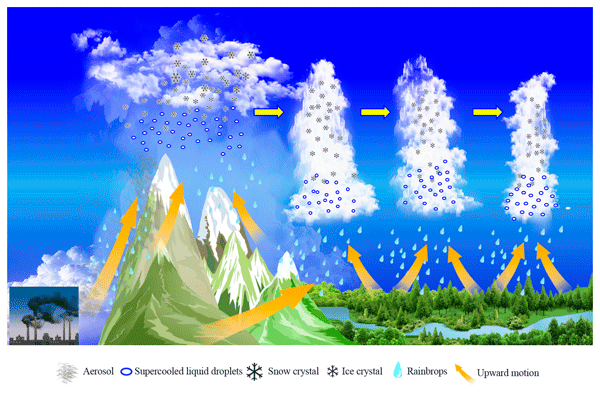
Under different large-scale atmospheric circulation backgrounds, these aerosol-activated ice clouds can be efficiently transported downstream along specific pathways, thereby promoting the occurrence of heavy precipitation in downstream regions, as illustrated in Fig. 3. We have also added the accumulated ice-cloud-phase distributions during the preceding 48 h for each day from 9 to 11 July 2018, corresponding to the day of the high-aerosol-loading pollution event and the following two days, together with FLEXPART forward-trajectory simulations for this episode (Fig. S2).A comparison shows that the spatial and temporal evolution of precipitation during 9–11 July 2018 (Figs. S2b–d) is consistent with both the evolving trajectories of ice-phase clouds (Figs. S2e–g) and the FLEXPART-simulated forward trajectories (Fig. S2h). As the event progressed, most of the FLEXPART trajectories were transported at high altitudes. This transport pattern is also consistent with the latent-heat transport trajectories that can represent the movement of ice clouds or ice crystals (Figs. 2a and 2b), as well as with the spatial distributions of ice-cloud- and mixed-phase-cloud anomalies under high- and low-aerosol-loading conditions in July 2018 and July 2019 (Fig. S1). Together, these results reveal a coherent downstream transport pathway through which long-range ice-crystal “seeding” links upstream aerosol activation to downstream cloud and precipitation development. This provides strong evidence that aerosol activation in the upstream region exerts a pronounced ice-seeding effect on downstream cloud-to-precipitation conversion.
The following text has therefore been added to Lines 326-329 of the revised manuscript:
“Comparative analysis shows that the evolution of precipitation during 9–11 July 2018 (Figs. S2b–d) is consistent with both the evolving distributions of ice-phase clouds (Figs. S2e–g) and the FLEXPART-simulated forward trajectories (Fig. S2h). As the episode progressed, most FLEXPART trajectories were transported at upper levels.”
Figure S2 See Supplementary material:2026-08-01+ACP-RC1_ZrCai.pdf
References
Xu, X. D., Cai, W. Y., Zhao, T. L., Zhang, H., Guo, X. L., Liu, W. Q., Zhang, T. S., Zhao, R. Z., Wu, C., Li, Y. Q., Wang, L., Yan, P., and Yang, C. J.: Understanding clouds and precipitation over the Mount Qomolangma: how does the aerosol activation effect exist?, Sci. Bull., 70, 3649–3658, https://doi.org/10.1016/j.scib.2025.09.031, 2025.
3、This study demonstrates that MQ exhibits high sensitivity to externally transported, high-concentration aerosols, which preferentially enhance ice-phase cloud formation and invigorate deep convective precipitation. The enhanced formation of ice-phase clouds leads to increased latent heat release, intensifying thermodynamic forcing over the TP and altering large-scale circulation patterns. I recommend further elaborating the response characteristics of externally imported aerosols to the MQ heat-pump effect, as well as the corresponding physical feedback mechanisms between externally imported aerosols and the MQ heat-pump effect.
Response 3:Thanks for the reviewer’s suggestions.
Allowing more and smaller cloud droplets to be lifted by the upward air flows due to the superposition of the MQ terrain uplift effect, extending the distance for the collision and coalescence growth of cloud droplets during the ascent along the south slope of the MQ. When a large number of small cloud droplets are lifted to the freezing level forming ice crystals, releasing an additional amount of latent heat energy (Molinié et al. 1995; Williams et al. 2002; Rosenfeld et al. 2006). The additional amount of latent heat energy could intensify the thermal forcing of the MQ (Xu et al., 2019), which can facilitate the convergence of lifting air flows from the south and north slopes. The inevitable result is invigoration of the convective clouds and additional rainfall, despite the slower conversion of cloud droplets to raindrops. That is, clouds gradually thickens with moist and polluted air mass. When cloud tops rise higher and extend further into ice cloud anvils, stronger precipitation can occur (Xu et al., 2025). This is consistent with the theoretical explanation of the "aerosol activation effect" proposed by Rosenfeld et al. (2008). Xu et al. (2025) analysis further reveals the "mutual feedback" mechanism between the activation effect of aerosols on the cloud-precipitation process and the heat source effect of the MQ from the perspective of atmospheric thermodynamical mechanisms, dynamic mechanism triggering deep convection and strengthening precipitation on the MQ. This kind of activation effect of aerosols on the cloud-precipitation process is more prominent at the MQ, “the clean area of the atmospheric environment”.
References
Rosenfeld, D., Lohmann, U., Raga, G. B., O'Dowd, C. D., Kulmala, M., Fuzzi, S., Reissell, A., and Andreae, M. O.: Flood or Drought: How Do Aerosols Affect Precipitation? Science, 321, 1309–1313, https://doi.org/10.1126/science.1160606, 2008.
Rosenfeld, D.: Aerosol-Cloud Interactions Control of Earth Radiation and Latent Heat Release Budgets, Space Sci. Rev., 125, 149–157, https://doi.org/10.1007/s11214-006-9053-6, 2006.
Molinié, J., and Pontikis, C. A.: A climatological study of tropical thunderstorm clouds and lightning frequencies on the French Guyana coast, Geophys. Res. Lett., 22, 1085–1088, https://doi.org/10.1029/95GL01036, 1995.
Williams, E., Rosenfeld, D., Madden, N., Gerlach, J., Gears, N., Atkinson, L., Dunnemann, N., Frostrom, G., Antonio, M., Biazon, B., Camargo, R., Franca, H., Gomes, A., Lima, M., Machado, R., Manhaes, S., Nachtigall, L., Piva, H., Quintiliano, W., Machado, L., Artaxo, P., Roberts, G., Renno, N., Blakeslee, R., Bailey, J., Boccippio, D., Betts, A., Wolff, D., Roy, B., Halverson, J., Rickenbach, T., and Avelino, E.: Contrasting convective regimes over the Amazon: implications for cloud electrification, J. Geophys. Res.: Atmos., 107, LBA50–LBA19, https://doi.org/10.1029/2001JD000380, 2002.
Xu, X. D., Dong, L. L., Zhao, Y., and Wang, Y. J.: Effect of the Asian Water Tower over the Qinghai-Tibet Plateau and the characteristics of atmospheric water circulation, Chin. Sci. Bull., 64, 2830–2841 (in Chinese), https://doi.org/10.1360/TB-2019-0203, 2019.
Xu, X. D., Cai, W. Y., Zhao, T. L., Zhang, H., Guo, X. L., Liu, W. Q., Zhang, T. S., Zhao, R. Z., Wu, C., Li, Y. Q., Wang, L., Yan, P., and Yang, C. J.: Understanding clouds and precipitation over the Mount Qomolangma: how does the aerosol activation effect exist? Sci. Bull., 70, 3649–3658, https://doi.org/10.1016/j.scib.2025.09.031, 2025.
-
AC1: 'Reply on RC1', Wenyue Cai, 03 Aug 2026
-
RC2: 'Comment on egusphere-2026-3136', Anonymous Referee #2, 14 Jul 2026
The manuscript addresses a scientifically important and potentially novel upstream–downstream linkage between South Asian aerosol transport, ice-phase cloud development over Mount Qomolangma, and precipitation over downstream East Asia. The study extends from local aerosol–cloud–precipitation interactions to the upstream–downstream linkages between the Plateau and eastern China, with significant scientific questions and high potential impact. However, the conceptual strength of the conclusion is far higher than the strength of the evidence. The central claim of a long-range ice-crystal seeding effect is presently inferred from spatial and temporal covariability rather than directly demonstrated. Major confounding by large-scale circulation and moisture transport has not been adequately controlled, the physical continuity and survival of transported ice crystals have not been established, and several aspects of the event selection and statistical analysis require fundamental revision.
"Despite these impacts, the intricate interactions between aerosol and cloud microphysics make the effects of aerosol on precipitation poorly understood (Levin and Cotton 2009; IPCC Climate Change 2013)。"The author summarizes the gaps in existing research in the Introduction, but this is only a broad background issue. In fact, the specific problem analysis of this study is not deep enough; this statement only addresses the general issue that the impact of current aerosols on rainfall is unclear, but does not focus on what specific problem this study intends to investigate in depth. In addition, the cited research analysis is insufficient, the literature is relatively outdated, and the IPCC has already released new reports.
The authors synthesized and compared high-AEC days and low-AEC days, and attributed the differences in ice-phase clouds, latent heat, and precipitation to aerosol effects. However, South Asian monsoon moisture transport, vertical motion, humidity, and cloud cover determine both the AEC in the Everest region and the formation of ice-phase clouds and downstream precipitation. In observational studies, separating aerosol effects from meteorological covariation is one of the difficulties in aerosol–cloud research, but simple grouping, correlation, or spatial overlap usually cannot provide causal attribution.
The authors attribute cloud phase anomalies at scales of hundreds to thousands of kilometers and lasting 1–3 days to the direct transport of ice crystals from Mount Everest, but provides no calculations of ice crystal trajectories, transport speeds, settling velocities, sublimation losses, or continuity of ice water content.
The authors use single-site AEC and MODIS AOD to infer that aerosols originate from South Asia, and further claims that high concentrations of carbonaceous aerosols act as efficient ice nuclei to promote ice formation. I think it is necessary to include trajectory clustering, potential source contribution analysis, or satellite/reanalysis aerosol type data.
The caption of Figure 1 states “90% confidence level (P > 0.1),” and Figure 4 states “95% confidence level (P > 0.05).” The statistical significance should be P < 0.1 and P < 0.05, respectively. This concerns whether the actual calculation of the significance regions used the wrong criteria.
Citation: https://doi.org/10.5194/egusphere-2026-3136-RC2 -
AC2: 'Reply on RC2', Wenyue Cai, 03 Aug 2026
Response to Referee #2
The manuscript addresses a scientifically important and potentially novel upstream–downstream linkage between South Asian aerosol transport, ice-phase cloud development over Mount Qomolangma, and precipitation over downstream East Asia. The study extends from local aerosol–cloud–precipitation interactions to the upstream–downstream linkages between the Plateau and eastern China, with significant scientific questions and high potential impact. However, the conceptual strength of the conclusion is far higher than the strength of the evidence. The central claim of a long-range ice-crystal seeding effect is presently inferred from spatial and temporal covariability rather than directly demonstrated. Major confounding by large-scale circulation and moisture transport has not been adequately controlled, the physical continuity and survival of transported ice crystals have not been established, and several aspects of the event selection and statistical analysis require fundamental revision.
1. "Despite these impacts, the intricate interactions between aerosol and cloud microphysics make the effects of aerosol on precipitation poorly understood (Levin and Cotton 2009; IPCC Climate Change 2013)。"The author summarizes the gaps in existing research in the Introduction, but this is only a broad background issue. In fact, the specific problem analysis of this study is not deep enough; this statement only addresses the general issue that the impact of current aerosols on rainfall is unclear, but does not focus on what specific problem this study intends to investigate in depth. In addition, the cited research analysis is insufficient, the literature is relatively outdated, and the IPCC has already released new reports.
Response 1:Following the suggestion of reviewer, we have cited the recent literature in the revised manuscript as follows:
Lines 93-108: Aerosols acting as CCN and INPs may alter cloud droplet activation, promote heterogeneous ice nucleation, and modify the partitioning among liquid, supercooled-liquid, mixed-phase, and ice-phase clouds (Zhu et al., 2024). A small subset of atmospheric aerosol particles can act as INPs and initiate heterogeneous ice formation in ice-phase clouds through immersion, deposition, contact, or condensation freezing. Mineral dust and soot particles are regarded as the primary atmospheric INP types. Once primary ice crystals are generated, depositional growth, riming, the Wegener-Bergeron-Findeisen process (Wegener, 1911; Bergeron, 1935; Findeisen, 1938), and secondary ice production can further amplify cloud glaciation and modify the partitioning between liquid and ice water (Murray et al., 2012). Nevertheless, aerosol concentration alone does not directly represent INP abundance, and the observed aerosol–ice-cloud relationship may also be affected by temperature, humidity, vertical motion, and cloud dynamics (Zhu et al., 2024; Xu et al. 2025). Atmospheric aerosols interact with clouds through tightly coupled microphysical, radiative, thermodynamic, and dynamical processes. Vertical motion, moisture availability, temperature and large-scale circulation are meteorological factors that collectively determine whether elevated aerosol loading stimulates or inhibits cloud and precipitation development. Therefore, the ice-phase clouds could be interpreted as the combined result of aerosol-mediated ice nucleation and favorable thermodynamic and dynamical conditions, rather than as an aerosol effect alone. These interactions are highly nonlinear and depend strongly on cloud type, cloud evolutionary stage, and the surrounding meteorological environment(IPCC, 2023).
References
Bergeron, T.: On the physics of cloud and precipitation, in: Proceedings of the Fifth Assembly of the International Union of Geodesy and Geophysics, Lisbon, Portugal, IUGG, 156–178, 1935.
Findeisen, W.: Die Kolloidmeterorologischem Vorgange der Niedershlagsbildung, Meteorol. Z., 55, 121–133, 1938.
Intergovernmental Panel on Climate Change. Climate Change 2021 – The Physical Science Basis: Working Group I Contribution to the Sixth Assessment Report of the Intergovernmental Panel on Climate Change (1st ed.), Cambridge University Press (2023), https://doi.org/10.1017/9781009157896
Murray, B. J., O'Sullivan, D., Atkinson, J. D., and Webb, M. E.: Ice nucleation by particles immersed in supercooled cloud droplets, Chem. Soc. Rev., 41, 6519–6554, https://doi.org/10.1039/c2cs35200a, 2012.
Wegener, A.: Thermodynamik der Atmosphäre, J. A. Barth, Leipzig, 331 pp., https://doi.org/10.1038/090031a0, 1911.
Zhu, S. Z., Qian, L., Ma, X. Q., Qiu, Y. J., Yang, J., He, X., Li, J. J., Zhu, L., Gong, J., and Lu, C. S.: Impact of Aerosols on the Macrophysical and Microphysical Characteristics of Ice-Phase and Mixed-Phase Clouds over the Tibetan Plateau, Remote Sens., 16, 1781, https://doi.org/10.3390/rs16101781, 2024.
2. The authors synthesized and compared high-AEC days and low-AEC days, and attributed the differences in ice-phase clouds, latent heat, and precipitation to aerosol effects. However, South Asian monsoon moisture transport, vertical motion, humidity, and cloud cover determine both the AEC in the Everest region and the formation of ice-phase clouds and downstream precipitation. In observational studies, separating aerosol effects from meteorological covariation is one of the difficulties in aerosol–cloud research, but simple grouping, correlation, or spatial overlap usually cannot provide causal attribution.
Response 2:From thermodynamic and dynamic perspectives, Xu et al. (2025) elucidated the relationships between AEC levels over the MQ and the associated atmospheric dynamic and thermodynamic conditions, as well as the complex relationships between heavy precipitation over the MQ region and vertical motion, water vapor, humidity, aerosols, and other relevant factors. They found pronounced differences in the vertical dynamic and thermodynamic structures associated with high- and low-aerosol-loading transport episodes over the MQ (Figs. 2c and 2d), which were accompanied by substantial differences in cloud-phase composition.
As shown in Table 1, during high-aerosol-loading episodes, strong ascending motion driven by intense diabatic heating enabled clouds to develop to greater altitudes, allowing large numbers of cloud droplets to be lifted above the freezing level and converted into ice-phase clouds. Consequently, the occurrence frequencies of supercooled-liquid, mixed-phase, and ice-phase clouds were significantly higher during high-aerosol-loading episodes than during low-aerosol-loading episodes. By contrast, liquid-phase clouds occurred more frequently during low-aerosol-loading episodes. On the basis of the differences in atmospheric vertical dynamic structures arising from the Q1 feedback effects associated with high- and low-aerosol-loading transport episodes, Xu et al. (2025) further examined the relationships among precipitation on the southern and northern slopes of MQ, AEC measured at the MQ lidar station, and the intensity of dynamical lifting, represented by vertical velocity and Q1, during July 2018 and July 2019 (Fig. 3). Although most precipitation events on both slopes occurred under conditions characterized by strong dynamical lifting, large Q1 values, and high AEC, the influence of aerosols on precipitation was more pronounced on the northern slope than on the southern slope under comparable lifting conditions.
As shown in Table 2, under similar dynamical lifting conditions (ω > 0.0 × 10⁻² Pa s⁻¹ d⁻¹), precipitation events exceeding 25 mm d⁻¹ occurred on the northern slope when the AEC anomaly was greater than or equal to 0.0 km⁻¹ d⁻¹. Comparisons of AEC with relative humidity and precipitation on the southern and northern slopes further revealed significant logarithmic relationships between AEC and relative humidity on both slopes. Interestingly, most relatively intense precipitation events exceeding 10 mm d⁻¹ on the northern slope occurred during periods when AEC increased rapidly while the increase in relative humidity gradually leveled off (Figs. 4a and 4b). In contrast, at Nyalam Station on the southern slope, where persistently humid conditions prevailed, high AEC values were mostly associated with weak precipitation (Fig. 4c).
The mean hourly precipitation intensity for different AEC categories showed a clear increasing trend with increasing AEC at the two northern-slope stations, whereas hourly precipitation intensity on the southern slope fluctuated only slightly as AEC increased (Fig. 4d). Clouds influenced by aerosol activation also exhibited more vigorous development. A comparison of the responses of convective-cloud development to lower-tropospheric aerosols and water vapor indicated that convective-cloud development over the MQ region was not primarily controlled by atmospheric moisture conditions. Its response to water vapor was considerably weaker than its response to AEC (Fig. 5). These results further support the conclusion that aerosol activation can make aerosols a key factor governing the evolution of convective clouds.
Fig. 2 See Supplementary material:2026-08-01+ACP-RC2_ZrCai.pdf
Table 1 See Supplementary material:2026-08-01+ACP-RC2_ZrCai.pdf
Fig. 3 See Supplementary material:2026-08-01+ACP-RC2_ZrCai.pdf
Table 2 See Supplementary material:2026-08-01+ACP-RC2_ZrCai.pdf
Fig. 4. See Supplementary material:2026-08-01+ACP-RC2_ZrCai.pdf
Fig. 5 See Supplementary material:2026-08-01+ACP-RC2_ZrCai.pdf
Building upon the work of Xu et al. (2025), the present study focuses on the activation effect of externally transported aerosols on ice-phase clouds. By comparing the differences in cloud phase, latent heat release, and cloud–precipitation processes between high- and low-aerosol-loading episodes during July 2018 and July 2019, we specifically investigate how externally transported aerosols over the MQ region can promote the formation of ice-phase clouds under different large-scale atmospheric circulation patterns. We further demonstrate that these aerosol-influenced ice clouds can be efficiently transported downstream along preferred pathways, thereby exerting a pronounced ice-crystal seeding effect on downstream cloud-to-precipitation conversion.
Cloud-phase retrievals from the FY-4A satellite further indicate that the occurrence frequencies of ice-phase clouds, supercooled liquid clouds, and mixed-phase clouds are all higher under high-aerosol-loading conditions than under low-aerosol-loading conditions. In contrast, liquid-phase clouds occur much more frequently during low-aerosol-loading episodes than during high-aerosol-loading episodes (Fig. 1c). Compared with liquid clouds, ice clouds occur more frequently over the Tibetan Plateau and exhibit a stronger association with aerosol loading, consistent with previous observational and modeling studies (Hua et al., 2020).
A comprehensive analysis of the diurnal variations in aerosol extinction coefficient derived from lidar observations, the maximum reflectivity observed by the X-band dual-polarization radar, and the occurrence frequencies of different cloud phases revealed that aerosol loading was significantly and positively correlated only with the occurrence frequencies of ice-phase and mixed-phase clouds, whereas no statistically significant relationship was found with liquid-phase or supercooled liquid clouds (Figs. 1d and 1e). Furthermore, the diurnal variations of ice-phase and mixed-phase cloud frequencies exhibited coherent peaks and troughs with the diurnal evolution of maximum radar reflectivity (Figs. 1d and 1e), suggesting that these cloud types are closely associated with aerosol-enhanced deep convective development.
These results indicate that increased aerosol loading is associated with enhanced occurrences of ice-phase and mixed-phase clouds within deep convective systems, whereas lower aerosol-loading conditions are generally accompanied by a higher persistence of liquid-phase clouds. To further clarify the relationships between aerosol effects and meteorological factors, we have incorporated the findings of our previous study into the Introduction, as follows:
Line 61-62:Over the Tibetan Plateau (TP), aerosol–cloud–precipitation interactions are particularly important because externally transported aerosols can be lifted rapidly by strong topographic and convective ascent (Xu et al. 2025).
Line 68-92:The Mount Qomolangma (MQ) as a natural laboratory for investigating aerosol–cloud–precipitation interactions over the TP (Xu et al. 2025). During the MQ aerosol–cloud–precipitation integrated vertical observation campaign, Xu et al. (2025) showed that, during the Indian summer monsoon, aerosols transported from South Asia exerted a pronounced activation effect on cloud and precipitation processes. Under dynamically forced lifting conditions, enhanced aerosol loading suppressed and delayed weak precipitation over MQ while promoting more vigorous cloud development, ultimately resulting in increased precipitation on the northern slope. The synergistic interaction between the thermodynamic–dynamic forcing over MQ and aerosol activation favored the development of deep convection associated with precipitation on the northern slope. Aerosol activation also enhanced cloud development. Convective-cloud development over the MQ region was found to be more responsive to aerosol than to atmospheric moisture conditions, suggesting that aerosol activation plays a key role in regulating the evolution of convective clouds (Xu et al. 2025).
From thermodynamic and dynamic perspectives, Xu et al. (2025) further elucidated the relationships between AEC levels over MQ and the associated atmospheric dynamic and thermodynamic conditions, as well as the complex relationships between heavy precipitation and meteorological factors, including vertical motion, water vapor, humidity, and aerosols. High-aerosol-loading episodes were characterized by a stronger apparent heat source (Q1) than low-aerosol-loading episodes, thereby enhancing ascending motion over the southern slope of MQ. Over the TP and its surrounding regions, transported soot and dust aerosols have been linked to variations in ice-crystal effective radius, ice water content, cloud optical properties, and cloud-phase partitioning (Liu et al. 2019). Under these distinct dynamic and thermodynamic conditions, the occurrence frequencies of ice-phase and mixed-phase clouds were significantly higher during high-aerosol-loading episodes than during low-aerosol-loading episodes (Xu et al. 2025).
Line 116-118: Therefore, under favorable thermodynamic and dynamic conditions, aerosol-influenced cloud particles and ice crystals may be transported downstream, potentially affecting cloud-to-precipitation conversion beyond the aerosol source region.
References
Liu, Y. Z., Hua, S., Jia, R., and Huang, J. P.: Effect of aerosols on the ice cloud properties over the Tibetan Plateau, J. Geophys. Res.: Atmos., 124, 9594–9608, https://doi.org/10.1029/2019JD030463, 2019.
Xu, X. D., Cai, W. Y., Zhao, T. L., Zhang, H., Guo, X. L., Liu, W. Q., Zhang, T. S., Zhao, R. Z., Wu, C., Li, Y. Q., Wang, L., Yan, P., and Yang, C. J.: Understanding clouds and precipitation over the Mount Qomolangma: how does the aerosol activation effect exist?, Sci. Bull., 70, 3649–3658, https://doi.org/10.1016/j.scib.2025.09.031, 2025.
3. The authors attribute cloud phase anomalies at scales of hundreds to thousands of kilometers and lasting 1–3 days to the direct transport of ice crystals from Mount Everest, but provides no calculations of ice crystal trajectories, transport speeds, settling velocities, sublimation losses, or continuity of ice water content.
The authors use single-site AEC and MODIS AOD to infer that aerosols originate from South Asia, and further claims that high concentrations of carbonaceous aerosols act as efficient ice nuclei to promote ice formation. I think it is necessary to include trajectory clustering, potential source contribution analysis, or satellite/reanalysis aerosol type data.
Response 3:The aerosol transport path and potential source areas from South Asia and the surrounding regions to the MQ are confirmed by the synthesized backward trajectories of high-concentration aerosol processes in July 2018 and July 2019 (Xu et al. (2025)). Here, the inference based on the relationship between the single-site AEC and MODIS AOD was intended not only to demonstrate that aerosols over the MQ originated from South Asia, but also to show that aerosol variations over the MQ were consistent with those over South Asia.
Following the reviewer’s suggestion, we have added the accumulated distributions of ice-phase clouds during the preceding 48 h for each day from 9 to 11 July 2018, together with FLEXPART forward-trajectory simulations for this high-aerosol-loading episode (Fig. S2). Comparative analysis shows that the evolution of precipitation during 9–11 July 2018 (Figs. S2b–d) is consistent with both the evolving distributions of ice-phase clouds (Figs. S2e–g) and the FLEXPART-simulated forward trajectories (Fig. S2h). As the episode progressed, most FLEXPART trajectories were transported at upper levels. These trajectories were also similar to the latent-heat transport pathways indicative of ice clouds or ice crystals (Figs. 2a and 2b), as well as to the spatial distributions of ice-phase and mixed-phase cloud anomalies under high- and low-aerosol-loading conditions in July 2018 and July 2019 (Fig. S1).
The following text has therefore been added to Lines 326-329 of the revised manuscript:
“Comparative analysis shows that the evolution of precipitation during 9–11 July 2018 (Figs. S2b–d) is consistent with both the evolving distributions of ice-phase clouds (Figs. S2e–g) and the FLEXPART-simulated forward trajectories (Fig. S2h). As the episode progressed, most FLEXPART trajectories were transported at upper levels.”
Fig. 2 See Supplementary material:2026-08-01+ACP-RC2_ZrCai.pdf
Figure S2 See Supplementary material:2026-08-01+ACP-RC2_ZrCai.pdf
References
Xu, X. D., Cai, W. Y., Zhao, T. L., Zhang, H., Guo, X. L., Liu, W. Q., Zhang, T. S., Zhao, R. Z., Wu, C., Li, Y. Q., Wang, L., Yan, P., and Yang, C. J.: Understanding clouds and precipitation over the Mount Qomolangma: how does the aerosol activation effect exist?, Sci. Bull., 70, 3649–3658, https://doi.org/10.1016/j.scib.2025.09.031, 2025.
4. The caption of Figure 1 states “90% confidence level (P > 0.1),” and Figure 4 states “95% confidence level (P > 0.05).” The statistical significance should be P < 0.1 and P < 0.05, respectively. This concerns whether the actual calculation of the significance regions used the wrong criteria.
Response 4: Thanks for the careful review. We have accordingly corrected the captions of Figures 1 and 4.
-
AC2: 'Reply on RC2', Wenyue Cai, 03 Aug 2026
Peer review completion


Interactive discussion
Status: closed
-
RC1: 'Comment on egusphere-2026-3136', Anonymous Referee #1, 03 Jul 2026
This manuscript investigates the critical role of externally transported aerosols over Mount Qomolangma (MQ) in modulating ice-phase cloud formation, downstream precipitation, and regional thermodynamic feedbacks. The topic is of great scientific significance for understanding aerosol–cloud–precipitation interactions over the Tibetan Plateau (TP). However, several key physical mechanisms, theoretical foundations, and feedback loops require further elaboration and clarification before publication. The specific comments are integrated as follows:
1、The study states that aerosols can promote the formation of ice-phase clouds. It is recommended to supplement relevant previous studies to strengthen the theoretical and observational evidence supporting the linkage between aerosols and ice clouds.
2、This study concludes that under different large-scale atmospheric circulation regimes, ice-phase cloud activated over MQ can be efficiently transported downstream through distinct pathways, exerting a pronounced ice crystal seeding effect on cloud–precipitation conversion. The physical mechanisms underlying the synergistic impacts of MQ exogenous aerosols and associated ice-phase clouds on downstream cloud-precipitation processes should be elaborated in detail. Furthermore, it is essential to clarify whether such upstream-to-downstream impacts arise from an individual controlling factor or the compound effects of multiple coupled factors. In addition, it is necessary to explore whether this upstream-downstream transport process is more closely correlated with the occurrence of intense precipitation.
3、This study demonstrates that MQ exhibits high sensitivity to externally transported, high-concentration aerosols, which preferentially enhance ice-phase cloud formation and invigorate deep convective precipitation. The enhanced formation of ice-phase clouds leads to increased latent heat release, intensifying thermodynamic forcing over the TP and altering large-scale circulation patterns. I recommend further elaborating the response characteristics of externally imported aerosols to the MQ heat-pump effect, as well as the corresponding physical feedback mechanisms between externally imported aerosols and the MQ heat-pump effect.
Citation: https://doi.org/10.5194/egusphere-2026-3136-RC1 -
AC1: 'Reply on RC1', Wenyue Cai, 03 Aug 2026
Responses to Referee #1
This manuscript investigates the critical role of externally transported aerosols over Mount Qomolangma (MQ) in modulating ice-phase cloud formation, downstream precipitation, and regional thermodynamic feedbacks. The topic is of great scientific significance for understanding aerosol–cloud–precipitation interactions over the Tibetan Plateau (TP). However, several key physical mechanisms, theoretical foundations, and feedback loops require further elaboration and clarification before publication. The specific comments are integrated as follows:
1、The study states that aerosols can promote the formation of ice-phase clouds. It is recommended to supplement relevant previous studies to strengthen the theoretical and observational evidence supporting the linkage between aerosols and ice clouds.
Response 1: Thanks for the reviewer’s suggestions. We have accordingly added the following discussions in the revised manuscript:
Lines 93-108: Aerosols acting as CCN and INPs may alter cloud droplet activation, promote heterogeneous ice nucleation, and modify the partitioning among liquid, supercooled-liquid, mixed-phase, and ice-phase clouds (Zhu et al., 2024). A small subset of atmospheric aerosol particles can act as INPs and initiate heterogeneous ice formation in ice-phase clouds through immersion, deposition, contact, or condensation freezing. Mineral dust and soot particles are regarded as the primary atmospheric INP types. Once primary ice crystals are generated, depositional growth, riming, the Wegener-Bergeron-Findeisen process (Wegener, 1911; Bergeron, 1935; Findeisen, 1938), and secondary ice production can further amplify cloud glaciation and modify the partitioning between liquid and ice water (Murray et al., 2012). Nevertheless, aerosol concentration alone does not directly represent INP abundance, and the observed aerosol–ice-cloud relationship may also be affected by temperature, humidity, vertical motion, and cloud dynamics (Zhu et al., 2024; Xu et al. 2025). Atmospheric aerosols interact with clouds through tightly coupled microphysical, radiative, thermodynamic, and dynamical processes. Vertical motion, moisture availability, temperature and large-scale circulation are meteorological factors that collectively determine whether elevated aerosol loading stimulates or inhibits cloud and precipitation development. Therefore, the ice-phase clouds could be interpreted as the combined result of aerosol-mediated ice nucleation and favorable thermodynamic and dynamical conditions, rather than as an aerosol effect alone. These interactions are highly nonlinear and depend strongly on cloud type, cloud evolutionary stage, and the surrounding meteorological environment(IPCC, 2023).
References
Bergeron, T.: On the physics of cloud and precipitation, in: Proceedings of the Fifth Assembly of the International Union of Geodesy and Geophysics, Lisbon, Portugal, IUGG, 156–178, 1935.
Findeisen, W.: Die Kolloidmeterorologischem Vorgange der Niedershlagsbildung, Meteorol. Z., 55, 121–133, 1938.
Intergovernmental Panel on Climate Change. Climate Change 2021 – The Physical Science Basis: Working Group I Contribution to the Sixth Assessment Report of the Intergovernmental Panel on Climate Change (1st ed.), Cambridge University Press (2023), https://doi.org/10.1017/9781009157896
Murray, B. J., O'Sullivan, D., Atkinson, J. D., and Webb, M. E.: Ice nucleation by particles immersed in supercooled cloud droplets, Chem. Soc. Rev., 41, 6519–6554, https://doi.org/10.1039/c2cs35200a, 2012.
Wegener, A.: Thermodynamik der Atmosphäre, J. A. Barth, Leipzig, 331 pp., https://doi.org/10.1038/090031a0, 1911.
Zhu, S. Z., Qian, L., Ma, X. Q., Qiu, Y. J., Yang, J., He, X., Li, J. J., Zhu, L., Gong, J., and Lu, C. S.: Impact of Aerosols on the Macrophysical and Microphysical Characteristics of Ice-Phase and Mixed-Phase Clouds over the Tibetan Plateau, Remote Sens., 16, 1781, https://doi.org/10.3390/rs16101781, 2024.
2、This study concludes that under different large-scale atmospheric circulation regimes, ice-phase cloud activated over MQ can be efficiently transported downstream through distinct pathways, exerting a pronounced ice crystal seeding effect on cloud–precipitation conversion. The physical mechanisms underlying the synergistic impacts of MQ exogenous aerosols and associated ice-phase clouds on downstream cloud-precipitation processes should be elaborated in detail. Furthermore, it is essential to clarify whether such upstream-to-downstream impacts arise from an individual controlling factor or the compound effects of multiple coupled factors. In addition, it is necessary to explore whether this upstream-downstream transport process is more closely correlated with the occurrence of intense precipitation.
Response 2:Xu et al. (2025) found that, among several factors—including South Asian moisture transport, atmospheric vertical motion, humidity, and aerosols—aerosols played a dominant role in the occurrence of heavy precipitation. The synergistic interaction between the thermodynamic–dynamic forcing over the MQ region and aerosol activation can trigger deep convection over MQ. Specifically, aerosol activation promotes more vigorous cloud development, thereby increasing the likelihood of ice-cloud formation.
Under different large-scale atmospheric circulation backgrounds, these aerosol-activated ice clouds can be efficiently transported downstream along specific pathways, thereby promoting the occurrence of heavy precipitation in downstream regions, as illustrated in Fig. 3. We have also added the accumulated ice-cloud-phase distributions during the preceding 48 h for each day from 9 to 11 July 2018, corresponding to the day of the high-aerosol-loading pollution event and the following two days, together with FLEXPART forward-trajectory simulations for this episode (Fig. S2).A comparison shows that the spatial and temporal evolution of precipitation during 9–11 July 2018 (Figs. S2b–d) is consistent with both the evolving trajectories of ice-phase clouds (Figs. S2e–g) and the FLEXPART-simulated forward trajectories (Fig. S2h). As the event progressed, most of the FLEXPART trajectories were transported at high altitudes. This transport pattern is also consistent with the latent-heat transport trajectories that can represent the movement of ice clouds or ice crystals (Figs. 2a and 2b), as well as with the spatial distributions of ice-cloud- and mixed-phase-cloud anomalies under high- and low-aerosol-loading conditions in July 2018 and July 2019 (Fig. S1). Together, these results reveal a coherent downstream transport pathway through which long-range ice-crystal “seeding” links upstream aerosol activation to downstream cloud and precipitation development. This provides strong evidence that aerosol activation in the upstream region exerts a pronounced ice-seeding effect on downstream cloud-to-precipitation conversion.
The following text has therefore been added to Lines 326-329 of the revised manuscript:
“Comparative analysis shows that the evolution of precipitation during 9–11 July 2018 (Figs. S2b–d) is consistent with both the evolving distributions of ice-phase clouds (Figs. S2e–g) and the FLEXPART-simulated forward trajectories (Fig. S2h). As the episode progressed, most FLEXPART trajectories were transported at upper levels.”
Figure S2 See Supplementary material:2026-08-01+ACP-RC1_ZrCai.pdf
References
Xu, X. D., Cai, W. Y., Zhao, T. L., Zhang, H., Guo, X. L., Liu, W. Q., Zhang, T. S., Zhao, R. Z., Wu, C., Li, Y. Q., Wang, L., Yan, P., and Yang, C. J.: Understanding clouds and precipitation over the Mount Qomolangma: how does the aerosol activation effect exist?, Sci. Bull., 70, 3649–3658, https://doi.org/10.1016/j.scib.2025.09.031, 2025.
3、This study demonstrates that MQ exhibits high sensitivity to externally transported, high-concentration aerosols, which preferentially enhance ice-phase cloud formation and invigorate deep convective precipitation. The enhanced formation of ice-phase clouds leads to increased latent heat release, intensifying thermodynamic forcing over the TP and altering large-scale circulation patterns. I recommend further elaborating the response characteristics of externally imported aerosols to the MQ heat-pump effect, as well as the corresponding physical feedback mechanisms between externally imported aerosols and the MQ heat-pump effect.
Response 3:Thanks for the reviewer’s suggestions.
Allowing more and smaller cloud droplets to be lifted by the upward air flows due to the superposition of the MQ terrain uplift effect, extending the distance for the collision and coalescence growth of cloud droplets during the ascent along the south slope of the MQ. When a large number of small cloud droplets are lifted to the freezing level forming ice crystals, releasing an additional amount of latent heat energy (Molinié et al. 1995; Williams et al. 2002; Rosenfeld et al. 2006). The additional amount of latent heat energy could intensify the thermal forcing of the MQ (Xu et al., 2019), which can facilitate the convergence of lifting air flows from the south and north slopes. The inevitable result is invigoration of the convective clouds and additional rainfall, despite the slower conversion of cloud droplets to raindrops. That is, clouds gradually thickens with moist and polluted air mass. When cloud tops rise higher and extend further into ice cloud anvils, stronger precipitation can occur (Xu et al., 2025). This is consistent with the theoretical explanation of the "aerosol activation effect" proposed by Rosenfeld et al. (2008). Xu et al. (2025) analysis further reveals the "mutual feedback" mechanism between the activation effect of aerosols on the cloud-precipitation process and the heat source effect of the MQ from the perspective of atmospheric thermodynamical mechanisms, dynamic mechanism triggering deep convection and strengthening precipitation on the MQ. This kind of activation effect of aerosols on the cloud-precipitation process is more prominent at the MQ, “the clean area of the atmospheric environment”.
References
Rosenfeld, D., Lohmann, U., Raga, G. B., O'Dowd, C. D., Kulmala, M., Fuzzi, S., Reissell, A., and Andreae, M. O.: Flood or Drought: How Do Aerosols Affect Precipitation? Science, 321, 1309–1313, https://doi.org/10.1126/science.1160606, 2008.
Rosenfeld, D.: Aerosol-Cloud Interactions Control of Earth Radiation and Latent Heat Release Budgets, Space Sci. Rev., 125, 149–157, https://doi.org/10.1007/s11214-006-9053-6, 2006.
Molinié, J., and Pontikis, C. A.: A climatological study of tropical thunderstorm clouds and lightning frequencies on the French Guyana coast, Geophys. Res. Lett., 22, 1085–1088, https://doi.org/10.1029/95GL01036, 1995.
Williams, E., Rosenfeld, D., Madden, N., Gerlach, J., Gears, N., Atkinson, L., Dunnemann, N., Frostrom, G., Antonio, M., Biazon, B., Camargo, R., Franca, H., Gomes, A., Lima, M., Machado, R., Manhaes, S., Nachtigall, L., Piva, H., Quintiliano, W., Machado, L., Artaxo, P., Roberts, G., Renno, N., Blakeslee, R., Bailey, J., Boccippio, D., Betts, A., Wolff, D., Roy, B., Halverson, J., Rickenbach, T., and Avelino, E.: Contrasting convective regimes over the Amazon: implications for cloud electrification, J. Geophys. Res.: Atmos., 107, LBA50–LBA19, https://doi.org/10.1029/2001JD000380, 2002.
Xu, X. D., Dong, L. L., Zhao, Y., and Wang, Y. J.: Effect of the Asian Water Tower over the Qinghai-Tibet Plateau and the characteristics of atmospheric water circulation, Chin. Sci. Bull., 64, 2830–2841 (in Chinese), https://doi.org/10.1360/TB-2019-0203, 2019.
Xu, X. D., Cai, W. Y., Zhao, T. L., Zhang, H., Guo, X. L., Liu, W. Q., Zhang, T. S., Zhao, R. Z., Wu, C., Li, Y. Q., Wang, L., Yan, P., and Yang, C. J.: Understanding clouds and precipitation over the Mount Qomolangma: how does the aerosol activation effect exist? Sci. Bull., 70, 3649–3658, https://doi.org/10.1016/j.scib.2025.09.031, 2025.
-
AC1: 'Reply on RC1', Wenyue Cai, 03 Aug 2026
-
RC2: 'Comment on egusphere-2026-3136', Anonymous Referee #2, 14 Jul 2026
The manuscript addresses a scientifically important and potentially novel upstream–downstream linkage between South Asian aerosol transport, ice-phase cloud development over Mount Qomolangma, and precipitation over downstream East Asia. The study extends from local aerosol–cloud–precipitation interactions to the upstream–downstream linkages between the Plateau and eastern China, with significant scientific questions and high potential impact. However, the conceptual strength of the conclusion is far higher than the strength of the evidence. The central claim of a long-range ice-crystal seeding effect is presently inferred from spatial and temporal covariability rather than directly demonstrated. Major confounding by large-scale circulation and moisture transport has not been adequately controlled, the physical continuity and survival of transported ice crystals have not been established, and several aspects of the event selection and statistical analysis require fundamental revision.
"Despite these impacts, the intricate interactions between aerosol and cloud microphysics make the effects of aerosol on precipitation poorly understood (Levin and Cotton 2009; IPCC Climate Change 2013)。"The author summarizes the gaps in existing research in the Introduction, but this is only a broad background issue. In fact, the specific problem analysis of this study is not deep enough; this statement only addresses the general issue that the impact of current aerosols on rainfall is unclear, but does not focus on what specific problem this study intends to investigate in depth. In addition, the cited research analysis is insufficient, the literature is relatively outdated, and the IPCC has already released new reports.
The authors synthesized and compared high-AEC days and low-AEC days, and attributed the differences in ice-phase clouds, latent heat, and precipitation to aerosol effects. However, South Asian monsoon moisture transport, vertical motion, humidity, and cloud cover determine both the AEC in the Everest region and the formation of ice-phase clouds and downstream precipitation. In observational studies, separating aerosol effects from meteorological covariation is one of the difficulties in aerosol–cloud research, but simple grouping, correlation, or spatial overlap usually cannot provide causal attribution.
The authors attribute cloud phase anomalies at scales of hundreds to thousands of kilometers and lasting 1–3 days to the direct transport of ice crystals from Mount Everest, but provides no calculations of ice crystal trajectories, transport speeds, settling velocities, sublimation losses, or continuity of ice water content.
The authors use single-site AEC and MODIS AOD to infer that aerosols originate from South Asia, and further claims that high concentrations of carbonaceous aerosols act as efficient ice nuclei to promote ice formation. I think it is necessary to include trajectory clustering, potential source contribution analysis, or satellite/reanalysis aerosol type data.
The caption of Figure 1 states “90% confidence level (P > 0.1),” and Figure 4 states “95% confidence level (P > 0.05).” The statistical significance should be P < 0.1 and P < 0.05, respectively. This concerns whether the actual calculation of the significance regions used the wrong criteria.
Citation: https://doi.org/10.5194/egusphere-2026-3136-RC2 -
AC2: 'Reply on RC2', Wenyue Cai, 03 Aug 2026
Response to Referee #2
The manuscript addresses a scientifically important and potentially novel upstream–downstream linkage between South Asian aerosol transport, ice-phase cloud development over Mount Qomolangma, and precipitation over downstream East Asia. The study extends from local aerosol–cloud–precipitation interactions to the upstream–downstream linkages between the Plateau and eastern China, with significant scientific questions and high potential impact. However, the conceptual strength of the conclusion is far higher than the strength of the evidence. The central claim of a long-range ice-crystal seeding effect is presently inferred from spatial and temporal covariability rather than directly demonstrated. Major confounding by large-scale circulation and moisture transport has not been adequately controlled, the physical continuity and survival of transported ice crystals have not been established, and several aspects of the event selection and statistical analysis require fundamental revision.
1. "Despite these impacts, the intricate interactions between aerosol and cloud microphysics make the effects of aerosol on precipitation poorly understood (Levin and Cotton 2009; IPCC Climate Change 2013)。"The author summarizes the gaps in existing research in the Introduction, but this is only a broad background issue. In fact, the specific problem analysis of this study is not deep enough; this statement only addresses the general issue that the impact of current aerosols on rainfall is unclear, but does not focus on what specific problem this study intends to investigate in depth. In addition, the cited research analysis is insufficient, the literature is relatively outdated, and the IPCC has already released new reports.
Response 1:Following the suggestion of reviewer, we have cited the recent literature in the revised manuscript as follows:
Lines 93-108: Aerosols acting as CCN and INPs may alter cloud droplet activation, promote heterogeneous ice nucleation, and modify the partitioning among liquid, supercooled-liquid, mixed-phase, and ice-phase clouds (Zhu et al., 2024). A small subset of atmospheric aerosol particles can act as INPs and initiate heterogeneous ice formation in ice-phase clouds through immersion, deposition, contact, or condensation freezing. Mineral dust and soot particles are regarded as the primary atmospheric INP types. Once primary ice crystals are generated, depositional growth, riming, the Wegener-Bergeron-Findeisen process (Wegener, 1911; Bergeron, 1935; Findeisen, 1938), and secondary ice production can further amplify cloud glaciation and modify the partitioning between liquid and ice water (Murray et al., 2012). Nevertheless, aerosol concentration alone does not directly represent INP abundance, and the observed aerosol–ice-cloud relationship may also be affected by temperature, humidity, vertical motion, and cloud dynamics (Zhu et al., 2024; Xu et al. 2025). Atmospheric aerosols interact with clouds through tightly coupled microphysical, radiative, thermodynamic, and dynamical processes. Vertical motion, moisture availability, temperature and large-scale circulation are meteorological factors that collectively determine whether elevated aerosol loading stimulates or inhibits cloud and precipitation development. Therefore, the ice-phase clouds could be interpreted as the combined result of aerosol-mediated ice nucleation and favorable thermodynamic and dynamical conditions, rather than as an aerosol effect alone. These interactions are highly nonlinear and depend strongly on cloud type, cloud evolutionary stage, and the surrounding meteorological environment(IPCC, 2023).
References
Bergeron, T.: On the physics of cloud and precipitation, in: Proceedings of the Fifth Assembly of the International Union of Geodesy and Geophysics, Lisbon, Portugal, IUGG, 156–178, 1935.
Findeisen, W.: Die Kolloidmeterorologischem Vorgange der Niedershlagsbildung, Meteorol. Z., 55, 121–133, 1938.
Intergovernmental Panel on Climate Change. Climate Change 2021 – The Physical Science Basis: Working Group I Contribution to the Sixth Assessment Report of the Intergovernmental Panel on Climate Change (1st ed.), Cambridge University Press (2023), https://doi.org/10.1017/9781009157896
Murray, B. J., O'Sullivan, D., Atkinson, J. D., and Webb, M. E.: Ice nucleation by particles immersed in supercooled cloud droplets, Chem. Soc. Rev., 41, 6519–6554, https://doi.org/10.1039/c2cs35200a, 2012.
Wegener, A.: Thermodynamik der Atmosphäre, J. A. Barth, Leipzig, 331 pp., https://doi.org/10.1038/090031a0, 1911.
Zhu, S. Z., Qian, L., Ma, X. Q., Qiu, Y. J., Yang, J., He, X., Li, J. J., Zhu, L., Gong, J., and Lu, C. S.: Impact of Aerosols on the Macrophysical and Microphysical Characteristics of Ice-Phase and Mixed-Phase Clouds over the Tibetan Plateau, Remote Sens., 16, 1781, https://doi.org/10.3390/rs16101781, 2024.
2. The authors synthesized and compared high-AEC days and low-AEC days, and attributed the differences in ice-phase clouds, latent heat, and precipitation to aerosol effects. However, South Asian monsoon moisture transport, vertical motion, humidity, and cloud cover determine both the AEC in the Everest region and the formation of ice-phase clouds and downstream precipitation. In observational studies, separating aerosol effects from meteorological covariation is one of the difficulties in aerosol–cloud research, but simple grouping, correlation, or spatial overlap usually cannot provide causal attribution.
Response 2:From thermodynamic and dynamic perspectives, Xu et al. (2025) elucidated the relationships between AEC levels over the MQ and the associated atmospheric dynamic and thermodynamic conditions, as well as the complex relationships between heavy precipitation over the MQ region and vertical motion, water vapor, humidity, aerosols, and other relevant factors. They found pronounced differences in the vertical dynamic and thermodynamic structures associated with high- and low-aerosol-loading transport episodes over the MQ (Figs. 2c and 2d), which were accompanied by substantial differences in cloud-phase composition.
As shown in Table 1, during high-aerosol-loading episodes, strong ascending motion driven by intense diabatic heating enabled clouds to develop to greater altitudes, allowing large numbers of cloud droplets to be lifted above the freezing level and converted into ice-phase clouds. Consequently, the occurrence frequencies of supercooled-liquid, mixed-phase, and ice-phase clouds were significantly higher during high-aerosol-loading episodes than during low-aerosol-loading episodes. By contrast, liquid-phase clouds occurred more frequently during low-aerosol-loading episodes. On the basis of the differences in atmospheric vertical dynamic structures arising from the Q1 feedback effects associated with high- and low-aerosol-loading transport episodes, Xu et al. (2025) further examined the relationships among precipitation on the southern and northern slopes of MQ, AEC measured at the MQ lidar station, and the intensity of dynamical lifting, represented by vertical velocity and Q1, during July 2018 and July 2019 (Fig. 3). Although most precipitation events on both slopes occurred under conditions characterized by strong dynamical lifting, large Q1 values, and high AEC, the influence of aerosols on precipitation was more pronounced on the northern slope than on the southern slope under comparable lifting conditions.
As shown in Table 2, under similar dynamical lifting conditions (ω > 0.0 × 10⁻² Pa s⁻¹ d⁻¹), precipitation events exceeding 25 mm d⁻¹ occurred on the northern slope when the AEC anomaly was greater than or equal to 0.0 km⁻¹ d⁻¹. Comparisons of AEC with relative humidity and precipitation on the southern and northern slopes further revealed significant logarithmic relationships between AEC and relative humidity on both slopes. Interestingly, most relatively intense precipitation events exceeding 10 mm d⁻¹ on the northern slope occurred during periods when AEC increased rapidly while the increase in relative humidity gradually leveled off (Figs. 4a and 4b). In contrast, at Nyalam Station on the southern slope, where persistently humid conditions prevailed, high AEC values were mostly associated with weak precipitation (Fig. 4c).
The mean hourly precipitation intensity for different AEC categories showed a clear increasing trend with increasing AEC at the two northern-slope stations, whereas hourly precipitation intensity on the southern slope fluctuated only slightly as AEC increased (Fig. 4d). Clouds influenced by aerosol activation also exhibited more vigorous development. A comparison of the responses of convective-cloud development to lower-tropospheric aerosols and water vapor indicated that convective-cloud development over the MQ region was not primarily controlled by atmospheric moisture conditions. Its response to water vapor was considerably weaker than its response to AEC (Fig. 5). These results further support the conclusion that aerosol activation can make aerosols a key factor governing the evolution of convective clouds.
Fig. 2 See Supplementary material:2026-08-01+ACP-RC2_ZrCai.pdf
Table 1 See Supplementary material:2026-08-01+ACP-RC2_ZrCai.pdf
Fig. 3 See Supplementary material:2026-08-01+ACP-RC2_ZrCai.pdf
Table 2 See Supplementary material:2026-08-01+ACP-RC2_ZrCai.pdf
Fig. 4. See Supplementary material:2026-08-01+ACP-RC2_ZrCai.pdf
Fig. 5 See Supplementary material:2026-08-01+ACP-RC2_ZrCai.pdf
Building upon the work of Xu et al. (2025), the present study focuses on the activation effect of externally transported aerosols on ice-phase clouds. By comparing the differences in cloud phase, latent heat release, and cloud–precipitation processes between high- and low-aerosol-loading episodes during July 2018 and July 2019, we specifically investigate how externally transported aerosols over the MQ region can promote the formation of ice-phase clouds under different large-scale atmospheric circulation patterns. We further demonstrate that these aerosol-influenced ice clouds can be efficiently transported downstream along preferred pathways, thereby exerting a pronounced ice-crystal seeding effect on downstream cloud-to-precipitation conversion.
Cloud-phase retrievals from the FY-4A satellite further indicate that the occurrence frequencies of ice-phase clouds, supercooled liquid clouds, and mixed-phase clouds are all higher under high-aerosol-loading conditions than under low-aerosol-loading conditions. In contrast, liquid-phase clouds occur much more frequently during low-aerosol-loading episodes than during high-aerosol-loading episodes (Fig. 1c). Compared with liquid clouds, ice clouds occur more frequently over the Tibetan Plateau and exhibit a stronger association with aerosol loading, consistent with previous observational and modeling studies (Hua et al., 2020).
A comprehensive analysis of the diurnal variations in aerosol extinction coefficient derived from lidar observations, the maximum reflectivity observed by the X-band dual-polarization radar, and the occurrence frequencies of different cloud phases revealed that aerosol loading was significantly and positively correlated only with the occurrence frequencies of ice-phase and mixed-phase clouds, whereas no statistically significant relationship was found with liquid-phase or supercooled liquid clouds (Figs. 1d and 1e). Furthermore, the diurnal variations of ice-phase and mixed-phase cloud frequencies exhibited coherent peaks and troughs with the diurnal evolution of maximum radar reflectivity (Figs. 1d and 1e), suggesting that these cloud types are closely associated with aerosol-enhanced deep convective development.
These results indicate that increased aerosol loading is associated with enhanced occurrences of ice-phase and mixed-phase clouds within deep convective systems, whereas lower aerosol-loading conditions are generally accompanied by a higher persistence of liquid-phase clouds. To further clarify the relationships between aerosol effects and meteorological factors, we have incorporated the findings of our previous study into the Introduction, as follows:
Line 61-62:Over the Tibetan Plateau (TP), aerosol–cloud–precipitation interactions are particularly important because externally transported aerosols can be lifted rapidly by strong topographic and convective ascent (Xu et al. 2025).
Line 68-92:The Mount Qomolangma (MQ) as a natural laboratory for investigating aerosol–cloud–precipitation interactions over the TP (Xu et al. 2025). During the MQ aerosol–cloud–precipitation integrated vertical observation campaign, Xu et al. (2025) showed that, during the Indian summer monsoon, aerosols transported from South Asia exerted a pronounced activation effect on cloud and precipitation processes. Under dynamically forced lifting conditions, enhanced aerosol loading suppressed and delayed weak precipitation over MQ while promoting more vigorous cloud development, ultimately resulting in increased precipitation on the northern slope. The synergistic interaction between the thermodynamic–dynamic forcing over MQ and aerosol activation favored the development of deep convection associated with precipitation on the northern slope. Aerosol activation also enhanced cloud development. Convective-cloud development over the MQ region was found to be more responsive to aerosol than to atmospheric moisture conditions, suggesting that aerosol activation plays a key role in regulating the evolution of convective clouds (Xu et al. 2025).
From thermodynamic and dynamic perspectives, Xu et al. (2025) further elucidated the relationships between AEC levels over MQ and the associated atmospheric dynamic and thermodynamic conditions, as well as the complex relationships between heavy precipitation and meteorological factors, including vertical motion, water vapor, humidity, and aerosols. High-aerosol-loading episodes were characterized by a stronger apparent heat source (Q1) than low-aerosol-loading episodes, thereby enhancing ascending motion over the southern slope of MQ. Over the TP and its surrounding regions, transported soot and dust aerosols have been linked to variations in ice-crystal effective radius, ice water content, cloud optical properties, and cloud-phase partitioning (Liu et al. 2019). Under these distinct dynamic and thermodynamic conditions, the occurrence frequencies of ice-phase and mixed-phase clouds were significantly higher during high-aerosol-loading episodes than during low-aerosol-loading episodes (Xu et al. 2025).
Line 116-118: Therefore, under favorable thermodynamic and dynamic conditions, aerosol-influenced cloud particles and ice crystals may be transported downstream, potentially affecting cloud-to-precipitation conversion beyond the aerosol source region.
References
Liu, Y. Z., Hua, S., Jia, R., and Huang, J. P.: Effect of aerosols on the ice cloud properties over the Tibetan Plateau, J. Geophys. Res.: Atmos., 124, 9594–9608, https://doi.org/10.1029/2019JD030463, 2019.
Xu, X. D., Cai, W. Y., Zhao, T. L., Zhang, H., Guo, X. L., Liu, W. Q., Zhang, T. S., Zhao, R. Z., Wu, C., Li, Y. Q., Wang, L., Yan, P., and Yang, C. J.: Understanding clouds and precipitation over the Mount Qomolangma: how does the aerosol activation effect exist?, Sci. Bull., 70, 3649–3658, https://doi.org/10.1016/j.scib.2025.09.031, 2025.
3. The authors attribute cloud phase anomalies at scales of hundreds to thousands of kilometers and lasting 1–3 days to the direct transport of ice crystals from Mount Everest, but provides no calculations of ice crystal trajectories, transport speeds, settling velocities, sublimation losses, or continuity of ice water content.
The authors use single-site AEC and MODIS AOD to infer that aerosols originate from South Asia, and further claims that high concentrations of carbonaceous aerosols act as efficient ice nuclei to promote ice formation. I think it is necessary to include trajectory clustering, potential source contribution analysis, or satellite/reanalysis aerosol type data.
Response 3:The aerosol transport path and potential source areas from South Asia and the surrounding regions to the MQ are confirmed by the synthesized backward trajectories of high-concentration aerosol processes in July 2018 and July 2019 (Xu et al. (2025)). Here, the inference based on the relationship between the single-site AEC and MODIS AOD was intended not only to demonstrate that aerosols over the MQ originated from South Asia, but also to show that aerosol variations over the MQ were consistent with those over South Asia.
Following the reviewer’s suggestion, we have added the accumulated distributions of ice-phase clouds during the preceding 48 h for each day from 9 to 11 July 2018, together with FLEXPART forward-trajectory simulations for this high-aerosol-loading episode (Fig. S2). Comparative analysis shows that the evolution of precipitation during 9–11 July 2018 (Figs. S2b–d) is consistent with both the evolving distributions of ice-phase clouds (Figs. S2e–g) and the FLEXPART-simulated forward trajectories (Fig. S2h). As the episode progressed, most FLEXPART trajectories were transported at upper levels. These trajectories were also similar to the latent-heat transport pathways indicative of ice clouds or ice crystals (Figs. 2a and 2b), as well as to the spatial distributions of ice-phase and mixed-phase cloud anomalies under high- and low-aerosol-loading conditions in July 2018 and July 2019 (Fig. S1).
The following text has therefore been added to Lines 326-329 of the revised manuscript:
“Comparative analysis shows that the evolution of precipitation during 9–11 July 2018 (Figs. S2b–d) is consistent with both the evolving distributions of ice-phase clouds (Figs. S2e–g) and the FLEXPART-simulated forward trajectories (Fig. S2h). As the episode progressed, most FLEXPART trajectories were transported at upper levels.”
Fig. 2 See Supplementary material:2026-08-01+ACP-RC2_ZrCai.pdf
Figure S2 See Supplementary material:2026-08-01+ACP-RC2_ZrCai.pdf
References
Xu, X. D., Cai, W. Y., Zhao, T. L., Zhang, H., Guo, X. L., Liu, W. Q., Zhang, T. S., Zhao, R. Z., Wu, C., Li, Y. Q., Wang, L., Yan, P., and Yang, C. J.: Understanding clouds and precipitation over the Mount Qomolangma: how does the aerosol activation effect exist?, Sci. Bull., 70, 3649–3658, https://doi.org/10.1016/j.scib.2025.09.031, 2025.
4. The caption of Figure 1 states “90% confidence level (P > 0.1),” and Figure 4 states “95% confidence level (P > 0.05).” The statistical significance should be P < 0.1 and P < 0.05, respectively. This concerns whether the actual calculation of the significance regions used the wrong criteria.
Response 4: Thanks for the careful review. We have accordingly corrected the captions of Figures 1 and 4.
-
AC2: 'Reply on RC2', Wenyue Cai, 03 Aug 2026
Peer review completion
Journal article(s) based on this preprint
Viewed
| HTML | XML | Total | Supplement | BibTeX | EndNote | |
|---|---|---|---|---|---|---|
| 143 | 82 | 25 | 250 | 33 | 30 | 37 |
- HTML: 143
- PDF: 82
- XML: 25
- Total: 250
- Supplement: 33
- BibTeX: 30
- EndNote: 37
Viewed (geographical distribution)
| Country | # | Views | % |
|---|
| Total: | 0 |
| HTML: | 0 |
| PDF: | 0 |
| XML: | 0 |
- 1
Xiangde Xu

Tianliang Zhao
Changjun Yang
Kai Meng
Chong Wu
Na Dong
Yueqing Li
Shunjiu Wang
Wenqing Liu
Tianshu Zhang
Ga Zhuo
Shengjun Zhang
Chunsong Lu
Jinghua Chen
Kai Yang
Jianming Xu
The requested preprint has a corresponding peer-reviewed final revised paper. You are encouraged to refer to the final revised version.
- Preprint
(1700 KB) - Metadata XML
-
Supplement
(540 KB) - BibTeX
- EndNote
- Final revised paper
This manuscript investigates the critical role of externally transported aerosols over Mount Qomolangma (MQ) in modulating ice-phase cloud formation, downstream precipitation, and regional thermodynamic feedbacks. The topic is of great scientific significance for understanding aerosol–cloud–precipitation interactions over the Tibetan Plateau (TP). However, several key physical mechanisms, theoretical foundations, and feedback loops require further elaboration and clarification before publication. The specific comments are integrated as follows:
1、The study states that aerosols can promote the formation of ice-phase clouds. It is recommended to supplement relevant previous studies to strengthen the theoretical and observational evidence supporting the linkage between aerosols and ice clouds.
2、This study concludes that under different large-scale atmospheric circulation regimes, ice-phase cloud activated over MQ can be efficiently transported downstream through distinct pathways, exerting a pronounced ice crystal seeding effect on cloud–precipitation conversion. The physical mechanisms underlying the synergistic impacts of MQ exogenous aerosols and associated ice-phase clouds on downstream cloud-precipitation processes should be elaborated in detail. Furthermore, it is essential to clarify whether such upstream-to-downstream impacts arise from an individual controlling factor or the compound effects of multiple coupled factors. In addition, it is necessary to explore whether this upstream-downstream transport process is more closely correlated with the occurrence of intense precipitation.
3、This study demonstrates that MQ exhibits high sensitivity to externally transported, high-concentration aerosols, which preferentially enhance ice-phase cloud formation and invigorate deep convective precipitation. The enhanced formation of ice-phase clouds leads to increased latent heat release, intensifying thermodynamic forcing over the TP and altering large-scale circulation patterns. I recommend further elaborating the response characteristics of externally imported aerosols to the MQ heat-pump effect, as well as the corresponding physical feedback mechanisms between externally imported aerosols and the MQ heat-pump effect.