
the Creative Commons Attribution 4.0 License.
the Creative Commons Attribution 4.0 License.
 | 04 Jun 2026
Seasonal stratification regulates carbon allocation between particulate and dissolved pathways in the Gulf of Aqaba
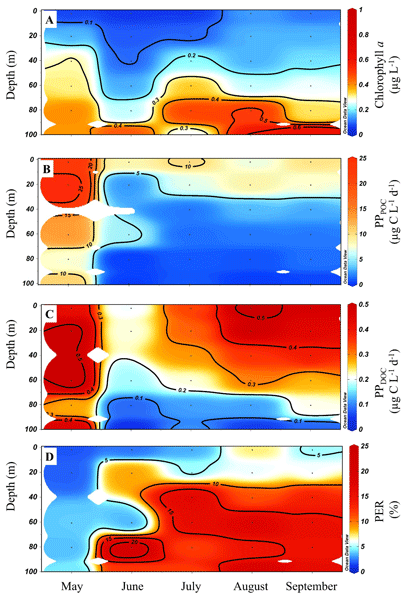
Abstract. Water column stratification exerts fundamental control on microbial carbon cycling in oligotrophic areas of the ocean, yet its impact on the partitioning and fate of newly fixed carbon remains insufficiently resolved. Here, we investigated carbon fluxes in the Northern Red Sea, Gulf of Aqaba from 5 cruises conducted during the stratified period. We measured 14C-based measurements of primary production partitioned into particulate (>0.7 µm; PPPOC) and dissolved (<0.7 µm; PPDOC) fractions, bacterial production (BP), community and bacterial respiration across the euphotic zone (0–100 m). As stratification intensifies and nutrient supply from depth diminishes, depth-integrated PPPOC declined from 1.26 to 0.35 g C m-2 d-1 while the relative contribution of dissolved carbon pathways increases. The fraction of newly fixed carbon released as dissolved organic carbon (extracellular release; PER) increased from 2.5 % to >7 % of total PP, indicating that a larger fraction of photosynthetically fixed carbon was released into the dissolved C pool. PPDOC (0.02–0.03 g C m-2 d-1) was positively correlated with BP (0.08–0.16 g C m-2 d-1), suggesting that recently released dissolved substrates contribute to sustaining heterotrophic microbial activity. Despite declining primary production, BR remained substantial (0.23–0.52 g C m-2 d-1), resulting in low to moderate bacterial growth efficiency (13–35 %) and indicating that most processed carbon was respired rather than incorporated into biomass. These findings indicate that summer stratification enhances the relative importance of dissolved carbon release and microbial recycling, thereby reducing the efficiency of carbon transfer to depth in the Gulf of Aqaba and likely other oligotrophic systems.
Competing interests: The contact author has declared that neither of the authors has any competing interests.
Publisher's note: Copernicus Publications remains neutral with regard to jurisdictional claims made in the text, published maps, institutional affiliations, or any other geographical representation in this paper. While Copernicus Publications makes every effort to include appropriate place names, the final responsibility lies with the authors. Views expressed in the text are those of the authors and do not necessarily reflect the views of the publisher.-
Notice on discussion status
The requested preprint has a corresponding peer-reviewed final revised paper. You are encouraged to refer to the final revised version.
-
Preprint
(1632 KB)
-
The requested preprint has a corresponding peer-reviewed final revised paper. You are encouraged to refer to the final revised version.
- Preprint
(1632 KB) - Metadata XML
- BibTeX
- EndNote
- Final revised paper


Journal article(s) based on this preprint
Interactive discussion
Status: closed
-
RC1: 'Comment on egusphere-2026-2917', Anonymous Referee #1, 09 Jul 2026
- AC1: 'Reply on RC1', Eyal Rahav, 10 Aug 2026
-
RC2: 'Comment on egusphere-2026-2917', Anonymous Referee #2, 04 Aug 2026
The authors present a detailed examination of carbon cycling in the upper 100 m of the water column in the oligotrophic Gulf of Aqaba across late spring to late summer, using a series of incubation experiments. They conclude that stratification-driven nutrient limitation in the euphotic zone leads to rapid recycling of photosynthetically produced organic carbon, with a large fraction of this carbon rapidly shunted to the dissolved pool. They further situate these findings within the context of climate-driven upper-ocean stratification and associated declines in surface production, and call for additional work extending to longer time periods and more oligotrophic regions.
The manuscript reads well, although a key methodological concern is the use of GF/F filtration to partition 14C-labeled carbon into particulate versus dissolved fractions, given that the study's own premise predicts a shift toward smaller cell sizes under stratification and nutrient limitation. GF/F has a pore size of ~0.7 µm and is known to under-retain picoplankton in this size class, particularly Prochlorococcus-like cyanobacteria (~0.6 µm), which means a fraction of labeled carbon residing in intact small cells could pass into the filtrate and be misclassified as dissolved organic carbon rather than particulate biomass. Because this artifact would bias the partitioning in the same direction as the paper's central claim, it is difficult to distinguish a genuine increase in extracellular release from an artifact of size-selective filter breakthrough as the community shifts toward smaller cells. Furthermore, this concern is compounded by another potential sources of error in the 14C-PER approach that are not addressed in the manuscript, for example, possible adsorption of labeled dissolved or colloidal material onto the glass fiber matrix (which would bias in the opposite direction, inflating the particulate fraction). Given that the paper's mechanistic conclusion rests entirely on this filter-based partitioning, I would recommend the authors either validate their GF/F separation against a defined 0.2 µm membrane filter (or a size-fractionation series) in this system, or explicitly address why filter breakthrough of small cells cannot account for the observed DOC-dominant signal.
Below are some minor comments:
Line 118, describe how inorganic carbon is removed.
Line 128, what’s “bicarbonate evaporation”?
Line 180, what type of filters are used for nutrient sample collection. Some of the NOx values look suspicious, i.e., the high values in 20 and 40 m in June and August, respectively.
Reed, M.H., Strope, E.K., Cremona, F., Myers, J.A., Newell, S.E. and McCarthy, M.J., 2023. Effects of filtration timing and pore size on measured nutrient concentrations in environmental water samples. Limnology and Oceanography: Methods, 21, 1-12.
Line 212, add MLD in the nutrient plots to show the relative position. Also it would be useful to show actual euphotic zone, not simply 0-100 m.
Line 251, remove “to”.
Line 358-360, incomplete sentence.
Citation: https://doi.org/10.5194/egusphere-2026-2917-RC2 - AC2: 'Reply on RC2', Eyal Rahav, 10 Aug 2026
Peer review completion


Interactive discussion
Status: closed
-
RC1: 'Comment on egusphere-2026-2917', Anonymous Referee #1, 09 Jul 2026
This manuscript presents a valuable dataset on microbial carbon cycling during the stratified season in the Gulf of Aqaba. By combining measurements of particulate and dissolved primary production, bacterial production, community respiration, and ancillary environmental parameters, the authors provide a useful perspective on how seasonal stratification may alter carbon allocation between particulate and dissolved pathways in an oligotrophic marine system.
The study addresses an important question and the dataset is unique. I found the manuscript generally well organized and suitable for publication after revision. However, several aspects of the analyses and interpretations require clarification and some conclusions should be more cautiously framed.
1. One of the main conclusions of the manuscript is that increasing stratification shifts carbon cycling toward dissolved pathways and enhances microbial recycling. Since both the percentage of PER and BGE were calculated, it would be informative to directly examine whether these two quantities are related. For example, is BGE higher when a larger fraction of newly fixed carbon is released as dissolved organic carbon? A simple correlation analysis between PER and BGE could provide additional support for the proposed coupling between dissolved carbon release and bacterial carbon utilization.
2. The manuscript interprets the observed BGE values as characteristic of strongly recycling oligotrophic systems. While this interpretation is reasonable, recent studies from other oligotrophic environments have reported comparatively high BGE values despite nutrient limitation. For example, recent work conducted in the Taiwan Strait found relatively elevated BGE under oligotrophic conditions (Liu et al., 2026; JGR-Oceans). It would be useful to discuss these contrasting observations. In particular, what factors might explain why oligotrophic systems sometimes exhibit low BGE and sometimes relatively high BGE? A brief discussion placing the Gulf of Aqaba observations within this broader context would enhance the manuscript.
3. Some statements need to be clarified.
Lines 352-356: I found this interpretation difficult to follow. If chlorophyll biomass becomes increasingly concentrated in the DCM, it does not necessarily imply “low standing stocks.” Could lower bacterial consumption at DCM explain this pattern?
The authors should clarify what they mean by “maintaining low standing stocks but operating at reduced photosynthetic efficiency” and explain the mechanistic basis for this decoupling more explicitly.Lines 381-386: The contrast with Devresse et al. (2022) is currently confusing. Earlier in the paragraph, semi-labile DOC is presented as a reservoir that buffers temporal mismatches between production and consumption. However, in the ETNA example, semi-labile DOC appears to support a production-driven carbon cycle. Please clarify whether the semi-labile DOC in these two cases represents accumulated DOC pools versus freshly produced DOC associated with contemporaneous primary production.
Lines 418-420: If nutrients are rapidly taken up by microorganisms, biological processes are clearly influencing their distributions.
Lines 424-427: Earlier results indicate that PER values are also relatively high near the DCM. Could the pronounced DCM observed during stratification primarily reflect photoacclimation rather than true biomass accumulation? Therefore, it is not obvious why carbon fixed at the DCM should preferentially contribute to biomass accumulation and export rather than dissolved pathways.
Minor comments
Please define all abbreviations when they first appear in the manuscript. For example, DOC and silicic acid [Si(OH)4] should be introduced with their full names before abbreviations are used.
Lines 80–88: The knowledge gap regarding the partitioning of newly fixed carbon and its connection to heterotrophic metabolism is introduced twice in slightly different wording. Streamlining this section would improve readability and sharpen the study objectives.
Line 251: The phrase “in June–September to (Figure 2B)” appears incomplete and should be corrected.
Line 256: “in the area” are rather vague. Please specify this region.
Citation: https://doi.org/10.5194/egusphere-2026-2917-RC1 - AC1: 'Reply on RC1', Eyal Rahav, 10 Aug 2026
-
RC2: 'Comment on egusphere-2026-2917', Anonymous Referee #2, 04 Aug 2026
The authors present a detailed examination of carbon cycling in the upper 100 m of the water column in the oligotrophic Gulf of Aqaba across late spring to late summer, using a series of incubation experiments. They conclude that stratification-driven nutrient limitation in the euphotic zone leads to rapid recycling of photosynthetically produced organic carbon, with a large fraction of this carbon rapidly shunted to the dissolved pool. They further situate these findings within the context of climate-driven upper-ocean stratification and associated declines in surface production, and call for additional work extending to longer time periods and more oligotrophic regions.
The manuscript reads well, although a key methodological concern is the use of GF/F filtration to partition 14C-labeled carbon into particulate versus dissolved fractions, given that the study's own premise predicts a shift toward smaller cell sizes under stratification and nutrient limitation. GF/F has a pore size of ~0.7 µm and is known to under-retain picoplankton in this size class, particularly Prochlorococcus-like cyanobacteria (~0.6 µm), which means a fraction of labeled carbon residing in intact small cells could pass into the filtrate and be misclassified as dissolved organic carbon rather than particulate biomass. Because this artifact would bias the partitioning in the same direction as the paper's central claim, it is difficult to distinguish a genuine increase in extracellular release from an artifact of size-selective filter breakthrough as the community shifts toward smaller cells. Furthermore, this concern is compounded by another potential sources of error in the 14C-PER approach that are not addressed in the manuscript, for example, possible adsorption of labeled dissolved or colloidal material onto the glass fiber matrix (which would bias in the opposite direction, inflating the particulate fraction). Given that the paper's mechanistic conclusion rests entirely on this filter-based partitioning, I would recommend the authors either validate their GF/F separation against a defined 0.2 µm membrane filter (or a size-fractionation series) in this system, or explicitly address why filter breakthrough of small cells cannot account for the observed DOC-dominant signal.
Below are some minor comments:
Line 118, describe how inorganic carbon is removed.
Line 128, what’s “bicarbonate evaporation”?
Line 180, what type of filters are used for nutrient sample collection. Some of the NOx values look suspicious, i.e., the high values in 20 and 40 m in June and August, respectively.
Reed, M.H., Strope, E.K., Cremona, F., Myers, J.A., Newell, S.E. and McCarthy, M.J., 2023. Effects of filtration timing and pore size on measured nutrient concentrations in environmental water samples. Limnology and Oceanography: Methods, 21, 1-12.
Line 212, add MLD in the nutrient plots to show the relative position. Also it would be useful to show actual euphotic zone, not simply 0-100 m.
Line 251, remove “to”.
Line 358-360, incomplete sentence.
Citation: https://doi.org/10.5194/egusphere-2026-2917-RC2 - AC2: 'Reply on RC2', Eyal Rahav, 10 Aug 2026
Peer review completion
Journal article(s) based on this preprint
Viewed
| HTML | XML | Total | BibTeX | EndNote | |
|---|---|---|---|---|---|
| 82 | 52 | 28 | 162 | 17 | 14 |
- HTML: 82
- PDF: 52
- XML: 28
- Total: 162
- BibTeX: 17
- EndNote: 14
Viewed (geographical distribution)
| Country | # | Views | % |
|---|
| Total: | 0 |
| HTML: | 0 |
| PDF: | 0 |
| XML: | 0 |
- 1

Adina Paytan
The requested preprint has a corresponding peer-reviewed final revised paper. You are encouraged to refer to the final revised version.
- Preprint
(1632 KB) - Metadata XML
This manuscript presents a valuable dataset on microbial carbon cycling during the stratified season in the Gulf of Aqaba. By combining measurements of particulate and dissolved primary production, bacterial production, community respiration, and ancillary environmental parameters, the authors provide a useful perspective on how seasonal stratification may alter carbon allocation between particulate and dissolved pathways in an oligotrophic marine system.
The study addresses an important question and the dataset is unique. I found the manuscript generally well organized and suitable for publication after revision. However, several aspects of the analyses and interpretations require clarification and some conclusions should be more cautiously framed.
1. One of the main conclusions of the manuscript is that increasing stratification shifts carbon cycling toward dissolved pathways and enhances microbial recycling. Since both the percentage of PER and BGE were calculated, it would be informative to directly examine whether these two quantities are related. For example, is BGE higher when a larger fraction of newly fixed carbon is released as dissolved organic carbon? A simple correlation analysis between PER and BGE could provide additional support for the proposed coupling between dissolved carbon release and bacterial carbon utilization.
2. The manuscript interprets the observed BGE values as characteristic of strongly recycling oligotrophic systems. While this interpretation is reasonable, recent studies from other oligotrophic environments have reported comparatively high BGE values despite nutrient limitation. For example, recent work conducted in the Taiwan Strait found relatively elevated BGE under oligotrophic conditions (Liu et al., 2026; JGR-Oceans). It would be useful to discuss these contrasting observations. In particular, what factors might explain why oligotrophic systems sometimes exhibit low BGE and sometimes relatively high BGE? A brief discussion placing the Gulf of Aqaba observations within this broader context would enhance the manuscript.
3. Some statements need to be clarified.
Lines 352-356: I found this interpretation difficult to follow. If chlorophyll biomass becomes increasingly concentrated in the DCM, it does not necessarily imply “low standing stocks.” Could lower bacterial consumption at DCM explain this pattern?
The authors should clarify what they mean by “maintaining low standing stocks but operating at reduced photosynthetic efficiency” and explain the mechanistic basis for this decoupling more explicitly.
Lines 381-386: The contrast with Devresse et al. (2022) is currently confusing. Earlier in the paragraph, semi-labile DOC is presented as a reservoir that buffers temporal mismatches between production and consumption. However, in the ETNA example, semi-labile DOC appears to support a production-driven carbon cycle. Please clarify whether the semi-labile DOC in these two cases represents accumulated DOC pools versus freshly produced DOC associated with contemporaneous primary production.
Lines 418-420: If nutrients are rapidly taken up by microorganisms, biological processes are clearly influencing their distributions.
Lines 424-427: Earlier results indicate that PER values are also relatively high near the DCM. Could the pronounced DCM observed during stratification primarily reflect photoacclimation rather than true biomass accumulation? Therefore, it is not obvious why carbon fixed at the DCM should preferentially contribute to biomass accumulation and export rather than dissolved pathways.
Minor comments
Please define all abbreviations when they first appear in the manuscript. For example, DOC and silicic acid [Si(OH)4] should be introduced with their full names before abbreviations are used.
Lines 80–88: The knowledge gap regarding the partitioning of newly fixed carbon and its connection to heterotrophic metabolism is introduced twice in slightly different wording. Streamlining this section would improve readability and sharpen the study objectives.
Line 251: The phrase “in June–September to (Figure 2B)” appears incomplete and should be corrected.
Line 256: “in the area” are rather vague. Please specify this region.