
the Creative Commons Attribution 4.0 License.
the Creative Commons Attribution 4.0 License.
 | 11 Jun 2026
Historical climate extremes in Europe and the connection between spring precipitation and summer heat
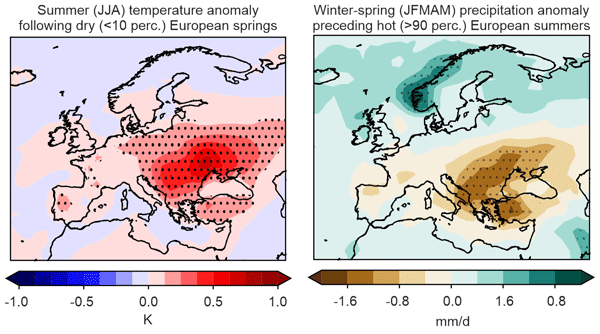
Abstract. Hot European summers are often preceded by dry springs such as in 2022, but also in 1473 or 1540, two well-known summers of catastrophic heat. Spring precipitation deficits deplete soil moisture levels, which can amplify extreme summer temperature anomalies in Europe through land-atmosphere feedback mechanisms and altered atmospheric circulation. However, the link is not particularly strong, and hence long time series might help to better elucidate the mechanisms. Starting from documentary data and an atlas of temperature, precipitation, and atmospheric circulation over Europe for climate extremes in the last 600 years, we explore this relationship in more detail. We analyse the extreme heat summer of 1473, which followed dry spring conditions in Southeastern Europe related to a positive East Atlantic pattern. We then use the ModE-RA paleo-reanalysis and combine it with an analysis of 11,760 years of atmospheric model simulations as well as other reanalyses and reconstructions. Using a moving climatology approach with LOESS regressions to calculate anomalies, we identify significant negative correlations between winter-spring precipitation and summer temperatures in all data sets in the latitude band 36°–48° N (strongest over southeastern Europe), corresponding to known moisture-limited regions. Moreover, apart from precipitation anomalies, hot summers are preceded by increased blocking over north-central Europe and a positive East Atlantic pattern. Conversely, dry winter-springs are followed by more frequent blocking over northern Europe and, in model simulations, an increase in frequency and intensity of summer heatwaves. A linear regression approach for temperature in the northern Mediterranean region shows that precipitation in April and May has a strong, direct influence that does not vanish when taking the detailed atmospheric circulation in winter, spring, and summer into account, and hence cannot be explained by the effect of circulation on both, spring precipitation and summer temperature.
-
Notice on discussion status
The requested preprint has a corresponding peer-reviewed final revised paper. You are encouraged to refer to the final revised version.
-
Preprint
(2608 KB)
-
Supplement
(21418 KB)
-
The requested preprint has a corresponding peer-reviewed final revised paper. You are encouraged to refer to the final revised version.
- Preprint
(2608 KB) - Metadata XML
-
Supplement
(21418 KB) - BibTeX
- EndNote
- Final revised paper


Journal article(s) based on this preprint
Interactive discussion
Status: closed
-
RC1: 'Comment on egusphere-2026-2852', Olivier Planchon, 21 Jun 2026
This particularly fascinating article proposes to go back 600 years in the past of Europe in order to identify, using proxy and instrumental data, reanalyses, and numerical simulations, whether the combination of certain spring weather / climate conditions is, significantly, heralding hot summers (a terribly topical subject!).
Given the quality of this work, I have no negative criticism to make. I would just like to ask a few questions and propose some suggestions to the authors, which may possibly improve the understanding of certain points and results that seem particularly interesting to me.
1) Would it be possible to specify what is the influence of the climatic context of the Little Ice Age (and its more or less severe / attenuated internal oscillations) on the frequency of atmospheric circulation types and their manifestations in terms of weather conditions highlighted in this study?
- NAO+ and NAO- phases;
- blocking patterns;
- occurrence of megadrought events.
2) Climatic conditions (interannual variability and multi-year alternately warm / cool oscillations) and atmospheric circulation that occurred during the transition between the end of the Little Ice Age and the period of contemporary global warming, did they influence certain results?
3) Possibility of an influence of the type of data used and analyzed on the results?
Compared to proxy data, what impacts and what importance could have precisely the measurements carried out from the seventeenth century onwards and their development (increasingly numerous across Europe) over the following centuries, in the analyses and on the results obtained in this work?
4) Among the questions asked by the authors themselves about highlighting characteristics specific to South-Eastern Europe climatology in the interpretation and understanding of the results, maybe the classification of atmospheric circulation patterns used in this work is not precise enough? If the classification used is relevant at the scale of the European continent, it is probably less so at smaller scales. Would the use of a more detailed classification such as that of Hess-Brezowsky circulation types (Großwetterlagen), if possible in the context of this work, be better suited to this regional scale?
- AC1: 'Reply on RC1', Stefan Bronnimann, 16 Aug 2026
-
RC2: 'Comment on egusphere-2026-2852', Carla Mateus, 13 Jul 2026
Dear Authors,
Please consider the comments and suggestions below, which are provided to enhance the quality of the manuscript.
Review of ‘Historical climate extremes in Europe and the connection between spring precipitation and summer heat’ submitted to Climate of the Past.
The manuscript is well written and clear, and the scientific significance of its content and outputs fits the scope of Climate of the Past. The topic is of paramount concern and importance. The methodology is adequate and explained to ensure traceability and reproducibility. The figures and supplementary materials are of adequate quality and quantity.
Minor comments and suggestions are provided below:
- Introduction
The authors give proper credit to related work and clearly indicate their own contributions by citing prior studies to support their arguments. However, further information is required for clarity to inform an international and/or non-expert readership of the manuscript:
- Why is this study important?
- Mention compound events and why they are important.
- It would be great to provide references on long-term trends and projections of spring & summer precipitation and summer heat waves; linking past and future.
- Expand why you have selected these specific historical extremes as case studies (e.g. what makes them stand out in the long record).
2.2. Documentary data
Lines 110 – 111: “In the English countryside, spring was perceived as an event rather than a season.” Why? Expand and provide references.
2.3. Methods
Line 124: Rephrase as ‘Atlas of European climate extremes since 1421’.
2.3.2 Seasonal precipitation and temperature
Justify and/or present references for why you have chosen precipitation anomalies below the 10th percentile and temperature anomalies above the 90th percentile (e.g., the significance of the impacts of these extremes).
2.3.3 Atmospheric circulation
Provide references for the data used.
It would be great to have a brief explanation of the importance of the NAO, the East Atlantic pattern, the Scandinavian pattern, and the three indices of the jet stream over the Atlantic-European sector.
Line 171: “We then used a regression approach to predict JJA 2 m temperature from spring predictors.” Provide references (e.g., a statistical textbook) to ensure reproducibility for other researchers.
Line 177: Same comment as above; please provide a reference.
Further results suggestion:
It would be interesting to reference the Little Ice Age to see how the frequency and characteristics of events have changed over time and to link this to the ‘Appendix: Documentary data for hot summers that followed dry springs’.
It would be interesting to include a figure that illustrates or presents original documentary data to highlight the impacts associated with one of the historical case studies (e.g., a painting, illustration, manuscript, or newspaper).
- Discussion and conclusion
This section must be expanded. What is the importance of these findings?
Lines 382-383: “We find a link between dry springs and warm summers in climate reconstructions, consistent with other studies.” Provide examples of previous studies/references.
Best wishes,
Carla
Citation: https://doi.org/10.5194/egusphere-2026-2852-RC2 - AC2: 'Reply on RC2', Stefan Bronnimann, 16 Aug 2026
Peer review completion


Interactive discussion
Status: closed
-
RC1: 'Comment on egusphere-2026-2852', Olivier Planchon, 21 Jun 2026
This particularly fascinating article proposes to go back 600 years in the past of Europe in order to identify, using proxy and instrumental data, reanalyses, and numerical simulations, whether the combination of certain spring weather / climate conditions is, significantly, heralding hot summers (a terribly topical subject!).
Given the quality of this work, I have no negative criticism to make. I would just like to ask a few questions and propose some suggestions to the authors, which may possibly improve the understanding of certain points and results that seem particularly interesting to me.
1) Would it be possible to specify what is the influence of the climatic context of the Little Ice Age (and its more or less severe / attenuated internal oscillations) on the frequency of atmospheric circulation types and their manifestations in terms of weather conditions highlighted in this study?
- NAO+ and NAO- phases;
- blocking patterns;
- occurrence of megadrought events.
2) Climatic conditions (interannual variability and multi-year alternately warm / cool oscillations) and atmospheric circulation that occurred during the transition between the end of the Little Ice Age and the period of contemporary global warming, did they influence certain results?
3) Possibility of an influence of the type of data used and analyzed on the results?
Compared to proxy data, what impacts and what importance could have precisely the measurements carried out from the seventeenth century onwards and their development (increasingly numerous across Europe) over the following centuries, in the analyses and on the results obtained in this work?
4) Among the questions asked by the authors themselves about highlighting characteristics specific to South-Eastern Europe climatology in the interpretation and understanding of the results, maybe the classification of atmospheric circulation patterns used in this work is not precise enough? If the classification used is relevant at the scale of the European continent, it is probably less so at smaller scales. Would the use of a more detailed classification such as that of Hess-Brezowsky circulation types (Großwetterlagen), if possible in the context of this work, be better suited to this regional scale?
- AC1: 'Reply on RC1', Stefan Bronnimann, 16 Aug 2026
-
RC2: 'Comment on egusphere-2026-2852', Carla Mateus, 13 Jul 2026
Dear Authors,
Please consider the comments and suggestions below, which are provided to enhance the quality of the manuscript.
Review of ‘Historical climate extremes in Europe and the connection between spring precipitation and summer heat’ submitted to Climate of the Past.
The manuscript is well written and clear, and the scientific significance of its content and outputs fits the scope of Climate of the Past. The topic is of paramount concern and importance. The methodology is adequate and explained to ensure traceability and reproducibility. The figures and supplementary materials are of adequate quality and quantity.
Minor comments and suggestions are provided below:
- Introduction
The authors give proper credit to related work and clearly indicate their own contributions by citing prior studies to support their arguments. However, further information is required for clarity to inform an international and/or non-expert readership of the manuscript:
- Why is this study important?
- Mention compound events and why they are important.
- It would be great to provide references on long-term trends and projections of spring & summer precipitation and summer heat waves; linking past and future.
- Expand why you have selected these specific historical extremes as case studies (e.g. what makes them stand out in the long record).
2.2. Documentary data
Lines 110 – 111: “In the English countryside, spring was perceived as an event rather than a season.” Why? Expand and provide references.
2.3. Methods
Line 124: Rephrase as ‘Atlas of European climate extremes since 1421’.
2.3.2 Seasonal precipitation and temperature
Justify and/or present references for why you have chosen precipitation anomalies below the 10th percentile and temperature anomalies above the 90th percentile (e.g., the significance of the impacts of these extremes).
2.3.3 Atmospheric circulation
Provide references for the data used.
It would be great to have a brief explanation of the importance of the NAO, the East Atlantic pattern, the Scandinavian pattern, and the three indices of the jet stream over the Atlantic-European sector.
Line 171: “We then used a regression approach to predict JJA 2 m temperature from spring predictors.” Provide references (e.g., a statistical textbook) to ensure reproducibility for other researchers.
Line 177: Same comment as above; please provide a reference.
Further results suggestion:
It would be interesting to reference the Little Ice Age to see how the frequency and characteristics of events have changed over time and to link this to the ‘Appendix: Documentary data for hot summers that followed dry springs’.
It would be interesting to include a figure that illustrates or presents original documentary data to highlight the impacts associated with one of the historical case studies (e.g., a painting, illustration, manuscript, or newspaper).
- Discussion and conclusion
This section must be expanded. What is the importance of these findings?
Lines 382-383: “We find a link between dry springs and warm summers in climate reconstructions, consistent with other studies.” Provide examples of previous studies/references.
Best wishes,
Carla
Citation: https://doi.org/10.5194/egusphere-2026-2852-RC2 - AC2: 'Reply on RC2', Stefan Bronnimann, 16 Aug 2026
Peer review completion
Journal article(s) based on this preprint
Viewed
| HTML | XML | Total | Supplement | BibTeX | EndNote | |
|---|---|---|---|---|---|---|
| 517 | 312 | 37 | 866 | 92 | 24 | 25 |
- HTML: 517
- PDF: 312
- XML: 37
- Total: 866
- Supplement: 92
- BibTeX: 24
- EndNote: 25
Viewed (geographical distribution)
| Country | # | Views | % |
|---|
| Total: | 0 |
| HTML: | 0 |
| PDF: | 0 |
| XML: | 0 |
- 1
Cited


Laura Lipfert
Ralf Hand
Angela-Maria Burgdorf
Christian Pfister
Heinz Wanner
Stefan Brönnimann

The requested preprint has a corresponding peer-reviewed final revised paper. You are encouraged to refer to the final revised version.
- Preprint
(2608 KB) - Metadata XML
-
Supplement
(21418 KB) - BibTeX
- EndNote
- Final revised paper