
the Creative Commons Attribution 4.0 License.
the Creative Commons Attribution 4.0 License.
 | 27 May 2026
Dust Radiative Effects and Impact on Energy Production over the Mediterranean Basin
Abstract. Atmospheric aerosols are among the key factors affecting the Earth’s radiation budget, playing a fundamental role in understanding climate forcing, feedback mechanisms, and their impact on future climate projections and on solar energy systems. More specifically, dust aerosol particles, which are characterized by high complexity of their optical and microphysical properties, remain one of the most uncertain components. In this study, we focus on four severe dust events across multiple sites in the broader Mediterranean Basin between 2021 and 2022. We employ a combination of ground-based
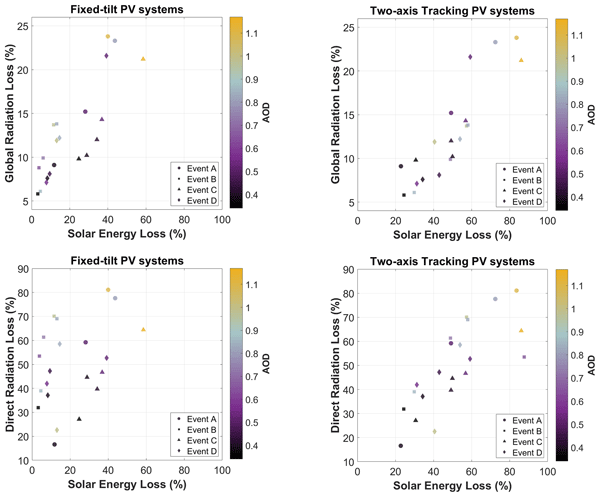
remote sensing observations along with Radiative Transfer (RT) modelling, with the libRadtran package and METAL-WRF scheme, as well as photovoltaic (PV) power generation simulations using the Global Solar Energy Estimator (GSEE) to investigate the impact of the different optical and geometrical aspects of these events on solar radiation and solar energy. The results revealed that the strongest dust-induced attenuation was systematically observed in the direct component of solar radiation (DNI), with maximum losses frequently exceeding 60–80%, while Global Horizontal Irradiance (GHI) typically ranged between 5% and 25%. These findings were reflected directly into substantial PV power output losses, for both fixed tilt and two-axis tracking systems, reaching ~45% and 80%, respectively, with the impact on the latter being significantly higher due to their strong dependence on DNI. A sensitivity analysis based on how aerosol optical properties and solar geometry jointly influence PV energy production revealed that Solar Zenith Angle (SZA) plays the most dominant role, followed by Aerosol Optical Depth (AOD), which leads to strong attenuation independently of SZA under altered aerosol load conditions. Finally, the comparison of the modelled PV output estimated from the modelled irradiances based on the two different RT models with the PV output considering ground-based GHI measurements revealed a similar agreement under clear sky conditions, while under cloudy conditions, the analysis revealed the critical role of the diffuse horizontal irradiance (DHI) component in the simulations.
Competing interests: At least one of the (co-)authors is a member of the editorial board of Atmospheric Measurement Techniques. The peer-review process was guided by an independent editor, and the authors also have no other competing interests to declare.
Publisher's note: Copernicus Publications remains neutral with regard to jurisdictional claims made in the text, published maps, institutional affiliations, or any other geographical representation in this paper. While Copernicus Publications makes every effort to include appropriate place names, the final responsibility lies with the authors. Views expressed in the text are those of the authors and do not necessarily reflect the views of the publisher.-
Notice on discussion status
The requested preprint has a corresponding peer-reviewed final revised paper. You are encouraged to refer to the final revised version.
-
Preprint
(2101 KB)
-
Supplement
(1305 KB)
-
The requested preprint has a corresponding peer-reviewed final revised paper. You are encouraged to refer to the final revised version.
- Preprint
(2101 KB) - Metadata XML
-
Supplement
(1305 KB) - BibTeX
- EndNote
- Final revised paper


Journal article(s) based on this preprint
Interactive discussion
Status: closed
-
RC1: 'Comment on egusphere-2026-2775', Anonymous Referee #1, 11 Jun 2026
-
AC1: 'Reply on RC1', Dimitra Kouklaki, 29 Jul 2026
We would like to sincerely thank the reviewer for providing comments and suggestions which have contributed to improving our manuscript. We have carefully considered all suggestions and revised the manuscript accordingly.
A detailed response to all comments has been provided in the attached PDF file. Reviewer’s comments are written in italics. Our answers are provided in normal text. Unless otherwise indicated, the numbering of lines, figures, and sections in our responses correspond to the revised manuscript.
-
AC1: 'Reply on RC1', Dimitra Kouklaki, 29 Jul 2026
-
RC2: 'Comment on egusphere-2026-2775', Anonymous Referee #2, 26 Jun 2026
The authors presented a systematic analysis of the influences of dust aerosols on solar energy production in the Mediterranean Basin during four dust storms between 2021 and 2022. The topic is relevant, and the manuscript presents a comprehensive analysis. I would suggest a major revision before publishing on AMT. Please see my comments below.
Main comments:
1. The analysis is based on four different dust events. However, using only the station names listed in Table 1 makes it difficult for readers to understand the spatial extent and characteristics of these events. It is recommended to provide additional information describing their spatial distribution and intensity. Furthermore, as the manuscript indicates that solar energy production is strongly influenced by dust aerosol optical depth, it would be helpful to include a brief description of the intensity of each dust event.
2. The introduction section lacks a clear and coherent logical structure. For example, after the discussion of atmospheric aerosols, with dust particles as the main focus (lines 57-60), the authors return to a general discussion of aerosols' direct and indirect radiative effects (lines 60-61).
3. The authors estimate PV output using ground-based measurements and METAL-WRF for AMX and Lampedusa. However, given the spatial and temporal variation of dust transport and aerosol properties, it would be helpful to explain whether the conclusions drawn from these two case studies can be generalized to the broader Mediterranean Basin. Furthermore, as these two stations are affected by Saharan and Middle Eastern dust events, respectively, it would be useful to discuss whether dust from these distinct source regions has distinct implications for PV energy production and model performance.
Minor comments:
1. Lines 64, 75: Please avoid having two sets of parentheses next to each other.
2. Line 158: The reason for using Level 1.5 AERONET data should be provided.
3. Line 165: Need references for the criteria.
4. Line 365: It is not clear how the “global direct radiation losses” are defined.
5. Line 434: Why are only two stations used?
6. Line 515: “These days have been excluded.” Please be specific.
7. Please use either "Figure X" or "Fig. X" consistently throughout the manuscript when referring to figures.
Citation: https://doi.org/10.5194/egusphere-2026-2775-RC2 -
AC2: 'Reply on RC2', Dimitra Kouklaki, 29 Jul 2026
We would like to sincerely thank the reviewer for the time and effort they put into reviewing our manuscript, as well as for the valuable comments and suggestions provided. We have carefully considered all suggestions and revised the manuscript accordingly.
A detailed response to all comments has been provided in the attached PDF file. Reviewer’s comments are written in italics. Our answers are provided in normal text. Unless otherwise indicated, the numbering of lines, figures, and sections in our responses correspond to the revised manuscript.
-
AC2: 'Reply on RC2', Dimitra Kouklaki, 29 Jul 2026
Peer review completion


Interactive discussion
Status: closed
-
RC1: 'Comment on egusphere-2026-2775', Anonymous Referee #1, 11 Jun 2026
I found the manuscript interesting and generally well written. In particular, the Introduction provides a clear and informative overview of the scientific background and motivation of the study. I recommend a number of clarifications and minor revisions that would improve the manuscript's clarity, reproducibility, and overall presentation prior to publication.
MAJOR COMMENTS:
- Please include a clear definition of the reported losses, preferably inlcuding the corresponding equation. The reference used to compute the percentage losses should be explicitly stated. Some related definitions appear later in the manuscript (Line 375), but this concept should be introduced earlier and described in greater detail.
- A map showing the geographical distribution of the considered sites would help the reader better understand the study area and the analysis presented in Section 2.
- Methodology: a description of the broadband radiation measurements is missing. Please provide information on the measurement sites, instruments/sensors, measured variables, quality-control procedures, and any other relevant details.
- How is GTI obtained from SSR? Please clarify the procedure used for this conversion, as this step can introduce significant uncertainties. If this calculation is performed internally within GSEE, please state so and briefly describe the methodology in the Section 2.
-The description of the GSEE implementation is not sufficiently detailed. Please specify explicitly which irradiance components (GHI, DHI, DNI and/or plane-of-array irradiance) were provided as inputs to GSEE for each simulation setup (measurements, libRadtran and METAL-WRF), and clarify whether the transposition to the PV plane was performed internally by GSEE. Also include some details in the PV generation model.
- Figure 4: please clarify what is meant by "solar energy loss". Does it refer to tilted irradiance, PV energy production, or another quantity? Also indicate the reference used for the normalization and percentage calculations.
- Please include the optimum fixed tilt angle used at each site.
- Please provide more details on the clear-sky selection procedure.
MINOR COMMENTS:- L35 - Please clarify that the sensitivity analysis is performed under clear skies conditions
- Fig.1. the figure is difficult to interpret. Is the color coding important for the analysis? If so, please clarify its meaning and improve readability.
- There is a missmatch between figure numbering and the figure references in the text. (e.g. Figures 5, 6 an 7). Please check figure numbering throughout the manuscript. Also, use a consistent format when referring to figures. For example Fig. X
- Ssec 3.3 Please refer to figures in order of appearance. For example, Fig. 11 appears referenced before Fig. 9.
- L260: fixed tilt: which angle?
- Fig. 9 and Fig. 11: please indicate which days are considered clear-sky cases.
- In the sensitivity analysis, please specify the wavelength associated with the reported AOD values.
- Fig. 11 and Fig. 1comparing outputs from a clear sky radiative transfer model (libRadtran in this case) with measurements affected by cloudiness is difficult to interpret and does not provide a meaningful assessment of model performance.
- conclusions: consider removing "Under cloudy conditions, the comparisons lead to greater differences and an overall overestimation in the case of libRadtran", as this result is expected when comparing clear-sky simulations with cloudy-sky observations.
SUGGESTIONS:
- Consider including a glossary of the main acronyms and variables used throughout the manuscript.
- L120: is there any estimate of the annual energy losses associated with dust events over the study region? Although outside the main scope of this work, such information could help place the reported event-scale impacts into a broader context.
- Since completely clear days are relatively scarce, the authors could consider using clear-sky periods selected from different days (even when a full day is not entirely cloudless) through the application of a clear-sky detection algorithm. This could potentially increase the amount of data available for the final analysis.
Citation: https://doi.org/10.5194/egusphere-2026-2775-RC1 -
AC1: 'Reply on RC1', Dimitra Kouklaki, 29 Jul 2026
We would like to sincerely thank the reviewer for providing comments and suggestions which have contributed to improving our manuscript. We have carefully considered all suggestions and revised the manuscript accordingly.
A detailed response to all comments has been provided in the attached PDF file. Reviewer’s comments are written in italics. Our answers are provided in normal text. Unless otherwise indicated, the numbering of lines, figures, and sections in our responses correspond to the revised manuscript.
-
AC1: 'Reply on RC1', Dimitra Kouklaki, 29 Jul 2026
-
RC2: 'Comment on egusphere-2026-2775', Anonymous Referee #2, 26 Jun 2026
The authors presented a systematic analysis of the influences of dust aerosols on solar energy production in the Mediterranean Basin during four dust storms between 2021 and 2022. The topic is relevant, and the manuscript presents a comprehensive analysis. I would suggest a major revision before publishing on AMT. Please see my comments below.
Main comments:
1. The analysis is based on four different dust events. However, using only the station names listed in Table 1 makes it difficult for readers to understand the spatial extent and characteristics of these events. It is recommended to provide additional information describing their spatial distribution and intensity. Furthermore, as the manuscript indicates that solar energy production is strongly influenced by dust aerosol optical depth, it would be helpful to include a brief description of the intensity of each dust event.
2. The introduction section lacks a clear and coherent logical structure. For example, after the discussion of atmospheric aerosols, with dust particles as the main focus (lines 57-60), the authors return to a general discussion of aerosols' direct and indirect radiative effects (lines 60-61).
3. The authors estimate PV output using ground-based measurements and METAL-WRF for AMX and Lampedusa. However, given the spatial and temporal variation of dust transport and aerosol properties, it would be helpful to explain whether the conclusions drawn from these two case studies can be generalized to the broader Mediterranean Basin. Furthermore, as these two stations are affected by Saharan and Middle Eastern dust events, respectively, it would be useful to discuss whether dust from these distinct source regions has distinct implications for PV energy production and model performance.
Minor comments:
1. Lines 64, 75: Please avoid having two sets of parentheses next to each other.
2. Line 158: The reason for using Level 1.5 AERONET data should be provided.
3. Line 165: Need references for the criteria.
4. Line 365: It is not clear how the “global direct radiation losses” are defined.
5. Line 434: Why are only two stations used?
6. Line 515: “These days have been excluded.” Please be specific.
7. Please use either "Figure X" or "Fig. X" consistently throughout the manuscript when referring to figures.
Citation: https://doi.org/10.5194/egusphere-2026-2775-RC2 -
AC2: 'Reply on RC2', Dimitra Kouklaki, 29 Jul 2026
We would like to sincerely thank the reviewer for the time and effort they put into reviewing our manuscript, as well as for the valuable comments and suggestions provided. We have carefully considered all suggestions and revised the manuscript accordingly.
A detailed response to all comments has been provided in the attached PDF file. Reviewer’s comments are written in italics. Our answers are provided in normal text. Unless otherwise indicated, the numbering of lines, figures, and sections in our responses correspond to the revised manuscript.
-
AC2: 'Reply on RC2', Dimitra Kouklaki, 29 Jul 2026
Peer review completion
Journal article(s) based on this preprint
Viewed
| HTML | XML | Total | Supplement | BibTeX | EndNote | |
|---|---|---|---|---|---|---|
| 272 | 109 | 50 | 431 | 62 | 34 | 44 |
- HTML: 272
- PDF: 109
- XML: 50
- Total: 431
- Supplement: 62
- BibTeX: 34
- EndNote: 44
Viewed (geographical distribution)
| Country | # | Views | % |
|---|
| Total: | 0 |
| HTML: | 0 |
| PDF: | 0 |
| XML: | 0 |
- 1

Georgia Charalampous
Anna Moustaka
Alkistis Papetta
Celia Herrero del Barrio
Rizos-Theodoros Chadoulis
S. Yeşer Aslanoğlu
Sara Herrero-Anta
Michail Mytilinaios
Nikolaos Papadimitriou
Katerina Anyfanti
Christos Spyrou
Daniela Meloni
Konstantinos Fragkos
Yevgeny Derimian
Tatiana Di Iorio
Rodanthi-Elisavet Mamouri
Vassilis Amiridis
Stavros Solomos
Stelios Kazadzis
Ilias Fountoulakis
The requested preprint has a corresponding peer-reviewed final revised paper. You are encouraged to refer to the final revised version.
- Preprint
(2101 KB) - Metadata XML
-
Supplement
(1305 KB) - BibTeX
- EndNote
- Final revised paper
I found the manuscript interesting and generally well written. In particular, the Introduction provides a clear and informative overview of the scientific background and motivation of the study. I recommend a number of clarifications and minor revisions that would improve the manuscript's clarity, reproducibility, and overall presentation prior to publication.
MAJOR COMMENTS:
- Please include a clear definition of the reported losses, preferably inlcuding the corresponding equation. The reference used to compute the percentage losses should be explicitly stated. Some related definitions appear later in the manuscript (Line 375), but this concept should be introduced earlier and described in greater detail.
- A map showing the geographical distribution of the considered sites would help the reader better understand the study area and the analysis presented in Section 2.
- Methodology: a description of the broadband radiation measurements is missing. Please provide information on the measurement sites, instruments/sensors, measured variables, quality-control procedures, and any other relevant details.
- How is GTI obtained from SSR? Please clarify the procedure used for this conversion, as this step can introduce significant uncertainties. If this calculation is performed internally within GSEE, please state so and briefly describe the methodology in the Section 2.
-The description of the GSEE implementation is not sufficiently detailed. Please specify explicitly which irradiance components (GHI, DHI, DNI and/or plane-of-array irradiance) were provided as inputs to GSEE for each simulation setup (measurements, libRadtran and METAL-WRF), and clarify whether the transposition to the PV plane was performed internally by GSEE. Also include some details in the PV generation model.
- Figure 4: please clarify what is meant by "solar energy loss". Does it refer to tilted irradiance, PV energy production, or another quantity? Also indicate the reference used for the normalization and percentage calculations.
- Please include the optimum fixed tilt angle used at each site.
- Please provide more details on the clear-sky selection procedure.
MINOR COMMENTS:
- L35 - Please clarify that the sensitivity analysis is performed under clear skies conditions
- Fig.1. the figure is difficult to interpret. Is the color coding important for the analysis? If so, please clarify its meaning and improve readability.
- There is a missmatch between figure numbering and the figure references in the text. (e.g. Figures 5, 6 an 7). Please check figure numbering throughout the manuscript. Also, use a consistent format when referring to figures. For example Fig. X
- Ssec 3.3 Please refer to figures in order of appearance. For example, Fig. 11 appears referenced before Fig. 9.
- L260: fixed tilt: which angle?
- Fig. 9 and Fig. 11: please indicate which days are considered clear-sky cases.
- In the sensitivity analysis, please specify the wavelength associated with the reported AOD values.
- Fig. 11 and Fig. 1comparing outputs from a clear sky radiative transfer model (libRadtran in this case) with measurements affected by cloudiness is difficult to interpret and does not provide a meaningful assessment of model performance.
- conclusions: consider removing "Under cloudy conditions, the comparisons lead to greater differences and an overall overestimation in the case of libRadtran", as this result is expected when comparing clear-sky simulations with cloudy-sky observations.
SUGGESTIONS:
- Consider including a glossary of the main acronyms and variables used throughout the manuscript.
- L120: is there any estimate of the annual energy losses associated with dust events over the study region? Although outside the main scope of this work, such information could help place the reported event-scale impacts into a broader context.
- Since completely clear days are relatively scarce, the authors could consider using clear-sky periods selected from different days (even when a full day is not entirely cloudless) through the application of a clear-sky detection algorithm. This could potentially increase the amount of data available for the final analysis.