
the Creative Commons Attribution 4.0 License.
the Creative Commons Attribution 4.0 License.
 | 13 May 2026
Everyday weather in a warmer world
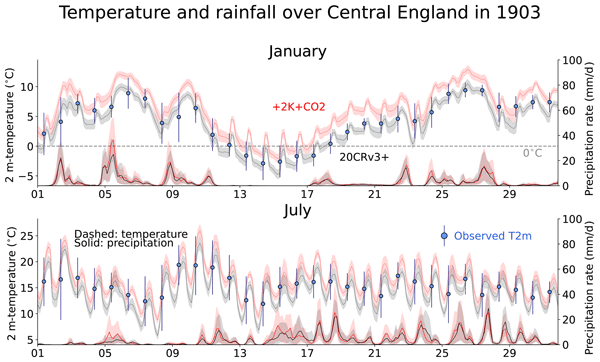
Abstract. How would the weather of a year from history be experienced in a warmer world? We reconstruct the weather of 1903 using a reanalysis system that assimilates only surface pressure observations (20CRv3) with observed SSTs, and then reconstruct it again with increased SSTs and atmospheric CO2 levels. By assimilating the same pressure observations, the reanalysis experiments produce the same weather patterns, and so we translate the weather of 1903 into a warmer context. We focus on changes in the everyday weather of four regions with a high density of historical pressure observations, where the circulation is constrained and differences between the experiments are due to the thermodynamic component of climate change. In these regions, nearly all days are warmer in the warmer world experiments, but the largest increases occur on cold days (below freezing) and hot days (above 20 °C). Daily rainfall becomes more variable, even in regions where total rainfall is reduced. Fewer days experience light rain while more days experience heavy rain, and rainfall only increases on less than one day in 10. This single year pair of reanalysis experiments also recovers common patterns of observed and projected long-term changes. For example, Western Mediterranean precipitation declines outside winter, but shows a small increase in winter in the absence of storm track shifts. By anchoring our analysis in weather patterns that have actually occurred, the reanalysis experiments point to how our day-to-day experience of the weather may change in a warmer world.
-
Notice on discussion status
The requested preprint has a corresponding peer-reviewed final revised paper. You are encouraged to refer to the final revised version.
-
Preprint
(7374 KB)
-
Supplement
(1096 KB)
-
The requested preprint has a corresponding peer-reviewed final revised paper. You are encouraged to refer to the final revised version.
- Preprint
(7374 KB) - Metadata XML
-
Supplement
(1096 KB) - BibTeX
- EndNote
- Final revised paper


Journal article(s) based on this preprint
Interactive discussion
Status: closed
-
RC1: 'Comment on egusphere-2026-2548', Anonymous Referee #1, 16 Jun 2026
- AC1: 'Reply to RC1', Rhidian Thomas, 15 Jul 2026
-
RC2: 'Comment on egusphere-2026-2548', Anonymous Referee #2, 22 Jun 2026
The manuscript by Thomas et al. uses the 20CRv3 reanalysis system to assess the effect of a uniform 2°C SST warming and a combined 2°C SST warming plus a CO2 concentration increase on the global and regional weather of the year 1903. The very same pressure and cyclone track patterns are assimilated in both the control and the sensitivity experiments, allowing an approximation of the pure thermodynamic effect (or at least some part of it) of the imposed warming/CO2 increase for identical weather situations. The authors find a regionally dependent atmospheric warming of typically a little more than the imposed +2°C. In four investigated sub-domains, the largest warmings (much more than 2°C) are found at the tails of the temperature distribution, i.e. on cold days and on warm days. Daily rainfall becomes more variable, and the thermodynamic signal alone can cause seasonally dependent precipitation changes.
I have to admit that after reading the abstract and introduction I have not been too convinced on the usefulness of the work presented, especially of its motivation. While reading the full manuscript, however, more and more interesting points became evident, and I believe that the manuscript could be a valid contribution to the scientific community after a few adjustments were made. The quality of presentation, in general, is high. The results are nicely illustrated for most parts. The conclusions openly and appropriately mention the limitations of the work.
My suggestion is to return to the manuscript to the authors for major revision, during which the points listed below should be addressed.
With kind regards.
MAJOR ISSUES
Motivation of the work: I do certainly understand that it is tempting to use existing simulations (Hawkins et al.) and to make more complete use of them. But the choice of the year 1903 for this study needs to be much better motivated in my opinion. Where is this particular year located in the climatology of the early 1900s? I doubt that it was regular/mean year in all parts of the world. Presenting such an analysis is important when interpreting the results as regular/mean weather. At the end of the day, simulating and analysing a 20- or 30-year period would be much more informative.
Motivation of the technique: Relating to the previous point, interpreting the results of the one-year long simulations as thermodynamic effects on that year’s weather is partly critical in my opinion. The applied technique (assimilation of pressure observations) is regionally extremely strong I’d say and would not allow regional feedbacks (within a general large-scale weather situation) and their effects on day-to-day weather variability to develop in a perturbed setup. Could the authors provide some more evidence that the system is not too constrained in this respect? Also, imposing the SST warming without adapting the pressure observations that are assimilated can be critical in this sense. Buth would go hand in hand for pure thermodynamic reasons. Could the authors comment on this?
Validation: In general, only few validations are presented, only at the Central England scale, and focusing on precipitation. However, if changes in day-to-day precipitation variability are analysed, for instance, some decent performance of the 20CRv3 control run for these aspects would have to be shown (although, as the authors correctly state, precipitation conditions are probably more poorly constrained).
Literature review and comparison: The literature review covers the PGW technique, but misses out further possibilities (e.g. large scale nudging). Also, the results obtained should somehow be set into the context of existing works (not targeting specifically the year 1903 of course, but more general the thermodynamic effects of global warming on weather variability).
Sea ice snow: Parts of the temperature sensitivity and probably also parts of the global patterns presented in Fig. 4 could be explained by snow and/or sea ice changes. A brief supporting analysis of these points would help the interpretation of the results.
MINOR ISSUES
Language: The authors frequently refer to the issue how the 1903 weather conditions would be “experienced” in a warmer world. This closely follows the storyline concept, but in the end only meteorological standard variables are analysed and no relation is made to the actual perception of the weather conditions. I’d hence suggest to adapt the wording here.
Line 265: You probably mean Figs. 8c and 8d here.
Citation: https://doi.org/10.5194/egusphere-2026-2548-RC2 - AC2: 'Reply to RC2', Rhidian Thomas, 15 Jul 2026
Peer review completion


Interactive discussion
Status: closed
-
RC1: 'Comment on egusphere-2026-2548', Anonymous Referee #1, 16 Jun 2026
Review of "Everyday weather in a warmer world", by Thomas et al.
The authors use a historical reanalysis system to generate a reanalysis for the year 1903 and then perform "pseudo global warming"-like simulations by increasing SSTs uniformly by 2 K and by additionally changing the CO2 concentration to 530 ppm, while assimilating the same surface and sea-level pressure observations. This allows addressing the hypothetical, pure thermodynamic effects and separate ocean warming and total warming. The paper then discusses the results at different spatial and temporal scales, focusing on the changes in the distributions and always addressing the underlying processes. The paper is well written and interesting and deserves publication. The results are convincingly discussed and relevant for our understanding of climate change processes. The obvious drawback inherent to this approach arises from constraining atmospheric circulation from observations while leaving the thermodynamics to the model. The fear is that it might lead to inconsistencies and it is not clear what the clean separation between thermodynamics and dynamics then actually means (e.g., when the vertical velocity still changes). Or phrased differently: How realistic is the simulated +2K+CO2 weather? Is it an unbiased sample of future weather? I will address that point below. However, I think this is an extremely useful undertaking that should be performed and should be published. We can learn a lot from this paper.Comments
- The authors use 1903 as a study year. This happens to be a globally very cold year (one of the coldest in the HadCRUT5.1 data set), which should be stated. The warmest year in HadCRUT5.1 is ca. 1.7 °C warmer. Although 20CRv3 stops a bit earlier, I am missing the argument that the pseudo global warming experiment is not taking the 20CRv3 system far away from what it has experienced and for what it has been evaluated (i.e., future in the paper is the near-future). I think this would be a supporting argument.
- That said: 1903 is the year following the Santa Maria eruption. This also should be stated, as this was one of the largest tropical eruptions of the 20th century.
- The question of the separation of thermodynamics and dynamics is of course key. Does the assimilation of real weather that unfolded in a 2 degree cooler world still give consistent weather in a warmer world? The approach allows the interpretations of individual factors, which is great, but what about the goal of the paper? The Abstract starts with "How would the weather of a year from history be experienced in a warmer world?" and ends with "...how our day-to-day experience of the weather may change in a warmer world", which is not exactly the same. I think the paper does the former, while the latter implies that the simulated weather is (a) plausible and (b) an unbiased sample of the warmer world weather.
- To better judge how consistent this is or how far the system is pushed, some additional analyses might help. It would perhaps be interesting to look into the innovation statistics to see whether the assimilation scheme constantly tries to back-correct thermodynamically induced dynamic effects by the model and vice versa. Or it would be good to know whether the QC now rejects certain observations I did not before (e.g., hurricanes). Do other important factors (localisation, inflation) change? Given the argument above, I doubt that any of this is the case, but would be good to know. The innovation statistics could give an indication into the dynamical changes the model would have liked to do.
- I appreciate the surface energy balance decomposition in the supplement. Still, it might also be interesting to say just a few words about clouds (which appear at many instances in the discussion) and stability or generally the third dimension. I do not think the paper should be substantially longer, however, the clean separation of dynamics and thermodynamics is not so clean as only the surface is constrained and vertical velocity and cloud formation react partly while still being strongly constrained.
- Please add information about the land cover in the model: How it is prescribed and how does the model depict land-atmosphere interaction (as this is concluded to be a factor in 4.1). Also, is sea ice also changed or just SSTs?
- For the same reasons as above, it would be very interesting to also analyse some not-so-well constrained regions.Minor
L. 317: Why can your experiments "be considered a strongly conditioned form of attribution"? What do you attribute?
Supplement, line 10: Fig. S2 -> Fig. S3Citation: https://doi.org/10.5194/egusphere-2026-2548-RC1 - AC1: 'Reply to RC1', Rhidian Thomas, 15 Jul 2026
-
RC2: 'Comment on egusphere-2026-2548', Anonymous Referee #2, 22 Jun 2026
The manuscript by Thomas et al. uses the 20CRv3 reanalysis system to assess the effect of a uniform 2°C SST warming and a combined 2°C SST warming plus a CO2 concentration increase on the global and regional weather of the year 1903. The very same pressure and cyclone track patterns are assimilated in both the control and the sensitivity experiments, allowing an approximation of the pure thermodynamic effect (or at least some part of it) of the imposed warming/CO2 increase for identical weather situations. The authors find a regionally dependent atmospheric warming of typically a little more than the imposed +2°C. In four investigated sub-domains, the largest warmings (much more than 2°C) are found at the tails of the temperature distribution, i.e. on cold days and on warm days. Daily rainfall becomes more variable, and the thermodynamic signal alone can cause seasonally dependent precipitation changes.
I have to admit that after reading the abstract and introduction I have not been too convinced on the usefulness of the work presented, especially of its motivation. While reading the full manuscript, however, more and more interesting points became evident, and I believe that the manuscript could be a valid contribution to the scientific community after a few adjustments were made. The quality of presentation, in general, is high. The results are nicely illustrated for most parts. The conclusions openly and appropriately mention the limitations of the work.
My suggestion is to return to the manuscript to the authors for major revision, during which the points listed below should be addressed.
With kind regards.
MAJOR ISSUES
Motivation of the work: I do certainly understand that it is tempting to use existing simulations (Hawkins et al.) and to make more complete use of them. But the choice of the year 1903 for this study needs to be much better motivated in my opinion. Where is this particular year located in the climatology of the early 1900s? I doubt that it was regular/mean year in all parts of the world. Presenting such an analysis is important when interpreting the results as regular/mean weather. At the end of the day, simulating and analysing a 20- or 30-year period would be much more informative.
Motivation of the technique: Relating to the previous point, interpreting the results of the one-year long simulations as thermodynamic effects on that year’s weather is partly critical in my opinion. The applied technique (assimilation of pressure observations) is regionally extremely strong I’d say and would not allow regional feedbacks (within a general large-scale weather situation) and their effects on day-to-day weather variability to develop in a perturbed setup. Could the authors provide some more evidence that the system is not too constrained in this respect? Also, imposing the SST warming without adapting the pressure observations that are assimilated can be critical in this sense. Buth would go hand in hand for pure thermodynamic reasons. Could the authors comment on this?
Validation: In general, only few validations are presented, only at the Central England scale, and focusing on precipitation. However, if changes in day-to-day precipitation variability are analysed, for instance, some decent performance of the 20CRv3 control run for these aspects would have to be shown (although, as the authors correctly state, precipitation conditions are probably more poorly constrained).
Literature review and comparison: The literature review covers the PGW technique, but misses out further possibilities (e.g. large scale nudging). Also, the results obtained should somehow be set into the context of existing works (not targeting specifically the year 1903 of course, but more general the thermodynamic effects of global warming on weather variability).
Sea ice snow: Parts of the temperature sensitivity and probably also parts of the global patterns presented in Fig. 4 could be explained by snow and/or sea ice changes. A brief supporting analysis of these points would help the interpretation of the results.
MINOR ISSUES
Language: The authors frequently refer to the issue how the 1903 weather conditions would be “experienced” in a warmer world. This closely follows the storyline concept, but in the end only meteorological standard variables are analysed and no relation is made to the actual perception of the weather conditions. I’d hence suggest to adapt the wording here.
Line 265: You probably mean Figs. 8c and 8d here.
Citation: https://doi.org/10.5194/egusphere-2026-2548-RC2 - AC2: 'Reply to RC2', Rhidian Thomas, 15 Jul 2026
Peer review completion
Journal article(s) based on this preprint
Viewed
| HTML | XML | Total | Supplement | BibTeX | EndNote | |
|---|---|---|---|---|---|---|
| 560 | 224 | 37 | 821 | 80 | 46 | 55 |
- HTML: 560
- PDF: 224
- XML: 37
- Total: 821
- Supplement: 80
- BibTeX: 46
- EndNote: 55
Viewed (geographical distribution)
| Country | # | Views | % |
|---|
| Total: | 0 |
| HTML: | 0 |
| PDF: | 0 |
| XML: | 0 |
- 1
Rhidian Huw Thomas

Gilbert P. Compo
Steve George
Gabriele C. Hegerl
Andrew Schurer
Theodore G. Shepherd
Laura C. Slivinski
Vikki Thompson
Ed Hawkins
The requested preprint has a corresponding peer-reviewed final revised paper. You are encouraged to refer to the final revised version.
- Preprint
(7374 KB) - Metadata XML
-
Supplement
(1096 KB) - BibTeX
- EndNote
- Final revised paper
Review of "Everyday weather in a warmer world", by Thomas et al.
The authors use a historical reanalysis system to generate a reanalysis for the year 1903 and then perform "pseudo global warming"-like simulations by increasing SSTs uniformly by 2 K and by additionally changing the CO2 concentration to 530 ppm, while assimilating the same surface and sea-level pressure observations. This allows addressing the hypothetical, pure thermodynamic effects and separate ocean warming and total warming. The paper then discusses the results at different spatial and temporal scales, focusing on the changes in the distributions and always addressing the underlying processes. The paper is well written and interesting and deserves publication. The results are convincingly discussed and relevant for our understanding of climate change processes. The obvious drawback inherent to this approach arises from constraining atmospheric circulation from observations while leaving the thermodynamics to the model. The fear is that it might lead to inconsistencies and it is not clear what the clean separation between thermodynamics and dynamics then actually means (e.g., when the vertical velocity still changes). Or phrased differently: How realistic is the simulated +2K+CO2 weather? Is it an unbiased sample of future weather? I will address that point below. However, I think this is an extremely useful undertaking that should be performed and should be published. We can learn a lot from this paper.
Comments
- The authors use 1903 as a study year. This happens to be a globally very cold year (one of the coldest in the HadCRUT5.1 data set), which should be stated. The warmest year in HadCRUT5.1 is ca. 1.7 °C warmer. Although 20CRv3 stops a bit earlier, I am missing the argument that the pseudo global warming experiment is not taking the 20CRv3 system far away from what it has experienced and for what it has been evaluated (i.e., future in the paper is the near-future). I think this would be a supporting argument.
- That said: 1903 is the year following the Santa Maria eruption. This also should be stated, as this was one of the largest tropical eruptions of the 20th century.
- The question of the separation of thermodynamics and dynamics is of course key. Does the assimilation of real weather that unfolded in a 2 degree cooler world still give consistent weather in a warmer world? The approach allows the interpretations of individual factors, which is great, but what about the goal of the paper? The Abstract starts with "How would the weather of a year from history be experienced in a warmer world?" and ends with "...how our day-to-day experience of the weather may change in a warmer world", which is not exactly the same. I think the paper does the former, while the latter implies that the simulated weather is (a) plausible and (b) an unbiased sample of the warmer world weather.
- To better judge how consistent this is or how far the system is pushed, some additional analyses might help. It would perhaps be interesting to look into the innovation statistics to see whether the assimilation scheme constantly tries to back-correct thermodynamically induced dynamic effects by the model and vice versa. Or it would be good to know whether the QC now rejects certain observations I did not before (e.g., hurricanes). Do other important factors (localisation, inflation) change? Given the argument above, I doubt that any of this is the case, but would be good to know. The innovation statistics could give an indication into the dynamical changes the model would have liked to do.
- I appreciate the surface energy balance decomposition in the supplement. Still, it might also be interesting to say just a few words about clouds (which appear at many instances in the discussion) and stability or generally the third dimension. I do not think the paper should be substantially longer, however, the clean separation of dynamics and thermodynamics is not so clean as only the surface is constrained and vertical velocity and cloud formation react partly while still being strongly constrained.
- Please add information about the land cover in the model: How it is prescribed and how does the model depict land-atmosphere interaction (as this is concluded to be a factor in 4.1). Also, is sea ice also changed or just SSTs?
- For the same reasons as above, it would be very interesting to also analyse some not-so-well constrained regions.
Minor
L. 317: Why can your experiments "be considered a strongly conditioned form of attribution"? What do you attribute?
Supplement, line 10: Fig. S2 -> Fig. S3