
the Creative Commons Attribution 4.0 License.
the Creative Commons Attribution 4.0 License.
 | 13 May 2026
Molecular characteristics and formation pathways of organosulfur compounds: a comparative field study across contrasting atmospheric environments
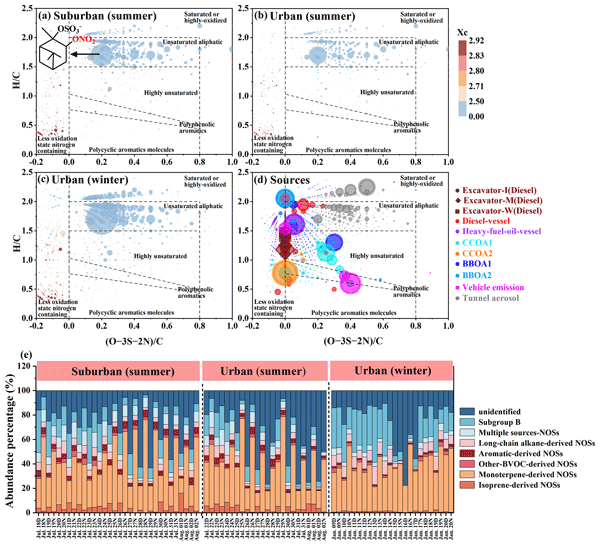
Abstract. Organosulfur compounds (OrgSs), especially organosulfates (OSs), are ubiquitous aerosol components. However, the spatial, seasonal, and diurnal variations of OrgS formation in polluted atmospheres remain poorly understood. Here, we monitored particulate OrgSs at an urban site and a suburban site in Shanghai and examined their molecular composition and formation pathways under contrasting atmospheric conditions. A total of 1964, 1914, and 2689 OrgS molecular formulas were detected in suburban summer, urban summer, and urban winter, respectively. More than 79 % of sulfur-containing molecular formulas had (4s + 3n)/o ≤ 1, indicating that OrgSs were dominated by OSs and nitrooxy-OSs (NOSs). Compared with summer, wintertime OrgSs exhibited lower O/C ratios but higher double-bond equivalence and aromaticity, suggesting a stronger influence of anthropogenic emissions and more unsaturated molecular structures. Although OrgSs were mostly present in aliphatic molecular structures, an increase in the number of aromatic OSs in winter revealed an enhanced contribution from anthropogenic sources. Isoprene/monoterpene-derived OSs peaked during the daytime due to photochemical oxidation in summer, whereas monoterpene-derived NOSs were markedly enhanced at night via nighttime NO3-initiated oxidation. Non-metric multidimensional scaling analysis further revealed that OrgS composition in summer was associated with temperature and O3 during the day but shifted toward RH-driven processing at night. In winter, inorganic nitrogen and sulfur species, aerosol liquid water content, and particle acidity became more important in shaping OrgS composition, suggesting enhanced aqueous-phase and acid-catalyzed formation. These findings provide molecular-level insights into the sources and formation of atmospheric OrgSs across contrasting environments.
-
Notice on discussion status
The requested preprint has a corresponding peer-reviewed final revised paper. You are encouraged to refer to the final revised version.
-
Preprint
(2914 KB)
-
Supplement
(1913 KB)
-
The requested preprint has a corresponding peer-reviewed final revised paper. You are encouraged to refer to the final revised version.
- Preprint
(2914 KB) - Metadata XML
-
Supplement
(1913 KB) - BibTeX
- EndNote
- Final revised paper


Journal article(s) based on this preprint
Interactive discussion
Status: closed
-
RC1: 'Comment on egusphere-2026-2472', Anonymous Referee #1, 05 Jun 2026
-
AC1: 'Reply on RC1', Xianda Gong, 28 Jul 2026
The comment was uploaded in the form of a supplement: https://egusphere.copernicus.org/preprints/2026/egusphere-2026-2472/egusphere-2026-2472-AC1-supplement.pdf
-
AC1: 'Reply on RC1', Xianda Gong, 28 Jul 2026
-
RC2: 'Comment on egusphere-2026-2472', Anonymous Referee #2, 05 Jun 2026
The authors present a detailed and valuable molecular-level study of atmospheric organosulfur compounds in Shanghai using UHPLC-Orbitrap MS. The combination of urban/suburban sampling, seasonal and diurnal contrasts, and non-target detection of thousands of CHOS and CHONS formulas provides useful insight into OrgS sources and formation pathways in a polluted megacity atmosphere. This broader molecular characterization distinguishes the present work from the authors’ earlier Shanghai organosulfur study (Cai et al., 2020).
Lines 321–324: The statement that Shanghai CHOS has a distinct molecular composition relative to other regions should be softened or clarified. Since the O/Cw values are reported to be comparable to those from the Pearl River Delta, the conclusion should be framed as differences from some regions rather than as a broadly distinct composition relative to all other regions. Table S3 also suggests that Shanghai agrees reasonably well with other cities in China, and that O/Cw values can vary substantially within a given study, such as Wang et al. (2017).
Line 414: Please elaborate on the basis for the tentative NOS determination. Were these assignments based on molecular formula constraints, MS/MS diagnostic fragments. How accurate is the determination, tentative makes me think its unsure, but maybe I missed it earlier in the ms.
Line 441: The word “proven” may be too strong. Consider using softer wording such as “attributed to,” “reported as,” or “consistent with. As you then go on to say there are potential other sources.
Line 478: The difference in multiple-source OS contribution to total CHOS intensity between suburban summer (22 ± 7.2%) and urban summer (23 ± 6.8%) appears small relative to the reported variability. Is this difference statistically significant?
Lines 649–652: Is Cl⁻ strongly correlated with marine tracers such as Na⁺ and Mg²⁺? This would help distinguish marine/sea-salt chloride from possible anthropogenic chloride sources. If the relevant ion data are available, a sea-salt/non-sea-salt chloride estimate or correlation analysis would strengthen this interpretation. (Keene et al., 1986)
Figures: Please ensure consistency in the use of “Figure” and “Fig.” throughout the manuscript.
Citation: https://doi.org/10.5194/egusphere-2026-2472-RC2 -
AC2: 'Reply on RC2', Xianda Gong, 28 Jul 2026
The comment was uploaded in the form of a supplement: https://egusphere.copernicus.org/preprints/2026/egusphere-2026-2472/egusphere-2026-2472-AC2-supplement.pdf
-
AC2: 'Reply on RC2', Xianda Gong, 28 Jul 2026
-
RC3: 'Comment on egusphere-2026-2472', Anonymous Referee #3, 05 Jun 2026
This manuscript presents a comprehensive molecular-level characterization of atmospheric organosulfur compounds (OrgSs) in Shanghai under contrasting urban/suburban and summer/winter conditions using UHPLC-Orbitrap MS. The dataset is extensive, and the comparison across different atmospheric environments provides valuable insights into the sources, composition, and potential formation pathways of organosulfur compounds. The study addresses an important topic in atmospheric chemistry and contributes to our understanding of anthropogenic-biogenic interactions in secondary organic aerosol formation.
Overall, the manuscript is well organized and contains a substantial amount of novel information. However, several interpretations appear to be stronger than what can be directly supported by the presented data, and some important uncertainties require further discussion. I believe the manuscript has the potential to be published after the following comments are carefully addressed.
- Influence of temperature-driven gas-particle partitioning on seasonal differences
The manuscript repeatedly emphasizes the substantially larger number of OrgS formulas detected in winter compared with summer. However, it remains unclear whether this difference reflects enhanced chemical production or simply stronger partitioning of semi-volatile and intermediate-volatility compounds into the particle phase under lower winter temperatures.
Since temperature strongly affects gas-particle partitioning, the authors should discuss this issue more explicitly. Without considering volatility effects, the conclusion that winter exhibits greater molecular diversity may be overinterpreted. Furthermore, to facilitate a more rigorous comparison, the authors are encouraged to supplement the formula count data with comparisons of OrgS signal intensity normalized to organic matter (OM) mass across seasons, which would help disentangle whether the observed differences reflect genuine compositional changes or merely loading effects.
- Volatility distribution should be considered
Related to Comment 1, it would be highly informative to classify the detected OrgSs according to volatility (e.g., LVOC, SVOC, and IVOC categories) or other volatility-related metrics. Comparing the relative abundance of compounds with different volatility characteristics across seasons would help distinguish between enhanced formation and enhanced condensation resulting from lower winter temperatures.
- Identification of OSs and NOSs based solely on elemental composition remains uncertain
The classification of OSs and NOSs is primarily based on the criterion (4S + 3N)/O ≤ 1. While this approach has been widely used, it remains an indirect assignment based on molecular formula.
The authors should better discuss the uncertainty associated with this classification and clearly indicate what fraction of the assigned compounds was independently supported by MS/MS fragmentation analysis.
- Interpretation of NMDS results should be more cautious
The NMDS analysis identifies associations between environmental variables and OrgS composition. However, several sections of the manuscript describe certain variables as “drivers” or controlling factors. For example, in Section 3.4 and the Conclusions, phrases such as “significant drivers” and “key parameter” are used in ways that imply causation.
Because NMDS is fundamentally a correlation-based approach, the results demonstrate associations rather than causal relationships. The language in these specific passages should be revised accordingly (e.g., replacing “driver” with “associated factor”), while the existing cautious terminology used elsewhere in the manuscript (e.g., “associated with,” “possible drivers”) is appropriate and should be maintained.
- Uncertainty in aerosol pH estimation requires further discussion
Aerosol pH was estimated without gaseous NH₃ measurements, and a uniform correction of one pH unit was applied.
Given the potentially large seasonal variation in NH₃ concentrations between summer and winter in Shanghai, applying a single correction value to both seasons may introduce systematic uncertainty. The authors should discuss the limitations of this approach and, if possible, provide a sensitivity analysis to assess the potential impact on the pH-dependent conclusions drawn in Section 3.4.
- Strong conclusions regarding formation mechanisms are not always fully supported
Several statements throughout the manuscript attribute observed patterns directly to specific formation pathways, in ways that go beyond what the observational evidence can demonstrate. The following examples are particularly notable: First, in Section 3.3 (lines 576-579), the daytime peak in isoprene/monoterpene-derived OSs is directly attributed to "•OH-initiated oxidation" driven by "enhanced biogenic emissions under high temperatures and intense solar radiation." While this interpretation is plausible, the study lacks direct measurements of •OH radical concentrations, BVOC emission fluxes, or OS production rates, and therefore the evidence is consistent with this mechanism rather than demonstrating it. Second, in Section 3.3 (lines 587-592), the higher wintertime abundance of monoterpene-derived OSs is attributed to heterogeneous reactions between SO₂ and monoterpene-derived SOA, based primarily on the observation that SO₂ levels were 1.6–1.8 times higher in winter. However, elevated SO₂ alone does not confirm this specific pathway, as other processes (e.g., enhanced aqueous-phase reactions, increased aerosol acidity, or changes in gas-particle partitioning) could equally account for the observed pattern. Third, in Section 3.4 (lines 712-718), the combination of elevated ALWC and lower aerosol pH is described as having "likely provided a favorable multiphase reaction environment" for OrgS formation in winter. While the NMDS analysis shows correlations between these variables and OrgS composition, the correlational nature of this analysis (see also Comment 6) means that the causal role of ALWC and pH cannot be established without additional mechanistic evidence. The authors are encouraged to revise these and similar statements to more clearly distinguish between observations that are consistent with a proposed mechanism and direct evidence demonstrating that mechanism. Phrases such as "our results are consistent with," "this pattern may reflect," or "we cannot exclude the possibility that" would more accurately represent the strength of the evidence.
Minor Comments
- The abstract states that the study “examined formation pathways”. Since the pathways are inferred rather than directly measured, wording such as “investigated potential formation pathways” may be more appropriate.
- Several statements attribute daytime maxima of specific compounds directly to photochemical oxidation. These interpretations should be expressed more cautiously unless supported by additional evidence.
Citation: https://doi.org/10.5194/egusphere-2026-2472-RC3 -
AC3: 'Reply on RC3', Xianda Gong, 28 Jul 2026
The comment was uploaded in the form of a supplement: https://egusphere.copernicus.org/preprints/2026/egusphere-2026-2472/egusphere-2026-2472-AC3-supplement.pdf
-
RC4: 'Comment on egusphere-2026-2472', Anonymous Referee #4, 08 Jun 2026
This study measured the molecular composition of organosulfur compounds in atmospheric PM2.5 samples at urban and suburban site in Shanghai by using UHPLC-Orbitrap MS, and then analyzed their sources and formation pathways under contrasting atmospheric conditions. The major conclusion was that the OrgS composition was mainly affected by temperature and O during daytime and by RH at night in summer, while in winter acid-catalyzed aqueous formation increased. Overall, the paper was well organized, and the results was of scientific significance in better understanding the sources and formation of OrgSs in the atmosphere. I have only some minor comments for authors’ consideration.
- Considering the sampling method, I preferred using “day-night variation” rather than “diurnal variation” in discussion.
- Line 267-270, what is your purpose for this sentence?
- Line 371-373, I noticed the DBE of CHONS was much higher than that of CHOS, it can’t be simply explain by nitrate functional group addition. More explanations should be provided.
- Line 523-526, does the (O-3S-2N)/C values also have day-night difference, which may support the conclusion of enhanced nighttime chemistry?
- Section 3.4, in Line 718-729, the authors concluded the “molecular composition of OrgSs in summer was primarily controlled by photochemical oxidation and humidity-driven heterogeneous processes…”. However, this conclusion was mainly inferred by NMDS2 results. NMDS1 dimension results should also summarized in conclusion, as well as in Abstract.
Citation: https://doi.org/10.5194/egusphere-2026-2472-RC4 -
AC4: 'Reply on RC4', Xianda Gong, 28 Jul 2026
The comment was uploaded in the form of a supplement: https://egusphere.copernicus.org/preprints/2026/egusphere-2026-2472/egusphere-2026-2472-AC4-supplement.pdf
Peer review completion


Interactive discussion
Status: closed
-
RC1: 'Comment on egusphere-2026-2472', Anonymous Referee #1, 05 Jun 2026
This study presents observation of atmospheric organosulfur compounds (OrgSs) based on PM2.5 samples collected at urban and suburban sites in Shanghai during summer and winter, using UHPLC-Orbitrap MS. The authors report a large number of OrgS molecular formulas and explore their spatiotemporal variability, potential precursors, and formation pathways. The results highlight that summer OrgS composition is predominantly driven by photochemical oxidation (O3, temperature), while winter OrgS formation is more influenced by aqueous-phase processing, aerosol liquid water content, acidity, and enhanced anthropogenic emissions. Overall, A revision is recommended for future publication.
My comments:
- Line 119, winter sampling was conducted only at the urban site, not at the suburban site. This sampling design cannot provide a full seasonal comparison across both urban and suburban environments and makes it difficult to compare seasonal differences.
- Line 170, ISORROPIA-II was run without gas-phase NH3 data, and a +1 pH correction was applied. The authors cite an average deviation of −0.97 pH units from a previous study (in Beijing), but they did not assess the uncertainty of this correction under Shanghai’s summer/winter conditions.
- The results are mainly relative abundances and intensity percentages, without concentrations (e.g., ng/m3) for OrgS. This issue makes it different to compare with other studies and model evaluations.
- The study used molecular formula assignments to infer precursor origins (e.g., biogenic vs. anthropogenic). How did they distinguish OrgSs from both sources (Line 345).
- Caption of Figure 6, are references Brüggemann et al., 2020 and Bruggemann et al., 2020 the same?
- The manuscript about orgS and SOA would benefit from citing the study Natl. Sci. Rev 2025;12:nwaf221.
- The manuscript uses both "Fig." and "Figure" in the main text.
Citation: https://doi.org/10.5194/egusphere-2026-2472-RC1 -
AC1: 'Reply on RC1', Xianda Gong, 28 Jul 2026
The comment was uploaded in the form of a supplement: https://egusphere.copernicus.org/preprints/2026/egusphere-2026-2472/egusphere-2026-2472-AC1-supplement.pdf
-
RC2: 'Comment on egusphere-2026-2472', Anonymous Referee #2, 05 Jun 2026
The authors present a detailed and valuable molecular-level study of atmospheric organosulfur compounds in Shanghai using UHPLC-Orbitrap MS. The combination of urban/suburban sampling, seasonal and diurnal contrasts, and non-target detection of thousands of CHOS and CHONS formulas provides useful insight into OrgS sources and formation pathways in a polluted megacity atmosphere. This broader molecular characterization distinguishes the present work from the authors’ earlier Shanghai organosulfur study (Cai et al., 2020).
Lines 321–324: The statement that Shanghai CHOS has a distinct molecular composition relative to other regions should be softened or clarified. Since the O/Cw values are reported to be comparable to those from the Pearl River Delta, the conclusion should be framed as differences from some regions rather than as a broadly distinct composition relative to all other regions. Table S3 also suggests that Shanghai agrees reasonably well with other cities in China, and that O/Cw values can vary substantially within a given study, such as Wang et al. (2017).
Line 414: Please elaborate on the basis for the tentative NOS determination. Were these assignments based on molecular formula constraints, MS/MS diagnostic fragments. How accurate is the determination, tentative makes me think its unsure, but maybe I missed it earlier in the ms.
Line 441: The word “proven” may be too strong. Consider using softer wording such as “attributed to,” “reported as,” or “consistent with. As you then go on to say there are potential other sources.
Line 478: The difference in multiple-source OS contribution to total CHOS intensity between suburban summer (22 ± 7.2%) and urban summer (23 ± 6.8%) appears small relative to the reported variability. Is this difference statistically significant?
Lines 649–652: Is Cl⁻ strongly correlated with marine tracers such as Na⁺ and Mg²⁺? This would help distinguish marine/sea-salt chloride from possible anthropogenic chloride sources. If the relevant ion data are available, a sea-salt/non-sea-salt chloride estimate or correlation analysis would strengthen this interpretation. (Keene et al., 1986)
Figures: Please ensure consistency in the use of “Figure” and “Fig.” throughout the manuscript.
Citation: https://doi.org/10.5194/egusphere-2026-2472-RC2 -
AC2: 'Reply on RC2', Xianda Gong, 28 Jul 2026
The comment was uploaded in the form of a supplement: https://egusphere.copernicus.org/preprints/2026/egusphere-2026-2472/egusphere-2026-2472-AC2-supplement.pdf
-
AC2: 'Reply on RC2', Xianda Gong, 28 Jul 2026
-
RC3: 'Comment on egusphere-2026-2472', Anonymous Referee #3, 05 Jun 2026
This manuscript presents a comprehensive molecular-level characterization of atmospheric organosulfur compounds (OrgSs) in Shanghai under contrasting urban/suburban and summer/winter conditions using UHPLC-Orbitrap MS. The dataset is extensive, and the comparison across different atmospheric environments provides valuable insights into the sources, composition, and potential formation pathways of organosulfur compounds. The study addresses an important topic in atmospheric chemistry and contributes to our understanding of anthropogenic-biogenic interactions in secondary organic aerosol formation.
Overall, the manuscript is well organized and contains a substantial amount of novel information. However, several interpretations appear to be stronger than what can be directly supported by the presented data, and some important uncertainties require further discussion. I believe the manuscript has the potential to be published after the following comments are carefully addressed.
- Influence of temperature-driven gas-particle partitioning on seasonal differences
The manuscript repeatedly emphasizes the substantially larger number of OrgS formulas detected in winter compared with summer. However, it remains unclear whether this difference reflects enhanced chemical production or simply stronger partitioning of semi-volatile and intermediate-volatility compounds into the particle phase under lower winter temperatures.
Since temperature strongly affects gas-particle partitioning, the authors should discuss this issue more explicitly. Without considering volatility effects, the conclusion that winter exhibits greater molecular diversity may be overinterpreted. Furthermore, to facilitate a more rigorous comparison, the authors are encouraged to supplement the formula count data with comparisons of OrgS signal intensity normalized to organic matter (OM) mass across seasons, which would help disentangle whether the observed differences reflect genuine compositional changes or merely loading effects.
- Volatility distribution should be considered
Related to Comment 1, it would be highly informative to classify the detected OrgSs according to volatility (e.g., LVOC, SVOC, and IVOC categories) or other volatility-related metrics. Comparing the relative abundance of compounds with different volatility characteristics across seasons would help distinguish between enhanced formation and enhanced condensation resulting from lower winter temperatures.
- Identification of OSs and NOSs based solely on elemental composition remains uncertain
The classification of OSs and NOSs is primarily based on the criterion (4S + 3N)/O ≤ 1. While this approach has been widely used, it remains an indirect assignment based on molecular formula.
The authors should better discuss the uncertainty associated with this classification and clearly indicate what fraction of the assigned compounds was independently supported by MS/MS fragmentation analysis.
- Interpretation of NMDS results should be more cautious
The NMDS analysis identifies associations between environmental variables and OrgS composition. However, several sections of the manuscript describe certain variables as “drivers” or controlling factors. For example, in Section 3.4 and the Conclusions, phrases such as “significant drivers” and “key parameter” are used in ways that imply causation.
Because NMDS is fundamentally a correlation-based approach, the results demonstrate associations rather than causal relationships. The language in these specific passages should be revised accordingly (e.g., replacing “driver” with “associated factor”), while the existing cautious terminology used elsewhere in the manuscript (e.g., “associated with,” “possible drivers”) is appropriate and should be maintained.
- Uncertainty in aerosol pH estimation requires further discussion
Aerosol pH was estimated without gaseous NH₃ measurements, and a uniform correction of one pH unit was applied.
Given the potentially large seasonal variation in NH₃ concentrations between summer and winter in Shanghai, applying a single correction value to both seasons may introduce systematic uncertainty. The authors should discuss the limitations of this approach and, if possible, provide a sensitivity analysis to assess the potential impact on the pH-dependent conclusions drawn in Section 3.4.
- Strong conclusions regarding formation mechanisms are not always fully supported
Several statements throughout the manuscript attribute observed patterns directly to specific formation pathways, in ways that go beyond what the observational evidence can demonstrate. The following examples are particularly notable: First, in Section 3.3 (lines 576-579), the daytime peak in isoprene/monoterpene-derived OSs is directly attributed to "•OH-initiated oxidation" driven by "enhanced biogenic emissions under high temperatures and intense solar radiation." While this interpretation is plausible, the study lacks direct measurements of •OH radical concentrations, BVOC emission fluxes, or OS production rates, and therefore the evidence is consistent with this mechanism rather than demonstrating it. Second, in Section 3.3 (lines 587-592), the higher wintertime abundance of monoterpene-derived OSs is attributed to heterogeneous reactions between SO₂ and monoterpene-derived SOA, based primarily on the observation that SO₂ levels were 1.6–1.8 times higher in winter. However, elevated SO₂ alone does not confirm this specific pathway, as other processes (e.g., enhanced aqueous-phase reactions, increased aerosol acidity, or changes in gas-particle partitioning) could equally account for the observed pattern. Third, in Section 3.4 (lines 712-718), the combination of elevated ALWC and lower aerosol pH is described as having "likely provided a favorable multiphase reaction environment" for OrgS formation in winter. While the NMDS analysis shows correlations between these variables and OrgS composition, the correlational nature of this analysis (see also Comment 6) means that the causal role of ALWC and pH cannot be established without additional mechanistic evidence. The authors are encouraged to revise these and similar statements to more clearly distinguish between observations that are consistent with a proposed mechanism and direct evidence demonstrating that mechanism. Phrases such as "our results are consistent with," "this pattern may reflect," or "we cannot exclude the possibility that" would more accurately represent the strength of the evidence.
Minor Comments
- The abstract states that the study “examined formation pathways”. Since the pathways are inferred rather than directly measured, wording such as “investigated potential formation pathways” may be more appropriate.
- Several statements attribute daytime maxima of specific compounds directly to photochemical oxidation. These interpretations should be expressed more cautiously unless supported by additional evidence.
Citation: https://doi.org/10.5194/egusphere-2026-2472-RC3 -
AC3: 'Reply on RC3', Xianda Gong, 28 Jul 2026
The comment was uploaded in the form of a supplement: https://egusphere.copernicus.org/preprints/2026/egusphere-2026-2472/egusphere-2026-2472-AC3-supplement.pdf
-
RC4: 'Comment on egusphere-2026-2472', Anonymous Referee #4, 08 Jun 2026
This study measured the molecular composition of organosulfur compounds in atmospheric PM2.5 samples at urban and suburban site in Shanghai by using UHPLC-Orbitrap MS, and then analyzed their sources and formation pathways under contrasting atmospheric conditions. The major conclusion was that the OrgS composition was mainly affected by temperature and O during daytime and by RH at night in summer, while in winter acid-catalyzed aqueous formation increased. Overall, the paper was well organized, and the results was of scientific significance in better understanding the sources and formation of OrgSs in the atmosphere. I have only some minor comments for authors’ consideration.
- Considering the sampling method, I preferred using “day-night variation” rather than “diurnal variation” in discussion.
- Line 267-270, what is your purpose for this sentence?
- Line 371-373, I noticed the DBE of CHONS was much higher than that of CHOS, it can’t be simply explain by nitrate functional group addition. More explanations should be provided.
- Line 523-526, does the (O-3S-2N)/C values also have day-night difference, which may support the conclusion of enhanced nighttime chemistry?
- Section 3.4, in Line 718-729, the authors concluded the “molecular composition of OrgSs in summer was primarily controlled by photochemical oxidation and humidity-driven heterogeneous processes…”. However, this conclusion was mainly inferred by NMDS2 results. NMDS1 dimension results should also summarized in conclusion, as well as in Abstract.
Citation: https://doi.org/10.5194/egusphere-2026-2472-RC4 -
AC4: 'Reply on RC4', Xianda Gong, 28 Jul 2026
The comment was uploaded in the form of a supplement: https://egusphere.copernicus.org/preprints/2026/egusphere-2026-2472/egusphere-2026-2472-AC4-supplement.pdf
Peer review completion
Journal article(s) based on this preprint
Viewed
| HTML | XML | Total | Supplement | BibTeX | EndNote | |
|---|---|---|---|---|---|---|
| 474 | 166 | 50 | 690 | 83 | 49 | 47 |
- HTML: 474
- PDF: 166
- XML: 50
- Total: 690
- Supplement: 83
- BibTeX: 49
- EndNote: 47
Viewed (geographical distribution)
| Country | # | Views | % |
|---|
| Total: | 0 |
| HTML: | 0 |
| PDF: | 0 |
| XML: | 0 |
- 1
Dongmei Cai

Ruiqi Zhang
Shenyan Zhang
Yuhan Cheng
Saidur Rahaman
Yin Fang
The requested preprint has a corresponding peer-reviewed final revised paper. You are encouraged to refer to the final revised version.
- Preprint
(2914 KB) - Metadata XML
-
Supplement
(1913 KB) - BibTeX
- EndNote
- Final revised paper
This study presents observation of atmospheric organosulfur compounds (OrgSs) based on PM2.5 samples collected at urban and suburban sites in Shanghai during summer and winter, using UHPLC-Orbitrap MS. The authors report a large number of OrgS molecular formulas and explore their spatiotemporal variability, potential precursors, and formation pathways. The results highlight that summer OrgS composition is predominantly driven by photochemical oxidation (O3, temperature), while winter OrgS formation is more influenced by aqueous-phase processing, aerosol liquid water content, acidity, and enhanced anthropogenic emissions. Overall, A revision is recommended for future publication.
My comments: