
the Creative Commons Attribution 4.0 License.
the Creative Commons Attribution 4.0 License.
 | 12 May 2026
Invited perspectives: Uncertainties in natural systems may be uncomfortable, but ignoring them would be absurd
Abstract. Uncertainties in natural systems are pervasive, varied, and unavoidable due to inherent open system complexity and limited knowledge. Therefore, the evolution of a natural system cannot be predicted deterministically and probabilistic forecasts are commonly used to account for these uncertainties. As the Voltaire-inspired title suggests, representing and quantifying all uncertainties in hazard and risk forecasting is difficult yet essential for an effective risk-cycle management and for a meaningful scientific evaluation of forecasting models. Although this paper focuses on hazard forecasting, we argue that the discussion and treatment of uncertainty apply equally to vulnerability and, therefore, to risk assessment. These challenges are reflected in the current absence of a common hierarchy of uncertainties, of a shared quantitative procedure to include all uncertainties in a forecast, and of effective communication and decision-making protocols, across different hazards and risks. Deepening the understanding of these distinct challenges has been the main goal of a dedicated task force of scientists from different disciplines, experts in communication, and decision-makers in the framework of a large Italian project on multirisk under NextGenEU funds – the RETURN project (https://www.fondazionereturn.it/en/) – which includes eighteen Italian universities and research centers, the Italian Civil Protection Department, Italian State Railways, Assicurazioni Generali, other profit entities, and one Italian River Basin Authority. Within this initiative, we examined several examples of natural hazard forecasting and projections, from the perspectives of experts in various fields and/or users of these forecasts. The task force found that different hazards share key features and challenges regarding uncertainty understanding, quantification and communication, which may be embedded in a common framework. Such a framework would include a similar hierarchy of uncertainties that defines a complete hazard forecast, which is essential to properly evaluate forecasting models. This work categorizes the common key scientific and communication challenges, propose potential solutions, and intend to stimulate a deeper reflection on these issues.
-
Notice on discussion status
The requested preprint has a corresponding peer-reviewed final revised paper. You are encouraged to refer to the final revised version.
-
Preprint
(2176 KB)
-
The requested preprint has a corresponding peer-reviewed final revised paper. You are encouraged to refer to the final revised version.
- Preprint
(2176 KB) - Metadata XML
- BibTeX
- EndNote
- Final revised paper


Journal article(s) based on this preprint
Interactive discussion
Status: closed
-
RC1: 'Comment on egusphere-2026-2254', Anonymous Referee #1, 21 Jun 2026
This paper focuses on characterizing uncertainty in hazard assessments/forecasting for natural systems. This "best-practices" paper suggests a common framework for understanding, quantifying and communicating hazard assessments and their attendant uncertainties. This paper is well-written and makes several excellent points, particularly relating to communicating uncertainty-quantified hazard assessment/forecast. That said, I believe the paper also has some blind spots that should be clarified or elaborated on.
- line 90: The description of type the mechanisms for how uncertainty is incorporated into determinist physics-based models is oversimplified. With the use of surrogates or ROMs, many probabilistic aleatory scenario models can be posited and used with the surrogate/ROMS to calculate the probability of hazard levels or exceedances.
- On the topic of physics-based models, there is no discussion in this paper of structural uncertainties. Even the best physics-based models (high-order, well-calibrated, etc.) are only an approximation to reality and often not reducible even with a concerted effort at minimizing epistemic uncertainties. This is perhaps the hardest kind of uncertainty to quantify, but it shouldn't go unmentioned. See Smith and Berger, 2019 10.1146/annurev-statistics-030718-105232
- Line 264-271. These sentences seem to contradict themselves. The processes are random. For a tephra fall out event we don't know when, the volume of material ejected, the hight of the ash cloud, the distribution of grain sizes, the wind speed/direction, etc. We model this aleatory variability of such random scenarios with a pdf. So I don't know what "Attempting to attribute aleatory ... character directly to the process -- rather than the model is problematic, since they coincide only if the model is true" means. Of course we don't know the "true" model of the process, that's why we posit epistemic uncertainty about the aleatoric model.
- Line 329-332. Related to 3, the sentence "Changing the experimental concept, i.e. changing the way we in which we collect the data that we want to describe, we change the aleatory variability" also does not make sense to me. Back to the tephra example, the randomness inherent. How do we have any power to change it? In both 3 and 4, perhaps you are trying to get at a more subtle point that needs further elucidation.
- It would be useful to spend some more time discussing high-impact tail events for hazards that may have sufficient data on small scales, little-to-no-data at a large scale. How does this framework handle such extrapolation or can we only rely on "expert opinion"?
- It would be nice if you discussed non-stationarity, particularly in the context of exceedance probabilities (over some time frame). If aleatory models are built on existing data sets and stationary assumptions, hazard forecasts could go wrong quickly. This is particularly true in the context of a warming planet that is changing the underlying physical processes that drive many oceanic and weather related hazards. Again, I'm not expecting you to "solve" this problem in your framework, but it is certainly worth discussing. This could perhaps be expanded into the Communication section as well -- what does a 100-year flood mean under such non-stationarity? How do we get a handle on that kind of epistemic uncertainty?
- Line 324: One last small point, you should reference a news article that contains this quote. Junior researchers may not be familiar with it and it would be good to point them toward that cultural reference.
Citation: https://doi.org/10.5194/egusphere-2026-2254-RC1 - AC1: 'Reply on RC1', Warner Marzocchi, 22 Jul 2026
-
RC2: 'Comment on egusphere-2026-2254', Francesca Pianosi, 10 Jul 2026
This is an interesting perspective article on understanding, quantifying and communicating uncertainties across hazard sectors. The paper is very relevant for the NHESS readership and particularly because of the focus on bringing different communities (earthquakes, floods, tsunamis, etc.) together and fostering best practice sharing. I found the section on communication challenges especially interesting and important - possibly because it is an area where I am less experienced/trained, but I suppose the same will be true for many NHESS readers!
This said, there are several points that I think the authors may consider in a revision to reinforce their paper, better place it in the context of previous literature, and make it more accessible to a variety of readers.
MAJOR POINTS
1) The manuscript is the outcome of a national project that brought together scientists and practitioners from different natural hazard/risk sectors. While this may have been the first attempt of this kind in Italy (has it?) there certainly have been similar efforts in other countries. For example, I am aware of a similar project in the UK, which resulted in two NHESS papers very relevant to this manuscript:
https://nhess.copernicus.org/articles/18/2741/2018/ - a review of the treatment of epistemic uncertainty in hazard assessment, covering floods, landslides, droughts, earthquakes, tsunamis, volcano eruptions, windstorms
https://nhess.copernicus.org/articles/18/2769/2018/ - a discussion of good practices in dealing with epistemic uncertainties across hazards
Some key messages from the two papers above seem to well align with those of this manuscript, for example on the importance of quantifying and communicating epistemic uncertainty per se, or the potential for defining common approaches across hazards. On other points, the authors’ views may diverge. Either way, it would be good to see some acknowledgement and discussion of this past work (also beyond the two papers linked above, if others can be found) so to better place this manuscript’s contribution in the context of previous literature.
2) The manuscript focuses on hazard, rather than risk assessment, but the authors claim that their work is “a crucial first step toward understanding uncertainties in risk forecasting as well” (L. 50). I think this is possibly oversimplifying a more complicated issue and may deserve a bit more nuance.
I am familiar with a thread of literature that has attempted at formally quantifying the relative importance of hazard, vulnerability and exposure uncertainties on risk assessment. These studies tend to consistently find that the impact of hazard uncertainty is dwarfed by uncertainty in vulnerability. See for examples De Moel et al 2014, Metin et al 2018, Pianosi et al 2026 for floods or Dawkins et al 2023 for heatwaves. Another example: I recently reviewed a paper for NHESS (Ruf et al 2026) presenting a new computationally efficient approach to improve simulation of dyke failures. A key motivation for that work was to enable uncertainty-aware evaluation of the benefits of flood mitigation measures. However (and quite ironically!) the sensitivity analysis enabled by the new hazard model showed that, at least in the paper’s case study, risk metrics were completely controlled by uncertainty in flood damage estimation and essentially insensitive to uncertainty in hazard - including uncertain assumptions about dyke breaches!
This is not to say that improving hazard assessment is not important – good quality hazard models are essential for a range of uses, from early-warning to emergency management to improving understanding of physical impacts of different infrastructure or land use decisions, etc. However, if hazard models are used to feed into larger risk assessment modelling chain, and decision-makers are only interested in summary output metrics (e.g. cost-benefit ratio of different mitigation measures; or annual average loss from a given hazard, etc.) then sensitivity analysis literature has shown us that aggregate outputs are typically controlled by a limited number of uncertainty sources (e.g. Wagener and Pianosi 2019), and in the field of natural risk assessment these dominant controls are likely to be in the vulnerability/exposure component rather than the hazard one.
I do not expect this manuscript to go deep into this discussion as the focus here is hazard assessment, however I think the authors should at least mention how moving from hazard to risk opens up a range of other issues due to even bigger uncertainties in vulnerability/exposure, and that the transition from analysing uncertainty in hazard to uncertainty in risk is more complex than somehow suggested by the manuscript in its present form.
3) On the subjective view of probabilities, particularly Lines 260-264: “Although scientists often prefer the frequentist framework … testing against data becomes meaningless”: this is discussion very interesting although I am not sure I completely follow the argument here. I do not think that the ‘subjective approach’ necessarily implies that “testing models against data … becomes useless”. I tend to embrace the subjective view of probability, as described here:
https://environment.blogs.bristol.ac.uk/2017/03/20/what-is-probability/
whereby “probabilities … represent a consensus of well-informed people” (and, of course, satisfying Kolmogorov axioms). I do not think this implies discarding the role of testing against data, indeed success (or better, lack of failure) in goodness-of-fit tests is one of the key pieces of ‘evidence’ by which well-informed people will build their consensus on probabilities. This point could be clarified? Also note that Lindley 2000 cited on line 264 does not that seem to be included in the reference list!
4) I found the description of the unified framework by Marzocchi and Jordan (pages 12-13) not always easy to follow. I think this section would benefit from some more practical examples of how different concepts (“experimental concept”, “explanatory variables”, etc.) would be applied/interpreted in different contexts, including those (floods & droughts, extreme weather) where the approach has not been applied so far. This would be a very valuable addition to help bridge gaps between communities and share best practice.
Similarly on page 15, the discussion of reliability, calibration, and consistency (L. 366-379) is very abstract and would probably benefit from few concrete examples. For example, the difference between consistency and calibration test is not clear to me (maybe because I am from one of those communities where “calibration” is “the process of estimating parameters”!) and the description in the glossary and Figure 6 are not sufficient! Again, a few application examples across different hazards would probably be very useful here.
5) Lines 412: “Needless to say, the least desirable situation is having few or no data” and Lines 423: “… consensus could also be understood as acceptance of procedures and models, not necessarily as agreement on their results (i.e. similarity)”
For hazards such as floods and droughts, this situation where observations are scarce, completely missing, or of very poor quality (i.e. potentially affected by errors of the same magnitude as the observations themselves) is extremely common! This is why this community has developed very comprehensive approaches to “model validation” including many that focus on “acceptance of procedures and models” rather than fit-to-data. There is a very good discussion of this topic for example in Mertz et al 2024, including the distinction between “outcome-based” and “process-based” validation/evaluation approaches. Again, a more comprehensive discussion and linking to previous literature would be good here!References:
De Moel et al 2014: https://doi.org/10.5194/nhess-18- 3089-2018
Metin et al 2018: https://doi.org/10.1016/j.scitotenv.2013.12.015
Wagener and Pianosi 2019: https://doi.org/10.1016/j.earscirev.2019.04.006
Pianosi et al 2026: https://doi.org/10.5194/nhess-26-1727-2026
Dawkins et al 2023: https://doi.org/10.1016/j.crm.2023.100511
Ruf et al 2026: https://doi.org/10.5194/egusphere-2025-4875
Mertz et al 2024: https://doi.org/10.5194/nhess-24-4015-2024MINOR POINTS
L. 15: “These challenges” unclear what this refers to (which challenges?)
L. 49: “across a range of natural hazards – including floods, earthquakes, volcanic phenomena, landslides, climate projections”
I am not sure I would include climate projections in this list. The ‘key’ source of uncertainty in climate projections is uncertainty in the evolution of input forcings (carbon emissions, population growth/decline, technology development) over long-term future. This type of uncertainty is fundamentally irreducible (we do not know how the world will look like in 50 or even 100 years from now and will not be able to test our guesses against observations!) and so should probably be kept distinct ‘epistemic’ uncertainty which, at least in principle, could be reduced with more investigation, experiments, etc.L. 72: “its limited knowledge” maybe should be “our limited knowledge”
Figure 1: I wonder if the “context” box in this Figure should include a larger set of “model uses”. For example, where would insurers (such as Assicurazioni Generali) sit? Is their way of using models captured by the three points currently listed?
L. 173: “In many other forecasts” maybe should be “in many other sectors”
Citation: https://doi.org/10.5194/egusphere-2026-2254-RC2 - AC2: 'Reply on RC2', Warner Marzocchi, 22 Jul 2026
-
AC3: 'Reply on RC2', Warner Marzocchi, 22 Jul 2026
Publisher’s note: this comment is a copy of AC2 and its content was therefore removed on 24 July 2026.
Citation: https://doi.org/10.5194/egusphere-2026-2254-AC3
Peer review completion


Interactive discussion
Status: closed
-
RC1: 'Comment on egusphere-2026-2254', Anonymous Referee #1, 21 Jun 2026
This paper focuses on characterizing uncertainty in hazard assessments/forecasting for natural systems. This "best-practices" paper suggests a common framework for understanding, quantifying and communicating hazard assessments and their attendant uncertainties. This paper is well-written and makes several excellent points, particularly relating to communicating uncertainty-quantified hazard assessment/forecast. That said, I believe the paper also has some blind spots that should be clarified or elaborated on.
- line 90: The description of type the mechanisms for how uncertainty is incorporated into determinist physics-based models is oversimplified. With the use of surrogates or ROMs, many probabilistic aleatory scenario models can be posited and used with the surrogate/ROMS to calculate the probability of hazard levels or exceedances.
- On the topic of physics-based models, there is no discussion in this paper of structural uncertainties. Even the best physics-based models (high-order, well-calibrated, etc.) are only an approximation to reality and often not reducible even with a concerted effort at minimizing epistemic uncertainties. This is perhaps the hardest kind of uncertainty to quantify, but it shouldn't go unmentioned. See Smith and Berger, 2019 10.1146/annurev-statistics-030718-105232
- Line 264-271. These sentences seem to contradict themselves. The processes are random. For a tephra fall out event we don't know when, the volume of material ejected, the hight of the ash cloud, the distribution of grain sizes, the wind speed/direction, etc. We model this aleatory variability of such random scenarios with a pdf. So I don't know what "Attempting to attribute aleatory ... character directly to the process -- rather than the model is problematic, since they coincide only if the model is true" means. Of course we don't know the "true" model of the process, that's why we posit epistemic uncertainty about the aleatoric model.
- Line 329-332. Related to 3, the sentence "Changing the experimental concept, i.e. changing the way we in which we collect the data that we want to describe, we change the aleatory variability" also does not make sense to me. Back to the tephra example, the randomness inherent. How do we have any power to change it? In both 3 and 4, perhaps you are trying to get at a more subtle point that needs further elucidation.
- It would be useful to spend some more time discussing high-impact tail events for hazards that may have sufficient data on small scales, little-to-no-data at a large scale. How does this framework handle such extrapolation or can we only rely on "expert opinion"?
- It would be nice if you discussed non-stationarity, particularly in the context of exceedance probabilities (over some time frame). If aleatory models are built on existing data sets and stationary assumptions, hazard forecasts could go wrong quickly. This is particularly true in the context of a warming planet that is changing the underlying physical processes that drive many oceanic and weather related hazards. Again, I'm not expecting you to "solve" this problem in your framework, but it is certainly worth discussing. This could perhaps be expanded into the Communication section as well -- what does a 100-year flood mean under such non-stationarity? How do we get a handle on that kind of epistemic uncertainty?
- Line 324: One last small point, you should reference a news article that contains this quote. Junior researchers may not be familiar with it and it would be good to point them toward that cultural reference.
Citation: https://doi.org/10.5194/egusphere-2026-2254-RC1 - AC1: 'Reply on RC1', Warner Marzocchi, 22 Jul 2026
-
RC2: 'Comment on egusphere-2026-2254', Francesca Pianosi, 10 Jul 2026
This is an interesting perspective article on understanding, quantifying and communicating uncertainties across hazard sectors. The paper is very relevant for the NHESS readership and particularly because of the focus on bringing different communities (earthquakes, floods, tsunamis, etc.) together and fostering best practice sharing. I found the section on communication challenges especially interesting and important - possibly because it is an area where I am less experienced/trained, but I suppose the same will be true for many NHESS readers!
This said, there are several points that I think the authors may consider in a revision to reinforce their paper, better place it in the context of previous literature, and make it more accessible to a variety of readers.
MAJOR POINTS
1) The manuscript is the outcome of a national project that brought together scientists and practitioners from different natural hazard/risk sectors. While this may have been the first attempt of this kind in Italy (has it?) there certainly have been similar efforts in other countries. For example, I am aware of a similar project in the UK, which resulted in two NHESS papers very relevant to this manuscript:
https://nhess.copernicus.org/articles/18/2741/2018/ - a review of the treatment of epistemic uncertainty in hazard assessment, covering floods, landslides, droughts, earthquakes, tsunamis, volcano eruptions, windstorms
https://nhess.copernicus.org/articles/18/2769/2018/ - a discussion of good practices in dealing with epistemic uncertainties across hazards
Some key messages from the two papers above seem to well align with those of this manuscript, for example on the importance of quantifying and communicating epistemic uncertainty per se, or the potential for defining common approaches across hazards. On other points, the authors’ views may diverge. Either way, it would be good to see some acknowledgement and discussion of this past work (also beyond the two papers linked above, if others can be found) so to better place this manuscript’s contribution in the context of previous literature.
2) The manuscript focuses on hazard, rather than risk assessment, but the authors claim that their work is “a crucial first step toward understanding uncertainties in risk forecasting as well” (L. 50). I think this is possibly oversimplifying a more complicated issue and may deserve a bit more nuance.
I am familiar with a thread of literature that has attempted at formally quantifying the relative importance of hazard, vulnerability and exposure uncertainties on risk assessment. These studies tend to consistently find that the impact of hazard uncertainty is dwarfed by uncertainty in vulnerability. See for examples De Moel et al 2014, Metin et al 2018, Pianosi et al 2026 for floods or Dawkins et al 2023 for heatwaves. Another example: I recently reviewed a paper for NHESS (Ruf et al 2026) presenting a new computationally efficient approach to improve simulation of dyke failures. A key motivation for that work was to enable uncertainty-aware evaluation of the benefits of flood mitigation measures. However (and quite ironically!) the sensitivity analysis enabled by the new hazard model showed that, at least in the paper’s case study, risk metrics were completely controlled by uncertainty in flood damage estimation and essentially insensitive to uncertainty in hazard - including uncertain assumptions about dyke breaches!
This is not to say that improving hazard assessment is not important – good quality hazard models are essential for a range of uses, from early-warning to emergency management to improving understanding of physical impacts of different infrastructure or land use decisions, etc. However, if hazard models are used to feed into larger risk assessment modelling chain, and decision-makers are only interested in summary output metrics (e.g. cost-benefit ratio of different mitigation measures; or annual average loss from a given hazard, etc.) then sensitivity analysis literature has shown us that aggregate outputs are typically controlled by a limited number of uncertainty sources (e.g. Wagener and Pianosi 2019), and in the field of natural risk assessment these dominant controls are likely to be in the vulnerability/exposure component rather than the hazard one.
I do not expect this manuscript to go deep into this discussion as the focus here is hazard assessment, however I think the authors should at least mention how moving from hazard to risk opens up a range of other issues due to even bigger uncertainties in vulnerability/exposure, and that the transition from analysing uncertainty in hazard to uncertainty in risk is more complex than somehow suggested by the manuscript in its present form.
3) On the subjective view of probabilities, particularly Lines 260-264: “Although scientists often prefer the frequentist framework … testing against data becomes meaningless”: this is discussion very interesting although I am not sure I completely follow the argument here. I do not think that the ‘subjective approach’ necessarily implies that “testing models against data … becomes useless”. I tend to embrace the subjective view of probability, as described here:
https://environment.blogs.bristol.ac.uk/2017/03/20/what-is-probability/
whereby “probabilities … represent a consensus of well-informed people” (and, of course, satisfying Kolmogorov axioms). I do not think this implies discarding the role of testing against data, indeed success (or better, lack of failure) in goodness-of-fit tests is one of the key pieces of ‘evidence’ by which well-informed people will build their consensus on probabilities. This point could be clarified? Also note that Lindley 2000 cited on line 264 does not that seem to be included in the reference list!
4) I found the description of the unified framework by Marzocchi and Jordan (pages 12-13) not always easy to follow. I think this section would benefit from some more practical examples of how different concepts (“experimental concept”, “explanatory variables”, etc.) would be applied/interpreted in different contexts, including those (floods & droughts, extreme weather) where the approach has not been applied so far. This would be a very valuable addition to help bridge gaps between communities and share best practice.
Similarly on page 15, the discussion of reliability, calibration, and consistency (L. 366-379) is very abstract and would probably benefit from few concrete examples. For example, the difference between consistency and calibration test is not clear to me (maybe because I am from one of those communities where “calibration” is “the process of estimating parameters”!) and the description in the glossary and Figure 6 are not sufficient! Again, a few application examples across different hazards would probably be very useful here.
5) Lines 412: “Needless to say, the least desirable situation is having few or no data” and Lines 423: “… consensus could also be understood as acceptance of procedures and models, not necessarily as agreement on their results (i.e. similarity)”
For hazards such as floods and droughts, this situation where observations are scarce, completely missing, or of very poor quality (i.e. potentially affected by errors of the same magnitude as the observations themselves) is extremely common! This is why this community has developed very comprehensive approaches to “model validation” including many that focus on “acceptance of procedures and models” rather than fit-to-data. There is a very good discussion of this topic for example in Mertz et al 2024, including the distinction between “outcome-based” and “process-based” validation/evaluation approaches. Again, a more comprehensive discussion and linking to previous literature would be good here!References:
De Moel et al 2014: https://doi.org/10.5194/nhess-18- 3089-2018
Metin et al 2018: https://doi.org/10.1016/j.scitotenv.2013.12.015
Wagener and Pianosi 2019: https://doi.org/10.1016/j.earscirev.2019.04.006
Pianosi et al 2026: https://doi.org/10.5194/nhess-26-1727-2026
Dawkins et al 2023: https://doi.org/10.1016/j.crm.2023.100511
Ruf et al 2026: https://doi.org/10.5194/egusphere-2025-4875
Mertz et al 2024: https://doi.org/10.5194/nhess-24-4015-2024MINOR POINTS
L. 15: “These challenges” unclear what this refers to (which challenges?)
L. 49: “across a range of natural hazards – including floods, earthquakes, volcanic phenomena, landslides, climate projections”
I am not sure I would include climate projections in this list. The ‘key’ source of uncertainty in climate projections is uncertainty in the evolution of input forcings (carbon emissions, population growth/decline, technology development) over long-term future. This type of uncertainty is fundamentally irreducible (we do not know how the world will look like in 50 or even 100 years from now and will not be able to test our guesses against observations!) and so should probably be kept distinct ‘epistemic’ uncertainty which, at least in principle, could be reduced with more investigation, experiments, etc.L. 72: “its limited knowledge” maybe should be “our limited knowledge”
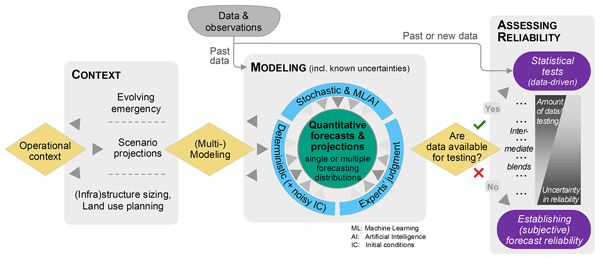
Figure 1: I wonder if the “context” box in this Figure should include a larger set of “model uses”. For example, where would insurers (such as Assicurazioni Generali) sit? Is their way of using models captured by the three points currently listed?
L. 173: “In many other forecasts” maybe should be “in many other sectors”
Citation: https://doi.org/10.5194/egusphere-2026-2254-RC2 - AC2: 'Reply on RC2', Warner Marzocchi, 22 Jul 2026
-
AC3: 'Reply on RC2', Warner Marzocchi, 22 Jul 2026
Publisher’s note: this comment is a copy of AC2 and its content was therefore removed on 24 July 2026.
Citation: https://doi.org/10.5194/egusphere-2026-2254-AC3
Peer review completion
Journal article(s) based on this preprint
Viewed
| HTML | XML | Total | BibTeX | EndNote | |
|---|---|---|---|---|---|
| 338 | 148 | 45 | 531 | 37 | 37 |
- HTML: 338
- PDF: 148
- XML: 45
- Total: 531
- BibTeX: 37
- EndNote: 37
Viewed (geographical distribution)
| Country | # | Views | % |
|---|
| Total: | 0 |
| HTML: | 0 |
| PDF: | 0 |
| XML: | 0 |
- 1
Warner Marzocchi

Alberto Montanari
The requested preprint has a corresponding peer-reviewed final revised paper. You are encouraged to refer to the final revised version.
- Preprint
(2176 KB) - Metadata XML