
the Creative Commons Attribution 4.0 License.
the Creative Commons Attribution 4.0 License.
 | 09 Feb 2026
Estuarine Mixing Drives Organic Nitrogen Transformation and Bioavailability Dynamics
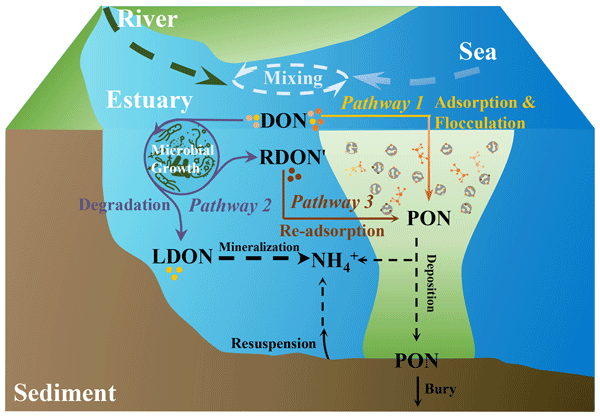
Abstract. Estuaries act as critical transition zones for nitrogen transport, where the dynamics of inorganic nitrogen has been extensively studied. In contrast, organic nitrogen (ON), encompassing particulate organic nitrogen (PON) and dissolved organic nitrogen (DON), is strongly influenced by estuarine mixing of freshwater and seawater. However, the mechanisms driving ON transformation and their implications for bioavailability remain poorly understood. Here, estuarine mixing experiments are conducted across salinity gradients to explore ON transformation and changes in nitrogen bioavailability driven by physicochemical and biological processes. Using tangential flow filtration, optical signatures, and stable isotopes (δ¹³C, δ¹⁵N), we quantified ON composition and molecular characteristics. DON dominated the ON pool (> 71 %) throughout the mixing process, with the low-molecular-weight (LMW) fraction accounting for 49 ± 7.8 %. Salt-induced flocculation and adsorption (i.e. physicochemical processes) preferentially transferred a large fraction (63 ± 11 %) of humic-like components, mainly terrestrial refractory compounds, into the particulate phase, thereby increasing PON. Meanwhile, biological activity promoted the degradation of residual humic-like components (especially microbial C3), producing labile LMW-DON and ammonium. This conversion was evidenced by a strong negative correlation between humic-like and protein-like components in control treatments. The isotopic enrichment (δ¹³C, δ¹⁵N) and elevated C/N ratios in PON further suggested the re-adsorption of biologically-modified and δ¹⁵N-enriched DON onto particles, enhancing PON refractoriness. Overall, estuarine mixing drives conversion of humic-like ON into refractory particulate forms, while simultaneously enhancing the bioavailability of the residual dissolved nitrogen pool, thereby influencing nitrogen cycling and eutrophication risks at the river-sea interface.
-
Notice on discussion status
The requested preprint has a corresponding peer-reviewed final revised paper. You are encouraged to refer to the final revised version.
-
Preprint
(2500 KB)
-
Supplement
(1269 KB)
-
The requested preprint has a corresponding peer-reviewed final revised paper. You are encouraged to refer to the final revised version.
- Preprint
(2500 KB) - Metadata XML
-
Supplement
(1269 KB) - BibTeX
- EndNote
- Final revised paper


Journal article(s) based on this preprint
Interactive discussion
Status: closed
-
CC1: 'Comment on egusphere-2026-216', Xuegang Li, 12 Feb 2026
-
AC4: 'Reply on CC1', Chenglong Han, 13 May 2026
We sincerely thank the reviewer for the positive evaluation and encouraging comments on the significance, experimental design, and data quality of our study. All six specific comments have been carefully addressed; detailed point-by-point responses with revised text are provided in the Supplement. Below we summarize the major revisions.
- Contextualizing the significance of estuarine organic nitrogen. Quantitative global estimates of riverine nitrogen export (36–60 Tg N yr⁻¹ total; ~11.8 Tg N yr⁻¹ as DON) and recent modeling evidence for a 50.6% increase in DON export over the past century have been added to the Introduction to better highlight the importance of estuarine ON dynamics (Q1).
- Clarifying the temporal scope of the study. We acknowledge that the 3-day incubation captures rapid flocculation, adsorption, and initial microbial transformation but cannot directly verify long-term nitrogen sequestration. Related statements in Sections 4.3, 4.4, and 4.5 have been softened, and this limitation is now explicitly noted (Q2).
- Addressing the role of phytoplankton DIN assimilation in PON isotope enrichment. The reviewer correctly noted that DIN assimilation involves isotopic fractionation. However, because phytoplankton preferentially incorporate ¹⁴N, newly produced PON carries relatively low δ¹⁵N values, which would tend to decrease rather than increase bulk δ¹⁵N-PON. The observed positive δ¹⁵N deviation in the BAM treatments therefore indicates that the selective re-adsorption of microbially modified, ¹⁵N-enriched refractory DON (RDON′) dominated the isotopic budget, outweighing the opposing light-isotope input from phytoplankton production. Section 4.3 has been revised to explicitly incorporate this reasoning (Q3).
- Defining the "enhanced" nitrogen pump. The revised figure caption and text now clarify that "enhanced" refers to the mechanistic expansion of the classical physicochemical nitrogen pump by incorporating microbial transformation pathways — specifically, the coupling of microbial DON modification with RDON′ re-adsorption that promotes refractory PON accumulation (Q4).
- Statistical rigor. The Statistical Analysis section now specifies that data normality was assessed using the Shapiro–Wilk test and variance homogeneity using Levene's test prior to one-way ANOVA (Q5). All grammatical and formatting errors have been corrected (Q6).
We believe these revisions have strengthened the manuscript. A point-by-point response to each specific comment is provided in the Supplement.
-
AC4: 'Reply on CC1', Chenglong Han, 13 May 2026
-
RC1: 'Comment on egusphere-2026-216', Xiaosong Zhong, 10 Apr 2026
This manuscript addresses an important and timely topic: how estuarine mixing reshapes the partitioning, composition, and potential bioavailability of organic nitrogen. The distinction among PON, CON, and tDON is meaningful, and the comparison between biologically active mixing (BAM) and biologically inhibited mixing (BIM) is a potentially strong feature of the study. The analytical framework is also relatively comprehensive, combining TFF-based fractionation, fluorescence signatures, FTIR, stable isotopes, and ancillary particle and enzyme measurements. Overall, the study has clear potential and is built on a potentially publishable dataset.
Specific Comments
- The central message should be sharpened.At present, the manuscript tries to emphasize too many things at once: ON partitioning, DON bioavailability, PON refractoriness, nitrogen sequestration, eutrophication risk, and a broadly generalized estuarine framework. This weakens the paper’s main contribution. In my view, the strongest and most defensible message is that estuarine mixing generates a dual response: humic-like ON is preferentially transferred into particulate/refractory pools through adsorption and flocculation, while biological processing simultaneously alters the residual dissolved pool toward a more potentially labile composition. I encourage the authors to reorganize the abstract, discussion, and conclusions around this narrower and clearer core advance.
- The manuscript interprets increasing protein-like fluorescence, higher FI and BIX, lower SUVA254, and NH4+ accumulation as evidence for enhanced DON bioavailability. These are useful and suggestive indicators, but they remain indirect proxies. The study does not include direct DON bioassays, uptake experiments, or response experiments demonstrating that the transformed dissolved nitrogen pool is more readily used by microbes or phytoplankton. Therefore, I suggest that the manuscript consistently distinguish between demonstrated transformation and inferred increases in potential bioavailability.
- L84 provides coordinates for the riverine and marine endmembers and notes that the seawater site was located approximately 40 km downstream of the river mouth, but there is no figure showing the sampling region, the river mouth, and the relative positions of the two endmembers. A map is a basic but important element for a study of this type. It would help readers assess the geographic setting, the representativeness of the chosen endmembers, and the realism of the experimental river–sea mixing framework. I strongly recommend adding a location figure.
- L92-93 states that river water and seawater were mixed at 10:0, 8:2, 6:4, 5:5, 4:6, 2:8, and 0:10, but the manuscript does not explain why these particular ratios were selected. Were they chosen to represent specific salinity zones in the estuary, to match field observations, or simply to generate a broad mixing gradient? This matters because the interpretation of non-conservative behavior may depend on how well the critical salinity range is resolved. The authors should provide a clear rationale for this design choice.
- Figure 4 presents direct experimental observations, including FI, SUVA254, BIX, FTIR, POC, and C/N changes along the salinity gradient. They are primary results. Moving Figure 4 to the Results would also improve the structure of the paper.
- The manuscript ends by linking its findings to coastal eutrophication risk and bloom development. This is a reasonable broader implication, but it extends beyond what is directly shown in a short-term controlled mixing experiment based on one summer sampling event. The transformed ON pool may indeed have ecological implications, but the paper does not directly demonstrate downstream biological responses in the receiving coastal system. I recommend framing this as a likely implication or testable hypothesis, not as an outcome already established by the present study.
Technical Corrections
- L87 “dissolved oxygen (DO) were measured in Table S1”
- L171-172 “While in the BAM treatments” it should almost certainly refer to BIM?
- There is an apparent inconsistency regarding Figure 4d: the figure caption says FTIR is shown for BAM only, whereas the Discussion interprets the FTIR trends as occurring in the BIM.
- Supplement
(1) Text S1the TFF cleaning protocol appears to omit the concentrations for NaOH and HCl (“mol L-1 NaOH” and “mol L-1 HCl”)
(2) “Pdl” should presumably be “PdI,” and “Phl” also appears to be a typo or mislabeled parameter. Please check both the text and the figure labeling.
(3) The supplement still contains typographical errors such as “doenotes” in the Figure S8 caption.
(4) Table S1 “Sampling data” should be “Sampling date.”
(5) Table S2 in the supplement incorrectly refers to “truly dissolved organic carbon (tDON)” and should be corrected to nitrogen.
Citation: https://doi.org/10.5194/egusphere-2026-216-RC1 -
AC1: 'Reply on RC1', Chenglong Han, 13 May 2026
We sincerely thank the reviewer for the thorough and constructive evaluation of our manuscript. The reviewer's comments have been instrumental in improving the clarity, focus, and scientific rigor of the work. Below we summarize the main revisions made in response to the reviewer's comments; detailed point-by-point responses with specific revised text are provided in the Supplement.
- Central message and manuscript structure. Following the reviewer's suggestion, we have reorganized the Abstract, Discussion (Section 4.4), and Conclusions around a clearer and narrower core message: estuarine mixing generates a dual response in which physicochemical processes preferentially channel humic-like ON into refractory particulate pools, while biological processing simultaneously shifts the residual dissolved pool toward a more potentially labile composition. Broader implications (e.g., nitrogen sequestration, eutrophication risk) are now framed as downstream consequences rather than co-equal central themes (Q1, Q6).
- Distinguishing transformation from bioavailability. We have consistently distinguished between demonstrated compositional transformation and inferred potential bioavailability throughout the revised manuscript, and we have added an explicit limitation noting that direct DON bioassays are needed to confirm biological utilization of the transformed DON pool (Q2).
- Methodological clarity. A location map (new Figure S1) has been added to show the sampling region and endmember positions (Q3). The rationale for the selected mixing ratios has been clarified with supporting references (Q4). Figure 4 (now renumbered as Figure 3) has been moved from the Discussion to the Results section, with descriptive text redistributed accordingly (Q5).
- Technical corrections. All typographical errors, labeling inconsistencies, and unit omissions identified in the main text and Supplementary Information have been corrected (Q7–Q10).
We believe these revisions have substantially strengthened the manuscript and adequately addressed all of the reviewer's concerns. A detailed point-by-point response is provided in the Supplement.
-
RC2: 'Comment on egusphere-2026-216', Shengwei Cao, 14 Apr 2026
General comments
This manuscript investigates organic nitrogen transformation and bioavailability during estuarine mixing using a dual-treatment design (BAM vs. BIM) to separate biological from physicochemical processes. The topic is relevant to BG's scope, and the experimental approach — combining tangential flow filtration, EEM-PARAFAC, stable isotopes, FTIR, and enzyme assays — is comprehensive. The three-pathway conceptual model and the "enhanced nitrogen pump" framework are valuable contributions.
Scientific significance: The BAM/BIM design effectively isolates biological and physicochemical contributions to ON fate, which is difficult to achieve in field studies. The global estuarine ON synthesis (Fig. 5, Table S4) adds breadth.
Scientific quality: The analytical methods are sound, but several issues in data interpretation weaken key arguments — notably an apparent inconsistency between the FTIR description and figure caption (Line 257–258), a questionable zeta potential argument (Line 189–192), and insufficient support for the claimed humic-to-protein transformation pathway (Line 260–275).
Presentation quality: Generally well-organized, but inconsistent abbreviations, ambiguous method descriptions, and a disproportionately long limitations section reduce clarity. The Conclusions section lacks focus.
Specific Comments
Lines 119–122: The description of Zetasizer measurements immediately follows FTIR analysis of freeze-dried DON, making it unclear what matrix was actually measured for particle size and zeta potential. The measurement target should be specified.
Lines 142–143: The statement that declining CON and tDON concentrations cause the DON/ON ratio to decrease is logically incomplete — the ratio also depends on concurrent PON changes.
Lines 189–192: The claim that negative zeta potentials (ζ < 0) promote DON adsorption onto SPM is inconsistent with colloidal chemistry, where strongly negative ζ indicates greater electrostatic repulsion and colloidal stability. The roles of surface adsorption and colloidal destabilization/flocculation need to be distinguished.
Lines 257–258: FTIR evidence is attributed to the BIM treatments, but the Fig. 4d caption states these spectra are from BAM only. This contradiction undermines a key argument in Section 4.2.
Lines 260–275: The strong negative correlation between C2 and (C1+C3) does not establish that humic-like components are directly transformed into protein-like components. Alternative explanations (e.g., de novo microbial production of C2) could be considered.
Text S1 describes a two-step TFF (10 kDa + 1 kDa) yielding three size fractions, but only two are reported. The rationale for merging the >10 kDa and 1–10 kDa fractions is not explained.
Section 4.5 (Limitations) is disproportionately long and risks overshadowing the study's strengths. The Conclusions section partly repeats the Discussion and could be more concise and quantitative.
Technical Corrections
Line 30: "where critically mediate" — missing subject.
Line 95–96: "to inhibited" — should be "to inhibit."
Line 127 and Fig. S2 caption: "Phl" — should be "PdI."
Line 188: "are govern by" — should be "are governed by."
Line 309: "This study highlight" — should be "highlights."
Line 351: "component effects" — unclear; perhaps "compound effects"?
Fig. 2 legend: "phasa" — should be "phase."
Fig. S2a: Treatment labels "BEM"/"APM" are inconsistent with the defined abbreviations "BIM"/"BAM."
Citation: https://doi.org/10.5194/egusphere-2026-216-RC2 -
AC2: 'Reply on RC2', Chenglong Han, 13 May 2026
We sincerely thank the reviewer for the thorough and constructive evaluation. The reviewer recognized the scientific significance of our BAM/BIM experimental design and the value of the three-pathway conceptual model, while raising substantive concerns regarding data interpretation, methodological clarity, and presentation. We have carefully addressed every point; detailed point-by-point responses with specific revised text are provided in the Supplement. Below we summarize the major revisions.
- Scientific quality — resolving three key data-interpretation issues. (i) The mismatch between the FTIR discussion text (which cited BIM) and the figure caption (which showed BAM spectra) was a writing error and has been corrected (Q4). (ii) The zeta potential argument has been fundamentally revised: we now clearly distinguish surface adsorption driven by non-electrostatic interactions from colloidal destabilization and flocculation driven by electrical double-layer compression at intermediate salinities, and discuss the non-monotonic zeta potential trend as diagnostic evidence for the latter mechanism (Q3). (iii) We have explicitly acknowledged de novo microbial production of protein-like C2 as an alternative to the humic-to-protein transformation pathway, softened the causal language, and emphasized that our inference rests on the convergence of five independent lines of evidence — FTIR shifts, elevated DON-degrading enzyme expression, NH₄⁺ accumulation, net C2 enrichment above conservative mixing, and published analogues from comparable estuarine systems (Q5).
- Methodological clarity. The Zetasizer measurement matrix has been specified as 0.45 μm-filtered filtrates (Q1). A clear rationale is now provided for the two-step TFF protocol and the pooling of retentate fractions into a single colloidal fraction following standard operational definitions (Q6). The logical incompleteness in the DON/ON ratio interpretation has been corrected by acknowledging the differential decline rates of DON and PON (Q2).
- Presentation and structure. Section 4.5 (Limitations) has been condensed into two focused paragraphs — one on methodological constraints, one on future directions — removing content that restated Discussion findings. The Conclusions have been rewritten to deliver concise, quantitative take-home messages (e.g., 44–71% removal of humic-like DON; 6–12% C2 enrichment above conservative mixing) without repeating the Discussion (Q7). All inconsistent abbreviations, figure labeling errors, and grammatical issues identified in Q8–Q15 have been corrected in the revised manuscript and supplementary materials.
We believe these revisions have substantially strengthened the scientific rigor, internal consistency, and readability of the manuscript. A point-by-point response to each specific comment is provided in the Supplement.
-
AC2: 'Reply on RC2', Chenglong Han, 13 May 2026
-
RC3: 'Comment on egusphere-2026-216', Yixi Qiu, 15 Apr 2026
Manuscript egusphere‑2026‑216 employs laboratory incubation experiments to investigate the transformation of dissolved organic nitrogen (DON) and particulate organic nitrogen (PON), as well as nitrogen bioavailability. The study offers valuable insights with clear relevance to future research on nitrogen biogeochemical cycling in coastal waters. Overall, the experimental design is robust and the results are interesting and potentially impactful. However, several aspects require further clarification:
- Between line 50 and 55: is there a citation for “Humic-like (terrestrial and microbial sources) and protein-like components are considered as the dominant terrestrial DON components entering the sea”?
- Between line 110 and 115: authors mentioned the PN was considered equivalent to PON because PIN is less than 5%. Wonder how much would it affect the isotopic ratios? Especially if the nitrogen isotopic values of PIN vary along the salinity gradient, would it affect the observed trend?
- Between line 115 and 120: does the S in “Additional water quality parameters including S, pH, SPM, and chlorophyll-a (Chl-a) were measured” stand for sulfur? Why is sulfur collected and how would affect nitrogen? I don’t think I have seen the relevant discussion in the manuscript.
- In results, the manuscript mentioned the DON indicated a non-conservative mixing and PON indicated a conservative mixing. Do you have data to support it? All I can see from the paragraph and figures is that DON decreases with increasing salinity, which looks like conservative for DON.
- Between line 155 and 160: what are the theoretical fluorescence values?
- Between line 170 and 175: numbers from −28.3‰ to −26.5‰, 1.1‰ to 8.8‰, −26.1‰ to −25.9‰, and 6.2‰ to 7.2‰, are them statistically different? If not, it would be a stretch to say they decline along the salinity gradient, especially Figure 3 didn't look like these numbers decreased when the salinity increased.
- Between line 225 and 230: How does the Fig S5a indicate the decrease in the intensity of C1? I didn't found a decrease trend in the figure and also decrease with what? With time, treatment numbers, or salinity?
- Between line 230 and 235: what are the fluorescence index and biological index and how are them measured? You would want to address them in the methods section first.
Citation: https://doi.org/10.5194/egusphere-2026-216-RC3 -
AC3: 'Reply on RC3', Chenglong Han, 13 May 2026
We sincerely thank the reviewer for the positive evaluation of our experimental design and the constructive comments, which have helped us improve the clarity, rigor, and reproducibility of the manuscript. All eight specific comments have been carefully addressed; detailed point-by-point responses with revised text are provided in the Supplement. Below we summarize the major revisions.
- Strengthening the quantitative basis for conservative versus non-conservative mixing. The reviewer correctly identified that a decrease in concentration with increasing salinity does not by itself indicate conservative behavior. In the revised manuscript, we now explicitly define conservative mixing using a two-end-member model, provide calculated theoretical mixing concentrations and their deviations in new supplementary tables (Tables S3 and S4), and revise the Results text and Figure 1 caption to clearly distinguish conservative from non-conservative behavior for each ON fraction and PARAFAC component (Q4, Q5). The description of PON behavior has also been revised to reflect that PON was more conservatively distributed in BIM than in BAM, rather than being described as conservative under both treatments.
- Adding statistical rigor to isotopic interpretations. In response to the reviewer's concern about whether the reported isotopic ranges were statistically meaningful, we performed one-way ANOVA and linear regression analyses. These confirmed that significant decreasing trends in δ¹³C-PON and δ¹⁵N-PON along the salinity gradient occurred mainly in the BAM treatments, whereas BIM showed only weak or non-significant trends. The text has been revised accordingly, and a new supplementary figure (Fig. S7) presenting the regression results has been added (Q6).
- Evaluating the potential influence of particulate inorganic nitrogen on isotope measurements. A new isotope mass-balance sensitivity analysis (Text S3) demonstrates that even under conservative assumptions, the low PIN contribution (<5% of total PN) would shift bulk δ¹⁵N-PN by no more than ~1–2‰, which is minor relative to the observed δ¹⁵N-PON variation of 7.7‰ in the BAM treatments (Q2).
- Improving methodological clarity. The abbreviation "S" has been replaced with "salinity" to remove ambiguity (Q3). The optical indices FI, BIX, and SUVA₂₅₄ are now defined in the Methods section with detailed calculation procedures provided in new supplementary text (Text S4) (Q8). The description of fluorescence deviations from conservative mixing has been clarified to avoid misinterpretation (Q7). A missing citation has been added (Q1).
We believe these revisions have substantially improved the quantitative foundation and methodological transparency of the manuscript. A point-by-point response to each specific comment is provided in the Supplement.
Peer review completion


Interactive discussion
Status: closed
-
CC1: 'Comment on egusphere-2026-216', Xuegang Li, 12 Feb 2026
General Comments:
Estuaries act as critical filters for terrestrial nutrients transporting to the ocean. With the increasing anthropogenic nitrogen loading worldwide, understanding the transformation and bioavailability of organic nitrogen (ON) in estuarine mixing zones is becoming crucial for predicting coastal eutrophication. However, most previous studies focused on inorganic nitrogen, while the dynamics of the organic fraction remains less understood. This manuscript investigates the ON transformation and bioavailability dynamics during estuarine mixing, which addresses an important gap. The experimental design is logical, and the data is solid. It is a meaningful paper.
Specific Comments:
1. In Introduction, add quantitative data or recent estimates regarding the global flux of estuarine ON to highlight the significance of estuarine organic nitrogen.
2. The incubation experiments were conducted for 3 days. While this effectively captures rapid mixing processes, the manuscript discusses "long-term" nitrogen sequestration. It would be better to briefly mention the limitations of this short-term incubation in the Discussion section to ensure the extrapolation to long-term sinks is robust.
3. Since phytoplankton uptake of DIN involves isotopic fractionation, could this process also contribute to the elevated δ15N values in PON?
4. Figure 7 presents an "Enhanced nitrogen pump model." What exactly is "enhanced"?
5. The authors mention using parametric tests (e.g., t-tests or ANOVA) to compare treatments. It would be rigorous to briefly clarify whether the normality of the data distribution was checked.
6. I noticed several grammatical and formatting errors that should be corrected:
Line 127: “p” is not italic. Line 188: "The non-conservative changes... are govern by..." should be "are governed by".
Line 223: "...particle characteristics , typically..." There is an extra space before the comma.
Line 309: "This study highlight that..." should be "highlights".
Line 424: "Crucially, our isotopic evidence that biologically-modified DON re-adsorbs onto particles..." This sentence appears to be a fragment or grammatically incomplete (missing a main verb for "evidence" or "that" should be removed).
Citation: https://doi.org/10.5194/egusphere-2026-216-CC1 -
AC4: 'Reply on CC1', Chenglong Han, 13 May 2026
We sincerely thank the reviewer for the positive evaluation and encouraging comments on the significance, experimental design, and data quality of our study. All six specific comments have been carefully addressed; detailed point-by-point responses with revised text are provided in the Supplement. Below we summarize the major revisions.
- Contextualizing the significance of estuarine organic nitrogen. Quantitative global estimates of riverine nitrogen export (36–60 Tg N yr⁻¹ total; ~11.8 Tg N yr⁻¹ as DON) and recent modeling evidence for a 50.6% increase in DON export over the past century have been added to the Introduction to better highlight the importance of estuarine ON dynamics (Q1).
- Clarifying the temporal scope of the study. We acknowledge that the 3-day incubation captures rapid flocculation, adsorption, and initial microbial transformation but cannot directly verify long-term nitrogen sequestration. Related statements in Sections 4.3, 4.4, and 4.5 have been softened, and this limitation is now explicitly noted (Q2).
- Addressing the role of phytoplankton DIN assimilation in PON isotope enrichment. The reviewer correctly noted that DIN assimilation involves isotopic fractionation. However, because phytoplankton preferentially incorporate ¹⁴N, newly produced PON carries relatively low δ¹⁵N values, which would tend to decrease rather than increase bulk δ¹⁵N-PON. The observed positive δ¹⁵N deviation in the BAM treatments therefore indicates that the selective re-adsorption of microbially modified, ¹⁵N-enriched refractory DON (RDON′) dominated the isotopic budget, outweighing the opposing light-isotope input from phytoplankton production. Section 4.3 has been revised to explicitly incorporate this reasoning (Q3).
- Defining the "enhanced" nitrogen pump. The revised figure caption and text now clarify that "enhanced" refers to the mechanistic expansion of the classical physicochemical nitrogen pump by incorporating microbial transformation pathways — specifically, the coupling of microbial DON modification with RDON′ re-adsorption that promotes refractory PON accumulation (Q4).
- Statistical rigor. The Statistical Analysis section now specifies that data normality was assessed using the Shapiro–Wilk test and variance homogeneity using Levene's test prior to one-way ANOVA (Q5). All grammatical and formatting errors have been corrected (Q6).
We believe these revisions have strengthened the manuscript. A point-by-point response to each specific comment is provided in the Supplement.
-
AC4: 'Reply on CC1', Chenglong Han, 13 May 2026
-
RC1: 'Comment on egusphere-2026-216', Xiaosong Zhong, 10 Apr 2026
This manuscript addresses an important and timely topic: how estuarine mixing reshapes the partitioning, composition, and potential bioavailability of organic nitrogen. The distinction among PON, CON, and tDON is meaningful, and the comparison between biologically active mixing (BAM) and biologically inhibited mixing (BIM) is a potentially strong feature of the study. The analytical framework is also relatively comprehensive, combining TFF-based fractionation, fluorescence signatures, FTIR, stable isotopes, and ancillary particle and enzyme measurements. Overall, the study has clear potential and is built on a potentially publishable dataset.
Specific Comments
- The central message should be sharpened.At present, the manuscript tries to emphasize too many things at once: ON partitioning, DON bioavailability, PON refractoriness, nitrogen sequestration, eutrophication risk, and a broadly generalized estuarine framework. This weakens the paper’s main contribution. In my view, the strongest and most defensible message is that estuarine mixing generates a dual response: humic-like ON is preferentially transferred into particulate/refractory pools through adsorption and flocculation, while biological processing simultaneously alters the residual dissolved pool toward a more potentially labile composition. I encourage the authors to reorganize the abstract, discussion, and conclusions around this narrower and clearer core advance.
- The manuscript interprets increasing protein-like fluorescence, higher FI and BIX, lower SUVA254, and NH4+ accumulation as evidence for enhanced DON bioavailability. These are useful and suggestive indicators, but they remain indirect proxies. The study does not include direct DON bioassays, uptake experiments, or response experiments demonstrating that the transformed dissolved nitrogen pool is more readily used by microbes or phytoplankton. Therefore, I suggest that the manuscript consistently distinguish between demonstrated transformation and inferred increases in potential bioavailability.
- L84 provides coordinates for the riverine and marine endmembers and notes that the seawater site was located approximately 40 km downstream of the river mouth, but there is no figure showing the sampling region, the river mouth, and the relative positions of the two endmembers. A map is a basic but important element for a study of this type. It would help readers assess the geographic setting, the representativeness of the chosen endmembers, and the realism of the experimental river–sea mixing framework. I strongly recommend adding a location figure.
- L92-93 states that river water and seawater were mixed at 10:0, 8:2, 6:4, 5:5, 4:6, 2:8, and 0:10, but the manuscript does not explain why these particular ratios were selected. Were they chosen to represent specific salinity zones in the estuary, to match field observations, or simply to generate a broad mixing gradient? This matters because the interpretation of non-conservative behavior may depend on how well the critical salinity range is resolved. The authors should provide a clear rationale for this design choice.
- Figure 4 presents direct experimental observations, including FI, SUVA254, BIX, FTIR, POC, and C/N changes along the salinity gradient. They are primary results. Moving Figure 4 to the Results would also improve the structure of the paper.
- The manuscript ends by linking its findings to coastal eutrophication risk and bloom development. This is a reasonable broader implication, but it extends beyond what is directly shown in a short-term controlled mixing experiment based on one summer sampling event. The transformed ON pool may indeed have ecological implications, but the paper does not directly demonstrate downstream biological responses in the receiving coastal system. I recommend framing this as a likely implication or testable hypothesis, not as an outcome already established by the present study.
Technical Corrections
- L87 “dissolved oxygen (DO) were measured in Table S1”
- L171-172 “While in the BAM treatments” it should almost certainly refer to BIM?
- There is an apparent inconsistency regarding Figure 4d: the figure caption says FTIR is shown for BAM only, whereas the Discussion interprets the FTIR trends as occurring in the BIM.
- Supplement
(1) Text S1the TFF cleaning protocol appears to omit the concentrations for NaOH and HCl (“mol L-1 NaOH” and “mol L-1 HCl”)
(2) “Pdl” should presumably be “PdI,” and “Phl” also appears to be a typo or mislabeled parameter. Please check both the text and the figure labeling.
(3) The supplement still contains typographical errors such as “doenotes” in the Figure S8 caption.
(4) Table S1 “Sampling data” should be “Sampling date.”
(5) Table S2 in the supplement incorrectly refers to “truly dissolved organic carbon (tDON)” and should be corrected to nitrogen.
Citation: https://doi.org/10.5194/egusphere-2026-216-RC1 -
AC1: 'Reply on RC1', Chenglong Han, 13 May 2026
We sincerely thank the reviewer for the thorough and constructive evaluation of our manuscript. The reviewer's comments have been instrumental in improving the clarity, focus, and scientific rigor of the work. Below we summarize the main revisions made in response to the reviewer's comments; detailed point-by-point responses with specific revised text are provided in the Supplement.
- Central message and manuscript structure. Following the reviewer's suggestion, we have reorganized the Abstract, Discussion (Section 4.4), and Conclusions around a clearer and narrower core message: estuarine mixing generates a dual response in which physicochemical processes preferentially channel humic-like ON into refractory particulate pools, while biological processing simultaneously shifts the residual dissolved pool toward a more potentially labile composition. Broader implications (e.g., nitrogen sequestration, eutrophication risk) are now framed as downstream consequences rather than co-equal central themes (Q1, Q6).
- Distinguishing transformation from bioavailability. We have consistently distinguished between demonstrated compositional transformation and inferred potential bioavailability throughout the revised manuscript, and we have added an explicit limitation noting that direct DON bioassays are needed to confirm biological utilization of the transformed DON pool (Q2).
- Methodological clarity. A location map (new Figure S1) has been added to show the sampling region and endmember positions (Q3). The rationale for the selected mixing ratios has been clarified with supporting references (Q4). Figure 4 (now renumbered as Figure 3) has been moved from the Discussion to the Results section, with descriptive text redistributed accordingly (Q5).
- Technical corrections. All typographical errors, labeling inconsistencies, and unit omissions identified in the main text and Supplementary Information have been corrected (Q7–Q10).
We believe these revisions have substantially strengthened the manuscript and adequately addressed all of the reviewer's concerns. A detailed point-by-point response is provided in the Supplement.
-
RC2: 'Comment on egusphere-2026-216', Shengwei Cao, 14 Apr 2026
General comments
This manuscript investigates organic nitrogen transformation and bioavailability during estuarine mixing using a dual-treatment design (BAM vs. BIM) to separate biological from physicochemical processes. The topic is relevant to BG's scope, and the experimental approach — combining tangential flow filtration, EEM-PARAFAC, stable isotopes, FTIR, and enzyme assays — is comprehensive. The three-pathway conceptual model and the "enhanced nitrogen pump" framework are valuable contributions.
Scientific significance: The BAM/BIM design effectively isolates biological and physicochemical contributions to ON fate, which is difficult to achieve in field studies. The global estuarine ON synthesis (Fig. 5, Table S4) adds breadth.
Scientific quality: The analytical methods are sound, but several issues in data interpretation weaken key arguments — notably an apparent inconsistency between the FTIR description and figure caption (Line 257–258), a questionable zeta potential argument (Line 189–192), and insufficient support for the claimed humic-to-protein transformation pathway (Line 260–275).
Presentation quality: Generally well-organized, but inconsistent abbreviations, ambiguous method descriptions, and a disproportionately long limitations section reduce clarity. The Conclusions section lacks focus.
Specific Comments
Lines 119–122: The description of Zetasizer measurements immediately follows FTIR analysis of freeze-dried DON, making it unclear what matrix was actually measured for particle size and zeta potential. The measurement target should be specified.
Lines 142–143: The statement that declining CON and tDON concentrations cause the DON/ON ratio to decrease is logically incomplete — the ratio also depends on concurrent PON changes.
Lines 189–192: The claim that negative zeta potentials (ζ < 0) promote DON adsorption onto SPM is inconsistent with colloidal chemistry, where strongly negative ζ indicates greater electrostatic repulsion and colloidal stability. The roles of surface adsorption and colloidal destabilization/flocculation need to be distinguished.
Lines 257–258: FTIR evidence is attributed to the BIM treatments, but the Fig. 4d caption states these spectra are from BAM only. This contradiction undermines a key argument in Section 4.2.
Lines 260–275: The strong negative correlation between C2 and (C1+C3) does not establish that humic-like components are directly transformed into protein-like components. Alternative explanations (e.g., de novo microbial production of C2) could be considered.
Text S1 describes a two-step TFF (10 kDa + 1 kDa) yielding three size fractions, but only two are reported. The rationale for merging the >10 kDa and 1–10 kDa fractions is not explained.
Section 4.5 (Limitations) is disproportionately long and risks overshadowing the study's strengths. The Conclusions section partly repeats the Discussion and could be more concise and quantitative.
Technical Corrections
Line 30: "where critically mediate" — missing subject.
Line 95–96: "to inhibited" — should be "to inhibit."
Line 127 and Fig. S2 caption: "Phl" — should be "PdI."
Line 188: "are govern by" — should be "are governed by."
Line 309: "This study highlight" — should be "highlights."
Line 351: "component effects" — unclear; perhaps "compound effects"?
Fig. 2 legend: "phasa" — should be "phase."
Fig. S2a: Treatment labels "BEM"/"APM" are inconsistent with the defined abbreviations "BIM"/"BAM."
Citation: https://doi.org/10.5194/egusphere-2026-216-RC2 -
AC2: 'Reply on RC2', Chenglong Han, 13 May 2026
We sincerely thank the reviewer for the thorough and constructive evaluation. The reviewer recognized the scientific significance of our BAM/BIM experimental design and the value of the three-pathway conceptual model, while raising substantive concerns regarding data interpretation, methodological clarity, and presentation. We have carefully addressed every point; detailed point-by-point responses with specific revised text are provided in the Supplement. Below we summarize the major revisions.
- Scientific quality — resolving three key data-interpretation issues. (i) The mismatch between the FTIR discussion text (which cited BIM) and the figure caption (which showed BAM spectra) was a writing error and has been corrected (Q4). (ii) The zeta potential argument has been fundamentally revised: we now clearly distinguish surface adsorption driven by non-electrostatic interactions from colloidal destabilization and flocculation driven by electrical double-layer compression at intermediate salinities, and discuss the non-monotonic zeta potential trend as diagnostic evidence for the latter mechanism (Q3). (iii) We have explicitly acknowledged de novo microbial production of protein-like C2 as an alternative to the humic-to-protein transformation pathway, softened the causal language, and emphasized that our inference rests on the convergence of five independent lines of evidence — FTIR shifts, elevated DON-degrading enzyme expression, NH₄⁺ accumulation, net C2 enrichment above conservative mixing, and published analogues from comparable estuarine systems (Q5).
- Methodological clarity. The Zetasizer measurement matrix has been specified as 0.45 μm-filtered filtrates (Q1). A clear rationale is now provided for the two-step TFF protocol and the pooling of retentate fractions into a single colloidal fraction following standard operational definitions (Q6). The logical incompleteness in the DON/ON ratio interpretation has been corrected by acknowledging the differential decline rates of DON and PON (Q2).
- Presentation and structure. Section 4.5 (Limitations) has been condensed into two focused paragraphs — one on methodological constraints, one on future directions — removing content that restated Discussion findings. The Conclusions have been rewritten to deliver concise, quantitative take-home messages (e.g., 44–71% removal of humic-like DON; 6–12% C2 enrichment above conservative mixing) without repeating the Discussion (Q7). All inconsistent abbreviations, figure labeling errors, and grammatical issues identified in Q8–Q15 have been corrected in the revised manuscript and supplementary materials.
We believe these revisions have substantially strengthened the scientific rigor, internal consistency, and readability of the manuscript. A point-by-point response to each specific comment is provided in the Supplement.
-
AC2: 'Reply on RC2', Chenglong Han, 13 May 2026
-
RC3: 'Comment on egusphere-2026-216', Yixi Qiu, 15 Apr 2026
Manuscript egusphere‑2026‑216 employs laboratory incubation experiments to investigate the transformation of dissolved organic nitrogen (DON) and particulate organic nitrogen (PON), as well as nitrogen bioavailability. The study offers valuable insights with clear relevance to future research on nitrogen biogeochemical cycling in coastal waters. Overall, the experimental design is robust and the results are interesting and potentially impactful. However, several aspects require further clarification:
- Between line 50 and 55: is there a citation for “Humic-like (terrestrial and microbial sources) and protein-like components are considered as the dominant terrestrial DON components entering the sea”?
- Between line 110 and 115: authors mentioned the PN was considered equivalent to PON because PIN is less than 5%. Wonder how much would it affect the isotopic ratios? Especially if the nitrogen isotopic values of PIN vary along the salinity gradient, would it affect the observed trend?
- Between line 115 and 120: does the S in “Additional water quality parameters including S, pH, SPM, and chlorophyll-a (Chl-a) were measured” stand for sulfur? Why is sulfur collected and how would affect nitrogen? I don’t think I have seen the relevant discussion in the manuscript.
- In results, the manuscript mentioned the DON indicated a non-conservative mixing and PON indicated a conservative mixing. Do you have data to support it? All I can see from the paragraph and figures is that DON decreases with increasing salinity, which looks like conservative for DON.
- Between line 155 and 160: what are the theoretical fluorescence values?
- Between line 170 and 175: numbers from −28.3‰ to −26.5‰, 1.1‰ to 8.8‰, −26.1‰ to −25.9‰, and 6.2‰ to 7.2‰, are them statistically different? If not, it would be a stretch to say they decline along the salinity gradient, especially Figure 3 didn't look like these numbers decreased when the salinity increased.
- Between line 225 and 230: How does the Fig S5a indicate the decrease in the intensity of C1? I didn't found a decrease trend in the figure and also decrease with what? With time, treatment numbers, or salinity?
- Between line 230 and 235: what are the fluorescence index and biological index and how are them measured? You would want to address them in the methods section first.
Citation: https://doi.org/10.5194/egusphere-2026-216-RC3 -
AC3: 'Reply on RC3', Chenglong Han, 13 May 2026
We sincerely thank the reviewer for the positive evaluation of our experimental design and the constructive comments, which have helped us improve the clarity, rigor, and reproducibility of the manuscript. All eight specific comments have been carefully addressed; detailed point-by-point responses with revised text are provided in the Supplement. Below we summarize the major revisions.
- Strengthening the quantitative basis for conservative versus non-conservative mixing. The reviewer correctly identified that a decrease in concentration with increasing salinity does not by itself indicate conservative behavior. In the revised manuscript, we now explicitly define conservative mixing using a two-end-member model, provide calculated theoretical mixing concentrations and their deviations in new supplementary tables (Tables S3 and S4), and revise the Results text and Figure 1 caption to clearly distinguish conservative from non-conservative behavior for each ON fraction and PARAFAC component (Q4, Q5). The description of PON behavior has also been revised to reflect that PON was more conservatively distributed in BIM than in BAM, rather than being described as conservative under both treatments.
- Adding statistical rigor to isotopic interpretations. In response to the reviewer's concern about whether the reported isotopic ranges were statistically meaningful, we performed one-way ANOVA and linear regression analyses. These confirmed that significant decreasing trends in δ¹³C-PON and δ¹⁵N-PON along the salinity gradient occurred mainly in the BAM treatments, whereas BIM showed only weak or non-significant trends. The text has been revised accordingly, and a new supplementary figure (Fig. S7) presenting the regression results has been added (Q6).
- Evaluating the potential influence of particulate inorganic nitrogen on isotope measurements. A new isotope mass-balance sensitivity analysis (Text S3) demonstrates that even under conservative assumptions, the low PIN contribution (<5% of total PN) would shift bulk δ¹⁵N-PN by no more than ~1–2‰, which is minor relative to the observed δ¹⁵N-PON variation of 7.7‰ in the BAM treatments (Q2).
- Improving methodological clarity. The abbreviation "S" has been replaced with "salinity" to remove ambiguity (Q3). The optical indices FI, BIX, and SUVA₂₅₄ are now defined in the Methods section with detailed calculation procedures provided in new supplementary text (Text S4) (Q8). The description of fluorescence deviations from conservative mixing has been clarified to avoid misinterpretation (Q7). A missing citation has been added (Q1).
We believe these revisions have substantially improved the quantitative foundation and methodological transparency of the manuscript. A point-by-point response to each specific comment is provided in the Supplement.
Peer review completion
Journal article(s) based on this preprint
Viewed
| HTML | XML | Total | Supplement | BibTeX | EndNote | |
|---|---|---|---|---|---|---|
| 874 | 408 | 94 | 1,376 | 274 | 210 | 239 |
- HTML: 874
- PDF: 408
- XML: 94
- Total: 1,376
- Supplement: 274
- BibTeX: 210
- EndNote: 239
Viewed (geographical distribution)
| Country | # | Views | % |
|---|
| Total: | 0 |
| HTML: | 0 |
| PDF: | 0 |
| XML: | 0 |
- 1
Chenglong Han
Shaojun Qiu
Xinyi Li
Ying Ke
Rolf D. Vogt
Xueqiang Lu
The requested preprint has a corresponding peer-reviewed final revised paper. You are encouraged to refer to the final revised version.
- Preprint
(2500 KB) - Metadata XML
-
Supplement
(1269 KB) - BibTeX
- EndNote
- Final revised paper
General Comments:
Estuaries act as critical filters for terrestrial nutrients transporting to the ocean. With the increasing anthropogenic nitrogen loading worldwide, understanding the transformation and bioavailability of organic nitrogen (ON) in estuarine mixing zones is becoming crucial for predicting coastal eutrophication. However, most previous studies focused on inorganic nitrogen, while the dynamics of the organic fraction remains less understood. This manuscript investigates the ON transformation and bioavailability dynamics during estuarine mixing, which addresses an important gap. The experimental design is logical, and the data is solid. It is a meaningful paper.
Specific Comments:
1. In Introduction, add quantitative data or recent estimates regarding the global flux of estuarine ON to highlight the significance of estuarine organic nitrogen.
2. The incubation experiments were conducted for 3 days. While this effectively captures rapid mixing processes, the manuscript discusses "long-term" nitrogen sequestration. It would be better to briefly mention the limitations of this short-term incubation in the Discussion section to ensure the extrapolation to long-term sinks is robust.
3. Since phytoplankton uptake of DIN involves isotopic fractionation, could this process also contribute to the elevated δ15N values in PON?
4. Figure 7 presents an "Enhanced nitrogen pump model." What exactly is "enhanced"?
5. The authors mention using parametric tests (e.g., t-tests or ANOVA) to compare treatments. It would be rigorous to briefly clarify whether the normality of the data distribution was checked.
6. I noticed several grammatical and formatting errors that should be corrected:
Line 127: “p” is not italic. Line 188: "The non-conservative changes... are govern by..." should be "are governed by".
Line 223: "...particle characteristics , typically..." There is an extra space before the comma.
Line 309: "This study highlight that..." should be "highlights".
Line 424: "Crucially, our isotopic evidence that biologically-modified DON re-adsorbs onto particles..." This sentence appears to be a fragment or grammatically incomplete (missing a main verb for "evidence" or "that" should be removed).