
the Creative Commons Attribution 4.0 License.
the Creative Commons Attribution 4.0 License.
 | 19 May 2026
Development of a high-resolution coupled SHiELD-MOM6-LM4 – Part 2: Model overview, coupling technique, and evaluation of hydrological extremes during Hurricane Helene
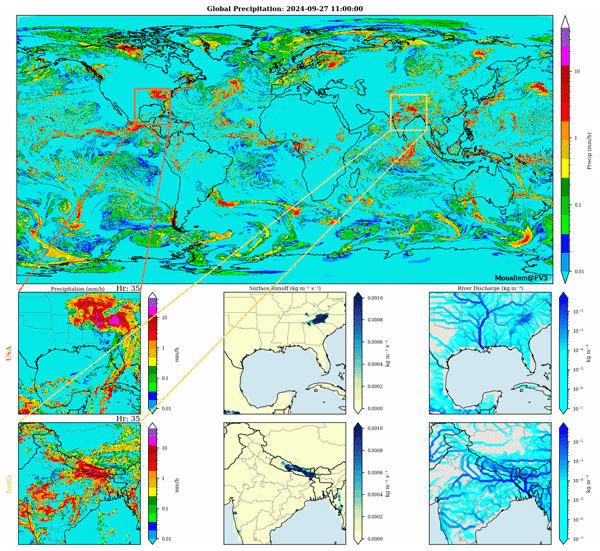
Abstract. This work describes the implementation strategy and technical challenges involved in integrating the Geophysical Fluid Dynamics Laboratory (GFDL)'s Land Model (LM4) with dynamic subgrid tiling capabilities within the atmospheric model, System for High-resolution modeling for Earth-to-Local Domains (SHiELD), capable of kilometer-scale global simulations. A key challenge addressed in this effort is coupling LM4, which was designed for implicit surface flux coupling, with SHiELD's explicit physics solver. We achieve this through a refactoring of the atmospheric physics suite and code drivers, enabling implicit land-atmosphere coupling of heat and moisture within the well established FMS coupler infrastructure. The resulting flexible architecture supports multiple model configurations from a single executable without recompilation. This extends SHiELD from an uncoupled atmospheric model, in which land processes are treated as a part of the atmospheric physics package, to a fully coupled high resolution atmosphere-ocean-land-ice model. We demonstrate the new system through a high-resolution global simulation of Hurricane Helene's landfall where the land component realistically captures the rapid soil saturation, localized runoff generation and multi-day river flooding concentration in Western North Carolina. These results validate the technical coupling strategy, unlock new forecast capabilities, and highlight the importance of interactive land-atmosphere coupling for simulating extreme weather and hydrological events.
-
Notice on discussion status
The requested preprint has a corresponding peer-reviewed final revised paper. You are encouraged to refer to the final revised version.
-
Preprint
(8868 KB)
-
The requested preprint has a corresponding peer-reviewed final revised paper. You are encouraged to refer to the final revised version.
- Preprint
(8868 KB) - Metadata XML
- BibTeX
- EndNote
- Final revised paper


Journal article(s) based on this preprint
Interactive discussion
Status: closed
-
RC1: 'Comment on egusphere-2026-2014', Anonymous Referee #1, 27 Jun 2026
-
AC1: 'Reply on RC1', Joseph Mouallem, 03 Aug 2026
We thank the reviewer for taking the time to evaluate the manuscript and for recognizing that the technical work is decent, promising and useful. We address key points below.
- We recognize the need to place the current work within the broader context of coupled climate and Earth System modeling at GFDL and worldwide. We agree that there is a rich history of Earth System Model development at many climate centers worldwide, including GFDL and the manuscript did not make it clear that this study is focusing on extending numerical weather prediction systems to include Earth system interactions that have traditionally been represented by fully coupled decadal-to-centennial ESMs.
We agree that the broader context needs to be strengthened and we have made substantial revisions to the introduction to clarify how the present work fits within ongoing efforts at GFDL and elsewhere to extend numerical weather prediction and existing coupling methodologies. Specifically, we expanded the introduction to discuss related land–atmosphere coupling approaches used in other Earth system and numerical weather prediction models, highlight how our work builds upon these efforts, and clarify the specific methodological contribution of this study. These additions provide the appropriate scholarly context while preserving the paper's primary focus on the methodology, implementation, and evaluation of the new coupling framework for analyzing surface water extremes associated with Hurricane Helene. - We added a direct coupled-vs-uncoupled comparison against NCEP Stage IV observed precipitation, with both configurations initialized from the same GFS analysis. This shows the coupled and uncoupled storm tracks and precipitation fields are nearly indistinguishable from one another and both compare well against Stage IV observations. This provides evidence that two-way land coupling does not measurably alter storm evolution on this event's timescale, and that the observed heavy-rainfall region over the Appalachians is captured in both configurations.
We revised the language throughout the results and conclusion to reflect the qualitative nature of the hydrological evaluation. For example, the hydrology results section now explicitly states that the results provide evidence the land model and its coupling "are behaving as expected from a qualitative perspective," and that "further work is underway to quantitatively evaluate the model's performance against observations." We removed or qualified the stronger validation language elsewhere in the text.
A comprehensive quantitative verification of hydrological forecast skill against observations (e.g., streamflow gauges and soil moisture networks) is beyond the scope of this paper and is now stated explicitly in the manuscript. Such an evaluation is ongoing and will be presented in future work. - We appreciate the reviewer identifying the remaining typos and inconsistencies. These are corrected in the revised manuscript.
- The simulation data were already publicly available in the same Zenodo repository as the code. The original data corresponded to the Version 2 release, which may not have been immediately apparent. For the revised manuscript, we have uploaded the additional simulation data associated with the new analyses and created a Version 3 release with an updated Zenodo DOI to ensure that the code and data corresponding to this manuscript are clearly identified.
Citation: https://doi.org/10.5194/egusphere-2026-2014-AC1 - We recognize the need to place the current work within the broader context of coupled climate and Earth System modeling at GFDL and worldwide. We agree that there is a rich history of Earth System Model development at many climate centers worldwide, including GFDL and the manuscript did not make it clear that this study is focusing on extending numerical weather prediction systems to include Earth system interactions that have traditionally been represented by fully coupled decadal-to-centennial ESMs.
-
AC1: 'Reply on RC1', Joseph Mouallem, 03 Aug 2026
-
RC2: 'Comment on egusphere-2026-2014', Anonymous Referee #2, 29 Jun 2026
-
AC2: 'Reply on RC2', Joseph Mouallem, 03 Aug 2026
We thank the referee for the careful review and thoughtful comments. We appreciate the positive assessment of the technical contribution and the recognition that the coupled SHiELD-LM4 framework represents a valuable step toward a fully implicit land-atmosphere-ocean modeling system. We revise the manuscript accordingly and address each comment below.
Major comments:
- We agree that the introduction should better motivate the scientific importance of land surface processes and place this work within the broader modeling landscape. In the revised manuscript, we expand the Introduction to discuss the role of land–atmosphere interactions in weather and Earth system prediction, particularly for extreme events where land surface states influence boundary layer evolution, surface fluxes, and hydrological processes. We also add a discussion of related coupled modeling frameworks to better contextualize our design choices. We emphasize that the primary contribution of this work is not the introduction of land-atmosphere coupling itself, but rather the implementation of the implicit coupling strategy within the fully coupled SHiELD modeling framework using the FMS Coupler infrastructure.
- Great question. In the current implementation, u_star is computed in the MOST scheme and is held constant outside the implicit solver of temperature and moisture, so the actual exchange coefficients are treated explicitly, while the thermodynamic fluxes are treatedreated implicitly. This design follows the existing atmospheric surface-layer implementation in ESM4 and avoids introducing additional dependencies within the solver.
The implicit timestep updates thermodynamic quantities while using a consistent value of u_star during each coupling timestep, therefore the resulting fluxes remain consistent within each iteration. This follows the logic introduced in Held I. (2004).
As noted in section 3.1, we assume that surface fluxes of momentum and other tracers have no implicit dependence on surface parameters. Nonetheless, the implicit strategy could be easily extended for momentum and other tracers which may become important in future implementations for high resolution configurations.
We have added additional discussion to clarify this design choice and its implications.
- Held, I. M. (2004). Surface fluxes, implicit time stepping, and the exchange grid: The structure of the surface exchange module (Technical Report). NOAA Geophysical Fluid Dynamics Laboratory. https://doi.org/10.5281/zenodo.18090279 - We appreciate the suggestion. We added a comparison between coupled and uncoupled SHiELD version as well as comparison to observational data to highlight that coupling to land does not affect the storm structure nor its characteristics. We would refrain from adding additional comparisons as the primary objective of this manuscript is to describe the development and implementation of the implicit LM4 coupling infrastructure within SHiELD and to demonstrate its numerical robustness and physical realism in a realistic weather simulation.
A comprehensive evaluation against observations, as well as systematic comparisons with the previous explicit implementation across multiple cases, would substantially broaden the scope of the paper. Such analyses are currently being pursued as separate, ongoing research initiatives.
We have also added discussion clarifying the objectives and limitations of the present study and explicitly identify comprehensive model validation and intercomparison as future work.
Minor comments:
- Land and ocean initial conditions are taken from a SPEAR run as described in section 4. The land components are already spun up and their corresponding conditions/configurations are left unchanged. We add additional text to further clarify this point.
- Corrected
- Corrected
- The stacked layers shown here are actually horizontal layers indexed by the vertically descending coordinate index ‘k’
- Corrected
- Corrected
- Corrected
- Corrected
Citation: https://doi.org/10.5194/egusphere-2026-2014-AC2 - We agree that the introduction should better motivate the scientific importance of land surface processes and place this work within the broader modeling landscape. In the revised manuscript, we expand the Introduction to discuss the role of land–atmosphere interactions in weather and Earth system prediction, particularly for extreme events where land surface states influence boundary layer evolution, surface fluxes, and hydrological processes. We also add a discussion of related coupled modeling frameworks to better contextualize our design choices. We emphasize that the primary contribution of this work is not the introduction of land-atmosphere coupling itself, but rather the implementation of the implicit coupling strategy within the fully coupled SHiELD modeling framework using the FMS Coupler infrastructure.
-
AC2: 'Reply on RC2', Joseph Mouallem, 03 Aug 2026
Peer review completion


Interactive discussion
Status: closed
-
RC1: 'Comment on egusphere-2026-2014', Anonymous Referee #1, 27 Jun 2026
The underlying technical work is decent, promising, and useful. In my view, this work concerns coupling explicit and implicit methods in surface exchange. However, I recommend a rejection (and I encourage a resubmission) as I explain below.
Fatal flaw: The manuscript presents the work in utter isolation, as if no other earth system models exist at all and as if this problem is unique to GFDL suite of models. I find that hard to believe, but even if so, should the authors want to assert that, they should say so explicitly. Without the important context of other earth system modeling activities past and present, I am not entirely sure publishing this type of work in a journal is appropriate. To me, in its current isolated state, this work contains noteworthy results, but without important scholarly context. For the work to be of relevance as to even warrant reviewers' time, I think it should offer more context.
Major flaws: Evaluation seems to be qualitiative in nature, but the authors seem to argue/assert stronger results (e.g., using the word "validate", "strong evidence" etc.). Would observations help here? I hope so. Moreover, the stability and conervation pieces are asserted, but not really shown. In a resubmission, I encourage a stronger quantiative engagement with the material at hand or being clearer about what the results imply.
Minor flaws: some typos and leftoever XXXX and inconsistent numbering/dating in text and figures --- please revise so that it is best suited for review. I would recommend a careful proofreading pass, including using autoamted tools (e.g., LLMs).
Data/code: Do you actually have the data underlying the manuscript uploaded? I could only see the code. Also, is there a specific release associated with this or is everything in the main public repositories?
Citation: https://doi.org/10.5194/egusphere-2026-2014-RC1 -
AC1: 'Reply on RC1', Joseph Mouallem, 03 Aug 2026
We thank the reviewer for taking the time to evaluate the manuscript and for recognizing that the technical work is decent, promising and useful. We address key points below.
- We recognize the need to place the current work within the broader context of coupled climate and Earth System modeling at GFDL and worldwide. We agree that there is a rich history of Earth System Model development at many climate centers worldwide, including GFDL and the manuscript did not make it clear that this study is focusing on extending numerical weather prediction systems to include Earth system interactions that have traditionally been represented by fully coupled decadal-to-centennial ESMs.
We agree that the broader context needs to be strengthened and we have made substantial revisions to the introduction to clarify how the present work fits within ongoing efforts at GFDL and elsewhere to extend numerical weather prediction and existing coupling methodologies. Specifically, we expanded the introduction to discuss related land–atmosphere coupling approaches used in other Earth system and numerical weather prediction models, highlight how our work builds upon these efforts, and clarify the specific methodological contribution of this study. These additions provide the appropriate scholarly context while preserving the paper's primary focus on the methodology, implementation, and evaluation of the new coupling framework for analyzing surface water extremes associated with Hurricane Helene. - We added a direct coupled-vs-uncoupled comparison against NCEP Stage IV observed precipitation, with both configurations initialized from the same GFS analysis. This shows the coupled and uncoupled storm tracks and precipitation fields are nearly indistinguishable from one another and both compare well against Stage IV observations. This provides evidence that two-way land coupling does not measurably alter storm evolution on this event's timescale, and that the observed heavy-rainfall region over the Appalachians is captured in both configurations.
We revised the language throughout the results and conclusion to reflect the qualitative nature of the hydrological evaluation. For example, the hydrology results section now explicitly states that the results provide evidence the land model and its coupling "are behaving as expected from a qualitative perspective," and that "further work is underway to quantitatively evaluate the model's performance against observations." We removed or qualified the stronger validation language elsewhere in the text.
A comprehensive quantitative verification of hydrological forecast skill against observations (e.g., streamflow gauges and soil moisture networks) is beyond the scope of this paper and is now stated explicitly in the manuscript. Such an evaluation is ongoing and will be presented in future work. - We appreciate the reviewer identifying the remaining typos and inconsistencies. These are corrected in the revised manuscript.
- The simulation data were already publicly available in the same Zenodo repository as the code. The original data corresponded to the Version 2 release, which may not have been immediately apparent. For the revised manuscript, we have uploaded the additional simulation data associated with the new analyses and created a Version 3 release with an updated Zenodo DOI to ensure that the code and data corresponding to this manuscript are clearly identified.
Citation: https://doi.org/10.5194/egusphere-2026-2014-AC1 - We recognize the need to place the current work within the broader context of coupled climate and Earth System modeling at GFDL and worldwide. We agree that there is a rich history of Earth System Model development at many climate centers worldwide, including GFDL and the manuscript did not make it clear that this study is focusing on extending numerical weather prediction systems to include Earth system interactions that have traditionally been represented by fully coupled decadal-to-centennial ESMs.
-
AC1: 'Reply on RC1', Joseph Mouallem, 03 Aug 2026
-
RC2: 'Comment on egusphere-2026-2014', Anonymous Referee #2, 29 Jun 2026
-
AC2: 'Reply on RC2', Joseph Mouallem, 03 Aug 2026
We thank the referee for the careful review and thoughtful comments. We appreciate the positive assessment of the technical contribution and the recognition that the coupled SHiELD-LM4 framework represents a valuable step toward a fully implicit land-atmosphere-ocean modeling system. We revise the manuscript accordingly and address each comment below.
Major comments:
- We agree that the introduction should better motivate the scientific importance of land surface processes and place this work within the broader modeling landscape. In the revised manuscript, we expand the Introduction to discuss the role of land–atmosphere interactions in weather and Earth system prediction, particularly for extreme events where land surface states influence boundary layer evolution, surface fluxes, and hydrological processes. We also add a discussion of related coupled modeling frameworks to better contextualize our design choices. We emphasize that the primary contribution of this work is not the introduction of land-atmosphere coupling itself, but rather the implementation of the implicit coupling strategy within the fully coupled SHiELD modeling framework using the FMS Coupler infrastructure.
- Great question. In the current implementation, u_star is computed in the MOST scheme and is held constant outside the implicit solver of temperature and moisture, so the actual exchange coefficients are treated explicitly, while the thermodynamic fluxes are treatedreated implicitly. This design follows the existing atmospheric surface-layer implementation in ESM4 and avoids introducing additional dependencies within the solver.
The implicit timestep updates thermodynamic quantities while using a consistent value of u_star during each coupling timestep, therefore the resulting fluxes remain consistent within each iteration. This follows the logic introduced in Held I. (2004).
As noted in section 3.1, we assume that surface fluxes of momentum and other tracers have no implicit dependence on surface parameters. Nonetheless, the implicit strategy could be easily extended for momentum and other tracers which may become important in future implementations for high resolution configurations.
We have added additional discussion to clarify this design choice and its implications.
- Held, I. M. (2004). Surface fluxes, implicit time stepping, and the exchange grid: The structure of the surface exchange module (Technical Report). NOAA Geophysical Fluid Dynamics Laboratory. https://doi.org/10.5281/zenodo.18090279 - We appreciate the suggestion. We added a comparison between coupled and uncoupled SHiELD version as well as comparison to observational data to highlight that coupling to land does not affect the storm structure nor its characteristics. We would refrain from adding additional comparisons as the primary objective of this manuscript is to describe the development and implementation of the implicit LM4 coupling infrastructure within SHiELD and to demonstrate its numerical robustness and physical realism in a realistic weather simulation.
A comprehensive evaluation against observations, as well as systematic comparisons with the previous explicit implementation across multiple cases, would substantially broaden the scope of the paper. Such analyses are currently being pursued as separate, ongoing research initiatives.
We have also added discussion clarifying the objectives and limitations of the present study and explicitly identify comprehensive model validation and intercomparison as future work.
Minor comments:
- Land and ocean initial conditions are taken from a SPEAR run as described in section 4. The land components are already spun up and their corresponding conditions/configurations are left unchanged. We add additional text to further clarify this point.
- Corrected
- Corrected
- The stacked layers shown here are actually horizontal layers indexed by the vertically descending coordinate index ‘k’
- Corrected
- Corrected
- Corrected
- Corrected
Citation: https://doi.org/10.5194/egusphere-2026-2014-AC2 - We agree that the introduction should better motivate the scientific importance of land surface processes and place this work within the broader modeling landscape. In the revised manuscript, we expand the Introduction to discuss the role of land–atmosphere interactions in weather and Earth system prediction, particularly for extreme events where land surface states influence boundary layer evolution, surface fluxes, and hydrological processes. We also add a discussion of related coupled modeling frameworks to better contextualize our design choices. We emphasize that the primary contribution of this work is not the introduction of land-atmosphere coupling itself, but rather the implementation of the implicit coupling strategy within the fully coupled SHiELD modeling framework using the FMS Coupler infrastructure.
-
AC2: 'Reply on RC2', Joseph Mouallem, 03 Aug 2026
Peer review completion
Journal article(s) based on this preprint
Model code and software
Development of a high-resolution coupled SHiELD-MOM6-LM4 model – Part 2: Model overview, coupling technique, and evaluation of hydrological extremes during Hurricane Helene Joseph Mouallem https://zenodo.org/records/19476778
Viewed
| HTML | XML | Total | BibTeX | EndNote | |
|---|---|---|---|---|---|
| 306 | 119 | 49 | 474 | 41 | 38 |
- HTML: 306
- PDF: 119
- XML: 49
- Total: 474
- BibTeX: 41
- EndNote: 38
Viewed (geographical distribution)
| Country | # | Views | % |
|---|
| Total: | 0 |
| HTML: | 0 |
| PDF: | 0 |
| XML: | 0 |
- 1

Sergey Malyshev
Zhihong Tan
Elena Shevliakova
Kun Gao
Lucas Harris
Rusty Benson
William Cooke
Niki Zadeh
Lauren Chilutti
The requested preprint has a corresponding peer-reviewed final revised paper. You are encouraged to refer to the final revised version.
- Preprint
(8868 KB) - Metadata XML
The underlying technical work is decent, promising, and useful. In my view, this work concerns coupling explicit and implicit methods in surface exchange. However, I recommend a rejection (and I encourage a resubmission) as I explain below.
Fatal flaw: The manuscript presents the work in utter isolation, as if no other earth system models exist at all and as if this problem is unique to GFDL suite of models. I find that hard to believe, but even if so, should the authors want to assert that, they should say so explicitly. Without the important context of other earth system modeling activities past and present, I am not entirely sure publishing this type of work in a journal is appropriate. To me, in its current isolated state, this work contains noteworthy results, but without important scholarly context. For the work to be of relevance as to even warrant reviewers' time, I think it should offer more context.
Major flaws: Evaluation seems to be qualitiative in nature, but the authors seem to argue/assert stronger results (e.g., using the word "validate", "strong evidence" etc.). Would observations help here? I hope so. Moreover, the stability and conervation pieces are asserted, but not really shown. In a resubmission, I encourage a stronger quantiative engagement with the material at hand or being clearer about what the results imply.
Minor flaws: some typos and leftoever XXXX and inconsistent numbering/dating in text and figures --- please revise so that it is best suited for review. I would recommend a careful proofreading pass, including using autoamted tools (e.g., LLMs).
Data/code: Do you actually have the data underlying the manuscript uploaded? I could only see the code. Also, is there a specific release associated with this or is everything in the main public repositories?