
the Creative Commons Attribution 4.0 License.
the Creative Commons Attribution 4.0 License.
 | 29 Jan 2026
Technical note: turbulence demonstrates height variations in closely spaced deep-sea mooring lines
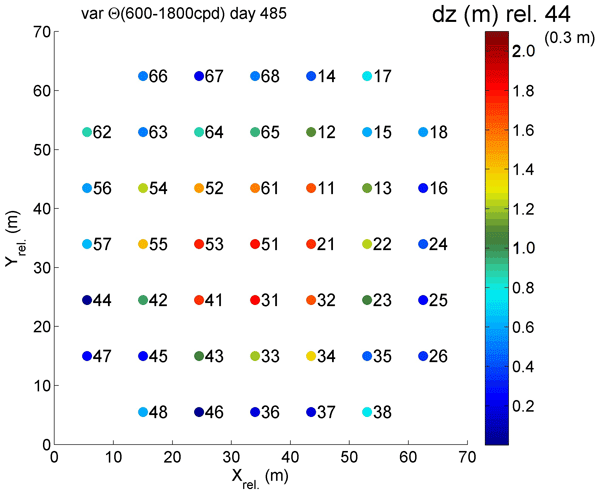
Abstract. It may be important to precisely know heights of moored oceanographic instrumentation. For example, moorings can be closely spaced or accidentally be located on small rocks or in small gullies. Height variations O(1 m) will yield registration of different values when conditions such as small-scale density stratification vary strongly. Such little height variations may prove difficult to measure in the deep sea, requiring high-accuracy pressure sensors preferably on all instruments in a mooring-array. In this paper, an alternative method for relative height determination is presented using high-resolution temperature sensors moored on multiple densely-spaced lines in the deep Western Mediterranean. While it was anticipated that height variations between lines could be detected under near-homogeneous conditions via adiabatic lapse rate O(0.0001 °C m-1) by the 0.00003 °C-noise-level sensors, such was prevented by the impossibility of properly correcting for short-term bias due to electronic drift. Instead, a satisfactory height determination was found during a period of relatively strong stratification and large turbulence activity. By band-pass filtering data of the highest-resolved turbulent motions across the strongest temperature gradient, significant height variations were detectable to within ±0.2 m.
-
Notice on discussion status
The requested preprint has a corresponding peer-reviewed final revised paper. You are encouraged to refer to the final revised version.
-
Preprint
(2231 KB)
-
The requested preprint has a corresponding peer-reviewed final revised paper. You are encouraged to refer to the final revised version.
- Preprint
(2231 KB) - Metadata XML
- BibTeX
- EndNote
- Final revised paper


Journal article(s) based on this preprint
Interactive discussion
Status: closed
-
RC1: 'Comment on egusphere-2026-189', Anonymous Referee #1, 26 Feb 2026
- Abstract starts with strong suggestive and assumption based sentences. It would be much better to directly expose the problem.- Introduction is quite short. Even though this is a technical note, some background and literature might be very useful.- Experiment location can be shared on a map (Fig 1 possibly).- In the results and 3.1 Parabola model section, there is a complex definition of geometric system including different models. I believe there needs to be a sentence or small explanation as to why this complex corrections/calculations are being done.- In figure 5, the colors mentioned (cyan, magenta) hardly visible (possibly dominated by the red one)- Is there a specific reason as to pick line 53 as a reference in Fig 6? Better situated, no inclination etc.?- In figures, amount of decimals/significant figures should be common (e.g.. 8.5, 9 in Fig 7)- I would love to see a comparison (maybe difference) of two methods (Fig 6 and Fig 10) of height values.- Fig 7a is very black line dominated. Might better present with reduced line thickness maybe?- In Fig A1 the color scale of two panels differ. Are we looking similar structures?- Fig 11 prefer legend (instead of in text explanation of colors)In general the new ingenious technical methods presented opened new ways for the calculation of the vertical shift/height variations of the mooring lines. Although the applicability is quite limited (having a similar massively complex mooring system). I believe this method will shed a new light on the use of mooring lines for deep sea measurements, as well as the design of the mooring systems (e.g.. 2m apart T-sensors)Citation: https://doi.org/
10.5194/egusphere-2026-189-RC1 -
AC1: 'Reply on RC1', Hans van Haren, 04 Mar 2026
>>>I thank the reviewer for the time to comment my manuscript. Replies are behind>>>
- Abstract starts with strong suggestive and assumption based sentences. It would be much better to directly expose the problem.
>>>First lines are removed from abstract now, as suggested.
- Introduction is quite short. Even though this is a technical note, some background and literature might be very useful.
>>>Some more text has been added to the Introduction. Actually, there is very little literature on the subject.
- Experiment location can be shared on a map (Fig 1 possibly).
>>>OK, added to figure 1 is an extra panel on the location (F1b; while old panel b is now panel c).
- In the results and 3.1 Parabola model section, there is a complex definition of geometric system including different models. I believe there needs to be a sentence or small explanation as to why this complex corrections/calculations are being done.
>>>Such a sentence is now added (around old l.105).
- In figure 5, the colors mentioned (cyan, magenta) hardly visible (possibly dominated by the red one)
>>>Agree, the plotting order is reversed now so that all are better visible.
- Is there a specific reason as to pick line 53 as a reference in Fig 6? Better situated, no inclination etc.?
>>>No, more or less arbitrary choice, from the center of the array.
- In figures, amount of decimals/significant figures should be common (e.g.. 8.5, 9 in Fig 7)
>>>That is a Matlab handle; modified manually now.
- I would love to see a comparison (maybe difference) of two methods (Fig 6 and Fig 10) of height values.
>>>In Fig. 11 data from the two centre lines of Fig. 6 are now added in magenta, for reference.
- Fig 7a is very black line dominated. Might better present with reduced line thickness maybe?
>>>The amount of blackness is due in part to the vigorous turbulence. The lines have been dotted now, to considerably remove blackness.
- In Fig A1 the color scale of two panels differ. Are we looking similar structures?
>>>No, the range was (and is) identical in the two panels, as has been better indicated now. Indeed, structures are similar, as indicated in the text.
- Fig 11 prefer legend (instead of in text explanation of colors)
>>>Fair enough, legend is given now.
In general the new ingenious technical methods presented opened new ways for the calculation of the vertical shift/height variations of the mooring lines. Although the applicability is quite limited (having a similar massively complex mooring system). I believe this method will shed a new light on the use of mooring lines for deep sea measurements, as well as the design of the mooring systems (e.g.. 2m apart T-sensors)
>>>Thank you for the appreciation.
Citation: https://doi.org/10.5194/egusphere-2026-189-AC1
-
AC1: 'Reply on RC1', Hans van Haren, 04 Mar 2026
-
RC2: 'Comment on egusphere-2026-189', Anonymous Referee #2, 03 Apr 2026
MS No.: egusphere-2026-189
MS type: Technical note
Major comments :
This technical note addresses the question of how to correct vertical variations in sensor position
between closely distributed moorings with adequate instrumentation (here RBRs) in a deep-sea
environment. Though it seems to concern only very specific network of moorings, it could be useful to
other users. Therefore, I am favorable to a publication after bringing some clarifications in the
manuscript.
Detailed comments:
paragraph 3.1: Parabola model (l.121 – 139)
- The 5° starting assumption relies on a test as I understand (from fig. 3 caption). How was that test
conducted? Additional information is need in the text.
- I’m not an expert in net deformation. Parabola shape seems intuitive given that each net node support
the same tension from each top-mooring buoyancy.... but are there any references? Are blue and red
curves the only possibilities?
-What guarantees that the outer pipe remains circular?
- Is the maximum 5° parabola better consistent with the expected elongation of the steel grid? I guess
the results (° more, less) depends on the tensioning of the grid lines and the fact that the outer pipe
remains more ore less circular?
Paragraph about slanted warm episodes (l.182 – 190)
I do not necessarily see why the parallel with slanted convection. Here, we have warm water intrusion
from above in the domain of the T-sensor cube. It's not cold water from convection as mentioned at
lines 190... Does the 3D-view from the cube exhibit systematic slanted warm ‘intrusions’?
Temperature sensor spectra (l. 191-197)
It would be quite informative then to show and comment the contrast between the typical averaged
spectra when homogeneous conditions occur vs stratified conditions associated with warm water events
as in Fig. 7 & 8.
l. 199: band-pass -filter and Fig. 8
I'm a bit lost with this paragraph:
A you referring to another spectrum? I don't see any example of spectrum using a band-pass filter
applied to theta(z,t).
We just have Fig. 8 with light smoothing of spectral rays at low frequencies and heavier smoothing
between spectral rays at high frequencies (which is not what I would call a band-pass filter).
Are you pointing Fig. 8 with the buoyancy (cyan-dashed) and inertial (black-dashed) slopes?
Please add the values of the slopes on Figure 8 and in the text + add references for such slopes in the
text.
Inertial and buoyancy subranges (l. 202): need a clarification
If I try to understand the point, the author wants to contrast the high frequency behavior of
thermistances that are close to the bottom (6, 20 m) with other that are farther (40 m, 120 m).
Those farther clearly align with the inertial black dashed line (-5/3 slope?), while the closest to the
seafloor seems 'closer' to the buoyancy cyan dashed line (-1 slope?).
My interpretation is different. At high frequencies (> 100 or 1000 cpd), all spectra follows a -5/3 slope,
but for the two sensors closest to the seafloor, that slope is shifted toward higher energy levels due to
energy input around 100 cpd @ 20 m high, and around 300-900 cpd @ 6 m high. Above those
frequencies of energy input, the inertial slope fits the high frequency part of 6 and 20 m sensors. To me,
there is no real evidence of a buoyancy subrange with those spectra (Fig. 8).
l. 205: ‘ Future investigations will be directed to improve statistics ...’: agree - difficult to tell which of
inertial or buoyancy lines better fits the spectra between 10 and 100 cpd. The difference in slopes
between those subranges is too tenuous with your illustration.
l. 207: temperature variance
Please indicate how it is calculated: Is it the variance, calculated over 1.3 day in physical space, of the
600-1800 cpd-band-pass filtered temperature time series?
About the height pattern (Fig. 10 and associated text)
Results (Fig. 10 vs 6) are convincing but...
Is there an assumption behind that the temperature field, or more exactly, the temperature variance field
has to be horizontally homogeneous across your sensor network, at a given depth, to be able to convert
temperature variance differences with the reference line to height using the 45-line variance average?
If yes, you should state it and you have to comment on the realism of the homogeneity assumption,
given the fact that, warm water events are transitory and are advected across the mooring network,
which may induce heterogeneity between neighboring lines.
In the same vein, I'd be curious to see the variability of Fig. 10 using other periods of warm water
events.
l. 243 comparison with ‘... open-ocean values observed in stratified waters well away from
boundaries’
Here, it would be fair to remind the reader that your experiment was located close to the shelf break,
where the strong Liguro-Provençal current flows. This contrasts with open-ocean dynamics.
Appendix A, l. 306: Define NTC where it first appears.
l. 319: addition: Low-pass time filtering, with a cut-off frequency of 500 cpd, does not reduce these
l. 319: ‘... but additional vertical filtering adequately removes the bias (Fig. A1c,f)’. Information
missing: impossible to reproduce, not enough details. What type of 10-m-vertical filter is used (Fig.
A1-cf)?
l. 342: ‘...temperature spectra become horizontal following buoyancy-subrange scaling, rather
abruptly.’
This rather true for old, but not for new sensors. For new sensors, green and magenta evolves
consistently from 50 (first crossing) to 100 cpd (last crossing). From 100 to 300 cpd, the green remains
flat and is consistent with a buoyancy subrange typical slope. Above 300 cpd, the slope gradually
increases towards a white noise slope (+1 on this scaled loglog plot).
l. 344: ‘... was no longer dominant at frequencies higher than that of the crossing, more so in Fig. A2a
than in Fig. A2b.’
I just wrote the opposite! A2a (new sensors) remains consistent with buoyancy subrange after crossing!
('more so' refers to no longer dominant after crossing)Citation: https://doi.org/10.5194/egusphere-2026-189-RC2 - AC2: 'Reply on RC2', Hans van Haren, 08 Apr 2026
-
RC3: 'Comment on egusphere-2026-189', Anonymous Referee #3, 14 Apr 2026
Dear Dr. van Haren,
Please find here my review of the manuscript entitled "Technical note: turbulence demonstrates height variations in closely spaced deep-sea mooring lines". This short note aims to determine that height variations in moorings lines relative to the seafloor (due to the deformation of a round grid made of steel cables under vertical pull by floatation) can be calculated. Three methods are considered, but the author demonstrates that the one based on turbulence variance is the more appropriate. Preliminary turbulence statistics are also presented at the end of the note (although the methodology for this part if not explain, see one comment below).
This is a very technical paper, but in itself the science is sound, although the manuscript would benefit from some clarifications. Since the data are from a unique mooring design, I doubt of the widespread applicability of this study: the error correction is only relevant to reference multi-lines moorings to one another, and this error in vertical position would be negligible for a single line mooring.
I do think that the analysis here could have also been contained in an appendix of another related study (at the end, only one method is really working, so the description of the failed attempts could have been avoided). For example, I note that the same author already has 2 other Technical Notes submitted to OS using the same data (and some figures are shared) and one paper accepted in GRL using also the same data set. I wonder why the current technical notes was not added to one of those studies in an appendix, but I am not overly worried if the Editor decides to leave it separate. If the Editor is fine with the observations I make above, I suggest the potential publication of the technical notes after some text-related changes.
---- Main Comments ----
L. 87-96, the whole paragraph: "In addition, because vertical temperature (density) gradients are so small in the deep Mediterranean, so that buoyancy frequency N = O(f) where f denotes the inertial frequency, reference was made to periods of typically one-hour duration that were quasi-homogeneous with temperature variations smaller than instrumental noise level (van Haren, 2022). Such >125-m tall quasi-homogeneous periods existed on days 350 (in 2020), 453, and 657 (-366 in 2021) in the records. This secondary drift correction allowed for proper calculations of turbulence values using the method of Thorpe (1977) under weakly stratified conditions. As will be demonstrated in Appendix A, under very weakly stratified conditions a tertiary correction involved low-pass filtering of data."
-> This whole section is not clear. It looks like something is missing from the first sentence and then "this secondary drift correction" seems to refer to a part that was not introduced... I suggest re-writing that paragraph.L. 111: "Eight 'corner-lines'... "
-> I suggest identifying them in Figure 1.L. 132 - 139: This part is not clear and very confusing.
In addition: "pushing it to the seafloor from the low side" -> What does it mean?
I suggest re-writing this part.L. 175: "Unexpectedly, such a method is not found during a near-homogeneous period."
-> What "found a method" means? and why "unexpectedly"?
Do you mean "this method does not work"?L.207: "During such a period of warm waters from above, temperature variance may be relatively low closest to the seafloor, but it increases to high levels well above common interior-values in the first O(10)m above seafloor (Figs 8, 9)."
-> It is unclear because at 2500m depth, O(10)m above bottom is relatively close to the seafloor... Please clarify.L. 214: dz = 2 is a constant in the equation? Please clarify.
L. 234: "Coarsely every two hours, 124-m vertically averaged turbulence dissipation rate peaks, indicating the largest overturns being about 100 m in height, given a waterflow speed of 0.03 m s-1."
-> This is really unclear. Please explain.L. 241: The method to derive turbulence variables is not explained. I understand that this may be described in other papers, but I think it is important to recall it here if some results are presented.
L. 216: "Here, the pattern is given for height determination by computing across the largest gradient of temperature-variance, between T-sensors #2 and #3 from the seafloor."
-> It is the first times #2 and #3 are introduce. What it means?L.261: "Instead, a mooring-height determination was *found* during a period of relatively large stratification"
-> Was achieved? (check also the rest of the text)Data availability statement:
Note to the Editor: Is this acceptable to just say that the data are too complex to be shared or used by someone else?Figure 6: A divergent colormap (centered at zero) would be more appropriate here.
---- Minor Comments ----Title: I personally find the title difficult to understand. I suggest something more straightforward such as "Determination of the height of mooring lines above seafloor using turbulence measurements"
The author uses a lot of unnecessary parentheses. I would personally remove.
E.g. L. 88: "In addition, because vertical temperature (density) gradients are so small ..." While I understand what the author means, but it could be more explicit: "... vertical gradients of temperature, and thus density, are so small ..."
Similar (unnecessary) parentheses are used elsewhere in the text Lines 92, 121, 166, 184, 275, 449
Also Lines 457: what is meant by "(sic!)" in the caption?L. 124: "the models start from there"
-> You mean it is the "zero-crossing value"? If so, please be more specific.L. 125: "angle of 5 deg. (green model in Fig. 3)"
-> add angle in Figure 3.L. 234: why "values" with quotation marks?
L. 246: "Although the warm-water event of Fig. 7 is relatively *strong*"
-> What "strong event" means? I suggest using a more precise qualificative (e.g., event of strong turbulence?).L. 248: "This will be reported elsewhere in more detail..."
-> where? how? elsewhere in the text? other paper?L. 255: "unmeasurably small"
-> Yet it was measured?L. 267: "several-fold" is used, but the following text uses "first" and "second" only.
Section 3.2 (and elsewhere): Please consider using scientific notation for temperature variance/precision.
Citation: https://doi.org/10.5194/egusphere-2026-189-RC3 -
AC3: 'Reply on RC3', Hans van Haren, 20 Apr 2026
>>>I thank the reviewer for the time to comment my manuscript. Replies are behind >>>
Dear Dr. van Haren,
Please find here my review of the manuscript entitled "Technical note: turbulence demonstrates height variations in closely spaced deep-sea mooring lines". This short note aims to determine that height variations in moorings lines relative to the seafloor (due to the deformation of a round grid made of steel cables under vertical pull by floatation) can be calculated. Three methods are considered, but the author demonstrates that the one based on turbulence variance is the more appropriate. Preliminary turbulence statistics are also presented at the end of the note (although the methodology for this part if not explain, see one comment below).
This is a very technical paper, but in itself the science is sound, although the manuscript would benefit from some clarifications. Since the data are from a unique mooring design, I doubt of the widespread applicability of this study: the error correction is only relevant to reference multi-lines moorings to one another, and this error in vertical position would be negligible for a single line mooring.
>>>Thank you for the appreciation. Indeed the method is most applicable for multiple line moorings, but it may be relevant for a single line mooring stretching as the method is more precise than most deep-sea pressure sensors.
I do think that the analysis here could have also been contained in an appendix of another related study (at the end, only one method is really working, so the description of the failed attempts could have been avoided). For example, I note that the same author already has 2 other Technical Notes submitted to OS using the same data (and some figures are shared) and one paper accepted in GRL using also the same data set. I wonder why the current technical notes was not added to one of those studies in an appendix, but I am not overly worried if the Editor decides to leave it separate. If the Editor is fine with the observations I make above, I suggest the potential publication of the technical notes after some text-related changes.
>>>I am sorry but I disagree. The presentation of methods that do not work as expected is valuable in itself. The presentation of the methods is too large for an appendix, in fact this technical note has one, now two, appendices. The technical notes and papers are all on different subjects.
---- Main Comments ----
- 87-96, the whole paragraph: "In addition, because vertical temperature (density) gradients are so small in the deep Mediterranean, so that buoyancy frequency N = O(f) where f denotes the inertial frequency, reference was made to periods of typically one-hour duration that were quasi-homogeneous with temperature variations smaller than instrumental noise level (van Haren, 2022). Such >125-m tall quasi-homogeneous periods existed on days 350 (in 2020), 453, and 657 (-366 in 2021) in the records. This secondary drift correction allowed for proper calculations of turbulence values using the method of Thorpe (1977) under weakly stratified conditions. As will be demonstrated in Appendix A, under very weakly stratified conditions a tertiary correction involved low-pass filtering of data."
-> This whole section is not clear. It looks like something is missing from the first sentence and then "this secondary drift correction" seems to refer to a part that was not introduced... I suggest re-writing that paragraph.
>>>This paragraph has been modified for clarification as suggested.
- 111: "Eight 'corner-lines'... "
-> I suggest identifying them in Figure 1.
>>>They are identified now in the Figure caption.
- 132 - 139: This part is not clear and very confusing.
In addition: "pushing it to the seafloor from the low side" -> What does it mean?
I suggest re-writing this part.
>>>This part is now rewritten as suggested.
- 175: "Unexpectedly, such a method is not found during a near-homogeneous period."
-> What "found a method" means? and why "unexpectedly"?
Do you mean "this method does not work"?
>>>It was meant to contrast with the adiabatic method, as that would work best under near-homogeneous conditions. Rewritten for clarification now.
L.207: "During such a period of warm waters from above, temperature variance may be relatively low closest to the seafloor, but it increases to high levels well above common interior-values in the first O(10)m above seafloor (Figs 8, 9)."
-> It is unclear because at 2500m depth, O(10)m above bottom is relatively close to the seafloor... Please clarify.
>>>Yes, although it depends a bit on the perspective. Modified ‘closest’ to ‘within a few meters from’ the seafloor now and removed ‘the first’.
- 214: dz = 2 is a constant in the equation? Please clarify.
>>>Yes it is, the distance between the sensors, as indicated now.
- 234: "Coarsely every two hours, 124-m vertically averaged turbulence dissipation rate peaks, indicating the largest overturns being about 100 m in height, given a waterflow speed of 0.03 m s-1."
-> This is really unclear. Please explain.
>>>Unclear indeed. Rewritten now, mentioning the observation of scale O(100) m of overturns, without the relation with waterflow speed.
- 241: The method to derive turbulence variables is not explained. I understand that this may be described in other papers, but I think it is important to recall it here if some results are presented.
>>>To be as concise as possible, because turbulence values are not the main topic in this technical note, reference was made to other papers like van Haren (2018), and van Haren and Gostiaux (2012) now added, with extensions in van Haren (2022).The main parts of T-data preparation were briefly indicated here in (old l.) 84-96. The new addition for data under near-homogeneous conditions was outlined in Appendix A.
- 216: "Here, the pattern is given for height determination by computing across the largest gradient of temperature-variance, between T-sensors #2 and #3 from the seafloor."
-> It is the first times #2 and #3 are introduce. What it means?
>>>Modified to h = 3.5 and 5.5 m now.
L.261: "Instead, a mooring-height determination was *found* during a period of relatively large stratification"
-> Was achieved? (check also the rest of the text)
>>>OK, thank you.
Data availability statement:
Note to the Editor: Is this acceptable to just say that the data are too complex to be shared or used by someone else?
>>>Sorry, but it is not said that the data are too complex to be shared. The stored raw data are data in non-engineering units from custom-made instrumentation which are meaningless without extensive post-processing. These data are completely different from ‘raw data’ from off the shelf instrumentation like CTD and current meters, which are shared.
Figure 6: A divergent colormap (centered at zero) would be more appropriate here.
>>>Sorry, but I disagree as values are completely relative (the arbitrary range could go from 0 to 6) and it is meant to be compared with Fig. 10.
---- Minor Comments ----
Title: I personally find the title difficult to understand. I suggest something more straightforward such as "Determination of the height of mooring lines above seafloor using turbulence measurements"
>>>Fair enough, with the addition of ‘deep-sea’ before ‘mooring’.
The author uses a lot of unnecessary parentheses. I would personally remove.
E.g. L. 88: "In addition, because vertical temperature (density) gradients are so small ..." While I understand what the author means, but it could be more explicit: "... vertical gradients of temperature, and thus density, are so small ..."
>>>Modified as suggested, thank you.
Similar (unnecessary) parentheses are used elsewhere in the text Lines 92, 121, 166, 184, 275, 449
>>>These are removed now.
Also Lines 457: what is meant by "(sic!)" in the caption?
>>>It means ‘thus’, but does not refer to a quotation. Removed now.
- 124: "the models start from there"
-> You mean it is the "zero-crossing value"? If so, please be more specific.
>>>No, the height above seafloor of the cable attachments, as indicated now.
- 125: "angle of 5 deg. (green model in Fig. 3)"
-> add angle in Figure 3.
>>>Angle inserted now.
- 234: why "values" with quotation marks?
>>>Because non-averaged values are not actual turbulence dissipation rates, but representing single displacements cast in units of dissipation rate. Indicated in caption now.
- 246: "Although the warm-water event of Fig. 7 is relatively *strong*"
-> What "strong event" means? I suggest using a more precise qualificative (e.g., event of strong turbulence?).
>>>Yes, event of strong turbulence.
- 248: "This will be reported elsewhere in more detail..."
-> where? how? elsewhere in the text? other paper?
>>>Yes, paper under submission.
- 255: "unmeasurably small"
-> Yet it was measured?
>>>Thank you for pointing out. unmeasurably à negligibly
- 267: "several-fold" is used, but the following text uses "first" and "second" only.
>>>Yes, that is more than one, no?
Section 3.2 (and elsewhere): Please consider using scientific notation for temperature variance/precision.
>>>Done now.
Section 3.2 (and elsewhere): Please consider using scientific notation for temperature variance/precision.
>>>
Citation: https://doi.org/10.5194/egusphere-2026-189-AC3
-
AC3: 'Reply on RC3', Hans van Haren, 20 Apr 2026
Peer review completion


Interactive discussion
Status: closed
-
RC1: 'Comment on egusphere-2026-189', Anonymous Referee #1, 26 Feb 2026
- Abstract starts with strong suggestive and assumption based sentences. It would be much better to directly expose the problem.- Introduction is quite short. Even though this is a technical note, some background and literature might be very useful.- Experiment location can be shared on a map (Fig 1 possibly).- In the results and 3.1 Parabola model section, there is a complex definition of geometric system including different models. I believe there needs to be a sentence or small explanation as to why this complex corrections/calculations are being done.- In figure 5, the colors mentioned (cyan, magenta) hardly visible (possibly dominated by the red one)- Is there a specific reason as to pick line 53 as a reference in Fig 6? Better situated, no inclination etc.?- In figures, amount of decimals/significant figures should be common (e.g.. 8.5, 9 in Fig 7)- I would love to see a comparison (maybe difference) of two methods (Fig 6 and Fig 10) of height values.- Fig 7a is very black line dominated. Might better present with reduced line thickness maybe?- In Fig A1 the color scale of two panels differ. Are we looking similar structures?- Fig 11 prefer legend (instead of in text explanation of colors)In general the new ingenious technical methods presented opened new ways for the calculation of the vertical shift/height variations of the mooring lines. Although the applicability is quite limited (having a similar massively complex mooring system). I believe this method will shed a new light on the use of mooring lines for deep sea measurements, as well as the design of the mooring systems (e.g.. 2m apart T-sensors)Citation: https://doi.org/
10.5194/egusphere-2026-189-RC1 -
AC1: 'Reply on RC1', Hans van Haren, 04 Mar 2026
>>>I thank the reviewer for the time to comment my manuscript. Replies are behind>>>
- Abstract starts with strong suggestive and assumption based sentences. It would be much better to directly expose the problem.
>>>First lines are removed from abstract now, as suggested.
- Introduction is quite short. Even though this is a technical note, some background and literature might be very useful.
>>>Some more text has been added to the Introduction. Actually, there is very little literature on the subject.
- Experiment location can be shared on a map (Fig 1 possibly).
>>>OK, added to figure 1 is an extra panel on the location (F1b; while old panel b is now panel c).
- In the results and 3.1 Parabola model section, there is a complex definition of geometric system including different models. I believe there needs to be a sentence or small explanation as to why this complex corrections/calculations are being done.
>>>Such a sentence is now added (around old l.105).
- In figure 5, the colors mentioned (cyan, magenta) hardly visible (possibly dominated by the red one)
>>>Agree, the plotting order is reversed now so that all are better visible.
- Is there a specific reason as to pick line 53 as a reference in Fig 6? Better situated, no inclination etc.?
>>>No, more or less arbitrary choice, from the center of the array.
- In figures, amount of decimals/significant figures should be common (e.g.. 8.5, 9 in Fig 7)
>>>That is a Matlab handle; modified manually now.
- I would love to see a comparison (maybe difference) of two methods (Fig 6 and Fig 10) of height values.
>>>In Fig. 11 data from the two centre lines of Fig. 6 are now added in magenta, for reference.
- Fig 7a is very black line dominated. Might better present with reduced line thickness maybe?
>>>The amount of blackness is due in part to the vigorous turbulence. The lines have been dotted now, to considerably remove blackness.
- In Fig A1 the color scale of two panels differ. Are we looking similar structures?
>>>No, the range was (and is) identical in the two panels, as has been better indicated now. Indeed, structures are similar, as indicated in the text.
- Fig 11 prefer legend (instead of in text explanation of colors)
>>>Fair enough, legend is given now.
In general the new ingenious technical methods presented opened new ways for the calculation of the vertical shift/height variations of the mooring lines. Although the applicability is quite limited (having a similar massively complex mooring system). I believe this method will shed a new light on the use of mooring lines for deep sea measurements, as well as the design of the mooring systems (e.g.. 2m apart T-sensors)
>>>Thank you for the appreciation.
Citation: https://doi.org/10.5194/egusphere-2026-189-AC1
-
AC1: 'Reply on RC1', Hans van Haren, 04 Mar 2026
-
RC2: 'Comment on egusphere-2026-189', Anonymous Referee #2, 03 Apr 2026
MS No.: egusphere-2026-189
MS type: Technical note
Major comments :
This technical note addresses the question of how to correct vertical variations in sensor position
between closely distributed moorings with adequate instrumentation (here RBRs) in a deep-sea
environment. Though it seems to concern only very specific network of moorings, it could be useful to
other users. Therefore, I am favorable to a publication after bringing some clarifications in the
manuscript.
Detailed comments:
paragraph 3.1: Parabola model (l.121 – 139)
- The 5° starting assumption relies on a test as I understand (from fig. 3 caption). How was that test
conducted? Additional information is need in the text.
- I’m not an expert in net deformation. Parabola shape seems intuitive given that each net node support
the same tension from each top-mooring buoyancy.... but are there any references? Are blue and red
curves the only possibilities?
-What guarantees that the outer pipe remains circular?
- Is the maximum 5° parabola better consistent with the expected elongation of the steel grid? I guess
the results (° more, less) depends on the tensioning of the grid lines and the fact that the outer pipe
remains more ore less circular?
Paragraph about slanted warm episodes (l.182 – 190)
I do not necessarily see why the parallel with slanted convection. Here, we have warm water intrusion
from above in the domain of the T-sensor cube. It's not cold water from convection as mentioned at
lines 190... Does the 3D-view from the cube exhibit systematic slanted warm ‘intrusions’?
Temperature sensor spectra (l. 191-197)
It would be quite informative then to show and comment the contrast between the typical averaged
spectra when homogeneous conditions occur vs stratified conditions associated with warm water events
as in Fig. 7 & 8.
l. 199: band-pass -filter and Fig. 8
I'm a bit lost with this paragraph:
A you referring to another spectrum? I don't see any example of spectrum using a band-pass filter
applied to theta(z,t).
We just have Fig. 8 with light smoothing of spectral rays at low frequencies and heavier smoothing
between spectral rays at high frequencies (which is not what I would call a band-pass filter).
Are you pointing Fig. 8 with the buoyancy (cyan-dashed) and inertial (black-dashed) slopes?
Please add the values of the slopes on Figure 8 and in the text + add references for such slopes in the
text.
Inertial and buoyancy subranges (l. 202): need a clarification
If I try to understand the point, the author wants to contrast the high frequency behavior of
thermistances that are close to the bottom (6, 20 m) with other that are farther (40 m, 120 m).
Those farther clearly align with the inertial black dashed line (-5/3 slope?), while the closest to the
seafloor seems 'closer' to the buoyancy cyan dashed line (-1 slope?).
My interpretation is different. At high frequencies (> 100 or 1000 cpd), all spectra follows a -5/3 slope,
but for the two sensors closest to the seafloor, that slope is shifted toward higher energy levels due to
energy input around 100 cpd @ 20 m high, and around 300-900 cpd @ 6 m high. Above those
frequencies of energy input, the inertial slope fits the high frequency part of 6 and 20 m sensors. To me,
there is no real evidence of a buoyancy subrange with those spectra (Fig. 8).
l. 205: ‘ Future investigations will be directed to improve statistics ...’: agree - difficult to tell which of
inertial or buoyancy lines better fits the spectra between 10 and 100 cpd. The difference in slopes
between those subranges is too tenuous with your illustration.
l. 207: temperature variance
Please indicate how it is calculated: Is it the variance, calculated over 1.3 day in physical space, of the
600-1800 cpd-band-pass filtered temperature time series?
About the height pattern (Fig. 10 and associated text)
Results (Fig. 10 vs 6) are convincing but...
Is there an assumption behind that the temperature field, or more exactly, the temperature variance field
has to be horizontally homogeneous across your sensor network, at a given depth, to be able to convert
temperature variance differences with the reference line to height using the 45-line variance average?
If yes, you should state it and you have to comment on the realism of the homogeneity assumption,
given the fact that, warm water events are transitory and are advected across the mooring network,
which may induce heterogeneity between neighboring lines.
In the same vein, I'd be curious to see the variability of Fig. 10 using other periods of warm water
events.
l. 243 comparison with ‘... open-ocean values observed in stratified waters well away from
boundaries’
Here, it would be fair to remind the reader that your experiment was located close to the shelf break,
where the strong Liguro-Provençal current flows. This contrasts with open-ocean dynamics.
Appendix A, l. 306: Define NTC where it first appears.
l. 319: addition: Low-pass time filtering, with a cut-off frequency of 500 cpd, does not reduce these
l. 319: ‘... but additional vertical filtering adequately removes the bias (Fig. A1c,f)’. Information
missing: impossible to reproduce, not enough details. What type of 10-m-vertical filter is used (Fig.
A1-cf)?
l. 342: ‘...temperature spectra become horizontal following buoyancy-subrange scaling, rather
abruptly.’
This rather true for old, but not for new sensors. For new sensors, green and magenta evolves
consistently from 50 (first crossing) to 100 cpd (last crossing). From 100 to 300 cpd, the green remains
flat and is consistent with a buoyancy subrange typical slope. Above 300 cpd, the slope gradually
increases towards a white noise slope (+1 on this scaled loglog plot).
l. 344: ‘... was no longer dominant at frequencies higher than that of the crossing, more so in Fig. A2a
than in Fig. A2b.’
I just wrote the opposite! A2a (new sensors) remains consistent with buoyancy subrange after crossing!
('more so' refers to no longer dominant after crossing)Citation: https://doi.org/10.5194/egusphere-2026-189-RC2 - AC2: 'Reply on RC2', Hans van Haren, 08 Apr 2026
-
RC3: 'Comment on egusphere-2026-189', Anonymous Referee #3, 14 Apr 2026
Dear Dr. van Haren,
Please find here my review of the manuscript entitled "Technical note: turbulence demonstrates height variations in closely spaced deep-sea mooring lines". This short note aims to determine that height variations in moorings lines relative to the seafloor (due to the deformation of a round grid made of steel cables under vertical pull by floatation) can be calculated. Three methods are considered, but the author demonstrates that the one based on turbulence variance is the more appropriate. Preliminary turbulence statistics are also presented at the end of the note (although the methodology for this part if not explain, see one comment below).
This is a very technical paper, but in itself the science is sound, although the manuscript would benefit from some clarifications. Since the data are from a unique mooring design, I doubt of the widespread applicability of this study: the error correction is only relevant to reference multi-lines moorings to one another, and this error in vertical position would be negligible for a single line mooring.
I do think that the analysis here could have also been contained in an appendix of another related study (at the end, only one method is really working, so the description of the failed attempts could have been avoided). For example, I note that the same author already has 2 other Technical Notes submitted to OS using the same data (and some figures are shared) and one paper accepted in GRL using also the same data set. I wonder why the current technical notes was not added to one of those studies in an appendix, but I am not overly worried if the Editor decides to leave it separate. If the Editor is fine with the observations I make above, I suggest the potential publication of the technical notes after some text-related changes.
---- Main Comments ----
L. 87-96, the whole paragraph: "In addition, because vertical temperature (density) gradients are so small in the deep Mediterranean, so that buoyancy frequency N = O(f) where f denotes the inertial frequency, reference was made to periods of typically one-hour duration that were quasi-homogeneous with temperature variations smaller than instrumental noise level (van Haren, 2022). Such >125-m tall quasi-homogeneous periods existed on days 350 (in 2020), 453, and 657 (-366 in 2021) in the records. This secondary drift correction allowed for proper calculations of turbulence values using the method of Thorpe (1977) under weakly stratified conditions. As will be demonstrated in Appendix A, under very weakly stratified conditions a tertiary correction involved low-pass filtering of data."
-> This whole section is not clear. It looks like something is missing from the first sentence and then "this secondary drift correction" seems to refer to a part that was not introduced... I suggest re-writing that paragraph.L. 111: "Eight 'corner-lines'... "
-> I suggest identifying them in Figure 1.L. 132 - 139: This part is not clear and very confusing.
In addition: "pushing it to the seafloor from the low side" -> What does it mean?
I suggest re-writing this part.L. 175: "Unexpectedly, such a method is not found during a near-homogeneous period."
-> What "found a method" means? and why "unexpectedly"?
Do you mean "this method does not work"?L.207: "During such a period of warm waters from above, temperature variance may be relatively low closest to the seafloor, but it increases to high levels well above common interior-values in the first O(10)m above seafloor (Figs 8, 9)."
-> It is unclear because at 2500m depth, O(10)m above bottom is relatively close to the seafloor... Please clarify.L. 214: dz = 2 is a constant in the equation? Please clarify.
L. 234: "Coarsely every two hours, 124-m vertically averaged turbulence dissipation rate peaks, indicating the largest overturns being about 100 m in height, given a waterflow speed of 0.03 m s-1."
-> This is really unclear. Please explain.L. 241: The method to derive turbulence variables is not explained. I understand that this may be described in other papers, but I think it is important to recall it here if some results are presented.
L. 216: "Here, the pattern is given for height determination by computing across the largest gradient of temperature-variance, between T-sensors #2 and #3 from the seafloor."
-> It is the first times #2 and #3 are introduce. What it means?L.261: "Instead, a mooring-height determination was *found* during a period of relatively large stratification"
-> Was achieved? (check also the rest of the text)Data availability statement:
Note to the Editor: Is this acceptable to just say that the data are too complex to be shared or used by someone else?Figure 6: A divergent colormap (centered at zero) would be more appropriate here.
---- Minor Comments ----Title: I personally find the title difficult to understand. I suggest something more straightforward such as "Determination of the height of mooring lines above seafloor using turbulence measurements"
The author uses a lot of unnecessary parentheses. I would personally remove.
E.g. L. 88: "In addition, because vertical temperature (density) gradients are so small ..." While I understand what the author means, but it could be more explicit: "... vertical gradients of temperature, and thus density, are so small ..."
Similar (unnecessary) parentheses are used elsewhere in the text Lines 92, 121, 166, 184, 275, 449
Also Lines 457: what is meant by "(sic!)" in the caption?L. 124: "the models start from there"
-> You mean it is the "zero-crossing value"? If so, please be more specific.L. 125: "angle of 5 deg. (green model in Fig. 3)"
-> add angle in Figure 3.L. 234: why "values" with quotation marks?
L. 246: "Although the warm-water event of Fig. 7 is relatively *strong*"
-> What "strong event" means? I suggest using a more precise qualificative (e.g., event of strong turbulence?).L. 248: "This will be reported elsewhere in more detail..."
-> where? how? elsewhere in the text? other paper?L. 255: "unmeasurably small"
-> Yet it was measured?L. 267: "several-fold" is used, but the following text uses "first" and "second" only.
Section 3.2 (and elsewhere): Please consider using scientific notation for temperature variance/precision.
Citation: https://doi.org/10.5194/egusphere-2026-189-RC3 -
AC3: 'Reply on RC3', Hans van Haren, 20 Apr 2026
>>>I thank the reviewer for the time to comment my manuscript. Replies are behind >>>
Dear Dr. van Haren,
Please find here my review of the manuscript entitled "Technical note: turbulence demonstrates height variations in closely spaced deep-sea mooring lines". This short note aims to determine that height variations in moorings lines relative to the seafloor (due to the deformation of a round grid made of steel cables under vertical pull by floatation) can be calculated. Three methods are considered, but the author demonstrates that the one based on turbulence variance is the more appropriate. Preliminary turbulence statistics are also presented at the end of the note (although the methodology for this part if not explain, see one comment below).
This is a very technical paper, but in itself the science is sound, although the manuscript would benefit from some clarifications. Since the data are from a unique mooring design, I doubt of the widespread applicability of this study: the error correction is only relevant to reference multi-lines moorings to one another, and this error in vertical position would be negligible for a single line mooring.
>>>Thank you for the appreciation. Indeed the method is most applicable for multiple line moorings, but it may be relevant for a single line mooring stretching as the method is more precise than most deep-sea pressure sensors.
I do think that the analysis here could have also been contained in an appendix of another related study (at the end, only one method is really working, so the description of the failed attempts could have been avoided). For example, I note that the same author already has 2 other Technical Notes submitted to OS using the same data (and some figures are shared) and one paper accepted in GRL using also the same data set. I wonder why the current technical notes was not added to one of those studies in an appendix, but I am not overly worried if the Editor decides to leave it separate. If the Editor is fine with the observations I make above, I suggest the potential publication of the technical notes after some text-related changes.
>>>I am sorry but I disagree. The presentation of methods that do not work as expected is valuable in itself. The presentation of the methods is too large for an appendix, in fact this technical note has one, now two, appendices. The technical notes and papers are all on different subjects.
---- Main Comments ----
- 87-96, the whole paragraph: "In addition, because vertical temperature (density) gradients are so small in the deep Mediterranean, so that buoyancy frequency N = O(f) where f denotes the inertial frequency, reference was made to periods of typically one-hour duration that were quasi-homogeneous with temperature variations smaller than instrumental noise level (van Haren, 2022). Such >125-m tall quasi-homogeneous periods existed on days 350 (in 2020), 453, and 657 (-366 in 2021) in the records. This secondary drift correction allowed for proper calculations of turbulence values using the method of Thorpe (1977) under weakly stratified conditions. As will be demonstrated in Appendix A, under very weakly stratified conditions a tertiary correction involved low-pass filtering of data."
-> This whole section is not clear. It looks like something is missing from the first sentence and then "this secondary drift correction" seems to refer to a part that was not introduced... I suggest re-writing that paragraph.
>>>This paragraph has been modified for clarification as suggested.
- 111: "Eight 'corner-lines'... "
-> I suggest identifying them in Figure 1.
>>>They are identified now in the Figure caption.
- 132 - 139: This part is not clear and very confusing.
In addition: "pushing it to the seafloor from the low side" -> What does it mean?
I suggest re-writing this part.
>>>This part is now rewritten as suggested.
- 175: "Unexpectedly, such a method is not found during a near-homogeneous period."
-> What "found a method" means? and why "unexpectedly"?
Do you mean "this method does not work"?
>>>It was meant to contrast with the adiabatic method, as that would work best under near-homogeneous conditions. Rewritten for clarification now.
L.207: "During such a period of warm waters from above, temperature variance may be relatively low closest to the seafloor, but it increases to high levels well above common interior-values in the first O(10)m above seafloor (Figs 8, 9)."
-> It is unclear because at 2500m depth, O(10)m above bottom is relatively close to the seafloor... Please clarify.
>>>Yes, although it depends a bit on the perspective. Modified ‘closest’ to ‘within a few meters from’ the seafloor now and removed ‘the first’.
- 214: dz = 2 is a constant in the equation? Please clarify.
>>>Yes it is, the distance between the sensors, as indicated now.
- 234: "Coarsely every two hours, 124-m vertically averaged turbulence dissipation rate peaks, indicating the largest overturns being about 100 m in height, given a waterflow speed of 0.03 m s-1."
-> This is really unclear. Please explain.
>>>Unclear indeed. Rewritten now, mentioning the observation of scale O(100) m of overturns, without the relation with waterflow speed.
- 241: The method to derive turbulence variables is not explained. I understand that this may be described in other papers, but I think it is important to recall it here if some results are presented.
>>>To be as concise as possible, because turbulence values are not the main topic in this technical note, reference was made to other papers like van Haren (2018), and van Haren and Gostiaux (2012) now added, with extensions in van Haren (2022).The main parts of T-data preparation were briefly indicated here in (old l.) 84-96. The new addition for data under near-homogeneous conditions was outlined in Appendix A.
- 216: "Here, the pattern is given for height determination by computing across the largest gradient of temperature-variance, between T-sensors #2 and #3 from the seafloor."
-> It is the first times #2 and #3 are introduce. What it means?
>>>Modified to h = 3.5 and 5.5 m now.
L.261: "Instead, a mooring-height determination was *found* during a period of relatively large stratification"
-> Was achieved? (check also the rest of the text)
>>>OK, thank you.
Data availability statement:
Note to the Editor: Is this acceptable to just say that the data are too complex to be shared or used by someone else?
>>>Sorry, but it is not said that the data are too complex to be shared. The stored raw data are data in non-engineering units from custom-made instrumentation which are meaningless without extensive post-processing. These data are completely different from ‘raw data’ from off the shelf instrumentation like CTD and current meters, which are shared.
Figure 6: A divergent colormap (centered at zero) would be more appropriate here.
>>>Sorry, but I disagree as values are completely relative (the arbitrary range could go from 0 to 6) and it is meant to be compared with Fig. 10.
---- Minor Comments ----
Title: I personally find the title difficult to understand. I suggest something more straightforward such as "Determination of the height of mooring lines above seafloor using turbulence measurements"
>>>Fair enough, with the addition of ‘deep-sea’ before ‘mooring’.
The author uses a lot of unnecessary parentheses. I would personally remove.
E.g. L. 88: "In addition, because vertical temperature (density) gradients are so small ..." While I understand what the author means, but it could be more explicit: "... vertical gradients of temperature, and thus density, are so small ..."
>>>Modified as suggested, thank you.
Similar (unnecessary) parentheses are used elsewhere in the text Lines 92, 121, 166, 184, 275, 449
>>>These are removed now.
Also Lines 457: what is meant by "(sic!)" in the caption?
>>>It means ‘thus’, but does not refer to a quotation. Removed now.
- 124: "the models start from there"
-> You mean it is the "zero-crossing value"? If so, please be more specific.
>>>No, the height above seafloor of the cable attachments, as indicated now.
- 125: "angle of 5 deg. (green model in Fig. 3)"
-> add angle in Figure 3.
>>>Angle inserted now.
- 234: why "values" with quotation marks?
>>>Because non-averaged values are not actual turbulence dissipation rates, but representing single displacements cast in units of dissipation rate. Indicated in caption now.
- 246: "Although the warm-water event of Fig. 7 is relatively *strong*"
-> What "strong event" means? I suggest using a more precise qualificative (e.g., event of strong turbulence?).
>>>Yes, event of strong turbulence.
- 248: "This will be reported elsewhere in more detail..."
-> where? how? elsewhere in the text? other paper?
>>>Yes, paper under submission.
- 255: "unmeasurably small"
-> Yet it was measured?
>>>Thank you for pointing out. unmeasurably à negligibly
- 267: "several-fold" is used, but the following text uses "first" and "second" only.
>>>Yes, that is more than one, no?
Section 3.2 (and elsewhere): Please consider using scientific notation for temperature variance/precision.
>>>Done now.
Section 3.2 (and elsewhere): Please consider using scientific notation for temperature variance/precision.
>>>
Citation: https://doi.org/10.5194/egusphere-2026-189-AC3
-
AC3: 'Reply on RC3', Hans van Haren, 20 Apr 2026
Peer review completion
Journal article(s) based on this preprint
Viewed
| HTML | XML | Total | BibTeX | EndNote | |
|---|---|---|---|---|---|
| 856 | 411 | 107 | 1,374 | 85 | 131 |
- HTML: 856
- PDF: 411
- XML: 107
- Total: 1,374
- BibTeX: 85
- EndNote: 131
Viewed (geographical distribution)
| Country | # | Views | % |
|---|
| Total: | 0 |
| HTML: | 0 |
| PDF: | 0 |
| XML: | 0 |
- 1
Hans van Haren

The requested preprint has a corresponding peer-reviewed final revised paper. You are encouraged to refer to the final revised version.
- Preprint
(2231 KB) - Metadata XML