
the Creative Commons Attribution 4.0 License.
the Creative Commons Attribution 4.0 License.
 | 10 Apr 2026
disdrodb: an open-source Python package for standardized processing, sharing, and analysis of disdrometer data
Abstract. Disdrometers are specialized sensors designed to measure key properties of falling hydrometeors. Their observations are essential for characterizing precipitation particle size distributions (PSDs) and support a wide range of applications, including precipitation microphysics research, the development and evaluation of remote-sensing precipitation retrievals, and the modelling of microwave signal propagation through the atmosphere for telecommunication systems. However, the broader use of disdrometer data is hindered by limited access to existing datasets, heterogeneous raw data formats, and the lack of standardized, reproducible processing workflows.
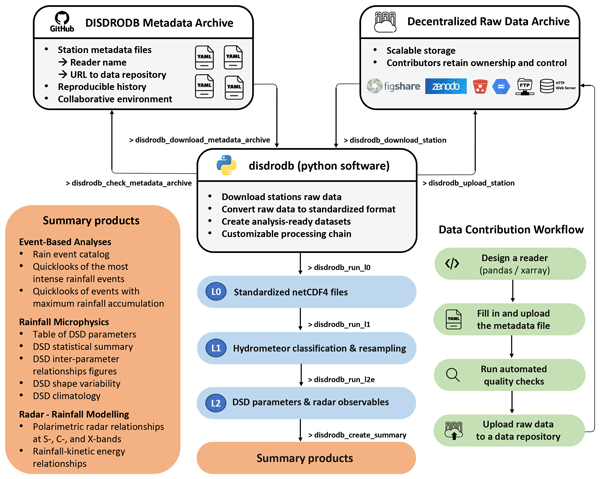
This article presents the DISDRODB infrastructure and the associated open-source Python package disdrodb, a community framework for standardized sharing, processing, and analysis of disdrometer data. DISDRODB combines a centralized metadata archive with a decentralized data-sharing model, allowing institutions to retain control of raw data while making their datasets globally discoverable and straightforward for users to access and download through a common interface. The disdrodb software converts heterogeneous raw measurements into analysis-ready products through a modular three-level pipeline: L0 for standardized ingestion and formatting into netCDF4, L1 for temporal resampling, quality control, and hydrometeor/precipitation-type classification, and L2 for derivation of PSD integral parameters, parametric PSD model fitting, and simulation of polarimetric radar variables at multiple frequencies.
The framework provides a transparent, configurable, and reproducible open-source workflow for disdrometer data processing, with scalable execution from local environments to distributed computing systems. It also supports automatic generation of summary diagnostics for scientific analysis and is built on a modular, flexible architecture designed for community-driven extensions.
DISDRODB lowers barriers to both data access and analysis by enabling straightforward discovery and download of disdrometer datasets alongside reproducible processing workflows, thereby supporting large-sample studies of PSD variability, improved disdrometer intercomparison, and broader use of disdrometer observations in atmospheric science and remote sensing.
Competing interests: At least one of the (co-)authors is a member of the editorial board of Atmospheric Measurement Techniques.
Publisher's note: Copernicus Publications remains neutral with regard to jurisdictional claims made in the text, published maps, institutional affiliations, or any other geographical representation in this paper. While Copernicus Publications makes every effort to include appropriate place names, the final responsibility lies with the authors. Views expressed in the text are those of the authors and do not necessarily reflect the views of the publisher.-
Notice on discussion status
The requested preprint has a corresponding peer-reviewed final revised paper. You are encouraged to refer to the final revised version.
-
Preprint
(2314 KB)
-
The requested preprint has a corresponding peer-reviewed final revised paper. You are encouraged to refer to the final revised version.
- Preprint
(2314 KB) - Metadata XML
- BibTeX
- EndNote
- Final revised paper


Journal article(s) based on this preprint
Interactive discussion
Status: closed
-
RC1: 'Comment on egusphere-2026-1886', Anonymous Referee #1, 22 May 2026
Disdrometers and other non-catching precipitation measurement instruments have the potential to address some of the limitations of conventional catching precipitation gauges. For example, disdrometers have a greater sensitivity to detect trace amounts of precipitation compared to conventional catching-type gauges. They provide additional information on precipitation types (for which many of these instruments were originally developed). And the lack of a catching device reduces the required maintenance in the field. Despite being in use for some decades already, non-catching instruments have not been standardized for measuring precipitation amounts and related quantities in a similar manner to conventional catching gauges. As a result, uncertainties and limitations are difficult to assess systematically.
One of the main challenges is the use of proprietary software that varies between instrument types, which hampers data comparability. Researchers who choose to work with raw data face additional challenges, including the need to develop algorithms, handle large volumes of data, and manage metadata effectively. This often results in a lack of consistency and limits collaboration between researchers. Furthermore, many users adopt these instruments as "ground truth" for other precipitation research without critically evaluating their unique measurement methods.
This paper introduces disdrodb, a novel toolset that provides a standardized approach for processing, sharing, and analyzing raw data from disdrometers.
The authors present a well-organized and thorough discussion of disdrometer technology, its challenges, and the solutions offered by their disdrodb software package. They deliver an in-depth description of the tool, including its infrastructure, metadata archive, decentralized data sharing capabilities, and software for generating standardized data products. They provide examples that illustrate how the software processes and organizes data and also show selected use cases especially for radar applications. An appendix with methodological explanations gives further details on the methodology.
This paper addresses a critical gap in the field of precipitation measurement by providing a practical and standardized solution for processing and sharing disdrometer data. Although the paper is lengthy, the comprehensive detail it provides enhances its utility for a broad audience. Instead of requiring readers to consult multiple sources, the paper consolidates essential information, making it a practical, one-stop resource. I appreciate that the paper not only introduces a technical solution but also raises awareness of the implications and challenges of using these instruments. This is especially beneficial for users who may rely on disdrometers without fully understanding their measurement principles or limitations.
By fostering standardization and encouraging data sharing, disdrodb has the potential to significantly advance the utility and credibility of disdrometers in precipitation research. I strongly support its publication.
I only have very few specific comments:
Please use the citations as suggested by WMO for the WMO-Guide nr. 8 to meteorological instruments and measurements of observation: World Meteorological Organization (WMO). Guide to Instruments and Methods of Observation (WMO-No. 8), Volume I. Geneva, 2024. see https://library.wmo.int/records/item/68695-guide-to-instruments-and-methods-of-observation
I assume that you have produced Figure 4 yourself, but in the text you are mentioning that the partioning is based on Friedrich et al. (2013). I suggest to add this information also in the figure caption.
Citation: https://doi.org/10.5194/egusphere-2026-1886-RC1 -
AC1: 'Reply on RC1', Gionata Ghiggi, 22 Jun 2026
We thank the reviewer for their thorough reading of our manuscript, their appreciation of the utility of disdrodb, and their strong support for the publication of this work. Below we address the specific comments and outline the changes made to the manuscript.
Comment 1. Please use the citations as suggested by WMO for the WMO-Guide nr. 8 to meteorological instruments and measurements of observation: World Meteorological Organization (WMO). Guide to Instruments and Methods of Observation (WMO-No. 8), Volume I. Geneva, 2024. see https://library.wmo.int/records/item/68695-guide-to-instruments-and-methods-of-observation
Thank you for pointing this out. We have updated the citation for the WMO Guide in our bibliography to strictly follow the official formatting suggested by the WMO.
The WMO citations in the bibliography appear now as:- WMO: Manual on Codes (WMO-No. 306), Volume I.1., Tech. rep., World Meteorological Organization, ISBN 978-92-63-10306-2, https://library.wmo.int/idurl/4/35713, 2019.
- WMO: Guide to Instruments and Methods of Observation (WMO-No. 8), Volume I – Measurement of Meteorological Variables, Tech. rep., World Meteorological Organization, ISBN 9789263100085, https://doi.org/10.59327/WMO/CIMO/1, 2024
Comment 2. I assume that you have produced Figure 4 yourself, but in the text you are mentioning that the partitioning is based on Friedrich et al. (2013). I suggest to add this information also in the figure caption.
Figure 4 was produced by us, but the conceptual partitioning framework is indeed inspired by Friedrich et al. (2013). Following your suggestion, we have updated the caption of Figure 4 to explicitly acknowledge the source:
"Schematic illustration of particle size–velocity spectrum partitioning, inspired by Friedrich et al. 2013 and derived from theoretical fall velocity–particle size relationships (see Appendix B). The hydrometeor masks are automatically adjusted according to the station altitude."
Citation: https://doi.org/10.5194/egusphere-2026-1886-AC1
-
AC1: 'Reply on RC1', Gionata Ghiggi, 22 Jun 2026
-
RC2: 'Comment on egusphere-2026-1886', Scott Collis, 26 May 2026
The paper "disdrodb: an open-source Python package for standardized processing, sharing, and analysis of disdrometer data" by Gionata Ghiggi and co-authors describes a software framework Distrodb. It is comprehensive in its description of the package and provides a good reference for folks who are using the package. The paper is good but suffers from "filler text" which is not important to the main purpose of the paper.
One suggestion is to heavily pare down the text in the introduction. This is not a review article and the reader is not here to read a comparison of different rain gauge technology.
I also question the authors assertion that disdrometers can measure down to 0.01mm/hr of rainfall. Please provide a citation here. 0.01mm/hr is very very light rainfall (extremely light drizzle).
Citation: https://doi.org/10.5194/egusphere-2026-1886-RC2 -
AC2: 'Reply on RC2', Gionata Ghiggi, 22 Jun 2026
We sincerely thank the reviewer for their valuable feedback and critical evaluation of our manuscript. We appreciate the recognition that our paper is well-organized, comprehensive, and serves as a good reference for the community. Detailed responses to the reviewer’s comments are provided in the Supplement.
-
AC2: 'Reply on RC2', Gionata Ghiggi, 22 Jun 2026
Peer review completion


Interactive discussion
Status: closed
-
RC1: 'Comment on egusphere-2026-1886', Anonymous Referee #1, 22 May 2026
Disdrometers and other non-catching precipitation measurement instruments have the potential to address some of the limitations of conventional catching precipitation gauges. For example, disdrometers have a greater sensitivity to detect trace amounts of precipitation compared to conventional catching-type gauges. They provide additional information on precipitation types (for which many of these instruments were originally developed). And the lack of a catching device reduces the required maintenance in the field. Despite being in use for some decades already, non-catching instruments have not been standardized for measuring precipitation amounts and related quantities in a similar manner to conventional catching gauges. As a result, uncertainties and limitations are difficult to assess systematically.
One of the main challenges is the use of proprietary software that varies between instrument types, which hampers data comparability. Researchers who choose to work with raw data face additional challenges, including the need to develop algorithms, handle large volumes of data, and manage metadata effectively. This often results in a lack of consistency and limits collaboration between researchers. Furthermore, many users adopt these instruments as "ground truth" for other precipitation research without critically evaluating their unique measurement methods.
This paper introduces disdrodb, a novel toolset that provides a standardized approach for processing, sharing, and analyzing raw data from disdrometers.
The authors present a well-organized and thorough discussion of disdrometer technology, its challenges, and the solutions offered by their disdrodb software package. They deliver an in-depth description of the tool, including its infrastructure, metadata archive, decentralized data sharing capabilities, and software for generating standardized data products. They provide examples that illustrate how the software processes and organizes data and also show selected use cases especially for radar applications. An appendix with methodological explanations gives further details on the methodology.
This paper addresses a critical gap in the field of precipitation measurement by providing a practical and standardized solution for processing and sharing disdrometer data. Although the paper is lengthy, the comprehensive detail it provides enhances its utility for a broad audience. Instead of requiring readers to consult multiple sources, the paper consolidates essential information, making it a practical, one-stop resource. I appreciate that the paper not only introduces a technical solution but also raises awareness of the implications and challenges of using these instruments. This is especially beneficial for users who may rely on disdrometers without fully understanding their measurement principles or limitations.
By fostering standardization and encouraging data sharing, disdrodb has the potential to significantly advance the utility and credibility of disdrometers in precipitation research. I strongly support its publication.
I only have very few specific comments:
Please use the citations as suggested by WMO for the WMO-Guide nr. 8 to meteorological instruments and measurements of observation: World Meteorological Organization (WMO). Guide to Instruments and Methods of Observation (WMO-No. 8), Volume I. Geneva, 2024. see https://library.wmo.int/records/item/68695-guide-to-instruments-and-methods-of-observation
I assume that you have produced Figure 4 yourself, but in the text you are mentioning that the partioning is based on Friedrich et al. (2013). I suggest to add this information also in the figure caption.
Citation: https://doi.org/10.5194/egusphere-2026-1886-RC1 -
AC1: 'Reply on RC1', Gionata Ghiggi, 22 Jun 2026
We thank the reviewer for their thorough reading of our manuscript, their appreciation of the utility of disdrodb, and their strong support for the publication of this work. Below we address the specific comments and outline the changes made to the manuscript.
Comment 1. Please use the citations as suggested by WMO for the WMO-Guide nr. 8 to meteorological instruments and measurements of observation: World Meteorological Organization (WMO). Guide to Instruments and Methods of Observation (WMO-No. 8), Volume I. Geneva, 2024. see https://library.wmo.int/records/item/68695-guide-to-instruments-and-methods-of-observation
Thank you for pointing this out. We have updated the citation for the WMO Guide in our bibliography to strictly follow the official formatting suggested by the WMO.
The WMO citations in the bibliography appear now as:- WMO: Manual on Codes (WMO-No. 306), Volume I.1., Tech. rep., World Meteorological Organization, ISBN 978-92-63-10306-2, https://library.wmo.int/idurl/4/35713, 2019.
- WMO: Guide to Instruments and Methods of Observation (WMO-No. 8), Volume I – Measurement of Meteorological Variables, Tech. rep., World Meteorological Organization, ISBN 9789263100085, https://doi.org/10.59327/WMO/CIMO/1, 2024
Comment 2. I assume that you have produced Figure 4 yourself, but in the text you are mentioning that the partitioning is based on Friedrich et al. (2013). I suggest to add this information also in the figure caption.
Figure 4 was produced by us, but the conceptual partitioning framework is indeed inspired by Friedrich et al. (2013). Following your suggestion, we have updated the caption of Figure 4 to explicitly acknowledge the source:
"Schematic illustration of particle size–velocity spectrum partitioning, inspired by Friedrich et al. 2013 and derived from theoretical fall velocity–particle size relationships (see Appendix B). The hydrometeor masks are automatically adjusted according to the station altitude."
Citation: https://doi.org/10.5194/egusphere-2026-1886-AC1
-
AC1: 'Reply on RC1', Gionata Ghiggi, 22 Jun 2026
-
RC2: 'Comment on egusphere-2026-1886', Scott Collis, 26 May 2026
The paper "disdrodb: an open-source Python package for standardized processing, sharing, and analysis of disdrometer data" by Gionata Ghiggi and co-authors describes a software framework Distrodb. It is comprehensive in its description of the package and provides a good reference for folks who are using the package. The paper is good but suffers from "filler text" which is not important to the main purpose of the paper.
One suggestion is to heavily pare down the text in the introduction. This is not a review article and the reader is not here to read a comparison of different rain gauge technology.
I also question the authors assertion that disdrometers can measure down to 0.01mm/hr of rainfall. Please provide a citation here. 0.01mm/hr is very very light rainfall (extremely light drizzle).
Citation: https://doi.org/10.5194/egusphere-2026-1886-RC2 -
AC2: 'Reply on RC2', Gionata Ghiggi, 22 Jun 2026
We sincerely thank the reviewer for their valuable feedback and critical evaluation of our manuscript. We appreciate the recognition that our paper is well-organized, comprehensive, and serves as a good reference for the community. Detailed responses to the reviewer’s comments are provided in the Supplement.
-
AC2: 'Reply on RC2', Gionata Ghiggi, 22 Jun 2026
Peer review completion
Journal article(s) based on this preprint
Viewed
| HTML | XML | Total | BibTeX | EndNote | |
|---|---|---|---|---|---|
| 391 | 195 | 47 | 633 | 39 | 37 |
- HTML: 391
- PDF: 195
- XML: 47
- Total: 633
- BibTeX: 39
- EndNote: 37
Viewed (geographical distribution)
| Country | # | Views | % |
|---|
| Total: | 0 |
| HTML: | 0 |
| PDF: | 0 |
| XML: | 0 |
- 1
Gionata Ghiggi
Kim Candolfi
Anne-Claire Billaux-Roux
Régis Longchamps
Son Pham-Ba
Charlotte Weil

The requested preprint has a corresponding peer-reviewed final revised paper. You are encouraged to refer to the final revised version.
- Preprint
(2314 KB) - Metadata XML