
the Creative Commons Attribution 4.0 License.
the Creative Commons Attribution 4.0 License.
 | 10 Apr 2026
First Observations of the Solar-Heating Imprint on Seasonal Variations in Diurnal Tidal Structure in the MLT Region
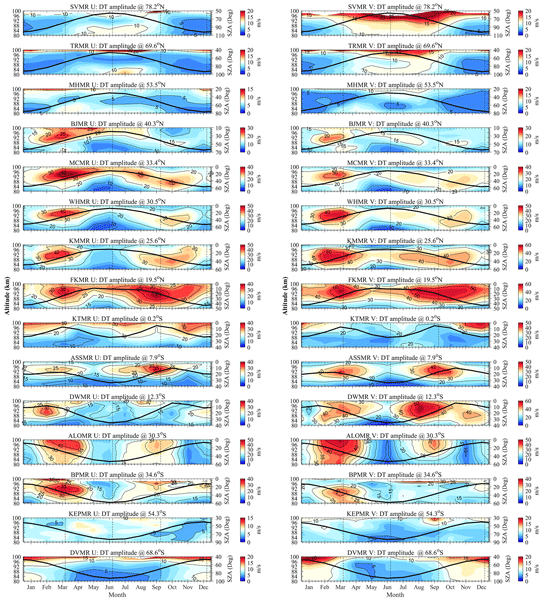
Abstract. A global climatology of diurnal tides in the mesosphere and lower thermosphere (MLT) is constructed using multiyear observations from fifteen meteor radars distributed worldwide. The results show that diurnal tidal amplitudes are strongest at low and mid-latitudes (10°–50° N/S), with peak values of about 60 m s-1 near 20°–30° N/S, and are comparatively weak near the Equator and at polar latitudes. The seasonal variations of the diurnal tide are characterized by maxima around the equinoxes and minima during the solstices. In addition to these global climatological features, we identify a clear modulation of the vertical structure of diurnal tidal amplitude and phase by seasonal variations in solar forcing, represented here by the solar zenith angle (SZA). This modulation is particularly evident at northern low and mid-latitudes, but is much weaker in the Southern Hemisphere. The hemispheric asymmetry suggests that the tidal response to solar forcing is not globally uniform. To further explore the possible cause of this asymmetry, we examine the meridional fluxes of zonal tidal momentum. The results suggest that background zonal winds can influence tidal propagation through filtering effects and momentum drag, thereby contributing to the observed hemispheric differences in tidal structure. These results provide new observational evidence for the coupling between solar forcing and diurnal tides in the MLT region and offer useful constraints for the evaluation of general circulation models. They also improve our understanding of tidal propagation and variability in the middle and upper atmosphere.
-
Notice on discussion status
The requested preprint has a corresponding peer-reviewed final revised paper. You are encouraged to refer to the final revised version.
-
Preprint
(4805 KB)
-
The requested preprint has a corresponding peer-reviewed final revised paper. You are encouraged to refer to the final revised version.
- Preprint
(4805 KB) - Metadata XML
- BibTeX
- EndNote
- Final revised paper


Journal article(s) based on this preprint
Interactive discussion
Status: closed
-
RC1: 'Comment on egusphere-2026-1883', Anonymous Referee #1, 12 Jun 2026
-
AC1: 'Reply on RC1', Wen Yi, 13 Aug 2026
The comment was uploaded in the form of a supplement: https://egusphere.copernicus.org/preprints/2026/egusphere-2026-1883/egusphere-2026-1883-AC1-supplement.pdf
-
AC1: 'Reply on RC1', Wen Yi, 13 Aug 2026
-
RC2: 'Comment on egusphere-2026-1883', Anonymous Referee #2, 26 Jun 2026
General comment:
The manuscript presents climatologies of the diurnal tidal amplitude and phases obtained from 15 meteor radars covering nearly all latitudes from Antarctica up to the far North on Svalbard. Furthermore, the solar zenith angle is used as a proxy to correlate the tidal excitation with the derived climatological behavior. The study also includes an intercomparison of WACCM model data. The key findings of the manuscript are related to interhemispheric asymmetries in the climatological pattern of the diurnal tide. The semidiurnal tide is briefly discussed in the context of the solar zenith angle, but no correlation was found.
More specific comments:
- ALOMR is assigned to be a Genesis LTd manufactured radar, but it is an ATARD multistatic setup. Please correct.
- Tidal fits and climatology
It is recommended to add a sentence on how the climatologies are obtained from the 7-day tidal fits. It might also be worth mentioning that when tidal amplitudes from different studies are compared, some deviations might be simply due to different data processing.
- Image quality
The image quality is a bit hard to read and needs to be improved. When looking at the overview images, it is hard to read the station names.
- The discussion of the solar zenith angle as a proxy for the tidal excitation needs to be expanded. The temporal variability and interhemispheric differences of trace gases play a crucial role in the tidal excitation and need to be discussed in a bit more detail. Exothermic chemical reactions, primary, secondary, and tertiary ozone might also have a more pronounced effect on the tidal amplitude and phases.
- WACCM
The reviewer recommends adding a paragraph describing the details of the run used for the analysis. Meanwhile, there are so many versions of WACCM, WACCM-X available that the results might differ between different runs. The paragraph should contain some general information on the grid resolution, temporal resolution, and GW parameterizations.
- Tidal momentum flux
The section about the tidal momentum flux is a bit confusing. The estimated momentum flux describes how the tides would interact with the mean flow. It is not clear to the reviewer how this quantity can be used to justify that background winds modulate tidal amplitudes and phase, affecting the vertical propagation. This needs to be clarified. However, this parameter seems to be a valuable diagnostic to demonstrate the importance of the diurnal tidal forcing on the mean flow. The values appear to be rather large compared to GW forcing, which would underline that the tides play an important role as well as gravity waves. This also deserves some discussion and is a major contribution of the study.
- Figure A1
Looking at Figure A1, there appears to be a mismatch of the y-label. The Figure title says ‘phase’ plots, but the y-label describes amplitude.
Citation: https://doi.org/10.5194/egusphere-2026-1883-RC2 -
AC2: 'Reply on RC2', Wen Yi, 13 Aug 2026
The comment was uploaded in the form of a supplement: https://egusphere.copernicus.org/preprints/2026/egusphere-2026-1883/egusphere-2026-1883-AC2-supplement.pdf
Peer review completion
Post-review adjustments


Interactive discussion
Status: closed
-
RC1: 'Comment on egusphere-2026-1883', Anonymous Referee #1, 12 Jun 2026
Review of “First Observations of the Solar-Heating Imprint on Seasonal Variations in Diurnal Tidal Structure in the MLT Region” by Wen Yi et al.
General comments
This new manuscript presents a global observational study of diurnal tides in the mesosphere and lower thermosphere region based on multi-year wind measurements from fifteen meteor radars distributed from the southern to the northern polar regions. The authors derive seasonal-altitude structures of diurnal tidal amplitudes and phases and show that the tides are strongest at low and mid-latitudes, with pronounced maxima near the equinoxes and weaker amplitudes near the solstices, the equator, and polar latitudes. A key result is the identification of a modulation of the vertical tidal structure by seasonal changes in solar forcing, represented by the solar zenith angle. This imprint is most evident at northern low and mid-latitudes and appears weaker in the Southern Hemisphere, suggesting a hemispheric asymmetry in the tidal response. The study further compares the observations with SD-WACCM simulations and discusses the possible role of background winds and tidal momentum fluxes in shaping the observed differences.
The manuscript is methodologically sound and presents a valuable observational data set. In particular, the use of multi-year measurements from fifteen meteor radars provides an unusually broad ground-based perspective on diurnal tides in the MLT region. I therefore consider the study useful for the community. However, the manuscript would benefit from a clearer and more compelling motivation. At present, the Introduction explains the general relevance of atmospheric tides and the limitations of previous satellite- and single-station-based studies, but it does not sufficiently sharpen the specific knowledge gap addressed here. As a result, the reader only gradually understands why the reported solar-heating imprint, its hemispheric asymmetry, and the comparison with SD-WACCM represent a significant advance rather than an incremental climatological description.
I recommend that the authors revise the Introduction and possibly the beginning of the Discussion to state more explicitly: (i) what was not known before about the seasonal vertical structure of diurnal tides from ground-based observations, (ii) why solar zenith angle provides a useful conceptual framework for interpreting these variations, (iii) why the hemispheric asymmetry is physically important, and (iv) how the results constrain or challenge current general circulation models. This would make the paper more engaging and help readers better appreciate the broader significance of an otherwise solid analysis.
Overall, I find the manuscript scientifically sound and based on a solid observational and methodological framework. The data set is valuable, the analysis appears appropriate, and the main conclusions are generally supported by the presented results. I therefore recommend publication of the manuscript after minor revision. The revision should mainly focus on improving the clarity of the scientific motivation, sharpening the statement of novelty and broader relevance, and addressing the specific comments listed below.
Specific comments
Lines 50–61 and Section 3.2 (lines 288–323): The authors might want to be more precise in framing the novelty of the reported SZA dependence. The general influence of solar heating, and hence of seasonal variations in solar illumination, on atmospheric thermal tides is well established. Therefore, the novelty of the present study should not be presented as the discovery that solar forcing affects diurnal tides per se. Rather, the authors should clarify that their contribution is the global meteor-radar-based observational documentation of an SZA-related modulation of the vertical amplitude and phase structure of locally observed diurnal tides in the MLT region, including its hemispheric asymmetry and its incomplete representation in SD-WACCM.
Lines 114–117: The manuscript refers to a “global climatology” and emphasizes the global distribution of the meteor-radar network. While the use of fifteen radars indeed provides a very valuable and unusually broad ground-based perspective, the spatial sampling is not globally uniform. In particular, some latitude and longitude sectors are much better represented than others, with several Northern Hemisphere stations concentrated in East Asia. The authors may wish to slightly qualify the wording where appropriate, or briefly discuss how the non-uniform station distribution could affect the interpretation of hemispheric differences and the representativeness of the inferred “global” patterns.
Lines 150–156 and Fig. A1: The authors state that the choice of fitting window length has only a minimal effect on the analysis of seasonal tidal variations and therefore adopt a 7-day window with a 1-day step. However, Fig. A1 appears to indicate that the 11-day window leads to somewhat stronger smoothing of the time series compared with the 5-day and 7-day windows. While this may not affect the climatological seasonal patterns emphasized in the manuscript, it would be useful to mention this smoothing effect explicitly and to clarify that the conclusion of “minimal effect” refers mainly to the seasonal-scale variability considered here, rather than to shorter-term tidal variability.
Section 3.2 (lines 288–323): The reported relationship between SZA and the vertical structure of the diurnal tide is one of the central results of the manuscript. At present, however, this relationship appears to be mainly inferred visually from the seasonal-altitude plots. It would strengthen the paper if the authors could quantify this relationship more explicitly, for example by providing correlation coefficients, lag correlations, or a simple metric describing the seasonal variation in the altitude of the amplitude maximum. This would make the evidence for the proposed SZA modulation more robust and easier to assess.
Lines 337–351: The authors correctly note that single-station meteor-radar observations represent a combination of migrating and nonmigrating tidal components. This limitation should be more explicitly connected to the interpretation of the SZA dependence. Since nonmigrating tides may be influenced by zonally asymmetric heating, topography, latent heat release, and wave interactions, the authors should be cautious not to imply that the observed local tidal structures can be attributed to direct solar forcing alone. A short clarification would help distinguish between the established role of solar heating in tidal excitation and the more complex interpretation of locally observed composite tides.
Lines 352–363: The authors refer only generally to “data from the European Centre for Medium-Range Weather Forecasts (ECMWF)” when discussing surface net solar radiation and surface latent heat flux. However, the Data Availability Statement suggests that ERA5 reanalysis data were used. This should be stated explicitly in the main text, including the specific data product and variables used, and the appropriate reference should be added, i.e. Hersbach et al. (2020) for ERA5.
Conclusions (lines 422–449): The manuscript focuses on climatological seasonal patterns, but I wonder whether the authors could make better use of the multi-year nature of the radar data set by briefly discussing interannual variability. This aspect may be relevant because the individual radar records have different lengths and cover partly different years. Although the authors compare results from shorter and longer subsets at Davis to assess the robustness of the climatology, it would still be useful to know how large the year-to-year variability of the diurnal tide amplitudes and phases is at selected stations, and whether it could influence the inferred seasonal structures or hemispheric differences. I do not necessarily suggest a full additional analysis, but a short discussion, or one representative supplementary figure, would help readers assess the robustness and representativeness of the reported climatological patterns.
Conclusions (lines 422–449): The comparison with SD-WACCM is discussed in Section 3.2, but it is not clearly taken up again in the Conclusions. Since the model comparison is an important part of the manuscript and helps demonstrate the value of the observational data set, the authors should briefly summarize the main outcome there. In particular, the Conclusions should state that SD-WACCM reproduces some aspects of the observed seasonal diurnal-tide variability, especially at higher latitudes and partly in the phase structure, but does not fully capture the SZA-related amplitude modulation and the observed low- and mid-latitude seasonal patterns. This would also strengthen the statement that the radar climatology provides useful constraints for model evaluation.
Technical corrections
Lines 211–214: The sentence “However, the seasonal morphology of diurnal tides two conjugate 30° latitudes…” is a bit unclear and appears to be grammatically incorrect.
Line 233: “The Meridional DT amplitudes” -> “The meridional DT amplitudes”
Line 434: “vertical altitude structure” is redundant, use “vertical structure” or “altitude structure”
Citation: https://doi.org/10.5194/egusphere-2026-1883-RC1 -
AC1: 'Reply on RC1', Wen Yi, 13 Aug 2026
The comment was uploaded in the form of a supplement: https://egusphere.copernicus.org/preprints/2026/egusphere-2026-1883/egusphere-2026-1883-AC1-supplement.pdf
-
AC1: 'Reply on RC1', Wen Yi, 13 Aug 2026
-
RC2: 'Comment on egusphere-2026-1883', Anonymous Referee #2, 26 Jun 2026
General comment:
The manuscript presents climatologies of the diurnal tidal amplitude and phases obtained from 15 meteor radars covering nearly all latitudes from Antarctica up to the far North on Svalbard. Furthermore, the solar zenith angle is used as a proxy to correlate the tidal excitation with the derived climatological behavior. The study also includes an intercomparison of WACCM model data. The key findings of the manuscript are related to interhemispheric asymmetries in the climatological pattern of the diurnal tide. The semidiurnal tide is briefly discussed in the context of the solar zenith angle, but no correlation was found.
More specific comments:
- ALOMR is assigned to be a Genesis LTd manufactured radar, but it is an ATARD multistatic setup. Please correct.
- Tidal fits and climatology
It is recommended to add a sentence on how the climatologies are obtained from the 7-day tidal fits. It might also be worth mentioning that when tidal amplitudes from different studies are compared, some deviations might be simply due to different data processing.
- Image quality
The image quality is a bit hard to read and needs to be improved. When looking at the overview images, it is hard to read the station names.
- The discussion of the solar zenith angle as a proxy for the tidal excitation needs to be expanded. The temporal variability and interhemispheric differences of trace gases play a crucial role in the tidal excitation and need to be discussed in a bit more detail. Exothermic chemical reactions, primary, secondary, and tertiary ozone might also have a more pronounced effect on the tidal amplitude and phases.
- WACCM
The reviewer recommends adding a paragraph describing the details of the run used for the analysis. Meanwhile, there are so many versions of WACCM, WACCM-X available that the results might differ between different runs. The paragraph should contain some general information on the grid resolution, temporal resolution, and GW parameterizations.
- Tidal momentum flux
The section about the tidal momentum flux is a bit confusing. The estimated momentum flux describes how the tides would interact with the mean flow. It is not clear to the reviewer how this quantity can be used to justify that background winds modulate tidal amplitudes and phase, affecting the vertical propagation. This needs to be clarified. However, this parameter seems to be a valuable diagnostic to demonstrate the importance of the diurnal tidal forcing on the mean flow. The values appear to be rather large compared to GW forcing, which would underline that the tides play an important role as well as gravity waves. This also deserves some discussion and is a major contribution of the study.
- Figure A1
Looking at Figure A1, there appears to be a mismatch of the y-label. The Figure title says ‘phase’ plots, but the y-label describes amplitude.
Citation: https://doi.org/10.5194/egusphere-2026-1883-RC2 -
AC2: 'Reply on RC2', Wen Yi, 13 Aug 2026
The comment was uploaded in the form of a supplement: https://egusphere.copernicus.org/preprints/2026/egusphere-2026-1883/egusphere-2026-1883-AC2-supplement.pdf
Peer review completion
Post-review adjustments
Journal article(s) based on this preprint
Viewed
| HTML | XML | Total | BibTeX | EndNote | |
|---|---|---|---|---|---|
| 404 | 157 | 55 | 616 | 37 | 40 |
- HTML: 404
- PDF: 157
- XML: 55
- Total: 616
- BibTeX: 37
- EndNote: 40
Viewed (geographical distribution)
| Country | # | Views | % |
|---|
| Total: | 0 |
| HTML: | 0 |
| PDF: | 0 |
| XML: | 0 |
- 1
Jianyuan Wang

Chengyun Yang
Iain M. Reid
Robert A. Vincent
Andrew Mackinnon
Damian J. Murphy
Njål Gulbrandsen
Masaki Tsutsumi
Baiqi Ning
Guozhu Li
Nicholas J. Mitchell
Tracy Moffat-Griffin
Toshitaka Tsuda
Alan Z. Liu
Zishun Qiao
Haiying Li
Paulo P. Batista
Jianfei Wu
Tingdi Chen
Xiankang Dou
The requested preprint has a corresponding peer-reviewed final revised paper. You are encouraged to refer to the final revised version.
- Preprint
(4805 KB) - Metadata XML
Review of “First Observations of the Solar-Heating Imprint on Seasonal Variations in Diurnal Tidal Structure in the MLT Region” by Wen Yi et al.
General comments
This new manuscript presents a global observational study of diurnal tides in the mesosphere and lower thermosphere region based on multi-year wind measurements from fifteen meteor radars distributed from the southern to the northern polar regions. The authors derive seasonal-altitude structures of diurnal tidal amplitudes and phases and show that the tides are strongest at low and mid-latitudes, with pronounced maxima near the equinoxes and weaker amplitudes near the solstices, the equator, and polar latitudes. A key result is the identification of a modulation of the vertical tidal structure by seasonal changes in solar forcing, represented by the solar zenith angle. This imprint is most evident at northern low and mid-latitudes and appears weaker in the Southern Hemisphere, suggesting a hemispheric asymmetry in the tidal response. The study further compares the observations with SD-WACCM simulations and discusses the possible role of background winds and tidal momentum fluxes in shaping the observed differences.
The manuscript is methodologically sound and presents a valuable observational data set. In particular, the use of multi-year measurements from fifteen meteor radars provides an unusually broad ground-based perspective on diurnal tides in the MLT region. I therefore consider the study useful for the community. However, the manuscript would benefit from a clearer and more compelling motivation. At present, the Introduction explains the general relevance of atmospheric tides and the limitations of previous satellite- and single-station-based studies, but it does not sufficiently sharpen the specific knowledge gap addressed here. As a result, the reader only gradually understands why the reported solar-heating imprint, its hemispheric asymmetry, and the comparison with SD-WACCM represent a significant advance rather than an incremental climatological description.
I recommend that the authors revise the Introduction and possibly the beginning of the Discussion to state more explicitly: (i) what was not known before about the seasonal vertical structure of diurnal tides from ground-based observations, (ii) why solar zenith angle provides a useful conceptual framework for interpreting these variations, (iii) why the hemispheric asymmetry is physically important, and (iv) how the results constrain or challenge current general circulation models. This would make the paper more engaging and help readers better appreciate the broader significance of an otherwise solid analysis.
Overall, I find the manuscript scientifically sound and based on a solid observational and methodological framework. The data set is valuable, the analysis appears appropriate, and the main conclusions are generally supported by the presented results. I therefore recommend publication of the manuscript after minor revision. The revision should mainly focus on improving the clarity of the scientific motivation, sharpening the statement of novelty and broader relevance, and addressing the specific comments listed below.
Specific comments
Lines 50–61 and Section 3.2 (lines 288–323): The authors might want to be more precise in framing the novelty of the reported SZA dependence. The general influence of solar heating, and hence of seasonal variations in solar illumination, on atmospheric thermal tides is well established. Therefore, the novelty of the present study should not be presented as the discovery that solar forcing affects diurnal tides per se. Rather, the authors should clarify that their contribution is the global meteor-radar-based observational documentation of an SZA-related modulation of the vertical amplitude and phase structure of locally observed diurnal tides in the MLT region, including its hemispheric asymmetry and its incomplete representation in SD-WACCM.
Lines 114–117: The manuscript refers to a “global climatology” and emphasizes the global distribution of the meteor-radar network. While the use of fifteen radars indeed provides a very valuable and unusually broad ground-based perspective, the spatial sampling is not globally uniform. In particular, some latitude and longitude sectors are much better represented than others, with several Northern Hemisphere stations concentrated in East Asia. The authors may wish to slightly qualify the wording where appropriate, or briefly discuss how the non-uniform station distribution could affect the interpretation of hemispheric differences and the representativeness of the inferred “global” patterns.
Lines 150–156 and Fig. A1: The authors state that the choice of fitting window length has only a minimal effect on the analysis of seasonal tidal variations and therefore adopt a 7-day window with a 1-day step. However, Fig. A1 appears to indicate that the 11-day window leads to somewhat stronger smoothing of the time series compared with the 5-day and 7-day windows. While this may not affect the climatological seasonal patterns emphasized in the manuscript, it would be useful to mention this smoothing effect explicitly and to clarify that the conclusion of “minimal effect” refers mainly to the seasonal-scale variability considered here, rather than to shorter-term tidal variability.
Section 3.2 (lines 288–323): The reported relationship between SZA and the vertical structure of the diurnal tide is one of the central results of the manuscript. At present, however, this relationship appears to be mainly inferred visually from the seasonal-altitude plots. It would strengthen the paper if the authors could quantify this relationship more explicitly, for example by providing correlation coefficients, lag correlations, or a simple metric describing the seasonal variation in the altitude of the amplitude maximum. This would make the evidence for the proposed SZA modulation more robust and easier to assess.
Lines 337–351: The authors correctly note that single-station meteor-radar observations represent a combination of migrating and nonmigrating tidal components. This limitation should be more explicitly connected to the interpretation of the SZA dependence. Since nonmigrating tides may be influenced by zonally asymmetric heating, topography, latent heat release, and wave interactions, the authors should be cautious not to imply that the observed local tidal structures can be attributed to direct solar forcing alone. A short clarification would help distinguish between the established role of solar heating in tidal excitation and the more complex interpretation of locally observed composite tides.
Lines 352–363: The authors refer only generally to “data from the European Centre for Medium-Range Weather Forecasts (ECMWF)” when discussing surface net solar radiation and surface latent heat flux. However, the Data Availability Statement suggests that ERA5 reanalysis data were used. This should be stated explicitly in the main text, including the specific data product and variables used, and the appropriate reference should be added, i.e. Hersbach et al. (2020) for ERA5.
Conclusions (lines 422–449): The manuscript focuses on climatological seasonal patterns, but I wonder whether the authors could make better use of the multi-year nature of the radar data set by briefly discussing interannual variability. This aspect may be relevant because the individual radar records have different lengths and cover partly different years. Although the authors compare results from shorter and longer subsets at Davis to assess the robustness of the climatology, it would still be useful to know how large the year-to-year variability of the diurnal tide amplitudes and phases is at selected stations, and whether it could influence the inferred seasonal structures or hemispheric differences. I do not necessarily suggest a full additional analysis, but a short discussion, or one representative supplementary figure, would help readers assess the robustness and representativeness of the reported climatological patterns.
Conclusions (lines 422–449): The comparison with SD-WACCM is discussed in Section 3.2, but it is not clearly taken up again in the Conclusions. Since the model comparison is an important part of the manuscript and helps demonstrate the value of the observational data set, the authors should briefly summarize the main outcome there. In particular, the Conclusions should state that SD-WACCM reproduces some aspects of the observed seasonal diurnal-tide variability, especially at higher latitudes and partly in the phase structure, but does not fully capture the SZA-related amplitude modulation and the observed low- and mid-latitude seasonal patterns. This would also strengthen the statement that the radar climatology provides useful constraints for model evaluation.
Technical corrections
Lines 211–214: The sentence “However, the seasonal morphology of diurnal tides two conjugate 30° latitudes…” is a bit unclear and appears to be grammatically incorrect.
Line 233: “The Meridional DT amplitudes” -> “The meridional DT amplitudes”
Line 434: “vertical altitude structure” is redundant, use “vertical structure” or “altitude structure”