
the Creative Commons Attribution 4.0 License.
the Creative Commons Attribution 4.0 License.
 | 30 Apr 2026
Strategic Design of Methane Observation Networks to Improve Emission Estimates: A Case Study in Africa
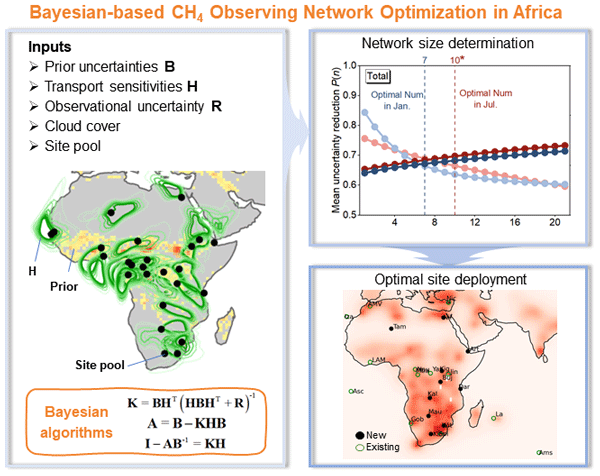
Abstract. Ground-based and satellite atmospheric observations are essential for reducing uncertainties in methane (CH4) emissions by atmospheric inversion, particularly in data-sparse regions such as Africa. However, adding new observation sites does not yield linear improvements of emission uncertainties because overlapping transport sensitivities reduces marginal information gain. Here we develop a Bayesian framework to strategically optimize CH4 observation network design for column retrievals from upward-looking Fourier Transform Infrared (FTIR) spectrometers (e.g., EM27/SUN), jointly identifying the optimal number of sites and their spatial configuration. The framework quantifies uncertainty reduction for grid-point (1°) total and sectoral emissions while accounting for transport redundancy, cloud screening, and observational errors. Using January and July as representative months, we find that uncertainty reduction increases rapidly during early network expansion but gradually saturates beyond a certain number of additional sites. An optimized configuration of ten new sites added to the existing network achieves over 65 % reduction in prior uncertainty for total African CH4 emissions in both months, with comparable improvements across fire, wetland, and anthropogenic sectors. Sensitivity analyses indicate that while the optimal number of sites varies with assumptions about cloud filtering, the spatial configuration remains robust, supporting cost-effective observation network design in data-sparse regions.
-
Notice on discussion status
The requested preprint has a corresponding peer-reviewed final revised paper. You are encouraged to refer to the final revised version.
-
Preprint
(2229 KB)
-
Supplement
(3515 KB)
-
The requested preprint has a corresponding peer-reviewed final revised paper. You are encouraged to refer to the final revised version.
- Preprint
(2229 KB) - Metadata XML
-
Supplement
(3515 KB) - BibTeX
- EndNote
- Final revised paper


Journal article(s) based on this preprint
Interactive discussion
Status: closed
-
RC1: 'Comment on egusphere-2026-1832', Anonymous Referee #1, 22 Jun 2026
-
AC1: 'Reply on RC1', Hui Li, 24 Jul 2026
The comment was uploaded in the form of a supplement: https://egusphere.copernicus.org/preprints/2026/egusphere-2026-1832/egusphere-2026-1832-AC1-supplement.pdf
-
AC1: 'Reply on RC1', Hui Li, 24 Jul 2026
-
RC2: 'Comment on egusphere-2026-1832', Anonymous Referee #2, 17 Jul 2026
The manuscript presented by Li et al. investigates an optimal design (size and placement) of an EM27 total column CH4 network in Africa.
This is an excellent manuscript, very well written, concise and easy to follow. The proposed method employs a Bayesian framework building on previous network design studies such as Kaminski and Rayner (2017). The design involves two steps, first finding an optimal number of sites from an ensemble of candidate sites, then identifying the optimal combination of sites for this number maximising the uncertainty reduction for a selected target quantity (e.g. total African CH4 emissions). The method is sound, well-motivated, and formally outlined in a clear way. The results of the study are convincing and relevant. I particularly like the approach of not randomly searching for locations, but starting from a pre-defined set of candidate sites potentially offering the infrastructure for setting up and operating such an instrument. Cloud cover is a severe limitation for this type of measurements, but is quite carefully included in the analysis.
The manuscript is already in a very good state. I thus have only a few minor points and small corrections:
- Line 68: Please consider adding two recent network design for CO2 and CH4: 1. Villalobos et al. (https://doi.org/1088/1748-9326/adc41e), 2) Thanwerdas et al. (https://doi.org/10.5194/egusphere-2025-5804), which were similarly exploring the suitability of existing infrastructure.
- Line 152: The choice of a different year for the inventories (2023) and meteorology (2025) is certainly not ideal for natural fluxes correlated with meteorology such as wildfires and wetlands. I don't expect this to severely impact the results but this was clearly not an optimal choice when designing the study.
- Line 234. Up to this equation, this is all standard Bayesian formalism. It would be nice if it could be stated more clearly how the proposed network design approach differs from previous studies.
- Line 242: Incomplete sentence. Please add "is" between "n*" and "determined"
- Figure 2: The middle x-axis label of the upper figure should be corrected. It currently reads "9 Operational + 4 Plan Sites plan".
- Table S2 in the supplement: The table provides an overview the existing, planned, and candidate sites. Since this list is important, it should be stated more clearly in the manuscript how these planned and candidate sites were chosen. It is unclear, for example, which organization / project has planned the four sites. Also the selection of candidate sites needs some more explanation. What kind of sites are these? Why are they suited for EM27 deployment?
- Line 378: Seasonal transport patterns also play a role here.
- Line 453: It should probably be "system parameters" not "system parameter"
- Line 493: The last section should probably be called "Discussion and Conclusions" since there is no final Conclusion section.
- Line 501: The sentence emphasises that the global configuration avoids the need for lateral boundary conditions. However, I don’t see any difference from a regional study employing e.g. backward Lagrangian transport simulations over 10-20 days as often done. The footprints computed in this way would be very comparable to those computed with LMDZ. I thus suggest adding a sentence instead emphasising that the approach could equally well be applied in combination with backward Lagrangian transport simulations (which would likely be cheaper and could be run at higher resolution).
Citation: https://doi.org/10.5194/egusphere-2026-1832-RC2 -
AC2: 'Reply on RC2', Hui Li, 24 Jul 2026
The comment was uploaded in the form of a supplement: https://egusphere.copernicus.org/preprints/2026/egusphere-2026-1832/egusphere-2026-1832-AC2-supplement.pdf
Peer review completion


Post-review adjustments


Interactive discussion
Status: closed
-
RC1: 'Comment on egusphere-2026-1832', Anonymous Referee #1, 22 Jun 2026
Review of “Strategic Design of Methane Observation Networks to Improve Emission Estimates: A Case Study in Africa” by Li et al.
The article presents a way to optimize the design of a reference network within an area of interest (in this case for Methane remote sensing stations in Africa, but it can be applied to other species and regions), based on the reduction of emission uncertainties using a Bayesian inversion framework.It is important to note that the determination of the optimal number and spatial configuration of the network starts from a predetermined pool of candidate measurement sites, where sufficient expertise and support is deemed to be available.
The paper is clearly written, the methodology is sound, and while the individual optimal network configuration results are dependent on the choice of various key parameters, the robustness analysis clearly identifies a significant group of stations that are selected under almost all conditions.
General remarks:
line 289 and 290 on cloud statistics: Are only day-time hours considered?Section 3.4: A curious omission when it comes to quantifying the impact of certain variables, is the footprint sensitivity. This parameter is currently calculated based on the latter half of each month and thus comprises of 16 to 30 day backward integration lengths. Would it be possible to evaluate a subset of short vs long integration times?
line 465: Here you discuss a test where you vary the prescribed network size from 1 to 21 additional sites. However, all these simulations start from the presumption that all candidate sites in each variation will be selected at the same time. Another scenario would be an organic growth scenario, where stations are selected and added to the network, one at a time, each one aiming to maximize the uncertainty reduction. Would such a network configuration differ with the first approach?
Minor remark:
line 48: “particularly given the region’s high vulnerability to climate change” seems like a weird fit in this sentence? Shouldn’t it be the end of the follow up sentence?
The potential for rapid…further elevates the region’s importance in the global CH4 budget, particularly given the region’s high vulnerability to climate change. Or even the one after that. Despite this growing significance and the region’s high vulnerability to climate change, African…
Question:
As stated by the authors, the methodology can be applied to other species, and since the geographical distribution of emission sources differ between different species, so will the resulting optimal network configurations. In practice however, networks are rarely targeted towards a single molecule. What adjustments need to be made for the method to work on a set of molecules?Citation: https://doi.org/10.5194/egusphere-2026-1832-RC1 -
AC1: 'Reply on RC1', Hui Li, 24 Jul 2026
The comment was uploaded in the form of a supplement: https://egusphere.copernicus.org/preprints/2026/egusphere-2026-1832/egusphere-2026-1832-AC1-supplement.pdf
-
AC1: 'Reply on RC1', Hui Li, 24 Jul 2026
-
RC2: 'Comment on egusphere-2026-1832', Anonymous Referee #2, 17 Jul 2026
The manuscript presented by Li et al. investigates an optimal design (size and placement) of an EM27 total column CH4 network in Africa.
This is an excellent manuscript, very well written, concise and easy to follow. The proposed method employs a Bayesian framework building on previous network design studies such as Kaminski and Rayner (2017). The design involves two steps, first finding an optimal number of sites from an ensemble of candidate sites, then identifying the optimal combination of sites for this number maximising the uncertainty reduction for a selected target quantity (e.g. total African CH4 emissions). The method is sound, well-motivated, and formally outlined in a clear way. The results of the study are convincing and relevant. I particularly like the approach of not randomly searching for locations, but starting from a pre-defined set of candidate sites potentially offering the infrastructure for setting up and operating such an instrument. Cloud cover is a severe limitation for this type of measurements, but is quite carefully included in the analysis.
The manuscript is already in a very good state. I thus have only a few minor points and small corrections:
- Line 68: Please consider adding two recent network design for CO2 and CH4: 1. Villalobos et al. (https://doi.org/1088/1748-9326/adc41e), 2) Thanwerdas et al. (https://doi.org/10.5194/egusphere-2025-5804), which were similarly exploring the suitability of existing infrastructure.
- Line 152: The choice of a different year for the inventories (2023) and meteorology (2025) is certainly not ideal for natural fluxes correlated with meteorology such as wildfires and wetlands. I don't expect this to severely impact the results but this was clearly not an optimal choice when designing the study.
- Line 234. Up to this equation, this is all standard Bayesian formalism. It would be nice if it could be stated more clearly how the proposed network design approach differs from previous studies.
- Line 242: Incomplete sentence. Please add "is" between "n*" and "determined"
- Figure 2: The middle x-axis label of the upper figure should be corrected. It currently reads "9 Operational + 4 Plan Sites plan".
- Table S2 in the supplement: The table provides an overview the existing, planned, and candidate sites. Since this list is important, it should be stated more clearly in the manuscript how these planned and candidate sites were chosen. It is unclear, for example, which organization / project has planned the four sites. Also the selection of candidate sites needs some more explanation. What kind of sites are these? Why are they suited for EM27 deployment?
- Line 378: Seasonal transport patterns also play a role here.
- Line 453: It should probably be "system parameters" not "system parameter"
- Line 493: The last section should probably be called "Discussion and Conclusions" since there is no final Conclusion section.
- Line 501: The sentence emphasises that the global configuration avoids the need for lateral boundary conditions. However, I don’t see any difference from a regional study employing e.g. backward Lagrangian transport simulations over 10-20 days as often done. The footprints computed in this way would be very comparable to those computed with LMDZ. I thus suggest adding a sentence instead emphasising that the approach could equally well be applied in combination with backward Lagrangian transport simulations (which would likely be cheaper and could be run at higher resolution).
Citation: https://doi.org/10.5194/egusphere-2026-1832-RC2 -
AC2: 'Reply on RC2', Hui Li, 24 Jul 2026
The comment was uploaded in the form of a supplement: https://egusphere.copernicus.org/preprints/2026/egusphere-2026-1832/egusphere-2026-1832-AC2-supplement.pdf
Peer review completion
Post-review adjustments
Journal article(s) based on this preprint
Viewed
| HTML | XML | Total | Supplement | BibTeX | EndNote | |
|---|---|---|---|---|---|---|
| 479 | 156 | 67 | 702 | 92 | 65 | 66 |
- HTML: 479
- PDF: 156
- XML: 67
- Total: 702
- Supplement: 92
- BibTeX: 65
- EndNote: 66
Viewed (geographical distribution)
| Country | # | Views | % |
|---|
| Total: | 0 |
| HTML: | 0 |
| PDF: | 0 |
| XML: | 0 |
- 1
Hui Li

Philippe Ciais
Frederic Chevallier
Paul Palmer
Frank Hase
Morgan Lopez
Elsa Ordway
Shushi Peng
Danielle Monteverde
Michel Ramonet
Jason Michael St. Clair
Le Bienfaiteur Sagang
Benjamin Poulter
The requested preprint has a corresponding peer-reviewed final revised paper. You are encouraged to refer to the final revised version.
- Preprint
(2229 KB) - Metadata XML
-
Supplement
(3515 KB) - BibTeX
- EndNote
- Final revised paper
Review of “Strategic Design of Methane Observation Networks to Improve Emission Estimates: A Case Study in Africa” by Li et al.
The article presents a way to optimize the design of a reference network within an area of interest (in this case for Methane remote sensing stations in Africa, but it can be applied to other species and regions), based on the reduction of emission uncertainties using a Bayesian inversion framework.
It is important to note that the determination of the optimal number and spatial configuration of the network starts from a predetermined pool of candidate measurement sites, where sufficient expertise and support is deemed to be available.
The paper is clearly written, the methodology is sound, and while the individual optimal network configuration results are dependent on the choice of various key parameters, the robustness analysis clearly identifies a significant group of stations that are selected under almost all conditions.
General remarks:
line 289 and 290 on cloud statistics: Are only day-time hours considered?
Section 3.4: A curious omission when it comes to quantifying the impact of certain variables, is the footprint sensitivity. This parameter is currently calculated based on the latter half of each month and thus comprises of 16 to 30 day backward integration lengths. Would it be possible to evaluate a subset of short vs long integration times?
line 465: Here you discuss a test where you vary the prescribed network size from 1 to 21 additional sites. However, all these simulations start from the presumption that all candidate sites in each variation will be selected at the same time. Another scenario would be an organic growth scenario, where stations are selected and added to the network, one at a time, each one aiming to maximize the uncertainty reduction. Would such a network configuration differ with the first approach?
Minor remark:
line 48: “particularly given the region’s high vulnerability to climate change” seems like a weird fit in this sentence? Shouldn’t it be the end of the follow up sentence?
The potential for rapid…further elevates the region’s importance in the global CH4 budget, particularly given the region’s high vulnerability to climate change. Or even the one after that. Despite this growing significance and the region’s high vulnerability to climate change, African…
Question:
As stated by the authors, the methodology can be applied to other species, and since the geographical distribution of emission sources differ between different species, so will the resulting optimal network configurations. In practice however, networks are rarely targeted towards a single molecule. What adjustments need to be made for the method to work on a set of molecules?