
the Creative Commons Attribution 4.0 License.
the Creative Commons Attribution 4.0 License.
 | 15 Apr 2026
Understanding the Interannual Variability of Hail in Switzerland
Abstract. Hailstorms are among the most damaging natural hazards in Switzerland, yet the large-scale processes governing their interannual variability remain poorly understood, limiting the potential for early prediction and risk preparedness. Using a 64-year reconstruction of past hail days (1959–2022) and ERA5 reanalysis data, we identify the dominant atmospheric, oceanic, and land-surface patterns associated with particularly active hail seasons north and south of the Swiss Alps.
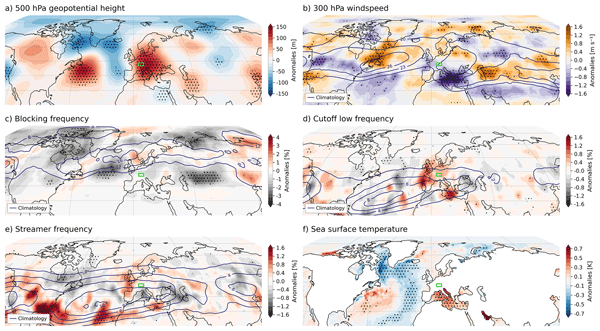
Active hail seasons are associated with recurrent large-scale circulation anomalies, characterized by a zonally or meridionally oriented Euro-Atlantic wave train, together with seasonally preconditioned background states in sea-surface temperatures, near-surface temperature, and the mid-tropospheric circulation. These conditions promote repeated occurrences of hail-favorable environments with warm and moist boundary layers, enhanced instability, and moderate convective inhibition. The identified patterns differ significantly from those in hail-sparse seasons and exhibit distinct regional differences: north of the Alps, moisture supply is linked primarily to Atlantic influences and continental evaporation, and the strongest seasonal-scale anomalies occur in temperature, indicating a predominantly temperature-limited regime. South of the Alps, hail activity is associated with frequent elevated dry-layer conditions and a stronger contribution from Mediterranean moisture, occurring in a generally more convection-favorable environment with weaker seasonal-scale anomalies. We further find wintertime precursors of active hail seasons, including continental cooling and Pacific SST anomalies resembling a positive Pacific Decadal Oscillation phase, pointing to low-frequency preconditioning through large-scale teleconnection pathways. Together, these results identify consistent circulation regimes and precursor signals that could underpin (sub-)seasonal hail prediction in Switzerland and Central Europe.
-
Notice on discussion status
The requested preprint has a corresponding peer-reviewed final revised paper. You are encouraged to refer to the final revised version.
-
Preprint
(51576 KB)
-
Supplement
(51881 KB)
-
The requested preprint has a corresponding peer-reviewed final revised paper. You are encouraged to refer to the final revised version.
- Preprint
(51576 KB) - Metadata XML
-
Supplement
(51881 KB) - BibTeX
- EndNote
- Final revised paper


Journal article(s) based on this preprint
Interactive discussion
Status: closed
- RC1: 'Comment on egusphere-2026-1831', Anonymous Referee #1, 24 May 2026
-
RC2: 'Comment on egusphere-2026-1831', Anonymous Referee #2, 27 May 2026
This manuscript investigates large- and local-scale atmospheric patterns associated with hail-active years in Switzerland. The analysis is conducted separately for northern and southern Switzerland, and highlights the similarities and differences of the discussed mechanisms. The manuscript is well written and clearly structured. The methodologyis robust and explained with an appropriate level of detail. The figures are informative and comprehensive, and the results are both original and noteworthy, making the study suitable for publication. I have only minor comments that should be addressed prior to
publication.Please find the review attached.
-
AC1: 'Author comment on egusphere-2026-1831', Lena Wilhelm, 23 Jul 2026
Dear reviewers,
we thank you for the thorough evaluation of the manuscript and for your helpful suggestions. The constructive feedback has helped us identify areas where clarification and additional information were needed to improve the manuscript. We have addressed all comments in detail in the reply document below.
Peer review completion


Interactive discussion
Status: closed
-
RC1: 'Comment on egusphere-2026-1831', Anonymous Referee #1, 24 May 2026
This manuscript highlights the large, and local scale patterns accompanied with high and low frequency hail years in Switzerland. Analysis is conducted on both the north, and the south side of the Swiss Alps, due to the differences in their respective convection-triggering mechanisms. The manuscript is very intriguing and well-written. My main suggestions are adding further analysis comparing the large scale patterns associated with the north, and south Alps strong hail years (see comments below).
- #28 - instead of moisture deficit, maybe just moisture conditions?
- #32-34: no action item, love the way this is laid out!
- #35-37: can the authors elaborate a little, for each of these scenarios? A few sentences are enough.
- #53: What is differential vorticity advection?
- #56: theta_e is not defined.
- #78: So -> thus
- #94: I’m not sure what the question means.
- #108: or ->and. Can the authors briefly explain how and why two different time formats are used?
- #115: Can the author elaborate on the motivation of “singling out” and examining blocking frequency?
- #138: Citation format error
- #187-188: I think I get this statement, but I’m not sure. Do you mean that we see this type of anomalies potentially because this type of anomaly is frequently occurring, regardless of active or non-active hail year? Can the authors elaborate on this?
- Fig.3 caption:Suggest moving the ‘the R-metic represents…’ part into the main manuscript body, where R-metris is first mentioned.
- #212: Since it is mentioned, suggesting adding a brief summary on why the aforementioned large style conditions are favorable (this would also nicely follow the logic of #32-34).
- #234: Is this sentence jumbled?
- #252-253: The boundary layer alone cannot determine CIN and CAPE. Suggesting also discussing the overall vertical thermodynamics profile.
- #254: I understand the aforementioned conditions are favorable for deep moist conditions, but hail doesn’t seem to be specifically looped in. Can the authors elaborate on the chain of logic? Even if it’s just more supercell-esque stable, long living storms -> more hail. Also, does the active hail year correspond to the active storm years in the region? It may be interesting to check.
- #321: Is there a way to check if the high CIN promotes less disorganized storms (as the authors previously mentioned)?
- #329-330: Can the authors briefly explain how the goal of this analysis differs from the R-metic ones?
- #334-335: Correct me if I’m wrong- I’m trying to interpret Fig 8. If the strongest-year seasonal mean leans closer towards hail days (row 3,4) and differs a lot from all non-hail days (row 1,2), that means the seasonal mean of the variable examined is more relevant to frequent hail occurrences. On the other hand, if the strongest-year seasonal mean has virtually little difference compared to non-hail days (like SST here), the seasonal mean of the variable examined is not especially relevant. Does this sound right?
- #351-352. Cool observations! What do you think this indicates specifically? Z500, SST and T2m are less relevant/only come into effect in indicating hail frequency when the anomalies reach a certain degree?
- #366-367: Seems like the two explanations are directly contradicting each other (unless it’s the authors’ intention).
- #398: It would be really nice to have a side by side comparison for the north, and south anomaly setup (e.g., Fig 2a and Fig 5a, in the style of FIg. 10 or Fig A5) with one of two paragraphs explaining why the differences occur.
- #403-409: Can the authors explain why these differences exist? (see the last comment).
- #432: Can we move Fig. A5 into the main text? It’s a really nice figure and extensively discussed in the manuscript.
- #440: Why is some northern-strongest hail year not also southern-strongest hail year then, if the north is characterized by stronger anomalies? What is the limiting factor for the south in those years?
- #444-448: Very cool summaries! No action item here.
- #518: Steepened -> reduced? (inversion-like?) Unless I completely got it wrong.
- #544: Can the authors elaborate on the “this” in together this.
Citation: https://doi.org/10.5194/egusphere-2026-1831-RC1 -
RC2: 'Comment on egusphere-2026-1831', Anonymous Referee #2, 27 May 2026
This manuscript investigates large- and local-scale atmospheric patterns associated with hail-active years in Switzerland. The analysis is conducted separately for northern and southern Switzerland, and highlights the similarities and differences of the discussed mechanisms. The manuscript is well written and clearly structured. The methodologyis robust and explained with an appropriate level of detail. The figures are informative and comprehensive, and the results are both original and noteworthy, making the study suitable for publication. I have only minor comments that should be addressed prior to
publication.Please find the review attached.
-
AC1: 'Author comment on egusphere-2026-1831', Lena Wilhelm, 23 Jul 2026
Dear reviewers,
we thank you for the thorough evaluation of the manuscript and for your helpful suggestions. The constructive feedback has helped us identify areas where clarification and additional information were needed to improve the manuscript. We have addressed all comments in detail in the reply document below.
Peer review completion
Journal article(s) based on this preprint
Data sets
Reconstructed hail days for northern and southern Switzerland from 1959 to 2022 Lena Wilhelm https://doi.org/10.5281/zenodo.17353698
Viewed
| HTML | XML | Total | Supplement | BibTeX | EndNote | |
|---|---|---|---|---|---|---|
| 291 | 206 | 42 | 539 | 69 | 35 | 37 |
- HTML: 291
- PDF: 206
- XML: 42
- Total: 539
- Supplement: 69
- BibTeX: 35
- EndNote: 37
Viewed (geographical distribution)
| Country | # | Views | % |
|---|
| Total: | 0 |
| HTML: | 0 |
| PDF: | 0 |
| XML: | 0 |
- 1

Monika Feldmann
Katharina Schröer
Cornelia Schwierz
Olivia Martius
The requested preprint has a corresponding peer-reviewed final revised paper. You are encouraged to refer to the final revised version.
- Preprint
(51576 KB) - Metadata XML
-
Supplement
(51881 KB) - BibTeX
- EndNote
- Final revised paper
This manuscript highlights the large, and local scale patterns accompanied with high and low frequency hail years in Switzerland. Analysis is conducted on both the north, and the south side of the Swiss Alps, due to the differences in their respective convection-triggering mechanisms. The manuscript is very intriguing and well-written. My main suggestions are adding further analysis comparing the large scale patterns associated with the north, and south Alps strong hail years (see comments below).