
the Creative Commons Attribution 4.0 License.
the Creative Commons Attribution 4.0 License.
 | 10 Apr 2026
Building blocks of localized storm tracks: revisiting asymmetries between the NH and SH in storm track strength
Abstract. An intermediate-complexity moist general circulation model is used to investigate the forcing of localized storm tracks by land–sea contrast, horizontal gradients in ocean heat uptake, planetary albedo, and topography. The additivity of the response to these building blocks is investigated. Building on previous work focusing on stationary waves, the storm track patterns and strength are not simply the linear additive sum of the response to each surface inhomogeneity. As observed on Earth, the SH storm tracks are stronger than those in the NH, and also stronger over ocean basins than over continents. In this model, the most important building block for this asymmetry is land-sea contrast, however, there is substantial non-additivity both in the regional structure and also the hemispheric asymmetry. An energy budget perspective offers some insight on the causes of the non-additivity, and highlights how the net impact of each building block on outgoing longwave radiation is dependent on the existence of the other two. Relatively small changes in oceanic heat transport from the Southern Ocean to the North Atlantic have a pronounced impact on the individual terms making up the energy budget, however there is substantial cancellation between these terms leading to a small impact on the NH vs. SH asymmetry in storm track strength. The detailed structure of albedo has a weak impact on the NH vs. SH asymmetry due to substantial cancellation between the changes in individual terms making up the energy budget, even though the albedo profile has a large impact on the overall transient eddy activity in each hemisphere.
Competing interests: At least one of the (co-)authors is a member of the editorial board of Weather and Climate Dynamics.
Publisher's note: Copernicus Publications remains neutral with regard to jurisdictional claims made in the text, published maps, institutional affiliations, or any other geographical representation in this paper. While Copernicus Publications makes every effort to include appropriate place names, the final responsibility lies with the authors. Views expressed in the text are those of the authors and do not necessarily reflect the views of the publisher.-
Notice on discussion status
The requested preprint has a corresponding peer-reviewed final revised paper. You are encouraged to refer to the final revised version.
-
Preprint
(12045 KB)
-
Supplement
(1917 KB)
-
The requested preprint has a corresponding peer-reviewed final revised paper. You are encouraged to refer to the final revised version.
- Preprint
(12045 KB) - Metadata XML
-
Supplement
(1917 KB) - BibTeX
- EndNote
- Final revised paper


Journal article(s) based on this preprint
Interactive discussion
Status: closed
-
RC1: 'Comment on egusphere-2026-1767', Anonymous Referee #1, 07 May 2026
-
AC1: 'Reply on RC1', Chaim Garfinkel, 23 Jun 2026
The comment was uploaded in the form of a supplement: https://egusphere.copernicus.org/preprints/2026/egusphere-2026-1767/egusphere-2026-1767-AC1-supplement.pdf
-
AC1: 'Reply on RC1', Chaim Garfinkel, 23 Jun 2026
-
RC2: 'Comment on egusphere-2026-1767', Anonymous Referee #2, 25 May 2026
In the present manuscript, the authors investigate how different types of surface forcing modulate storm track intensity and the established NH-SH hemispheric asymmetry. The main forcing mechanisms of investigation are three realistic surface inhomogeneities, namely land-sea contrast, topography, and ocean heat transport. Furthermore, the prescribed albedo is varied to assess the influence of simplifying cloud radiative effects. The authors make use of different storm track metrics and an energy budget framework to quantitatively diagnose the effects of different forcing mechanisms on storm track strength. It is found that adding individual surface inhomogeneities generally shifts the partitioning of heat transport from the transient towards the stationary component of the flow. This is more pronounced in the NH and land-sea contrast is determined as the most influential which can explain the NH-SH asymmetry in storm track strength. Realistic imposed northward ocean heat transport acts in a similar way, yet the transient transport regains importance when ocean transport is increased further. Finally, varying albedo has a minor effect on heat transport due to compensations in short and longwave radiation.
In my view, the authors pose an intriguing overarching research question and the intermediate-complexity model represents the fitting tool to assess it. The systematic approach of including all experiments and isolated vs. full nonlinear responses, showing local changes in storm tracks (instead of zonal means only), and complementing with temperature and wind fields potentially make this manuscript a useful reference for future research on storm track dynamics. The complexity introduced by the number of mechanisms would likely allow for many more in-depth analyses, but considering the current length of the manuscript I believe the authors have already addressed and discussed an appropriate number of aspects. While I would appreciate the analyses within this manuscript to be added to the existing literature, I see a few major points that need improvement or clarification. Specifically, this concerns the determination of the most important inhomogeneity for the SH-NH asymmetry and uncertainty quantification. In addition, at a few instances the presentation of figures and the discussion deserves polishing. Please find further remarks in my comments below.
Major comments
- L301 If the residuals in each simulation are ≤ 0.12 PW, then the change in the residual from one simulation can be ≤0.24 PW. While this is still tiny compared to the total flux, it might be comparable to the reduction of the TE MSE transport in one hemisphere (Fig. 9a). This could become relevant for the hemispheric asymmetry percentage and the interpretation whether one inhomogeneity combination matters more than the other. It would be helpful if the authors could provide an estimate of the uncertainty of the asymmetry percentage of TE and SE+MM with respect to the budget residual. If the authors have tested the sensitivity with regards to the latitudinal integration bound (defining the polar cap as e.g. 40-90°), this might also add confidence to the results.
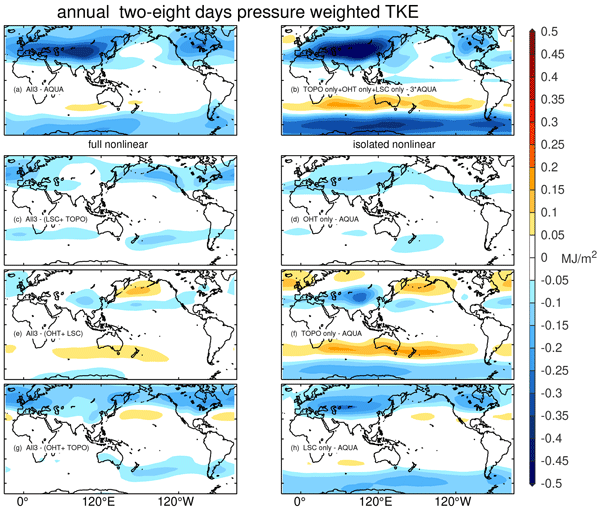
- The interpretability of the results would benefit from showing the response in the total atmospheric heat transport. For instance, the argumentation surrounding the energy deficit related to imposed OHT in L330 or L434 appears flawed to me. Keeping the solar radiation constant but adding a northward ocean heat transport by design leads to a larger “deficit” in the NH, as in more energy has to be lost by longwave radiation. From a TOA perspective, the MHT has to increase, but isn’t this increase achieved by the imposed OHT, such that total AHT does not necessarily have to change (which is stated in L330 “necessitating an increase in overall meridional heat transport in the NH even as TE weakens” and L437 “a more pronounced gradient in net energy input in the NH requires stronger total moist static energy flux in the NH ”)? Indeed, from the bars in Fig. 9a6,8 it does not look like TE+(SE+MM) increases when adding OHT. Changes in total atmospheric heat transport could be shown as additional bars or in the supplement. In this light, the formulation in L454 “OHT preferentially fluxes heat to the extratropical NH more than the extratropical SH, which necessitates a reduction in transient eddies mostly in the NH” is not fully precise. Moreover, if I got it right in Fig. 4 the intention behind panel b is to show that OHT takes over more of the poleward heat transport in both hemispheres, but if it is labelled as “All3” shouldn’t the OHT arrows also be slightly asymmetric as in panel c?
- In L490, you conclude that land-sea contrast is the most important factor for the storm track asymmetry. Based on the MSE framework, the isolated effect of OHT is not too far behind, though, as is topography (Fig. 9b5,6). Is it really justified then to frame the discrepancy between this study and Shaw et al. 2022 as “LSC” vs. “ocean and topography”? Furthermore, both TKE measures in Fig. 7 suggest that OHT instead has the most pronounced effect on the asymmetry (notably, in White et al. 2021 (Fig. S4), it seems to be land-sea contrast) while the response to a combination of two inhomogeneities is very method dependent. Given that the divergence of the total MSE transport is strongly shaped by the boundary currents in the NH reanalysis (Mayer et al. 2024), the comparably weak role of topography for seems consistent with literature. Overall, though, it seems to me that not all storm track metrics that have been investigated are considered for the conclusion.
- In the discussion and outlook of this work, the vertical structure of the storm track response may deserve more attention. While transient MSE fluxes are “bottom-heavy” due to the presence of moisture, band-pass TKE is rather dominated by upper levels flows. This possibly explains some method disagreement (Fig. 7 left vs. right vs. 9b) regarding the most important inhomogeneity for the NH-SH asymmetry. While these analyses help us get some insight to hemispheric asymmetries in storm track intensity, going beyond vertical integrals could help understanding the non-additivity of forcing mechanisms.
Minor comments
- Entering the manuscript through the abstract left me confused how many building blocks are subject of investigation (or what component is considered a building block) since e.g. the list in L2 includes albedo but later it is referred to three blocks in L9 (“the other two”). It would help specifying that albedo is prescribed and fixed when investigating the three zonal inhomogeneity set-ups.
- L3 The use of the expression “Building on previous work” is not clear to me. Do you mean “Based on...” or “consistent with...”?
- Section 2: A very brief description of how the land-sea contrast is implemented would be appreciated.
- L104: Rather “The second major change made to …”?
- L104 and following: While the implied OHT of the White et al. 2021 configuration is too low, what makes it “good” (e.g. is it similar to observed patters)? If the strength of the surface flux anomalies has a qualitative effect on the TE-SE partitioning, the location of anomalies may too, so I think the motivation for this set-up should be clear.
- L179 Please add further details on how the flux decomposition and vertical integration is performed on sigma levels. Do you use a time-independent, zonally averaged surface pressure as some other studies that apply such a decomposition? Did you actually test L181 “due to performing the calculation on sigma levels” or have a reference that using pressure levels gives a much larger residual on the hemispheric and annual mean scale? In any case, further information could improve reproducibility.
- L234 Isn’t it appropriate to speak of an equatorward shift of the SH storm track rather than a dampening?
- L243 Is there any previous literature on the isolated and/or non-linear response of introducing land in the SH that deserves referencing at this point?
- Figure 9a7: Adding topography leads to SE taking over TE transport in the NH. This is expected from Cox et al. 2022, yet there seems to be a comparable change in the TOA energy input that is not found in Cox et al. (their total atmospheric heat transport remains largely unaffected). This difference when using realistic topography seems noteworthy.
- Regarding the combining of SE+MM in Fig. 9: In the extratropics, instantaneous eddy heat transport is anti-correlated with the overturning heat transport (e.g. Cox et al., 2024). How does this look like in a 3-term framework for your simulations? Is TE anti-correlated with SE+MM, TE+SE with MM, or TE+MM with SE? Are changes in MM small enough to be excluded from Fig. 4?
- L376 Please specify whether this is MHT or OHT change.
- L380 The changes of 0.1 PW are rather hard to detect by eye from Fig. 11a. If this figure is intended to fit the full page width, you have enough space to indicate the numeric values next to the bars, for instance. Notably, the values are in the residual range that you specify in Sect. 5.
- When motivating the study with model biases (e.g. L425) I suggest that the authors formulate the added benefit more explicitly as e.g. “… could help assessing the possible contribution of zonal inhomogeneities to model biases” since there are also other model biases such as resolution or clouds.
- L440 Consider adding “weaken atmospheric storm tracks in both hemispheres” to indicate that the hemispheric asymmetry is discussed later on.
- Discussion section:
1. Arguably, the “Discussion” already starts with contrasting the findings to Shaw et al. 2022 in L494. Apart from the labeling, I found these paragraphs rather difficult to follow. It is written that there are “at least two possible reasons” which is followed by three bullet points, while the bullet points contain a back and forth including for instance “… however, … . In contrast, …, however, … . … though…”.
2. L531 and onward: It is a nice idea to discuss the zonal structure of the SH storm track given that you have an appropriate dataset to address this. I’m not against including this but since it is not related to the main research question about NH-SH asymmetries it seems inappropriate to be the first paragraph of the discussion section. In contrast, the discussion of the North American storm track from L541 to me are more relevant to the NH-SH asymmetry.
- Appendix B: Is the global integral of the flux divergence equal to zero?
Technical corrections
- Equation 4: suggest consistently using one symbol for latitude.
- Fig. 3: Remove “stationary waves” from subpanel title or put within parentheses?
- Fig. 4: “east-west OHT only” should mean “south-north”? “FLAT” is not introduced.
- Fig. 6e and later: replace “CONTROL” with “All3”.
- You use OHF in figures but OHT in-text.
- Fig. 14 What are the grey crosses?
- L495 It would help if “symmetrized” was clarified as “hemispherically and zonally symmetric”.
- L532 “that the zonal structure in SSTs is”
- Please add DOIs to your references.
- Please fix the references by TH Vonder Haar.
References
Cox T, Donohoe A, Roe GH, Armour KC, and Frierson DMW (2022) Near invariance of poleward atmospheric heat transport in response to midlatitude orography. J Clim 35:4099–4113. https://doi.org/10.1175/JCLI-D-21-0888.1
Cox, T, Donohoe, A, Armour, KC, Roe, GH, and Frierson, DMW (2024) A New Method for Calculating Instantaneous Atmospheric Heat Transport, J Clim 37:4337–4346, https://doi.org/10.1175/JCLI-D-23-0521.1
Mayer, M., Kato, S., Bosilovich, M., Bechtold, P., Mayer, J., Schröder, M., Behrangi, A., Wild, M., Kobayashi, S., Li Z, and L’Ecuyer, T. (2024) Assessment of Atmospheric and Surface Energy Budgets Using Observation-Based Data Products. Surv Geophys 45:1827–1854, https://doi.org/10.1007/s10712-024-09827-x
Citation: https://doi.org/10.5194/egusphere-2026-1767-RC2 -
AC2: 'Reply on RC2', Chaim Garfinkel, 23 Jun 2026
The comment was uploaded in the form of a supplement: https://egusphere.copernicus.org/preprints/2026/egusphere-2026-1767/egusphere-2026-1767-AC2-supplement.pdf
-
AC2: 'Reply on RC2', Chaim Garfinkel, 23 Jun 2026
Peer review completion


Interactive discussion
Status: closed
-
RC1: 'Comment on egusphere-2026-1767', Anonymous Referee #1, 07 May 2026
Review of “Building blocks of localized storm tracks: revisiting asymmetries between the NH and SH in storm track strength”
This paper uses the MiMA GCM to investigate how three surface inhomogeneities, land-sea contrast, topography, and ocean heat transport, individually and jointly shape the zonal localization and hemispheric asymmetry of midlatitude storm tracks. The authors quantify both isolated and full nonlinear responses to each building block, and use a moist static energy budget to attribute the stronger SH storm tracks to specific terms in the energy balance. The main conclusions are that (i) all three building blocks contribute to storm track localization with substantial non-additivity, (ii) land-sea contrast is the most important factor for the NH/SH asymmetry, and (iii) observationally poorly constrained ocean heat transport can have significant effects on the non-additivity of the different surface inhomogeneities.
The experimental framework is well-designed and represents clear progress over earlier idealized studies by combining realistic geography with the flexibility to isolate individual forcings, and by comparing the NH and SH. The conclusion that storm track strength is very sensitive to uncertainties in ocean heat transport is an important result and should inspire future research. This study contains a wealth of results, for which there is simply not enough space for discussion. I believe the authors did a great job at summarizing the detailed analysis and condensing out the most important take-home messages. Nevertheless, I feel two aspects deserve more attention in the discussion of the results: (i) the role of moisture, and (ii) the interpretation of the weakening effect of land-sea contrast on the storm tracks.
General comments
The role of moisture: Moisture has significant effects on the organization of storm tracks through latent heat release (e.g., Schemm, 2023; Auestad et al., 2025), and its effects on blocking anticyclones are well documented (e.g., Steinfeld et al., 2020). Hence, I assume that the presence of moisture will also have a role in partitioning MSE fluxes into transient eddy and stationary eddy contributions, which will likely be modulated by the separate building blocks as well. While this is beyond the scope of the current analysis, the progress in our understanding of the role of moisture for storm track structure since Brayshaw’s studies, in my opinion, would motivate a short discussion in the outlook section of this paper.
The weakening effect of land-sea contrast: The result that land-sea contrast weakens storm track strength was a bit unintuitive to me at first. I believe that in this study, this can be mostly understood as a localization of the storm tracks, and with that the introduction of stationary waves, and so I agree with the reasoning of the study. However, from a weather perspective, land-sea contrast in the North Pacific and North Atlantic storm tracks has been shown to invigorate cyclone development (Brayshaw et al. 2009). First, such air-sea interaction can again impact the organization of the storm tracks (e.g., Wenta et al., 2024). Second, the scope of WCD also aims at connecting weather and climate dynamics, and here there would be an opportunity to achieve this by adding some more context to the presented results, that would also strengthen the relevance of the work for other communities.
Specific comments
L198: In section 3, the T45 run (Fig. 1d) also struggles with the tilt of the NA storm track when compared to T85 (1b) and ERA5 (1a). The tilt is a key zonal asymmetry in the NH with large relevance for the downstream climate, so I suggest adding this aspect to the discussion of the model differences here.
L232: You mention a damping effect of TOPO on the SH TKE, particularly for Fig. 6f. But there is also a pronounced equatorward shift of the TKE. Visually the weakening tendency seems more prominent in the SH. First, is there a good reason you do not mention the meridional shift effect? And second, why is there an opposing sign in this shift between the hemispheres (poleward shift in the NH, but an equatorward shift in the SH)?
L432-433: In afar could the strengthening of stationary eddies and the weakening of transient eddies through the introduction of surface inhomogeneities simply be understood as a localization of the storm tracks in longitude?
Technical comments
Figure 3 caption: ?? equation
L159: Check citation format Oort and VONDER
References
Auestad, H., Shibu, A., Ceppi, P., & Woollings, T. (2025). The latent heating feedback on the mid‐latitude circulation. Geophysical Research Letters, 52(18), e2025GL116437.
Brayshaw, D. J., Hoskins, B., & Blackburn, M. (2009). The basic ingredients of the North Atlantic storm track. Part I: Land–sea contras
Schemm, S. (2023). Toward eliminating the decades‐old “too zonal and too equatorward” storm‐track bias in climate models. Journal of Advances in Modeling Earth Systems, 15(2), e2022MS003482.
Steinfeld, D., Boettcher, M., Forbes, R., & Pfahl, S. (2020). The sensitivity of atmospheric blocking to upstream latent heating–numerical experiments. Weather and Climate Dynamics, 1(2), 405-426.
Wenta, M., Grams, C. M., Papritz, L., & Federer, M. (2024). Linking Gulf Stream air–sea interactions to the exceptional blocking episode in February 2019: a Lagrangian perspective. Weather and Climate Dynamics, 5(1), 181-209.
Citation: https://doi.org/10.5194/egusphere-2026-1767-RC1 -
AC1: 'Reply on RC1', Chaim Garfinkel, 23 Jun 2026
The comment was uploaded in the form of a supplement: https://egusphere.copernicus.org/preprints/2026/egusphere-2026-1767/egusphere-2026-1767-AC1-supplement.pdf
-
AC1: 'Reply on RC1', Chaim Garfinkel, 23 Jun 2026
-
RC2: 'Comment on egusphere-2026-1767', Anonymous Referee #2, 25 May 2026
In the present manuscript, the authors investigate how different types of surface forcing modulate storm track intensity and the established NH-SH hemispheric asymmetry. The main forcing mechanisms of investigation are three realistic surface inhomogeneities, namely land-sea contrast, topography, and ocean heat transport. Furthermore, the prescribed albedo is varied to assess the influence of simplifying cloud radiative effects. The authors make use of different storm track metrics and an energy budget framework to quantitatively diagnose the effects of different forcing mechanisms on storm track strength. It is found that adding individual surface inhomogeneities generally shifts the partitioning of heat transport from the transient towards the stationary component of the flow. This is more pronounced in the NH and land-sea contrast is determined as the most influential which can explain the NH-SH asymmetry in storm track strength. Realistic imposed northward ocean heat transport acts in a similar way, yet the transient transport regains importance when ocean transport is increased further. Finally, varying albedo has a minor effect on heat transport due to compensations in short and longwave radiation.
In my view, the authors pose an intriguing overarching research question and the intermediate-complexity model represents the fitting tool to assess it. The systematic approach of including all experiments and isolated vs. full nonlinear responses, showing local changes in storm tracks (instead of zonal means only), and complementing with temperature and wind fields potentially make this manuscript a useful reference for future research on storm track dynamics. The complexity introduced by the number of mechanisms would likely allow for many more in-depth analyses, but considering the current length of the manuscript I believe the authors have already addressed and discussed an appropriate number of aspects. While I would appreciate the analyses within this manuscript to be added to the existing literature, I see a few major points that need improvement or clarification. Specifically, this concerns the determination of the most important inhomogeneity for the SH-NH asymmetry and uncertainty quantification. In addition, at a few instances the presentation of figures and the discussion deserves polishing. Please find further remarks in my comments below.
Major comments
- L301 If the residuals in each simulation are ≤ 0.12 PW, then the change in the residual from one simulation can be ≤0.24 PW. While this is still tiny compared to the total flux, it might be comparable to the reduction of the TE MSE transport in one hemisphere (Fig. 9a). This could become relevant for the hemispheric asymmetry percentage and the interpretation whether one inhomogeneity combination matters more than the other. It would be helpful if the authors could provide an estimate of the uncertainty of the asymmetry percentage of TE and SE+MM with respect to the budget residual. If the authors have tested the sensitivity with regards to the latitudinal integration bound (defining the polar cap as e.g. 40-90°), this might also add confidence to the results.
- The interpretability of the results would benefit from showing the response in the total atmospheric heat transport. For instance, the argumentation surrounding the energy deficit related to imposed OHT in L330 or L434 appears flawed to me. Keeping the solar radiation constant but adding a northward ocean heat transport by design leads to a larger “deficit” in the NH, as in more energy has to be lost by longwave radiation. From a TOA perspective, the MHT has to increase, but isn’t this increase achieved by the imposed OHT, such that total AHT does not necessarily have to change (which is stated in L330 “necessitating an increase in overall meridional heat transport in the NH even as TE weakens” and L437 “a more pronounced gradient in net energy input in the NH requires stronger total moist static energy flux in the NH ”)? Indeed, from the bars in Fig. 9a6,8 it does not look like TE+(SE+MM) increases when adding OHT. Changes in total atmospheric heat transport could be shown as additional bars or in the supplement. In this light, the formulation in L454 “OHT preferentially fluxes heat to the extratropical NH more than the extratropical SH, which necessitates a reduction in transient eddies mostly in the NH” is not fully precise. Moreover, if I got it right in Fig. 4 the intention behind panel b is to show that OHT takes over more of the poleward heat transport in both hemispheres, but if it is labelled as “All3” shouldn’t the OHT arrows also be slightly asymmetric as in panel c?
- In L490, you conclude that land-sea contrast is the most important factor for the storm track asymmetry. Based on the MSE framework, the isolated effect of OHT is not too far behind, though, as is topography (Fig. 9b5,6). Is it really justified then to frame the discrepancy between this study and Shaw et al. 2022 as “LSC” vs. “ocean and topography”? Furthermore, both TKE measures in Fig. 7 suggest that OHT instead has the most pronounced effect on the asymmetry (notably, in White et al. 2021 (Fig. S4), it seems to be land-sea contrast) while the response to a combination of two inhomogeneities is very method dependent. Given that the divergence of the total MSE transport is strongly shaped by the boundary currents in the NH reanalysis (Mayer et al. 2024), the comparably weak role of topography for seems consistent with literature. Overall, though, it seems to me that not all storm track metrics that have been investigated are considered for the conclusion.
- In the discussion and outlook of this work, the vertical structure of the storm track response may deserve more attention. While transient MSE fluxes are “bottom-heavy” due to the presence of moisture, band-pass TKE is rather dominated by upper levels flows. This possibly explains some method disagreement (Fig. 7 left vs. right vs. 9b) regarding the most important inhomogeneity for the NH-SH asymmetry. While these analyses help us get some insight to hemispheric asymmetries in storm track intensity, going beyond vertical integrals could help understanding the non-additivity of forcing mechanisms.
Minor comments
- Entering the manuscript through the abstract left me confused how many building blocks are subject of investigation (or what component is considered a building block) since e.g. the list in L2 includes albedo but later it is referred to three blocks in L9 (“the other two”). It would help specifying that albedo is prescribed and fixed when investigating the three zonal inhomogeneity set-ups.
- L3 The use of the expression “Building on previous work” is not clear to me. Do you mean “Based on...” or “consistent with...”?
- Section 2: A very brief description of how the land-sea contrast is implemented would be appreciated.
- L104: Rather “The second major change made to …”?
- L104 and following: While the implied OHT of the White et al. 2021 configuration is too low, what makes it “good” (e.g. is it similar to observed patters)? If the strength of the surface flux anomalies has a qualitative effect on the TE-SE partitioning, the location of anomalies may too, so I think the motivation for this set-up should be clear.
- L179 Please add further details on how the flux decomposition and vertical integration is performed on sigma levels. Do you use a time-independent, zonally averaged surface pressure as some other studies that apply such a decomposition? Did you actually test L181 “due to performing the calculation on sigma levels” or have a reference that using pressure levels gives a much larger residual on the hemispheric and annual mean scale? In any case, further information could improve reproducibility.
- L234 Isn’t it appropriate to speak of an equatorward shift of the SH storm track rather than a dampening?
- L243 Is there any previous literature on the isolated and/or non-linear response of introducing land in the SH that deserves referencing at this point?
- Figure 9a7: Adding topography leads to SE taking over TE transport in the NH. This is expected from Cox et al. 2022, yet there seems to be a comparable change in the TOA energy input that is not found in Cox et al. (their total atmospheric heat transport remains largely unaffected). This difference when using realistic topography seems noteworthy.
- Regarding the combining of SE+MM in Fig. 9: In the extratropics, instantaneous eddy heat transport is anti-correlated with the overturning heat transport (e.g. Cox et al., 2024). How does this look like in a 3-term framework for your simulations? Is TE anti-correlated with SE+MM, TE+SE with MM, or TE+MM with SE? Are changes in MM small enough to be excluded from Fig. 4?
- L376 Please specify whether this is MHT or OHT change.
- L380 The changes of 0.1 PW are rather hard to detect by eye from Fig. 11a. If this figure is intended to fit the full page width, you have enough space to indicate the numeric values next to the bars, for instance. Notably, the values are in the residual range that you specify in Sect. 5.
- When motivating the study with model biases (e.g. L425) I suggest that the authors formulate the added benefit more explicitly as e.g. “… could help assessing the possible contribution of zonal inhomogeneities to model biases” since there are also other model biases such as resolution or clouds.
- L440 Consider adding “weaken atmospheric storm tracks in both hemispheres” to indicate that the hemispheric asymmetry is discussed later on.
- Discussion section:
1. Arguably, the “Discussion” already starts with contrasting the findings to Shaw et al. 2022 in L494. Apart from the labeling, I found these paragraphs rather difficult to follow. It is written that there are “at least two possible reasons” which is followed by three bullet points, while the bullet points contain a back and forth including for instance “… however, … . In contrast, …, however, … . … though…”.
2. L531 and onward: It is a nice idea to discuss the zonal structure of the SH storm track given that you have an appropriate dataset to address this. I’m not against including this but since it is not related to the main research question about NH-SH asymmetries it seems inappropriate to be the first paragraph of the discussion section. In contrast, the discussion of the North American storm track from L541 to me are more relevant to the NH-SH asymmetry.
- Appendix B: Is the global integral of the flux divergence equal to zero?
Technical corrections
- Equation 4: suggest consistently using one symbol for latitude.
- Fig. 3: Remove “stationary waves” from subpanel title or put within parentheses?
- Fig. 4: “east-west OHT only” should mean “south-north”? “FLAT” is not introduced.
- Fig. 6e and later: replace “CONTROL” with “All3”.
- You use OHF in figures but OHT in-text.
- Fig. 14 What are the grey crosses?
- L495 It would help if “symmetrized” was clarified as “hemispherically and zonally symmetric”.
- L532 “that the zonal structure in SSTs is”
- Please add DOIs to your references.
- Please fix the references by TH Vonder Haar.
References
Cox T, Donohoe A, Roe GH, Armour KC, and Frierson DMW (2022) Near invariance of poleward atmospheric heat transport in response to midlatitude orography. J Clim 35:4099–4113. https://doi.org/10.1175/JCLI-D-21-0888.1
Cox, T, Donohoe, A, Armour, KC, Roe, GH, and Frierson, DMW (2024) A New Method for Calculating Instantaneous Atmospheric Heat Transport, J Clim 37:4337–4346, https://doi.org/10.1175/JCLI-D-23-0521.1
Mayer, M., Kato, S., Bosilovich, M., Bechtold, P., Mayer, J., Schröder, M., Behrangi, A., Wild, M., Kobayashi, S., Li Z, and L’Ecuyer, T. (2024) Assessment of Atmospheric and Surface Energy Budgets Using Observation-Based Data Products. Surv Geophys 45:1827–1854, https://doi.org/10.1007/s10712-024-09827-x
Citation: https://doi.org/10.5194/egusphere-2026-1767-RC2 -
AC2: 'Reply on RC2', Chaim Garfinkel, 23 Jun 2026
The comment was uploaded in the form of a supplement: https://egusphere.copernicus.org/preprints/2026/egusphere-2026-1767/egusphere-2026-1767-AC2-supplement.pdf
-
AC2: 'Reply on RC2', Chaim Garfinkel, 23 Jun 2026
Peer review completion
Journal article(s) based on this preprint
Viewed
| HTML | XML | Total | Supplement | BibTeX | EndNote | |
|---|---|---|---|---|---|---|
| 380 | 193 | 51 | 624 | 98 | 53 | 45 |
- HTML: 380
- PDF: 193
- XML: 51
- Total: 624
- Supplement: 98
- BibTeX: 53
- EndNote: 45
Viewed (geographical distribution)
| Country | # | Views | % |
|---|
| Total: | 0 |
| HTML: | 0 |
| PDF: | 0 |
| XML: | 0 |
- 1
Chaim I. Garfinkel

Tiffany Shaw
Benny Keller
Edwin P. Gerber
Ian P. White
Martin Jucker
Wuhan Ning
Siming Liu
The requested preprint has a corresponding peer-reviewed final revised paper. You are encouraged to refer to the final revised version.
- Preprint
(12045 KB) - Metadata XML
-
Supplement
(1917 KB) - BibTeX
- EndNote
- Final revised paper
Review of “Building blocks of localized storm tracks: revisiting asymmetries between the NH and SH in storm track strength”
This paper uses the MiMA GCM to investigate how three surface inhomogeneities, land-sea contrast, topography, and ocean heat transport, individually and jointly shape the zonal localization and hemispheric asymmetry of midlatitude storm tracks. The authors quantify both isolated and full nonlinear responses to each building block, and use a moist static energy budget to attribute the stronger SH storm tracks to specific terms in the energy balance. The main conclusions are that (i) all three building blocks contribute to storm track localization with substantial non-additivity, (ii) land-sea contrast is the most important factor for the NH/SH asymmetry, and (iii) observationally poorly constrained ocean heat transport can have significant effects on the non-additivity of the different surface inhomogeneities.
The experimental framework is well-designed and represents clear progress over earlier idealized studies by combining realistic geography with the flexibility to isolate individual forcings, and by comparing the NH and SH. The conclusion that storm track strength is very sensitive to uncertainties in ocean heat transport is an important result and should inspire future research. This study contains a wealth of results, for which there is simply not enough space for discussion. I believe the authors did a great job at summarizing the detailed analysis and condensing out the most important take-home messages. Nevertheless, I feel two aspects deserve more attention in the discussion of the results: (i) the role of moisture, and (ii) the interpretation of the weakening effect of land-sea contrast on the storm tracks.
General comments
The role of moisture: Moisture has significant effects on the organization of storm tracks through latent heat release (e.g., Schemm, 2023; Auestad et al., 2025), and its effects on blocking anticyclones are well documented (e.g., Steinfeld et al., 2020). Hence, I assume that the presence of moisture will also have a role in partitioning MSE fluxes into transient eddy and stationary eddy contributions, which will likely be modulated by the separate building blocks as well. While this is beyond the scope of the current analysis, the progress in our understanding of the role of moisture for storm track structure since Brayshaw’s studies, in my opinion, would motivate a short discussion in the outlook section of this paper.
The weakening effect of land-sea contrast: The result that land-sea contrast weakens storm track strength was a bit unintuitive to me at first. I believe that in this study, this can be mostly understood as a localization of the storm tracks, and with that the introduction of stationary waves, and so I agree with the reasoning of the study. However, from a weather perspective, land-sea contrast in the North Pacific and North Atlantic storm tracks has been shown to invigorate cyclone development (Brayshaw et al. 2009). First, such air-sea interaction can again impact the organization of the storm tracks (e.g., Wenta et al., 2024). Second, the scope of WCD also aims at connecting weather and climate dynamics, and here there would be an opportunity to achieve this by adding some more context to the presented results, that would also strengthen the relevance of the work for other communities.
Specific comments
L198: In section 3, the T45 run (Fig. 1d) also struggles with the tilt of the NA storm track when compared to T85 (1b) and ERA5 (1a). The tilt is a key zonal asymmetry in the NH with large relevance for the downstream climate, so I suggest adding this aspect to the discussion of the model differences here.
L232: You mention a damping effect of TOPO on the SH TKE, particularly for Fig. 6f. But there is also a pronounced equatorward shift of the TKE. Visually the weakening tendency seems more prominent in the SH. First, is there a good reason you do not mention the meridional shift effect? And second, why is there an opposing sign in this shift between the hemispheres (poleward shift in the NH, but an equatorward shift in the SH)?
L432-433: In afar could the strengthening of stationary eddies and the weakening of transient eddies through the introduction of surface inhomogeneities simply be understood as a localization of the storm tracks in longitude?
Technical comments
Figure 3 caption: ?? equation
L159: Check citation format Oort and VONDER
References
Auestad, H., Shibu, A., Ceppi, P., & Woollings, T. (2025). The latent heating feedback on the mid‐latitude circulation. Geophysical Research Letters, 52(18), e2025GL116437.
Brayshaw, D. J., Hoskins, B., & Blackburn, M. (2009). The basic ingredients of the North Atlantic storm track. Part I: Land–sea contras
Schemm, S. (2023). Toward eliminating the decades‐old “too zonal and too equatorward” storm‐track bias in climate models. Journal of Advances in Modeling Earth Systems, 15(2), e2022MS003482.
Steinfeld, D., Boettcher, M., Forbes, R., & Pfahl, S. (2020). The sensitivity of atmospheric blocking to upstream latent heating–numerical experiments. Weather and Climate Dynamics, 1(2), 405-426.
Wenta, M., Grams, C. M., Papritz, L., & Federer, M. (2024). Linking Gulf Stream air–sea interactions to the exceptional blocking episode in February 2019: a Lagrangian perspective. Weather and Climate Dynamics, 5(1), 181-209.