
the Creative Commons Attribution 4.0 License.
the Creative Commons Attribution 4.0 License.
 | 23 Jun 2026
Biochar addition enhances soil aggregate stability by modulating soil internal forces: The critical role of readily oxidized organic carbon and particulate organic carbon
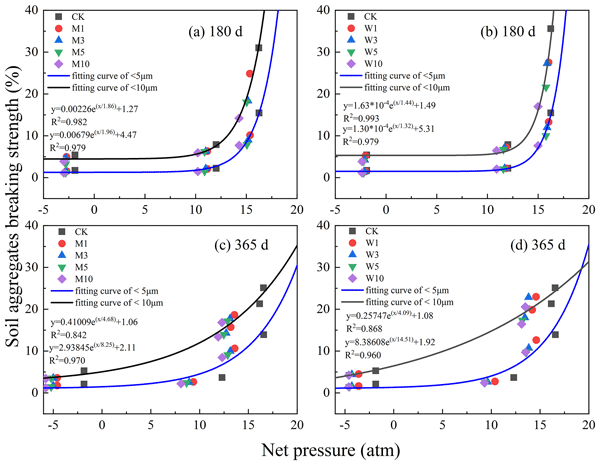
Abstract. Degradation of soil structure and function is a significant obstacle to sustainable agriculture, yet using biochar is known to be an effective way of increasing soil organic carbon and boosting structure. Aggregate stability is greatly influenced by soil internal forces (SIFs), such as van der Waals, hydration, and electrostatic forces. However, it is still not clear which specific organic carbon components play a significant role in the stability of aggregates and the action of soil internal forces. In this study, a field simulation experiment was conducted using maize straw and wheat straw biochars to investigate how biochar addtion affect soil aggregate stability. The findings showed that as the rate of biochar application increased from 0 % to 10 % over 180 day and 365 days, the contents of soil light fraction organic carbon (LFOC), particulate organic carbon (POC), dissolved organic carbon (DOC), readily oxidized organic carbon (ROC), as well as soil specific surface area and surface charge number, increased. The content of different carbon fractions decreased with prolonged incubation time, while soil electrochemical parameters continued to increase throughout the incubation period. Pearson correlation and redundancy analyses showed that soil active organic carbon fractions were strongly correlated with soil surface electrochemical properties, with ROC and POC being the primary factors. Soil aggregate stability increased with higher biochar application rates, and the beneficial effect of biochar on aggregate stability became increasingly pronounced over time. Based on the quantitative estimates of SIFs, the addition of biochar facilitated soil aggregates stability by increasing van der Waals attractive pressure and decreasing electrostatic repulsive pressure, and finally lowering net repulsive pressure between soil particles. The soil aggregate breaking strength increased quickly at initially and then leveled out as the electrolyte content decreased; 10−2 mol L−1 marked the tipping point. The study identified the active organic carbon (ROC and POC) fractions which could mediate the soil surface electrochemical properties and soil internal forces, finally enhance soil aggregate stability. Our research provides a theoretical basis for the targeted use and modifying of biochar to efficiently improve soil structure.
-
Notice on discussion status
The requested preprint has a corresponding peer-reviewed final revised paper. You are encouraged to refer to the final revised version.
-
Preprint
(2003 KB)
-
Supplement
(640 KB)
-
The requested preprint has a corresponding peer-reviewed final revised paper. You are encouraged to refer to the final revised version.
- Preprint
(2003 KB) - Metadata XML
-
Supplement
(640 KB) - BibTeX
- EndNote
- Final revised paper


Journal article(s) based on this preprint
Interactive discussion
Status: closed
-
RC1: 'Comment on egusphere-2026-1761', Anonymous Referee #1, 22 Jul 2026
- AC1: 'Reply on RC1', Feinan Hu, 25 Jul 2026
-
RC2: 'Comment on egusphere-2026-1761', Anonymous Referee #2, 15 Aug 2026
This manuscript investigates the effects of maize straw biochar and wheat straw biochar on soil aggregate stability by linking active organic carbon fractions, soil surface electrochemical properties, soil internal forces, and aggregate breakdown behavior. The study provides valuable insights into the mechanisms underlying biochar-induced soil structural improvement. The combination of organic carbon fraction analysis and quantitative evaluation of soil internal forces represents a meaningful contribution to the field of soil physics and soil amendment research. However, several issues regarding methodological clarification, mechanistic interpretation, and presentation should be addressed to further improve the manuscript. Therefore, I recommend minor revision before publication.
- The calculation of internal soil forces is a key innovation of this study. Specific details regarding this theoretical calculation should be provided.
- The authors used Na⁺-saturated soil samples to quantify aggregate stability and internal forces. Please discuss how this treatment may differ from natural soil conditions and how it affects the interpretation of the results.
- This paper emphasizes that biochar enhances aggregate stability by strengthening van der Waals forces and weakening electrostatic repulsions. However, the role of hydration repulsions appears to be rarely mentioned. Please explain why hydration repulsions are neglected.
- Since soil electrolyte concentration varies substantially under different irrigation, salinity, and climate conditions, the authors should clarify how the laboratory electrolyte gradient relates to realistic soil environments.
- Natural soils typically contain a variety of exchangeable cations and a complex electrolyte composition. The limitations of the experimental design in this study should be discussed in greater detail, and future research directions involving mixed electrolyte systems or field validation should be proposed.
Citation: https://doi.org/10.5194/egusphere-2026-1761-RC2 - AC2: 'Reply on RC2', Feinan Hu, 17 Aug 2026
Peer review completion


Interactive discussion
Status: closed
-
RC1: 'Comment on egusphere-2026-1761', Anonymous Referee #1, 22 Jul 2026
Soil aggregate stability is significant obstacle to sustainable agriculture, and biochar is an effective way of improving the stability. However, it is still not clear which specific organic carbon components play a significant role in the stability of aggregates and the action of soil internal forces. The present study investigated the effects of biochar application on soil aggregate stability through analyzing the responses of soil active carbon fraction and electrochemical properties, soil internal forces, and soil aggregate stability to biochar application. The paper is well written with clear logic. Some comments should be considered before accepting publication.
1. The references cited in the MS are relatively dated. It is recommended that the authors incorporate more recently published relevant literature to strengthen the timeliness of the review.
2. It is recommended that the detailed calculations pertaining to the electrochemical performance and soil internal forces be provided in the Supporting Information.
3. Soil electrochemical properties under biochar treatment for 365 days?
4. The data in Table 5 should be used the same order of magnitude.
5. Fig. 9, the differences between a and b, c and d?
Citation: https://doi.org/10.5194/egusphere-2026-1761-RC1 - AC1: 'Reply on RC1', Feinan Hu, 25 Jul 2026
-
RC2: 'Comment on egusphere-2026-1761', Anonymous Referee #2, 15 Aug 2026
This manuscript investigates the effects of maize straw biochar and wheat straw biochar on soil aggregate stability by linking active organic carbon fractions, soil surface electrochemical properties, soil internal forces, and aggregate breakdown behavior. The study provides valuable insights into the mechanisms underlying biochar-induced soil structural improvement. The combination of organic carbon fraction analysis and quantitative evaluation of soil internal forces represents a meaningful contribution to the field of soil physics and soil amendment research. However, several issues regarding methodological clarification, mechanistic interpretation, and presentation should be addressed to further improve the manuscript. Therefore, I recommend minor revision before publication.
- The calculation of internal soil forces is a key innovation of this study. Specific details regarding this theoretical calculation should be provided.
- The authors used Na⁺-saturated soil samples to quantify aggregate stability and internal forces. Please discuss how this treatment may differ from natural soil conditions and how it affects the interpretation of the results.
- This paper emphasizes that biochar enhances aggregate stability by strengthening van der Waals forces and weakening electrostatic repulsions. However, the role of hydration repulsions appears to be rarely mentioned. Please explain why hydration repulsions are neglected.
- Since soil electrolyte concentration varies substantially under different irrigation, salinity, and climate conditions, the authors should clarify how the laboratory electrolyte gradient relates to realistic soil environments.
- Natural soils typically contain a variety of exchangeable cations and a complex electrolyte composition. The limitations of the experimental design in this study should be discussed in greater detail, and future research directions involving mixed electrolyte systems or field validation should be proposed.
Citation: https://doi.org/10.5194/egusphere-2026-1761-RC2 - AC2: 'Reply on RC2', Feinan Hu, 17 Aug 2026
Peer review completion
Journal article(s) based on this preprint
Viewed
| HTML | XML | Total | Supplement | BibTeX | EndNote | |
|---|---|---|---|---|---|---|
| 198 | 68 | 28 | 294 | 41 | 24 | 29 |
- HTML: 198
- PDF: 68
- XML: 28
- Total: 294
- Supplement: 41
- BibTeX: 24
- EndNote: 29
Viewed (geographical distribution)
| Country | # | Views | % |
|---|
| Total: | 0 |
| HTML: | 0 |
| PDF: | 0 |
| XML: | 0 |
- 1
Xiaoshuai Song
Chenyang Xu
Huanhuan Zhao
Jiangwen Li
Wei Du
Wuquan Ding
Zhenghong Yu
Fengbao Zhang
Feinan Hu

The requested preprint has a corresponding peer-reviewed final revised paper. You are encouraged to refer to the final revised version.
- Preprint
(2003 KB) - Metadata XML
-
Supplement
(640 KB) - BibTeX
- EndNote
- Final revised paper
Soil aggregate stability is significant obstacle to sustainable agriculture, and biochar is an effective way of improving the stability. However, it is still not clear which specific organic carbon components play a significant role in the stability of aggregates and the action of soil internal forces. The present study investigated the effects of biochar application on soil aggregate stability through analyzing the responses of soil active carbon fraction and electrochemical properties, soil internal forces, and soil aggregate stability to biochar application. The paper is well written with clear logic. Some comments should be considered before accepting publication.
1. The references cited in the MS are relatively dated. It is recommended that the authors incorporate more recently published relevant literature to strengthen the timeliness of the review.
2. It is recommended that the detailed calculations pertaining to the electrochemical performance and soil internal forces be provided in the Supporting Information.
3. Soil electrochemical properties under biochar treatment for 365 days?
4. The data in Table 5 should be used the same order of magnitude.
5. Fig. 9, the differences between a and b, c and d?