
the Creative Commons Attribution 4.0 License.
the Creative Commons Attribution 4.0 License.
 | 18 May 2026
Complexation strength between organic carbon and transition metal ions dominates the photochemical conversion of SO2 to sulfates
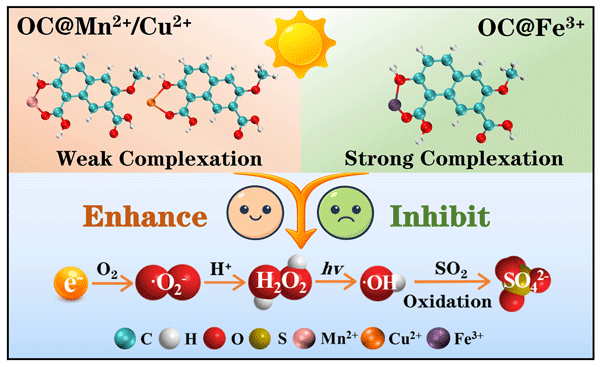
Abstract. The photooxidation of SO2 on organic carbon (OC) is a critical pathway for sulfate formation, yet the role of interactions between OC and transition metal ions (TMIs) in this process remains scarcely understood. We systematically investigated potential influences of TMIs (Fe3+, Cu2+ and Mn2+) on the conversion of SO2 to sulfates on OC from coal combustion under irradiation. Fe3+ exhibited a significantly antagonistic effect, whereas Cu2+ and Mn2+ enhanced SO2 uptake and sulfate generation on OC. Spectroscopic evidences, including absorbance decreasing and fluorescence quenching, confirmed the complexes formation of TMI with chromophores in OC. Fe3+ owned the strongest binding affinity with chromophores, followed by Cu2+ and Mn2+. This variation in the coordination strength dominated the generation of reactive species, such as free electrons (e−), superoxide radicals (•O2−), H2O2 and hydroxyl radicals (•OH), and •OH acted as a pivotal trigger to drive the sulfate production. Extended investigations containing more metal ions demonstrated that the regulatory effects on the sulfate production were generally governed through their ability to suppress or facilitate the •OH generation.
-
Notice on discussion status
The requested preprint has a corresponding peer-reviewed final revised paper. You are encouraged to refer to the final revised version.
-
Preprint
(2557 KB)
-
Supplement
(1410 KB)
-
The requested preprint has a corresponding peer-reviewed final revised paper. You are encouraged to refer to the final revised version.
- Preprint
(2557 KB) - Metadata XML
-
Supplement
(1410 KB) - BibTeX
- EndNote
- Final revised paper


Journal article(s) based on this preprint
Interactive discussion
Status: closed
- RC1: 'Comment on egusphere-2026-1728', Anonymous Referee #1, 29 May 2026
-
RC2: 'Comment on egusphere-2026-1728', Anonymous Referee #2, 11 Jun 2026
Organic carbon usually coexists with transition metal ions in atmospheric aerosols. This study demonstrated that the heterogeneous conversion of SO2 to sulfates was strongly modulated through the complexation interactions between OC and TMIs. The complexation strength adjusted the generation of •OH, which can dominate the sulfate formation. This manuscript is well designed and clearly written. It can be accepted to publish in Amospheric Chemistry and Physics after minor revisions.
Major Concerns:
- Whether sulfates in fresh samples were subtracted in IC measurements? This should be considered to ensure the accuracy of sulfate production.
- In lines 226–240, the decrease in absorbance of OC@TMIs compared to OC+TMIs is attributed to complexation between OC and TMIs. This interpretation is insufficiently supported. A mechanistic relationship between the decrease in the absorbance and OC–TMI complexation is necessary to better understand this phenomenon.
- In EPR measurements, the data under irradiation are reported. Whether any reactive species may be generated under dark conditions. The experiments can be carried out to determine the formation of reactive species in the absence of light.
- In lines 352–356, O2 activation on MS@Cu2+ is discussed according to O2 adsorption energy and O–O bond length. The O–O bond length increases slightly from 1.20 Å for MS to 1.21 Å for MS@Cu2+. This should be refined to avoid overemphasizing the O2 activation ability of Cu2+.
- In lines 406–422, an extended discussion about the effects of different OC@TMIs on SO2 photooxidation to sulfates is given. However, environmental concentrations of these metal ions vary in aerosols. A discussion limitation may be considered.
- In line 415 and Figure 6b, the reported linear relationship had a relative large error of approximately 70% and appears to assume a zero intercept. Forcing the regression through the origin may affect the reliability of the slope. A linear fitting without forcing the intercept to zero should be provided.
Minor Concerns:
- OC+TMIs was defined multiple times throughout the text. Authors should provide a clear definition at the first occurrence and avoid repeating it unnecessarily.
- In ATR-IR measurements, potential interference from ZnSe could affect the detection of sulfates or other functional groups and should be described.
- Why were samples extracted with formaldehyde aqueous solution in Text S6? The rationale should be explained.
- In lines 249–250, the manuscript draws a key conclusion regarding the complexation between OC and TMIs. However, no literature references are provided to support this conclusion.
Citation: https://doi.org/10.5194/egusphere-2026-1728-RC2 -
RC3: 'Comment on egusphere-2026-1728', Anonymous Referee #3, 30 Jun 2026
Major Comments:
- It would interesting know the formation of reactive species under dark conditions.
- For how were the sampling done for each trials? Did the author measure or corrected sampling artifacts of OC? If yes, then it should be mentioned in the manuscript. If no, the authors must mention that too.
- The authors are suggested to explain why only Fe, Cu and Mn were selected as TMIs for this study.
- Line 238: ΔAbs has not been defined earlier.
- The conclusion introduces to new equations, figures and discussions. The authors are suggested to discuss those results in a section before the conclusion. Then keep conclusion section exclusively for concluding the discussion, and not start another discussion.
Citation: https://doi.org/10.5194/egusphere-2026-1728-RC3 - EC1: 'Comment on egusphere-2026-1728', Chiara Giorio, 02 Jul 2026
-
AC1: 'Comment on egusphere-2026-1728', Chong Han, 29 Jul 2026
The comment was uploaded in the form of a supplement: https://egusphere.copernicus.org/preprints/2026/egusphere-2026-1728/egusphere-2026-1728-AC1-supplement.pdf
Peer review completion


Interactive discussion
Status: closed
-
RC1: 'Comment on egusphere-2026-1728', Anonymous Referee #1, 29 May 2026
This study systematically investigated the effects of interactions between OC and TMIs on the heterogeneous photooxidation of SO2 to sulfates. Spectroscopic analyses and DFT calculations consistently confirmed the complexation between OC and TMIs. Variation in the complexation strength modulated the generation of reactive species, especially •OH as the key oxidant. This manuscript is well organized with ample data and clear figures and tables. It can be published in Atmospheric Chemistry and Physics after minor revisions.
- Fe3+, Cu2+ and Mn2+ were selected as representative transition metal ions. However, the reasons for choosing these specific metal ions were not clearly stated. It is suggested to provide a brief explanation.
- In Section 3.1, NaCl was used as a control to examine the effect of chloride ions on SO2 uptake. The specific NaCl concentration was not provided, and the chloride ions content differed among divalent and trivalent salts. Authors should clarify the NaCl concentration and discuss whether these differences could affect the results.
- Different SO2 concentrations were employed in the uptake, ATR-IR and IC experiments. The reasons for different SO2 concentrations should be briefly explained.
- In previous studies, gas-phase sulfuric acid formation was observed. It is unclear whether gas-phase sulfuric acid was generated in the current experiments (Section 3.2).
- In lines 236–237, the phrase “can served” is grammatically incorrect and should be revised to “can serve.” Authors should ensure grammatical consistency throughout the manuscript.
- In lines 238–240, ΔAbs was mentioned when comparing OC@TMIs and OC+TMIs, but the specific meaning or calculation method of ΔAbs was not clearly defined.
- It was confirmed that TMIs modulated photochemical reactive species and then influenced sulfate formation under irradiation. However, it remains unclear whether Fe3+, Cu2+ and Mn2+ could affect sulfate formation in the absence of light. The dark control experiments can be conducted for OC@TMIs to evaluate their non-photochemical contribution.
Citation: https://doi.org/10.5194/egusphere-2026-1728-RC1 -
RC2: 'Comment on egusphere-2026-1728', Anonymous Referee #2, 11 Jun 2026
Organic carbon usually coexists with transition metal ions in atmospheric aerosols. This study demonstrated that the heterogeneous conversion of SO2 to sulfates was strongly modulated through the complexation interactions between OC and TMIs. The complexation strength adjusted the generation of •OH, which can dominate the sulfate formation. This manuscript is well designed and clearly written. It can be accepted to publish in Amospheric Chemistry and Physics after minor revisions.
Major Concerns:
- Whether sulfates in fresh samples were subtracted in IC measurements? This should be considered to ensure the accuracy of sulfate production.
- In lines 226–240, the decrease in absorbance of OC@TMIs compared to OC+TMIs is attributed to complexation between OC and TMIs. This interpretation is insufficiently supported. A mechanistic relationship between the decrease in the absorbance and OC–TMI complexation is necessary to better understand this phenomenon.
- In EPR measurements, the data under irradiation are reported. Whether any reactive species may be generated under dark conditions. The experiments can be carried out to determine the formation of reactive species in the absence of light.
- In lines 352–356, O2 activation on MS@Cu2+ is discussed according to O2 adsorption energy and O–O bond length. The O–O bond length increases slightly from 1.20 Å for MS to 1.21 Å for MS@Cu2+. This should be refined to avoid overemphasizing the O2 activation ability of Cu2+.
- In lines 406–422, an extended discussion about the effects of different OC@TMIs on SO2 photooxidation to sulfates is given. However, environmental concentrations of these metal ions vary in aerosols. A discussion limitation may be considered.
- In line 415 and Figure 6b, the reported linear relationship had a relative large error of approximately 70% and appears to assume a zero intercept. Forcing the regression through the origin may affect the reliability of the slope. A linear fitting without forcing the intercept to zero should be provided.
Minor Concerns:
- OC+TMIs was defined multiple times throughout the text. Authors should provide a clear definition at the first occurrence and avoid repeating it unnecessarily.
- In ATR-IR measurements, potential interference from ZnSe could affect the detection of sulfates or other functional groups and should be described.
- Why were samples extracted with formaldehyde aqueous solution in Text S6? The rationale should be explained.
- In lines 249–250, the manuscript draws a key conclusion regarding the complexation between OC and TMIs. However, no literature references are provided to support this conclusion.
Citation: https://doi.org/10.5194/egusphere-2026-1728-RC2 -
RC3: 'Comment on egusphere-2026-1728', Anonymous Referee #3, 30 Jun 2026
Major Comments:
- It would interesting know the formation of reactive species under dark conditions.
- For how were the sampling done for each trials? Did the author measure or corrected sampling artifacts of OC? If yes, then it should be mentioned in the manuscript. If no, the authors must mention that too.
- The authors are suggested to explain why only Fe, Cu and Mn were selected as TMIs for this study.
- Line 238: ΔAbs has not been defined earlier.
- The conclusion introduces to new equations, figures and discussions. The authors are suggested to discuss those results in a section before the conclusion. Then keep conclusion section exclusively for concluding the discussion, and not start another discussion.
Citation: https://doi.org/10.5194/egusphere-2026-1728-RC3 - EC1: 'Comment on egusphere-2026-1728', Chiara Giorio, 02 Jul 2026
-
AC1: 'Comment on egusphere-2026-1728', Chong Han, 29 Jul 2026
The comment was uploaded in the form of a supplement: https://egusphere.copernicus.org/preprints/2026/egusphere-2026-1728/egusphere-2026-1728-AC1-supplement.pdf
Peer review completion
Journal article(s) based on this preprint
Viewed
| HTML | XML | Total | Supplement | BibTeX | EndNote | |
|---|---|---|---|---|---|---|
| 351 | 215 | 41 | 607 | 64 | 27 | 34 |
- HTML: 351
- PDF: 215
- XML: 41
- Total: 607
- Supplement: 64
- BibTeX: 27
- EndNote: 34
Viewed (geographical distribution)
| Country | # | Views | % |
|---|
| Total: | 0 |
| HTML: | 0 |
| PDF: | 0 |
| XML: | 0 |
- 1
Shaojie Yang
Shiwei Lai
Jianwei Zheng
Hao Na
Fu Li
Wangjin Yang
Chong Han

The requested preprint has a corresponding peer-reviewed final revised paper. You are encouraged to refer to the final revised version.
- Preprint
(2557 KB) - Metadata XML
-
Supplement
(1410 KB) - BibTeX
- EndNote
- Final revised paper
This study systematically investigated the effects of interactions between OC and TMIs on the heterogeneous photooxidation of SO2 to sulfates. Spectroscopic analyses and DFT calculations consistently confirmed the complexation between OC and TMIs. Variation in the complexation strength modulated the generation of reactive species, especially •OH as the key oxidant. This manuscript is well organized with ample data and clear figures and tables. It can be published in Atmospheric Chemistry and Physics after minor revisions.