
the Creative Commons Attribution 4.0 License.
the Creative Commons Attribution 4.0 License.
 | 02 Apr 2026
From κ to χ: Evaluating Hygroscopicity-Based Mixing State Estimates with a Particle-Resolved Model
Abstract. Aerosol mixing state strongly influences how particles interact with clouds, radiation, and atmospheric chemistry, but it remains difficult to quantify from routine observations. The aerosol mixing state index (χ) typically requires detailed single-particle composition data, available only from particle-resolved models or advanced measurements. Yuan and Zhao (2023) proposed estimating χ from in-situ hygroscopicity (κ) measurements using a hygroscopicity tandem differential mobility analyzer (HTDMA), offering a promising observational pathway. However, their method assumes a binary system of more- and less-hygroscopic components, which may not represent aerosol populations containing intermediate-hygroscopicity species. Here, we systematically evaluate this κ-based χ retrieval using the stochastic particle-resolved model PartMC-MOSAIC. We generated a large ensemble of aerosol populations from urban plume simulations spanning a wide range of emissions, aging conditions, and meteorology. For each population and particle diameter (50–250 nm), we compared the “true” mixing state index from per-particle composition (χPMC) with the χ inferred from κ distributions (χYZ). The retrieval performs well for many aerosol populations, but systematically overestimates χ when externally mixed intermediate-hygroscopicity components violate the binary assumption. By quantifying the error distributions across particle sizes, we derive uncertainty bounds for the retrieval and apply them to long-term HTDMA datasets from urban, continental, and coastal sites, providing a first multi-site assessment of seasonal variability in χ inferred from hygroscopicity measurements.
-
Notice on discussion status
The requested preprint has a corresponding peer-reviewed final revised paper. You are encouraged to refer to the final revised version.
-
Preprint
(2081 KB)
-
The requested preprint has a corresponding peer-reviewed final revised paper. You are encouraged to refer to the final revised version.
- Preprint
(2081 KB) - Metadata XML
- BibTeX
- EndNote
- Final revised paper


Journal article(s) based on this preprint
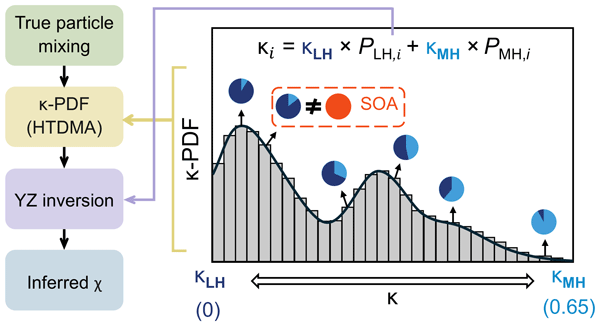
Airborne particles affect clouds, climate, and air quality, but it is difficult to determine how their chemical components are mixed within individual particles. We tested a method that estimates this mixing from water-uptake measurements using detailed computer simulations. The method works well in many cases, but can overestimate particle mixing when moderately water-attracting material exists in separate particle types. We then applied this uncertainty framework to long-term observations.
Interactive discussion
Status: closed
-
RC1: 'Comment on egusphere-2026-1724', Anonymous Referee #1, 22 Apr 2026
The comment was uploaded in the form of a supplement: https://egusphere.copernicus.org/preprints/2026/egusphere-2026-1724/egusphere-2026-1724-RC1-supplement.pdfCitation: https://doi.org/
10.5194/egusphere-2026-1724-RC1 -
AC1: 'Reply on RC1', Yicen Liu, 11 Jul 2026
The comment was uploaded in the form of a supplement: https://egusphere.copernicus.org/preprints/2026/egusphere-2026-1724/egusphere-2026-1724-AC1-supplement.pdf
-
AC1: 'Reply on RC1', Yicen Liu, 11 Jul 2026
-
RC2: 'Comment on egusphere-2026-1724', Anonymous Referee #2, 24 Apr 2026
Liu et al. evaluated the use of HTDMA-measured size-resolved κ to predict the mixing state index (χ, YZ method) with χ predicted by a particle-resolved model. Overall, this paper suggested that the YZ method is valid, especially in urban and continental regions. Liu et al. also provided estimates of the uncertainties associated with the YZ method, which can be applied in the future by others who use it. Overall, Liu et al. provided very detailed evaluations and discussions. However, I feel this paper still has many areas for improvement. I would suggest a major revision.
Major comments:
I feel this paper needs to improve by adding more scientific discussions. Currently, it is a very good technical note with some scientific discussions. One particular section where I want to see more scientific discussion is Section 5. The authors presented long-term measurements but did not provide sufficient discussion. For example, I am interested in the impacts of different sources on κ and χ. What will be the impact of chemical compositions, since most sites have AMS or ACSM? Any seasonal variations? Are there any site dependencies? I am also curious if you have predicted χ using your particle-resolved models at these sites. How will the confidence intervals discussed in previous sessions apply to this session?
1. I am not fully convinced why marine aerosols are not included in both methods, and why including them will cause overestimation of χ. Three of your sites are in the coastal regions (EPC, CRG, and HOU). Excluding marine aerosols will case significantly uncertainties in predicting aerosol composition and κ. I understand that marine aerosols are typically in the coarse mode, but there is growing evidence that fine marine aerosols are also prevalent. It would be beneficial to add more discussion of the exclusion of fine marine aerosols in the paper.
2. I have some comments related to ARM data. It is not very clear to me where each measurement is located. Moreover, as I mentioned in the previous comment, there are many other measurements in these sites, including aerosol size distribution, aerosol chemical composition, and meteorological measurements. Please consider utilizing the open-source data to provide a comprehensive discussion of χ and κ.
3. Could you add more types of hygroscopic species to the YZ model? How will that affect your results?
4. Please make sure to define the acronyms in the first place in the main manuscript.
5. There are some places not well defined at first. Please refer to my minor comments.
6. The figure size is too small and hard to read. I suggest make them larger
Minor comments:
1. L53-56, “Accordingly, … is computed.” It will be helpful to define MH and LH here since it is the first place these two terms appear.
2. L 78-80, “For the aerosol … can be calculated as:” It is not clear to me what bin means here. Do you mean size bin or κ bin?
3. L151-155, “We then … Na, and Ca.” χPMC was not defined in the main text before. Please define ARO1, ARO2, ALK1, OLE1, API1, API2, LIM1, LIM2, OIN, and OC.
4. L179-180, “Under the … LH species.” Could you explain why this happens?
5. Would section 4.3 fit better after section 4.1?
6. Could you label which one is internally mixed and which one is externally mixed in Fig. 2 a and b?
7. Figure 6 should come first before Figure 5 to help understand the site locations.
8. L259-260, “The results indicate … up to 86%.” Where are your results, and why do you think χ is an overestimate, and compared to what?
9. L273-283. “The coexistence … internally mixed populations.” I have a hard time following these two paragraphs.
Citation: https://doi.org/10.5194/egusphere-2026-1724-RC2 -
AC2: 'Reply on RC2', Yicen Liu, 11 Jul 2026
The comment was uploaded in the form of a supplement: https://egusphere.copernicus.org/preprints/2026/egusphere-2026-1724/egusphere-2026-1724-AC2-supplement.pdf
-
AC2: 'Reply on RC2', Yicen Liu, 11 Jul 2026
Peer review completion


Interactive discussion
Status: closed
-
RC1: 'Comment on egusphere-2026-1724', Anonymous Referee #1, 22 Apr 2026
The comment was uploaded in the form of a supplement: https://egusphere.copernicus.org/preprints/2026/egusphere-2026-1724/egusphere-2026-1724-RC1-supplement.pdf
-
AC1: 'Reply on RC1', Yicen Liu, 11 Jul 2026
The comment was uploaded in the form of a supplement: https://egusphere.copernicus.org/preprints/2026/egusphere-2026-1724/egusphere-2026-1724-AC1-supplement.pdf
-
AC1: 'Reply on RC1', Yicen Liu, 11 Jul 2026
-
RC2: 'Comment on egusphere-2026-1724', Anonymous Referee #2, 24 Apr 2026
Liu et al. evaluated the use of HTDMA-measured size-resolved κ to predict the mixing state index (χ, YZ method) with χ predicted by a particle-resolved model. Overall, this paper suggested that the YZ method is valid, especially in urban and continental regions. Liu et al. also provided estimates of the uncertainties associated with the YZ method, which can be applied in the future by others who use it. Overall, Liu et al. provided very detailed evaluations and discussions. However, I feel this paper still has many areas for improvement. I would suggest a major revision.
Major comments:
I feel this paper needs to improve by adding more scientific discussions. Currently, it is a very good technical note with some scientific discussions. One particular section where I want to see more scientific discussion is Section 5. The authors presented long-term measurements but did not provide sufficient discussion. For example, I am interested in the impacts of different sources on κ and χ. What will be the impact of chemical compositions, since most sites have AMS or ACSM? Any seasonal variations? Are there any site dependencies? I am also curious if you have predicted χ using your particle-resolved models at these sites. How will the confidence intervals discussed in previous sessions apply to this session?
1. I am not fully convinced why marine aerosols are not included in both methods, and why including them will cause overestimation of χ. Three of your sites are in the coastal regions (EPC, CRG, and HOU). Excluding marine aerosols will case significantly uncertainties in predicting aerosol composition and κ. I understand that marine aerosols are typically in the coarse mode, but there is growing evidence that fine marine aerosols are also prevalent. It would be beneficial to add more discussion of the exclusion of fine marine aerosols in the paper.
2. I have some comments related to ARM data. It is not very clear to me where each measurement is located. Moreover, as I mentioned in the previous comment, there are many other measurements in these sites, including aerosol size distribution, aerosol chemical composition, and meteorological measurements. Please consider utilizing the open-source data to provide a comprehensive discussion of χ and κ.
3. Could you add more types of hygroscopic species to the YZ model? How will that affect your results?
4. Please make sure to define the acronyms in the first place in the main manuscript.
5. There are some places not well defined at first. Please refer to my minor comments.
6. The figure size is too small and hard to read. I suggest make them larger
Minor comments:
1. L53-56, “Accordingly, … is computed.” It will be helpful to define MH and LH here since it is the first place these two terms appear.
2. L 78-80, “For the aerosol … can be calculated as:” It is not clear to me what bin means here. Do you mean size bin or κ bin?
3. L151-155, “We then … Na, and Ca.” χPMC was not defined in the main text before. Please define ARO1, ARO2, ALK1, OLE1, API1, API2, LIM1, LIM2, OIN, and OC.
4. L179-180, “Under the … LH species.” Could you explain why this happens?
5. Would section 4.3 fit better after section 4.1?
6. Could you label which one is internally mixed and which one is externally mixed in Fig. 2 a and b?
7. Figure 6 should come first before Figure 5 to help understand the site locations.
8. L259-260, “The results indicate … up to 86%.” Where are your results, and why do you think χ is an overestimate, and compared to what?
9. L273-283. “The coexistence … internally mixed populations.” I have a hard time following these two paragraphs.
Citation: https://doi.org/10.5194/egusphere-2026-1724-RC2 -
AC2: 'Reply on RC2', Yicen Liu, 11 Jul 2026
The comment was uploaded in the form of a supplement: https://egusphere.copernicus.org/preprints/2026/egusphere-2026-1724/egusphere-2026-1724-AC2-supplement.pdf
-
AC2: 'Reply on RC2', Yicen Liu, 11 Jul 2026
Peer review completion
Journal article(s) based on this preprint
Airborne particles affect clouds, climate, and air quality, but it is difficult to determine how their chemical components are mixed within individual particles. We tested a method that estimates this mixing from water-uptake measurements using detailed computer simulations. The method works well in many cases, but can overestimate particle mixing when moderately water-attracting material exists in separate particle types. We then applied this uncertainty framework to long-term observations.
Viewed
| HTML | XML | Total | BibTeX | EndNote | |
|---|---|---|---|---|---|
| 388 | 176 | 57 | 621 | 37 | 41 |
- HTML: 388
- PDF: 176
- XML: 57
- Total: 621
- BibTeX: 37
- EndNote: 41
Viewed (geographical distribution)
| Country | # | Views | % |
|---|
| Total: | 0 |
| HTML: | 0 |
| PDF: | 0 |
| XML: | 0 |
- 1
Yicen Liu
Jian Wang

The requested preprint has a corresponding peer-reviewed final revised paper. You are encouraged to refer to the final revised version.
- Preprint
(2081 KB) - Metadata XML
Airborne particles affect clouds, climate, and air quality, but it is difficult to determine how their chemical components are mixed within individual particles. We tested a method that estimates this mixing from water-uptake measurements using detailed computer simulations. The method works well in many cases, but can overestimate particle mixing when moderately water-attracting material exists in separate particle types. We then applied this uncertainty framework to long-term observations.
Airborne particles affect clouds, climate, and air quality, but it is difficult to determine how...