
the Creative Commons Attribution 4.0 License.
the Creative Commons Attribution 4.0 License.
 | 08 Apr 2026
Gas-phase degradation of the aroma compound ethyl butyrate and its methylated derivatives: UV-C photolysis and reactions with the hydroxyl radical
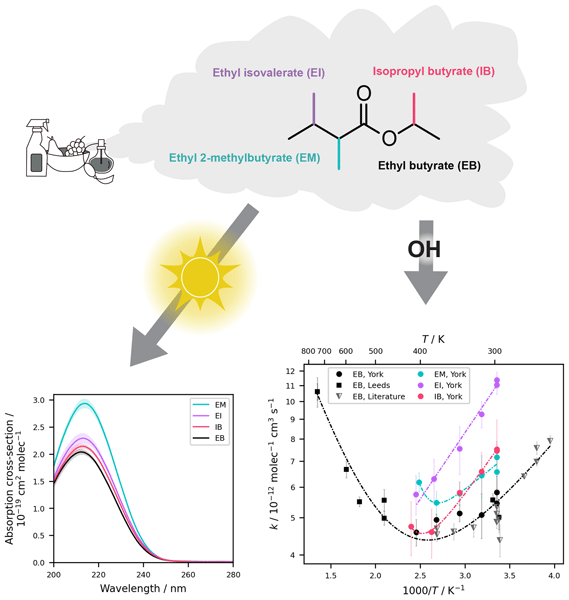
Abstract. The aroma compound ethyl butyrate (EB) and its methylated derivatives ethyl 2-methylbutyrate (EM), ethyl isovalerate (EI), and isopropyl butyrate (IB) are present in many consumer products. To evaluate the environmental and health impacts of these volatile organic compounds, a detailed understanding of their gas-phase photochemical reactivity is required. Here, we performed pulsed laser photolysis/laser-induced fluorescence (PLP-LIF) experiments to investigate the kinetics of their reactions with the hydroxyl radical (OH). Room temperature rate coefficients in units of 10-12 molec-1 cm3 s-1 with 2σ statistical errors were determined as: (5.5±0.2) for EB + OH, (7.0±0.3) for EM + OH, (11.2±0.4) for EI + OH, and (7.5±0.4) for IB + OH. All four reactions exhibited complex kinetics with distinct non-Arrhenius behaviour for temperatures up to about 400 K. This behaviour was attributed to pre-reaction complexes and is consistent with site-specific reactivities as predicted by an established structure-activity-relationship (SAR). In a second series of experiments, quasi-gas-phase UV-vis. spectroscopy and time-dependent density functional theory predictions were used to obtain absorption cross-sections. All four esters displayed an absorption band at around 213 nm (spin-forbidden π*←n transition), but did not absorb appreciably in the visible or UV-A part of the spectrum where light is abundant at ground level. Therefore, the reaction with OH was considered the main loss process, with lifetimes for tropospheric removal ranging from 22 to 45 hours. Photochemical ozone creation potentials were estimated to be in a moderate range between 28 and 34.
-
Notice on discussion status
The requested preprint has a corresponding peer-reviewed final revised paper. You are encouraged to refer to the final revised version.
-
Preprint
(1114 KB)
-
Supplement
(1048 KB)
-
The requested preprint has a corresponding peer-reviewed final revised paper. You are encouraged to refer to the final revised version.
- Preprint
(1114 KB) - Metadata XML
-
Supplement
(1048 KB) - BibTeX
- EndNote
- Final revised paper


Journal article(s) based on this preprint
Interactive discussion
Status: closed
- RC1: 'Comment on egusphere-2026-1660', Anonymous Referee #1, 13 Apr 2026
-
RC2: 'Comment on egusphere-2026-1660', Anonymous Referee #2, 05 May 2026
The authors have presented a very nice manuscript reporting their measurements of the degradation kinetics of several organic esters by OH radicals using a LIF-based technique and showed that atmospheric photolysis is a negligible degradation pathway. The manuscript should be accepted pending several minor revisions listed below.
More substantial general comments:
- Why weren't gas-phase UV spectra measured? The authors should at least briefly comment on this.
- EA is used as a proof of concept for the solution phase measurements, but it may not be representative of the other compounds. What scaling factors would apply more generally? While not required to include in this manuscript, additional validation results across a broader set of compounds would strengthen this point.
- The photolysis aspect feels somewhat overemphasized relative to the rest of the study. No specific changes are suggested here, but something to consider generally.
- The limitations of the SAR approach for derivatives could be discussed in more detail; more generally, SAR tends to perform poorly at temperature extremes.
- The authors should comment on why calculations were performed to predict spectra but not kinetics/relative energies of reactant/product stable geometries.
- Is any pressure dependence expected, particularly given the potential role of a pre-reactive complex, especially at lower temperatures?
Line-specific comments:
- Line 145: The authors should add a few sentences explaining why they chose to measure Hg lamp absorption at 185 nm rather than, e.g., 254 nm which would allow them to directly compare to the solution phase absorption spectra measured with UV-Vis.
- Line 182: Please state the laser fluence as well, if it was measured.
- Line 245: Is there any explanation as to why TD-DFT calculated CS values show markedly better (/less poor) agreement with measured spectra for EM compared to the other three molecules?
- Line 307: Absorption of a photon with energy far above the BDE threshold does not always result in a molecule being photolyzed (e.g. fluorescence, internal conversion can compete significantly depending on the species' electronic structure). The authors should perhaps instead consider something like “…assuming a quantum yield of 1 gives an upper limit to the photolysis rate.”
- Figure 5: The authors may want to consider removing the two/four parameter fits from the plots, especially b and c, as there may not be sufficient data points on the high temperature end to justify the different curve shapes. If the fits are removed from plots b and c, for instance, it’s not as (visually) clear which dataset should be fit to a curve or a straight line.
Two minor structural/grammatical issues are suggested below:
- Line 58: Change “source” to “sources.”
- Line 502: These two sections should perhaps be separated from one another to give a more succinct conclusions section while maintaining the in-depth discussion of the atmospheric implications of the work.
Citation: https://doi.org/10.5194/egusphere-2026-1660-RC2 - AC1: 'Response to the Reviewer Comments', Finja Löher, 12 Jun 2026
Peer review completion


Interactive discussion
Status: closed
-
RC1: 'Comment on egusphere-2026-1660', Anonymous Referee #1, 13 Apr 2026
This paper reports the results of a comprehensive experimental study of the gas-phase photochemical reactivity of ethyl butyrate and its methylated derivatives. The UV absorption spectrum was measured, and it was shown that photolysis is not an important loss mechanism for the title compounds. Rate coefficients for the reactions of OH radicals with the title compounds were determined using an absolute rate technique over a wide range of temperature. The new results confirm those from previous studies and greatly extend the kinetic database for these reactions. It is shown that reaction with OH is the dominant atmospheric fate of ethyl butyrate and its methylated derivatives. I recommend publication as is.
Citation: https://doi.org/10.5194/egusphere-2026-1660-RC1 -
RC2: 'Comment on egusphere-2026-1660', Anonymous Referee #2, 05 May 2026
The authors have presented a very nice manuscript reporting their measurements of the degradation kinetics of several organic esters by OH radicals using a LIF-based technique and showed that atmospheric photolysis is a negligible degradation pathway. The manuscript should be accepted pending several minor revisions listed below.
More substantial general comments:
- Why weren't gas-phase UV spectra measured? The authors should at least briefly comment on this.
- EA is used as a proof of concept for the solution phase measurements, but it may not be representative of the other compounds. What scaling factors would apply more generally? While not required to include in this manuscript, additional validation results across a broader set of compounds would strengthen this point.
- The photolysis aspect feels somewhat overemphasized relative to the rest of the study. No specific changes are suggested here, but something to consider generally.
- The limitations of the SAR approach for derivatives could be discussed in more detail; more generally, SAR tends to perform poorly at temperature extremes.
- The authors should comment on why calculations were performed to predict spectra but not kinetics/relative energies of reactant/product stable geometries.
- Is any pressure dependence expected, particularly given the potential role of a pre-reactive complex, especially at lower temperatures?
Line-specific comments:
- Line 145: The authors should add a few sentences explaining why they chose to measure Hg lamp absorption at 185 nm rather than, e.g., 254 nm which would allow them to directly compare to the solution phase absorption spectra measured with UV-Vis.
- Line 182: Please state the laser fluence as well, if it was measured.
- Line 245: Is there any explanation as to why TD-DFT calculated CS values show markedly better (/less poor) agreement with measured spectra for EM compared to the other three molecules?
- Line 307: Absorption of a photon with energy far above the BDE threshold does not always result in a molecule being photolyzed (e.g. fluorescence, internal conversion can compete significantly depending on the species' electronic structure). The authors should perhaps instead consider something like “…assuming a quantum yield of 1 gives an upper limit to the photolysis rate.”
- Figure 5: The authors may want to consider removing the two/four parameter fits from the plots, especially b and c, as there may not be sufficient data points on the high temperature end to justify the different curve shapes. If the fits are removed from plots b and c, for instance, it’s not as (visually) clear which dataset should be fit to a curve or a straight line.
Two minor structural/grammatical issues are suggested below:
- Line 58: Change “source” to “sources.”
- Line 502: These two sections should perhaps be separated from one another to give a more succinct conclusions section while maintaining the in-depth discussion of the atmospheric implications of the work.
Citation: https://doi.org/10.5194/egusphere-2026-1660-RC2 - AC1: 'Response to the Reviewer Comments', Finja Löher, 12 Jun 2026
Peer review completion
Journal article(s) based on this preprint
Viewed
| HTML | XML | Total | Supplement | BibTeX | EndNote | |
|---|---|---|---|---|---|---|
| 385 | 144 | 40 | 569 | 52 | 27 | 33 |
- HTML: 385
- PDF: 144
- XML: 40
- Total: 569
- Supplement: 52
- BibTeX: 27
- EndNote: 33
Viewed (geographical distribution)
| Country | # | Views | % |
|---|
| Total: | 0 |
| HTML: | 0 |
| PDF: | 0 |
| XML: | 0 |
- 1

Mark A. Blitz
Paul W. Seakins
Nicola Carslaw
The requested preprint has a corresponding peer-reviewed final revised paper. You are encouraged to refer to the final revised version.
- Preprint
(1114 KB) - Metadata XML
-
Supplement
(1048 KB) - BibTeX
- EndNote
- Final revised paper
This paper reports the results of a comprehensive experimental study of the gas-phase photochemical reactivity of ethyl butyrate and its methylated derivatives. The UV absorption spectrum was measured, and it was shown that photolysis is not an important loss mechanism for the title compounds. Rate coefficients for the reactions of OH radicals with the title compounds were determined using an absolute rate technique over a wide range of temperature. The new results confirm those from previous studies and greatly extend the kinetic database for these reactions. It is shown that reaction with OH is the dominant atmospheric fate of ethyl butyrate and its methylated derivatives. I recommend publication as is.