
the Creative Commons Attribution 4.0 License.
the Creative Commons Attribution 4.0 License.
 | 07 Apr 2026
Interhemispheric perspective on the most extreme surface winds in the storm tracks
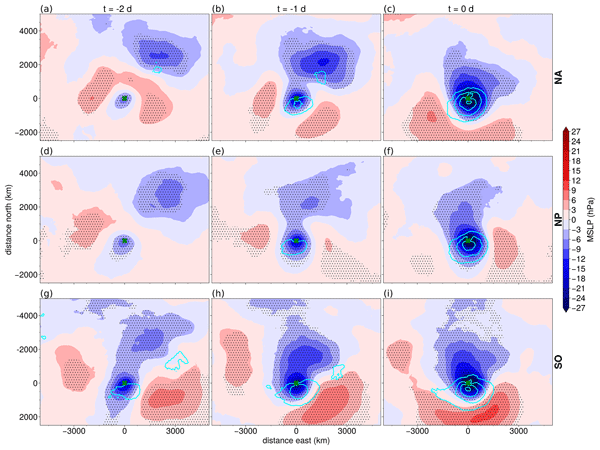
Abstract. Extratropical cyclones occur most frequently over the oceans, where they cause the strongest extreme surface winds. In this study, we investigate extreme surface winds during winter months in the northern and southern hemisphere, when the wind storms are the strongest. The analysis focuses on storm tracks over the North Atlantic, North Pacific and Southern Ocean. We use ERA5 reanalysis data to make composites of extratropical cyclones that cause the top 100 most extreme surface wind events from 1979 until 2020 ("top 100 extremes"). We focus on large-scale atmospheric processes and find that the most prominent large-scale feature of the top 100 extremes in each basin is the presence of a pre-existing downstream cyclone a few days before the time of the maximum surface winds. Pre-existing cyclones are situated poleward and eastward of the top 100 extremes and their presence is consistent with strong upper-level winds and potential vorticity anomalies. Differences between the basins and hemispheres are quantitative. The top 100 extremes in the northern hemisphere develop in an environment with higher mid-tropospheric Eady growth rates, higher deepening rates and stronger surface wind speeds around the cyclones than in the southern hemisphere. Furthermore, we run the general circulation model ISCA with different boundary conditions to investigate their influence on the basin-wide extreme surface winds. We find a strong positive correlation between basin-wide extremes in mid-tropospheric Eady growth rates and surface winds. Zonalizing sea-surface temperatures across tropical and extratropical regions greatly reduces the differences in extreme surface winds between the North Atlantic and North Pacific; inter-hemispheric differences in extreme surface winds between the North Atlantic and Southern Ocean are greatly reduced when sea-surface temperatures are zonalized globally and made hemispherically symmetric, and orography is flat.
-
Notice on discussion status
The requested preprint has a corresponding peer-reviewed final revised paper. You are encouraged to refer to the final revised version.
-
Preprint
(19940 KB)
-
Supplement
(3398 KB)
-
The requested preprint has a corresponding peer-reviewed final revised paper. You are encouraged to refer to the final revised version.
- Preprint
(19940 KB) - Metadata XML
-
Supplement
(3398 KB) - BibTeX
- EndNote
- Final revised paper


Journal article(s) based on this preprint
Interactive discussion
Status: closed
-
RC1: 'Comment on egusphere-2026-1649', Anonymous Referee #1, 05 May 2026
-
AC1: 'Reply on RC1', Aleksa Stanković, 16 Jun 2026
The comment was uploaded in the form of a supplement: https://egusphere.copernicus.org/preprints/2026/egusphere-2026-1649/egusphere-2026-1649-AC1-supplement.pdf
-
AC1: 'Reply on RC1', Aleksa Stanković, 16 Jun 2026
-
RC2: 'Comment on egusphere-2026-1649', Anonymous Referee #2, 05 May 2026
The comment was uploaded in the form of a supplement: https://egusphere.copernicus.org/preprints/2026/egusphere-2026-1649/egusphere-2026-1649-RC2-supplement.pdf
-
AC2: 'Reply on RC2', Aleksa Stanković, 16 Jun 2026
The comment was uploaded in the form of a supplement: https://egusphere.copernicus.org/preprints/2026/egusphere-2026-1649/egusphere-2026-1649-AC2-supplement.pdf
-
AC2: 'Reply on RC2', Aleksa Stanković, 16 Jun 2026
Peer review completion


Interactive discussion
Status: closed
-
RC1: 'Comment on egusphere-2026-1649', Anonymous Referee #1, 05 May 2026
This is a very nicely written paper that generalises the results of the authors’ previous study, showing that the most extreme windstorms in all of the storm track regions have a downstream pre-existing cyclone. The paper also demonstrates that a low-resolution idealised model can capture the hemispheric asymmetry in the extreme winds (where the NH storm tracks have stronger extreme winds than the SH). Experiments with this model indicate that the asymmetries are related to the Eady growth rate, and the topography.
I have a few comments and suggestions on the manuscript.
- Every instance of “northern hemisphere” and southern hemisphere should be Northern Hemisphere and Southern Hemisphere.
- Lines 54-55: I think the use of this intermediate complexity climate model is a key point of novelty in this study, therefore it should be given more attention in the introduction. I suggest including a paragraph on the use of such models and what previous studies have found when doing experiments such as the ones you have done.
- Line 142: I’m not sure about the benefit of saying that you ran 11 different experiments and will only discuss 3. It might be better to fully justify the experiments that you are including – why choose these set-ups? What were the hypotheses you were thinking about when running the experiments?
- Line 153: I’m not sure what you mean when you say the “prescribed SSTs are found”. Surely if you prescribe them you do not need to find them. Perhaps this just needs rewording.
- Line 157: Can you say how you know the surface winds are at a higher level in the model?
- Section 3.1: I think it would be really beneficial to include composites of the winds that you are trying to explain. This would help to see if there are structural differences between the NH and SH too.
- Line 221: typo in “central”.
- Line 284: Can you refer to a figure here?
- Line 287: It would be good to make it clear here that this result generalises the findings of your previous study (rather than being a brand new result). This is also the case for lines 300-303.
- Line 315: I think rather than saying when the jet core “weakens” it should say when the jet core “is weaker”.
- Line 339-340: This statement that it is unclear if the model can represent the storms is a key point. I think it would be good to either do the tracking and look at the individual storms in the model, or explain fully why this is not possible. The model may be quite low resolution, but some tracking algorithms (e.g. the Hodges method) track on T42 vorticity and so it should be possible. You find that the model can represent aspects of the extreme wind climatology, therefore we hope that this is due to the storms that are present in the model. It would be beneficial to show this somehow.
Citation: https://doi.org/10.5194/egusphere-2026-1649-RC1 -
AC1: 'Reply on RC1', Aleksa Stanković, 16 Jun 2026
The comment was uploaded in the form of a supplement: https://egusphere.copernicus.org/preprints/2026/egusphere-2026-1649/egusphere-2026-1649-AC1-supplement.pdf
-
RC2: 'Comment on egusphere-2026-1649', Anonymous Referee #2, 05 May 2026
The comment was uploaded in the form of a supplement: https://egusphere.copernicus.org/preprints/2026/egusphere-2026-1649/egusphere-2026-1649-RC2-supplement.pdf
-
AC2: 'Reply on RC2', Aleksa Stanković, 16 Jun 2026
The comment was uploaded in the form of a supplement: https://egusphere.copernicus.org/preprints/2026/egusphere-2026-1649/egusphere-2026-1649-AC2-supplement.pdf
-
AC2: 'Reply on RC2', Aleksa Stanković, 16 Jun 2026
Peer review completion
Journal article(s) based on this preprint
Viewed
| HTML | XML | Total | Supplement | BibTeX | EndNote | |
|---|---|---|---|---|---|---|
| 415 | 176 | 40 | 631 | 65 | 31 | 39 |
- HTML: 415
- PDF: 176
- XML: 40
- Total: 631
- Supplement: 65
- BibTeX: 31
- EndNote: 39
Viewed (geographical distribution)
| Country | # | Views | % |
|---|
| Total: | 0 |
| HTML: | 0 |
| PDF: | 0 |
| XML: | 0 |
- 1
Aleksa Stanković

Rodrigo Caballero
Gabriele Messori
The requested preprint has a corresponding peer-reviewed final revised paper. You are encouraged to refer to the final revised version.
- Preprint
(19940 KB) - Metadata XML
-
Supplement
(3398 KB) - BibTeX
- EndNote
- Final revised paper
This is a very nicely written paper that generalises the results of the authors’ previous study, showing that the most extreme windstorms in all of the storm track regions have a downstream pre-existing cyclone. The paper also demonstrates that a low-resolution idealised model can capture the hemispheric asymmetry in the extreme winds (where the NH storm tracks have stronger extreme winds than the SH). Experiments with this model indicate that the asymmetries are related to the Eady growth rate, and the topography.
I have a few comments and suggestions on the manuscript.