
the Creative Commons Attribution 4.0 License.
the Creative Commons Attribution 4.0 License.
 | 29 Apr 2026
High Frequency of Urban New Particle Formation on the Tibetan Plateau: Quantifying Formation Rates, Growth Rates, and CCN Production
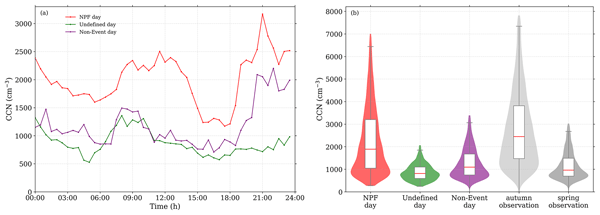
Abstract. New particle formation (NPF) strongly influences aerosol number size distributions and cloud condensation nuclei (CCN), yet its characteristics and climatic relevance in high-altitude urban environments over the Tibetan Plateau (TP) remain poorly constrained. We conducted in situ observations at Tibet University in Lhasa during the monsoon and pre-monsoon seasons. NPF event frequencies were 86.2 % during the monsoon season and 55.1 % during the pre-monsoon period. Observation days were classified into four types (Class I, Class II, Undefined, and Non-Event) based on the evolution of particle number size distribution (PNSD) and modal development. Seasonal comparisons indicate clear differences in the factors associated with NPF: monsoon season NPF was mainly associated with sulfur precursor availability, whereas no single clear controlling factor was evident during the pre-monsoon period. NPF substantially enhanced CCN at TU, with mean concentrations of 3351 ± 1919 cm⁻³ on Class I days, 1540.2 ± 872 cm⁻³ on Class II days, 880.5 ± 374 cm⁻³ on Undefined days, and 1278.1 ± 667 cm⁻³ on Non-Event days. The impact of NPF on CCN depends not only on nucleation, but also on the continued growth and survival of newly formed particles. This study provides new insights into urban NPF characteristics and the contribution of NPF to CCN on the TP, improving our understanding of aerosol–climate interactions in high-altitude urban environments.
-
Notice on discussion status
The requested preprint has a corresponding peer-reviewed final revised paper. You are encouraged to refer to the final revised version.
-
Preprint
(10712 KB)
-
Supplement
(1319 KB)
-
The requested preprint has a corresponding peer-reviewed final revised paper. You are encouraged to refer to the final revised version.
- Preprint
(10712 KB) - Metadata XML
-
Supplement
(1319 KB) - BibTeX
- EndNote
- Final revised paper


Journal article(s) based on this preprint
Interactive discussion
Status: closed
-
CC1: 'Comment on egusphere-2026-1628', Nima Zafarmomen, 14 May 2026
- AC3: 'Reply on CC1', Gang Zhao, 27 Jul 2026
-
RC1: 'Comment on egusphere-2026-1628', Anonymous Referee #2, 23 May 2026
First, thanks for considering me as a reviewer for this nice work. I have read the manuscript, and I believe that it presents very good observations of frequent NPF in a high-altitude urban environment on the Tibetan Plateau. The dataset is interesting and potentially important for understanding aerosol formation in unique mountain urban regions. However, several central conclusions depend on subjective event classification (that’s a well-known general problem) and some limitation on NPF mechanistic understanding. I like the study and I would like to see it published in ACP but it would need some revisions.
Here my comments:
Introduction:
The introduction is overall well structured; However, it might be that the literature review is somehow narrow. I do understand that the focus of the paper is the Tibetan Plateau however there are several other studies with a focus on high altitude measurements and location very close to the one done in this study. This introduction focuses strongly on recent Tibetan Plateau background studies while giving limited attention to the broader high-altitude and free-tropospheric NPF literature. I can imagine that a comparison done with measurements presented in Himalaya such as Bianchi et al. (2021, Nature Geoscience) but also many other studies could be good for this work. Also, this comparison can been done when discussing the possible precursors. In this way the authors can also benefit by distinguish their urban Lhasa case from other mountain NPF types.
Classification event:
It is well known that the actual classification method is subjective and probably quite qualitative. However, I have the feeling that in this case can be improved. Also, because many central results depend on the classification, like NPF frequency, J/GR statistics, and CCN formation. For example, in figure 2, I would even think that type II and even undefined can be considered as a class I event. Mostly, it seems that, the separation between Class II and Undefined events is not really clear. Something useful could be a day-by-day classification table, including event start/end times, growth-rate time windows, and so on. An additional approach could be to use a ranking method that classified that days in function of particles that have been produced.
Monsoon NPF mechanism and NPF mechanism in general:
The study says that monsoon NPF is mainly associated with SO₂ availability and therefore H₂SO₄ formation. This is can also be reasonable, but since the authors couldn’t measure all the parameters such as sulfuric acid, or bases such as ammonia or amines, or organic molecules and their oxidation products. SO2 is clearly quite high and therefore can be a reason for the NPF. One possibility could be to calculate Sulphuric Acid proxy from SO2 and see how it compare to the formation rate. Because of all of that I would say that the interpretation that monsoon NPF is sulfur-precursor-driven should be softened unless additional analysis such as at least Sulphuric Acid proxy Vs Formation rate. Also, the paper discusses possible VOC-related oxidation in the pre-monsoon season but cannot constrain it. We understand that these measurements are very complicated, especially in such location, however, considering recent literature on HOMs/OOMs in mountain and TP environments, the author should be more critical in highlighting these limitations. They have a beautiful data set also without going too much in details on the NPF mechanism.
Urban primary emissions vs NPF:
I think it would be good if the authors could try to better separate regional NPF from local primary ultrafine particle emissions. This could include analysis of wind direction, BC/NO₂/SO₂ spikes, rush-hour timing, and whether events occur simultaneously across broader size ranges. Considering the unique location this would add strength and very interesting new information to the study.
Other minor comments:
Line 25 – Define TU. I guess you mean TP.
Figure 1 – “Tibetan Plateau” is not visible. Also, define TU in the caption.
Figure 2 – Fix the Panel a Y-axes description. Caption is missing explanation.
Figure 3 – fixe axes labels here as well. Too many overlaps.
Caption in general could contain more information related to the figures.
Citation: https://doi.org/10.5194/egusphere-2026-1628-RC1 - AC1: 'Reply on RC1', Gang Zhao, 27 Jul 2026
-
RC2: 'Comment on egusphere-2026-1628', Anonymous Referee #1, 23 Jul 2026
The manuscript describes a dataset of particle number size distribution, precursor vapors and meteorology measurements at an urban high-altitude site. While the dataset is limited to two campaign-wise measurement periods of one month each, the dataset and its analyses provide valuable information on atmospheric new particle formation from a location not studied in this aspect before. Therefore, the manuscript is well in the scope of Atmospheric Chemistry and Physics. However, as pointed out by Referee #2 there are certain aspects in the present version of the study that would need to revised before the manuscript can be accepted for publication. I suggest the authors take into consideration the issues raised by Referee #2. My additional comments are following:
- I would recommend removing the distinction between NPF event Class I and Class II, and suggest these to be called NPF events. As seen from the supplement figures S1 and S2, there seem to be some days (Oct 26, March 25 and March 26) classified as Class I days, which by definition of Class I should show uninterrupted growth of particles but there are clear gaps in the measured PNSD data. On the other hand, some days (at least Oct 10 and Oct 19) seem to have quite continuous growth of particles, but these days have been classified as Class II days.
- Particle formation rates J3 and J7 seem to have almost identical magnitude and diurnal variation (Fig 6) for Class I and Class II events. This would also support having only one NPF event class (combination of the Class I and Class II days).
- Have the authors compared the calculated CCN concentrations (calculated assuming const. hygroscopicity and supersaturation) to the measured accumulation mode number concetrations N100-700, which is in many studies used as proxy for CCN? Based on Figures 5d and 10a, the diurnal variation of both these seems similar but the calculated CCN concentrations seem to be higher.
- Please define all symbols used in Equations 6 and 7
Citation: https://doi.org/10.5194/egusphere-2026-1628-RC2 - AC2: 'Reply on RC2', Gang Zhao, 27 Jul 2026
Peer review completion


Interactive discussion
Status: closed
-
CC1: 'Comment on egusphere-2026-1628', Nima Zafarmomen, 14 May 2026
The paper investigates new particle formation (NPF) in Lhasa, Tibet, a high-altitude urban environment on the Tibetan Plateau. The authors use in situ particle number size distribution measurements collected at Tibet University during the monsoon and pre-monsoon periods. The main objectives are to quantify the frequency of NPF events, determine particle formation and growth rates, identify the factors controlling NPF occurrence and development, and evaluate the potential contribution of NPF to cloud condensation nuclei (CCN). Overall, the manuscript is scientifically relevant and timely. Its strengths include its focus on an understudied urban Tibetan Plateau environment, the use of high-time-resolution SMPS observations, and its attempt to link NPF events with potential CCN production.
Minor comment:
- The study is based on two relatively short observational campaigns: 9 October–10 November 2024 and 25 March–22 April 2025. While these measurements provide valuable insight into NPF characteristics during the selected monsoon and pre-monsoon periods, the limited duration may not fully represent the broader seasonal variability. The authors should add a short discussion on the representativeness of these campaign periods and clarify whether the reported seasonal differences can be generalized to typical monsoon and pre-monsoon conditions over Lhasa.
- The NPF event classification relies mainly on visual inspection of particle size distribution evolution. The authors should briefly clarify how classification uncertainty was handled, especially for weak or discontinuous events.
- Since CCN concentrations were estimated rather than directly measured, the authors should mention the uncertainty associated with the assumed κ value and supersaturation.
- The possible role of VOCs in pre-monsoon particle growth is discussed, but VOCs were not measured. This point should be stated more cautiously.
- The site is influenced by local urban sources such as traffic, combustion, construction, and dust. The authors should briefly discuss how these emissions may affect NPF interpretation.
- I strongly recommend the authors should consider citing the study “Comprehensive spatiotemporal analysis of long-term mobile monitoring for traffic-related particles in a complex urban environment” in the Introduction or site-description discussion, as it provides relevant context on traffic-related particle variability in complex urban environments.
Citation: https://doi.org/10.5194/egusphere-2026-1628-CC1 - AC3: 'Reply on CC1', Gang Zhao, 27 Jul 2026
-
RC1: 'Comment on egusphere-2026-1628', Anonymous Referee #2, 23 May 2026
First, thanks for considering me as a reviewer for this nice work. I have read the manuscript, and I believe that it presents very good observations of frequent NPF in a high-altitude urban environment on the Tibetan Plateau. The dataset is interesting and potentially important for understanding aerosol formation in unique mountain urban regions. However, several central conclusions depend on subjective event classification (that’s a well-known general problem) and some limitation on NPF mechanistic understanding. I like the study and I would like to see it published in ACP but it would need some revisions.
Here my comments:
Introduction:
The introduction is overall well structured; However, it might be that the literature review is somehow narrow. I do understand that the focus of the paper is the Tibetan Plateau however there are several other studies with a focus on high altitude measurements and location very close to the one done in this study. This introduction focuses strongly on recent Tibetan Plateau background studies while giving limited attention to the broader high-altitude and free-tropospheric NPF literature. I can imagine that a comparison done with measurements presented in Himalaya such as Bianchi et al. (2021, Nature Geoscience) but also many other studies could be good for this work. Also, this comparison can been done when discussing the possible precursors. In this way the authors can also benefit by distinguish their urban Lhasa case from other mountain NPF types.
Classification event:
It is well known that the actual classification method is subjective and probably quite qualitative. However, I have the feeling that in this case can be improved. Also, because many central results depend on the classification, like NPF frequency, J/GR statistics, and CCN formation. For example, in figure 2, I would even think that type II and even undefined can be considered as a class I event. Mostly, it seems that, the separation between Class II and Undefined events is not really clear. Something useful could be a day-by-day classification table, including event start/end times, growth-rate time windows, and so on. An additional approach could be to use a ranking method that classified that days in function of particles that have been produced.
Monsoon NPF mechanism and NPF mechanism in general:
The study says that monsoon NPF is mainly associated with SO₂ availability and therefore H₂SO₄ formation. This is can also be reasonable, but since the authors couldn’t measure all the parameters such as sulfuric acid, or bases such as ammonia or amines, or organic molecules and their oxidation products. SO2 is clearly quite high and therefore can be a reason for the NPF. One possibility could be to calculate Sulphuric Acid proxy from SO2 and see how it compare to the formation rate. Because of all of that I would say that the interpretation that monsoon NPF is sulfur-precursor-driven should be softened unless additional analysis such as at least Sulphuric Acid proxy Vs Formation rate. Also, the paper discusses possible VOC-related oxidation in the pre-monsoon season but cannot constrain it. We understand that these measurements are very complicated, especially in such location, however, considering recent literature on HOMs/OOMs in mountain and TP environments, the author should be more critical in highlighting these limitations. They have a beautiful data set also without going too much in details on the NPF mechanism.
Urban primary emissions vs NPF:
I think it would be good if the authors could try to better separate regional NPF from local primary ultrafine particle emissions. This could include analysis of wind direction, BC/NO₂/SO₂ spikes, rush-hour timing, and whether events occur simultaneously across broader size ranges. Considering the unique location this would add strength and very interesting new information to the study.
Other minor comments:
Line 25 – Define TU. I guess you mean TP.
Figure 1 – “Tibetan Plateau” is not visible. Also, define TU in the caption.
Figure 2 – Fix the Panel a Y-axes description. Caption is missing explanation.
Figure 3 – fixe axes labels here as well. Too many overlaps.
Caption in general could contain more information related to the figures.
Citation: https://doi.org/10.5194/egusphere-2026-1628-RC1 - AC1: 'Reply on RC1', Gang Zhao, 27 Jul 2026
-
RC2: 'Comment on egusphere-2026-1628', Anonymous Referee #1, 23 Jul 2026
The manuscript describes a dataset of particle number size distribution, precursor vapors and meteorology measurements at an urban high-altitude site. While the dataset is limited to two campaign-wise measurement periods of one month each, the dataset and its analyses provide valuable information on atmospheric new particle formation from a location not studied in this aspect before. Therefore, the manuscript is well in the scope of Atmospheric Chemistry and Physics. However, as pointed out by Referee #2 there are certain aspects in the present version of the study that would need to revised before the manuscript can be accepted for publication. I suggest the authors take into consideration the issues raised by Referee #2. My additional comments are following:
- I would recommend removing the distinction between NPF event Class I and Class II, and suggest these to be called NPF events. As seen from the supplement figures S1 and S2, there seem to be some days (Oct 26, March 25 and March 26) classified as Class I days, which by definition of Class I should show uninterrupted growth of particles but there are clear gaps in the measured PNSD data. On the other hand, some days (at least Oct 10 and Oct 19) seem to have quite continuous growth of particles, but these days have been classified as Class II days.
- Particle formation rates J3 and J7 seem to have almost identical magnitude and diurnal variation (Fig 6) for Class I and Class II events. This would also support having only one NPF event class (combination of the Class I and Class II days).
- Have the authors compared the calculated CCN concentrations (calculated assuming const. hygroscopicity and supersaturation) to the measured accumulation mode number concetrations N100-700, which is in many studies used as proxy for CCN? Based on Figures 5d and 10a, the diurnal variation of both these seems similar but the calculated CCN concentrations seem to be higher.
- Please define all symbols used in Equations 6 and 7
Citation: https://doi.org/10.5194/egusphere-2026-1628-RC2 - AC2: 'Reply on RC2', Gang Zhao, 27 Jul 2026
Peer review completion
Journal article(s) based on this preprint
Viewed
| HTML | XML | Total | Supplement | BibTeX | EndNote | |
|---|---|---|---|---|---|---|
| 529 | 185 | 56 | 770 | 84 | 49 | 45 |
- HTML: 529
- PDF: 185
- XML: 56
- Total: 770
- Supplement: 84
- BibTeX: 49
- EndNote: 45
Viewed (geographical distribution)
| Country | # | Views | % |
|---|
| Total: | 0 |
| HTML: | 0 |
| PDF: | 0 |
| XML: | 0 |
- 1
Qiqi Mo
Longjie Wen

Weili Lin
Fengjun Shen
Tong Liu
Yicheng Gao
Yi Chen
Tiantian Zhang
The requested preprint has a corresponding peer-reviewed final revised paper. You are encouraged to refer to the final revised version.
- Preprint
(10712 KB) - Metadata XML
-
Supplement
(1319 KB) - BibTeX
- EndNote
- Final revised paper
The paper investigates new particle formation (NPF) in Lhasa, Tibet, a high-altitude urban environment on the Tibetan Plateau. The authors use in situ particle number size distribution measurements collected at Tibet University during the monsoon and pre-monsoon periods. The main objectives are to quantify the frequency of NPF events, determine particle formation and growth rates, identify the factors controlling NPF occurrence and development, and evaluate the potential contribution of NPF to cloud condensation nuclei (CCN). Overall, the manuscript is scientifically relevant and timely. Its strengths include its focus on an understudied urban Tibetan Plateau environment, the use of high-time-resolution SMPS observations, and its attempt to link NPF events with potential CCN production.
Minor comment: