
the Creative Commons Attribution 4.0 License.
the Creative Commons Attribution 4.0 License.
 | 02 Apr 2026
Global and regional emissions of 1,2-dichloroethane derived from AGAGE and NOAA observations
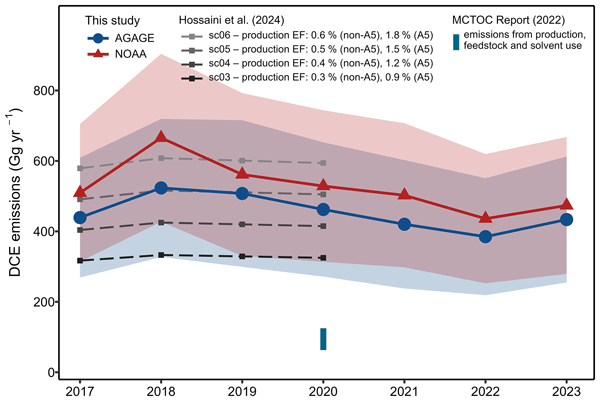
Abstract. For the first time, we present long-term, ongoing atmospheric measurements of 1,2-dichloroethane (DCE, CH2ClCH2Cl) from the Advanced Global Atmospheric Gases Experiment (AGAGE) and National Oceanic and Atmospheric Administration (NOAA) global monitoring networks. DCE is an industrially produced, very short-lived chlorinated substance (Cl-VSLS) that has the potential to contribute chlorine to the stratosphere and cause ozone depletion. Compared to other Cl-VSLS, DCE is produced in higher volumes for its primary use as a feedstock in polyvinyl chloride (PVC) manufacture. This production has sustained annual mean mole fractions at the Earth’s surface of between 5 and 10 ppt during 2017–2023, making it the third most abundant Cl-VSLS. In this study we estimate mean global emissions for 2017–2023 of 453 [268, 638] Gg yr−1 using the AGAGE observations, and 525 [316, 734] Gg yr−1 using the NOAA observations. We also use AGAGE measurements to estimate regional emissions for northwest Europe (2.06 [1.31, 2.65] Gg yr−1) and California (0.23 [0, 0.37] Gg yr−1), two domains with sufficient observational coverage to enable this approach. Our global emissions estimates are consistent (within uncertainties) with the only previously published estimate by Hossaini et al. (2024), whereas our regional emission estimates are at least an order of magnitude smaller than those in that study. This suggests global total emissions may be well constrained, but their spatial distribution remains uncertain. Improved measurement coverage in key source regions of DCE could address that uncertainty and better constrain the contribution of DCE to ozone-depleting chlorine in the stratosphere.
-
Notice on discussion status
The requested preprint has a corresponding peer-reviewed final revised paper. You are encouraged to refer to the final revised version.
-
Preprint
(3079 KB)
-
The requested preprint has a corresponding peer-reviewed final revised paper. You are encouraged to refer to the final revised version.
- Preprint
(3079 KB) - Metadata XML
- BibTeX
- EndNote
- Final revised paper


Journal article(s) based on this preprint
Interactive discussion
Status: closed
-
RC1: 'Comment on egusphere-2026-1589', Anonymous Referee #1, 04 May 2026
-
AC1: 'Reply on RC1', Joseph Pitt, 26 May 2026
The comment was uploaded in the form of a supplement: https://egusphere.copernicus.org/preprints/2026/egusphere-2026-1589/egusphere-2026-1589-AC1-supplement.pdf
-
AC1: 'Reply on RC1', Joseph Pitt, 26 May 2026
-
RC2: 'Comment on egusphere-2026-1589', Anonymous Referee #2, 17 May 2026
The manuscript “Global and regional emissions of 1,2-dichloroethane derived from AGAGE and NOAA observations” is of great importance, and the atmospheric chemistry scientific community will greatly benefit from its findings. The manuscript is very well written, and the data are clearly presented. The quality of the dataset is very high, as is the discussion of all the potential sources of errors, limitations, and areas of uncertainty. I only have a few minor comments, and after they have been considered by the authors, the paper is, in my opinion, ready for publication.
Specifically:
- L. 7: “…making it the third most abundant Cl-VSLS”, I would add the two species that are ranked first and second.
- L. 66–70: What is a “potential effect on stratospheric Cl- abundance” other than the “contribution to direct stratospheric ozone depletion”? However, I may simply be misunderstanding your point here.
- L. 109: Could you please clarify whether the 0.5% difference refers to differences between the two collection methods or between the two flasks in the paired set?
- The countries included in NW Europe do not — rightfully, from a geographic point of view — include Italy or Switzerland. However, of the five sampling sites whose measurements were used to determine NW European emissions, one is located in Switzerland and another in Italy. I was wondering about what I perceive as a discrepancy between the measuring sites and the domain used for the inferred emissions.
- L. 320: “There is no consistent trend of global mean atmospheric abundance over this period”. What kind of trend were you expecting (or what trend could possibly have been present) that you do not actually observe? For example, a steady increase? Do you have any comments regarding the annual fluctuations in DCE levels?
- Figure 3: Cosmetic issue, I feel that the blue used for the symbol representing Palmer Station is too similar to those used for Summit and Barrow.
Citation: https://doi.org/10.5194/egusphere-2026-1589-RC2 -
AC2: 'Reply on RC2', Joseph Pitt, 26 May 2026
The comment was uploaded in the form of a supplement: https://egusphere.copernicus.org/preprints/2026/egusphere-2026-1589/egusphere-2026-1589-AC2-supplement.pdf
-
RC3: 'Comment on egusphere-2026-1589', Anonymous Referee #3, 22 May 2026
The paper “Global and regional emissions of 1,2-dichloroethane derived from AGAGE and NOAA observations” by Pitt et al., (2026) reports data from continuous measurements of 1,2-dichloroethane (DCE), made by the authors, within two important global monitoring networks, specifically AGAGE and NOAA, which they will make it publicly available to the community through the networks’ websites. The paper primarily reports the sampling, analysis, and calibration techniques for the reported data. Then, they use these data to estimate global total emissions for years 2017-2023 using a global inverse modeling method. Authors also use regional inverse modeling methods to estimate regional emission maps for NW Europe and California.
First, I would like to extend my appreciation, on behalf of all users, to the measurement teams for their hard work and dedication in making these measurements. Atmospheric science community needs and relies on these long term datasets to better understand the Earth system and how it evolves.
Second, this study makes a valuable contribution to better understanding the DCE abundance and emissions, and it is worthy of publication in ACP. Nevertheless, the paper needs more discussion on some parts and potential restructuring of some sections and figures. Below, I list my comments, questions, and suggested edits that need to be addressed. “L” refers to “line” number in the manuscript.
Title
This paper primarily reports the measurements of DCE and the emission estimation is of a secondary importance as the authors correctly state in line 87-88 that "Here we present, for the first time, ongoing surface-based measurements of DCE from the AGAGE (AGAGE, 2025; Prinn et al., 2018) and NOAA (NOAA, 2025) global measurement networks." However, the title gives the impression that gridded emission files will be the main product of the paper, which is not the case as per my understanding. I would recommend using a more accurate title.
Abstract
L7-8: Please use mean ± std, instead of using brackets (e.g., [268, 638]). Using the bracket suggests a range, but my understanding is that these are the standard deviations following the results in L381.
Section 1 Introduction:
L33: I would suggest also mentioning ‘DCA’ as one of the abbreviated forms of 1,2-Dichloroethane. While both “DCA” and “DCE” have been used in the literature for this compound, DCE has been used for dichlroethEne too, when doing a ‘Web of Science” search for “dichloroethene DCE”.
L80: Please check the references to make sure they are used correctly. For example, it cites Pan et al. (2024) for ground based measurements. But, this mission was focused on UTLS using airborne measurements.
L89: Please reword the sentence to be accurate “With measurements from archived air samples, we extend the record back to 1995”, as my understanding is that this step is done for only a few sites.
Section 2.1: Measurement sites
I couldn’t find any information on the “AGAGE&NOAA” and “KOPRI” sites in the text (maybe lines 239-242) while they are shown in Figure 1. Please add what they are, and edit the results section accordingly.
L132: For clarity, please replace ‘std’ with another word, e.g., ‘stdm’ or another word. ‘std’ could also refer to standard deviation. Also, consider changing ‘air’ to be consistent with the standard measurement.
Section 2.2: Sampling and analysis
It is a pretty long section. Please separate it to sub-sections, maybe separate to AGAGE and NOAA measurements.
Section 2-3: Calibration
Same as the previous comment. Please consider separating it two calibration methods for AGAGE and NOAA.
Section 2-4-3: Regional modelling
I think presenting the differences between these models in a table format would be very helpful for the readers to better understand them. Please add a table to either the main text or the appendix.
Section 3.: Results and discussion
L 318: Since authors are showing the measurements, I would recommend removing the sentence about modeling results from this section, and move it to the modeling results section.
Figures2,3: Please use the stations’ abbreviated names instead of full name in these figures, so readers can easily find the location in Figure 1.
Similar to the comment above, please use consistent naming in the whole text; i.e., use the abbreviated names always (and use the station name in parenthesis if needed).
Figures 2,3: Also, the order for separating stations in each panel is not clear. I would recommend separating either by latitude or longitude ranges. It will help readers better understand the zonal distribution also. Or, maybe use a logarithmic scale and one panel in each figure might provide more insights on the differences; this way, extreme values would be also present which are important.
L336-345: I believe this section deserves more discussion; maybe an additional paragraph on more specifics. For example, which sites found high concentrations, what the range of those concentrations were, etc.
L340-342: What do the ranges show? Are they min-max? please specify. Also, please quantify the variability.
L346-L352: This paragraph quantifies other Cl-VSLS compounds, but misses to specify the corresponding measured values for DCE.
L353-364: This paragraph doesn’t show any results. Please move this paragraph to the methods sections.
L365-369: For the increasing trend, please quantify it. On the other hand, even if the trend is less clear after 2018, Figure 4 does show a change. Are there any speculations or hypothesis for that change?
When presenting the measurements, authors state there is not a consistent trend (line 319), and again in line 368. They also state that the estimated emissions do not show a trend (L381). However, Figure 4 shows a reduction in the last few years. At the same time, prior emissions were similar for years 2020-2023, but the posterior emissions are showing a decreasing trend in these years. They all suggest to me that there is a decreasing trend in the last few years. Please provide more clarifying information on these points.
Section 3.2: Global emissions
L405-413: Based on Figure 5, “sc3” is also within the uncertainty range. Why didn’t authors include it in the discussion?
Similarly, I find 50% variability pretty large in this case. It virtually removed all the differences made for scenarios in Hossaini et al. (2024). In other words, it seems the choice of prior emission scenario would not affect the results. Is that a correct assumption? If no, how sensitive are the results to the selected priori emission? Please clarify in the text.
Section 3.3: Regional emissions
L465-466 I guess another implication of this analysis is that emissions in Asia are much higher than what Hossaini et al., (2024) estimated. If authors agree, maybe they could comment on that in the text.
Code and data availability
The links seem to be expired in the time this review was done. Please make sure all the data becomes publicly available.
Citation: https://doi.org/10.5194/egusphere-2026-1589-RC3 -
AC3: 'Reply on RC3', Joseph Pitt, 26 May 2026
The comment was uploaded in the form of a supplement: https://egusphere.copernicus.org/preprints/2026/egusphere-2026-1589/egusphere-2026-1589-AC3-supplement.pdf
-
AC3: 'Reply on RC3', Joseph Pitt, 26 May 2026
Peer review completion


Interactive discussion
Status: closed
-
RC1: 'Comment on egusphere-2026-1589', Anonymous Referee #1, 04 May 2026
This paper describes measurements of 1,2-dicloroethane (DCE) at sites within the AGAGE and NOAA networks. The measurements are described and used in global and regional modeling to estimate global emissions and regional emissions for NW Europe and California. The global emissions are consistent with a previous study by Hossaini, but the regional emissions are much lower than Hossaini.
The paper is very clearly written, the results are significant and I recommend publication after addressing some minor comments.
Line 366-369 - The authors say that the increasing trend in DCE mole fraction in the archive samples is qualitatively consistent with increasing emissions after 2002 derived by Hossaini, but that it is not possible to provide a top-down estimate of global emissions. Is it possible to be a bit more quantitative, e.g. using scenarios of global emissions in the forward model, starting with the Hossaini emissions, with a specified latitudinal emission distribution consistent with Hossaini et al or the inferred distribution in this study? Couldn't a couple of different scenarios run forward in the 12-box model give some indication of the global emissions? I accept that there are not enough archive observations for the global inversion, but it still might be possible to be more quantitative.
Figs 7, F2 and F4 - I understand that it is difficult to show the prior and posterior emissions with the same linear scale. Have the authors tried a non-linear scale (e.g. such as used in Fig 6 of Manning et al., 2021 listed in the reference list)? It would be nice to be able to see more of the details in both the prior and posterior maps, but this is hard with the linear scale.
Line 477 - this is the first mention of the toxicity of DCE, it could be mentioned in the introduction.
I do think the paper would benefit from a Conclusions section, even if relatively short, and this is consistent with the Guidelines for authors at https://www.atmospheric-chemistry-and-physics.net/policies/guidelines_for_authors.html. There is an Implications Section, which could stay as it is, but there is no summary of the main results relating them to the objectives, other than in the abstract, and I think this is missed at the end of the paper. The abstract is at maximum length, perhaps that could be shortened and some detail moved to the Conclusions. The paper ends too abruptly without a summary at the end.
Citation: https://doi.org/10.5194/egusphere-2026-1589-RC1 -
AC1: 'Reply on RC1', Joseph Pitt, 26 May 2026
The comment was uploaded in the form of a supplement: https://egusphere.copernicus.org/preprints/2026/egusphere-2026-1589/egusphere-2026-1589-AC1-supplement.pdf
-
AC1: 'Reply on RC1', Joseph Pitt, 26 May 2026
-
RC2: 'Comment on egusphere-2026-1589', Anonymous Referee #2, 17 May 2026
The manuscript “Global and regional emissions of 1,2-dichloroethane derived from AGAGE and NOAA observations” is of great importance, and the atmospheric chemistry scientific community will greatly benefit from its findings. The manuscript is very well written, and the data are clearly presented. The quality of the dataset is very high, as is the discussion of all the potential sources of errors, limitations, and areas of uncertainty. I only have a few minor comments, and after they have been considered by the authors, the paper is, in my opinion, ready for publication.
Specifically:
- L. 7: “…making it the third most abundant Cl-VSLS”, I would add the two species that are ranked first and second.
- L. 66–70: What is a “potential effect on stratospheric Cl- abundance” other than the “contribution to direct stratospheric ozone depletion”? However, I may simply be misunderstanding your point here.
- L. 109: Could you please clarify whether the 0.5% difference refers to differences between the two collection methods or between the two flasks in the paired set?
- The countries included in NW Europe do not — rightfully, from a geographic point of view — include Italy or Switzerland. However, of the five sampling sites whose measurements were used to determine NW European emissions, one is located in Switzerland and another in Italy. I was wondering about what I perceive as a discrepancy between the measuring sites and the domain used for the inferred emissions.
- L. 320: “There is no consistent trend of global mean atmospheric abundance over this period”. What kind of trend were you expecting (or what trend could possibly have been present) that you do not actually observe? For example, a steady increase? Do you have any comments regarding the annual fluctuations in DCE levels?
- Figure 3: Cosmetic issue, I feel that the blue used for the symbol representing Palmer Station is too similar to those used for Summit and Barrow.
Citation: https://doi.org/10.5194/egusphere-2026-1589-RC2 -
AC2: 'Reply on RC2', Joseph Pitt, 26 May 2026
The comment was uploaded in the form of a supplement: https://egusphere.copernicus.org/preprints/2026/egusphere-2026-1589/egusphere-2026-1589-AC2-supplement.pdf
-
RC3: 'Comment on egusphere-2026-1589', Anonymous Referee #3, 22 May 2026
The paper “Global and regional emissions of 1,2-dichloroethane derived from AGAGE and NOAA observations” by Pitt et al., (2026) reports data from continuous measurements of 1,2-dichloroethane (DCE), made by the authors, within two important global monitoring networks, specifically AGAGE and NOAA, which they will make it publicly available to the community through the networks’ websites. The paper primarily reports the sampling, analysis, and calibration techniques for the reported data. Then, they use these data to estimate global total emissions for years 2017-2023 using a global inverse modeling method. Authors also use regional inverse modeling methods to estimate regional emission maps for NW Europe and California.
First, I would like to extend my appreciation, on behalf of all users, to the measurement teams for their hard work and dedication in making these measurements. Atmospheric science community needs and relies on these long term datasets to better understand the Earth system and how it evolves.
Second, this study makes a valuable contribution to better understanding the DCE abundance and emissions, and it is worthy of publication in ACP. Nevertheless, the paper needs more discussion on some parts and potential restructuring of some sections and figures. Below, I list my comments, questions, and suggested edits that need to be addressed. “L” refers to “line” number in the manuscript.
Title
This paper primarily reports the measurements of DCE and the emission estimation is of a secondary importance as the authors correctly state in line 87-88 that "Here we present, for the first time, ongoing surface-based measurements of DCE from the AGAGE (AGAGE, 2025; Prinn et al., 2018) and NOAA (NOAA, 2025) global measurement networks." However, the title gives the impression that gridded emission files will be the main product of the paper, which is not the case as per my understanding. I would recommend using a more accurate title.
Abstract
L7-8: Please use mean ± std, instead of using brackets (e.g., [268, 638]). Using the bracket suggests a range, but my understanding is that these are the standard deviations following the results in L381.
Section 1 Introduction:
L33: I would suggest also mentioning ‘DCA’ as one of the abbreviated forms of 1,2-Dichloroethane. While both “DCA” and “DCE” have been used in the literature for this compound, DCE has been used for dichlroethEne too, when doing a ‘Web of Science” search for “dichloroethene DCE”.
L80: Please check the references to make sure they are used correctly. For example, it cites Pan et al. (2024) for ground based measurements. But, this mission was focused on UTLS using airborne measurements.
L89: Please reword the sentence to be accurate “With measurements from archived air samples, we extend the record back to 1995”, as my understanding is that this step is done for only a few sites.
Section 2.1: Measurement sites
I couldn’t find any information on the “AGAGE&NOAA” and “KOPRI” sites in the text (maybe lines 239-242) while they are shown in Figure 1. Please add what they are, and edit the results section accordingly.
L132: For clarity, please replace ‘std’ with another word, e.g., ‘stdm’ or another word. ‘std’ could also refer to standard deviation. Also, consider changing ‘air’ to be consistent with the standard measurement.
Section 2.2: Sampling and analysis
It is a pretty long section. Please separate it to sub-sections, maybe separate to AGAGE and NOAA measurements.
Section 2-3: Calibration
Same as the previous comment. Please consider separating it two calibration methods for AGAGE and NOAA.
Section 2-4-3: Regional modelling
I think presenting the differences between these models in a table format would be very helpful for the readers to better understand them. Please add a table to either the main text or the appendix.
Section 3.: Results and discussion
L 318: Since authors are showing the measurements, I would recommend removing the sentence about modeling results from this section, and move it to the modeling results section.
Figures2,3: Please use the stations’ abbreviated names instead of full name in these figures, so readers can easily find the location in Figure 1.
Similar to the comment above, please use consistent naming in the whole text; i.e., use the abbreviated names always (and use the station name in parenthesis if needed).
Figures 2,3: Also, the order for separating stations in each panel is not clear. I would recommend separating either by latitude or longitude ranges. It will help readers better understand the zonal distribution also. Or, maybe use a logarithmic scale and one panel in each figure might provide more insights on the differences; this way, extreme values would be also present which are important.
L336-345: I believe this section deserves more discussion; maybe an additional paragraph on more specifics. For example, which sites found high concentrations, what the range of those concentrations were, etc.
L340-342: What do the ranges show? Are they min-max? please specify. Also, please quantify the variability.
L346-L352: This paragraph quantifies other Cl-VSLS compounds, but misses to specify the corresponding measured values for DCE.
L353-364: This paragraph doesn’t show any results. Please move this paragraph to the methods sections.
L365-369: For the increasing trend, please quantify it. On the other hand, even if the trend is less clear after 2018, Figure 4 does show a change. Are there any speculations or hypothesis for that change?
When presenting the measurements, authors state there is not a consistent trend (line 319), and again in line 368. They also state that the estimated emissions do not show a trend (L381). However, Figure 4 shows a reduction in the last few years. At the same time, prior emissions were similar for years 2020-2023, but the posterior emissions are showing a decreasing trend in these years. They all suggest to me that there is a decreasing trend in the last few years. Please provide more clarifying information on these points.
Section 3.2: Global emissions
L405-413: Based on Figure 5, “sc3” is also within the uncertainty range. Why didn’t authors include it in the discussion?
Similarly, I find 50% variability pretty large in this case. It virtually removed all the differences made for scenarios in Hossaini et al. (2024). In other words, it seems the choice of prior emission scenario would not affect the results. Is that a correct assumption? If no, how sensitive are the results to the selected priori emission? Please clarify in the text.
Section 3.3: Regional emissions
L465-466 I guess another implication of this analysis is that emissions in Asia are much higher than what Hossaini et al., (2024) estimated. If authors agree, maybe they could comment on that in the text.
Code and data availability
The links seem to be expired in the time this review was done. Please make sure all the data becomes publicly available.
Citation: https://doi.org/10.5194/egusphere-2026-1589-RC3 -
AC3: 'Reply on RC3', Joseph Pitt, 26 May 2026
The comment was uploaded in the form of a supplement: https://egusphere.copernicus.org/preprints/2026/egusphere-2026-1589/egusphere-2026-1589-AC3-supplement.pdf
-
AC3: 'Reply on RC3', Joseph Pitt, 26 May 2026
Peer review completion
Journal article(s) based on this preprint
Viewed
| HTML | XML | Total | BibTeX | EndNote | |
|---|---|---|---|---|---|
| 578 | 277 | 57 | 912 | 54 | 57 |
- HTML: 578
- PDF: 277
- XML: 57
- Total: 912
- BibTeX: 54
- EndNote: 57
Viewed (geographical distribution)
| Country | # | Views | % |
|---|
| Total: | 0 |
| HTML: | 0 |
| PDF: | 0 |
| XML: | 0 |
- 1

Dominique Rust
Anita Ganesan
Luke M. Western
Martin K. Vollmer
Jens Mühle
Tobias Bühlmann
Christina M. Harth
Stephen A. Montzka
Brad D. Hall
Isaac J. Vimont
Alistair J. Manning
Alison L. Redington
Stephan Henne
Daniela B. Melo
Saurabh Annadate
Lionel Constantin
Brendan M. Murphy
Matthew Rigby
Dickon Young
Simon O'Doherty
Angelina Wenger
Chris R. Lunder
Ove Hermansen
Thomas Wagenhäuser
Andreas Engel
Jgor Arduini
Michela Maione
Jaegeun Yun
Blagoj Mitrevski
Paul B. Krummel
Paul J. Fraser
Jooil Kim
Ray H. J. Wang
Tae Siek Rhee
Peter K. Salameh
T. Gerard Spain
Stefan Reimann
Ronald G. Prinn
Ray F. Weiss
Kieran M. Stanley
The requested preprint has a corresponding peer-reviewed final revised paper. You are encouraged to refer to the final revised version.
- Preprint
(3079 KB) - Metadata XML
This paper describes measurements of 1,2-dicloroethane (DCE) at sites within the AGAGE and NOAA networks. The measurements are described and used in global and regional modeling to estimate global emissions and regional emissions for NW Europe and California. The global emissions are consistent with a previous study by Hossaini, but the regional emissions are much lower than Hossaini.
The paper is very clearly written, the results are significant and I recommend publication after addressing some minor comments.
Line 366-369 - The authors say that the increasing trend in DCE mole fraction in the archive samples is qualitatively consistent with increasing emissions after 2002 derived by Hossaini, but that it is not possible to provide a top-down estimate of global emissions. Is it possible to be a bit more quantitative, e.g. using scenarios of global emissions in the forward model, starting with the Hossaini emissions, with a specified latitudinal emission distribution consistent with Hossaini et al or the inferred distribution in this study? Couldn't a couple of different scenarios run forward in the 12-box model give some indication of the global emissions? I accept that there are not enough archive observations for the global inversion, but it still might be possible to be more quantitative.
Figs 7, F2 and F4 - I understand that it is difficult to show the prior and posterior emissions with the same linear scale. Have the authors tried a non-linear scale (e.g. such as used in Fig 6 of Manning et al., 2021 listed in the reference list)? It would be nice to be able to see more of the details in both the prior and posterior maps, but this is hard with the linear scale.
Line 477 - this is the first mention of the toxicity of DCE, it could be mentioned in the introduction.
I do think the paper would benefit from a Conclusions section, even if relatively short, and this is consistent with the Guidelines for authors at https://www.atmospheric-chemistry-and-physics.net/policies/guidelines_for_authors.html. There is an Implications Section, which could stay as it is, but there is no summary of the main results relating them to the objectives, other than in the abstract, and I think this is missed at the end of the paper. The abstract is at maximum length, perhaps that could be shortened and some detail moved to the Conclusions. The paper ends too abruptly without a summary at the end.