
the Creative Commons Attribution 4.0 License.
the Creative Commons Attribution 4.0 License.
 | 08 Apr 2026
The influence of El Niño-Southern Oscillation on cool-season precipitation variability in the arid Middle East
Abstract. Precipitation in the Middle East exhibits large interannual variability, which is of high societal and environmental relevance given the region’s arid climate and limited water resources. While previous studies have linked the El Niño-Southern Oscillation (ENSO) to interannual precipitation variability in the Middle East, the understanding of this linkage and the underlying mechanisms remain fragmented. Using observation-based datasets and a range of diagnostics, this study quantifies the influence of ENSO on Middle Eastern precipitation variability during the extended cool season (October–May) and presents an integrated perspective on the driving atmospheric mechanisms. Consistent with previous studies, we find that El Niño is associated with increased precipitation, whereas La Niña is associated with decreased precipitation. This relationship is asymmetric and varies substantially within the cool season, with a strong precipitation increase during autumn and a modest increase in spring under El Niño conditions, and a persistent precipitation decrease throughout the cool season under La Niña conditions. These precipitation increases (decreases) during El Niño (La Niña) are associated with an equatorward (poleward) displacement of the subtropical jet and increased (decreased) Rossby wave breaking frequencies at the poleward flank and beneath the jet core. Simultaneously, a mid-tropospheric cyclonic (anticyclonic) circulation anomaly over the Middle East strengthens (weakens) atmospheric moisture transport into the region, contributing to enhanced (reduced) tropospheric moisture content and instability. Three different atmospheric mechanisms contribute to these regional circulation patterns: (1) a zonally symmetric shift in the meridional position of the subtropical jet along with anomalies in Rossby wave breaking frequency, (2) a barotropic Rossby wave response emanating from the tropical Pacific toward the Middle East via the extratropics, and (3) a baroclinic perturbation in the tropical circulation extending westwards over the Indian Ocean and South Asia consistent with a Gill-Matsuno-type response. Co-varying circulation patterns over the Indian Ocean, associated with the Indian Ocean Dipole, likely contribute to intraseasonal variability in ENSO's influence on Middle Eastern precipitation. Our findings advance process understanding of precipitation variability in the water-scarce Middle East, having implications for seasonal prediction, flood and drought warning, and the evaluation of climate projections.
Competing interests: At least one of the (co-)authors is a member of the editorial board of Weather and Climate Dynamics.
Publisher's note: Copernicus Publications remains neutral with regard to jurisdictional claims made in the text, published maps, institutional affiliations, or any other geographical representation in this paper. While Copernicus Publications makes every effort to include appropriate place names, the final responsibility lies with the authors. Views expressed in the text are those of the authors and do not necessarily reflect the views of the publisher.-
Notice on discussion status
The requested preprint has a corresponding peer-reviewed final revised paper. You are encouraged to refer to the final revised version.
-
Preprint
(4706 KB)
-
The requested preprint has a corresponding peer-reviewed final revised paper. You are encouraged to refer to the final revised version.
- Preprint
(4706 KB) - Metadata XML
- BibTeX
- EndNote
- Final revised paper


Journal article(s) based on this preprint
Interactive discussion
Status: closed
- RC1: 'Comment on egusphere-2026-1569', Mathew Barlow, 19 May 2026
-
RC2: 'Comment on egusphere-2026-1569', Dor Sandler, 26 May 2026
General Remarks:
The article presents a careful and comprehensive analysis of the effects of ENSO on Middle Eastern precipitation, as well as the underlying mechanisms within. The region of interest and atmospheric diagnostics are chosen and presented with clear reasoning, and objective, straightforward criteria. After a spatial and temporal analysis of the precipitation signal during ENSO years, the authors investigate various dynamical and thermodynamical mechanisms that might explain the ENSO-precipitation relationship.
While ENSO’s influence over the Middle East region has been a topic of academic discussion over several decades (as detailed by the authors), this article provides an important perspective by demonstrating and tying together three leading mechanisms, and exploring their overall relevance for a signal covering a large and varied domain. Global patterns are analyzed explicitly and given clear theoretical context, all of which provides an insightful and robust explanation for the ENSO-Middle East link.
Aside from several clarifying questions and minor comments, I will present one conceptual issue that should be better addressed before publication. Dynamically speaking, the analysis describes very clean, nearly symmetrical drivers for positive and negative precipitation anomalies: equatorward/poleward jet positions, antiphase difference in barotropic Rossby waves, cyclonic/anticyclonic Gill-Matsuno like response.
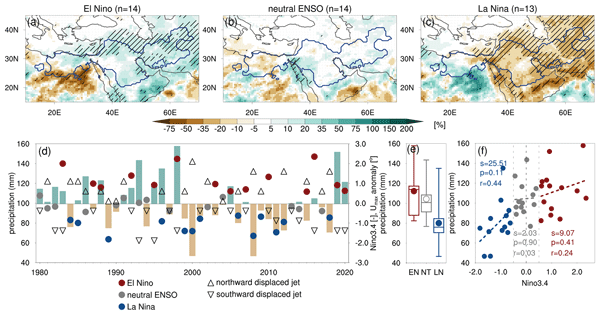
However, while the authors do describe the precipitation response is "asymmetric", one could argue that the El Nino phase has hardly a consistent effect, except for a specific 20-year period (~1980-2000). Evidence for this is especially notable in Fig. 2: relative to La Nina-driven drying, positive rain anomalies are considerably weaker and occupy a smaller part of the domain. Additionally, several counter-examples are found in the second half of the time series (4-5 negative/near-zero anomalies for 8 El Nino years). Finally, the Nino3.4-precipitation regression is very similar when comparing neutral and positive ENSO values. How do the authors explain this apparent difference? Does the El Nino rain response manifest as localized-yet-extreme anomalies? Is it a handful of outlier rainy years that dominate the composite response? Is it a more autumn-centered phenomenon that is smoothed out when analyzing the entire cold season? If I’m following the article’s logic correctly, I can say that it shows a robust mechanism for La Nina-driven drying, while highlighting how the inverse El Nino conditions are not sufficient for consistently generating positive rain anomalies. For further discussion of this point, see below.
Major Comments:
-
Fig 2(d-e): based on both subplots, it seems that the dry La Nina is consistent and robust. As you mention, there are only two instances where Nino3.4 is significantly negative and precipitation anomaly is non-negative. When comparing this signal to El Nino years, you write that “the relationship between cool-season precipitation and ENSO exhibits substantial asymmetry” and cite decadal effects and SST driven counter-examples.
However, I would argue that from 2000 onward, the El Nino-positive rain anomaly signal seems close to random. Of the 8 El Nino years, 3 have negative anomalies, 2 have weak positive anomalies and only 3 have notable positive precipitation anomalies. The time dependence of this connection was previously studied for a local test case in Price et al (1998): they use a longer time series from 1930 to investigate ENSO related rain anomalies in Israel, and note that no significant correlation can be found up until the 1980s.
-
Another aspect to consider in the El Nino-positive rain relationship is that the absolute amounts are small. Figure 3 shows that the rain enhancing effect is strongest in OCT and MAY. These are months where mean total amounts reach ~3-5 mm per month. So if that amount is doubled during El Nino years, what are we to learn from this? Is there a possibility, for example, that this could be one additional rain producing system that bumped the overall average?
-
A separate but related issue is spatial heterogeneity. The effect seems to be concentrated over a specific area within your chosen domain: the “fertile crescent” (Jordan, Syria, Iraq), parts of Iran, and Central Asian countries like Turkmenistan or Afghanistan. Meanwhile, the Arabian peninsula and North Africa show no statistically significant signal, while occupying roughly 50% of the domain. Do you have intuition as to why? Also, is there a possibility that including these large no-signal areas in the analysis weakens your overall result?
Minor Comments, Typos:
-
Pg. 5, line 155: Should be 10-45N instead of 10-45E
-
Pg. 6, line 171: Please note the sample size in this section as well. How many rainy and dry events were included in each subset?
-
Pg. 7, eq. 2: Consider changing the subscript notation for the layers. The "max" notation alludes to maximum pressure and/or h, which is confusing for the reader.
-
Pg. 8 line 233-234: How do you explain the Red Sea precipitation anomaly during neutral ENSO? This is interesting as it seems larger (albeit more local) than most positive/negative phase precipitation anomalies.
-
Fig. 2: (1) The text mentions anomalies between -35% to +20%, however the colorbar spans from -70% to 200%. Or is it showing mm? Please clarify. (2) The caption mentions a 1000 -sample Monte Carlo test, while the methods section says 10000 samples (line 179).
-
Pg. 11, line 349-351: "The similarity between the ENSO-based composites and those based on precipitation and dry-day events suggests that El Nino and La Nina events induce wet and dry conditions, respectively, through latitudinal shifts in the jet stream accompanied by anomalies in Rossby wave breaking frequencies." You can check this directly. How many of your 377 precipitation events fall within the 14 El Nino years? (and same for the 394 dry events and 13 La Nina years)
-
In Section 4 you present a compelling argument for the role of the subtropical jet position and wave breaking. Does the eddy driven midlatitude jet play any part in this interaction? The purple/green contours over Western Europe in figs 5a,c might support this. Also, note the interesting zonal wave structure arising in fig 4a between 30-60N. Previous works (Raveh-Rubin & Flaounas 2017; Sandler et al., 2024) show that equatorward polar jet undulations affect precipitation specifically in the Eastern Mediterranean. Another possible direction could be merged jet regimes (Harnik et al., 2014; Suresan et al., 2025) which can lead to extreme precipitation anomalies worldwide.
-
Pg. 12, line 377: "show a significant increase under El Niño conditions during October (𝑝 < 0.05), November (𝑝 < 0.1), and May (𝑝 < 0.05); Fig. 8a". Is the reference to the figure a typo? Or should it be in parantheses?
-
Figure 9: I suggest changing the color scale. Throughout the text you use red-brown to blue for El Nino/La Nina and dry/wet anomalies. This can create confusion for understanding Imax.
-
Pg. 16, lines 496-498: "Similarly, El Niño conditions coincided with several devastating floods during autumn in 1987, 1994, 1997, 2009, 2015, and 2018..." It makes sense to mention droughts as region-spanning phenomena, but it might be worth specifying where these El Nino-enhanced floods occured within the Middle East. Does it fit your spatial composites in Fig. 2?
Citation: https://doi.org/10.5194/egusphere-2026-1569-RC2 -
- AC1: 'Comment on egusphere-2026-1569', Andries Jan De Vries, 21 Jun 2026
Peer review completion


Interactive discussion
Status: closed
-
RC1: 'Comment on egusphere-2026-1569', Mathew Barlow, 19 May 2026
Summary
This analysis considers the influence of the El Niño - Southern Oscillation (ENSO) on the Middle East region (broadly defined) during the cold season. The analysis focuses on the role of Rossby wave breaking in shifting the jet and on the role of changes in moisture transport in affecting moisture availability and stability. These mechanisms are considered in the context of changes to jet position, barotropic Rossby wave propagation eastward from the eastern tropical Pacific, and baroclinic Rossby wave propagation westward from the western tropical Pacific. The substantial change in ENSO influence over the course of individual months within the cold season is also analyzed. As discussed by the authors, many of these topics have been considered in prior work, although the analysis of Rossby wave breaking appears new and the month-by-month consideration of ENSO influence is more detailed than prior work.
In my opinion, this analysis has the potential to provide an important step forward in our understanding of ENSO influence on the region, especially in terms of the role of Rossby wave breaking, and I enjoyed reading the manuscript. I do think some further analysis is needed to solidify the link with wave breaking, and I think some further discussion is needed to clarify some questions raised in the following. My recommendation is for major revisions to address these aspects, although I expect that addressing these points will be straightforward.
Main comments
1. The substantial change in Rossby wave breaking is shown to be co-occurring with changes in precipitation during ENSO phases, and this association certainly suggests an important influence. Unless I missed something, however, the analysis seemed to focus only on the ENSO influence on wave breaking, jet shift, and precipitation, rather than on the direct link between the wave breaking, itself, and the other variables. What would help complete the picture would be to directly examine the connection between the wave breaking, jet shift, and precipitation. For instance, it would be straightforward to define a local wave breaking index and composite precipitation and jet speed based on that index.
2. It was somewhat unclear to me as to how the influence of the baroclinic Rossby wave on the regional precipitation was being interpreted. One hypothesis that has been put forward is that the interaction between the wave and the mean flow results in isentropic downgliding over the region (e.g., Barlow et al. 2007, Hoell et al. 2012). How does that mechanism fit (or not fit) into the authors’ interpretation of the mechanisms at play? Or, put another way, the schematic shown as Fig. 9 in Barlow et al. (2016) highlights regional changes to vertical motion, moisture flux, and storm tracks, in the context of influence from both baroclinic and barotropic Rossby waves. Is the key new idea here that the storm track changes can be linked to the Rossby wave breaking, or do the authors have something different in mind?
3. It seems to me that it is still not clear which mechanisms are the most important. Regionally, there are changes to vertical velocity, moisture availability, stability, and storm tracks, and they are being influenced by at least two external influences: the remotely generated baroclinic and barotropic Rossby waves. This is further complicated by the fact that changes due to any one factor will also influence the others (e.g., externally-forced subsidence reduces precipitation and storm strength, which then causes less moisture to be pulled in, and so influences moisture transport). I think this complexity might be good to discuss in the summary section.
Other comments
1. Previous work has suggested that the type or “flavor” of ENSO event is important (e.g., central vs. eastern, temperature or temperature gradient in the western Pacific, link to Indian Ocean SSTs, etc.). How does that relate to the current work?
2. The region considered here is broader than most definitions of the “Middle East,” and extends into areas variously referred to as Southwest or Central Asia in prior work. While I’m not aware of general agreement on terminology, it’s probably worth commenting on this in the introduction, to reduce the chance of confusion.
3. The Gill-Matsuno response, on its own, does not appear sufficient to produce a baroclinic Rossby wave that extends into the region; rather, it appears necessary to also include the effect of the mean zonal wind. Aspects of this are explored in a simple model in Barlow (2012), in a linear baroclinic model in Barlow et al. (2002), and in a GCM in Barlow et al. (2007).
4. The notable change in ENSO influence over the course of the cold season for Iran is considered in Nuroozi et al. (2025), in the context of moisture transport, which may be of interest to the authors.
Regards,
Mathew BarlowReferences
Barlow, M., H. Cullen, and B. Lyon, 2002: Drought in Central and Southwest Asia: La Niña, the Warm Pool, and Indian Ocean Precipitation. J. Climate, 15, 697–700, https://doi.org/10.1175/1520-0442(2002)015<0697:DICASA>2.0.CO;2.
Barlow, M., Hoell, A. and Colby, F., 2007: Examining the wintertime response to tropical convection over the Indian Ocean by modifying convective heating in a full atmospheric model. Geophysical research letters, 34(19).
Barlow, M., 2012: Africa and West Asia. In: Intraseasonal Variability in the Atmosphere-Ocean Climate System. Springer Praxis Books. Springer, Berlin, Heidelberg. https://doi.org/10.1007/978-3-642-13914-7_13
Barlow, M., B. Zaitchik, S. Paz, E. Black, J. Evans, and A. Hoell, 2016: A Review of Drought in the Middle East and Southwest Asia. J. Climate, 29, 8547–8574, https://doi.org/10.1175/JCLI-D-13-00692.1.
Hoell, A., M. Barlow, and R. Saini, 2012: The Leading Pattern of Intraseasonal and Interannual Indian Ocean Precipitation Variability and Its Relationship with Asian Circulation during the Boreal Cold Season. J. Climate, 25, 7509–7526, https://doi.org/10.1175/JCLI-D-11-00572.1.
Nuroozi, H., Shirvani, A., & Barlow, M., 2025: The relationship between moisture in the low level of the troposphere and seasonal precipitation over Iran. Meteorological Applications, 32(2), e70033. https://doi.org/10.1002/met.70033
Citation: https://doi.org/10.5194/egusphere-2026-1569-RC1 -
RC2: 'Comment on egusphere-2026-1569', Dor Sandler, 26 May 2026
General Remarks:
The article presents a careful and comprehensive analysis of the effects of ENSO on Middle Eastern precipitation, as well as the underlying mechanisms within. The region of interest and atmospheric diagnostics are chosen and presented with clear reasoning, and objective, straightforward criteria. After a spatial and temporal analysis of the precipitation signal during ENSO years, the authors investigate various dynamical and thermodynamical mechanisms that might explain the ENSO-precipitation relationship.
While ENSO’s influence over the Middle East region has been a topic of academic discussion over several decades (as detailed by the authors), this article provides an important perspective by demonstrating and tying together three leading mechanisms, and exploring their overall relevance for a signal covering a large and varied domain. Global patterns are analyzed explicitly and given clear theoretical context, all of which provides an insightful and robust explanation for the ENSO-Middle East link.
Aside from several clarifying questions and minor comments, I will present one conceptual issue that should be better addressed before publication. Dynamically speaking, the analysis describes very clean, nearly symmetrical drivers for positive and negative precipitation anomalies: equatorward/poleward jet positions, antiphase difference in barotropic Rossby waves, cyclonic/anticyclonic Gill-Matsuno like response.
However, while the authors do describe the precipitation response is "asymmetric", one could argue that the El Nino phase has hardly a consistent effect, except for a specific 20-year period (~1980-2000). Evidence for this is especially notable in Fig. 2: relative to La Nina-driven drying, positive rain anomalies are considerably weaker and occupy a smaller part of the domain. Additionally, several counter-examples are found in the second half of the time series (4-5 negative/near-zero anomalies for 8 El Nino years). Finally, the Nino3.4-precipitation regression is very similar when comparing neutral and positive ENSO values. How do the authors explain this apparent difference? Does the El Nino rain response manifest as localized-yet-extreme anomalies? Is it a handful of outlier rainy years that dominate the composite response? Is it a more autumn-centered phenomenon that is smoothed out when analyzing the entire cold season? If I’m following the article’s logic correctly, I can say that it shows a robust mechanism for La Nina-driven drying, while highlighting how the inverse El Nino conditions are not sufficient for consistently generating positive rain anomalies. For further discussion of this point, see below.
Major Comments:
-
Fig 2(d-e): based on both subplots, it seems that the dry La Nina is consistent and robust. As you mention, there are only two instances where Nino3.4 is significantly negative and precipitation anomaly is non-negative. When comparing this signal to El Nino years, you write that “the relationship between cool-season precipitation and ENSO exhibits substantial asymmetry” and cite decadal effects and SST driven counter-examples.
However, I would argue that from 2000 onward, the El Nino-positive rain anomaly signal seems close to random. Of the 8 El Nino years, 3 have negative anomalies, 2 have weak positive anomalies and only 3 have notable positive precipitation anomalies. The time dependence of this connection was previously studied for a local test case in Price et al (1998): they use a longer time series from 1930 to investigate ENSO related rain anomalies in Israel, and note that no significant correlation can be found up until the 1980s.
-
Another aspect to consider in the El Nino-positive rain relationship is that the absolute amounts are small. Figure 3 shows that the rain enhancing effect is strongest in OCT and MAY. These are months where mean total amounts reach ~3-5 mm per month. So if that amount is doubled during El Nino years, what are we to learn from this? Is there a possibility, for example, that this could be one additional rain producing system that bumped the overall average?
-
A separate but related issue is spatial heterogeneity. The effect seems to be concentrated over a specific area within your chosen domain: the “fertile crescent” (Jordan, Syria, Iraq), parts of Iran, and Central Asian countries like Turkmenistan or Afghanistan. Meanwhile, the Arabian peninsula and North Africa show no statistically significant signal, while occupying roughly 50% of the domain. Do you have intuition as to why? Also, is there a possibility that including these large no-signal areas in the analysis weakens your overall result?
Minor Comments, Typos:
-
Pg. 5, line 155: Should be 10-45N instead of 10-45E
-
Pg. 6, line 171: Please note the sample size in this section as well. How many rainy and dry events were included in each subset?
-
Pg. 7, eq. 2: Consider changing the subscript notation for the layers. The "max" notation alludes to maximum pressure and/or h, which is confusing for the reader.
-
Pg. 8 line 233-234: How do you explain the Red Sea precipitation anomaly during neutral ENSO? This is interesting as it seems larger (albeit more local) than most positive/negative phase precipitation anomalies.
-
Fig. 2: (1) The text mentions anomalies between -35% to +20%, however the colorbar spans from -70% to 200%. Or is it showing mm? Please clarify. (2) The caption mentions a 1000 -sample Monte Carlo test, while the methods section says 10000 samples (line 179).
-
Pg. 11, line 349-351: "The similarity between the ENSO-based composites and those based on precipitation and dry-day events suggests that El Nino and La Nina events induce wet and dry conditions, respectively, through latitudinal shifts in the jet stream accompanied by anomalies in Rossby wave breaking frequencies." You can check this directly. How many of your 377 precipitation events fall within the 14 El Nino years? (and same for the 394 dry events and 13 La Nina years)
-
In Section 4 you present a compelling argument for the role of the subtropical jet position and wave breaking. Does the eddy driven midlatitude jet play any part in this interaction? The purple/green contours over Western Europe in figs 5a,c might support this. Also, note the interesting zonal wave structure arising in fig 4a between 30-60N. Previous works (Raveh-Rubin & Flaounas 2017; Sandler et al., 2024) show that equatorward polar jet undulations affect precipitation specifically in the Eastern Mediterranean. Another possible direction could be merged jet regimes (Harnik et al., 2014; Suresan et al., 2025) which can lead to extreme precipitation anomalies worldwide.
-
Pg. 12, line 377: "show a significant increase under El Niño conditions during October (𝑝 < 0.05), November (𝑝 < 0.1), and May (𝑝 < 0.05); Fig. 8a". Is the reference to the figure a typo? Or should it be in parantheses?
-
Figure 9: I suggest changing the color scale. Throughout the text you use red-brown to blue for El Nino/La Nina and dry/wet anomalies. This can create confusion for understanding Imax.
-
Pg. 16, lines 496-498: "Similarly, El Niño conditions coincided with several devastating floods during autumn in 1987, 1994, 1997, 2009, 2015, and 2018..." It makes sense to mention droughts as region-spanning phenomena, but it might be worth specifying where these El Nino-enhanced floods occured within the Middle East. Does it fit your spatial composites in Fig. 2?
Citation: https://doi.org/10.5194/egusphere-2026-1569-RC2 -
- AC1: 'Comment on egusphere-2026-1569', Andries Jan De Vries, 21 Jun 2026
Peer review completion
Journal article(s) based on this preprint
Viewed
| HTML | XML | Total | BibTeX | EndNote | |
|---|---|---|---|---|---|
| 819 | 1,060 | 48 | 1,927 | 41 | 42 |
- HTML: 819
- PDF: 1,060
- XML: 48
- Total: 1,927
- BibTeX: 41
- EndNote: 42
Viewed (geographical distribution)
| Country | # | Views | % |
|---|
| Total: | 0 |
| HTML: | 0 |
| PDF: | 0 |
| XML: | 0 |
- 1
Andries-Jan de Vries

Steven B. Feldstein
Jake W. Casselman
Georgios Fragkoulidis
Jos Lelieveld
Daniela I. V. Domeisen
The requested preprint has a corresponding peer-reviewed final revised paper. You are encouraged to refer to the final revised version.
- Preprint
(4706 KB) - Metadata XML
Summary
This analysis considers the influence of the El Niño - Southern Oscillation (ENSO) on the Middle East region (broadly defined) during the cold season. The analysis focuses on the role of Rossby wave breaking in shifting the jet and on the role of changes in moisture transport in affecting moisture availability and stability. These mechanisms are considered in the context of changes to jet position, barotropic Rossby wave propagation eastward from the eastern tropical Pacific, and baroclinic Rossby wave propagation westward from the western tropical Pacific. The substantial change in ENSO influence over the course of individual months within the cold season is also analyzed. As discussed by the authors, many of these topics have been considered in prior work, although the analysis of Rossby wave breaking appears new and the month-by-month consideration of ENSO influence is more detailed than prior work.
In my opinion, this analysis has the potential to provide an important step forward in our understanding of ENSO influence on the region, especially in terms of the role of Rossby wave breaking, and I enjoyed reading the manuscript. I do think some further analysis is needed to solidify the link with wave breaking, and I think some further discussion is needed to clarify some questions raised in the following. My recommendation is for major revisions to address these aspects, although I expect that addressing these points will be straightforward.
Main comments
1. The substantial change in Rossby wave breaking is shown to be co-occurring with changes in precipitation during ENSO phases, and this association certainly suggests an important influence. Unless I missed something, however, the analysis seemed to focus only on the ENSO influence on wave breaking, jet shift, and precipitation, rather than on the direct link between the wave breaking, itself, and the other variables. What would help complete the picture would be to directly examine the connection between the wave breaking, jet shift, and precipitation. For instance, it would be straightforward to define a local wave breaking index and composite precipitation and jet speed based on that index.
2. It was somewhat unclear to me as to how the influence of the baroclinic Rossby wave on the regional precipitation was being interpreted. One hypothesis that has been put forward is that the interaction between the wave and the mean flow results in isentropic downgliding over the region (e.g., Barlow et al. 2007, Hoell et al. 2012). How does that mechanism fit (or not fit) into the authors’ interpretation of the mechanisms at play? Or, put another way, the schematic shown as Fig. 9 in Barlow et al. (2016) highlights regional changes to vertical motion, moisture flux, and storm tracks, in the context of influence from both baroclinic and barotropic Rossby waves. Is the key new idea here that the storm track changes can be linked to the Rossby wave breaking, or do the authors have something different in mind?
3. It seems to me that it is still not clear which mechanisms are the most important. Regionally, there are changes to vertical velocity, moisture availability, stability, and storm tracks, and they are being influenced by at least two external influences: the remotely generated baroclinic and barotropic Rossby waves. This is further complicated by the fact that changes due to any one factor will also influence the others (e.g., externally-forced subsidence reduces precipitation and storm strength, which then causes less moisture to be pulled in, and so influences moisture transport). I think this complexity might be good to discuss in the summary section.
Other comments
1. Previous work has suggested that the type or “flavor” of ENSO event is important (e.g., central vs. eastern, temperature or temperature gradient in the western Pacific, link to Indian Ocean SSTs, etc.). How does that relate to the current work?
2. The region considered here is broader than most definitions of the “Middle East,” and extends into areas variously referred to as Southwest or Central Asia in prior work. While I’m not aware of general agreement on terminology, it’s probably worth commenting on this in the introduction, to reduce the chance of confusion.
3. The Gill-Matsuno response, on its own, does not appear sufficient to produce a baroclinic Rossby wave that extends into the region; rather, it appears necessary to also include the effect of the mean zonal wind. Aspects of this are explored in a simple model in Barlow (2012), in a linear baroclinic model in Barlow et al. (2002), and in a GCM in Barlow et al. (2007).
4. The notable change in ENSO influence over the course of the cold season for Iran is considered in Nuroozi et al. (2025), in the context of moisture transport, which may be of interest to the authors.
Regards,
Mathew Barlow
References
Barlow, M., H. Cullen, and B. Lyon, 2002: Drought in Central and Southwest Asia: La Niña, the Warm Pool, and Indian Ocean Precipitation. J. Climate, 15, 697–700, https://doi.org/10.1175/1520-0442(2002)015<0697:DICASA>2.0.CO;2.
Barlow, M., Hoell, A. and Colby, F., 2007: Examining the wintertime response to tropical convection over the Indian Ocean by modifying convective heating in a full atmospheric model. Geophysical research letters, 34(19).
Barlow, M., 2012: Africa and West Asia. In: Intraseasonal Variability in the Atmosphere-Ocean Climate System. Springer Praxis Books. Springer, Berlin, Heidelberg. https://doi.org/10.1007/978-3-642-13914-7_13
Barlow, M., B. Zaitchik, S. Paz, E. Black, J. Evans, and A. Hoell, 2016: A Review of Drought in the Middle East and Southwest Asia. J. Climate, 29, 8547–8574, https://doi.org/10.1175/JCLI-D-13-00692.1.
Hoell, A., M. Barlow, and R. Saini, 2012: The Leading Pattern of Intraseasonal and Interannual Indian Ocean Precipitation Variability and Its Relationship with Asian Circulation during the Boreal Cold Season. J. Climate, 25, 7509–7526, https://doi.org/10.1175/JCLI-D-11-00572.1.
Nuroozi, H., Shirvani, A., & Barlow, M., 2025: The relationship between moisture in the low level of the troposphere and seasonal precipitation over Iran. Meteorological Applications, 32(2), e70033. https://doi.org/10.1002/met.70033