
the Creative Commons Attribution 4.0 License.
the Creative Commons Attribution 4.0 License.
 | 30 Mar 2026
Southern African dust aerosols are rich in micronutrients, K-feldspar and carbonate minerals
Abstract. This study provides the first comprehensive characterisation of the chemical and mineralogical composition of mineral dust from Southern Africa, a major global dust source with significant impacts on regional climate and marine ecosystems. Laboratory-generated dust aerosol samples were produced using soils collected from key natural and emerging anthropogenic dust sources in Southern Africa.
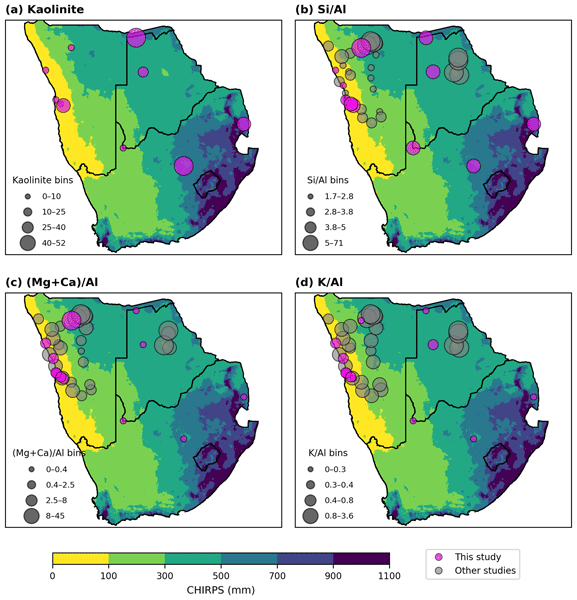
The chemical properties of mineral dust across Southern Africa were characterised using the elemental ratios Si/Al, (Ca + Mg)/Al, and K/Al, together with clay content. These indicators distinguish dust aerosols originating from arid western coastal areas from those originating from more humid eastern inland regions. They also provide information about the source-area environments and sediment weathering regimes, which are influenced by current and past temperature and precipitation patterns.
The results of this study indicate that Southern African dust contains essential micronutrients such as iron (Fe), phosphorus (P) and manganese (Mn), which can become soluble and bioaccessible during atmospheric transport. This affects the biogeochemistry of nearby and remote marine ecosystems, including the Southern Ocean. Southern African dust also contains higher levels of carbonates than Northern African dust sources, which can promote heterogeneous reactions and particle ageing, and contribute to cloud condensation nuclei in the extensive stratocumulus deck over the northern Bay of Benguela. Our findings also suggest that Southern African dust contains higher levels of K-feldspar than Northern African dust, and could therefore be an important source of ice-nucleating particles for low mixed-phase clouds over the Southern Ocean.
-
Notice on discussion status
The requested preprint has a corresponding peer-reviewed final revised paper. You are encouraged to refer to the final revised version.
-
Preprint
(1787 KB)
-
Supplement
(1195 KB)
-
The requested preprint has a corresponding peer-reviewed final revised paper. You are encouraged to refer to the final revised version.
- Preprint
(1787 KB) - Metadata XML
-
Supplement
(1195 KB) - BibTeX
- EndNote
- Final revised paper


Journal article(s) based on this preprint
Interactive discussion
Status: closed
- RC1: 'Comment on egusphere-2026-1532', Anonymous Referee #1, 28 Apr 2026
-
RC2: 'Comment on egusphere-2026-1532', Cassandra Gaston, 10 May 2026
Overview: Baldo et al provide a comprehensive dataset of dust composition from samples collected in different regions of southern hemispheric Africa. The dust is generated in two different lab set ups from soils representative of different dust emitting regions from both natural and anthropogenic sources. This paper is well written and I recommend it for publication after consideration of my suggestions.
- I do wonder if the paper would fit better in a journal such as Global Biogeochemical Cycles. I think ACP will be just fine but the authors should consider whether they will lose their geochemistry audience by publishing in an atmospheric journal.
- The authors can also comment on the dust emitting potential of the different sources using work from (Prospero et al., 2002)
- Methods: I’m unclear about how the dust was generated and how comparable the two methods are. Please clarify the comparability of the two methods to a reader unfamiliar with either method. I’m especially unclear how the CESAM works. A brief description needs to be added.
- For each system: what gas is used to suspend dust in the GAMEL and how much flow is used? Since more flow is used to collect the filters than is stated to generate the dust, what kind of dilution or makeup flow is used in both systems?
- Methods: were filter blanks also taken and similarly analyzed?
- How reliably was Al detected by your XRD methods? This is key to state as Al is the primary element that most data is ratioed to.
- Figure 5: I cannot distinguish the different studies. Can similar colors be used for the same region but different marker shapes be used to show the spread in other studies vs the current study?
- Line 518-520: is the low detection of Na simply due to the methodology?
- Heterogeneous reactions on carbonates (calcite and dolomite) are mentioned and the carbonates are cited as CCN. The authors should amend their discussion of carbonates to reflect that while sodium containing carbonates are very hygroscopic, calcite and dolomite are not so their ability to act as CCN is limited to only those that have undergone chemical aging (Gaston et al., 2017; Laskin et al., 2005; Sullivan et al., 2009).
- The authors also mention the bioavailability of micro and macro nutrients. Typically dusts require some chemical aging to make these nutrients available. Carbonates act to buffer the acid processing needed to solubilize P and Fe for example (Nenes et al., 2011; Stockdale et al., 2016) so the authors should clarify this important point.
- The authors could expand their discussion of the anthropogenic dusts particularly in the discussion and abstract. The high Cu, P, and Fe is very interesting and has a lot of implications for marine biogeochemical cycles, particularly if, as the authors suggest, these sources are increasing in spatial extent.
MINOR POINTS
- Figure 1 has a typo “mentionned” should be fixed
- Line 560: typo “Cal” should be “Ca”
REFERENCES CITED
Gaston, C. J. ;, Pratt, K. A. ;, Suski, K. J. ;, May, N. W. ;, Gill, T. E. ;, & Prather, K. A. ; (2017). Laboratory studies of the cloud droplet activation properties and corresponding chemistry of saline playa dust. Environmental Science & Technology, 51(3), 1348–1356.
Laskin, A., Iedema, M. J., Ichkovich, A., Graber, E. R., Taraniuk, I., & Rudich, Y. (2005). Direct observation of completely processed calcium carbonate dust particles. In Faraday Discussions (Vol. 130, pp. 453–468). The Royal Society of Chemistry. https://doi.org/10.1039/b417366j
Nenes, A., Krom, M. D., Mihalopoulos, N., Van Cappellen, P., Shi, Z., Bougiatioti, A., Zarmpas, P., & Herut, B. (2011). Atmospheric acidification of mineral aerosols: a source of bioavailable phosphorus for the oceans. Atmospheric Chemistry and Physics, 11(13), 6265–6272.
Prospero, J. M., Ginoux, P., Torres, O., Nicholson, S. E., & Gill, T. E. (2002). Environmental characterization of global sources of atmospheric soil dust identified with the Nimbus 7 Total Ozone Mapping Spectrometer (TOMS) absorbing aerosol product. Reviews of Geophysics, 40(1), https://doi.org/10.1029/2000RG000095.
Stockdale, A., Krom, M. D. ;, Mortimer, R. J. G. ;, Benning, L. G. ;, Carslaw, K. S. ;, Herbert, R. J. ;, Shi, Z. ;, Myriokefalitakis, S. ;, Kanakidou, M. ;, & Nenes, A. (2016). Understanding the nature of atmospheric acid processing of mineral dusts in supplying bioavailable phosphorus to the oceans. Proceedings of the National Academy of Sciences of the United States of America, 113(51), 14639–14644.
Sullivan, R. C., Moore, M. J. K., Petters, M. D., Kreidenweis, S. M., Roberts, G. C., & Prather, K. A. (2009). Effect of chemical mixing state on the hygroscopicity and cloud nucleation properties of calcium mineral dust particles. Atmospheric Chemistry and Physics, 9, 3303–3316.
Citation: https://doi.org/10.5194/egusphere-2026-1532-RC2 - AC1: 'Comment on egusphere-2026-1532', Clarissa Baldo, 19 Jun 2026
Peer review completion


Interactive discussion
Status: closed
-
RC1: 'Comment on egusphere-2026-1532', Anonymous Referee #1, 28 Apr 2026
Southern African dust is potentially important for the Southern Hemisphere dust cycle, marine biogeochemistry, and aerosol–cloud interactions. This study provides valuable data by combining laboratory-generated dust aerosols, XRF/XRD analyses, and a literature-based integrated dataset. However, a major concern is that the measurements mainly support conclusions on elemental and mineralogical composition, whereas some discussions on bioaccessibility, CCN activity, INP activity, heterogeneous reactions, and climatic impacts remain largely inferential. These implications should either be better supported or presented more cautiously. I suggest that the authors consider the following points.
1. The spatial representativeness of source categories, such as Free State, Skukuza, Hope Mine, and Kalahari BOT, is less clear. The authors should provide, either in the main text or the Supplement, the number of samples for each source type, their spatial coverage, the criteria used for site selection, and evidence that these sites correspond to active or potential dust-emission hotspots.
2. The study uses GAMEL and CESAMto generate dust aerosols, but their possible effects on elemental or mineralogical fractionation are not fully discussed. The authors should clarify whether the two systems may introduce systematic differences in the generated dust composition. If common samples were analysed using both systems, a direct comparison would be useful.
3. The total aerosol mass was estimated from the sum of major elemental oxides. This approach may introduce biases for samples enriched in carbonates, salts, sulfates, hydrated minerals, or water. The authors should compare the oxide-sum mass with gravimetric filter mass, if available, or discuss the potential bias caused by excluding components.
4. The manuscript suggests that carbonate-rich Southern African dust may promote heterogeneous reactions, particle ageing, hygroscopicity, and CCN activity. This is plausible, but the current evidence is mainly mineralogical. The authors should either provide quantitative or semi-quantitative support, or relevant literature-based constraints.
5. The Si/Al, (Ca+Mg)/Al, and K/Al ratios are reasonable tracers for distinguishing arid western coastal sources from more humid inland eastern sources. However, Fig. 5 shows considerable overlap among some source categories. The authors should consider applying multivariate or classification methods, such as PCA, hierarchical clustering, or random forest classification, to evaluate how well these ratios discriminate between source regions.
Citation: https://doi.org/10.5194/egusphere-2026-1532-RC1 -
RC2: 'Comment on egusphere-2026-1532', Cassandra Gaston, 10 May 2026
Overview: Baldo et al provide a comprehensive dataset of dust composition from samples collected in different regions of southern hemispheric Africa. The dust is generated in two different lab set ups from soils representative of different dust emitting regions from both natural and anthropogenic sources. This paper is well written and I recommend it for publication after consideration of my suggestions.
- I do wonder if the paper would fit better in a journal such as Global Biogeochemical Cycles. I think ACP will be just fine but the authors should consider whether they will lose their geochemistry audience by publishing in an atmospheric journal.
- The authors can also comment on the dust emitting potential of the different sources using work from (Prospero et al., 2002)
- Methods: I’m unclear about how the dust was generated and how comparable the two methods are. Please clarify the comparability of the two methods to a reader unfamiliar with either method. I’m especially unclear how the CESAM works. A brief description needs to be added.
- For each system: what gas is used to suspend dust in the GAMEL and how much flow is used? Since more flow is used to collect the filters than is stated to generate the dust, what kind of dilution or makeup flow is used in both systems?
- Methods: were filter blanks also taken and similarly analyzed?
- How reliably was Al detected by your XRD methods? This is key to state as Al is the primary element that most data is ratioed to.
- Figure 5: I cannot distinguish the different studies. Can similar colors be used for the same region but different marker shapes be used to show the spread in other studies vs the current study?
- Line 518-520: is the low detection of Na simply due to the methodology?
- Heterogeneous reactions on carbonates (calcite and dolomite) are mentioned and the carbonates are cited as CCN. The authors should amend their discussion of carbonates to reflect that while sodium containing carbonates are very hygroscopic, calcite and dolomite are not so their ability to act as CCN is limited to only those that have undergone chemical aging (Gaston et al., 2017; Laskin et al., 2005; Sullivan et al., 2009).
- The authors also mention the bioavailability of micro and macro nutrients. Typically dusts require some chemical aging to make these nutrients available. Carbonates act to buffer the acid processing needed to solubilize P and Fe for example (Nenes et al., 2011; Stockdale et al., 2016) so the authors should clarify this important point.
- The authors could expand their discussion of the anthropogenic dusts particularly in the discussion and abstract. The high Cu, P, and Fe is very interesting and has a lot of implications for marine biogeochemical cycles, particularly if, as the authors suggest, these sources are increasing in spatial extent.
MINOR POINTS
- Figure 1 has a typo “mentionned” should be fixed
- Line 560: typo “Cal” should be “Ca”
REFERENCES CITED
Gaston, C. J. ;, Pratt, K. A. ;, Suski, K. J. ;, May, N. W. ;, Gill, T. E. ;, & Prather, K. A. ; (2017). Laboratory studies of the cloud droplet activation properties and corresponding chemistry of saline playa dust. Environmental Science & Technology, 51(3), 1348–1356.
Laskin, A., Iedema, M. J., Ichkovich, A., Graber, E. R., Taraniuk, I., & Rudich, Y. (2005). Direct observation of completely processed calcium carbonate dust particles. In Faraday Discussions (Vol. 130, pp. 453–468). The Royal Society of Chemistry. https://doi.org/10.1039/b417366j
Nenes, A., Krom, M. D., Mihalopoulos, N., Van Cappellen, P., Shi, Z., Bougiatioti, A., Zarmpas, P., & Herut, B. (2011). Atmospheric acidification of mineral aerosols: a source of bioavailable phosphorus for the oceans. Atmospheric Chemistry and Physics, 11(13), 6265–6272.
Prospero, J. M., Ginoux, P., Torres, O., Nicholson, S. E., & Gill, T. E. (2002). Environmental characterization of global sources of atmospheric soil dust identified with the Nimbus 7 Total Ozone Mapping Spectrometer (TOMS) absorbing aerosol product. Reviews of Geophysics, 40(1), https://doi.org/10.1029/2000RG000095.
Stockdale, A., Krom, M. D. ;, Mortimer, R. J. G. ;, Benning, L. G. ;, Carslaw, K. S. ;, Herbert, R. J. ;, Shi, Z. ;, Myriokefalitakis, S. ;, Kanakidou, M. ;, & Nenes, A. (2016). Understanding the nature of atmospheric acid processing of mineral dusts in supplying bioavailable phosphorus to the oceans. Proceedings of the National Academy of Sciences of the United States of America, 113(51), 14639–14644.
Sullivan, R. C., Moore, M. J. K., Petters, M. D., Kreidenweis, S. M., Roberts, G. C., & Prather, K. A. (2009). Effect of chemical mixing state on the hygroscopicity and cloud nucleation properties of calcium mineral dust particles. Atmospheric Chemistry and Physics, 9, 3303–3316.
Citation: https://doi.org/10.5194/egusphere-2026-1532-RC2 - AC1: 'Comment on egusphere-2026-1532', Clarissa Baldo, 19 Jun 2026
Peer review completion
Journal article(s) based on this preprint
Viewed
| HTML | XML | Total | Supplement | BibTeX | EndNote | |
|---|---|---|---|---|---|---|
| 662 | 297 | 68 | 1,027 | 104 | 86 | 90 |
- HTML: 662
- PDF: 297
- XML: 68
- Total: 1,027
- Supplement: 104
- BibTeX: 86
- EndNote: 90
Viewed (geographical distribution)
| Country | # | Views | % |
|---|
| Total: | 0 |
| HTML: | 0 |
| PDF: | 0 |
| XML: | 0 |
- 1
Clarissa Baldo

Servanne Chevaillier
Sophie Nowak
Gael Noyalet
Sandra Lafon
Claudia Di Biagio
Amelie Chaput
James King
Mathieu Cazaunau
Edouard Pangui
Jean-Francois Doussin
Remi Stanus
Nadine Mattielli
Heleen C. Vos
Gregory S. Okin
Brigitte Language
Stuart Piketh
Karine Desboeufs
Akinori Ito
Silvia Becagli
Laurie Barrier
Stephane Jacquemound
Paola Formenti
The requested preprint has a corresponding peer-reviewed final revised paper. You are encouraged to refer to the final revised version.
- Preprint
(1787 KB) - Metadata XML
-
Supplement
(1195 KB) - BibTeX
- EndNote
- Final revised paper
Southern African dust is potentially important for the Southern Hemisphere dust cycle, marine biogeochemistry, and aerosol–cloud interactions. This study provides valuable data by combining laboratory-generated dust aerosols, XRF/XRD analyses, and a literature-based integrated dataset. However, a major concern is that the measurements mainly support conclusions on elemental and mineralogical composition, whereas some discussions on bioaccessibility, CCN activity, INP activity, heterogeneous reactions, and climatic impacts remain largely inferential. These implications should either be better supported or presented more cautiously. I suggest that the authors consider the following points.
1. The spatial representativeness of source categories, such as Free State, Skukuza, Hope Mine, and Kalahari BOT, is less clear. The authors should provide, either in the main text or the Supplement, the number of samples for each source type, their spatial coverage, the criteria used for site selection, and evidence that these sites correspond to active or potential dust-emission hotspots.
2. The study uses GAMEL and CESAMto generate dust aerosols, but their possible effects on elemental or mineralogical fractionation are not fully discussed. The authors should clarify whether the two systems may introduce systematic differences in the generated dust composition. If common samples were analysed using both systems, a direct comparison would be useful.
3. The total aerosol mass was estimated from the sum of major elemental oxides. This approach may introduce biases for samples enriched in carbonates, salts, sulfates, hydrated minerals, or water. The authors should compare the oxide-sum mass with gravimetric filter mass, if available, or discuss the potential bias caused by excluding components.
4. The manuscript suggests that carbonate-rich Southern African dust may promote heterogeneous reactions, particle ageing, hygroscopicity, and CCN activity. This is plausible, but the current evidence is mainly mineralogical. The authors should either provide quantitative or semi-quantitative support, or relevant literature-based constraints.
5. The Si/Al, (Ca+Mg)/Al, and K/Al ratios are reasonable tracers for distinguishing arid western coastal sources from more humid inland eastern sources. However, Fig. 5 shows considerable overlap among some source categories. The authors should consider applying multivariate or classification methods, such as PCA, hierarchical clustering, or random forest classification, to evaluate how well these ratios discriminate between source regions.