
the Creative Commons Attribution 4.0 License.
the Creative Commons Attribution 4.0 License.
 | 20 Mar 2026
Methanethiol and dimethyl sulfide measurements in seawater and the atmosphere around the Antarctic Peninsula and in the Weddell Sea
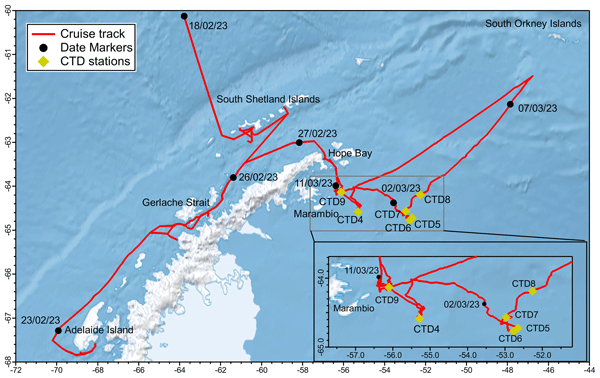
Abstract. Inclusion of methanethiol (MeSH) in global chemistry–climate models has shown that MeSH emissions increase SO2, particulate sulfate and aerosol cooling over the Southern Ocean. However, measurements in the Southern Ocean are sparse. In February and March 2023, we deployed three online high-resolution mass spectrometers to measure MeSH and dimethyl sulfide (DMS) in seawater (down to 100 m in depth) and air during a cruise on the west side of the Antarctic Peninsula and the Weddell Sea. MeSH concentrations in surface seawater (mean 0.56, range 0.12 to 1.9 nmol dm-3) were within the range previously reported for the polar and subpolar regions. Considering concurrent DMS concentrations (mean 1.6, range 0.45 to 11.3 nmol dm-3), MeSH represented 30 ± 7 % of the ocean’s volatile methylated sulfur (VMS = DMS + MeSH). Depth profiles of MeSH showed higher concentrations in the euphotic layer. Sea to air fluxes of MeSH (mean 1.0, range 0 to 5.0 µmol m2 d-1) were comparable to those of DMS (mean 1.7, range -0.6 to 8.6 µmol m2 d-1). Ambient air MeSH (mean 15, range 1 to 60 pptv) was low and similar to other observations. Air DMS concentrations were about a factor of 10 higher than MeSH (mean 0.25, range 0.01 to 1.35 ppb) and there was excellent agreement between two different mass spectrometer instruments using different ionization chemistry. MeSH seawater concentrations, sea–air fluxes, and atmospheric mixing ratios displayed depletion during daytime. Overall, this dataset represents a useful resource for model validation.
Competing interests: LRW, HS, VP, and FL-H are employed by the vendors of the Vocus PTR and Vocus B. All other authors declare that they have no conflict of interest.
Publisher's note: Copernicus Publications remains neutral with regard to jurisdictional claims made in the text, published maps, institutional affiliations, or any other geographical representation in this paper. While Copernicus Publications makes every effort to include appropriate place names, the final responsibility lies with the authors. Views expressed in the text are those of the authors and do not necessarily reflect the views of the publisher.-
Notice on discussion status
The requested preprint has a corresponding peer-reviewed final revised paper. You are encouraged to refer to the final revised version.
-
Preprint
(2049 KB)
-
Supplement
(1441 KB)
-
The requested preprint has a corresponding peer-reviewed final revised paper. You are encouraged to refer to the final revised version.
- Preprint
(2049 KB) - Metadata XML
-
Supplement
(1441 KB) - BibTeX
- EndNote
- Final revised paper


Journal article(s) based on this preprint
Interactive discussion
Status: closed
- RC1: 'Comment on egusphere-2026-1472', Nadja Steiner, 05 May 2026
-
RC2: 'Comment on egusphere-2026-1472', Manon Rocco, 05 May 2026
This manuscript provides essential measurements of DMS and MeSH concentrations in both the gas and aqueous phases. These data are valuable for better constraining models and improving our understanding of their role in the climate system.
The manuscript is well written, and I only have minor comments, which are provided in the attached PDF
- AC1: 'Comment on egusphere-2026-1472', Charel Wohl, 10 Jun 2026
Peer review completion


Interactive discussion
Status: closed
-
RC1: 'Comment on egusphere-2026-1472', Nadja Steiner, 05 May 2026
The manuacript presents a timly analysis of MeSH in connection with DMS, highlighting the potential importance and need to assess and observe and model MeSH alongside with DMS. This provides an excellent data set and analysis to support modelling experiments.
The manuscript is well written and I have only minor comments ( see attached pdf)
One caveat is, I am not a laboratory researcher and while the methods seem well described and clear, I cannot judge the actual methods.
While I would be willing to review an updated manuscript, I don't think it is necessary, given I only have minor comments
-
RC2: 'Comment on egusphere-2026-1472', Manon Rocco, 05 May 2026
This manuscript provides essential measurements of DMS and MeSH concentrations in both the gas and aqueous phases. These data are valuable for better constraining models and improving our understanding of their role in the climate system.
The manuscript is well written, and I only have minor comments, which are provided in the attached PDF
- AC1: 'Comment on egusphere-2026-1472', Charel Wohl, 10 Jun 2026
Peer review completion
Journal article(s) based on this preprint
Viewed
| HTML | XML | Total | Supplement | BibTeX | EndNote | |
|---|---|---|---|---|---|---|
| 1,001 | 556 | 106 | 1,663 | 185 | 81 | 94 |
- HTML: 1,001
- PDF: 556
- XML: 106
- Total: 1,663
- Supplement: 185
- BibTeX: 81
- EndNote: 94
Viewed (geographical distribution)
| Country | # | Views | % |
|---|
| Total: | 0 |
| HTML: | 0 |
| PDF: | 0 |
| XML: | 0 |
- 1

Elisabeth Deschaseaux
Lauriane L. J. Quéléver
David C. S. Beddows
Harald Stark
Veronika Pospisilova
Felipe Lopez-Hilfiker
Guillaume Chamba
Karine Sellegri
Elisabet L. Sà
Queralt Güell-Bujons
Magda Vila
Yaiza M. Castillo
Arianna Rocchi
Ana Sotomayor
Dolors Vaqué
Manuel Dall’Osto
Elisa Berdalet
Rafel Simó
The requested preprint has a corresponding peer-reviewed final revised paper. You are encouraged to refer to the final revised version.
- Preprint
(2049 KB) - Metadata XML
-
Supplement
(1441 KB) - BibTeX
- EndNote
- Final revised paper
The manuacript presents a timly analysis of MeSH in connection with DMS, highlighting the potential importance and need to assess and observe and model MeSH alongside with DMS. This provides an excellent data set and analysis to support modelling experiments.
The manuscript is well written and I have only minor comments ( see attached pdf)
One caveat is, I am not a laboratory researcher and while the methods seem well described and clear, I cannot judge the actual methods.
While I would be willing to review an updated manuscript, I don't think it is necessary, given I only have minor comments