
the Creative Commons Attribution 4.0 License.
the Creative Commons Attribution 4.0 License.
 | 05 Mar 2026
Good performance of low-cost carbon dioxide sensor based on intercomparisons with the standard eddy-covariance system
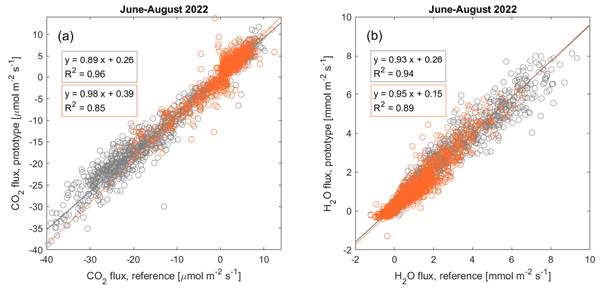
Abstract. Flux measurements have started to play an important role outside academia in assessing carbon sinks of different ecosystems and land-use types. If natural carbon solutions are to be deployed and monetized in carbon markets, more low-powered and low-cost flux systems should be deployed. There is a growing need for low-cost sensors that still fulfil the requirements for scientific applications. We present a case study where Vaisala company and the University of Helsinki joined their industrial and academic competencies to create an inexpensive yet precise fast-response carbon dioxide (CO2) and water vapour (H2O) sensor. A working prototype was developed and field-tested against a scientific reference eddy covariance (EC) setup. Special attention was paid to response time, lowered sampling frequency, and auto-calibration related to the temperature. The results at the end of the project were very promising. The enclosed-path EC prototype had a CO2 response time of 0.18 sec and a noise level of 1 ppm at a 5 Hz sampling rate. The internal auto-calibration procedure was continuously improved such that CO2 signal drifting was avoided and the instrument was capable of measuring CO2 fluxes with high correlation relative to the reference EC setup (R2 = 0.98).
Competing interests: Pirkko V\"{a}kimies and Hilkka Heiskari-Tuohiniemi were affiliated and compensated by Vaisala Oyj.
Publisher's note: Copernicus Publications remains neutral with regard to jurisdictional claims made in the text, published maps, institutional affiliations, or any other geographical representation in this paper. While Copernicus Publications makes every effort to include appropriate place names, the final responsibility lies with the authors. Views expressed in the text are those of the authors and do not necessarily reflect the views of the publisher.-
Notice on discussion status
The requested preprint has a corresponding peer-reviewed final revised paper. You are encouraged to refer to the final revised version.
-
Preprint
(3329 KB)
-
Supplement
(614 KB)
-
The requested preprint has a corresponding peer-reviewed final revised paper. You are encouraged to refer to the final revised version.
- Preprint
(3329 KB) - Metadata XML
-
Supplement
(614 KB) - BibTeX
- EndNote
- Final revised paper


Journal article(s) based on this preprint
Interactive discussion
Status: closed
-
RC1: 'Comment on egusphere-2026-144', Anonymous Referee #4, 26 Mar 2026
-
AC1: 'Reply on RC1', Üllar Rannik, 05 May 2026
The comment was uploaded in the form of a supplement: https://egusphere.copernicus.org/preprints/2026/egusphere-2026-144/egusphere-2026-144-AC1-supplement.pdf
-
AC1: 'Reply on RC1', Üllar Rannik, 05 May 2026
-
RC2: 'Comment on egusphere-2026-144', Anonymous Referee #2, 27 Mar 2026
This manuscript describes the development and evaluation of a low-cost CO₂/H₂O sensor for eddy covariance applications, which is particularly relevant given the growing demand for scalable carbon flux measurements. The results of this sensor are in agreement with the chosen reference system. Before publication, some clarification should be required as follows:
1. Impact of software updates on results: The paper describes some updates during the field campaign, particularly a major change on July 21. More clarification should be given to the software update and autocalibration and how that affected performance. Would this be a reliable method for a more long term use or how does drift affect over long periods of time?
2. Differences in the prototype and reference system: As stated in the paper, the prototype and reference systems are installed at different heights and separated horizontally. Additionally, the prototype operates at 5 Hz, compared to 10 Hz for the reference system. Clarification should be given in the manuscript of how these changes impact the data between the prototype and the reference. For example, how does the separation affect flux differences?
3. Line 16 says, "The results at the end of the paper are very promising..." and then proceeds to give the results. This sentence is not needed. The results should prove the promise, it does not need to be stated.
4. Line 151: "indicated the presence of noise at high frequencies", consider specifying the frequency range
5. The figures are in a blue/green color palette. Consider switching to a blue/red palette instead for readability.
Citation: https://doi.org/10.5194/egusphere-2026-144-RC2 -
AC2: 'Reply on RC2', Üllar Rannik, 05 May 2026
The comment was uploaded in the form of a supplement: https://egusphere.copernicus.org/preprints/2026/egusphere-2026-144/egusphere-2026-144-AC2-supplement.pdf
-
AC2: 'Reply on RC2', Üllar Rannik, 05 May 2026
-
RC3: 'Comment on egusphere-2026-144', Anonymous Referee #1, 27 Mar 2026
This work designed a low-cost CO2 sensor to measure CO2 flux. The system has advantages in fast response and low noise. The good performance of the low-cost sensor was validated by simultaneous long-term field measurement of CO2 flux using a scientific reference eddy covariance setup. This study fits well within the scope of AMT and have importance implications in greenhouse gas measurements and the evaluation of their climate effects. The following concerns should be addressed before it can be accepted for publication.
Specific comments:
Lines 83-85: The fund information should go to the section “Acknowledgements”.
Lines 111-115: The software updates have a significant impact on the performance of the sensor. The authors should elaborate on what the key update is.
Lines 120-124: The CO2 mixing ratios before and after 21 July should be given to have a better understanding of how the software update shapes the measurement of CO2.
Figure 6: The current x-axis is difficult to read. I would suggest changing the x-axis to day 1 to 31.
Figure 8: The difference in CO2 flux in September is also relatively large. What is the reason?
Citation: https://doi.org/10.5194/egusphere-2026-144-RC3 -
AC3: 'Reply on RC3', Üllar Rannik, 05 May 2026
The comment was uploaded in the form of a supplement: https://egusphere.copernicus.org/preprints/2026/egusphere-2026-144/egusphere-2026-144-AC3-supplement.pdf
-
AC3: 'Reply on RC3', Üllar Rannik, 05 May 2026
-
RC4: 'Comment on egusphere-2026-144', Anonymous Referee #3, 06 Apr 2026
The manuscript by Rannik et al. studies the performance of a fast-response prototype CO2 and H2O vapor sensor that was implemented in a low-cost eddy covariance (EC) system. Its performance was then compared against simultaneous observations from a commercial high-performance EC system in an agricultural field in 2022. Correlations (R2) greater than 0.92 were reported between the prototype and reference setup's CO2 and H2O fluxes. The CO2 sensor also had a noise level of ~1 ppm and around ~0.1 ppth for H2O at a 5 Hz sampling rate.
I think this paper would be of interest to readers of AMT but only after adequate attention to the following comments:
MAJOR REVISIONS
- Authors are obligated to declare any competing interests at the end of the manuscript to clarify their relationship to Vaisala and if any of the authors are being compensated by the company (whether financial or other support).
- Line 85: "would be cheaper than the currently commercially available ones": Cheaper by how much? Do not cite exact prices, but is it cheaper by 25%, 50%, etc. when taking into account all the parts? The title of the paper has 'low cost' in its title, so there should be some indication of the prototype's low cost in case someone wanted to build it themselves or replicate this study.
- Section 2.1: I assume that the blueprints of the prototype sensor are likely intellectual property of Vaisala, but the current description of the low cost sensor is gravely lacking. For example, what is the operating principle (e.g., NDIR, etc.)? What spectral lines are being used? How can it achieve a fast time response (5 Hz) at a fraction of the cost? As a reviewer, I need to assess how novel this sensor is compared to other CO2 sensors already available, but I have no way of doing so given the lack of technical information about the sensor itself.
- Lines 93-94: "The main feature of the instrument was its built-in autocalibration capability": Authors need to describe this capability/functionality in greater detail since it impacts the sensor's performance in the study. The authors even admit in Lines 122-123 that "well-designed autocalibration functionality appeared to be a critical feature of the prototype with the thermopile detector," so it's important to describe the technical aspects of this autocalibration feature for the reader.
- Line 110 (and elsewhere): Enigmatic software upgrades and maintenance are referred to throughout the manuscript. What exactly was being changed in these software upgrades or maintenance periods that fixed sensor drift and generally improved the sensor's performance? Such knowledge would be helpful for readers to be aware of if they are trying to build their own setup.
- Lines 283-286: Remove paragraph concerning Vaisala's market analysis and investment strategy since it does not belong in a scientific manuscript. However, the instrument's lack of availability does raise concerns about reproducibility if the prototype instrument cannot be obtained by anyone other than the authors. What technical aspects can be shared with the community about the prototype so that others may independently reproduce the results of this paper?
MINOR REVISIONS
- Figure 1: I appreciate the included photos, but a detailed schematic/diagram of the prototype EC setup would be of greater benefit to the reader.
- Title: Authors may want to consider adding 'fast-response' to the manuscript's title since there are many CO2 sensors available on the market (e.g., some using NDIR) but most are inadequate for EC applications.
- Lines 22-24: "There has been discussion... For example, in agriculture...": Please cite studies that back up this claim.
- Fig 5: Suggest giving each sub-period its own color so that it is easier to differentiate between the time periods in the figure. It also helps denote that the instrument was operating differently during those periods.
- Lines 181-182: "An increase in signal noise... for H2O." What caused this to happen on 21 July? Is it from the software update? If so, what was changed in the update that caused the noise to get worse?
- Figure 8 caption: Authors need to explicitly comment in the caption for Fig 8(b, g, l) that the magnitude for the reference and prototype fluxes is lower from 21 July since the fluxes for the latter half of July are lower than the first half. It is presumably not due to the software update from 21 July onwards.
TECHNICAL REVISIONS
- Lines 12-13: Recommend removing phrase "present a case study... industrial and academic competencies" from the sentence since affiliations are already listed for the authors. The emphasis should always be on the prototype setup and not on the company that produced it. As mentioned before, put any competing interests or conflict of interest in a separate section.
- Lines 147-148: There seems to be a missing or extra word in the sentence as it is currently written.
Citation: https://doi.org/10.5194/egusphere-2026-144-RC4 -
AC4: 'Reply on RC4', Üllar Rannik, 05 May 2026
The comment was uploaded in the form of a supplement: https://egusphere.copernicus.org/preprints/2026/egusphere-2026-144/egusphere-2026-144-AC4-supplement.pdf
-
AC4: 'Reply on RC4', Üllar Rannik, 05 May 2026
Peer review completion


Interactive discussion
Status: closed
-
RC1: 'Comment on egusphere-2026-144', Anonymous Referee #4, 26 Mar 2026
This study presents a fast-response, low-cost carbon dioxide sensor for flux measurements. It is based on approximately five months of field observations and includes comparisons with a standard eddy covariance system. The sensor’s performance is thoroughly evaluated, and it appears to offer a cost-effective alternative for field CO2 flux measurements. However, a few major issues should be addressed before the manuscript can be considered for publication in AMT.
Major Comments:
- Clarification of technical details: As this is primarily a technical paper intended for users of CO₂ flux measurements, I think some methodological aspects need to be explained more clearly in the manuscript itself. In particular, it is not sufficiently clear what improvements were introduced with the software update and how these changes affected the sensor performance. A more explicit description would be very helpful. Similarly, the autocalibration procedure should be described in more detail. At present, it is difficult to understand how this procedure is implemented in practice and how it affects the long-term behaviour of the sensor. Related to this, it would also be useful if the authors could comment on the temporal evolution of sensor drift. For example, does the drift increase approximately linearly with time, or does it follow a different pattern?
- Response time and wind conditions: The approach used to estimate the sensor response time would benefit from some further clarification. As I understand it, the estimate is derived from data collected under unstable atmospheric conditions and within a relatively narrow wind speed range of 2.5–3.5 m s⁻¹.This raises the question of whether the derived response time is partly influenced by the prevailing wind or turbulence conditions. If so, the authors should discuss to what extent the estimated response time may depend on wind speed or atmospheric state more generally. Would the same response time be obtained under calmer conditions, or under stronger turbulence? Some discussion of the robustness of this estimate would strengthen the paper.
- Uncertainty in weak flux measurements: I also feel that the manuscript should discuss more carefully the uncertainty associated with very weak CO₂ fluxes. For example, in Figure 6 the H₂O fluxes show a relatively smooth decline from July to September. The August H₂O fluxes are weaker than in July, but they are still clearly visible and remain higher than those in September. In contrast, the CO₂ fluxes over the same period remain close to zero. This makes me wonder how reliably the sensor can quantify very small CO₂ fluxes. A similar concern arises from Figure 7. If one focuses on the August data only, excluding the period from 21 July 2022 to the end of July 2022, the agreement between prototype and reference appears rather weak for small CO₂ fluxes, especially in the range of about –5 to 5 µmol m⁻² s⁻¹. This suggests that the uncertainty may be substantial in the near-zero range. I would therefore encourage the authors to discuss more explicitly the reliability and uncertainty of the sensor under weak-flux conditions.
Other Comments:
In Figure 4, sensible heat flux is used as an indicator of atmospheric stability. I wonder whether momentum flux or friction velocity (u*) might be more appropriate for this purpose. At least, the choice of sensible heat flux should be justified more clearly.
It would be useful to include some practical recommendations for long-term operation and maintenance. Based on the results shown, the system appears to require relatively frequent updates, and some guidance for future users would add value to the paper.
The prototype sensor operates at 5 Hz, whereas the reference eddy-covariance system typically operates at 10 Hz. The manuscript should discuss how this difference in sampling frequency may affect the flux calculation and the comparison between the two systems. In particular, could the lower sampling rate lead to a bias or loss of information?
Technical Corrections:
Line 16: I would suggest avoiding the word “promising”, which sounds slightly informal in this context.
Line 137: Please clarify which lag time was used for the CO₂ flux calculation.
Line 147: Delete the extra word “for”.
Line 213: Please clarify whether this refers to r or R², and use the appropriate notation consistently.
Figure 5: It would help readability to use slightly more distinct colours or symbols for the different periods.
Citation: https://doi.org/10.5194/egusphere-2026-144-RC1 -
AC1: 'Reply on RC1', Üllar Rannik, 05 May 2026
The comment was uploaded in the form of a supplement: https://egusphere.copernicus.org/preprints/2026/egusphere-2026-144/egusphere-2026-144-AC1-supplement.pdf
-
RC2: 'Comment on egusphere-2026-144', Anonymous Referee #2, 27 Mar 2026
This manuscript describes the development and evaluation of a low-cost CO₂/H₂O sensor for eddy covariance applications, which is particularly relevant given the growing demand for scalable carbon flux measurements. The results of this sensor are in agreement with the chosen reference system. Before publication, some clarification should be required as follows:
1. Impact of software updates on results: The paper describes some updates during the field campaign, particularly a major change on July 21. More clarification should be given to the software update and autocalibration and how that affected performance. Would this be a reliable method for a more long term use or how does drift affect over long periods of time?
2. Differences in the prototype and reference system: As stated in the paper, the prototype and reference systems are installed at different heights and separated horizontally. Additionally, the prototype operates at 5 Hz, compared to 10 Hz for the reference system. Clarification should be given in the manuscript of how these changes impact the data between the prototype and the reference. For example, how does the separation affect flux differences?
3. Line 16 says, "The results at the end of the paper are very promising..." and then proceeds to give the results. This sentence is not needed. The results should prove the promise, it does not need to be stated.
4. Line 151: "indicated the presence of noise at high frequencies", consider specifying the frequency range
5. The figures are in a blue/green color palette. Consider switching to a blue/red palette instead for readability.
Citation: https://doi.org/10.5194/egusphere-2026-144-RC2 -
AC2: 'Reply on RC2', Üllar Rannik, 05 May 2026
The comment was uploaded in the form of a supplement: https://egusphere.copernicus.org/preprints/2026/egusphere-2026-144/egusphere-2026-144-AC2-supplement.pdf
-
AC2: 'Reply on RC2', Üllar Rannik, 05 May 2026
-
RC3: 'Comment on egusphere-2026-144', Anonymous Referee #1, 27 Mar 2026
This work designed a low-cost CO2 sensor to measure CO2 flux. The system has advantages in fast response and low noise. The good performance of the low-cost sensor was validated by simultaneous long-term field measurement of CO2 flux using a scientific reference eddy covariance setup. This study fits well within the scope of AMT and have importance implications in greenhouse gas measurements and the evaluation of their climate effects. The following concerns should be addressed before it can be accepted for publication.
Specific comments:
Lines 83-85: The fund information should go to the section “Acknowledgements”.
Lines 111-115: The software updates have a significant impact on the performance of the sensor. The authors should elaborate on what the key update is.
Lines 120-124: The CO2 mixing ratios before and after 21 July should be given to have a better understanding of how the software update shapes the measurement of CO2.
Figure 6: The current x-axis is difficult to read. I would suggest changing the x-axis to day 1 to 31.
Figure 8: The difference in CO2 flux in September is also relatively large. What is the reason?
Citation: https://doi.org/10.5194/egusphere-2026-144-RC3 -
AC3: 'Reply on RC3', Üllar Rannik, 05 May 2026
The comment was uploaded in the form of a supplement: https://egusphere.copernicus.org/preprints/2026/egusphere-2026-144/egusphere-2026-144-AC3-supplement.pdf
-
AC3: 'Reply on RC3', Üllar Rannik, 05 May 2026
-
RC4: 'Comment on egusphere-2026-144', Anonymous Referee #3, 06 Apr 2026
The manuscript by Rannik et al. studies the performance of a fast-response prototype CO2 and H2O vapor sensor that was implemented in a low-cost eddy covariance (EC) system. Its performance was then compared against simultaneous observations from a commercial high-performance EC system in an agricultural field in 2022. Correlations (R2) greater than 0.92 were reported between the prototype and reference setup's CO2 and H2O fluxes. The CO2 sensor also had a noise level of ~1 ppm and around ~0.1 ppth for H2O at a 5 Hz sampling rate.
I think this paper would be of interest to readers of AMT but only after adequate attention to the following comments:
MAJOR REVISIONS
- Authors are obligated to declare any competing interests at the end of the manuscript to clarify their relationship to Vaisala and if any of the authors are being compensated by the company (whether financial or other support).
- Line 85: "would be cheaper than the currently commercially available ones": Cheaper by how much? Do not cite exact prices, but is it cheaper by 25%, 50%, etc. when taking into account all the parts? The title of the paper has 'low cost' in its title, so there should be some indication of the prototype's low cost in case someone wanted to build it themselves or replicate this study.
- Section 2.1: I assume that the blueprints of the prototype sensor are likely intellectual property of Vaisala, but the current description of the low cost sensor is gravely lacking. For example, what is the operating principle (e.g., NDIR, etc.)? What spectral lines are being used? How can it achieve a fast time response (5 Hz) at a fraction of the cost? As a reviewer, I need to assess how novel this sensor is compared to other CO2 sensors already available, but I have no way of doing so given the lack of technical information about the sensor itself.
- Lines 93-94: "The main feature of the instrument was its built-in autocalibration capability": Authors need to describe this capability/functionality in greater detail since it impacts the sensor's performance in the study. The authors even admit in Lines 122-123 that "well-designed autocalibration functionality appeared to be a critical feature of the prototype with the thermopile detector," so it's important to describe the technical aspects of this autocalibration feature for the reader.
- Line 110 (and elsewhere): Enigmatic software upgrades and maintenance are referred to throughout the manuscript. What exactly was being changed in these software upgrades or maintenance periods that fixed sensor drift and generally improved the sensor's performance? Such knowledge would be helpful for readers to be aware of if they are trying to build their own setup.
- Lines 283-286: Remove paragraph concerning Vaisala's market analysis and investment strategy since it does not belong in a scientific manuscript. However, the instrument's lack of availability does raise concerns about reproducibility if the prototype instrument cannot be obtained by anyone other than the authors. What technical aspects can be shared with the community about the prototype so that others may independently reproduce the results of this paper?
MINOR REVISIONS
- Figure 1: I appreciate the included photos, but a detailed schematic/diagram of the prototype EC setup would be of greater benefit to the reader.
- Title: Authors may want to consider adding 'fast-response' to the manuscript's title since there are many CO2 sensors available on the market (e.g., some using NDIR) but most are inadequate for EC applications.
- Lines 22-24: "There has been discussion... For example, in agriculture...": Please cite studies that back up this claim.
- Fig 5: Suggest giving each sub-period its own color so that it is easier to differentiate between the time periods in the figure. It also helps denote that the instrument was operating differently during those periods.
- Lines 181-182: "An increase in signal noise... for H2O." What caused this to happen on 21 July? Is it from the software update? If so, what was changed in the update that caused the noise to get worse?
- Figure 8 caption: Authors need to explicitly comment in the caption for Fig 8(b, g, l) that the magnitude for the reference and prototype fluxes is lower from 21 July since the fluxes for the latter half of July are lower than the first half. It is presumably not due to the software update from 21 July onwards.
TECHNICAL REVISIONS
- Lines 12-13: Recommend removing phrase "present a case study... industrial and academic competencies" from the sentence since affiliations are already listed for the authors. The emphasis should always be on the prototype setup and not on the company that produced it. As mentioned before, put any competing interests or conflict of interest in a separate section.
- Lines 147-148: There seems to be a missing or extra word in the sentence as it is currently written.
Citation: https://doi.org/10.5194/egusphere-2026-144-RC4 -
AC4: 'Reply on RC4', Üllar Rannik, 05 May 2026
The comment was uploaded in the form of a supplement: https://egusphere.copernicus.org/preprints/2026/egusphere-2026-144/egusphere-2026-144-AC4-supplement.pdf
-
AC4: 'Reply on RC4', Üllar Rannik, 05 May 2026
Peer review completion
Journal article(s) based on this preprint
Viewed
| HTML | XML | Total | Supplement | BibTeX | EndNote | |
|---|---|---|---|---|---|---|
| 970 | 549 | 145 | 1,664 | 249 | 119 | 173 |
- HTML: 970
- PDF: 549
- XML: 145
- Total: 1,664
- Supplement: 249
- BibTeX: 119
- EndNote: 173
Viewed (geographical distribution)
| Country | # | Views | % |
|---|
| Total: | 0 |
| HTML: | 0 |
| PDF: | 0 |
| XML: | 0 |
- 1
Üllar Rannik

Ivan Mammarella
Timo Vesala
Pirkko Väkimies
Hilkka Heiskari-Tuohiniemi
Mika Korkiakoski
The requested preprint has a corresponding peer-reviewed final revised paper. You are encouraged to refer to the final revised version.
- Preprint
(3329 KB) - Metadata XML
-
Supplement
(614 KB) - BibTeX
- EndNote
- Final revised paper
This study presents a fast-response, low-cost carbon dioxide sensor for flux measurements. It is based on approximately five months of field observations and includes comparisons with a standard eddy covariance system. The sensor’s performance is thoroughly evaluated, and it appears to offer a cost-effective alternative for field CO2 flux measurements. However, a few major issues should be addressed before the manuscript can be considered for publication in AMT.
Major Comments:
Other Comments:
In Figure 4, sensible heat flux is used as an indicator of atmospheric stability. I wonder whether momentum flux or friction velocity (u*) might be more appropriate for this purpose. At least, the choice of sensible heat flux should be justified more clearly.
It would be useful to include some practical recommendations for long-term operation and maintenance. Based on the results shown, the system appears to require relatively frequent updates, and some guidance for future users would add value to the paper.
The prototype sensor operates at 5 Hz, whereas the reference eddy-covariance system typically operates at 10 Hz. The manuscript should discuss how this difference in sampling frequency may affect the flux calculation and the comparison between the two systems. In particular, could the lower sampling rate lead to a bias or loss of information?
Technical Corrections:
Line 16: I would suggest avoiding the word “promising”, which sounds slightly informal in this context.
Line 137: Please clarify which lag time was used for the CO₂ flux calculation.
Line 147: Delete the extra word “for”.
Line 213: Please clarify whether this refers to r or R², and use the appropriate notation consistently.
Figure 5: It would help readability to use slightly more distinct colours or symbols for the different periods.