
the Creative Commons Attribution 4.0 License.
the Creative Commons Attribution 4.0 License.
 | 30 Jan 2026
Automatic Methane Plume Masking Based on Wavelet Transform Image Processing: Application to MethaneAIR and MethaneSAT data
Abstract. Accurate and efficient plume masking is essential for remote sensing-based detection and quantification of methane and other point source emissions, as plume masks are critical not only for quantifying emission rates, but also for visualization and source localization. However, plume masking relies largely on human operation when the retrieved plume concentrations are weak relative to the background, which hinders the automatic plume detection. This study presents an automatic plume masking method based on wavelet transform image processing. Given a methane concentration enhancement image with no prior knowledge of source locations, a 2D discrete wavelet transform is applied to enhance plume signals while suppressing background noise. The binary plume masks are then generated and filtered using criteria such as concentration, plume shape, and wind direction. The method includes tunable parameters to ensure high detection accuracy under varying background and meteorological conditions. This method detected 60 % more plumes, mainly with lower fluxes, than a thresholding method from both MethaneAIR and MethaneSAT data, while finding fewer false positives, proving its potential to realize automatic plume detection across platforms at different scales and resolutions. Its high sensitivity to low-volume emissions also enables a lower detection limit and provides a more comprehensive emission rate distribution. Compared to machine learning models, this method is computationally efficient and does not require training data. Although designed for MethaneSAT purposes, this method is broadly applicable for plume detection from concentration imagery on various airborne and spaceborne remote sensing platforms and for numerous atmospheric species.
-
Notice on discussion status
The requested preprint has a corresponding peer-reviewed final revised paper. You are encouraged to refer to the final revised version.
-
Preprint
(11964 KB)
-
Supplement
(2660 KB)
-
The requested preprint has a corresponding peer-reviewed final revised paper. You are encouraged to refer to the final revised version.
- Preprint
(11964 KB) - Metadata XML
-
Supplement
(2660 KB) - BibTeX
- EndNote
- Final revised paper


Journal article(s) based on this preprint
Interactive discussion
Status: closed
-
RC1: 'Comment on egusphere-2026-141', Sandro Meier, 17 Feb 2026
-
AC1: 'Reply on RC1', Zhan Zhang, 18 May 2026
The comment was uploaded in the form of a supplement: https://egusphere.copernicus.org/preprints/2026/egusphere-2026-141/egusphere-2026-141-AC1-supplement.pdf
-
AC1: 'Reply on RC1', Zhan Zhang, 18 May 2026
-
RC2: 'Comment on egusphere-2026-141', Anonymous Referee #2, 24 Mar 2026
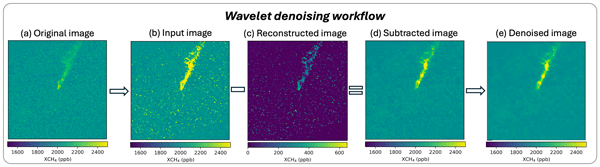
The authors present an algorithm for delineating methane plumes within methane concentration or enhancement fields. This algorithm combines image processing based on wavelet decompositions, thresholding on the processed image and filtering steps on the masked potential plumes. The preprocessing is started by clipping the methane enhancement field, this clipped image is then decomposed into wavelet components. From the high frequency components an image is reconstructed that contains only the small scale structure. This is subtracted from the clipped image with the aim of greatly reducing noise and small artifacts. This image is then denoised using soft thresholding wavelet denoising. Plume masking is done on this last image using a threshold based on the local noise, and a minimum mask size. These masks are then filtered using varying criteria, based on shape, elongation w.r.t. wind.
All of the parameters in the masking are optimized on three methaneAIR and three methaneSAT scenes, maximizing true positives and minimizing false negatives, with separated parameters for both platforms. The authors compare their plume detections with plumes detected using a thresholding method (Warren et al. 2025). They show that their method finds a lot more plumes and fewer false negatives.
Major comments:
The manuscript presents a new method for masking plumes. The focus of the method, the wavelet transform is not strictly new, as it has been used before, both within and outside the field. Other spatial frequency-based techniques such as Difference of Gaussians, median filters, and other denoising techniques are also widely applied in the field. This undermining the claimed novelty of the method.
While the authors show that their method is better than the method used in Warren et al., they still show that they miss about 10% of the plumes detected with the other method. Any discussion on why these plumes are missed is missing. Furthermore, it raises the question of the completeness of the plume detections from method presented here. The paper does not touch on this at all. I feel that a discussion on the number (and type) of missed plumes is required to properly assess the detection and masking method.
Furthermore, abstract and the conclusions focus on the wavelet transform as the main workhorse of the results. The Supplemental materials, however, show that the extra filtering steps are critical in lowering the number of false positives. How many false positives these steps exactly exclude is not shown. As such it is not clear if it is the masking on the wavelet transformed image that enables the results or if a better tuned version of the Warren et al method with the extra filtering steps would lead to a similar number of true plumes and false negatives.
Another problematic, major claim is on the computational efficiency. While this is a recurring claim in the paper, there is no result that compares the computational power required to process the observations, especially when including the parameter exploration required to optimize the algorithm.
This leads to a manuscript that falls short of an academic paper. The method presented would feel fine in an Algorithmic Theoretical Baseline Document or as part of a paper that focusses on the impact of the retrieved plumes. As it is as a method paper, however, it is not rigorous enough in showing the impact and efficacy of the presented methods, especially the specific form of the wavelet transform used. Without this I cannot recommend this manuscript for publication.
For this manuscript to be reconsidered I would like to see the following three things:- An evaluation of the merit of wavelet transforms over other image processing or denoising
- A discussion on the choice of the Haar wavelet decompositions out of the large array of frequency filtering techniques out there.
- An analysis of the completeness of the proposed method with a discussion on the type of plumes that are not captured by the current algorithm.
Minor comments:
Line 3: Plume masking does not seem critical to source localization; plume detection would be enough for that.
Line 11-12: “Its high sensitivity to low-volume emissions also enables
a lower detection limit and provides a more comprehensive emission rate distribution.” This claim is only present in the abstract, furthermore the paper does not include any quantification of the detection limit or the completeness of the emission rate distributions.
Line 12-14: Computational efficiency of the method is not really discussed in the paper and significant platform specific tuning has gone into the method presented as such the claims in these lines seem overstated.
Introduction: The definition of what is and is not a good plume or plume mask varies by application. For example, in figure S4 the authors discard a plume mask that to many readers would be a fine mask to use. A discussion on the type of plume/plume mask the authors are looking for would help the reader understand what the authors are trying to achieve.
Line 29: see line 3 above
Line 30: When talking about the background interference here, it would be good to provide some examples.
Line 51-52: There is an abrupt change in the text flow between these two paragraphs. Guide the reader more.
line 70 (and 294): The authors claim the method is broadly applicable to multiple platforms and species, while they only discuss a single species with two (closely) related platforms. Substantiation of this claim is required.
line 78: For readers a range of swath lengths or scene surface areas would help in understanding the coverage of the used observations
line 82: The word sounding seems out of place here, furthermore it creates ambiguity on the scales at which data is masked. Is this based on the pixel grid, the instrument spatial sampling or something else?
Line 115-120: Wavelet transform should be linear, so subtracting the high frequency image from the input image should be the same as setting the high frequency components to zero. Looking at the implementation on github, an observed difference in behavior might be purely due to clipping to positive values in intermediate steps. This should be explained properly in the main text.
Line 121: Setting L to half its maximum value feels arbitrary, has this been explored?
Line 124: I am missing the context for the soft thresholding wavelet denoising, please elaborate and add some references.
Line 131: It is unclear if the scaling factor is based on the original image noise or the denoised image, please clarify.
Line 133: An imaged based local background is used here, while the wavelet transform also contains information on the background that could be used to correct for large scale background variations. Why was a local background measurement chosen?
Line 142: A note on which data product the hotspot detection would be good for clarity.
Line 147: It is mentioned that the pixel threshold value for the plume hotspot is adjustable, but its value is not discussed anywhere in the paper of the supplementary materials
Line 149: This looks to be a version of Hysteresis Thresholding. Could the authors comment of if it is, and if so cite the relevant work?
Line 187: This presumably already includes wind information? Please clarify in the text.
Line 193 “all plume detections presented in the Results section” Unclear phrasing: Is this limited to the plumes presented in Figure 3 and 6, or does it also include all plumes underlying the statistics in Fig 4 and 5?
Line 216: The supplied version of the SI does not contain a full list of the 262 additional plumes.
Figure 2: The note in the figure implies that a number of flights have not been processed. From the figure this would be about 14% of the total DI thresholding plumes. It would be good to either include these flights in the analysis or include a discussion on why these flights are excluded.
Figures 2, 4 and 5: The stacked bars feel like the wrong choice for the visualization here. The 200-400 kg/h bar in figure 2 can easily be interpreted as ~18 DI only plumes, ~25 DI + WL plumes and ~88 wavelet only plumes, while I think that is not the message of these figures. The use of irregular spacing of the x- and y-axis ticks and frequency as y axis label “frequency” also feel off.
Line 225: Statement on future work is very vague and generic. It would be good to more concretely identify specific challenges and solutions.
Line 232: Segmented plumes is a problem for most instruments, especially high-resolution instruments. The comment about this being a methaneAIR/methaneSAT problem feels out of place.
Figure 3. The plume in panel b) seems like a well-defined plume that should not be hard to catch with a thresholding method. Why was this plume not captured originally?
Line 251: The concept of ‘collection’ is not introduced.
Line 265: In section 2.2.3 it is mentioned that plumes without clear heads are removed as possible plumes, but in these lines it it implied that they are still included as false positives.
Line 276-279: Similar to the statement in line 225 this is very vague and requires some substantiation.
Line 292-293: (see major comments) The computational cost of the wavelet method, especially optimizing it for a new platform or species is not discussed, to it is impossible to judge if it is more efficient than machine learning.
Line 294: Same comment as for line 70.
Line 297: It is very much appreciated that the authors share their code, however, for the audience it would be useful if it was expanded to include an example application of the workflow images of figure one or a feel reproduction package of the data used in the paper.Citation: https://doi.org/10.5194/egusphere-2026-141-RC2 -
AC2: 'Reply on RC2', Zhan Zhang, 18 May 2026
The comment was uploaded in the form of a supplement: https://egusphere.copernicus.org/preprints/2026/egusphere-2026-141/egusphere-2026-141-AC2-supplement.pdf
Peer review completion


Interactive discussion
Status: closed
-
RC1: 'Comment on egusphere-2026-141', Sandro Meier, 17 Feb 2026
Summary
The authors introduce an automated method to detect methane plumes in satellite and airborne imagery using a 2D wavelet transform to suppress background noise and enhance the detectability of methane plumes, especially from sources with lower emissions. With their approach, the authors claim to improve previous detection methods such as thresholding, statistical tests etc., which often miss weak plumes, or machine-learning based plume detection, which avoids the cost and training requirements of ML methods. They state to show the first implementation of wavelet-based denoising for atmospheric studies. In their processing pipeline, CH4 concentration maps are denoised using 2D wavelets, plumes are identified using thresholding and the detected plumes are filtered using concentration patterns, plume shape, and wind direction. Lastly, emissions are quantified with a previously used divergence-integral method.
Tests on airborne data from MethaneAIR and spaceborne data from MethaneSAT show that the method detects about 60% more plumes than conventional thresholding, while producing fewer false positives. As the newly detected plumes mostly originate from weaker sources, the new method essentially decreases the detection limit of the sensors. The authors state that the limitations of their methods are diffuse emissions with low methane enhancements and atypical shape as well as overlapping plumes. Therefore, some manual checking is still needed with their approach.
General comments
Overall, the manuscript is well written and addresses an important constraint in trace gas remote sensing: Plume detection and emission quantification often require extensive manual input and can therefore be time consuming. Another key strength of the study is also that data from both a spaceborne and airborne instrument are used which demonstrates that their approach has the potential to be widely applicable.
The novelty implied by the title (“automatic methane plume masking”) appears to be somewhat overstated. The plume detection approach is largely consistent with existing threshold-based methods used in prior studies (see line 130), followed by standard filtering based on plume morphology and wind direction. The primary methodological difference appears to be the inclusion of a denoising step prior to plume detection. Therefore, the claim in the title does not align well with the content of the manuscript and its key strength: Using wavelet denoising for atmospheric (hyperspectral) data which is also what the authors state on line 96. Therefore, the authors should either put a focus on how a detection pipeline should be set up to function in a (semi-)automated way (e.g., 1. apply any denoising method, 2. Filter the detected plumes using the described methods, 3. Quantify emissions with any method) or focus on the effect of denoising on detection limits and emission quantification for given sensors.
When it comes to denoising, the authors use the well-established 2D wavelet transform for image denoising. As previous studies have shown, this method is also viable for hyperspectral air- and spaceborne data (e.g., in Rasti et al., 2018, https://www.mdpi.com/2072-4292/10/3/482). However, these studies also show that for hyperspectral images (i.e. also MethaneAIR and MethaneSAT) there are more advanced methods than a 2D wavelet transform, such as 3D wavelet or HyRes (e.g., https://ieeexplore.ieee.org/document/8098642); especially since these methods benefit from redundancy of information in the spectral bands.
Therefore, the authors should address the following aspects:
- The study uses CH4 maps derived from hyperspectral data. As hyperspectral data contains much more redundancy of information in the spectral bands, which is beneficial for denoising, the authors should either motivate why they apply the denoising only to the CH4 maps or use a more sophisticated denoising method such as 3D wavelets or HyRes and compare it to the current results using 2D wavelets.
- The goal of remote sensing of trace gases is not only to detect sources but also to quantify their emissions. Therefore, the authors should also quantify the impact of the proposed denoising approach (including hyperparameter choices) on the resulting emission estimates and detection limits. Since this requires access to ground truth, a suitable approach would be to use synthetic plume images and add noise with different characteristics (e.g., Gaussian and non-Gaussian). This would allow a systematic assessment of whether and to what extent the denoising step biases or alters the inferred emission rates.
- The described denoising effectively improves the detection limit of the instruments. Therefore, it would be good to analyse the effect of denoising on the detection limits.
Specific comments
- L11ff: How much lower is the effective detection limit with your method?
- L12: There are many more disadvantages of ML methods that could be listed here like the lack of uncertainty propagation, regression to the mean, often unrealistic training data etc.
- L13 & L70: What are "MethaneSAT purposes"?
- L35ff: One important paper to cite would also be Kuhlmann et al., 2024 (https://gmd.copernicus.org/articles/17/4773/2024/)
- L73 & 85: please indicate the along and across-track resolution
- L97: As far as I can follow, the pre-processing step was not part of the processing in Hüpfel et al., (2021). Please provide more details about why this is needed in the current study but was not in Hüpfel et al.
- L99: What you are doing here is basically the 99% confidence interval. Please make this clearer to the reader.
- L104: The authors state that the hyperparameters "were chosen to maximize plume detections while minimizing false positives”. This risks overfitting to the evaluation dataset (e.g., similar sensor properties, surface characteristics etc.). Therefore, this issue should either be addressed or discussed.
- L122: How did you arrive at this value for L? Did you perform sensitivity analysis? How do the estimated emissions change when changing L? It would be good to include this in your sensitivity analysis.
- L124: Please explain why this additional denoising needed if your previous wavelet transform is supposed to filter out the high frequency noise (L118)? Especially since this step was not performed in Hüpfel et al., (2021).
- L149: Please provide values of high and low ratios. Also provide the thresholds used.
- L165ff: At the scale of MethaneSAT, using a coarsely resolved wind data product such as HRRR or GFS might work well, especially if there is little topography as it was the case for the data presented. However, at smaller spatial scales (such as for MethaneAIR) and in more complex terrain, filtering your data based on wind direction might become problematic as the influence of turbulence grows larger (see e.g., https://amt.copernicus.org/articles/19/333/2026/). Please discuss this limitation in the discussion section.
- L188: Please explain which wind speed product you used for the emission quantification (e.g., 10m wind speed, PBL average, effective wind speed and how you calculated it.)
- L235ff: Please be more concrete about the performance of your algorithm: How many low concentration plumes were filtered out and how many remained?
- L263: You could also mention that the longer the plumes, the more the assumption of steady wind conditions are violated
- L274ff: Please elaborate why the application of the wavelet transform to subregions would improve the sensitivity of your method.
- L285: Please be more concrete about the performance of your method: Add numbers to the text or insert a confusion matrix or a summarising table that show how well your method performed compared to the previous results (e.g., TP, FP, FN, detection limits etc.)
Technical corrections
- L6 & 92 & 214 & 253 etc.: "Plume signals" sounds a bit off. Use plumes or CH4 enhancements instead.
- L14 & 45: "concentration imagery" sounds a bit off. Use concentration maps or CH4 enhancement maps instead.
- L33: Not "plume detection methods" but "plume detection"
- In my opinion, Figure 1 is quite unintuitive. Please set the label as titles, add colourbars below each subplot, make the figure caption more descriptive and separate the upper and lower row as the lower row is only supposed to show the processing used to obtain figure (c).
- Please fix the tick labels in Figure 2, remove the note from the figure and put it into the figure caption, remove the text in the upper right and set it as title
- L221: Please use a different expression, e.g. homogeneity
- The plume outlines in Figure 6 are hardly visible for people with colour vision deficiency (e.g., with Achromatopsia, see https://www.color-blindness.com/coblis-color-blindness-simulator/). Please use more suitable colour.
Citation: https://doi.org/10.5194/egusphere-2026-141-RC1 -
AC1: 'Reply on RC1', Zhan Zhang, 18 May 2026
The comment was uploaded in the form of a supplement: https://egusphere.copernicus.org/preprints/2026/egusphere-2026-141/egusphere-2026-141-AC1-supplement.pdf
-
RC2: 'Comment on egusphere-2026-141', Anonymous Referee #2, 24 Mar 2026
The authors present an algorithm for delineating methane plumes within methane concentration or enhancement fields. This algorithm combines image processing based on wavelet decompositions, thresholding on the processed image and filtering steps on the masked potential plumes. The preprocessing is started by clipping the methane enhancement field, this clipped image is then decomposed into wavelet components. From the high frequency components an image is reconstructed that contains only the small scale structure. This is subtracted from the clipped image with the aim of greatly reducing noise and small artifacts. This image is then denoised using soft thresholding wavelet denoising. Plume masking is done on this last image using a threshold based on the local noise, and a minimum mask size. These masks are then filtered using varying criteria, based on shape, elongation w.r.t. wind.
All of the parameters in the masking are optimized on three methaneAIR and three methaneSAT scenes, maximizing true positives and minimizing false negatives, with separated parameters for both platforms. The authors compare their plume detections with plumes detected using a thresholding method (Warren et al. 2025). They show that their method finds a lot more plumes and fewer false negatives.
Major comments:
The manuscript presents a new method for masking plumes. The focus of the method, the wavelet transform is not strictly new, as it has been used before, both within and outside the field. Other spatial frequency-based techniques such as Difference of Gaussians, median filters, and other denoising techniques are also widely applied in the field. This undermining the claimed novelty of the method.
While the authors show that their method is better than the method used in Warren et al., they still show that they miss about 10% of the plumes detected with the other method. Any discussion on why these plumes are missed is missing. Furthermore, it raises the question of the completeness of the plume detections from method presented here. The paper does not touch on this at all. I feel that a discussion on the number (and type) of missed plumes is required to properly assess the detection and masking method.
Furthermore, abstract and the conclusions focus on the wavelet transform as the main workhorse of the results. The Supplemental materials, however, show that the extra filtering steps are critical in lowering the number of false positives. How many false positives these steps exactly exclude is not shown. As such it is not clear if it is the masking on the wavelet transformed image that enables the results or if a better tuned version of the Warren et al method with the extra filtering steps would lead to a similar number of true plumes and false negatives.
Another problematic, major claim is on the computational efficiency. While this is a recurring claim in the paper, there is no result that compares the computational power required to process the observations, especially when including the parameter exploration required to optimize the algorithm.
This leads to a manuscript that falls short of an academic paper. The method presented would feel fine in an Algorithmic Theoretical Baseline Document or as part of a paper that focusses on the impact of the retrieved plumes. As it is as a method paper, however, it is not rigorous enough in showing the impact and efficacy of the presented methods, especially the specific form of the wavelet transform used. Without this I cannot recommend this manuscript for publication.
For this manuscript to be reconsidered I would like to see the following three things:- An evaluation of the merit of wavelet transforms over other image processing or denoising
- A discussion on the choice of the Haar wavelet decompositions out of the large array of frequency filtering techniques out there.
- An analysis of the completeness of the proposed method with a discussion on the type of plumes that are not captured by the current algorithm.
Minor comments:
Line 3: Plume masking does not seem critical to source localization; plume detection would be enough for that.
Line 11-12: “Its high sensitivity to low-volume emissions also enables
a lower detection limit and provides a more comprehensive emission rate distribution.” This claim is only present in the abstract, furthermore the paper does not include any quantification of the detection limit or the completeness of the emission rate distributions.
Line 12-14: Computational efficiency of the method is not really discussed in the paper and significant platform specific tuning has gone into the method presented as such the claims in these lines seem overstated.
Introduction: The definition of what is and is not a good plume or plume mask varies by application. For example, in figure S4 the authors discard a plume mask that to many readers would be a fine mask to use. A discussion on the type of plume/plume mask the authors are looking for would help the reader understand what the authors are trying to achieve.
Line 29: see line 3 above
Line 30: When talking about the background interference here, it would be good to provide some examples.
Line 51-52: There is an abrupt change in the text flow between these two paragraphs. Guide the reader more.
line 70 (and 294): The authors claim the method is broadly applicable to multiple platforms and species, while they only discuss a single species with two (closely) related platforms. Substantiation of this claim is required.
line 78: For readers a range of swath lengths or scene surface areas would help in understanding the coverage of the used observations
line 82: The word sounding seems out of place here, furthermore it creates ambiguity on the scales at which data is masked. Is this based on the pixel grid, the instrument spatial sampling or something else?
Line 115-120: Wavelet transform should be linear, so subtracting the high frequency image from the input image should be the same as setting the high frequency components to zero. Looking at the implementation on github, an observed difference in behavior might be purely due to clipping to positive values in intermediate steps. This should be explained properly in the main text.
Line 121: Setting L to half its maximum value feels arbitrary, has this been explored?
Line 124: I am missing the context for the soft thresholding wavelet denoising, please elaborate and add some references.
Line 131: It is unclear if the scaling factor is based on the original image noise or the denoised image, please clarify.
Line 133: An imaged based local background is used here, while the wavelet transform also contains information on the background that could be used to correct for large scale background variations. Why was a local background measurement chosen?
Line 142: A note on which data product the hotspot detection would be good for clarity.
Line 147: It is mentioned that the pixel threshold value for the plume hotspot is adjustable, but its value is not discussed anywhere in the paper of the supplementary materials
Line 149: This looks to be a version of Hysteresis Thresholding. Could the authors comment of if it is, and if so cite the relevant work?
Line 187: This presumably already includes wind information? Please clarify in the text.
Line 193 “all plume detections presented in the Results section” Unclear phrasing: Is this limited to the plumes presented in Figure 3 and 6, or does it also include all plumes underlying the statistics in Fig 4 and 5?
Line 216: The supplied version of the SI does not contain a full list of the 262 additional plumes.
Figure 2: The note in the figure implies that a number of flights have not been processed. From the figure this would be about 14% of the total DI thresholding plumes. It would be good to either include these flights in the analysis or include a discussion on why these flights are excluded.
Figures 2, 4 and 5: The stacked bars feel like the wrong choice for the visualization here. The 200-400 kg/h bar in figure 2 can easily be interpreted as ~18 DI only plumes, ~25 DI + WL plumes and ~88 wavelet only plumes, while I think that is not the message of these figures. The use of irregular spacing of the x- and y-axis ticks and frequency as y axis label “frequency” also feel off.
Line 225: Statement on future work is very vague and generic. It would be good to more concretely identify specific challenges and solutions.
Line 232: Segmented plumes is a problem for most instruments, especially high-resolution instruments. The comment about this being a methaneAIR/methaneSAT problem feels out of place.
Figure 3. The plume in panel b) seems like a well-defined plume that should not be hard to catch with a thresholding method. Why was this plume not captured originally?
Line 251: The concept of ‘collection’ is not introduced.
Line 265: In section 2.2.3 it is mentioned that plumes without clear heads are removed as possible plumes, but in these lines it it implied that they are still included as false positives.
Line 276-279: Similar to the statement in line 225 this is very vague and requires some substantiation.
Line 292-293: (see major comments) The computational cost of the wavelet method, especially optimizing it for a new platform or species is not discussed, to it is impossible to judge if it is more efficient than machine learning.
Line 294: Same comment as for line 70.
Line 297: It is very much appreciated that the authors share their code, however, for the audience it would be useful if it was expanded to include an example application of the workflow images of figure one or a feel reproduction package of the data used in the paper.Citation: https://doi.org/10.5194/egusphere-2026-141-RC2 -
AC2: 'Reply on RC2', Zhan Zhang, 18 May 2026
The comment was uploaded in the form of a supplement: https://egusphere.copernicus.org/preprints/2026/egusphere-2026-141/egusphere-2026-141-AC2-supplement.pdf
Peer review completion
Journal article(s) based on this preprint
Viewed
| HTML | XML | Total | Supplement | BibTeX | EndNote | |
|---|---|---|---|---|---|---|
| 1,747 | 1,105 | 192 | 3,044 | 239 | 129 | 237 |
- HTML: 1,747
- PDF: 1,105
- XML: 192
- Total: 3,044
- Supplement: 239
- BibTeX: 129
- EndNote: 237
Viewed (geographical distribution)
| Country | # | Views | % |
|---|
| Total: | 0 |
| HTML: | 0 |
| PDF: | 0 |
| XML: | 0 |
- 1

Maryann Sargent
Jack D. Warren
Apisada Chulakadabba
Marcus Russi
Sasha Ayvazov
Joshua Benmergui
Marvin Knapp
Ethan Kyzivat
Christopher C. Miller
Sébastien Roche
Bingkun Luo
David J. Miller
Maya Nasr
James P. Williams
Katlyn MacKay
Mark Omara
Luis Guanter
Ritesh Gautam
Jonathan Franklin
Xiong Liu
Steven C. Wofsy
The requested preprint has a corresponding peer-reviewed final revised paper. You are encouraged to refer to the final revised version.
- Preprint
(11964 KB) - Metadata XML
-
Supplement
(2660 KB) - BibTeX
- EndNote
- Final revised paper
Summary
The authors introduce an automated method to detect methane plumes in satellite and airborne imagery using a 2D wavelet transform to suppress background noise and enhance the detectability of methane plumes, especially from sources with lower emissions. With their approach, the authors claim to improve previous detection methods such as thresholding, statistical tests etc., which often miss weak plumes, or machine-learning based plume detection, which avoids the cost and training requirements of ML methods. They state to show the first implementation of wavelet-based denoising for atmospheric studies. In their processing pipeline, CH4 concentration maps are denoised using 2D wavelets, plumes are identified using thresholding and the detected plumes are filtered using concentration patterns, plume shape, and wind direction. Lastly, emissions are quantified with a previously used divergence-integral method.
Tests on airborne data from MethaneAIR and spaceborne data from MethaneSAT show that the method detects about 60% more plumes than conventional thresholding, while producing fewer false positives. As the newly detected plumes mostly originate from weaker sources, the new method essentially decreases the detection limit of the sensors. The authors state that the limitations of their methods are diffuse emissions with low methane enhancements and atypical shape as well as overlapping plumes. Therefore, some manual checking is still needed with their approach.
General comments
Overall, the manuscript is well written and addresses an important constraint in trace gas remote sensing: Plume detection and emission quantification often require extensive manual input and can therefore be time consuming. Another key strength of the study is also that data from both a spaceborne and airborne instrument are used which demonstrates that their approach has the potential to be widely applicable.
The novelty implied by the title (“automatic methane plume masking”) appears to be somewhat overstated. The plume detection approach is largely consistent with existing threshold-based methods used in prior studies (see line 130), followed by standard filtering based on plume morphology and wind direction. The primary methodological difference appears to be the inclusion of a denoising step prior to plume detection. Therefore, the claim in the title does not align well with the content of the manuscript and its key strength: Using wavelet denoising for atmospheric (hyperspectral) data which is also what the authors state on line 96. Therefore, the authors should either put a focus on how a detection pipeline should be set up to function in a (semi-)automated way (e.g., 1. apply any denoising method, 2. Filter the detected plumes using the described methods, 3. Quantify emissions with any method) or focus on the effect of denoising on detection limits and emission quantification for given sensors.
When it comes to denoising, the authors use the well-established 2D wavelet transform for image denoising. As previous studies have shown, this method is also viable for hyperspectral air- and spaceborne data (e.g., in Rasti et al., 2018, https://www.mdpi.com/2072-4292/10/3/482). However, these studies also show that for hyperspectral images (i.e. also MethaneAIR and MethaneSAT) there are more advanced methods than a 2D wavelet transform, such as 3D wavelet or HyRes (e.g., https://ieeexplore.ieee.org/document/8098642); especially since these methods benefit from redundancy of information in the spectral bands.
Therefore, the authors should address the following aspects:
Specific comments
Technical corrections