
the Creative Commons Attribution 4.0 License.
the Creative Commons Attribution 4.0 License.
 | 04 May 2026
Modelling mineral dust emissions from proglacial valleys of the St. Elias Mountains, Canada
Abstract. Proglacial valleys of western Canada and Alaska demonstrate extensive historical and contemporary records of mineral dust emissions. These contributions remain unresolved by current dust emission modelling and unaccounted for in global emission estimates. We developed and evaluated a sub-km implementation of the Weather Research and Forecasting model with Chemistry (WRF-Chem) capable of simulating dust emissions from proglacial valleys of the St. Elias Mountains, Canada. Modelling these dust sources required precise treatment of surface characteristics and wind dynamics to accurately resolve surface erodibility, emission rates and aerosol dispersion within this mountainous terrain. Land-surface inputs were overhauled, with explicit treatment of glaciofluvial deposit heterogeneity and inundation conditions. Simulations covering 5–19 day periods across 2019–2022 were evaluated against in situ meteorological and dust emission measurements, camera stations and surface-based Doppler LiDAR data. A total emission rate of 1.0 × 10⁴ kg km–2 day–1 was estimated from erodible deposits across 47 days of simulation. Seasonal-dependent skill in reproducing surface meteorology and in-valley vertical dispersion is demonstrated, modifying dust dispersion. Emission dynamics from a variety of glaciofluvial deposits were successfully reproduced, however the sensitivity of the emission scheme to soil texture is discussed in light of glaciofluvial deposit heterogeneity and dataset scarcity. The successful model implementation under extreme topographic conditions and arguably the most severely constrained deposits (channel width: 0.1 – 3 km; sidewalls up to +1.7 km) supports the potential of this approach to simulate dust emissions from currently unaccounted for proglacial valleys across northwest North America and other regions.
-
Notice on discussion status
The requested preprint has a corresponding peer-reviewed final revised paper. You are encouraged to refer to the final revised version.
-
Preprint
(4128 KB)
-
Supplement
(2902 KB)
-
The requested preprint has a corresponding peer-reviewed final revised paper. You are encouraged to refer to the final revised version.
- Preprint
(4128 KB) - Metadata XML
-
Supplement
(2902 KB) - BibTeX
- EndNote
- Final revised paper


Journal article(s) based on this preprint
Interactive discussion
Status: closed
- RC1: 'Comment on egusphere-2026-1343', Anonymous Referee #2, 27 May 2026
-
RC2: 'Comment on egusphere-2026-1343', Anonymous Referee #1, 28 May 2026
General Comments
This manuscript presents a modeling study that develops and evaluates a high-resolution WRF-Chem framework for simulating mineral dust emissions from proglacial valleys of the St. Elias Mountains, Canada. The manuscript is well structured, and the research method is based on a comprehensive suite of observations, including surface meteorological stations, optical particle counters, camera observations, and Doppler LiDAR measurements. The topic is interesting and important, especially because dust emissions from high-latitude proglacial valleys remain largely unresolved in current dust modeling efforts and are not represented in most regional or global dust inventories. The manuscript also contains substantial technical effort in modifying land-surface inputs and adapting the dust emission scheme for confined glaciofluvial deposits. In general, the manuscript demonstrates promising model skills in reproducing emission timing and some aspects of meteorology and vertical transport, with reasonable discussions of the simulation results. Therefore, I would recommend a major revision with more detailed discussion of model bias, parameter sensitivity, and the representativeness of the evaluation.
Major Comments:
A major issue with the manuscript is regarding the interpretation of the simulation bias in dust emission flux. As shown in the manuscript, the model successfully reproduced all observed emission events during the evaluation periods, but the simulated vertical dust flux at the DV grid point was only about 4% of the measured value. The manuscript attributes this mainly to underestimated surface winds, the aggregate disintegration behavior in the Shao (2004) scheme, and the overestimated soil moisture correction. While all of these are plausible, the discussion still remains somewhat qualitative and does not yet clearly establish which factor is most responsible for the large flux discrepancy. In particular, the results show that simulated fluxes are extremely sensitive to the prescribed soil texture, and that the comparison improves substantially when averaging over emissive grid cells of the delta rather than comparing only the DV grid point. This suggests that both parameter sensitivity and representativeness mismatch are central to the interpretation. Therefore, the discussion of modeling bias may benefit from a more detailed and more quantitative explanation.
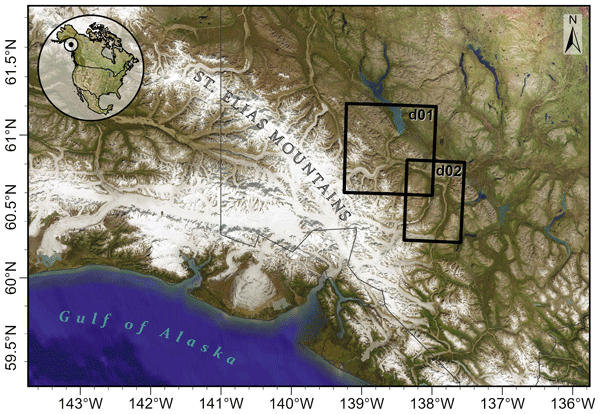
Another major issue concerns the uncertainty associated with the customized land-surface characterization. The manuscript makes major improvements to land use, soil classes, albedo, roughness length, and the binary erodible source function, and this is clearly one of the strengths of the work. However, many of these choices are based on necessarily limited field observations or pragmatic assumptions, such as prescribing representative textures for several outwash classes and assigning the upper Kaskawulsh valley entirely as coarse material. Since these assumptions directly control emission strength, threshold friction velocity, and the spatial pattern of erodibility, it will be helpful to discuss more explicitly how uncertainty in these prescribed surface properties affects the robustness and transferability of the results. As shown in Fig.1, it seems like the whole St. Elias Mountains contain much larger areas with very similar landcover and topography as d01 and d02 simulated in this study. Thus, the extent to which this study can be confidently generalized to the whole area is worth to discuss.
Specific Comments:
(1) In the Abstract, the manuscript states that a total emission rate was estimated from erodible deposits across 47 simulation days. Since the manuscript also shows that the modeled dust flux is highly sensitive to soil texture, soil moisture, and point-versus-area comparison, it would be helpful to clarify in the abstract and conclusion that this value should be interpreted as a first-order estimate rather than a tightly constrained regional emission budget.
(2) For the description of the erodible source function, the manuscript defines potential erodible areas as surfaces inundated during summer and exposed in autumn at least 5 times during 1984–2023. The basis for choosing “5 times” is not fully explained. It would be helpful to provide more justification for this threshold, or at least discuss how sensitive the mapped source area is to this criterion.
(3) In Section 2.2.2, four outwash deposit classes are introduced with prescribed representative soil textures and aerodynamic roughness lengths. Since these parameters are central to the results, it might be helpful to summarize more explicitly in the main text how much of the simulated emission area falls into each of these four classes, rather than leaving the reader to infer their importance indirectly.
(4) For the albedo adjustment, the manuscript states that the albedo of the glaciofluvial deposits was set to 0.14 based on average noontime observations at the DV station, replacing the default barren-surface value of 0.38. Since albedo is likely to vary with sediment type, moisture state, and illumination conditions, it would be useful to briefly discuss whether this single value is expected to be representative for all deposit classes and all simulation periods.
(5) In the surface meteorology evaluation, the manuscript notes that the 24 h spin-up may have been insufficient for soil moisture adjustment, especially during s01. Soil moisture directly affects threshold friction velocity and emission onset. It would be useful to comment on whether a longer spin-up period was tested, or whether computational constraints prevented this.
(6) For the comparison of dust flux at DV versus the average over emissive grid cells on the delta, the manuscript shows a large difference between these two simulated quantities. The discussion would benefit from being more explicit about the representativeness issue: to what extent should the DV tower measurement be interpreted as a point-scale flux, and to what extent is it reasonable to compare it with a grid-cell or delta-averaged model flux?
(7) The manuscript uses camera observations to qualitatively evaluate dust activity in adjacent valleys. The limitations of the method should perhaps be emphasized a bit more clearly. Since camera-based emission logs depend on visibility conditions, viewing angle, and plume contrast, it would be helpful to briefly comment on whether weak or short-lived events may have been missed in the qualitative record.
(8) Figure 2 contains many symbols and terms that are not easy to follow on first reading. It may help to simplify the presentation slightly or to ensure that all modified parameters are clearly highlighted in the figure caption, so that readers can more easily identify what was changed relative to the standard implementation.
Citation: https://doi.org/10.5194/egusphere-2026-1343-RC2 - AC1: 'Response to reviewers', Daniel Bellamy, 28 Jul 2026
Peer review completion


Interactive discussion
Status: closed
-
RC1: 'Comment on egusphere-2026-1343', Anonymous Referee #2, 27 May 2026
This manuscript discusses the development and evaluation of high-resolution WRF-Chem modeling approaches to simulate mineral dust emissions from proglacial valleys in the St. Elias Mountains, Canada, across three different time periods and seasons. The land-
surface input datasets were updated and the Shao (2004) dust emission scheme was modified to better represent surface erodibility. The model results were evaluated using field data from meteorological stations, Doppler LiDAR, and cameras. The model successfully captured dust emission dynamics, demonstrating seasonal and diurnal variability and dependence on soil type. The model underpredicted surface wind speeds
and vertical dust flux, while overpredicting soil moisture. These studies could be used to improve our understanding of high-latitude dust emissions and their response to climate change.
Specific comments:
Figure 9c and d: The contour plot of wind direction is difficult to understand in the way it is presented.
Figure 10: What is causing the high dust concentration in LiDAR data around 1-1.5 km on May 24? -
RC2: 'Comment on egusphere-2026-1343', Anonymous Referee #1, 28 May 2026
General Comments
This manuscript presents a modeling study that develops and evaluates a high-resolution WRF-Chem framework for simulating mineral dust emissions from proglacial valleys of the St. Elias Mountains, Canada. The manuscript is well structured, and the research method is based on a comprehensive suite of observations, including surface meteorological stations, optical particle counters, camera observations, and Doppler LiDAR measurements. The topic is interesting and important, especially because dust emissions from high-latitude proglacial valleys remain largely unresolved in current dust modeling efforts and are not represented in most regional or global dust inventories. The manuscript also contains substantial technical effort in modifying land-surface inputs and adapting the dust emission scheme for confined glaciofluvial deposits. In general, the manuscript demonstrates promising model skills in reproducing emission timing and some aspects of meteorology and vertical transport, with reasonable discussions of the simulation results. Therefore, I would recommend a major revision with more detailed discussion of model bias, parameter sensitivity, and the representativeness of the evaluation.
Major Comments:
A major issue with the manuscript is regarding the interpretation of the simulation bias in dust emission flux. As shown in the manuscript, the model successfully reproduced all observed emission events during the evaluation periods, but the simulated vertical dust flux at the DV grid point was only about 4% of the measured value. The manuscript attributes this mainly to underestimated surface winds, the aggregate disintegration behavior in the Shao (2004) scheme, and the overestimated soil moisture correction. While all of these are plausible, the discussion still remains somewhat qualitative and does not yet clearly establish which factor is most responsible for the large flux discrepancy. In particular, the results show that simulated fluxes are extremely sensitive to the prescribed soil texture, and that the comparison improves substantially when averaging over emissive grid cells of the delta rather than comparing only the DV grid point. This suggests that both parameter sensitivity and representativeness mismatch are central to the interpretation. Therefore, the discussion of modeling bias may benefit from a more detailed and more quantitative explanation.
Another major issue concerns the uncertainty associated with the customized land-surface characterization. The manuscript makes major improvements to land use, soil classes, albedo, roughness length, and the binary erodible source function, and this is clearly one of the strengths of the work. However, many of these choices are based on necessarily limited field observations or pragmatic assumptions, such as prescribing representative textures for several outwash classes and assigning the upper Kaskawulsh valley entirely as coarse material. Since these assumptions directly control emission strength, threshold friction velocity, and the spatial pattern of erodibility, it will be helpful to discuss more explicitly how uncertainty in these prescribed surface properties affects the robustness and transferability of the results. As shown in Fig.1, it seems like the whole St. Elias Mountains contain much larger areas with very similar landcover and topography as d01 and d02 simulated in this study. Thus, the extent to which this study can be confidently generalized to the whole area is worth to discuss.
Specific Comments:
(1) In the Abstract, the manuscript states that a total emission rate was estimated from erodible deposits across 47 simulation days. Since the manuscript also shows that the modeled dust flux is highly sensitive to soil texture, soil moisture, and point-versus-area comparison, it would be helpful to clarify in the abstract and conclusion that this value should be interpreted as a first-order estimate rather than a tightly constrained regional emission budget.
(2) For the description of the erodible source function, the manuscript defines potential erodible areas as surfaces inundated during summer and exposed in autumn at least 5 times during 1984–2023. The basis for choosing “5 times” is not fully explained. It would be helpful to provide more justification for this threshold, or at least discuss how sensitive the mapped source area is to this criterion.
(3) In Section 2.2.2, four outwash deposit classes are introduced with prescribed representative soil textures and aerodynamic roughness lengths. Since these parameters are central to the results, it might be helpful to summarize more explicitly in the main text how much of the simulated emission area falls into each of these four classes, rather than leaving the reader to infer their importance indirectly.
(4) For the albedo adjustment, the manuscript states that the albedo of the glaciofluvial deposits was set to 0.14 based on average noontime observations at the DV station, replacing the default barren-surface value of 0.38. Since albedo is likely to vary with sediment type, moisture state, and illumination conditions, it would be useful to briefly discuss whether this single value is expected to be representative for all deposit classes and all simulation periods.
(5) In the surface meteorology evaluation, the manuscript notes that the 24 h spin-up may have been insufficient for soil moisture adjustment, especially during s01. Soil moisture directly affects threshold friction velocity and emission onset. It would be useful to comment on whether a longer spin-up period was tested, or whether computational constraints prevented this.
(6) For the comparison of dust flux at DV versus the average over emissive grid cells on the delta, the manuscript shows a large difference between these two simulated quantities. The discussion would benefit from being more explicit about the representativeness issue: to what extent should the DV tower measurement be interpreted as a point-scale flux, and to what extent is it reasonable to compare it with a grid-cell or delta-averaged model flux?
(7) The manuscript uses camera observations to qualitatively evaluate dust activity in adjacent valleys. The limitations of the method should perhaps be emphasized a bit more clearly. Since camera-based emission logs depend on visibility conditions, viewing angle, and plume contrast, it would be helpful to briefly comment on whether weak or short-lived events may have been missed in the qualitative record.
(8) Figure 2 contains many symbols and terms that are not easy to follow on first reading. It may help to simplify the presentation slightly or to ensure that all modified parameters are clearly highlighted in the figure caption, so that readers can more easily identify what was changed relative to the standard implementation.
Citation: https://doi.org/10.5194/egusphere-2026-1343-RC2 - AC1: 'Response to reviewers', Daniel Bellamy, 28 Jul 2026
Peer review completion
Journal article(s) based on this preprint
Viewed
| HTML | XML | Total | Supplement | BibTeX | EndNote | |
|---|---|---|---|---|---|---|
| 385 | 106 | 43 | 534 | 55 | 41 | 39 |
- HTML: 385
- PDF: 106
- XML: 43
- Total: 534
- Supplement: 55
- BibTeX: 41
- EndNote: 39
Viewed (geographical distribution)
| Country | # | Views | % |
|---|
| Total: | 0 |
| HTML: | 0 |
| PDF: | 0 |
| XML: | 0 |
- 1
Daniel Bellamy

Martina Klose
Daniel F. Nadeau
Sebastian Engelstaedter
Richard Washington
James King
The requested preprint has a corresponding peer-reviewed final revised paper. You are encouraged to refer to the final revised version.
- Preprint
(4128 KB) - Metadata XML
-
Supplement
(2902 KB) - BibTeX
- EndNote
- Final revised paper
This manuscript discusses the development and evaluation of high-resolution WRF-Chem modeling approaches to simulate mineral dust emissions from proglacial valleys in the St. Elias Mountains, Canada, across three different time periods and seasons. The land-
surface input datasets were updated and the Shao (2004) dust emission scheme was modified to better represent surface erodibility. The model results were evaluated using field data from meteorological stations, Doppler LiDAR, and cameras. The model successfully captured dust emission dynamics, demonstrating seasonal and diurnal variability and dependence on soil type. The model underpredicted surface wind speeds
and vertical dust flux, while overpredicting soil moisture. These studies could be used to improve our understanding of high-latitude dust emissions and their response to climate change.
Specific comments:
Figure 9c and d: The contour plot of wind direction is difficult to understand in the way it is presented.
Figure 10: What is causing the high dust concentration in LiDAR data around 1-1.5 km on May 24?