
the Creative Commons Attribution 4.0 License.
the Creative Commons Attribution 4.0 License.
 | 09 Apr 2026
On the theoretical limitations of joint inversion for basal slipperiness and effective viscosity in ice-flow models
Abstract. When modelling ice flows there are several aspects which are poorly constrained by observations, in particular parameters related to ice rheology and basal sliding. In computational ice flow models, inversion methods are frequently used to estimate the spatial distribution of these hidden fields. These methods use surface measurement data in combination with a forward model of the ice dynamics that relate the hidden fields to the surface fields. In this study we approximate the forward model using first-order linear perturbation theory to gain insights into our ability to extract information about the ice viscosity at the same time as basal slipperiness, and to understand the theoretical limitations. We frame the inversion problem in terms of a Gaussian maximum a-posteriori estimation with explicitly stated priors for the hidden fields. We illustrate the inversion behaviour with perturbations applied to flow down a laterally confined channel, where both viscosity and slipperiness can play a significant role in the ice sheet dynamics. Our results indicate that it is possible to extract information about the viscosity field at the same time as estimating the basal slipperiness, with strong horizontal gradients in the surface velocity field essential for good viscosity retrieval. We recommend always inverting for basal slipperiness and viscosity together over grounded ice areas in ice-sheet models, and explicitly recognising prior knowledge of the hidden fields in the retrieval through either the inclusion of appropriate priors and regularisation.
-
Notice on discussion status
The requested preprint has a corresponding peer-reviewed final revised paper. You are encouraged to refer to the final revised version.
-
Preprint
(1297 KB)
-
The requested preprint has a corresponding peer-reviewed final revised paper. You are encouraged to refer to the final revised version.
- Preprint
(1297 KB) - Metadata XML
- BibTeX
- EndNote
- Final revised paper


Journal article(s) based on this preprint
Interactive discussion
Status: closed
-
RC1: 'Comment on egusphere-2026-1313', Anonymous Referee #1, 06 May 2026
- AC1: 'Reply on RC1', Camilla Schelpe, 04 Jul 2026
-
RC2: 'Comment on egusphere-2026-1313', Daniel Martin, 07 Jun 2026
Many ice sheet models infer initial conditions to match observations by performing some form of inversion for basal friction and/or ice rheology (viscosity, A, etc). In this work, the authors use a set of previously-defined transfer functions to explore the theoretical basis for performing this sort of inversion, with a focus on evaluating whether simultaneously solving for both basal friction and ice viscosity is well-behaved and whether it is desirable. They are able to provide some genuine insights into how perturbations in these quantities are propagated through to solutions in an inversion, both in ideal and noisy situations, and the role of regularization in extracting useful results from noisy data. They then follow up their idealized example with a more-realistic example using the Ua model.
I found this work generally well-written and understandable. The conclusions and demonstrations in this work are compelling, and I believe it represents a significant contribution to our understanding of how inversions in ice flow models work. I think this work is suitable for publication after some straightforward modifications.
There are a few places where the tone of the prose leans toward a somewhat non-collegial tone – I’ve attempted to point out specific examples, but in general I’d encourage the authors to avoid phrasing which reads like ”We’re right, everybody else is wrong”, which generally isn’t helpful. It’s sufficient to simply make your points without that level of editorializing.
One issue you don’t touch on which I think is relevant given other developments in the field: given your finding of separation of basal friction and rheology/viscosity in your inversions, this implies that mismatches between model and ”true” rheology will be expressed in, and isolated to, the component of the inversion which adjusts viscosity or A. In particular, mismatches in the Glen’s Law flow exponent will be accounted for there. I suspect the implication that these mismatches likely can’t be accounted for via basal friction is important.
Another point it would be good for the authors to address is potential limitations in this work due to the various simplifications and assumptions made. I think the work does a very good job of simplifying in support of extracting meaningful insight, but there are still likely impacts from these, and it would be good to include a short discussion along those lines.
In particular, I suspect that your choice of a linear rheology may oversimplify things somewhat. In practice, the Glen’s Law rheology generally used for ice tends to result in concentrated regions of high strain rates, with a correspondingly relatively fine spatial structure of viscosity (more pronounced if n=4, which many observations seem to support), along with an interplay between velocity and viscosity perturbations. One could imagine that this would result in some coupling between basal friction and viscosity, unlike what you find in the linear model. It would be good if you were able to address this. If not beyond the scope of this work, one nice additional example would be to add a second Ua inversion example which uses the full nonlinear rheology.
I expect the impact of m in the basal friction formulation is less, but still worth mentioning potential impacts in your discussion. In general, I think a paragraph summing the ways your example model deviates from common practice and potential impacts would be a helpful addition to the discussion section.
Specific points:
- lines 24-25: I think it would be better to mention basal friction/slipperiness first, then rate factor/viscosity/rheology -- admittedly a personal preference which you're welcome to ignore, but in my experience, most modeling efforts start by inverting for basal friction and then move on to the somewhat-harder rheology.
- line 25: I think you could more-generally call this the local rheology of the ice, rather than rate factor (and then mention that it could be rate factor, viscosity, some form of "damage", etc.). I think that's somewhat more evocative, and also covers the fairly wide range of approaches people take to this aspect.
- line 103: I'd suggest "commonly-used in" instead of "appropriate for" here.
- line 140: "surface velocity fields" -> "perturbations in the surface velocity fields"
- line 154: I think "flow line at a given y" would be clearer than "each y flow line", because my initial interpretation was "y-directional flow"
- 190-197: This is a very nice result! (even if I'm worried it may not completely hold for a nonlinear rheology).
- line 257: "some data errors" -- can you expand here (or somewhere) what the form of your data errors/noise take for these experiments? If I'm reading correctly, "data errors" are only applied to the ice surface "measurements", correct? (as opposed to ice velocities or bed height).
- line 274: I'd suggest a toning-down or removal of "This is in direct contradiction to many of the claims in the literature", which is needlessly confrontational. It's fair to lead with "Unlike others (cite), we find that.." or "Unlike (cite), we find that..."
- line 282: I'd use "baseline" instead of "true" here, since the "true" fields in the context of these experiments are actually baseline + perturbation.
- line 284: I think it would be helpful to spell out what "i.i.d." stands for. I had to look it up, and if I had to, other readers will as well.
- Figures 4 and 5: It looks like the perturbations are actually of the form sin(log(A)) and sin(log(c)), correct? It would be good to mention that explicitly since it's logarithmic in these figures and not in Figure 3.
- line 320: "as has been suggested by some authors" is also unnecessary.
- line 322: "we believe that" -- it's better to confirm things when possible rather than guessing at something in print. In this case, I can confirm that BISICLES generally performs its inversions to match mag(velocity) (which is stated in Cornford, et al, 2015.)
Citation: https://doi.org/10.5194/egusphere-2026-1313-RC2 - AC2: 'Reply on RC2', Camilla Schelpe, 04 Jul 2026
Peer review completion


Interactive discussion
Status: closed
-
RC1: 'Comment on egusphere-2026-1313', Anonymous Referee #1, 06 May 2026
In this paper the authors discuss the dual inversion of basal slipperiness and viscosity in ice-flow models.
They first derive a linearised forward model as a set of transfer functions that relates how small pertubations in the vsicosity and basal sliperiness are transfered to the surface velocities. The inverse problem is then formulating in a Bayesian framework.The model performance is evaluated using a synthetical test case and different levels of data errors and regularisation. The same experiment is then repeated using the Ua ice flow model.
The paper is well written and the results convicing. As mentionned in the introduction, inverse methods are very popular to initialise unknown parameters in ice flow models, and this paper provide a very interesting contribution to the field. The analytical results with the linearised model allow to understand the effects of the different perturbations and the role of the regularisation.
Below are two points that could be considered for a minor revision of the paper:
- as the proposed experiment involves out-of-phase perturbations, it could be interesting to show if the results still holds for perturbations that would be in phase or not completely out of phase.
- it would be interesting to add a discussion section to summarise the main assumptions and how this could affect inversions for real settings; For example, the proposed experiement assume a perfect model, linear friction and flow laws, uncorrelated observations errors, perfectly known surface and bed elevations, well constrained prior.
minor comments:
- Section 2.1 : define the notation with bar on top for the background fields. This is defined only in the Appendix.
- Line 203 "prior modelled using the Matern covariance function" and Appendix: equivalence between Tikhonov regularisation and covariance functions can be derived analytically for some special cases (see also e.g. Barth et al. (2014)) and helps to understand the role of the regularisation. But can be worth to mention that in general it will not be explicit. The effect of a prior error covariance matrix parameterised using Matern correlation functions can be reproduced using a diffusion operator, as it is done in e.g. FeniCs (Recinos et al., 2023).
- Line 227 "T** is an m x m" matrix; m is defined in the Appendix not in the main text and m is already used for the exponent of the friction law.
References:
- Barth, A., Beckers, J.-M., Troupin, C., Alvera-Azcárate, A., Vandenbulcke, L., 2014. divand-1.0: n-dimensional variational data analysis for ocean observations. Geoscientific Model Development 7, 225–241. https://doi.org/10.5194/gmd-7-225-2014
- Recinos, B., Goldberg, D., Maddison, J.R., Todd, J., 2023. A framework for time-dependent Ice Sheet Uncertainty Quantification, applied to three West Antarctic ice streams (preprint). Ice sheets/Data Assimilation. https://doi.org/10.5194/tc-2023-27
Citation: https://doi.org/10.5194/egusphere-2026-1313-RC1 - AC1: 'Reply on RC1', Camilla Schelpe, 04 Jul 2026
-
RC2: 'Comment on egusphere-2026-1313', Daniel Martin, 07 Jun 2026
Many ice sheet models infer initial conditions to match observations by performing some form of inversion for basal friction and/or ice rheology (viscosity, A, etc). In this work, the authors use a set of previously-defined transfer functions to explore the theoretical basis for performing this sort of inversion, with a focus on evaluating whether simultaneously solving for both basal friction and ice viscosity is well-behaved and whether it is desirable. They are able to provide some genuine insights into how perturbations in these quantities are propagated through to solutions in an inversion, both in ideal and noisy situations, and the role of regularization in extracting useful results from noisy data. They then follow up their idealized example with a more-realistic example using the Ua model.
I found this work generally well-written and understandable. The conclusions and demonstrations in this work are compelling, and I believe it represents a significant contribution to our understanding of how inversions in ice flow models work. I think this work is suitable for publication after some straightforward modifications.
There are a few places where the tone of the prose leans toward a somewhat non-collegial tone – I’ve attempted to point out specific examples, but in general I’d encourage the authors to avoid phrasing which reads like ”We’re right, everybody else is wrong”, which generally isn’t helpful. It’s sufficient to simply make your points without that level of editorializing.
One issue you don’t touch on which I think is relevant given other developments in the field: given your finding of separation of basal friction and rheology/viscosity in your inversions, this implies that mismatches between model and ”true” rheology will be expressed in, and isolated to, the component of the inversion which adjusts viscosity or A. In particular, mismatches in the Glen’s Law flow exponent will be accounted for there. I suspect the implication that these mismatches likely can’t be accounted for via basal friction is important.
Another point it would be good for the authors to address is potential limitations in this work due to the various simplifications and assumptions made. I think the work does a very good job of simplifying in support of extracting meaningful insight, but there are still likely impacts from these, and it would be good to include a short discussion along those lines.
In particular, I suspect that your choice of a linear rheology may oversimplify things somewhat. In practice, the Glen’s Law rheology generally used for ice tends to result in concentrated regions of high strain rates, with a correspondingly relatively fine spatial structure of viscosity (more pronounced if n=4, which many observations seem to support), along with an interplay between velocity and viscosity perturbations. One could imagine that this would result in some coupling between basal friction and viscosity, unlike what you find in the linear model. It would be good if you were able to address this. If not beyond the scope of this work, one nice additional example would be to add a second Ua inversion example which uses the full nonlinear rheology.
I expect the impact of m in the basal friction formulation is less, but still worth mentioning potential impacts in your discussion. In general, I think a paragraph summing the ways your example model deviates from common practice and potential impacts would be a helpful addition to the discussion section.
Specific points:
- lines 24-25: I think it would be better to mention basal friction/slipperiness first, then rate factor/viscosity/rheology -- admittedly a personal preference which you're welcome to ignore, but in my experience, most modeling efforts start by inverting for basal friction and then move on to the somewhat-harder rheology.
- line 25: I think you could more-generally call this the local rheology of the ice, rather than rate factor (and then mention that it could be rate factor, viscosity, some form of "damage", etc.). I think that's somewhat more evocative, and also covers the fairly wide range of approaches people take to this aspect.
- line 103: I'd suggest "commonly-used in" instead of "appropriate for" here.
- line 140: "surface velocity fields" -> "perturbations in the surface velocity fields"
- line 154: I think "flow line at a given y" would be clearer than "each y flow line", because my initial interpretation was "y-directional flow"
- 190-197: This is a very nice result! (even if I'm worried it may not completely hold for a nonlinear rheology).
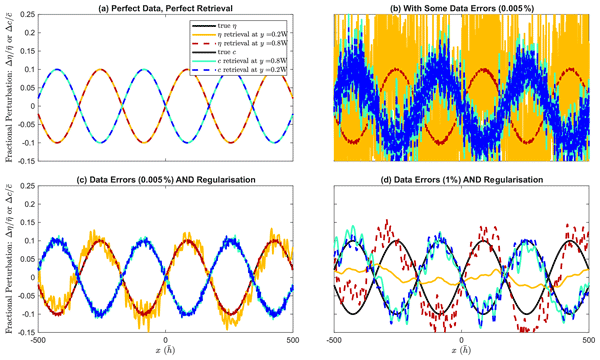
- line 257: "some data errors" -- can you expand here (or somewhere) what the form of your data errors/noise take for these experiments? If I'm reading correctly, "data errors" are only applied to the ice surface "measurements", correct? (as opposed to ice velocities or bed height).
- line 274: I'd suggest a toning-down or removal of "This is in direct contradiction to many of the claims in the literature", which is needlessly confrontational. It's fair to lead with "Unlike others (cite), we find that.." or "Unlike (cite), we find that..."
- line 282: I'd use "baseline" instead of "true" here, since the "true" fields in the context of these experiments are actually baseline + perturbation.
- line 284: I think it would be helpful to spell out what "i.i.d." stands for. I had to look it up, and if I had to, other readers will as well.
- Figures 4 and 5: It looks like the perturbations are actually of the form sin(log(A)) and sin(log(c)), correct? It would be good to mention that explicitly since it's logarithmic in these figures and not in Figure 3.
- line 320: "as has been suggested by some authors" is also unnecessary.
- line 322: "we believe that" -- it's better to confirm things when possible rather than guessing at something in print. In this case, I can confirm that BISICLES generally performs its inversions to match mag(velocity) (which is stated in Cornford, et al, 2015.)
Citation: https://doi.org/10.5194/egusphere-2026-1313-RC2 - AC2: 'Reply on RC2', Camilla Schelpe, 04 Jul 2026
Peer review completion
Journal article(s) based on this preprint
Viewed
| HTML | XML | Total | BibTeX | EndNote | |
|---|---|---|---|---|---|
| 363 | 155 | 43 | 561 | 48 | 45 |
- HTML: 363
- PDF: 155
- XML: 43
- Total: 561
- BibTeX: 48
- EndNote: 45
Viewed (geographical distribution)
| Country | # | Views | % |
|---|
| Total: | 0 |
| HTML: | 0 |
| PDF: | 0 |
| XML: | 0 |
- 1

G. Hilmar Gudmundsson
The requested preprint has a corresponding peer-reviewed final revised paper. You are encouraged to refer to the final revised version.
- Preprint
(1297 KB) - Metadata XML
In this paper the authors discuss the dual inversion of basal slipperiness and viscosity in ice-flow models.
They first derive a linearised forward model as a set of transfer functions that relates how small pertubations in the vsicosity and basal sliperiness are transfered to the surface velocities. The inverse problem is then formulating in a Bayesian framework.
The model performance is evaluated using a synthetical test case and different levels of data errors and regularisation. The same experiment is then repeated using the Ua ice flow model.
The paper is well written and the results convicing. As mentionned in the introduction, inverse methods are very popular to initialise unknown parameters in ice flow models, and this paper provide a very interesting contribution to the field. The analytical results with the linearised model allow to understand the effects of the different perturbations and the role of the regularisation.
Below are two points that could be considered for a minor revision of the paper:
minor comments:
References: