
the Creative Commons Attribution 4.0 License.
the Creative Commons Attribution 4.0 License.
 | 11 Mar 2026
Biogeochemical controls on carbonate dynamics driven by methane and freshwater inputs in shallow sediments of a brackish continental shelf sea
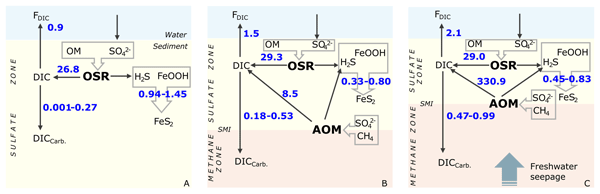
Abstract. Continental shelf seas are essential to the carbon cycle, supporting nearly one-third of global marine primary production and significantly contributing to the burial of organic and inorganic carbon. Processes such as organoclastic sulfate reduction (OSR), methane production or anaerobic oxidation of methane (AOM), occurring in coastal sediments, have a significant impact on the carbon cycling in the marine environment. That impact may be modified by an increased organic matter (OM) supply or freshwater input. In the present interdisciplinary study, we investigated carbonate dynamics in three benthic environments of a brackish continental shelf sea: (1) anoxic sediments dominated by OSR; (2) nearshore sediments with high terrigenous OM input and active methanogenesis; and (3) sediments influenced by groundwater infiltration and pore-water freshening, coupled with methanogenesis. We analyzed pore-water chemistry (DIC, total alkalinity, major ions, nutrients), sediment geochemistry (CH4, total organic carbon, total nitrogen, total sulfur), and mineralogy, including authigenic carbonates and iron sulfides. We used stable isotopes of DIC (δ13C-DIC), methane (δ13C-CH4, δ2H-CH4) and organic matter (δ13C, δ15N) to trace carbon transformations. We also determined rates of OSR and AOM experimentally. Based on these data, we have proposed conceptual models of carbon cycling in the three sedimentary environments. At the methane-free sediment, organic matter degradation was primarily governed by OSR, producing 53.6 mmol m-2 d-1 of DIC within the top 100 cm, accompanied by limited carbonate burial and dominant pyrite accumulation. In contrast, methane-bearing sediments displayed markedly enhanced carbonate dynamics. The role of methane-related processes became increasingly important in sediments influenced by freshwater input, where pore water freshening reduces sulfate availability, shallows the sulfate-methane transition and stimulates exceptionally high AOM rates reaching up to 1077 μmol dm-3 d-1, resulting in a DIC production rate of 331 mmol dm-3 d-1, more than fivefold higher than OSR. This environment facilitates significant authigenic dolomite burial (ranging from 467 to 994 μmol m-2 d-1), illustrating efficient inorganic carbon sequestration within these sediments. Our study provides the first quantitative estimate of authigenic dolomite burial rates in Baltic Sea sediments.
-
Notice on discussion status
The requested preprint has a corresponding peer-reviewed final revised paper. You are encouraged to refer to the final revised version.
-
Preprint
(1905 KB)
-
Supplement
(2886 KB)
-
The requested preprint has a corresponding peer-reviewed final revised paper. You are encouraged to refer to the final revised version.
- Preprint
(1905 KB) - Metadata XML
-
Supplement
(2886 KB) - BibTeX
- EndNote
- Final revised paper


Journal article(s) based on this preprint
Interactive discussion
Status: closed
-
RC1: 'Comment on egusphere-2026-1238', Tom Jilbert, 16 Apr 2026
- AC1: 'Reply on RC1', Katarzyna Łukawska-Matuszewska, 13 May 2026
-
RC2: 'Comment on egusphere-2026-1238', Anonymous Referee #2, 28 Apr 2026
The authors present original geochemical data from the composition of porewater and selected sediment samples obtained during two cruises to the Bay of Gdansk. Besides dissolved major and selected trace elements, sediment samples were investigated for microbial variables, and standard powder X-ray diffraction and SEM-EDS was used for bulk phase analysis. Furthermore, potential net microbial sulfate reduction rates at room temperature were obtained from laboratory incubations with added substrate. Hydrochemical results are used to calculate saturation indices for selected minerals. The authors further use estimates for pyrite and CaMg carbonate (the authors call 'dolomite') contents to calculate so-called 'burial/accumulation' rates for these two minerals. Not Rieveld evaluation of the powder XRD was carried out, what makes a proper quantification difficult. CNS data are apparently given for decarbonatized samples, no TIC data were analyzed. The data are then used to state that low-T dolomitization is an important process for carbon sequestration in Baltic Sea sediments.
A such, the data set is original and add on the existing data base for the Baltic Sea. As outlined below, however, the manuscript contains many assumptions that lead to a substantial overinterpretation of the actual results. Many data that are essential in evaluating the actual results are missing.The authors state without analytical proove, that a carbonate with a pressumable Ca:Mg stoichiometry of 1 is dolomite and that it is formed by authigenesis. As correctly mentioned in the manuscript, no ordering reflections where able to be identified due to the low mineral contents. So claiming that 'authigenic dolomite' is found is a possible overinterpretation of the actual observations, considering the known problems to form dolomite at low temperature. Claiming both, the cationic ordering state and the formation process requiers independent proove by other methods. It has been shown previously in a not-cited study (Jakobsen & Postma, GCA, 1989) that also detrital dolomite from erosional fluxes from land is found in the Baltic Sea.
Further detailed comments:
L39: have these references observed this for the first time?
L40: Why calling this a trendy 'dead zone' when microbes are rather active?
L93: No TIC was analyzed
L110: has the rim being discared?
L127: Which d13C values were assigned to the standards used?
L135: Has the pH been measured in the pre water? Show the data. How have rhizon-typical phenomena like degassing of CO2 and H2S been considered in a correction of the pH?
L142: The samples were only dried at 40-50°C, so the samples were not completely water-free. How to refer then the analytical results to the necessary dry weight %?
L145: Data are given in 'wt.%'? But according to the analytical protocoll, CNS was only measured in decarbonatized samples. Therefore, they do not refer to the original bulk sediment(?)
L161: For what reason LOI was analyzed (data are not shown)?
L173: What are the SEM-EDS and Mössbauer spectroscopy instruments used?
L182: Which pH was used for the modeling? The results in S9 look rather unusual for sediment pore waters. Extremely high supersaturations in some regions. How was the redox system quantified for dissolved FeIII/FeII which is needed to make an estimate for the stability of Fe(III) bearing solids?
L190: How to gain quantitative information about low mineral contents from powder XRD without using Rietveld? How many samples were analyzed in which way to make an estimate of the CaMg carbonate and pyrite contents from EDS scans?
L192: The are obviously 'potential' sulfate reduction rates, after dilution, addition of external substrate used by complete oxidizers, and at a temperature (20°C) exceeding in-situ conditions. Nothing is found in the discussion about the uncertainty of this approach and the inherent assumptions.
L328: Proto dolomite? Are there other elements in the CaMg carbonate lattice than Ca and Mg (e.g. (Mn or Fe)?
L340: In Fig.4h no calcite is marked (the text only states pyrite, 'dolomite' and diatoom
L375-392: Instead of compairng the d13C and d15N data of OM with very general sources, the data should be compared with extensive measuremements done by the Struck and Voss laboratories.
L495-497: Why stating that the pore water profiles may be indicative for Fe or Mn-AOM (in 30-60 cm below seafloor), when two lines later this assumpiton is taken back?
L618: Are the given decimals significant?
L627: What is ment with 'similar radiotracer methods'? The whole-core incubation using 35SO42- is clearly not similar to the approach applied in this study
L684: How is the formation process of this carbonate phase ('authigenesis') prooven?S9: What was the base for calculating the saturation indices? How was the pH estimated? How was the FeII/III distribution in the solution calculated? The results for greigite are completely different to the those obtained by Kulik et al. (2000; Aqu. Geochem.) Why are these discrepencies not discussed?
Citation: https://doi.org/10.5194/egusphere-2026-1238-RC2 - AC2: 'Reply on RC2', Katarzyna Łukawska-Matuszewska, 13 May 2026
Peer review completion


Interactive discussion
Status: closed
-
RC1: 'Comment on egusphere-2026-1238', Tom Jilbert, 16 Apr 2026
Interactive comment on “Biogeochemical controls on carbonate dynamics driven by methane and freshwater inputs in shallow sediments of a brackish continental shelf sea” by Łukawska-Matuszewska et al.
General
This paper presents an extremely comprehensive analysis of sediment biogeochemistry at three locations in the Gdansk Deep. The authors should be commended for the integrated approach to study solid-phase and porewater chemistry, which yields valuable insights into coupled primary and secondary diagenetic processes. In particular the work focuses on the factors controlling the rates of diagenetic mineral formation and burial (especially dolomite and pyrite) but touches on many other topics due to the breadth of the data.
I agree with most of the conclusions of the study but there are some interpretations that I would suggest to modify because their implications may be misunderstood if taken at face value. For example I do not think it is justified to state unilaterally that methanogenic sediments favor authigenic carbonate formation. I would also like to see some clarification of the separate measurements of del13-DIC and del 13C-CO2 included in the porewater analysis and how these results should be interpreted, and some more details about the incubation experiments and connected data processing. Overall I would say that the breadth of the approach introduces some difficulties to maintain coherence in the manuscript. Some rewriting of the introduction would help to guide the reader towards the rationale of the study in a more logical way. My Line by Line comments contain all the relevant points to be addressed. I wish the authors success in their revisions.
Line by Line
Line 24: “In” rather than “At” the methane-free sediment
Lines 25 and 29: DIC production rates are given here in two separate units. For the sake of readability it would be sensible to use the same unit.
Lines 34-80 (general comments on Introduction): Lines 72-80 do a good job of outlining the eventual rationale for the study, but some of the earlier text is harder to read. I suggest to try to introduce the key biogeochemical processes to be studied in a more consistent way, e.g. treat primary and secondary diagenetic processes separately, then introduce the effects of salinity and submarine groundwater discharge, and finally focus on those processes that control alkalinity production as a driver of carbonate precipitation. The current flow jumps between these concepts and is not always consistent.
Lines 45-48: OSR should not lower pH or enhance carbonate dissolution because there is 2:1 production of HCO3- vs. H+. Please check and rephrase.
Line 91: Does this mean 7 cores in July 2023 and another 7 in February 2024? Please be specific.
Line 94: This should read "CH4, CO2 and their stable isotopes..." (but see later comments about needed clarifications about this methodology).
Line 99: How was the rhizon sampling performed under anoxic conditions, was the setup placed in a glove bag?
Line 107: At what stage was a headspace injected into the methane sample vials? This should be stated.
Line 160: The term IG in equation (2) is not defined.
Line 163-172: this section concerns porewater analyses so it is not clear why it is placed here in the sediment analyses section.
Line 168: What was the detection limit in terms of CH4 concentrations to obtain reliable delC13 data? Was a pre-concentration unit used?
Line 178: How were thin sections produced? Was the sediment embedded and if so with which resin?
Line 186: Clarify that d in equation 3 is the wet bulk density.
Line 190: Was the PXRD quantification achieved using the Rietveld method? Please comment on the uncertainty for estimates of dolomite and pyrite content in the ranges calculated in this study.
Line 198: If the measured product is H2S, how does this method to determine OSR exclude H2S produced by SO4-AOM?
Line 237: 3.2 has the same heading as 3.1 (!)
Line 286: This clarification of the incubation approach should also be stated in the Methods.
Line 296 (Table 1): The raw data used to calculate the rates needs to be included in the Supplement. Also it is interesting to note that MET-2 and ZGG are very similar in terms of experimentally-derived process rates. This does not seem to match with the porewater profiles, in which AOM appears much more important at MET-2.
Line 308: Can this variable volume of "sediment matrix" be related to changes in water content downcore? The images imply so, but it depends partly on how the thin sections were prepared, see earlier comment and adjust accordingly.
Line 328: Where are the SEM-EDS results?
Line 334 (Fig. 4): "c" appears to be pyrite and not calcite as stated in the caption.
Line 398: The diagenetic reactions are given different codes (e.g. R1, R2) in the main text and in the supplement. Please be consistent throughout.
Line 426-427: Is this a reference to the incubation results of the present study? If so please be clear.
Line 435: For completeness should denitrification be considered here?
Line 439: Refer to Table 2 again showing the low values of dolomite at this site.
Line 446-447: This logic is not quite correct, because as stated earlier in the manuscript, carbonate alkalinity, as HCO3- + 2(CO3 2-) is not quite equivalent to DIC. I am not against using these type of approximations to derive useful information from the dataset, but all assumptions should be made clear.
Line 499: Should the reference to Fig. 4 actually be to Fig. 5?
Line 544-545 (important): I think the interpretation is more nuanced. Generally the formation of carbonates will be a function of the overall rate of the primary diagenetic reactions producing DIC and thus raising the IAP of dolomite and calcite. There is no mechanistic reason why methanogenic sediments (in the absence of sulfate) should favor carbonate precipitation; on the contrary OSR-dominated systems would be expected to have higher rates of diagenesis generally, due to greater energy yield of OSR. However, in systems where both process occur but overall diagenesis rates are so high that sulfate is exhausted in the uppermost decimeters (e.g. MET-1, MET-2 here), DIC will be observed to be higher overall (thus favoring carbonate formation), and by coincidence a methanogenic zone will be observed in short sediment cores that would otherwise be confined to deeper horizons. So I would suggest that one of the main outcomes of this study is to highlight how topographic features such as pockmarks influence the sedimentation regime such that demand for electron acceptors is concentrated in specific areas, leading to knock-on effects in secondary processes such as mineral formation (with contrasting outcomes for sulfides and carbonates).
Line 973: Whiticar (1999) is missing from the bibliography. Check all references.
Supplement Fig. S3 (important): This point concerns the methodology for stable carbon isotopic analysis of dissolved inorganic carbon species used in the study, and how the data should be interpreted. Samples appear to have been taken in two separate ways: 1. in connection with the CH4 sampling, for which wet sediments were stored in 2.5%NaOH and then headspace gas was extracted for del13C-CO2; and 2. in connection with the DIC sampling, for which extracted porewaters were acidified with phosphoric acid and all DIC converted to CO2 for determination of del13C-DIC. A couple of queries here:
- for method 1, do the authors assume the data is reporting the del13C of only the dissolved CO2 (i.e. not the HCO3- and CO3(2-) derived fractions)?
- if so, how should those data differ from the del13C-DIC, if the entire DIC pool is in equilibrium? I checked the Whiticar (1999) paper and it seems that there is some interchangeable use of the terms del13C-CO2 and del13C-DIC in that study. For example in Fig. 7 of Whiticar the axis states “del13C-CO2” but the caption indicates “carbon isotopes of bicarbonate”. But if the authors are aware of literature of isotopic fractionation within the carbonate system in porewaters they should cite it here and explain how it impacts on the observations.
- please comment on how it was possible to achieve sufficient recovery of CO2 by method 1, if the treatment with NaOH shifted the equilibrium in the carbonate system towards HCO3- and CO3(2-)? Is it a question of how quickly the headspace samples were taken?
Supplement Fig. S9: There is no legend so the color coding is not clear.
Citation: https://doi.org/10.5194/egusphere-2026-1238-RC1 - AC1: 'Reply on RC1', Katarzyna Łukawska-Matuszewska, 13 May 2026
-
RC2: 'Comment on egusphere-2026-1238', Anonymous Referee #2, 28 Apr 2026
The authors present original geochemical data from the composition of porewater and selected sediment samples obtained during two cruises to the Bay of Gdansk. Besides dissolved major and selected trace elements, sediment samples were investigated for microbial variables, and standard powder X-ray diffraction and SEM-EDS was used for bulk phase analysis. Furthermore, potential net microbial sulfate reduction rates at room temperature were obtained from laboratory incubations with added substrate. Hydrochemical results are used to calculate saturation indices for selected minerals. The authors further use estimates for pyrite and CaMg carbonate (the authors call 'dolomite') contents to calculate so-called 'burial/accumulation' rates for these two minerals. Not Rieveld evaluation of the powder XRD was carried out, what makes a proper quantification difficult. CNS data are apparently given for decarbonatized samples, no TIC data were analyzed. The data are then used to state that low-T dolomitization is an important process for carbon sequestration in Baltic Sea sediments.
A such, the data set is original and add on the existing data base for the Baltic Sea. As outlined below, however, the manuscript contains many assumptions that lead to a substantial overinterpretation of the actual results. Many data that are essential in evaluating the actual results are missing.The authors state without analytical proove, that a carbonate with a pressumable Ca:Mg stoichiometry of 1 is dolomite and that it is formed by authigenesis. As correctly mentioned in the manuscript, no ordering reflections where able to be identified due to the low mineral contents. So claiming that 'authigenic dolomite' is found is a possible overinterpretation of the actual observations, considering the known problems to form dolomite at low temperature. Claiming both, the cationic ordering state and the formation process requiers independent proove by other methods. It has been shown previously in a not-cited study (Jakobsen & Postma, GCA, 1989) that also detrital dolomite from erosional fluxes from land is found in the Baltic Sea.
Further detailed comments:
L39: have these references observed this for the first time?
L40: Why calling this a trendy 'dead zone' when microbes are rather active?
L93: No TIC was analyzed
L110: has the rim being discared?
L127: Which d13C values were assigned to the standards used?
L135: Has the pH been measured in the pre water? Show the data. How have rhizon-typical phenomena like degassing of CO2 and H2S been considered in a correction of the pH?
L142: The samples were only dried at 40-50°C, so the samples were not completely water-free. How to refer then the analytical results to the necessary dry weight %?
L145: Data are given in 'wt.%'? But according to the analytical protocoll, CNS was only measured in decarbonatized samples. Therefore, they do not refer to the original bulk sediment(?)
L161: For what reason LOI was analyzed (data are not shown)?
L173: What are the SEM-EDS and Mössbauer spectroscopy instruments used?
L182: Which pH was used for the modeling? The results in S9 look rather unusual for sediment pore waters. Extremely high supersaturations in some regions. How was the redox system quantified for dissolved FeIII/FeII which is needed to make an estimate for the stability of Fe(III) bearing solids?
L190: How to gain quantitative information about low mineral contents from powder XRD without using Rietveld? How many samples were analyzed in which way to make an estimate of the CaMg carbonate and pyrite contents from EDS scans?
L192: The are obviously 'potential' sulfate reduction rates, after dilution, addition of external substrate used by complete oxidizers, and at a temperature (20°C) exceeding in-situ conditions. Nothing is found in the discussion about the uncertainty of this approach and the inherent assumptions.
L328: Proto dolomite? Are there other elements in the CaMg carbonate lattice than Ca and Mg (e.g. (Mn or Fe)?
L340: In Fig.4h no calcite is marked (the text only states pyrite, 'dolomite' and diatoom
L375-392: Instead of compairng the d13C and d15N data of OM with very general sources, the data should be compared with extensive measuremements done by the Struck and Voss laboratories.
L495-497: Why stating that the pore water profiles may be indicative for Fe or Mn-AOM (in 30-60 cm below seafloor), when two lines later this assumpiton is taken back?
L618: Are the given decimals significant?
L627: What is ment with 'similar radiotracer methods'? The whole-core incubation using 35SO42- is clearly not similar to the approach applied in this study
L684: How is the formation process of this carbonate phase ('authigenesis') prooven?S9: What was the base for calculating the saturation indices? How was the pH estimated? How was the FeII/III distribution in the solution calculated? The results for greigite are completely different to the those obtained by Kulik et al. (2000; Aqu. Geochem.) Why are these discrepencies not discussed?
Citation: https://doi.org/10.5194/egusphere-2026-1238-RC2 - AC2: 'Reply on RC2', Katarzyna Łukawska-Matuszewska, 13 May 2026
Peer review completion
Journal article(s) based on this preprint
Viewed
| HTML | XML | Total | Supplement | BibTeX | EndNote | |
|---|---|---|---|---|---|---|
| 826 | 318 | 80 | 1,224 | 144 | 71 | 86 |
- HTML: 826
- PDF: 318
- XML: 80
- Total: 1,224
- Supplement: 144
- BibTeX: 71
- EndNote: 86
Viewed (geographical distribution)
| Country | # | Views | % |
|---|
| Total: | 0 |
| HTML: | 0 |
| PDF: | 0 |
| XML: | 0 |
- 1
Cited


Katarzyna Łukawska-Matuszewska
Grzegorz Rzepa
Aleksandra Brodecka-Goluch
Andrzej Borkowski
Beata Gebus-Czupyt
Artur Błachowski
Maciej Manecki
Jarosław Kania
Maciej Dwornik
Magdalena Radzikowska
The requested preprint has a corresponding peer-reviewed final revised paper. You are encouraged to refer to the final revised version.
- Preprint
(1905 KB) - Metadata XML
-
Supplement
(2886 KB) - BibTeX
- EndNote
- Final revised paper
Interactive comment on “Biogeochemical controls on carbonate dynamics driven by methane and freshwater inputs in shallow sediments of a brackish continental shelf sea” by Łukawska-Matuszewska et al.
General
This paper presents an extremely comprehensive analysis of sediment biogeochemistry at three locations in the Gdansk Deep. The authors should be commended for the integrated approach to study solid-phase and porewater chemistry, which yields valuable insights into coupled primary and secondary diagenetic processes. In particular the work focuses on the factors controlling the rates of diagenetic mineral formation and burial (especially dolomite and pyrite) but touches on many other topics due to the breadth of the data.
I agree with most of the conclusions of the study but there are some interpretations that I would suggest to modify because their implications may be misunderstood if taken at face value. For example I do not think it is justified to state unilaterally that methanogenic sediments favor authigenic carbonate formation. I would also like to see some clarification of the separate measurements of del13-DIC and del 13C-CO2 included in the porewater analysis and how these results should be interpreted, and some more details about the incubation experiments and connected data processing. Overall I would say that the breadth of the approach introduces some difficulties to maintain coherence in the manuscript. Some rewriting of the introduction would help to guide the reader towards the rationale of the study in a more logical way. My Line by Line comments contain all the relevant points to be addressed. I wish the authors success in their revisions.
Line by Line
Line 24: “In” rather than “At” the methane-free sediment
Lines 25 and 29: DIC production rates are given here in two separate units. For the sake of readability it would be sensible to use the same unit.
Lines 34-80 (general comments on Introduction): Lines 72-80 do a good job of outlining the eventual rationale for the study, but some of the earlier text is harder to read. I suggest to try to introduce the key biogeochemical processes to be studied in a more consistent way, e.g. treat primary and secondary diagenetic processes separately, then introduce the effects of salinity and submarine groundwater discharge, and finally focus on those processes that control alkalinity production as a driver of carbonate precipitation. The current flow jumps between these concepts and is not always consistent.
Lines 45-48: OSR should not lower pH or enhance carbonate dissolution because there is 2:1 production of HCO3- vs. H+. Please check and rephrase.
Line 91: Does this mean 7 cores in July 2023 and another 7 in February 2024? Please be specific.
Line 94: This should read "CH4, CO2 and their stable isotopes..." (but see later comments about needed clarifications about this methodology).
Line 99: How was the rhizon sampling performed under anoxic conditions, was the setup placed in a glove bag?
Line 107: At what stage was a headspace injected into the methane sample vials? This should be stated.
Line 160: The term IG in equation (2) is not defined.
Line 163-172: this section concerns porewater analyses so it is not clear why it is placed here in the sediment analyses section.
Line 168: What was the detection limit in terms of CH4 concentrations to obtain reliable delC13 data? Was a pre-concentration unit used?
Line 178: How were thin sections produced? Was the sediment embedded and if so with which resin?
Line 186: Clarify that d in equation 3 is the wet bulk density.
Line 190: Was the PXRD quantification achieved using the Rietveld method? Please comment on the uncertainty for estimates of dolomite and pyrite content in the ranges calculated in this study.
Line 198: If the measured product is H2S, how does this method to determine OSR exclude H2S produced by SO4-AOM?
Line 237: 3.2 has the same heading as 3.1 (!)
Line 286: This clarification of the incubation approach should also be stated in the Methods.
Line 296 (Table 1): The raw data used to calculate the rates needs to be included in the Supplement. Also it is interesting to note that MET-2 and ZGG are very similar in terms of experimentally-derived process rates. This does not seem to match with the porewater profiles, in which AOM appears much more important at MET-2.
Line 308: Can this variable volume of "sediment matrix" be related to changes in water content downcore? The images imply so, but it depends partly on how the thin sections were prepared, see earlier comment and adjust accordingly.
Line 328: Where are the SEM-EDS results?
Line 334 (Fig. 4): "c" appears to be pyrite and not calcite as stated in the caption.
Line 398: The diagenetic reactions are given different codes (e.g. R1, R2) in the main text and in the supplement. Please be consistent throughout.
Line 426-427: Is this a reference to the incubation results of the present study? If so please be clear.
Line 435: For completeness should denitrification be considered here?
Line 439: Refer to Table 2 again showing the low values of dolomite at this site.
Line 446-447: This logic is not quite correct, because as stated earlier in the manuscript, carbonate alkalinity, as HCO3- + 2(CO3 2-) is not quite equivalent to DIC. I am not against using these type of approximations to derive useful information from the dataset, but all assumptions should be made clear.
Line 499: Should the reference to Fig. 4 actually be to Fig. 5?
Line 544-545 (important): I think the interpretation is more nuanced. Generally the formation of carbonates will be a function of the overall rate of the primary diagenetic reactions producing DIC and thus raising the IAP of dolomite and calcite. There is no mechanistic reason why methanogenic sediments (in the absence of sulfate) should favor carbonate precipitation; on the contrary OSR-dominated systems would be expected to have higher rates of diagenesis generally, due to greater energy yield of OSR. However, in systems where both process occur but overall diagenesis rates are so high that sulfate is exhausted in the uppermost decimeters (e.g. MET-1, MET-2 here), DIC will be observed to be higher overall (thus favoring carbonate formation), and by coincidence a methanogenic zone will be observed in short sediment cores that would otherwise be confined to deeper horizons. So I would suggest that one of the main outcomes of this study is to highlight how topographic features such as pockmarks influence the sedimentation regime such that demand for electron acceptors is concentrated in specific areas, leading to knock-on effects in secondary processes such as mineral formation (with contrasting outcomes for sulfides and carbonates).
Line 973: Whiticar (1999) is missing from the bibliography. Check all references.
Supplement Fig. S3 (important): This point concerns the methodology for stable carbon isotopic analysis of dissolved inorganic carbon species used in the study, and how the data should be interpreted. Samples appear to have been taken in two separate ways: 1. in connection with the CH4 sampling, for which wet sediments were stored in 2.5%NaOH and then headspace gas was extracted for del13C-CO2; and 2. in connection with the DIC sampling, for which extracted porewaters were acidified with phosphoric acid and all DIC converted to CO2 for determination of del13C-DIC. A couple of queries here:
Supplement Fig. S9: There is no legend so the color coding is not clear.