
the Creative Commons Attribution 4.0 License.
the Creative Commons Attribution 4.0 License.
 | 02 Jun 2026
Performance and methodological evaluation of a quantum-cascade-laser photoacoustic aerodynamic gradient system for field-scale NH3 flux measurements
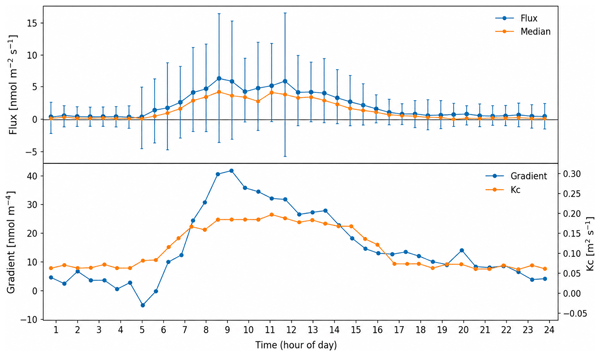
Abstract. Reliable quantification of ammonia (NH3) surface–atmosphere exchange remains challenging due to the compound’s reactivity, inlet interactions, and the sensitivity of gradient-based flux estimates to instrumental response characteristics. We present the field evaluation and methodological assessment of a quantum-cascade- laser (QCL) based photoacoustic (PA) aerodynamic gradient system for half-hourly NH3 flux measurements under agricultural conditions. The campaign covered a 54-day post-fertilization period under predominantly dry soil conditions, including the transition from bare soil to a developing winter rapeseed canopy. Instrumental performance was assessed through co-located inlet comparison experiments, yielding a random uncertainty of ±2 ppb (1σ) and demonstrating negligible systematic bias between sampling channels. The system operated continuously under field conditions with active thermal stabilization and humidity management. Fluxes were calculated using Monin-Obukhov similarity theory (MOST) across an ensemble of universal stability functions to evaluate methodological sensitivity. Sensitivity analysis indicated that variability attributable solely to stability-function selection remained small relative to observed diurnal flux amplitudes. Mean NH3 emission during the investigated period was 1.85 nmol m–2 s–1, corresponding to 1.21 kg N ha–1 or 4.0 % of the applied fertilizer nitrogen. A pronounced diurnal asymmetry was observed, with daytime emissions approximately one order of magnitude higher than nighttime values, reflecting strong coupling between turbulent exchange and radiation-driven surface processes. Complementary machine-learning analysis indicated that incorporating short-term temporal memory substantially improved the representation of NH3 flux dynamics and revealed distinct daytime and nighttime exchange regimes. The combined QCL–photoacoustic gradient system demonstrated robust field performance and low instrumental bias, supporting its applicability for long-term field-scale studies of reactive trace gas exchange.
-
Notice on discussion status
The requested preprint has a corresponding peer-reviewed final revised paper. You are encouraged to refer to the final revised version.
-
Preprint
(956 KB)
-
The requested preprint has a corresponding peer-reviewed final revised paper. You are encouraged to refer to the final revised version.
- Preprint
(956 KB) - Metadata XML
- BibTeX
- EndNote
- Final revised paper


Journal article(s) based on this preprint
Interactive discussion
Status: closed
-
RC1: 'Comment on egusphere-2026-1219', Hossein Maazallahi, 05 Jun 2026
-
AC1: 'Reply on RC1', László Horváth, 11 Jun 2026
The comment was uploaded in the form of a supplement: https://egusphere.copernicus.org/preprints/2026/egusphere-2026-1219/egusphere-2026-1219-AC1-supplement.pdf
-
AC1: 'Reply on RC1', László Horváth, 11 Jun 2026
-
RC2: 'Comment on egusphere-2026-1219', Anonymous Referee #2, 22 Jun 2026
The manuscript describes a QCL-based photoacoustic aerodynamic gradient system for measuring half-hourly NH3 fluxes under agricultural field conditions. The system's performance was validated through field measurements of NH3 fluxes under predominantly dry soil conditions. The key drivers of NH3 surface-atmosphere exchange during daytime and nighttime were resolved by using a machine learning method. Overall, the combined QCL–photoacoustic gradient system had robust field performance and low instrumental bias and can be used for long-term NH3 flux measurement. The manuscript well fits the scope of AMT. It can be recommended for publication after the following comments are addressed.
Specific comments:
Reliable quantification of NH3 remains challenging due to the inlet interactions. However, the NH3 losses in the inlet were not evaluated or calibrated. Though the NH3 loss in both inlet lines was similar, it would bias the accurate quantification of NH3 fluxes. The uncertainties induced by the inlet interactions should be evaluated. This can be done by using standard gases or a permeation tube of NH3.
Lines 38-40: Given that the system has a high detection limit (~ 3 ppb with 2 min average), it may not be applicable to relatively clean conditions. The authors should emphasize the applicability for “agricultural conditions”.
Lines 161-162: How long is the sampling line? What is the residence time in the sampling line?
Lines 177-178: Please elaborate on how the sampling-related measurement uncertainty was derived.
Lines 307-310: Is the intrinsic system memory induced by the measurement system or soil property? More explanation is needed to help understand the mechanistic presence of system memory.
Lines 336-340: This is an important result and should be given as a figure in the main text.
Lines 477-485: It is better to have figures to show the comparison between predicted and measured NH3 fluxes.
Technical comments:
Line 93: define QCL.
Citation: https://doi.org/10.5194/egusphere-2026-1219-RC2 -
AC2: 'Reply on RC2', László Horváth, 11 Jul 2026
The comment was uploaded in the form of a supplement: https://egusphere.copernicus.org/preprints/2026/egusphere-2026-1219/egusphere-2026-1219-AC2-supplement.pdf
-
AC2: 'Reply on RC2', László Horváth, 11 Jul 2026
Peer review completion


Interactive discussion
Status: closed
-
RC1: 'Comment on egusphere-2026-1219', Hossein Maazallahi, 05 Jun 2026
-
AC1: 'Reply on RC1', László Horváth, 11 Jun 2026
The comment was uploaded in the form of a supplement: https://egusphere.copernicus.org/preprints/2026/egusphere-2026-1219/egusphere-2026-1219-AC1-supplement.pdf
-
AC1: 'Reply on RC1', László Horváth, 11 Jun 2026
-
RC2: 'Comment on egusphere-2026-1219', Anonymous Referee #2, 22 Jun 2026
The manuscript describes a QCL-based photoacoustic aerodynamic gradient system for measuring half-hourly NH3 fluxes under agricultural field conditions. The system's performance was validated through field measurements of NH3 fluxes under predominantly dry soil conditions. The key drivers of NH3 surface-atmosphere exchange during daytime and nighttime were resolved by using a machine learning method. Overall, the combined QCL–photoacoustic gradient system had robust field performance and low instrumental bias and can be used for long-term NH3 flux measurement. The manuscript well fits the scope of AMT. It can be recommended for publication after the following comments are addressed.
Specific comments:
Reliable quantification of NH3 remains challenging due to the inlet interactions. However, the NH3 losses in the inlet were not evaluated or calibrated. Though the NH3 loss in both inlet lines was similar, it would bias the accurate quantification of NH3 fluxes. The uncertainties induced by the inlet interactions should be evaluated. This can be done by using standard gases or a permeation tube of NH3.
Lines 38-40: Given that the system has a high detection limit (~ 3 ppb with 2 min average), it may not be applicable to relatively clean conditions. The authors should emphasize the applicability for “agricultural conditions”.
Lines 161-162: How long is the sampling line? What is the residence time in the sampling line?
Lines 177-178: Please elaborate on how the sampling-related measurement uncertainty was derived.
Lines 307-310: Is the intrinsic system memory induced by the measurement system or soil property? More explanation is needed to help understand the mechanistic presence of system memory.
Lines 336-340: This is an important result and should be given as a figure in the main text.
Lines 477-485: It is better to have figures to show the comparison between predicted and measured NH3 fluxes.
Technical comments:
Line 93: define QCL.
Citation: https://doi.org/10.5194/egusphere-2026-1219-RC2 -
AC2: 'Reply on RC2', László Horváth, 11 Jul 2026
The comment was uploaded in the form of a supplement: https://egusphere.copernicus.org/preprints/2026/egusphere-2026-1219/egusphere-2026-1219-AC2-supplement.pdf
-
AC2: 'Reply on RC2', László Horváth, 11 Jul 2026
Peer review completion
Journal article(s) based on this preprint
Data sets
Kartal_repository_package.zip János Fekete, Zoltán Bozóki, Csilla Gombi, László Horváth, Zoltán Nagy, Krisztina Pintér, Tamás Weidinger, Anna Szabó, and Helga Huszár https://doi.org/10.82570/SZTE_Datarepo_b7hfb-dms70
Viewed
| HTML | XML | Total | BibTeX | EndNote | |
|---|---|---|---|---|---|
| 184 | 56 | 18 | 258 | 8 | 15 |
- HTML: 184
- PDF: 56
- XML: 18
- Total: 258
- BibTeX: 8
- EndNote: 15
Viewed (geographical distribution)
| Country | # | Views | % |
|---|
| Total: | 0 |
| HTML: | 0 |
| PDF: | 0 |
| XML: | 0 |
- 1
János Fekete
Zoltán Bozóki
Csilla Gombi
László Horváth
Zoltán Nagy
Krisztina Pintér
Tamás Weidinger
Anna Szabó
Helga Huszár
The requested preprint has a corresponding peer-reviewed final revised paper. You are encouraged to refer to the final revised version.
- Preprint
(956 KB) - Metadata XML
Enclosed, please find my comments.