
the Creative Commons Attribution 4.0 License.
the Creative Commons Attribution 4.0 License.
 | 12 Mar 2026
Characterising magnetopause surface waves within magnetosphere–ionosphere–ground coupling
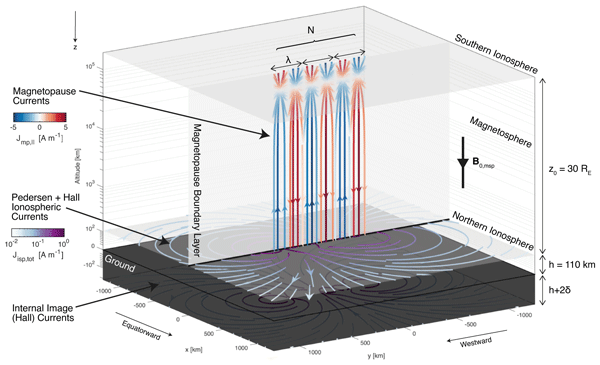
Abstract. Disturbances to the magnetopause location driven by upstream pressure variations or flow shear instabilities may be described as surface waves, which act as localised sources of field-aligned currents coupling the magnetosphere to the ionosphere. However, their impacts on the ionosphere and ground across representative ranges of wave and system properties are poorly understood. We, therefore, develop a simple numerical model for dispersionless mesoscale magnetopause surface waves within the coupled magnetosphere–ionosphere–ground system. In general, the impacts of finite wave packets can be decomposed into periodic fluctuations (with matching wavelength to that in the magnetosphere) along with slowly-varying trends that result from finite wave effects. Finite wave packets act in the far-field like a string of alternating field-aligned currents well described both in the ionosphere and on the ground as a two-dimensional current dipole. In the ionosphere, near-field periodic fluctuations exponentially decay over the reduced wavelength latitudinally away from the projected magnetopause boundary layer flux tubes, which may limit how well they can be resolved by radar. The relationship between the magnetic field above and below the ionosphere becomes more complicated for surface waves than infinite plane Alfvén waves due to the additional spatial structure, which introduces interference across the spectrum of wavenumbers present. This modifies how the ionosphere screens, rotates, and spatially smears magnetic field perturbations across all three components in different ways, importantly resulting in latitudinal scales of amplitude and polarisation variation smaller than typical ground magnetometer spacings, motivating the need for denser networks. A range of effective skin depths in the ground are applicable to surface waves, meaning ground induction can vary between a near-perfect insulator to a good conductor, affecting both observable ground magnetic fields and resulting geoelectric fields. The predicted peak amplitudes of surface waves' impacts suggest they may act as significant sources of ionospheric/thermospheric Joule heating and geoelectric fields in the ground, thereby contributing to space weather impacts though highly localised latitudinally. Our results provide key insight into interpreting ground-based observations, of particular timeliness with the rollout of new digital ionospheric radars and the upcoming SMILE mission's planned conjugate ground–space campaigns.
-
Notice on discussion status
The requested preprint has a corresponding peer-reviewed final revised paper. You are encouraged to refer to the final revised version.
-
Preprint
(7334 KB)
-
The requested preprint has a corresponding peer-reviewed final revised paper. You are encouraged to refer to the final revised version.
- Preprint
(7334 KB) - Metadata XML
- BibTeX
- EndNote
- Final revised paper


Journal article(s) based on this preprint
Interactive discussion
Status: closed
-
RC1: 'Comment on egusphere-2026-1200', Anonymous Referee #1, 08 Apr 2026
- CC1: 'Reply on RC1', Martin Archer, 09 Apr 2026
-
AC1: 'Reply on RC1', Martin Archer, 09 Apr 2026
Apologies, a response to the reviewer's final point was accidentally not included, which we include below.
We take the reviewer’s point that the resistive-coupling length scale from combining the Knight parameter with the Pedersen conductance can, in general, vary. While it is typically smaller than the wavelengths of surface waves at the MI-interface, in cases when they are comparable then the field-aligned current amplitudes of the waves may become modified. We already provided an approximate modification of the linear current amplitudes due to this effect. We agree that parallel electric fields, in general, play a significant effect within MI-coupling. We will revise our statement accordingly.
Citation: https://doi.org/10.5194/egusphere-2026-1200-AC1 -
RC3: 'Reply on AC1', Anonymous Referee #1, 03 Jun 2026
-
AC3: 'Reply on RC3', Martin Archer, 04 Jun 2026
Please find our further responses attached.
-
RC4: 'Reply on AC3', Anonymous Referee #1, 04 Jun 2026
I am reasonably satisfied with the authors' responses. However, I don't see any revised version of the paper in order to assess whether the modifications address my concerns.
Citation: https://doi.org/10.5194/egusphere-2026-1200-RC4 -
CC2: 'Reply on RC4', Martin Archer, 04 Jun 2026
Dear Referee,
A revised manuscript will be submitted once the open discussion phase has completed and the editor gives the go ahead to implement the planned revisions we have outlined. Please see https://www.annales-geophysicae.net/peer_review/interactive_review_process.html
Citation: https://doi.org/10.5194/egusphere-2026-1200-CC2 -
AC4: 'Reply on RC4', Martin Archer, 06 Jun 2026
Please see my community comment on the review process for this journal.
Citation: https://doi.org/10.5194/egusphere-2026-1200-AC4
-
CC2: 'Reply on RC4', Martin Archer, 04 Jun 2026
-
RC4: 'Reply on AC3', Anonymous Referee #1, 04 Jun 2026
-
AC3: 'Reply on RC3', Martin Archer, 04 Jun 2026
-
RC3: 'Reply on AC1', Anonymous Referee #1, 03 Jun 2026
-
RC2: 'Comment on egusphere-2026-1200', Anonymous Referee #2, 03 Jun 2026
This manuscript presents a theoretical study of magnetosphere-ionosphere-ground coupling under the influence of magnetopause surface waves (MSW). The author presented analytical derivations and numerical simulations based on a Cartesian box geometry assumption. The authors argue that MSW effects can be decomposed into periodic fluctuations (near-field assumption) and slowly-varying trends (far-field assumption), which can be described as a current dipole and exponentially decaying source, respectively. The two assumptions also result in different consequences in ground magnetic perturbations, indicating complexity in interpreting ground geomagnetic/geoelectric responses. This study provides detailed analytical derivations and calculation with a simplified numerical model, bridging the gap between ground and space observations of MSW effects on the ground. I only have some minor suggestions that may contribute to the clarity and applicability of the conclusions.
- The authors also indicated that the Cartesian box model is simplified for local mesoscale waves (200-1600 km in the ionosphere, 1-9 Re on the magnetopause). At what wavelength does the Cartesian approximation begin to break down, especially when taking into account the field line curvature in a realistic dipole like geometry?
- The box model seems to neglect the contribution from the background FAC, i.e., classical Region 0/1/2 FAC pairs that exist in realistic magnetosphere-ionosphere.
Some minor notes:
Line 61: need a space between Re and “in size”.
Line 733: ionophere -> “ionosphere”.
Citation: https://doi.org/10.5194/egusphere-2026-1200-RC2 -
AC2: 'Reply on RC2', Martin Archer, 03 Jun 2026
We thank the reviewer for their time in reading and providing comments on our manuscript. We have the following responses to their thoughtfully suggested minor comments.
This manuscript presents a theoretical study of magnetosphere-ionosphere-ground coupling under the influence of magnetopause surface waves (MSW). The author presented analytical derivations and numerical simulations based on a Cartesian box geometry assumption. The authors argue that MSW effects can be decomposed into periodic fluctuations (near-field assumption) and slowly-varying trends (far-field assumption), which can be described as a current dipole and exponentially decaying source, respectively. The two assumptions also result in different consequences in ground magnetic perturbations, indicating complexity in interpreting ground geomagnetic/geoelectric responses. This study provides detailed analytical derivations and calculation with a simplified numerical model, bridging the gap between ground and space observations of MSW effects on the ground. I only have some minor suggestions that may contribute to the clarity and applicability of the conclusions.
We thank the reviewer for their positive assessment of our manuscript.
The authors also indicated that the Cartesian box model is simplified for local mesoscale waves (200-1600 km in the ionosphere, 1-9 Re on the magnetopause). At what wavelength does the Cartesian approximation begin to break down, especially when taking into account the field line curvature in a realistic dipole like geometry?
The reviewer raises an interesting point that we had overlooked mentioning in the text. Our focus on the applicable wave scales for the Cartesian box model was based on the curvature of the Earth/ionosphere. To assess this, we considered when the line-of-sight vector between a ground point and an ionospheric current source, as applicable in e.g. the Biot-Savart law, was tangent to the surface of the Earth. This leads to roughly a 1250km distance from the origin (in any direction) for which the box model is appropriate. Taking a similar approach when considering instead the curvature of magnetospheric field lines, the distance over which the ground tangent intersects its overhead field line will be at least of order the field lines’ radius of curvature at the ionosphere and more likely comparable to the L-shell value. For the high-latitudes applicable to the magnetopause these are considerably larger values, e.g. a dipole field-line at 70deg latitude has a 3.6RE radius of curvature and L-shell of 8.7RE. These are clearly much larger than the transverse scales in the ionosphere considered. We will make mention of this point in the manuscript. A full treatment of magnetic geometry would involve computing the correction term outlined by Fukushima (1976), which we mention in the discussion (lines 743-746 of the preprint) and leave to future work given the large parameter space to explore with this.
The box model seems to neglect the contribution from the background FAC, i.e., classical Region 0/1/2 FAC pairs that exist in realistic magnetosphere-ionosphere.
We mentioned on line 125 that we only incorporate current systems due to the surface wave in this model. The Region 0/1/2 FAC systems and their ionospheric counterparts serve as a time-constant (though spatially varying) background to the linear equations solved. These do not affect, and can easily be separated from, the time-varying wave effects. Choosing to omit the background renders our results more general and independent of any specific background current system used. We can make note of this point in the revision.
Some minor notes:
Line 61: need a space between Re and “in size”.
Line 733: ionophere -> “ionosphere”.
Thank you for spotting these, we will correct them.
Citation: https://doi.org/10.5194/egusphere-2026-1200-AC2
Peer review completion


Interactive discussion
Status: closed
-
RC1: 'Comment on egusphere-2026-1200', Anonymous Referee #1, 08 Apr 2026
- CC1: 'Reply on RC1', Martin Archer, 09 Apr 2026
-
AC1: 'Reply on RC1', Martin Archer, 09 Apr 2026
Apologies, a response to the reviewer's final point was accidentally not included, which we include below.
We take the reviewer’s point that the resistive-coupling length scale from combining the Knight parameter with the Pedersen conductance can, in general, vary. While it is typically smaller than the wavelengths of surface waves at the MI-interface, in cases when they are comparable then the field-aligned current amplitudes of the waves may become modified. We already provided an approximate modification of the linear current amplitudes due to this effect. We agree that parallel electric fields, in general, play a significant effect within MI-coupling. We will revise our statement accordingly.
Citation: https://doi.org/10.5194/egusphere-2026-1200-AC1 -
RC3: 'Reply on AC1', Anonymous Referee #1, 03 Jun 2026
-
AC3: 'Reply on RC3', Martin Archer, 04 Jun 2026
Please find our further responses attached.
-
RC4: 'Reply on AC3', Anonymous Referee #1, 04 Jun 2026
I am reasonably satisfied with the authors' responses. However, I don't see any revised version of the paper in order to assess whether the modifications address my concerns.
Citation: https://doi.org/10.5194/egusphere-2026-1200-RC4 -
CC2: 'Reply on RC4', Martin Archer, 04 Jun 2026
Dear Referee,
A revised manuscript will be submitted once the open discussion phase has completed and the editor gives the go ahead to implement the planned revisions we have outlined. Please see https://www.annales-geophysicae.net/peer_review/interactive_review_process.html
Citation: https://doi.org/10.5194/egusphere-2026-1200-CC2 -
AC4: 'Reply on RC4', Martin Archer, 06 Jun 2026
Please see my community comment on the review process for this journal.
Citation: https://doi.org/10.5194/egusphere-2026-1200-AC4
-
CC2: 'Reply on RC4', Martin Archer, 04 Jun 2026
-
RC4: 'Reply on AC3', Anonymous Referee #1, 04 Jun 2026
-
AC3: 'Reply on RC3', Martin Archer, 04 Jun 2026
-
RC3: 'Reply on AC1', Anonymous Referee #1, 03 Jun 2026
-
RC2: 'Comment on egusphere-2026-1200', Anonymous Referee #2, 03 Jun 2026
This manuscript presents a theoretical study of magnetosphere-ionosphere-ground coupling under the influence of magnetopause surface waves (MSW). The author presented analytical derivations and numerical simulations based on a Cartesian box geometry assumption. The authors argue that MSW effects can be decomposed into periodic fluctuations (near-field assumption) and slowly-varying trends (far-field assumption), which can be described as a current dipole and exponentially decaying source, respectively. The two assumptions also result in different consequences in ground magnetic perturbations, indicating complexity in interpreting ground geomagnetic/geoelectric responses. This study provides detailed analytical derivations and calculation with a simplified numerical model, bridging the gap between ground and space observations of MSW effects on the ground. I only have some minor suggestions that may contribute to the clarity and applicability of the conclusions.
- The authors also indicated that the Cartesian box model is simplified for local mesoscale waves (200-1600 km in the ionosphere, 1-9 Re on the magnetopause). At what wavelength does the Cartesian approximation begin to break down, especially when taking into account the field line curvature in a realistic dipole like geometry?
- The box model seems to neglect the contribution from the background FAC, i.e., classical Region 0/1/2 FAC pairs that exist in realistic magnetosphere-ionosphere.
Some minor notes:
Line 61: need a space between Re and “in size”.
Line 733: ionophere -> “ionosphere”.
Citation: https://doi.org/10.5194/egusphere-2026-1200-RC2 -
AC2: 'Reply on RC2', Martin Archer, 03 Jun 2026
We thank the reviewer for their time in reading and providing comments on our manuscript. We have the following responses to their thoughtfully suggested minor comments.
This manuscript presents a theoretical study of magnetosphere-ionosphere-ground coupling under the influence of magnetopause surface waves (MSW). The author presented analytical derivations and numerical simulations based on a Cartesian box geometry assumption. The authors argue that MSW effects can be decomposed into periodic fluctuations (near-field assumption) and slowly-varying trends (far-field assumption), which can be described as a current dipole and exponentially decaying source, respectively. The two assumptions also result in different consequences in ground magnetic perturbations, indicating complexity in interpreting ground geomagnetic/geoelectric responses. This study provides detailed analytical derivations and calculation with a simplified numerical model, bridging the gap between ground and space observations of MSW effects on the ground. I only have some minor suggestions that may contribute to the clarity and applicability of the conclusions.
We thank the reviewer for their positive assessment of our manuscript.
The authors also indicated that the Cartesian box model is simplified for local mesoscale waves (200-1600 km in the ionosphere, 1-9 Re on the magnetopause). At what wavelength does the Cartesian approximation begin to break down, especially when taking into account the field line curvature in a realistic dipole like geometry?
The reviewer raises an interesting point that we had overlooked mentioning in the text. Our focus on the applicable wave scales for the Cartesian box model was based on the curvature of the Earth/ionosphere. To assess this, we considered when the line-of-sight vector between a ground point and an ionospheric current source, as applicable in e.g. the Biot-Savart law, was tangent to the surface of the Earth. This leads to roughly a 1250km distance from the origin (in any direction) for which the box model is appropriate. Taking a similar approach when considering instead the curvature of magnetospheric field lines, the distance over which the ground tangent intersects its overhead field line will be at least of order the field lines’ radius of curvature at the ionosphere and more likely comparable to the L-shell value. For the high-latitudes applicable to the magnetopause these are considerably larger values, e.g. a dipole field-line at 70deg latitude has a 3.6RE radius of curvature and L-shell of 8.7RE. These are clearly much larger than the transverse scales in the ionosphere considered. We will make mention of this point in the manuscript. A full treatment of magnetic geometry would involve computing the correction term outlined by Fukushima (1976), which we mention in the discussion (lines 743-746 of the preprint) and leave to future work given the large parameter space to explore with this.
The box model seems to neglect the contribution from the background FAC, i.e., classical Region 0/1/2 FAC pairs that exist in realistic magnetosphere-ionosphere.
We mentioned on line 125 that we only incorporate current systems due to the surface wave in this model. The Region 0/1/2 FAC systems and their ionospheric counterparts serve as a time-constant (though spatially varying) background to the linear equations solved. These do not affect, and can easily be separated from, the time-varying wave effects. Choosing to omit the background renders our results more general and independent of any specific background current system used. We can make note of this point in the revision.
Some minor notes:
Line 61: need a space between Re and “in size”.
Line 733: ionophere -> “ionosphere”.
Thank you for spotting these, we will correct them.
Citation: https://doi.org/10.5194/egusphere-2026-1200-AC2
Peer review completion
Journal article(s) based on this preprint
Viewed
| HTML | XML | Total | BibTeX | EndNote | |
|---|---|---|---|---|---|
| 850 | 694 | 84 | 1,628 | 72 | 97 |
- HTML: 850
- PDF: 694
- XML: 84
- Total: 1,628
- BibTeX: 72
- EndNote: 97
Viewed (geographical distribution)
| Country | # | Views | % |
|---|
| Total: | 0 |
| HTML: | 0 |
| PDF: | 0 |
| XML: | 0 |
- 1

David Southwood
Song Zhang
Qiran Sun
Mike Heyns
The requested preprint has a corresponding peer-reviewed final revised paper. You are encouraged to refer to the final revised version.
- Preprint
(7334 KB) - Metadata XML
See attached pdf file.