
the Creative Commons Attribution 4.0 License.
the Creative Commons Attribution 4.0 License.
 | 11 Mar 2026
Design, operation and characterization of a mobile laboratory for community-scale atmospheric research
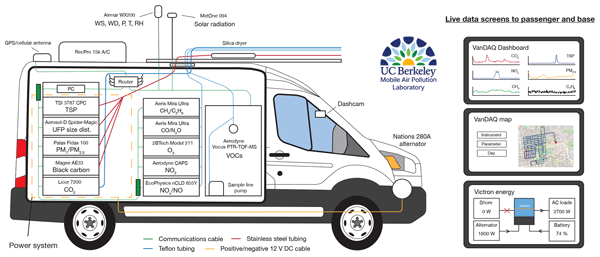
Abstract. Mobile laboratories equipped with research grade instrumentation make it possible to accurately observe fine scale (< 10 m) concentration gradients driven by local emissions, chemistry and meteorology. The flexibility afforded in measurement location makes mobile monitoring well suited to community pollution source characterization and rapid response to natural and anthropogenic situations. However, constructing a platform capable of these measurements requires simultaneous consideration of many engineering challenges and previous examples are rarely documented sufficiently for replication. Here, we present the design process and engineering decisions behind the UC Berkeley Mobile Air Pollution Laboratory (CalMAPLab). Built into a Ford Transit 250 van, the laboratory delivers extensive chemical speciation of air pollution in the gaseous and particulate phases. We characterize the performance of the electrical system, climate control and instrumentation suite for mobile measurements with over 500 hours of test driving. In addition, we introduce a fully open-source data acquisition system with live geospatial visualization that facilitates emissions plume mapping throughout a community. Our presentation of the fully described open design of the facility is intended to provide a transferable blueprint for high performance mobile monitoring in community-scale atmospheric research.
-
Notice on discussion status
The requested preprint has a corresponding peer-reviewed final revised paper. You are encouraged to refer to the final revised version.
-
Preprint
(4299 KB)
-
Supplement
(2477 KB)
-
The requested preprint has a corresponding peer-reviewed final revised paper. You are encouraged to refer to the final revised version.
- Preprint
(4299 KB) - Metadata XML
-
Supplement
(2477 KB) - BibTeX
- EndNote
- Final revised paper


Journal article(s) based on this preprint
Interactive discussion
Status: closed
-
RC1: 'Comment on egusphere-2026-1189', Anonymous Referee #1, 08 May 2026
-
AC1: 'Reply on RC1', Samuel Cliff, 15 Jun 2026
The comment was uploaded in the form of a supplement: https://egusphere.copernicus.org/preprints/2026/egusphere-2026-1189/egusphere-2026-1189-AC1-supplement.pdf
-
AC1: 'Reply on RC1', Samuel Cliff, 15 Jun 2026
-
RC2: 'Comment on egusphere-2026-1189', Glenn Wolfe, 22 May 2026
The editor gave up on finding a referee and reviewed it himself.
-
AC2: 'Reply on RC2', Samuel Cliff, 15 Jun 2026
The comment was uploaded in the form of a supplement: https://egusphere.copernicus.org/preprints/2026/egusphere-2026-1189/egusphere-2026-1189-AC2-supplement.pdf
-
AC2: 'Reply on RC2', Samuel Cliff, 15 Jun 2026
Peer review completion


Interactive discussion
Status: closed
-
RC1: 'Comment on egusphere-2026-1189', Anonymous Referee #1, 08 May 2026
CalMAPLab is a Ford Transit 250 retrofitted as a research-grade mobile air-quality laboratory, built around a strong contemporary instrument payload (Vocus PTR-ToF-MS, dual Aeris Mira Ultras, LI-7200, CAPS, EcoPhysics nCLD, 2BTech O₃, Fidas, AE33, CPC, Spider-MAGIC) and supported by VanDAQ, a custom open-source data acquisition and user interface framework. The vehicle and electrical integration are modern, and with 500+ hours of test driving the platform clearly works as intended. The manuscript has three problems the current draft does not adequately address. The novelty claim does not hold up against an existing literature the authors do not cite. The most distinctive piece of work, VanDAQ, is documented at a depth that does not match its novelty. The hardware description is precise enough to convince a reader the system works but not precise enough to let another group build one.
The novelty claim is not consistent with the prior platform-description literature
The Introduction names Drewnick et al. (2012) and Xia et al. (2020) as the only platform descriptions providing detailed open documentation, and the abstract and conclusions advance the manuscript as a "transferable blueprint" filling a gap. This reading of the field is incomplete. Bush et al. (2015, AMT) describe a compact mobile observatory of nearly identical scope and target species (CO₂, CO, CH₄, NOₓ, O₃, aerosol, meteorology) with a comparable instrument payload, deployed across the western US, and is uncited. Whitehill et al. (2024, AMT) describe Aclima's Ford Transit-based mobile calibration laboratory. They operated in the same San Francisco Bay Area sampling domain in which CalMAPLab is tested, with a published cross-comparison against fixed reference sites, and is also uncited. The Aerodyne Mobile Laboratory (AML) and the broad literature it has generated (Kolb et al., Yacovitch et al., Herndon et al.), and the NOAA CSD mobile van, are not engaged with either. Several of these prior platforms address exactly the topics the present manuscript frames as documentation gaps: synchronised multi-instrument acquisition, GPS-merged data products, and plume-mapping demonstrations. The blueprint framing should be revised to engage with these precedents. The authors should state plainly what is incrementally new, most plausibly the integration of a Vocus PTR-ToF-MS into a community-scale Ford Transit deployment paired with a published open-source DAQ stack, rather than imply a void that is not actually present.
VanDAQ is the most novel contribution and is described at a depth that undersells it
An open-source, instrument-agnostic acquirer/collector/submitter pipeline that writes into a star-schema SQL database, drives a live operator dashboard, transmits one-minute submission files to a central server, and supports a map-based interface for adaptive plume tracing is a contribution worth publication on its own. The treatment in Section 2.7 does not give the reader enough to use it. The configuration-file format that lets a single acquirer code body service many instruments is the central element of the instrument-agnostic claim, and the manuscript does not show an example. The time-synchronisation regime across acquirer processes is not stated (NTP-disciplined? GPS-disciplined? what is the worst-case timestamp skew between two acquirers handling a 1 Hz event?). The behaviour of the POSIX queue between acquirer and collector under back-pressure or process failure is not described, and it is unclear whether submission files persist to disk before acknowledgement (what happens when the system crashes or loses power?). The database write pattern, per-row inserts versus COPY, and how throughput scales across 1 Hz × 500 h × N instruments, is not measured. The repository link is given but the manuscript does not point to a license, a tagged release for the paper, a CITATION.cff and Zenodo DOI, an "adding a new instrument" tutorial, or any test coverage. Until these are in place the open-source framing is a label rather than a deliverable. I would suggest re-anchoring the manuscript on VanDAQ as its central contribution, with the hardware payload providing context.
The hardware sections are detailed enough to be persuasive but not detailed enough to be reproducible
For a paper whose stated goal is a transferable blueprint, several of the engineering decisions that most affect a replicator's outcome are described only in outline.
Fig. 3 lists per-instrument flow rates, but inlet residence time is given only as "2–3 seconds." A 1 Hz platform claiming meter-level resolution warrants a tabulation of residence time as a function of line ID, length, and flow, and the laminar-flow figure (Re = 1200 for the particle inlet) should be accompanied by an entrance-length calculation given the inlet cone geometry.
The Mira Ultras, CAPS, and Vocus are temperature-sensitive, and the sample lines run between an interior climate-controlled volume and a roof-mounted ambient inlet. The transient thermal response of the lines as the van moves between, say, a 35 °C parking lot and a 12 °C coastal fog bank is not addressed.
The GitHub repository is referenced but the manuscript does not point to specific design files: rack-layout CAD, machining files for the inlet plates, a parts BOM with quantities. For a transferable blueprint these need to be either in the supplement or clearly catalogued in the repository, with the manuscript pointing readers to them.
The "community-scale" framing is asked to carry more than the application supports
"Community-scale" appears in the title, abstract, and conclusions, and the West Oakland demonstration is the only engagement with a community context. As presented it is a technical demonstration of the live-mapping interface rather than community-engaged research. The methanethiol-based attribution of a CH₄ plume to a wastewater treatment plant is qualitatively compelling but is not quantified: no emission rate, no plume-decay analysis, no comparison against inventory. It is an existence proof rather than a finding. The framing should be revised to "neighborhood-scale" or "fine-spatial-scale."
The paper currently reaches for three different framings, a novel platform, a community reference benchmark, and a replicable open design, and is stronger on the third than the first two. Committing more clearly to one, and accepting that a platform-description paper does not need to be all three, would tighten the manuscript considerably.
Presentation
The section ordering (goals → instruments → vehicle → power → layout → inlet → DAQ → post-processing → application) reads cleanly, and the prose is generally precise. Section 2.2 substantially restates Table A1 and could be cut to roughly half its current length by deferring instrument specs to the table and confining the prose to the design choices (e.g., Fidas vs alternative PM monitors, Spider-MAGIC vs conventional SMPS).
A short "novelty" framing at the close of Section 1 would set reader expectations. At present the strongest contribution (VanDAQ) is not encountered until Section 2.7.Technical
"kW/hour" on line 414 is not a valid charging-rate unit; Fig. 6d correctly uses kWh for the cumulative quantity. The Re = 1200 figure for the particle inlet should be accompanied by the diameter, viscosity, and velocity used. Hyphenation is inconsistent (real time vs real-time), and "battery-electric" capitalisation drifts between Methods and Conclusions.
The reference list is generally fit for purpose but should be expanded to engage with the prior platforms identified above – a deeper literature review may be necessary (Bush 2015, Whitehill 2024, the AML literature, the NOAA CSD van).
Recommendation
I recommend major revisions. The platform is real, the engineering is solid, and the paper has a place in the AMT literature. To make this a better manuscript, the authors should
(1) reframe the novelty claim against the prior platform-description literature,
(2) substantially deepen Section 2.7 so the open-source claim is operationally meaningful,
(3) close the reproducibility gaps in thermal management, pumping, inlet, and construction-level documentation, and
(4) either dial back the "community-scale" framing or back it with a quantitative scientific demonstration.
A more focused paper anchored on VanDAQ and the open-design framing, with the hardware as supporting context, would in my view be a stronger contribution than the current attempt to claim all three framings at once.Citation: https://doi.org/10.5194/egusphere-2026-1189-RC1 -
AC1: 'Reply on RC1', Samuel Cliff, 15 Jun 2026
The comment was uploaded in the form of a supplement: https://egusphere.copernicus.org/preprints/2026/egusphere-2026-1189/egusphere-2026-1189-AC1-supplement.pdf
-
AC1: 'Reply on RC1', Samuel Cliff, 15 Jun 2026
-
RC2: 'Comment on egusphere-2026-1189', Glenn Wolfe, 22 May 2026
The editor gave up on finding a referee and reviewed it himself.
-
AC2: 'Reply on RC2', Samuel Cliff, 15 Jun 2026
The comment was uploaded in the form of a supplement: https://egusphere.copernicus.org/preprints/2026/egusphere-2026-1189/egusphere-2026-1189-AC2-supplement.pdf
-
AC2: 'Reply on RC2', Samuel Cliff, 15 Jun 2026
Peer review completion
Journal article(s) based on this preprint
Viewed
| HTML | XML | Total | Supplement | BibTeX | EndNote | |
|---|---|---|---|---|---|---|
| 818 | 609 | 72 | 1,499 | 180 | 68 | 118 |
- HTML: 818
- PDF: 609
- XML: 72
- Total: 1,499
- Supplement: 180
- BibTeX: 68
- EndNote: 118
Viewed (geographical distribution)
| Country | # | Views | % |
|---|
| Total: | 0 |
| HTML: | 0 |
| PDF: | 0 |
| XML: | 0 |
- 1
Samuel J. Cliff
Michael R. Giordano
Haley McNamara Byrne
Robert J. Weber
Jude Z. Hebert
Kyle Huang

Joshua S. Apte
The requested preprint has a corresponding peer-reviewed final revised paper. You are encouraged to refer to the final revised version.
- Preprint
(4299 KB) - Metadata XML
-
Supplement
(2477 KB) - BibTeX
- EndNote
- Final revised paper
CalMAPLab is a Ford Transit 250 retrofitted as a research-grade mobile air-quality laboratory, built around a strong contemporary instrument payload (Vocus PTR-ToF-MS, dual Aeris Mira Ultras, LI-7200, CAPS, EcoPhysics nCLD, 2BTech O₃, Fidas, AE33, CPC, Spider-MAGIC) and supported by VanDAQ, a custom open-source data acquisition and user interface framework. The vehicle and electrical integration are modern, and with 500+ hours of test driving the platform clearly works as intended. The manuscript has three problems the current draft does not adequately address. The novelty claim does not hold up against an existing literature the authors do not cite. The most distinctive piece of work, VanDAQ, is documented at a depth that does not match its novelty. The hardware description is precise enough to convince a reader the system works but not precise enough to let another group build one.
The novelty claim is not consistent with the prior platform-description literature
The Introduction names Drewnick et al. (2012) and Xia et al. (2020) as the only platform descriptions providing detailed open documentation, and the abstract and conclusions advance the manuscript as a "transferable blueprint" filling a gap. This reading of the field is incomplete. Bush et al. (2015, AMT) describe a compact mobile observatory of nearly identical scope and target species (CO₂, CO, CH₄, NOₓ, O₃, aerosol, meteorology) with a comparable instrument payload, deployed across the western US, and is uncited. Whitehill et al. (2024, AMT) describe Aclima's Ford Transit-based mobile calibration laboratory. They operated in the same San Francisco Bay Area sampling domain in which CalMAPLab is tested, with a published cross-comparison against fixed reference sites, and is also uncited. The Aerodyne Mobile Laboratory (AML) and the broad literature it has generated (Kolb et al., Yacovitch et al., Herndon et al.), and the NOAA CSD mobile van, are not engaged with either. Several of these prior platforms address exactly the topics the present manuscript frames as documentation gaps: synchronised multi-instrument acquisition, GPS-merged data products, and plume-mapping demonstrations. The blueprint framing should be revised to engage with these precedents. The authors should state plainly what is incrementally new, most plausibly the integration of a Vocus PTR-ToF-MS into a community-scale Ford Transit deployment paired with a published open-source DAQ stack, rather than imply a void that is not actually present.
VanDAQ is the most novel contribution and is described at a depth that undersells it
An open-source, instrument-agnostic acquirer/collector/submitter pipeline that writes into a star-schema SQL database, drives a live operator dashboard, transmits one-minute submission files to a central server, and supports a map-based interface for adaptive plume tracing is a contribution worth publication on its own. The treatment in Section 2.7 does not give the reader enough to use it. The configuration-file format that lets a single acquirer code body service many instruments is the central element of the instrument-agnostic claim, and the manuscript does not show an example. The time-synchronisation regime across acquirer processes is not stated (NTP-disciplined? GPS-disciplined? what is the worst-case timestamp skew between two acquirers handling a 1 Hz event?). The behaviour of the POSIX queue between acquirer and collector under back-pressure or process failure is not described, and it is unclear whether submission files persist to disk before acknowledgement (what happens when the system crashes or loses power?). The database write pattern, per-row inserts versus COPY, and how throughput scales across 1 Hz × 500 h × N instruments, is not measured. The repository link is given but the manuscript does not point to a license, a tagged release for the paper, a CITATION.cff and Zenodo DOI, an "adding a new instrument" tutorial, or any test coverage. Until these are in place the open-source framing is a label rather than a deliverable. I would suggest re-anchoring the manuscript on VanDAQ as its central contribution, with the hardware payload providing context.
The hardware sections are detailed enough to be persuasive but not detailed enough to be reproducible
For a paper whose stated goal is a transferable blueprint, several of the engineering decisions that most affect a replicator's outcome are described only in outline.
Fig. 3 lists per-instrument flow rates, but inlet residence time is given only as "2–3 seconds." A 1 Hz platform claiming meter-level resolution warrants a tabulation of residence time as a function of line ID, length, and flow, and the laminar-flow figure (Re = 1200 for the particle inlet) should be accompanied by an entrance-length calculation given the inlet cone geometry.
The Mira Ultras, CAPS, and Vocus are temperature-sensitive, and the sample lines run between an interior climate-controlled volume and a roof-mounted ambient inlet. The transient thermal response of the lines as the van moves between, say, a 35 °C parking lot and a 12 °C coastal fog bank is not addressed.
The GitHub repository is referenced but the manuscript does not point to specific design files: rack-layout CAD, machining files for the inlet plates, a parts BOM with quantities. For a transferable blueprint these need to be either in the supplement or clearly catalogued in the repository, with the manuscript pointing readers to them.
The "community-scale" framing is asked to carry more than the application supports
"Community-scale" appears in the title, abstract, and conclusions, and the West Oakland demonstration is the only engagement with a community context. As presented it is a technical demonstration of the live-mapping interface rather than community-engaged research. The methanethiol-based attribution of a CH₄ plume to a wastewater treatment plant is qualitatively compelling but is not quantified: no emission rate, no plume-decay analysis, no comparison against inventory. It is an existence proof rather than a finding. The framing should be revised to "neighborhood-scale" or "fine-spatial-scale."
The paper currently reaches for three different framings, a novel platform, a community reference benchmark, and a replicable open design, and is stronger on the third than the first two. Committing more clearly to one, and accepting that a platform-description paper does not need to be all three, would tighten the manuscript considerably.
Presentation
The section ordering (goals → instruments → vehicle → power → layout → inlet → DAQ → post-processing → application) reads cleanly, and the prose is generally precise. Section 2.2 substantially restates Table A1 and could be cut to roughly half its current length by deferring instrument specs to the table and confining the prose to the design choices (e.g., Fidas vs alternative PM monitors, Spider-MAGIC vs conventional SMPS).
A short "novelty" framing at the close of Section 1 would set reader expectations. At present the strongest contribution (VanDAQ) is not encountered until Section 2.7.
Technical
"kW/hour" on line 414 is not a valid charging-rate unit; Fig. 6d correctly uses kWh for the cumulative quantity. The Re = 1200 figure for the particle inlet should be accompanied by the diameter, viscosity, and velocity used. Hyphenation is inconsistent (real time vs real-time), and "battery-electric" capitalisation drifts between Methods and Conclusions.
The reference list is generally fit for purpose but should be expanded to engage with the prior platforms identified above – a deeper literature review may be necessary (Bush 2015, Whitehill 2024, the AML literature, the NOAA CSD van).
Recommendation
I recommend major revisions. The platform is real, the engineering is solid, and the paper has a place in the AMT literature. To make this a better manuscript, the authors should
(1) reframe the novelty claim against the prior platform-description literature,
(2) substantially deepen Section 2.7 so the open-source claim is operationally meaningful,
(3) close the reproducibility gaps in thermal management, pumping, inlet, and construction-level documentation, and
(4) either dial back the "community-scale" framing or back it with a quantitative scientific demonstration.
A more focused paper anchored on VanDAQ and the open-design framing, with the hardware as supporting context, would in my view be a stronger contribution than the current attempt to claim all three framings at once.