
the Creative Commons Attribution 4.0 License.
the Creative Commons Attribution 4.0 License.
 | 06 Mar 2026
Climate variability in Poland (Central Europe) in the 16th century based on multiproxy data
Abstract. The article includes an overview of the current state of knowledge regarding climate in Poland (Central Europe) in the 16th century and its changes. For this purpose, we utilised all previously published reconstructions and five new quantitative reconstructions incorporating dendrochronological data and documentary evidence. New dendrochronological data were used to reconstruct the mean winter or late winter–early spring temperatures, while documentary evidence enabled the reconstruction of mean winter (DJF) and summer (JJA) temperatures. The climate of Poland in the 16th century, as reconstructed from documentary evidence, was colder than it is today (1991–2020), particularly in winter (by 3.6 °C). In summer, it was only 0.7 °C colder than today. Compared to the average for the entire 20th century, however, the summer average in the 16th century was 0.3 °C warmer, whereas the winter average was 2.5 °C colder. In both dendrochronological reconstructions of the temperature of south-eastern Poland, the temperatures in the 16th century were generally lower than those recorded today (1951–2000), particularly in the case of the reconstruction based on the fir chronology (December–March). Anomalies, however, both positive and negative, were usually of less than one standard deviation from the long-term mean. On the other hand, in northern Poland, the February–March temperatures in the 16th century were, on average, comparable to those of the present. Most available temperature reconstructions for Poland reveal cooling over the last few decades of the 16th century, particularly during the winter half-year. The climate in the 16th century was more continental than it is today.
-
Notice on discussion status
The requested preprint has a corresponding peer-reviewed final revised paper. You are encouraged to refer to the final revised version.
-
Preprint
(1363 KB)
-
Supplement
(517 KB)
-
The requested preprint has a corresponding peer-reviewed final revised paper. You are encouraged to refer to the final revised version.
- Preprint
(1363 KB) - Metadata XML
-
Supplement
(517 KB) - BibTeX
- EndNote
- Final revised paper


Journal article(s) based on this preprint
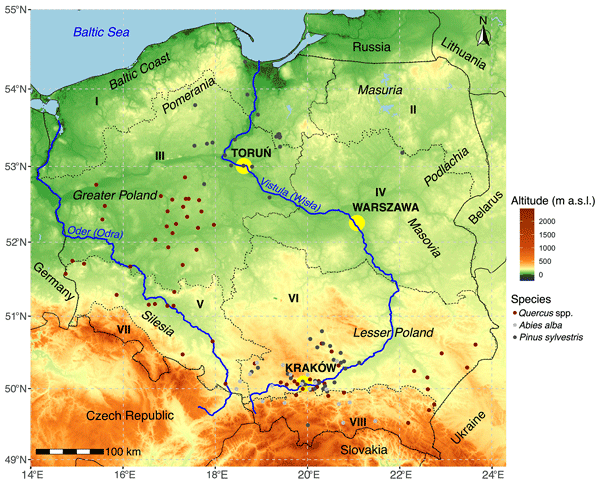
The paper provides an updated analysis of Poland's climate, focusing on the 16th century using a multiproxy approach (documentary evidence and dendrochronological data). Newly gathered historical sources and dendrochronological data helped reconstruct five updated mean air temperature series: decadal winter and summer means from documentary evidence, and annual means for winter and late winter–early spring derived from dendrochronological data.
Interactive discussion
Status: closed
-
RC1: 'Comment on egusphere-2026-1172', Olivier Planchon, 19 Mar 2026
-
AC1: 'Reply on RC1', Aleksandra Pospieszynska, 20 May 2026
The comment was uploaded in the form of a supplement: https://egusphere.copernicus.org/preprints/2026/egusphere-2026-1172/egusphere-2026-1172-AC1-supplement.pdf
-
AC1: 'Reply on RC1', Aleksandra Pospieszynska, 20 May 2026
-
RC2: 'Comment on egusphere-2026-1172', Anonymous Referee #2, 06 Apr 2026
Dear Authors,
The paper ‘Climate variability in Poland (Central Europe) in the 16th century based on multiproxy data’ fits the scope of Climate of the Past.
A few comments are provided to enhance the manuscript:
It would be important to add a few sentences about the effects of proximity to the sea in the North and of continentality in the South, and to cross-reference them with the mentioned air temperature differences.
Lines 62 – 65: Add references.
Lines 100 – 103: Add references.
Line 111: Add references.
Lines 484 – 486: This sentence is unclear, and it would need additional data and references to support arguments. Is this statement valid for Central Europe? How about other regions in Europe with very different climates (e.g. Southern Europe or Western Europe)?
Line 634: Explain and add references/data to support arguments, particularly when comparing Poland to other geographical areas.
Do the documentary sources mention the impacts of climate deterioration? It would be interesting to include a few examples/transcripts to highlight the impacts, such as on farming/crops or freeze-thaw cycles.
Include an image of one of the documentary sources for context and illustration purposes.
Best wishes,
Reviewer
Citation: https://doi.org/10.5194/egusphere-2026-1172-RC2 -
AC2: 'Reply on RC2', Aleksandra Pospieszynska, 20 May 2026
The comment was uploaded in the form of a supplement: https://egusphere.copernicus.org/preprints/2026/egusphere-2026-1172/egusphere-2026-1172-AC2-supplement.pdf
-
AC3: 'Reply on RC2', Aleksandra Pospieszynska, 20 May 2026
The comment was uploaded in the form of a supplement: https://egusphere.copernicus.org/preprints/2026/egusphere-2026-1172/egusphere-2026-1172-AC3-supplement.pdf
-
AC2: 'Reply on RC2', Aleksandra Pospieszynska, 20 May 2026
Peer review completion


Interactive discussion
Status: closed
-
RC1: 'Comment on egusphere-2026-1172', Olivier Planchon, 19 Mar 2026
This paper is placed in the context of numerous other publications dealing with the study of climatic conditions during the Little Ice Age in Western and Central Europe, by means of the combined analysis of dendrochronological data and documentary sources. The major interest of the results obtained is to confirm, on the territory of present-day Poland, the complexity of the climatic history at that time. The authors clearly show the existence of multi-year oscillations, both thermal and pluviometric, and sometimes contradict, in a very relevant way, the notion of the Little Ice Age as it is usually understood. Interannual climate variability is therefore highlighted, modulated according to the seasons. Seasonality seems to me, in this article, to be one of the most interesting points, because the authors highlight a continental character of the climate more accentuated than nowadays. Continentality is more rarely studied than the mere temporal evolution of temperature, which makes this point particularly interesting to study and develop, perhaps for a possible follow-up to this article? Many ''continentality indices'' have been developed for more than a century to quantify continentality using various parameters. Perhaps it would be relevant to use some of them for studies of palaeoclimatic reconstructions?
Two other questions for the authors:
- Among the documentary sources used, did the authors have in hand information concerning possible links between weather / climate conditions and agricultural activities, for example harvest dates and/or indications of yields and damage to certain crops?
- At that time, did the administration of the Hanseatic city of Danzig carry out systematic observations of the winter freeze-up of its port and gulf, like its ''colleagues'' in Riga?
-
AC1: 'Reply on RC1', Aleksandra Pospieszynska, 20 May 2026
The comment was uploaded in the form of a supplement: https://egusphere.copernicus.org/preprints/2026/egusphere-2026-1172/egusphere-2026-1172-AC1-supplement.pdf
-
AC1: 'Reply on RC1', Aleksandra Pospieszynska, 20 May 2026
-
RC2: 'Comment on egusphere-2026-1172', Anonymous Referee #2, 06 Apr 2026
Dear Authors,
The paper ‘Climate variability in Poland (Central Europe) in the 16th century based on multiproxy data’ fits the scope of Climate of the Past.
A few comments are provided to enhance the manuscript:
It would be important to add a few sentences about the effects of proximity to the sea in the North and of continentality in the South, and to cross-reference them with the mentioned air temperature differences.
Lines 62 – 65: Add references.
Lines 100 – 103: Add references.
Line 111: Add references.
Lines 484 – 486: This sentence is unclear, and it would need additional data and references to support arguments. Is this statement valid for Central Europe? How about other regions in Europe with very different climates (e.g. Southern Europe or Western Europe)?
Line 634: Explain and add references/data to support arguments, particularly when comparing Poland to other geographical areas.
Do the documentary sources mention the impacts of climate deterioration? It would be interesting to include a few examples/transcripts to highlight the impacts, such as on farming/crops or freeze-thaw cycles.
Include an image of one of the documentary sources for context and illustration purposes.
Best wishes,
Reviewer
Citation: https://doi.org/10.5194/egusphere-2026-1172-RC2 -
AC2: 'Reply on RC2', Aleksandra Pospieszynska, 20 May 2026
The comment was uploaded in the form of a supplement: https://egusphere.copernicus.org/preprints/2026/egusphere-2026-1172/egusphere-2026-1172-AC2-supplement.pdf
-
AC3: 'Reply on RC2', Aleksandra Pospieszynska, 20 May 2026
The comment was uploaded in the form of a supplement: https://egusphere.copernicus.org/preprints/2026/egusphere-2026-1172/egusphere-2026-1172-AC3-supplement.pdf
-
AC2: 'Reply on RC2', Aleksandra Pospieszynska, 20 May 2026
Peer review completion
Journal article(s) based on this preprint
The paper provides an updated analysis of Poland's climate, focusing on the 16th century using a multiproxy approach (documentary evidence and dendrochronological data). Newly gathered historical sources and dendrochronological data helped reconstruct five updated mean air temperature series: decadal winter and summer means from documentary evidence, and annual means for winter and late winter–early spring derived from dendrochronological data.
Viewed
| HTML | XML | Total | Supplement | BibTeX | EndNote | |
|---|---|---|---|---|---|---|
| 788 | 327 | 116 | 1,231 | 170 | 79 | 71 |
- HTML: 788
- PDF: 327
- XML: 116
- Total: 1,231
- Supplement: 170
- BibTeX: 79
- EndNote: 71
Viewed (geographical distribution)
| Country | # | Views | % |
|---|
| Total: | 0 |
| HTML: | 0 |
| PDF: | 0 |
| XML: | 0 |
- 1
Piotr Oliński
Marcin Koprowski
Waldemar Chorążyczewski
Elżbieta Szychowska-Krąpiec
Marek Krąpiec
The requested preprint has a corresponding peer-reviewed final revised paper. You are encouraged to refer to the final revised version.
- Preprint
(1363 KB) - Metadata XML
-
Supplement
(517 KB) - BibTeX
- EndNote
- Final revised paper
The paper provides an updated analysis of Poland's climate, focusing on the 16th century using a multiproxy approach (documentary evidence and dendrochronological data). Newly gathered historical sources and dendrochronological data helped reconstruct five updated mean air temperature series: decadal winter and summer means from documentary evidence, and annual means for winter and late winter–early spring derived from dendrochronological data.
The paper provides an updated analysis of Poland's climate, focusing on the 16th century using a...
This paper is placed in the context of numerous other publications dealing with the study of climatic conditions during the Little Ice Age in Western and Central Europe, by means of the combined analysis of dendrochronological data and documentary sources. The major interest of the results obtained is to confirm, on the territory of present-day Poland, the complexity of the climatic history at that time. The authors clearly show the existence of multi-year oscillations, both thermal and pluviometric, and sometimes contradict, in a very relevant way, the notion of the Little Ice Age as it is usually understood. Interannual climate variability is therefore highlighted, modulated according to the seasons. Seasonality seems to me, in this article, to be one of the most interesting points, because the authors highlight a continental character of the climate more accentuated than nowadays. Continentality is more rarely studied than the mere temporal evolution of temperature, which makes this point particularly interesting to study and develop, perhaps for a possible follow-up to this article? Many ''continentality indices'' have been developed for more than a century to quantify continentality using various parameters. Perhaps it would be relevant to use some of them for studies of palaeoclimatic reconstructions?
Two other questions for the authors:
- Among the documentary sources used, did the authors have in hand information concerning possible links between weather / climate conditions and agricultural activities, for example harvest dates and/or indications of yields and damage to certain crops?
- At that time, did the administration of the Hanseatic city of Danzig carry out systematic observations of the winter freeze-up of its port and gulf, like its ''colleagues'' in Riga?