
the Creative Commons Attribution 4.0 License.
the Creative Commons Attribution 4.0 License.
 | 17 Feb 2026
Predicting Organic–Inorganic Aerosol Efflorescence Using Thermodynamically Modeled Viscosity
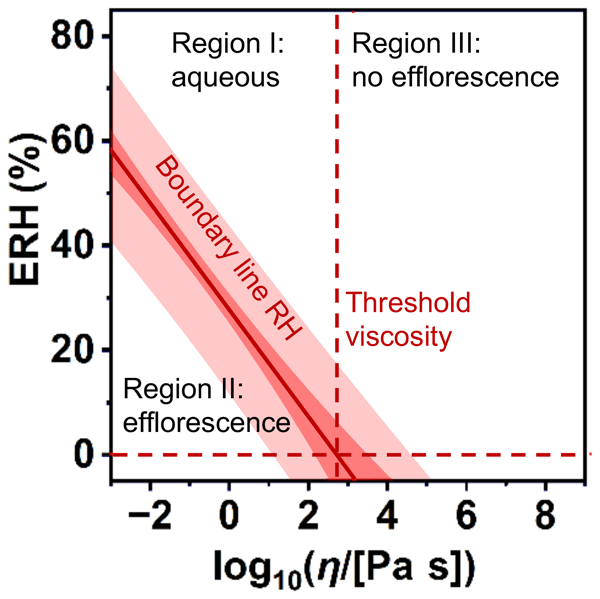
Abstract. Atmospheric aerosols, especially internally mixed organic-inorganic aerosols, exhibit complex phase behaviors that affect their size evolution, optical properties, and chemical reactivity, ultimately impacting climate and human health. Although parameterizations for secondary organic aerosol phase state exist, predictive models based on primary predictors for efflorescence in organic-inorganic aerosols remain underdeveloped. In this study, we evaluated several chemical parameters, including equivalent O:C ratio, organic mass fractions, glass transition temperature (Tg), and viscosity (η), and identified aerosol viscosity as the primary predictor of efflorescence relative humidity (ERH) in internally mixed organic-inorganic aerosols. We developed a linear viscosity-ERH model based on ERH and log10(η), which defines the boundary conditions for aerosol efflorescence when η< 4.76 × 10² Pa·s. Additionally, we showed that efflorescence is inhibited when η> 4.76 × 10² Pa·s. Validation using an independent dataset showed strong agreement between predicted and experimentally measured ERH (R² = 0.95). A multivariate regression model incorporating η and Tg improved prediction accuracy but was limited by Tg parameterization for complex organic-inorganic mixtures. Our findings highlight the role of aerosol viscosity in controlling efflorescence and emphasize the need to develop improved aerosol viscosity measurement techniques to better constrain aerosol phase transitions in atmospheric models.
-
Notice on discussion status
The requested preprint has a corresponding peer-reviewed final revised paper. You are encouraged to refer to the final revised version.
-
Preprint
(1011 KB)
-
Supplement
(676 KB)
-
The requested preprint has a corresponding peer-reviewed final revised paper. You are encouraged to refer to the final revised version.
- Preprint
(1011 KB) - Metadata XML
-
Supplement
(676 KB) - BibTeX
- EndNote
- Final revised paper


Journal article(s) based on this preprint
Interactive discussion
Status: closed
-
RC1: 'Comment on egusphere-2026-117', Anonymous Referee #1, 23 Feb 2026
-
AC2: 'Reply on RC1', Qishen Huang, 30 Mar 2026
We express our sincere gratitude to the reviewer for the insightful comments and positive assessment of our manuscript. The reviewers’ suggestions are constructive in enhancing the clarity of our work. We have carefully addressed all comments and will incorporate the corresponding revisions into the updated manuscript. Our detailed, point-by-point responses to the reviewers' evaluations are provided in the supplement file.
-
AC2: 'Reply on RC1', Qishen Huang, 30 Mar 2026
-
CC1: 'Incorrect Tg values in Table S4', Thomas Koop, 26 Feb 2026
The comment was uploaded in the form of a supplement: https://egusphere.copernicus.org/preprints/2026/egusphere-2026-117/egusphere-2026-117-CC1-supplement.pdf
-
AC1: 'Reply on CC1', Qishen Huang, 06 Mar 2026
Dear Dr. Armeli, Dr. Peters, and Dr. Koop,
We sincerely appreciate your detailed comments, which helped us identify errors and improve our manuscript. We have carefully gone through your comments and made the corresponding corrections and revisions, which are included in this document along with our explanations and responses. All revisions mentioned in this response will appear in future versions of both the main text and the SI. We hope that our manuscript has now become stronger, and we would greatly appreciate any further suggestions for improvement. Please find our detailed responses and revisions in the attached supplement file.
-
AC1: 'Reply on CC1', Qishen Huang, 06 Mar 2026
-
RC2: 'Comment on egusphere-2026-117', Anonymous Referee #2, 09 Mar 2026
This manuscript seeks to examine the physicochemical factors that affect the efflorescence relative humidity in mixed organic/inorganic aerosols, finding viscosity to be the most closely correlated. This paper is well written, presented clearly, and is an important topic well within the scope of ACP. However, I have in particular one major concern with the methodology that in my mind necessitates further analysis, as described below:
Major comment:
1. Line 107: The viscosity that is being correlated with the ERH is the viscosity at that ERH. Viscosity is a very strong function of RH, therefore, it is not surprising that there is a strong correlation between viscosity at the ERH and ERH. It may still be true that there is a deeper connection between viscosity and ERH, but that has not been proven without further analyses. Some analyses that could help answer this question and that I suggest include:
A. For a "representative" aerosol particle chemical system, how much does the viscosity change from say 60% RH to say 20% RH? If the change in viscosity for a fixed chemistry is comparable to the slope in Figure 2, that would suggest that most of the previously observed correlation is simply because viscosity is changing as a function of RH, rather than a deeper connection between viscosity and ERH. If the change in viscosity for a fixed chemistry is less than the slope in Figure 2, then that would suggest that viscosity being a function RH is part, but not all of the story, and that should be quantitatively discussed.
B. At a fixed RH, calculate the viscosity for each chemical system. If the correlation between viscosity and ERH is greatly reduced, this would also suggest that most of the previously observed correlation was due to the general correlation between viscosity and RH. If the correlation largely remains, that would suggest that there is a deep connection between viscosity and ERH, which would be very exciting! If the result is somewhere in the middle, as seems perhaps most likely, then again there should be some quantitative discussion of how much of the correlation is attributable to each factor.
Other comments:
2. For Figure 3b, the fit is indeed close to the x=y line, but it seems like that may be partially driven by the cluster of (0,0) points. What does the fit in Figure 3b look like without those points? It seems like some of the lower viscosity points are slightly underpredicted, which is not a major concern but I think warrants at least a comment.
3. If the major finding holds that viscosity controls ERH, and that high viscosity particles do not effloresce, could that mean that experimentalists are just waiting long enough to observe the efflorescence? It is worth commenting on what the typical timescale of these laboratory experimental observations are, what the typical time scales in the atmosphere are, and how long based on some simple physical principles efflorescence might be delayed for some of these higher viscosity compounds.
Citation: https://doi.org/10.5194/egusphere-2026-117-RC2 -
AC3: 'Reply on RC2', Qishen Huang, 30 Mar 2026
We sincerely thank the reviewer for their careful review of our manuscript and for the overall positive feedback. We highly appreciate the reviewer for highlighting the major concern regarding our methodology and the need for further analysis. We agree that viscosity is a strong function of relative humidity (RH), and the tests proposed by the reviewer have helped us clarify the underlying nature of the observed correlation. In response to this major concern, we have performed additional quantitative analyses as suggested by the reviewer. Furthermore, we have addressed all other comments, which included re-performing the fitting analysis after excluding the (0,0) data points and systematically comparing our laboratory timescales with atmospheric timescales to properly evaluate the kinetic limitations of efflorescence. Our detailed, point-by-point responses to the reviewer's comments, along with the corresponding revisions made to the manuscript, are in the supplement file.
-
AC3: 'Reply on RC2', Qishen Huang, 30 Mar 2026
-
RC3: 'Comment on egusphere-2026-117', Anonymous Referee #3, 09 Mar 2026
This manuscript studies the relationships controlling ERH in aerosol systems with different chemical compositions. I have following comments.
1. Page 6 line 155: Why kGT is assumed to be 2.5 for all organic water mixtures. There are references provided, however a sentence or two justifying this assumption is good.
2. What is the pH of these aerosol systems? pH impacts on aerosol properties greatly, and thus authors may want to comment on that.
3. Page 3, 10: some typos found. Please do an additional round of copy-editing.
4. Page 4, lines 100-105: Is it possible to add these equations as well to the equation lists for easy following?
5. Please expand the caption 3 to identify all abbreviations in the figure.
6. Is the change in viscosity due to differences in RH (e.g., 20% vs 75%) different between chemical systems studied? If so, do they follow any relationship with the structure/ functional groups present?
Citation: https://doi.org/10.5194/egusphere-2026-117-RC3 -
AC4: 'Reply on RC3', Qishen Huang, 30 Mar 2026
We sincerely thank the reviewer for their careful review of our manuscript and for the overall positive feedback. We have addressed all comments from the reviewer with point-by-point responses with corresponding revisions made to the manuscript. Our detailed response and revisions are provided below.
-
AC4: 'Reply on RC3', Qishen Huang, 30 Mar 2026
-
RC4: 'Comment on egusphere-2026-117', Anonymous Referee #4, 11 Mar 2026
This article by Shanshan Chen et al. provides an evaluation of physicochemical properties and their correlations with the efflorescence relative humidity (ERH) of aerosol particles containing organics and dissolved inorganic salts. The salts considered in the database are ammonium sulfate (AS), sodium chloride, potassium chloride and sodium nitrate. The training database is dominated by AS-containing aerosols. The physicochemical property with the highest correlation to ERH was found to be aerosol viscosity. The authors introduce a linear log(viscosity)–ERH model to aid in predicting the ERH for particles with the viscosity below a specified threshold of about 480 Pa s. Above that threshold, the ERH is assumed/predicted to be zero, i.e. indicating complete inhibition of efflorescence. The authors propose that aerosol viscosity is controlling ERH and that their simple model may be useful to predict ERH in applications.
The article is concise and investigates an interesting topic. I have general and several specific comments that should be addressed to provide a clearer description of the efflorescence/deliquescence definitions and a more balanced interpretation of the findings in light of prior work that suggest additional factors are at play in determining ERH, such as temperature, particle size, experimental approach, and degree of salt supersaturation, which can be affected by soluble organics.
General comments:
- Introduction (lines 43, 64): Please define or explain the meaning of efflorescence and deliquescence more carefully. Note that often not the whole particle undergoes deliquescence; rather, it is usually a solid (crystalline) salt or hydrate that does, while the remaining particle may be in an amorphous liquid or semi-solid state. Related to the above and the statement on line 64: “Efflorescence is a kinetically-controlled process that requires overcoming a nucleation energy barrier, …”, it should be further clarified under what conditions efflorescence can occur, as well as efflorescence due to what material crystallizing. In mixed organic-inorganic aerosols, it is typically not the case that the whole particle crystallizes, only a specific portion of inorganic and sometimes organic materials may crystallize. Furthermore, efflorescence is not entirely kinetically controlled. If the (aqueous) solution is not supersaturated thermodynamically with respect to the solid crystalline phase that may form, efflorescence is thermodynamically prohibited. The fact that some degree of supersaturation is needed to crystallize inorganic materials like ammonium sulfate or sodium chloride, is well known. For example, see the works by Marcolli and Krieger (2006, https://pubs.acs.org/doi/10.1021/jp0556759), Hodas et al. (2016, www.atmos-chem-phys.net/16/12767/2016/), Bouzidi et al. (2020, https://doi.org/10.1016/j.scitotenv.2022.153010).
- The study by Hodas et al. (2016) describes a thermodynamics-based method to model the conditions of salt crystallization and the associated ERH. Did the authors consider such thermodynamics-based methods? There is likely a close correlation between relative humidity (RH) and viscosity, as well as RH and degree of salt supersaturation relative to the ion activity product at saturation. Such effects and alternatives to predicting ERH should at least be discussed.
- Citations/References: several papers seem to be cited more than once and given different reference entries although they are referring to the exact same paper. For example, there is only one Li et al. (2020) paper but these and others are referenced with a,b postfixes. This needs to be fixed throughout the manuscript.
- If high viscosity suppresses efflorescence or strongly affects ERH, this may mean that measured ERH values can be affected by the protocol followed during experiments, such as the rate of dehumidification and time scale of the experiment overall. Efflorescence may still occur at nonzero relative humidity, but the experimenters may not have waited long enough. Please add some discussion of this aspect, e.g. how experimental time scales compare to average aerosol lifetime in the troposphere.
- For all figures and related tables: the temperature (ranges) of the data shown should be indicated. Both ERH and viscosity depend on temperature. It is therefore also not clear whether the derived regression model applies only to room temperature (assuming most data are for about 293–298 K) or more broadly.
Specific comments:
- Line 46–48: To add to the statements there, for clarity and completeness, aerosol particles consisting of more than a single phase may have crystalline as well as amorphous phases.
- Lines 94–96: There seem to be additional relevant datasets that the authors have not considered, e.g. Marcolli and Krieger (2006, https://pubs.acs.org/doi/10.1021/jp0556759) and Ciobanu et al. (2010, https://pubs.acs.org/doi/10.1021/jp103541w).
Ciobanu et al. (2010), in their Fig. 1 and Table 1, suggest that the ranges of the ERH of AS in particles may depend on particle diameter (for a range of similar temperatures). Their paper further discusses possible influence of phase separation on the ERH of AS, which would mean AS efflorescence may be affected by the presence of an organic coating in core-shell aerosols. In such cases, an inner aqueous AS-rich phase may show lower ERH independent of viscosity effects since the viscosity of the inner aqueous AS-rich phase would be similar to that of organic-free aqueous AS particles, which were shown to effloresce at a higher relative humidity in that study. Such findings are therefore questioning the reliability of predicting ERH solely based on viscosity and should be discussed in the context of the current studies findings. - Line 102: related to the general comments: “aerosol ERH” should likely be rephrased to refer to the ERH of a specific electrolyte/salt that can solidify in the aerosol. The remaining organic-rich aerosol phase may contain water and a small amount of dissolved ions from the salt components, hence it is misleading to talk of an overall “aerosol ERH”. In a multicomponent organic-inorganic particle, several distinct ERH may exist due to different salts crystallizing at different RH thresholds.
- Line 103: water (an inorganic) is not included here as part of n_inorg in the definition of x_org, right?
- Lines 110–115: This description of AIOMFAC-VISC seems to be incomplete. Looking both at the description of “Mixture viscosity prediction with AIOMFAC-VISC” on the https://aiomfac.lab.mcgill.ca/help.html page, as well as Lilek and Zuend (2022), the absolute rate theory approach is seemingly only used for the viscosity of aqueous inorganic phases, but not for aqueous organics; see Song et al. (2021, https://doi.org/10.5194/acp-21-10215-2021) and Lilek and Zuend (2022). Also, the Gervasi et al. reference on line 114 is not properly cited in the manuscript.
- Line 117: the Fredenslund et al., 1975; Hansen et al., 1991; references are about the UNIFAC concept mentioned in the previous sentences, not about mixing approaches.
- Line 121: since this is about sucrose-nitrate systems, the reference to be cited should likely be Song et al. (2021, https://doi.org/10.5194/acp-21-10215-2021) not Lilek and Zuend (2022)?
- Line 123: Is OIR including or excluding water? Also, clarify whether it is mass- or mole-based.
- Line 127: What is 1 CH OH? Clarify this notation. Presumably also notation like CH2 is really CH_2 with subscripts?
- Line 136: “volatility melting point” wording issue
- Line 156: A note perhaps worthy of mentioning in the manuscript: in addition to the outlined process for T_g(omega_org), one could also determine T_g of the mixture as a whole, including the effects from inorganic ions on T_g, by applying the viscosity predicted by AIOMFAC-VISC together with an assumption of the fragility parameter to the Vogel–Tammann–Fulcher equation (e.g. see Eqs. 6,7 of DeRieux et al. (2018, https://doi.org/10.5194/acp-18-6331-2018). However, the pure-component viscosity model for organics employed in AIOMFAC-web is probably less skillful than other methods, such as that by Armeli et al. (2023). However, for the purpose of the regression model, the usefulness of the T_g of the mixture predicted from mixture viscosity overall may be negligible since it would likely be redundant with just predicting mixture viscosity as already done.
- Figure 1: It would be of interest to show supplementary figure(s) where these scatter plots are shown separately for some of the different inorganic salts, e.g. for AS only, since the ERH of the binary aqueous salt solutions already differ and those may not be a function of viscosity. In that context, is there are clearer correlation obtained for specific salts or not?
- Line 180, Eq. (4): clarify the units of ERH the result from the right-hand-side of this expression. Presumably the expression yields percentage values, i.e. mathematically that is ERH*100 % on the left-hand-side and should be made clear. Also, the units of eta in the log_10 should be clarified (and for mathematical consistency normalized by the unit of eta as in the caption of Fig. 1).
- Line 186: define what ERH_ing is. The definition given in the caption of Figure S1 is unclear since there is no such thing as "the ERH of the inorganic salt". Do you mean that ERH_Ing refers to the ERH of the involved salt when considering the corresponding binary aqueous salt system at the same temperature?
- Line 191: several typos in the sentence
- Figure 3: x-axis are mislabeled between (a) and (b). For (a) should the y-axis be “Predicted ERH”? Also, the values at 0% ERH, i.e. the predicted and measured absence of ERH, should probably not be included in the correlation coefficient calculation (or provide both options). If there are a lot of points there, they mask the true predictive skill for ERH > 0.
- Line 246: If viscosity is not kinetically controlled, but efflorescence in supersaturated solutions is, then what is predicted through a relationship with viscosity leads to a deterministic outcome. Other methods for deterministic ERH prediction, such as that by Hodas et al. (2016) should then be discussed/considered too.
- Line 256: use consistent notation; seemingly log here is log_10 since in Eq. (8) ln is used as well.
- Lines 264-268: Consider also the following: in highly viscous aerosol, the measured RH outside of a particle/sample may differ substantially from the water activity inside the droplet phase where crystallization may occur. Hence, the fact that ERH is low or efflorescence absent in experimental setups may be due to the fact that the local water content and related water activity during drying gets "locked in" and the degree of supersaturation remains lower. Hence, the question of experimental protocol followed may matter here as well. Maybe also provide an estimate of the particle equilibration timescale for the upper limit of 4.76E2 Pa s established when considering the typical particle sizes used in the experimental studies on ERH (perhaps based on the framework from Koop et al., 2011).
- Line 280: correct the phrasing; the consequence is in opposite order, lower water content leads to lower water activity in the particle phase.
- Line 299: this statement is a big leap from the content of the rest of the paper. To my knowledge, whether including viscosity parameterizations in global climate models "will be essential" or negligible remains unclear.
- Tables S1, S2: please list the units of ERH and the temperature or the range of temperatures considered for the data listed.
Citation: https://doi.org/10.5194/egusphere-2026-117-RC4 -
AC5: 'Reply on RC4', Qishen Huang, 25 Apr 2026
We sincerely thank the reviewer for their careful review of our manuscript and for the overall positive feedback. We have addressed all comments from the reviewer with point-by-point responses with corresponding revisions made to the manuscript. Our detailed response and revisions are provided in the attachment.
-
RC5: 'Comment on egusphere-2026-117', Anonymous Referee #5, 15 Mar 2026
The comment was uploaded in the form of a supplement: https://egusphere.copernicus.org/preprints/2026/egusphere-2026-117/egusphere-2026-117-RC5-supplement.pdf
-
AC6: 'Reply on RC5', Qishen Huang, 25 Apr 2026
We would like to sincerely thank the editor and the reviewers for their thorough assessment of our manuscript and for their valuable comments and suggestions. We have carefully revised the manuscript in response to all comments, and we believe that these revisions have significantly improved the manuscript. In the attached file, we provide a detailed point-by-point response, with all changes incorporated into the revised version.
-
AC6: 'Reply on RC5', Qishen Huang, 25 Apr 2026
-
RC6: 'Comment on egusphere-2026-117', Anonymous Referee #6, 26 Mar 2026
General Comment
Chen et al. studied the association between aerosol efflorescence relative humidity (ERH) and viscosity by analyzing literature data collected from measurements. They developed a linear viscosity-ERH model that predicts the ERH of mixed organic-inorganic aerosol particles based on particle viscosity. The relationship between aerosol ERH and viscosity can be explained by the well-established nucleation-rate model of Turnbull (1969). The mechanistic findings are new and important to the atmospheric science community. Before the manuscript can be accepted for publication in the end, the following comments need to be addressed. Also, the quality of the work can benefit from the improvement of language and consistency in formatting.
Major Comments
- Temperature: While particle viscosity is dependent on temperature, the study association between viscosity and ERH is only valid for the temperature at which measurements were made. It is very important to clarify the working temperature throughout the main text, captions and SI.
- Section 2.1: How were data points chosen to make the training set? Were they randomly selected?
- Section 3.2: Have you tried another form of regression model? What is the rationale for picking the linear regression model as the choice?
- Conclusions and Implications: When discussing the implications for the ambient aerosols, could you please discuss in the border context including places other than China?
Minor Comments
- Lines 64 – 67: The current description is too vague. Could you elaborate more how different factors listed here influence the efflorescence?
- Lines 74 – 76: The sentence “Under such conditions, aerosols may shift from … glass transition temperature (Tg)” is unclear. Could you please rephrase it? I do not see how the efflorescence behavior shirt to amorphous phase transitions.
- Could you please specify the temperature for the data points collected? Were they measured in the same range? I assume temperature can affect efflorescence. Also, temperature is one of the inputs in AIOMFAC.
- Eq 2: The calculation of C0 is based on the parameterization of Li et al., 2016. Please note that this is not one parameterization for C0. To ensure the robustness of the claims in the manuscript, I would suggest including other C0 parameterizations to evaluate how the result of Tg and so the association between ERH and Tg will change.
- Line 186: Please include the description of the normalized aerosol ERH in the main text.
- Line 200: What does a Sig.F change mean?
- Fig 3: It looks like the x-axis labels have been swapped between the two subplots.
- Lines 247-248: Could you elaborate on “viscosity plays a central role in governing nucleation rates”? The current sentence is unclear.
- Lines 254-256: Could you provide references to the sentence “The term exp… to viscosity.”
Technical Comments
- Please ensure the consistency of formatting throughout the manuscript, for example:
- lines 38 -39: space should be added before “(Oswin et al., 2022)” and “(Reid et al., 2018)”
- line 42. (Novo et al., 2021) should be placed before the full dot.
- Lines 62-63: Please add references for “While laboratory studies have… remains limited”
- Line 71: It is supposed to be “ωorg” instead of “ωorg”.
- Line 72: It is better to use “highly viscous” rather than “high-viscosity”.
- Line 76: What direct and reliable measurement? Composition? Hygroscopicity?
- Line 103: It should be clear that 𝑥org is the organic molar fraction in the solute. Also, in line 124, should it be 𝑥org?
- Tables S1 and S2: The abbreviation of OIR is missing. Was the OIR calculated in mass or in moles? Could you provide the organic molar fraction in the tables?
- Line 127: aw was only used two times for water activity. This abbreviation of water activity is redundant.
Citation: https://doi.org/10.5194/egusphere-2026-117-RC6 -
AC7: 'Reply on RC6', Qishen Huang, 25 Apr 2026
We sincerely thank the reviewer for their careful evaluation of our manuscript and for the constructive and insightful comments. We have carefully considered all of the comments and suggestions, and have revised the manuscript accordingly. These revisions have helped us improve the clarity, rigor, and overall quality of the manuscript. In the attached file, we provide a detailed point-by-point response to each comment, and all corresponding changes have been incorporated into the revised manuscript.
Peer review completion


Interactive discussion
Status: closed
-
RC1: 'Comment on egusphere-2026-117', Anonymous Referee #1, 23 Feb 2026
This manuscript examines the key factors controlling the efflorescence relative humidity of internally mixed organic–inorganic aerosols. The authors identify aerosol viscosity as the primary predictor of efflorescence and develop a practical parameterization, including a viscosity threshold above which efflorescence is suppressed. The conclusions are well supported by the dataset and consistent with nucleation kinetics. Overall, the study addresses an interesting and important topic within the scope of Atmospheric Chemistry and Physics and is clearly written and well structured. I recommend publication after the authors address the comments below.
Specific Comments:
- Page 4, Line 95: The authors note compiling a total of 102 ERH data points, splitting them into 66 for the training set and 36 for the validation set. It would be helpful to briefly clarify the selection criteria used for this split.
- Page 6, line 156: When calculating the glass transition temperature using the Gordon-Taylor equation, why kGT is assumed to be 2.5 for all organic-water mixtures?
- Page 11 line 265: The determination of the viscosity threshold is an excellent finding. It might be beneficial to add one or two sentences contextualizing this value physically—specifically, how this threshold relates to the transition from a liquid to a semi-solid phase in the context of typical atmospheric timescales.
- Would other parameters that are not included in the study potentially affect aerosol efflorescence? For example aerosol pH?
- Page 3, line 78: Change “observaltional data” to “observational data”.
- Page 10, line 256: There is an extra “q” between “between” and the following word.
- Page 6, line 156:Change “assumted” to “assumed”.
- Page 7, line 180&183: Change “tranning” to “ training ” and “componets” to “components”.
- Page 7, line 184&186: Change "altough" to "although" and "nomalized" to "normalized"
- Page 8, Line 204: In Eq. (6), it should be “ERH”.
- Figure 3: Some abbreviations in the figure legend (e.g., CA, SUS) are not explained in the caption.
Citation: https://doi.org/10.5194/egusphere-2026-117-RC1 -
AC2: 'Reply on RC1', Qishen Huang, 30 Mar 2026
We express our sincere gratitude to the reviewer for the insightful comments and positive assessment of our manuscript. The reviewers’ suggestions are constructive in enhancing the clarity of our work. We have carefully addressed all comments and will incorporate the corresponding revisions into the updated manuscript. Our detailed, point-by-point responses to the reviewers' evaluations are provided in the supplement file.
-
CC1: 'Incorrect Tg values in Table S4', Thomas Koop, 26 Feb 2026
The comment was uploaded in the form of a supplement: https://egusphere.copernicus.org/preprints/2026/egusphere-2026-117/egusphere-2026-117-CC1-supplement.pdf
-
AC1: 'Reply on CC1', Qishen Huang, 06 Mar 2026
Dear Dr. Armeli, Dr. Peters, and Dr. Koop,
We sincerely appreciate your detailed comments, which helped us identify errors and improve our manuscript. We have carefully gone through your comments and made the corresponding corrections and revisions, which are included in this document along with our explanations and responses. All revisions mentioned in this response will appear in future versions of both the main text and the SI. We hope that our manuscript has now become stronger, and we would greatly appreciate any further suggestions for improvement. Please find our detailed responses and revisions in the attached supplement file.
-
AC1: 'Reply on CC1', Qishen Huang, 06 Mar 2026
-
RC2: 'Comment on egusphere-2026-117', Anonymous Referee #2, 09 Mar 2026
This manuscript seeks to examine the physicochemical factors that affect the efflorescence relative humidity in mixed organic/inorganic aerosols, finding viscosity to be the most closely correlated. This paper is well written, presented clearly, and is an important topic well within the scope of ACP. However, I have in particular one major concern with the methodology that in my mind necessitates further analysis, as described below:
Major comment:
1. Line 107: The viscosity that is being correlated with the ERH is the viscosity at that ERH. Viscosity is a very strong function of RH, therefore, it is not surprising that there is a strong correlation between viscosity at the ERH and ERH. It may still be true that there is a deeper connection between viscosity and ERH, but that has not been proven without further analyses. Some analyses that could help answer this question and that I suggest include:
A. For a "representative" aerosol particle chemical system, how much does the viscosity change from say 60% RH to say 20% RH? If the change in viscosity for a fixed chemistry is comparable to the slope in Figure 2, that would suggest that most of the previously observed correlation is simply because viscosity is changing as a function of RH, rather than a deeper connection between viscosity and ERH. If the change in viscosity for a fixed chemistry is less than the slope in Figure 2, then that would suggest that viscosity being a function RH is part, but not all of the story, and that should be quantitatively discussed.
B. At a fixed RH, calculate the viscosity for each chemical system. If the correlation between viscosity and ERH is greatly reduced, this would also suggest that most of the previously observed correlation was due to the general correlation between viscosity and RH. If the correlation largely remains, that would suggest that there is a deep connection between viscosity and ERH, which would be very exciting! If the result is somewhere in the middle, as seems perhaps most likely, then again there should be some quantitative discussion of how much of the correlation is attributable to each factor.
Other comments:
2. For Figure 3b, the fit is indeed close to the x=y line, but it seems like that may be partially driven by the cluster of (0,0) points. What does the fit in Figure 3b look like without those points? It seems like some of the lower viscosity points are slightly underpredicted, which is not a major concern but I think warrants at least a comment.
3. If the major finding holds that viscosity controls ERH, and that high viscosity particles do not effloresce, could that mean that experimentalists are just waiting long enough to observe the efflorescence? It is worth commenting on what the typical timescale of these laboratory experimental observations are, what the typical time scales in the atmosphere are, and how long based on some simple physical principles efflorescence might be delayed for some of these higher viscosity compounds.
Citation: https://doi.org/10.5194/egusphere-2026-117-RC2 -
AC3: 'Reply on RC2', Qishen Huang, 30 Mar 2026
We sincerely thank the reviewer for their careful review of our manuscript and for the overall positive feedback. We highly appreciate the reviewer for highlighting the major concern regarding our methodology and the need for further analysis. We agree that viscosity is a strong function of relative humidity (RH), and the tests proposed by the reviewer have helped us clarify the underlying nature of the observed correlation. In response to this major concern, we have performed additional quantitative analyses as suggested by the reviewer. Furthermore, we have addressed all other comments, which included re-performing the fitting analysis after excluding the (0,0) data points and systematically comparing our laboratory timescales with atmospheric timescales to properly evaluate the kinetic limitations of efflorescence. Our detailed, point-by-point responses to the reviewer's comments, along with the corresponding revisions made to the manuscript, are in the supplement file.
-
AC3: 'Reply on RC2', Qishen Huang, 30 Mar 2026
-
RC3: 'Comment on egusphere-2026-117', Anonymous Referee #3, 09 Mar 2026
This manuscript studies the relationships controlling ERH in aerosol systems with different chemical compositions. I have following comments.
1. Page 6 line 155: Why kGT is assumed to be 2.5 for all organic water mixtures. There are references provided, however a sentence or two justifying this assumption is good.
2. What is the pH of these aerosol systems? pH impacts on aerosol properties greatly, and thus authors may want to comment on that.
3. Page 3, 10: some typos found. Please do an additional round of copy-editing.
4. Page 4, lines 100-105: Is it possible to add these equations as well to the equation lists for easy following?
5. Please expand the caption 3 to identify all abbreviations in the figure.
6. Is the change in viscosity due to differences in RH (e.g., 20% vs 75%) different between chemical systems studied? If so, do they follow any relationship with the structure/ functional groups present?
Citation: https://doi.org/10.5194/egusphere-2026-117-RC3 -
AC4: 'Reply on RC3', Qishen Huang, 30 Mar 2026
We sincerely thank the reviewer for their careful review of our manuscript and for the overall positive feedback. We have addressed all comments from the reviewer with point-by-point responses with corresponding revisions made to the manuscript. Our detailed response and revisions are provided below.
-
AC4: 'Reply on RC3', Qishen Huang, 30 Mar 2026
-
RC4: 'Comment on egusphere-2026-117', Anonymous Referee #4, 11 Mar 2026
This article by Shanshan Chen et al. provides an evaluation of physicochemical properties and their correlations with the efflorescence relative humidity (ERH) of aerosol particles containing organics and dissolved inorganic salts. The salts considered in the database are ammonium sulfate (AS), sodium chloride, potassium chloride and sodium nitrate. The training database is dominated by AS-containing aerosols. The physicochemical property with the highest correlation to ERH was found to be aerosol viscosity. The authors introduce a linear log(viscosity)–ERH model to aid in predicting the ERH for particles with the viscosity below a specified threshold of about 480 Pa s. Above that threshold, the ERH is assumed/predicted to be zero, i.e. indicating complete inhibition of efflorescence. The authors propose that aerosol viscosity is controlling ERH and that their simple model may be useful to predict ERH in applications.
The article is concise and investigates an interesting topic. I have general and several specific comments that should be addressed to provide a clearer description of the efflorescence/deliquescence definitions and a more balanced interpretation of the findings in light of prior work that suggest additional factors are at play in determining ERH, such as temperature, particle size, experimental approach, and degree of salt supersaturation, which can be affected by soluble organics.
General comments:
- Introduction (lines 43, 64): Please define or explain the meaning of efflorescence and deliquescence more carefully. Note that often not the whole particle undergoes deliquescence; rather, it is usually a solid (crystalline) salt or hydrate that does, while the remaining particle may be in an amorphous liquid or semi-solid state. Related to the above and the statement on line 64: “Efflorescence is a kinetically-controlled process that requires overcoming a nucleation energy barrier, …”, it should be further clarified under what conditions efflorescence can occur, as well as efflorescence due to what material crystallizing. In mixed organic-inorganic aerosols, it is typically not the case that the whole particle crystallizes, only a specific portion of inorganic and sometimes organic materials may crystallize. Furthermore, efflorescence is not entirely kinetically controlled. If the (aqueous) solution is not supersaturated thermodynamically with respect to the solid crystalline phase that may form, efflorescence is thermodynamically prohibited. The fact that some degree of supersaturation is needed to crystallize inorganic materials like ammonium sulfate or sodium chloride, is well known. For example, see the works by Marcolli and Krieger (2006, https://pubs.acs.org/doi/10.1021/jp0556759), Hodas et al. (2016, www.atmos-chem-phys.net/16/12767/2016/), Bouzidi et al. (2020, https://doi.org/10.1016/j.scitotenv.2022.153010).
- The study by Hodas et al. (2016) describes a thermodynamics-based method to model the conditions of salt crystallization and the associated ERH. Did the authors consider such thermodynamics-based methods? There is likely a close correlation between relative humidity (RH) and viscosity, as well as RH and degree of salt supersaturation relative to the ion activity product at saturation. Such effects and alternatives to predicting ERH should at least be discussed.
- Citations/References: several papers seem to be cited more than once and given different reference entries although they are referring to the exact same paper. For example, there is only one Li et al. (2020) paper but these and others are referenced with a,b postfixes. This needs to be fixed throughout the manuscript.
- If high viscosity suppresses efflorescence or strongly affects ERH, this may mean that measured ERH values can be affected by the protocol followed during experiments, such as the rate of dehumidification and time scale of the experiment overall. Efflorescence may still occur at nonzero relative humidity, but the experimenters may not have waited long enough. Please add some discussion of this aspect, e.g. how experimental time scales compare to average aerosol lifetime in the troposphere.
- For all figures and related tables: the temperature (ranges) of the data shown should be indicated. Both ERH and viscosity depend on temperature. It is therefore also not clear whether the derived regression model applies only to room temperature (assuming most data are for about 293–298 K) or more broadly.
Specific comments:
- Line 46–48: To add to the statements there, for clarity and completeness, aerosol particles consisting of more than a single phase may have crystalline as well as amorphous phases.
- Lines 94–96: There seem to be additional relevant datasets that the authors have not considered, e.g. Marcolli and Krieger (2006, https://pubs.acs.org/doi/10.1021/jp0556759) and Ciobanu et al. (2010, https://pubs.acs.org/doi/10.1021/jp103541w).
Ciobanu et al. (2010), in their Fig. 1 and Table 1, suggest that the ranges of the ERH of AS in particles may depend on particle diameter (for a range of similar temperatures). Their paper further discusses possible influence of phase separation on the ERH of AS, which would mean AS efflorescence may be affected by the presence of an organic coating in core-shell aerosols. In such cases, an inner aqueous AS-rich phase may show lower ERH independent of viscosity effects since the viscosity of the inner aqueous AS-rich phase would be similar to that of organic-free aqueous AS particles, which were shown to effloresce at a higher relative humidity in that study. Such findings are therefore questioning the reliability of predicting ERH solely based on viscosity and should be discussed in the context of the current studies findings. - Line 102: related to the general comments: “aerosol ERH” should likely be rephrased to refer to the ERH of a specific electrolyte/salt that can solidify in the aerosol. The remaining organic-rich aerosol phase may contain water and a small amount of dissolved ions from the salt components, hence it is misleading to talk of an overall “aerosol ERH”. In a multicomponent organic-inorganic particle, several distinct ERH may exist due to different salts crystallizing at different RH thresholds.
- Line 103: water (an inorganic) is not included here as part of n_inorg in the definition of x_org, right?
- Lines 110–115: This description of AIOMFAC-VISC seems to be incomplete. Looking both at the description of “Mixture viscosity prediction with AIOMFAC-VISC” on the https://aiomfac.lab.mcgill.ca/help.html page, as well as Lilek and Zuend (2022), the absolute rate theory approach is seemingly only used for the viscosity of aqueous inorganic phases, but not for aqueous organics; see Song et al. (2021, https://doi.org/10.5194/acp-21-10215-2021) and Lilek and Zuend (2022). Also, the Gervasi et al. reference on line 114 is not properly cited in the manuscript.
- Line 117: the Fredenslund et al., 1975; Hansen et al., 1991; references are about the UNIFAC concept mentioned in the previous sentences, not about mixing approaches.
- Line 121: since this is about sucrose-nitrate systems, the reference to be cited should likely be Song et al. (2021, https://doi.org/10.5194/acp-21-10215-2021) not Lilek and Zuend (2022)?
- Line 123: Is OIR including or excluding water? Also, clarify whether it is mass- or mole-based.
- Line 127: What is 1 CH OH? Clarify this notation. Presumably also notation like CH2 is really CH_2 with subscripts?
- Line 136: “volatility melting point” wording issue
- Line 156: A note perhaps worthy of mentioning in the manuscript: in addition to the outlined process for T_g(omega_org), one could also determine T_g of the mixture as a whole, including the effects from inorganic ions on T_g, by applying the viscosity predicted by AIOMFAC-VISC together with an assumption of the fragility parameter to the Vogel–Tammann–Fulcher equation (e.g. see Eqs. 6,7 of DeRieux et al. (2018, https://doi.org/10.5194/acp-18-6331-2018). However, the pure-component viscosity model for organics employed in AIOMFAC-web is probably less skillful than other methods, such as that by Armeli et al. (2023). However, for the purpose of the regression model, the usefulness of the T_g of the mixture predicted from mixture viscosity overall may be negligible since it would likely be redundant with just predicting mixture viscosity as already done.
- Figure 1: It would be of interest to show supplementary figure(s) where these scatter plots are shown separately for some of the different inorganic salts, e.g. for AS only, since the ERH of the binary aqueous salt solutions already differ and those may not be a function of viscosity. In that context, is there are clearer correlation obtained for specific salts or not?
- Line 180, Eq. (4): clarify the units of ERH the result from the right-hand-side of this expression. Presumably the expression yields percentage values, i.e. mathematically that is ERH*100 % on the left-hand-side and should be made clear. Also, the units of eta in the log_10 should be clarified (and for mathematical consistency normalized by the unit of eta as in the caption of Fig. 1).
- Line 186: define what ERH_ing is. The definition given in the caption of Figure S1 is unclear since there is no such thing as "the ERH of the inorganic salt". Do you mean that ERH_Ing refers to the ERH of the involved salt when considering the corresponding binary aqueous salt system at the same temperature?
- Line 191: several typos in the sentence
- Figure 3: x-axis are mislabeled between (a) and (b). For (a) should the y-axis be “Predicted ERH”? Also, the values at 0% ERH, i.e. the predicted and measured absence of ERH, should probably not be included in the correlation coefficient calculation (or provide both options). If there are a lot of points there, they mask the true predictive skill for ERH > 0.
- Line 246: If viscosity is not kinetically controlled, but efflorescence in supersaturated solutions is, then what is predicted through a relationship with viscosity leads to a deterministic outcome. Other methods for deterministic ERH prediction, such as that by Hodas et al. (2016) should then be discussed/considered too.
- Line 256: use consistent notation; seemingly log here is log_10 since in Eq. (8) ln is used as well.
- Lines 264-268: Consider also the following: in highly viscous aerosol, the measured RH outside of a particle/sample may differ substantially from the water activity inside the droplet phase where crystallization may occur. Hence, the fact that ERH is low or efflorescence absent in experimental setups may be due to the fact that the local water content and related water activity during drying gets "locked in" and the degree of supersaturation remains lower. Hence, the question of experimental protocol followed may matter here as well. Maybe also provide an estimate of the particle equilibration timescale for the upper limit of 4.76E2 Pa s established when considering the typical particle sizes used in the experimental studies on ERH (perhaps based on the framework from Koop et al., 2011).
- Line 280: correct the phrasing; the consequence is in opposite order, lower water content leads to lower water activity in the particle phase.
- Line 299: this statement is a big leap from the content of the rest of the paper. To my knowledge, whether including viscosity parameterizations in global climate models "will be essential" or negligible remains unclear.
- Tables S1, S2: please list the units of ERH and the temperature or the range of temperatures considered for the data listed.
Citation: https://doi.org/10.5194/egusphere-2026-117-RC4 -
AC5: 'Reply on RC4', Qishen Huang, 25 Apr 2026
We sincerely thank the reviewer for their careful review of our manuscript and for the overall positive feedback. We have addressed all comments from the reviewer with point-by-point responses with corresponding revisions made to the manuscript. Our detailed response and revisions are provided in the attachment.
-
RC5: 'Comment on egusphere-2026-117', Anonymous Referee #5, 15 Mar 2026
The comment was uploaded in the form of a supplement: https://egusphere.copernicus.org/preprints/2026/egusphere-2026-117/egusphere-2026-117-RC5-supplement.pdf
-
AC6: 'Reply on RC5', Qishen Huang, 25 Apr 2026
We would like to sincerely thank the editor and the reviewers for their thorough assessment of our manuscript and for their valuable comments and suggestions. We have carefully revised the manuscript in response to all comments, and we believe that these revisions have significantly improved the manuscript. In the attached file, we provide a detailed point-by-point response, with all changes incorporated into the revised version.
-
AC6: 'Reply on RC5', Qishen Huang, 25 Apr 2026
-
RC6: 'Comment on egusphere-2026-117', Anonymous Referee #6, 26 Mar 2026
General Comment
Chen et al. studied the association between aerosol efflorescence relative humidity (ERH) and viscosity by analyzing literature data collected from measurements. They developed a linear viscosity-ERH model that predicts the ERH of mixed organic-inorganic aerosol particles based on particle viscosity. The relationship between aerosol ERH and viscosity can be explained by the well-established nucleation-rate model of Turnbull (1969). The mechanistic findings are new and important to the atmospheric science community. Before the manuscript can be accepted for publication in the end, the following comments need to be addressed. Also, the quality of the work can benefit from the improvement of language and consistency in formatting.
Major Comments
- Temperature: While particle viscosity is dependent on temperature, the study association between viscosity and ERH is only valid for the temperature at which measurements were made. It is very important to clarify the working temperature throughout the main text, captions and SI.
- Section 2.1: How were data points chosen to make the training set? Were they randomly selected?
- Section 3.2: Have you tried another form of regression model? What is the rationale for picking the linear regression model as the choice?
- Conclusions and Implications: When discussing the implications for the ambient aerosols, could you please discuss in the border context including places other than China?
Minor Comments
- Lines 64 – 67: The current description is too vague. Could you elaborate more how different factors listed here influence the efflorescence?
- Lines 74 – 76: The sentence “Under such conditions, aerosols may shift from … glass transition temperature (Tg)” is unclear. Could you please rephrase it? I do not see how the efflorescence behavior shirt to amorphous phase transitions.
- Could you please specify the temperature for the data points collected? Were they measured in the same range? I assume temperature can affect efflorescence. Also, temperature is one of the inputs in AIOMFAC.
- Eq 2: The calculation of C0 is based on the parameterization of Li et al., 2016. Please note that this is not one parameterization for C0. To ensure the robustness of the claims in the manuscript, I would suggest including other C0 parameterizations to evaluate how the result of Tg and so the association between ERH and Tg will change.
- Line 186: Please include the description of the normalized aerosol ERH in the main text.
- Line 200: What does a Sig.F change mean?
- Fig 3: It looks like the x-axis labels have been swapped between the two subplots.
- Lines 247-248: Could you elaborate on “viscosity plays a central role in governing nucleation rates”? The current sentence is unclear.
- Lines 254-256: Could you provide references to the sentence “The term exp… to viscosity.”
Technical Comments
- Please ensure the consistency of formatting throughout the manuscript, for example:
- lines 38 -39: space should be added before “(Oswin et al., 2022)” and “(Reid et al., 2018)”
- line 42. (Novo et al., 2021) should be placed before the full dot.
- Lines 62-63: Please add references for “While laboratory studies have… remains limited”
- Line 71: It is supposed to be “ωorg” instead of “ωorg”.
- Line 72: It is better to use “highly viscous” rather than “high-viscosity”.
- Line 76: What direct and reliable measurement? Composition? Hygroscopicity?
- Line 103: It should be clear that 𝑥org is the organic molar fraction in the solute. Also, in line 124, should it be 𝑥org?
- Tables S1 and S2: The abbreviation of OIR is missing. Was the OIR calculated in mass or in moles? Could you provide the organic molar fraction in the tables?
- Line 127: aw was only used two times for water activity. This abbreviation of water activity is redundant.
Citation: https://doi.org/10.5194/egusphere-2026-117-RC6 -
AC7: 'Reply on RC6', Qishen Huang, 25 Apr 2026
We sincerely thank the reviewer for their careful evaluation of our manuscript and for the constructive and insightful comments. We have carefully considered all of the comments and suggestions, and have revised the manuscript accordingly. These revisions have helped us improve the clarity, rigor, and overall quality of the manuscript. In the attached file, we provide a detailed point-by-point response to each comment, and all corresponding changes have been incorporated into the revised manuscript.
Peer review completion
Journal article(s) based on this preprint
Viewed
| HTML | XML | Total | Supplement | BibTeX | EndNote | |
|---|---|---|---|---|---|---|
| 1,866 | 543 | 239 | 2,648 | 350 | 178 | 254 |
- HTML: 1,866
- PDF: 543
- XML: 239
- Total: 2,648
- Supplement: 350
- BibTeX: 178
- EndNote: 254
Viewed (geographical distribution)
| Country | # | Views | % |
|---|
| Total: | 0 |
| HTML: | 0 |
| PDF: | 0 |
| XML: | 0 |
- 1
Shanshan Chen

Shu-Feng Pang
Pai Liu
Yun-Hong Zhang
The requested preprint has a corresponding peer-reviewed final revised paper. You are encouraged to refer to the final revised version.
- Preprint
(1011 KB) - Metadata XML
-
Supplement
(676 KB) - BibTeX
- EndNote
- Final revised paper
This manuscript examines the key factors controlling the efflorescence relative humidity of internally mixed organic–inorganic aerosols. The authors identify aerosol viscosity as the primary predictor of efflorescence and develop a practical parameterization, including a viscosity threshold above which efflorescence is suppressed. The conclusions are well supported by the dataset and consistent with nucleation kinetics. Overall, the study addresses an interesting and important topic within the scope of Atmospheric Chemistry and Physics and is clearly written and well structured. I recommend publication after the authors address the comments below.
Specific Comments: