
the Creative Commons Attribution 4.0 License.
the Creative Commons Attribution 4.0 License.
 | 30 Mar 2026
Progressive groundwater decoupling may drive a shift toward shallower and faster terrestrial water cycling
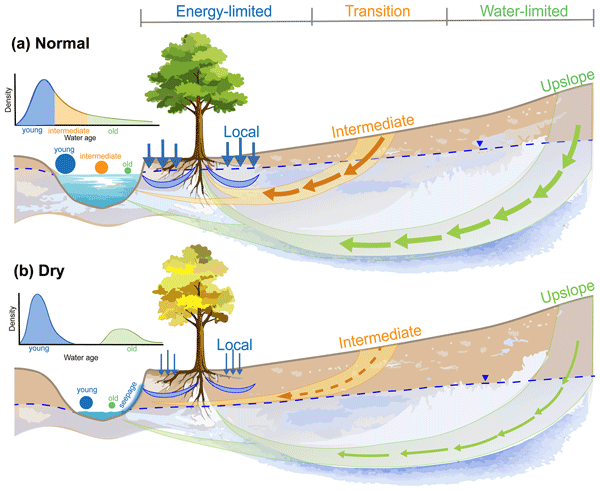
Abstract. Groundwater is widely regarded as a critical buffer that sustains evapotranspiration (ET) and streamflow under hydrologic stress. However, whether this buffering capacity persists under sustained increases in ET demand remains unclear. Here we test whether sustained increases in ET demand can reorganize subsurface connectivity and undermine effective groundwater buffering, using controlled hillslope simulations with integrated hydrologic modeling and particle tracking. Under baseline semi-arid forcing, ET and outflow exhibit coexisting young and older age components. Following late-summer groundwater drawdown, intermediate-age flow paths weaken, eventually producing a temporary age gap that separates shallow and deep sources. Streamflow responds more abruptly than ET due to hydraulic disconnection at the outlet. Warming and vegetation greening amplify this intrinsic seasonal tendency. Intermediate-age contributions collapse earlier and recover more slowly, amplifying the polarization between shallow and deep water pools and further suppressing older groundwater inputs. Streamflow becomes increasingly dominated by very young water, indicating strengthened groundwater–surface decoupling. These results suggest that sustained hydrologic stress structurally reduces effective groundwater connectivity, weakening subsurface buffering and shortening hydrologic memory. This tendency persists across parameter perturbations. As a consequence, water cycling shifts toward shallower and faster pathways. Progressive groundwater decoupling therefore represents not merely a change in source depth, but a structural transition toward a more rapidly recycled and potentially less predictable mode of terrestrial water cycling under sustained increases in terrestrial water use.
-
Notice on discussion status
The requested preprint has a corresponding peer-reviewed final revised paper. You are encouraged to refer to the final revised version.
-
Preprint
(2597 KB)
-
Supplement
(7198 KB)
-
The requested preprint has a corresponding peer-reviewed final revised paper. You are encouraged to refer to the final revised version.
- Preprint
(2597 KB) - Metadata XML
-
Supplement
(7198 KB) - BibTeX
- EndNote
- Final revised paper


Journal article(s) based on this preprint
Interactive discussion
Status: closed
-
RC1: 'Comment on egusphere-2026-1102', Anonymous Referee #1, 22 Apr 2026
-
AC1: 'Reply on RC1', Chen Yang, 21 May 2026
We sincerely thank the reviewer for the careful reading of our manuscript and for the many insightful and constructive comments. We are encouraged by the reviewer’s overall positive assessment of the study and appreciate the helpful suggestions for improving the manuscript.
We especially thank the reviewer for recommending several highly relevant studies, including Berkowitz and Zehe (2020), Schiavo et al. (2022), and Betterle and Belling (2024). We are currently carefully reading these works and will incorporate them into the revised manuscript. In particular, we will strengthen the broader conceptual framing of groundwater–surface water interactions and better connect our study with recent discussions on groundwater organization, connectivity, and water-limited aquifer behavior.
We also appreciate the reviewer’s comments regarding the parameter choices and hillslope configuration. In the revised manuscript, we will further clarify the rationale behind the experimental design, including the choice of representative parameter settings and the treatment of topographic gradients. We will also better discuss the limitations and broader applicability of the conceptual hillslope framework adopted in this study.
We thank the reviewer for pointing out the lack of clarity in Figure 6. We will revise the figure, clarify the y-axis and the intended message, and improve the related discussion in the main text.
Finally, following the reviewer’s suggestion, we will add a brief subsection introducing the governing equations used in the ParFlow surface and subsurface flow components.
We again sincerely thank the reviewer for these valuable comments. A detailed point-by-point response will be provided in the revised manuscript.
Citation: https://doi.org/10.5194/egusphere-2026-1102-AC1
-
AC1: 'Reply on RC1', Chen Yang, 21 May 2026
-
RC2: 'Comment on egusphere-2026-1102', Anonymous Referee #2, 09 May 2026
Review for “Progressive groundwater decoupling may drive a shift toward shallower and faster terrestrial water cycling” by Sun et al., for consideration in HESS.
This is an interesting study that is nicely organized and concisely presented. I believe it fits the scope of HESS and will be fit for publication after some clarifications and revisions. I have listed general and specific comments below that I hope will strengthen the paper.
General Comments:
1. The introduction relies heavily on two studies— one of which focuses on a snow-dominated mountain catchment. It should be noted that mountain sites like East River can have many streamflow generation processes and are shaped by other influences that are not discussed (e.g., snow, steep topography, shallow soils, mountain-block recharge, etc.—see Jencso et al., 2009; Somers and McKenzie, 2020) and may not be relevant elsewhere. How do these characteristics factor into the proposed shift toward shallower water cycling? Are there landscapes in which this shift would be unlikely to occur? If so, I would suggest to be more explicit in the scope of where this work is applicable.
- References:
- Jencso, K. G., et al. (2009). "Hydrologic connectivity between landscapes and streams: Transferring reach- and plot-scale understanding to the catchment scale." Water Resources Research 45(4).
- Somers, L. D. and J. M. McKenzie (2020). "A review of groundwater in high mountain environments." WIREs Water 7(6).
2. The term “reorganization pathway” is used several times but is not very clear, please define with first use. Does this suggest that under dry conditions, when the water table has receded to some critical point, a preferential pathway for young/local water emerges?
3. I would suggest to briefly summarize the main message from each figure into its respective caption to help direct the reader’s attention.
4. How would the findings from this study be extrapolated to real-world conditions (e.g., more heterogeneity in hillslope parameters)? I see that expanding to real study sites is potential future work, but some discussion of study limitations would be helpful to ground the broader applicability of this work’s conclusions.
Specific Comments:
Line 41: Suggest to revise the following to be more precise: “…as shallow soil moisture is depleted, “relative” groundwater contributions increase…”.
Line 66: Suggest to revise wording: I would not say the expectation is “strengthened” groundwater buffering under intensifying drought, rather more of a shift toward reliance on groundwater stores in the absence of input precipitation. The wording used later “intensifying groundwater dependence” seems more accurate to me.
Figure 1: Should the “local” water still be connected to the stream in panel b to show how the shallow flow paths dominate the water contributions?
Lines 107-111: Are there references to support these specific parameter values?
Line 112: It would be helpful to include the key governing equations for the ParFlow and EcoSLIM models.
Line 115: I realize that the aim is not to represent a specific field site, but Oklahoma is a fairly large and climatologically diverse state. Can you be more specific about where in Oklahoma the meteorological record is from?
Line 134: What LAI values were used in the baseline configuration? Perhaps a table in SI summarizing the key parameters for the baseline and additional scenarios would be helpful to include. I wonder also whether the perturbation scenarios are realistic for the “semi-arid woody hillslope” being represented in the baseline case? Is the “greening” scenario due to CO2 fertilization or some other driver? The relevance of these additional scenarios would benefit from more explanation and literature support.
Figures 2 & 3: What is the variation associated with the monthly values? If the model was run for 20 years at an hourly timestep, I assume the monthly values shown are averages.
Figure 3: Why are there no points in September for the non-baseline scenarios? And no point in August for the red line scenario (Temperature+1K MaxLAI+50%)?
Figures 4 and 5: It is a bit confusing to have the “x” direction of the hillslope on the vertical axis of the plots. It may also help to add a small panel with the hillslope configuration for visual context (e.g., as in Figure S3).
Line 244: Does the “lower 20m” refer to the “x” direction of the hillslope? (A visual representation of this would be helpful to avoid confusion).
Line 247: I believe this is the first use of “age gap”—can this be defined explicitly here?
Figure 6: It is difficult to see the differences between scenarios in this figure. Would it be helpful to overlay the months for different scenarios or add some guiding labels/annotations to highlight what the main message of the figure is? (Summarizing the main message in the caption as suggested above would be helpful, as well).
Figure 7: Similar to the comment about Figures 4 and 5, it is confusing to have the “x” direction of the hillslope represented on the vertical axis of the right panels, but then on the horizontal axis of the left panels. It would also help to add some description for the blue rectangles in the x vs. ET age panels in the caption.
Line 337-339: This statement needs stronger support—what is the evidence that old water in streams is sourced from deeper soil moisture as opposed to groundwater? (And how is “deep soil moisture” defined here?)
Line 339-341: Suggest to revise wording: As with previous comments (lines 41, 66), I think it would be more accurate to say that there is a greater reliance/dependence on groundwater under increasing stress (at least following the typical conceptualization), rather than becoming “more engaged”.
Citation: https://doi.org/10.5194/egusphere-2026-1102-RC2 -
AC2: 'Reply on RC2', Chen Yang, 21 May 2026
We sincerely thank the reviewer for the careful reading of our manuscript and for the constructive comments and suggestions. We are encouraged by the reviewer’s positive overall assessment and appreciate the detailed feedback, which will help us improve the clarity, framing, and presentation of the manuscript.
Regarding the general comments, we appreciate the reviewer’s point that the motivating examples discussed in the Introduction include landscapes with specific hydrologic characteristics, such as snow influence, steep topography, shallow soils, and mountain-block recharge. In the revised manuscript, we will more clearly distinguish between motivating observations from previous studies and the broader conceptual mechanism explored in our idealized hillslope simulations. We will also better clarify the intended scope of the study, discuss limitations related to landscape heterogeneity and real-world extrapolation, and incorporate the suggested references where appropriate.
We also thank the reviewer for noting that several conceptual terms and figure messages could be made clearer. In the revision, we will further clarify relevant terminology and revise figure captions to more clearly summarize the main message of each figure.
Regarding the specific comments, we have carefully reviewed each point. In the revised manuscript, we will improve wording where needed, add supporting references and methodological details, include key governing equations for ParFlow and EcoSLIM, clarify the meteorological forcing and scenario settings, and improve the presentation of several figures and captions.
We again thank the reviewer for these helpful comments. A detailed point-by-point response will be provided with the revised manuscript.
Citation: https://doi.org/10.5194/egusphere-2026-1102-AC2
Peer review completion


Interactive discussion
Status: closed
-
RC1: 'Comment on egusphere-2026-1102', Anonymous Referee #1, 22 Apr 2026
I have revised the paper entitled ‘Progressive groundwater decoupling may drive a shift toward shallower and faster terrestrial water cycling’. The paper is well-structured, scientifically sound, and can be published in the Hydrology and Earth System Science journal after some revisions. These can be itemized as follows. Best regards.
- There is a significant portion of the literature that may be useful to cite in the work. The Authors wisely underline key issues, like the fact that groundwater regulates surface fluxes IF it acts as long term reservoir. But the roots of these reasonings are deeper than data-driven studies (Condon et al., 2020; Miguel-Macho and Fan, 2025) and needs to be framed. In this context, the works of Berkowitz and Zehe (2020) and Schiavo et al. (2022) are milestones in reshaping the mutual role of surface and groundwater, being mutually feeding and more similar than we think. Berkowitz and Zehe (2020) assessed the similar nature of the two ‘water worlds’, while Schiavo et al. (2022) were the first to implement gravity-driven behaviors in groundwater networks to highlight the similar self-organized structure of groundwater flow patterns. These two works were important in closing the ties between these two worlds.
- Recent works have highlighted the water-limited nature of mountain aquifers. This has been clearly stated by Betterle and Belling (2024) for headwater catchments, whose discharge patterns. This is due to the geomorphological forcing being the main responsible for drainage patterns in prealpine and alpine environments. Moreover, they also have assessed the same three zones of different groundwater dynamics behaviors. I suggest incorporating these references as well to better frame the present conceptualization, also offered in Figure 1, in the recent literature.
- I am a bit skeptical about the deterministic values fixed as parameters in lines 100-111. Can the authors justify this choice and explain why they did not go for intervals of confidence for these parameters? The whole Section 2 should be sustained in the light of this comment.
- At lines 142-145, the Authors say they reduced the topographic gradient as lateral subsurface drainage control. Why did they do that? Is that consistent with local geological, hydrogeological, and flow patterns features? Saying this, they basically say the local flow patterns (lateral subsurface drainage) are being altered. This should be strongly supported. Moreover, wouldn’t these lateral drainage patterns change on a monthly basis rather than being just flattened a priori?
- Figure 6 is not clear to me. What is there on the y-axis? Could the authors find a better way to show it? Which core info do they want to share with this Figure?
- When introducing the parflow model, such as the surface flow model and subsurface unsaturated flow model, the Authors should introduce a small section with fundamental governing equations.
References:
Berkowitz, B. and Zehe, E.: Surface water and groundwater: unifying conceptualization and quantification of the two “water worlds”, Hydrol. Earth Syst. Sci., 24, 1831–1858, https://doi.org/10.5194/hess-24-1831-2020, 2020.
Betterle, A., & Bellin, A. (2024). Morphological and Hydrogeological Controls of Groundwater Flows and Water Age Distribution in Mountain Aquifers and Streams. Water Resources Research, 60(11), e2024WR037407. https://doi.org/10.1029/2024WR037407
Schiavo, M., Riva, M., Guadagnini, L., Zehe, E., & Guadagnini, A. (2022). Probabilistic identification of Preferential Groundwater Networks. Journal of Hydrology, 610, 127906. https://doi.org/10.1016/j.jhydrol.2022.127906Citation: https://doi.org/10.5194/egusphere-2026-1102-RC1 -
AC1: 'Reply on RC1', Chen Yang, 21 May 2026
We sincerely thank the reviewer for the careful reading of our manuscript and for the many insightful and constructive comments. We are encouraged by the reviewer’s overall positive assessment of the study and appreciate the helpful suggestions for improving the manuscript.
We especially thank the reviewer for recommending several highly relevant studies, including Berkowitz and Zehe (2020), Schiavo et al. (2022), and Betterle and Belling (2024). We are currently carefully reading these works and will incorporate them into the revised manuscript. In particular, we will strengthen the broader conceptual framing of groundwater–surface water interactions and better connect our study with recent discussions on groundwater organization, connectivity, and water-limited aquifer behavior.
We also appreciate the reviewer’s comments regarding the parameter choices and hillslope configuration. In the revised manuscript, we will further clarify the rationale behind the experimental design, including the choice of representative parameter settings and the treatment of topographic gradients. We will also better discuss the limitations and broader applicability of the conceptual hillslope framework adopted in this study.
We thank the reviewer for pointing out the lack of clarity in Figure 6. We will revise the figure, clarify the y-axis and the intended message, and improve the related discussion in the main text.
Finally, following the reviewer’s suggestion, we will add a brief subsection introducing the governing equations used in the ParFlow surface and subsurface flow components.
We again sincerely thank the reviewer for these valuable comments. A detailed point-by-point response will be provided in the revised manuscript.
Citation: https://doi.org/10.5194/egusphere-2026-1102-AC1
-
AC1: 'Reply on RC1', Chen Yang, 21 May 2026
-
RC2: 'Comment on egusphere-2026-1102', Anonymous Referee #2, 09 May 2026
Review for “Progressive groundwater decoupling may drive a shift toward shallower and faster terrestrial water cycling” by Sun et al., for consideration in HESS.
This is an interesting study that is nicely organized and concisely presented. I believe it fits the scope of HESS and will be fit for publication after some clarifications and revisions. I have listed general and specific comments below that I hope will strengthen the paper.
General Comments:
1. The introduction relies heavily on two studies— one of which focuses on a snow-dominated mountain catchment. It should be noted that mountain sites like East River can have many streamflow generation processes and are shaped by other influences that are not discussed (e.g., snow, steep topography, shallow soils, mountain-block recharge, etc.—see Jencso et al., 2009; Somers and McKenzie, 2020) and may not be relevant elsewhere. How do these characteristics factor into the proposed shift toward shallower water cycling? Are there landscapes in which this shift would be unlikely to occur? If so, I would suggest to be more explicit in the scope of where this work is applicable.
- References:
- Jencso, K. G., et al. (2009). "Hydrologic connectivity between landscapes and streams: Transferring reach- and plot-scale understanding to the catchment scale." Water Resources Research 45(4).
- Somers, L. D. and J. M. McKenzie (2020). "A review of groundwater in high mountain environments." WIREs Water 7(6).
2. The term “reorganization pathway” is used several times but is not very clear, please define with first use. Does this suggest that under dry conditions, when the water table has receded to some critical point, a preferential pathway for young/local water emerges?
3. I would suggest to briefly summarize the main message from each figure into its respective caption to help direct the reader’s attention.
4. How would the findings from this study be extrapolated to real-world conditions (e.g., more heterogeneity in hillslope parameters)? I see that expanding to real study sites is potential future work, but some discussion of study limitations would be helpful to ground the broader applicability of this work’s conclusions.
Specific Comments:
Line 41: Suggest to revise the following to be more precise: “…as shallow soil moisture is depleted, “relative” groundwater contributions increase…”.
Line 66: Suggest to revise wording: I would not say the expectation is “strengthened” groundwater buffering under intensifying drought, rather more of a shift toward reliance on groundwater stores in the absence of input precipitation. The wording used later “intensifying groundwater dependence” seems more accurate to me.
Figure 1: Should the “local” water still be connected to the stream in panel b to show how the shallow flow paths dominate the water contributions?
Lines 107-111: Are there references to support these specific parameter values?
Line 112: It would be helpful to include the key governing equations for the ParFlow and EcoSLIM models.
Line 115: I realize that the aim is not to represent a specific field site, but Oklahoma is a fairly large and climatologically diverse state. Can you be more specific about where in Oklahoma the meteorological record is from?
Line 134: What LAI values were used in the baseline configuration? Perhaps a table in SI summarizing the key parameters for the baseline and additional scenarios would be helpful to include. I wonder also whether the perturbation scenarios are realistic for the “semi-arid woody hillslope” being represented in the baseline case? Is the “greening” scenario due to CO2 fertilization or some other driver? The relevance of these additional scenarios would benefit from more explanation and literature support.
Figures 2 & 3: What is the variation associated with the monthly values? If the model was run for 20 years at an hourly timestep, I assume the monthly values shown are averages.
Figure 3: Why are there no points in September for the non-baseline scenarios? And no point in August for the red line scenario (Temperature+1K MaxLAI+50%)?
Figures 4 and 5: It is a bit confusing to have the “x” direction of the hillslope on the vertical axis of the plots. It may also help to add a small panel with the hillslope configuration for visual context (e.g., as in Figure S3).
Line 244: Does the “lower 20m” refer to the “x” direction of the hillslope? (A visual representation of this would be helpful to avoid confusion).
Line 247: I believe this is the first use of “age gap”—can this be defined explicitly here?
Figure 6: It is difficult to see the differences between scenarios in this figure. Would it be helpful to overlay the months for different scenarios or add some guiding labels/annotations to highlight what the main message of the figure is? (Summarizing the main message in the caption as suggested above would be helpful, as well).
Figure 7: Similar to the comment about Figures 4 and 5, it is confusing to have the “x” direction of the hillslope represented on the vertical axis of the right panels, but then on the horizontal axis of the left panels. It would also help to add some description for the blue rectangles in the x vs. ET age panels in the caption.
Line 337-339: This statement needs stronger support—what is the evidence that old water in streams is sourced from deeper soil moisture as opposed to groundwater? (And how is “deep soil moisture” defined here?)
Line 339-341: Suggest to revise wording: As with previous comments (lines 41, 66), I think it would be more accurate to say that there is a greater reliance/dependence on groundwater under increasing stress (at least following the typical conceptualization), rather than becoming “more engaged”.
Citation: https://doi.org/10.5194/egusphere-2026-1102-RC2 -
AC2: 'Reply on RC2', Chen Yang, 21 May 2026
We sincerely thank the reviewer for the careful reading of our manuscript and for the constructive comments and suggestions. We are encouraged by the reviewer’s positive overall assessment and appreciate the detailed feedback, which will help us improve the clarity, framing, and presentation of the manuscript.
Regarding the general comments, we appreciate the reviewer’s point that the motivating examples discussed in the Introduction include landscapes with specific hydrologic characteristics, such as snow influence, steep topography, shallow soils, and mountain-block recharge. In the revised manuscript, we will more clearly distinguish between motivating observations from previous studies and the broader conceptual mechanism explored in our idealized hillslope simulations. We will also better clarify the intended scope of the study, discuss limitations related to landscape heterogeneity and real-world extrapolation, and incorporate the suggested references where appropriate.
We also thank the reviewer for noting that several conceptual terms and figure messages could be made clearer. In the revision, we will further clarify relevant terminology and revise figure captions to more clearly summarize the main message of each figure.
Regarding the specific comments, we have carefully reviewed each point. In the revised manuscript, we will improve wording where needed, add supporting references and methodological details, include key governing equations for ParFlow and EcoSLIM, clarify the meteorological forcing and scenario settings, and improve the presentation of several figures and captions.
We again thank the reviewer for these helpful comments. A detailed point-by-point response will be provided with the revised manuscript.
Citation: https://doi.org/10.5194/egusphere-2026-1102-AC2
Peer review completion
Journal article(s) based on this preprint
Viewed
| HTML | XML | Total | Supplement | BibTeX | EndNote | |
|---|---|---|---|---|---|---|
| 609 | 204 | 48 | 861 | 173 | 30 | 46 |
- HTML: 609
- PDF: 204
- XML: 48
- Total: 861
- Supplement: 173
- BibTeX: 30
- EndNote: 46
Viewed (geographical distribution)
| Country | # | Views | % |
|---|
| Total: | 0 |
| HTML: | 0 |
| PDF: | 0 |
| XML: | 0 |
- 1
Aoqi Sun
Wenjie Xu
Enze Ma
Hua Yuan
Chen Yang

The requested preprint has a corresponding peer-reviewed final revised paper. You are encouraged to refer to the final revised version.
- Preprint
(2597 KB) - Metadata XML
-
Supplement
(7198 KB) - BibTeX
- EndNote
- Final revised paper
I have revised the paper entitled ‘Progressive groundwater decoupling may drive a shift toward shallower and faster terrestrial water cycling’. The paper is well-structured, scientifically sound, and can be published in the Hydrology and Earth System Science journal after some revisions. These can be itemized as follows. Best regards.
- There is a significant portion of the literature that may be useful to cite in the work. The Authors wisely underline key issues, like the fact that groundwater regulates surface fluxes IF it acts as long term reservoir. But the roots of these reasonings are deeper than data-driven studies (Condon et al., 2020; Miguel-Macho and Fan, 2025) and needs to be framed. In this context, the works of Berkowitz and Zehe (2020) and Schiavo et al. (2022) are milestones in reshaping the mutual role of surface and groundwater, being mutually feeding and more similar than we think. Berkowitz and Zehe (2020) assessed the similar nature of the two ‘water worlds’, while Schiavo et al. (2022) were the first to implement gravity-driven behaviors in groundwater networks to highlight the similar self-organized structure of groundwater flow patterns. These two works were important in closing the ties between these two worlds.
- Recent works have highlighted the water-limited nature of mountain aquifers. This has been clearly stated by Betterle and Belling (2024) for headwater catchments, whose discharge patterns. This is due to the geomorphological forcing being the main responsible for drainage patterns in prealpine and alpine environments. Moreover, they also have assessed the same three zones of different groundwater dynamics behaviors. I suggest incorporating these references as well to better frame the present conceptualization, also offered in Figure 1, in the recent literature.
- I am a bit skeptical about the deterministic values fixed as parameters in lines 100-111. Can the authors justify this choice and explain why they did not go for intervals of confidence for these parameters? The whole Section 2 should be sustained in the light of this comment.
- At lines 142-145, the Authors say they reduced the topographic gradient as lateral subsurface drainage control. Why did they do that? Is that consistent with local geological, hydrogeological, and flow patterns features? Saying this, they basically say the local flow patterns (lateral subsurface drainage) are being altered. This should be strongly supported. Moreover, wouldn’t these lateral drainage patterns change on a monthly basis rather than being just flattened a priori?
- Figure 6 is not clear to me. What is there on the y-axis? Could the authors find a better way to show it? Which core info do they want to share with this Figure?
- When introducing the parflow model, such as the surface flow model and subsurface unsaturated flow model, the Authors should introduce a small section with fundamental governing equations.
References:
Berkowitz, B. and Zehe, E.: Surface water and groundwater: unifying conceptualization and quantification of the two “water worlds”, Hydrol. Earth Syst. Sci., 24, 1831–1858, https://doi.org/10.5194/hess-24-1831-2020, 2020.
Betterle, A., & Bellin, A. (2024). Morphological and Hydrogeological Controls of Groundwater Flows and Water Age Distribution in Mountain Aquifers and Streams. Water Resources Research, 60(11), e2024WR037407. https://doi.org/10.1029/2024WR037407
Schiavo, M., Riva, M., Guadagnini, L., Zehe, E., & Guadagnini, A. (2022). Probabilistic identification of Preferential Groundwater Networks. Journal of Hydrology, 610, 127906. https://doi.org/10.1016/j.jhydrol.2022.127906