
the Creative Commons Attribution 4.0 License.
the Creative Commons Attribution 4.0 License.
 | 15 Jan 2026
Exploring the Mechanisms of Dust Emission and Transport based on Observations and GEOS-Chem Simulations
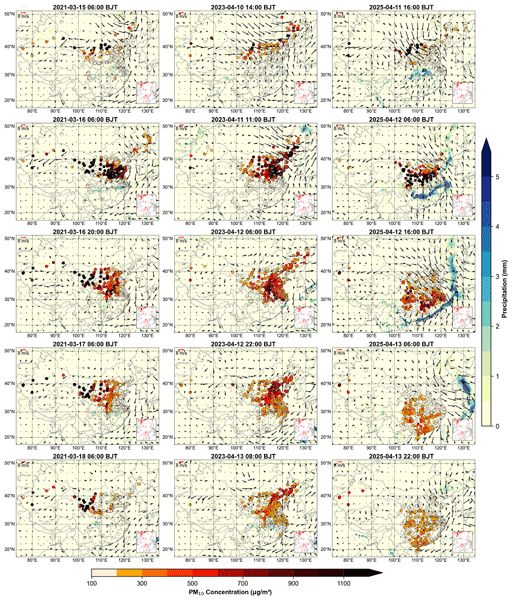
Abstract. Dust aerosols play a significant role in climate and air quality, yet understanding of their emission and long-range transport mechanisms remains incomplete. We investigated a severe April 2025 dust event in northern China using multi-source observations and GEOS-Chem simulations, comparing it against the 30-year climatology and historical events to analyze its meteorology, emission, and transport. Results show that the dust event in April was originated in the western Inner Mongolia (WIM) source region, accompanied by wind speeds exceeding 8 m/s and hourly PM₁₀ concentrations above 1900 μg/m³, and affected the southern China including Yangtze River Basin and Hainan Province. Under the influence of the Siberian high-pressure system and the Mongolian cyclone, the WIM experienced persistent dry-cold advection. Three months preceding the dust event, the WIM exhibited high temperatures (~2 °C), reduced precipitation (~−25 mm) and low volumetric soil water (~−0.02 m³/m³). Comparison with two other severe historical dust events in year 2021 and 2023, demonstrating that long-range transport in 2025 was primarily due to strong northerly winds that effectively guided southward transport of dust aerosols. Furthermore, the dust in 2025 consistently moved southward but generally behind the rainband, which imply relatively low wet scavenging and thereby enabling stable long-range transport. The study confirms that persistent drought and strong winds triggered intense dust emission, and that airflow transport under specific synoptic conditions dominated the long-range dust transport.
-
Notice on discussion status
The requested preprint has a corresponding peer-reviewed final revised paper. You are encouraged to refer to the final revised version.
-
Preprint
(2985 KB)
-
Supplement
(956 KB)
-
The requested preprint has a corresponding peer-reviewed final revised paper. You are encouraged to refer to the final revised version.
- Preprint
(2985 KB) - Metadata XML
-
Supplement
(956 KB) - BibTeX
- EndNote
- Final revised paper


Journal article(s) based on this preprint
Interactive discussion
Status: closed
-
RC1: 'Comment on egusphere-2025-6550', Anonymous Referee #1, 05 Feb 2026
- AC2: 'Reply on RC1', Peili Zou, 03 Apr 2026
-
RC2: 'Comment on egusphere-2025-6550', Anonymous Referee #2, 10 Feb 2026
General comments:
The paper studied a severe dust storm originating in the Western Inner Mongolia (WIM) that was transported southward to southern China during April 11-14, 2025. Using ground observations, reanalysis (ERA5), satellite retrievals (MODIS/Aqua), and an improved GEOS-Chem model, the authors demonstrate that the emission and long-range transport of Inner Mongolian dust were mainly driven by anomalously strong northerly winds associated with the Siberian high and the Mongolian cyclone, along with reduced local precipitation, soil moisture, and high surface temperatures. The event is then compared with two other extreme dust events in northern China that occurred in March 2021 and April 2023. By comparing the meteorological conditions and PM10 evolution patterns, it is found that the absence of strong northerly winds is the primary reason why dust plumes during the other two events were not transported to Hainan Province in southern coastal China. The paper is generally well written and easy to follow. However, the study would be strengthened by better clarifying the motivation and novelty, justifying the use of the modeling approach, and providing a more detailed analysis in the multi-event comparison.
Specific comments:
- Adding more information on the motivation of this study would further strengthen the manuscript. For example, beyond its unusual transport pathway, it would be helpful to clarify what unique features or mechanisms of this dust storm are revealed here that have not been addressed in previous studies.
- In Section 4.2, including a brief discussion explaining why model simulations are used and what specific questions can be addressed through modeling (or cannot be addressed through observations alone) would highlight the added value of the modeling component.
- Regarding modeling, are atmospheric circulation nudged to the GEOS-FP reanalysis? If not, it would be informative to show a comparison of modeled winds versus station observations or reanalysis, since winds are a key factor of dust emissions and transport.
- Daily wind speeds are examined for the 2025 event (Fig. 8) and the other two springtime severe dust events in 2021 and 2023 (Fig. 10). Since dust emissions are more sensitive to high wind speeds at sub-daily time scales, it may be informative to display hourly wind speeds from the ERA5 reanalysis, station data, and model, or alternatively to show daily maximum wind speeds.
- Section 4.3.2, additional clarification on how the two historical dust events were selected would be helpful. It is briefly mentioned that the two events were selected among “historical dust events in northern China since 2000” (Line 268). However, it is unclear which dataset was used to identify dust events and how a dust event is defined. The two events were referred to as “two most severe dust events” (line 268), but it was not clear whether severity refers to their magnitude (if so, the 2025 event is more severe), their impacts, or their duration. What’s confusing is that later in the discussion, these events are referred to as “typical historical dust storms” (lines 323, 342). Clarifying the selection criteria and the purpose of using these events for comparison would help guide the reader.
- The comparison between the 2025 event and the other two events could be strengthened by discussing uncertainties, using similar evolution time frames, and adding analysis on circulation patterns. As mentioned in the text, these two events generally originated in northern China, so their emission areas are not exactly centered over the WIM (Fig. S3). Acknowledging these discrepancies helps explain their different magnitudes over the VIM and their paths. In addition, showing more time steps for the 2021 and 2023 events may provide a more complete picture of their evolution. For example, in Fig. 11 (bottom left), by 1200 BJT on March 16, 2021, the PM10 concentrations were still very high, with some areas above 1100 µg/m3, suggesting that the event had not yet fully dissipated (in contrast to the 2025 event, for which PM10 cementations decreased to around 200-400 µg/m3 by 0600 BJT on April 13, 2025). Similarly, by 0300 BJT on April 12, 2023 (Fig. 11, bottom middle), dust concentrations also remained very high, around 700-900 µg/m3. Including additional snapshots closer to the dissipation stage of these events would enhance the comparison. Lastly, including an analysis on circulation patterns would help understand wind directions and transport pathways (Fig. 11). For example, it is mentioned that both the March 2021 and April 2023 events were associated with Mongolian cyclones (line 270). Were they also associated with the Siberian High? What about other differences?
- It is recommended to discuss the results in the context of previous studies. For instance, it is found that dust emissions in the WIM exceeded 400 μg/m² and the altitude of the dust plume reached 3.6 km. Are these values comparable to previous events, or are they substantially larger? Regarding the southward transport to Hainan province, was this the first occurrence of such a southward transport, or has it documented previously? It was noted that about 50% of springtime dust events in Mongolia and northern China are associated with “the combined influence of Mongolian cyclones and cold high-pressure systems” (line 162). Was the combination of a Mongolian cyclone and the Siberian high found in the April 2025 event unique?
- In Section 2.2, consider including a brief introduction to the dust emission scheme in the model.
- Figs. 2, 4-5, 8d, 10a, and 11, are the wind fields surface winds? Please clarify in the figure captions.
- Fig. 7, it would be helpful to also include modeled vertical and meridional winds in the figure.
- Fig. 8, is the time series of daily wind speed from the ERA5 or station observations?
- Fig. 10, it is preferred to show anomalies with reference to the long-term mean.
Technical corrections:
Fig. S2, although the figure caption refers to “AOD spatial distributions”, MODIS data do not appear to be displayed in the top row.
Citation: https://doi.org/10.5194/egusphere-2025-6550-RC2 - AC1: 'Reply on RC2', Peili Zou, 03 Apr 2026
Peer review completion


Interactive discussion
Status: closed
-
RC1: 'Comment on egusphere-2025-6550', Anonymous Referee #1, 05 Feb 2026
General remarks:
The authors present a detailed and well-documented case study of a dust storm originating in western Inner Mongolia that affected southern regions of China, including Hainan Island. The manuscript provides a thorough analysis of the physical processes driving dust emission, wet deposition, and long-range transport, and the comparison with historical records from the past 30 years as well as two recent dust storms is informative. However, while the results are clearly presented and internally consistent, many of the findings align closely with existing understanding of dust storm behavior. As a result, the study’s broader scientific significance and novelty are somewhat limited.
The manuscript would benefit from improved conciseness. While the discussion of the physical factors controlling dust emission and transport (e.g., wind, temperature, soil moisture, and precipitation) is relevant and informative, this material is repeated in multiple sections of the paper (lines 143–154, 236–244, 247–248, 271–273, etc.). Consolidating these discussions would reduce redundancy and improve the overall flow of the manuscript.
Specific comments:
Line 87-91: Why do the authors use ERA5 instead of MERRA2 meteorological data in the analysis? It’s worth noting that the latter is the meteorological data used to drive the GEOS-Chem atmospheric chemical transport model simulations.
Figure 2: Why is the coverage of MODIS AOD so sparse in the China region? The data shown in the figure makes it difficult to distinguish between PM10 and AOD. Please change "scatter plot represents PM10 concentration" to "solid circles represent PM10 concentration".
Figures 2: Please explain that the wind speed scale is located in the upper right corner of each subplot, and explain what the small inset in the lower right corner represents.
Line 121 and Figure 3: If the PM10 and PM2.5 concentrations in the WIM region remain around 100 μg/m³ and 20 μg/m³, respectively (Figure 3), then why is the ratio of PM2.5 to PM10 0.3 instead of 0.2?
Line 122 and Figure 3: Figure 3 shows that the dust storm began in the WIM region at 10:00 on April 11th, not at 17:00 as stated in line 122. In fact, the dust storm reached its peak at 17:00 at the WIM source region.
Line 126-127: Figure 4 does not show AOD values exceeding 2 in WIM.
Line 246-249: Please delete these two sentences, as they do not provide any necessary information.
Lie 275: What does “both” refer to?
Figure 9: Please specify the geographical coverage in the caption.
Figure 10: Please specify the geographical coverage for “western Inner Mongolia” in the caption.
Line 312-314: Please rephrase this sentence.
Figure 11: Please change “scatter plots” to be “filled circles”.
Technique correction:
Figure 1: change “WIM” to “Western Inner Mongolia (WIM)” and change “western Inner Mongolia” to “WIM”.
Line 271-272: Change “to compare” to “we compare”.
Citation: https://doi.org/10.5194/egusphere-2025-6550-RC1 - AC2: 'Reply on RC1', Peili Zou, 03 Apr 2026
-
RC2: 'Comment on egusphere-2025-6550', Anonymous Referee #2, 10 Feb 2026
General comments:
The paper studied a severe dust storm originating in the Western Inner Mongolia (WIM) that was transported southward to southern China during April 11-14, 2025. Using ground observations, reanalysis (ERA5), satellite retrievals (MODIS/Aqua), and an improved GEOS-Chem model, the authors demonstrate that the emission and long-range transport of Inner Mongolian dust were mainly driven by anomalously strong northerly winds associated with the Siberian high and the Mongolian cyclone, along with reduced local precipitation, soil moisture, and high surface temperatures. The event is then compared with two other extreme dust events in northern China that occurred in March 2021 and April 2023. By comparing the meteorological conditions and PM10 evolution patterns, it is found that the absence of strong northerly winds is the primary reason why dust plumes during the other two events were not transported to Hainan Province in southern coastal China. The paper is generally well written and easy to follow. However, the study would be strengthened by better clarifying the motivation and novelty, justifying the use of the modeling approach, and providing a more detailed analysis in the multi-event comparison.
Specific comments:
- Adding more information on the motivation of this study would further strengthen the manuscript. For example, beyond its unusual transport pathway, it would be helpful to clarify what unique features or mechanisms of this dust storm are revealed here that have not been addressed in previous studies.
- In Section 4.2, including a brief discussion explaining why model simulations are used and what specific questions can be addressed through modeling (or cannot be addressed through observations alone) would highlight the added value of the modeling component.
- Regarding modeling, are atmospheric circulation nudged to the GEOS-FP reanalysis? If not, it would be informative to show a comparison of modeled winds versus station observations or reanalysis, since winds are a key factor of dust emissions and transport.
- Daily wind speeds are examined for the 2025 event (Fig. 8) and the other two springtime severe dust events in 2021 and 2023 (Fig. 10). Since dust emissions are more sensitive to high wind speeds at sub-daily time scales, it may be informative to display hourly wind speeds from the ERA5 reanalysis, station data, and model, or alternatively to show daily maximum wind speeds.
- Section 4.3.2, additional clarification on how the two historical dust events were selected would be helpful. It is briefly mentioned that the two events were selected among “historical dust events in northern China since 2000” (Line 268). However, it is unclear which dataset was used to identify dust events and how a dust event is defined. The two events were referred to as “two most severe dust events” (line 268), but it was not clear whether severity refers to their magnitude (if so, the 2025 event is more severe), their impacts, or their duration. What’s confusing is that later in the discussion, these events are referred to as “typical historical dust storms” (lines 323, 342). Clarifying the selection criteria and the purpose of using these events for comparison would help guide the reader.
- The comparison between the 2025 event and the other two events could be strengthened by discussing uncertainties, using similar evolution time frames, and adding analysis on circulation patterns. As mentioned in the text, these two events generally originated in northern China, so their emission areas are not exactly centered over the WIM (Fig. S3). Acknowledging these discrepancies helps explain their different magnitudes over the VIM and their paths. In addition, showing more time steps for the 2021 and 2023 events may provide a more complete picture of their evolution. For example, in Fig. 11 (bottom left), by 1200 BJT on March 16, 2021, the PM10 concentrations were still very high, with some areas above 1100 µg/m3, suggesting that the event had not yet fully dissipated (in contrast to the 2025 event, for which PM10 cementations decreased to around 200-400 µg/m3 by 0600 BJT on April 13, 2025). Similarly, by 0300 BJT on April 12, 2023 (Fig. 11, bottom middle), dust concentrations also remained very high, around 700-900 µg/m3. Including additional snapshots closer to the dissipation stage of these events would enhance the comparison. Lastly, including an analysis on circulation patterns would help understand wind directions and transport pathways (Fig. 11). For example, it is mentioned that both the March 2021 and April 2023 events were associated with Mongolian cyclones (line 270). Were they also associated with the Siberian High? What about other differences?
- It is recommended to discuss the results in the context of previous studies. For instance, it is found that dust emissions in the WIM exceeded 400 μg/m² and the altitude of the dust plume reached 3.6 km. Are these values comparable to previous events, or are they substantially larger? Regarding the southward transport to Hainan province, was this the first occurrence of such a southward transport, or has it documented previously? It was noted that about 50% of springtime dust events in Mongolia and northern China are associated with “the combined influence of Mongolian cyclones and cold high-pressure systems” (line 162). Was the combination of a Mongolian cyclone and the Siberian high found in the April 2025 event unique?
- In Section 2.2, consider including a brief introduction to the dust emission scheme in the model.
- Figs. 2, 4-5, 8d, 10a, and 11, are the wind fields surface winds? Please clarify in the figure captions.
- Fig. 7, it would be helpful to also include modeled vertical and meridional winds in the figure.
- Fig. 8, is the time series of daily wind speed from the ERA5 or station observations?
- Fig. 10, it is preferred to show anomalies with reference to the long-term mean.
Technical corrections:
Fig. S2, although the figure caption refers to “AOD spatial distributions”, MODIS data do not appear to be displayed in the top row.
Citation: https://doi.org/10.5194/egusphere-2025-6550-RC2 - AC1: 'Reply on RC2', Peili Zou, 03 Apr 2026
Peer review completion
Journal article(s) based on this preprint
Viewed
| HTML | XML | Total | Supplement | BibTeX | EndNote | |
|---|---|---|---|---|---|---|
| 1,479 | 1,178 | 171 | 2,828 | 277 | 124 | 222 |
- HTML: 1,479
- PDF: 1,178
- XML: 171
- Total: 2,828
- Supplement: 277
- BibTeX: 124
- EndNote: 222
Viewed (geographical distribution)
| Country | # | Views | % |
|---|
| Total: | 0 |
| HTML: | 0 |
| PDF: | 0 |
| XML: | 0 |
- 1
Peili Zou

Rong Tian
Jianqi Zhao
Tong Yang
Yingying Ku
The requested preprint has a corresponding peer-reviewed final revised paper. You are encouraged to refer to the final revised version.
- Preprint
(2985 KB) - Metadata XML
-
Supplement
(956 KB) - BibTeX
- EndNote
- Final revised paper
General remarks:
The authors present a detailed and well-documented case study of a dust storm originating in western Inner Mongolia that affected southern regions of China, including Hainan Island. The manuscript provides a thorough analysis of the physical processes driving dust emission, wet deposition, and long-range transport, and the comparison with historical records from the past 30 years as well as two recent dust storms is informative. However, while the results are clearly presented and internally consistent, many of the findings align closely with existing understanding of dust storm behavior. As a result, the study’s broader scientific significance and novelty are somewhat limited.
The manuscript would benefit from improved conciseness. While the discussion of the physical factors controlling dust emission and transport (e.g., wind, temperature, soil moisture, and precipitation) is relevant and informative, this material is repeated in multiple sections of the paper (lines 143–154, 236–244, 247–248, 271–273, etc.). Consolidating these discussions would reduce redundancy and improve the overall flow of the manuscript.
Specific comments:
Line 87-91: Why do the authors use ERA5 instead of MERRA2 meteorological data in the analysis? It’s worth noting that the latter is the meteorological data used to drive the GEOS-Chem atmospheric chemical transport model simulations.
Figure 2: Why is the coverage of MODIS AOD so sparse in the China region? The data shown in the figure makes it difficult to distinguish between PM10 and AOD. Please change "scatter plot represents PM10 concentration" to "solid circles represent PM10 concentration".
Figures 2: Please explain that the wind speed scale is located in the upper right corner of each subplot, and explain what the small inset in the lower right corner represents.
Line 121 and Figure 3: If the PM10 and PM2.5 concentrations in the WIM region remain around 100 μg/m³ and 20 μg/m³, respectively (Figure 3), then why is the ratio of PM2.5 to PM10 0.3 instead of 0.2?
Line 122 and Figure 3: Figure 3 shows that the dust storm began in the WIM region at 10:00 on April 11th, not at 17:00 as stated in line 122. In fact, the dust storm reached its peak at 17:00 at the WIM source region.
Line 126-127: Figure 4 does not show AOD values exceeding 2 in WIM.
Line 246-249: Please delete these two sentences, as they do not provide any necessary information.
Lie 275: What does “both” refer to?
Figure 9: Please specify the geographical coverage in the caption.
Figure 10: Please specify the geographical coverage for “western Inner Mongolia” in the caption.
Line 312-314: Please rephrase this sentence.
Figure 11: Please change “scatter plots” to be “filled circles”.
Technique correction:
Figure 1: change “WIM” to “Western Inner Mongolia (WIM)” and change “western Inner Mongolia” to “WIM”.
Line 271-272: Change “to compare” to “we compare”.