
the Creative Commons Attribution 4.0 License.
the Creative Commons Attribution 4.0 License.
 | 21 Jan 2026
The multilayer ocean circulation melting the 79N Glacier ice tongue
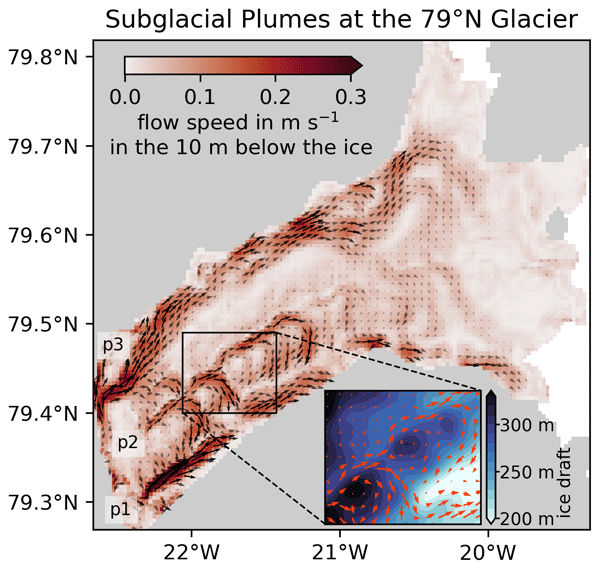
Abstract. The Greenland Ice Sheet is a major contributor to global sea level rise. While surface melting is driven by the atmosphere, oceanic processes melt the floating glacier tongues in northern Greenland from below. Because direct observations beneath these tongues are limited, numerical models are crucial for a detailed understanding of ice–ocean interactions. To study the oceanic melting of Greenland's largest floating ice tongue and the circulation induced by meltwater, we developed a high-resolution three-dimensional model of the 79° North Glacier fjord. Our simulation reveals that basal melting is driven by three distinct subglacial plumes with different signatures in temperature–salinity space. The paths of these buoyant gravity currents are set by the ice topography, particularly subglacial channels, and the Coriolis effect. One plume flows around cone-like features in the ice base with dimensions comparable to the Rossby radius, suggesting that the ice cones might be formed by the plume through subglacial melting. At about 100 m to 200 m depth, the plumes detach from the ice and export meltwater out of the fjord toward the open ocean. Heat for melting is supplied by a dense bottom plume flowing into the glacier cavity across the sill at the fjord entrance. Downstream of the sill, hydraulic control leads to enhanced mixing between plume and ambient water, cooling the inflow and reducing the amount of heat that reaches the glacier base. Our model resolves these details of the plumes in the ice cavity, improving the understanding of ocean-driven melt below glacier tongues.
-
Notice on discussion status
The requested preprint has a corresponding peer-reviewed final revised paper. You are encouraged to refer to the final revised version.
-
Preprint
(7665 KB)
-
The requested preprint has a corresponding peer-reviewed final revised paper. You are encouraged to refer to the final revised version.
- Preprint
(7665 KB) - Metadata XML
- BibTeX
- EndNote
- Final revised paper


Journal article(s) based on this preprint
Interactive discussion
Status: closed
-
RC1: 'Comment on egusphere-2025-6459', Jonathan Wiskandt, 23 Feb 2026
-
RC2: 'Reply on RC1', Anonymous Referee #2, 01 Mar 2026
-
AC2: 'Reply on RC2', Markus Reinert, 26 May 2026
Dear Anonymous Referee #2,
Thank you very much for your thorough review of our preprint. Please find our detailed answers to your comments in the attachment of our other comment "AC1: Reply on RC1", pages 8 to 14.
Best regards,
Markus Reinert on behalf of the AuthorsCitation: https://doi.org/10.5194/egusphere-2025-6459-AC2
-
AC2: 'Reply on RC2', Markus Reinert, 26 May 2026
- AC1: 'Reply on RC1', Markus Reinert, 26 May 2026
-
RC2: 'Reply on RC1', Anonymous Referee #2, 01 Mar 2026
Peer review completion


Interactive discussion
Status: closed
-
RC1: 'Comment on egusphere-2025-6459', Jonathan Wiskandt, 23 Feb 2026
Dear Authors,
I attach my comments as a PDF. I hope they are helpful.
Best, Jonathan
-
RC2: 'Reply on RC1', Anonymous Referee #2, 01 Mar 2026
-
AC2: 'Reply on RC2', Markus Reinert, 26 May 2026
Dear Anonymous Referee #2,
Thank you very much for your thorough review of our preprint. Please find our detailed answers to your comments in the attachment of our other comment "AC1: Reply on RC1", pages 8 to 14.
Best regards,
Markus Reinert on behalf of the AuthorsCitation: https://doi.org/10.5194/egusphere-2025-6459-AC2
-
AC2: 'Reply on RC2', Markus Reinert, 26 May 2026
- AC1: 'Reply on RC1', Markus Reinert, 26 May 2026
-
RC2: 'Reply on RC1', Anonymous Referee #2, 01 Mar 2026
Peer review completion
Journal article(s) based on this preprint
Viewed
| HTML | XML | Total | BibTeX | EndNote | |
|---|---|---|---|---|---|
| 1,392 | 840 | 134 | 2,366 | 85 | 133 |
- HTML: 1,392
- PDF: 840
- XML: 134
- Total: 2,366
- BibTeX: 85
- EndNote: 133
Viewed (geographical distribution)
| Country | # | Views | % |
|---|
| Total: | 0 |
| HTML: | 0 |
| PDF: | 0 |
| XML: | 0 |
- 1

Claudia Wekerle
Knut Klingbeil
Marvin Lorenz
Hans Burchard
The requested preprint has a corresponding peer-reviewed final revised paper. You are encouraged to refer to the final revised version.
- Preprint
(7665 KB) - Metadata XML
Dear Authors,
I attach my comments as a PDF. I hope they are helpful.
Best, Jonathan