
the Creative Commons Attribution 4.0 License.
the Creative Commons Attribution 4.0 License.
 | 12 Jan 2026
Gas-particle partitioning, molecular weight, and yield of organic nitrate under different urban VOC, NOx, and oxidation conditions during SAPHIR-CHANEL campaign
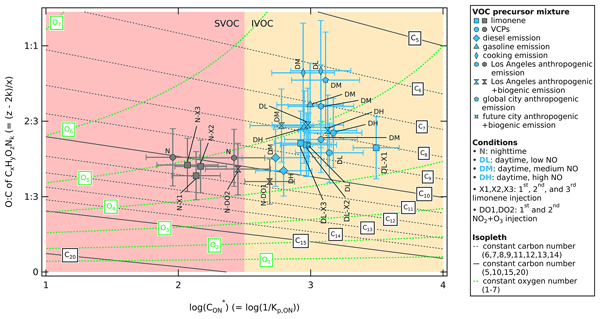
Abstract. Oxidation of volatile organic compounds (VOCs) involving hydroxyl radicals (OH.), nitrogen oxides (NOx), or nitrate radicals (NO3.) forms organic nitrates that undergo gas-particle partitioning, changing the lifetime of nitrogen compounds and their deposition on ecosystems. In urban areas, VOC composition is complex, with contributions from traffic, cooking, volatile chemical products (VCPs), and biogenic emissions. Secondary organic aerosol (SOA) formation from urban VOC mixtures was investigated using chamber experiments during the SAPHIR-CHANEL campaign under realistic VOC-NOx and oxidation conditions. The yield of total organic nitrates is higher for precursor mixtures with a higher percentage of unsaturated VOCs, such as those from traffic and cooking sources (11–21 %), compared to VCPs and complex urban emission replicas (2–7 %). Enhanced particle-phase partitioning is observed under nighttime oxidation (by NO3.) versus daytime oxidation (by OH.). Particulate organic nitrates have a higher average molecular weight under nighttime conditions (331 ± 13 g mol-1) than under daytime conditions (258 ± 24 g mol-1) due to increased oligomerization. Similarly, the mass fraction of the total organic aerosol that is organic nitrate is 2.6–4.5 times higher under nighttime than daytime conditions, likely due to higher molecular weight and lower temperatures. Although gas-phase organic nitrate composition varies substantially between precursor mixtures, bulk organic nitrate volatility is generally similar to that of modeled oxidized monoterpene nitrates (10−4–10−2 m3 μg−1 at 18–40 °C). These findings improve understanding of bulk organic nitrate sources and properties in a complex urban environment, allowing better simulations of air quality and nitrate deposition.
Competing interests: At least one of the (co-)authors is a member of the editorial board of Atmospheric Chemistry and Physics.
Publisher's note: Copernicus Publications remains neutral with regard to jurisdictional claims made in the text, published maps, institutional affiliations, or any other geographical representation in this paper. While Copernicus Publications makes every effort to include appropriate place names, the final responsibility lies with the authors. Views expressed in the text are those of the authors and do not necessarily reflect the views of the publisher.-
Notice on discussion status
The requested preprint has a corresponding peer-reviewed final revised paper. You are encouraged to refer to the final revised version.
-
Preprint
(4525 KB)
-
Supplement
(4182 KB)
-
The requested preprint has a corresponding peer-reviewed final revised paper. You are encouraged to refer to the final revised version.
- Preprint
(4525 KB) - Metadata XML
-
Supplement
(4182 KB) - BibTeX
- EndNote
- Final revised paper


Journal article(s) based on this preprint
Interactive discussion
Status: closed
-
RC1: 'Comment on egusphere-2025-6310', Anonymous Referee #1, 17 Feb 2026
-
AC1: 'Comment on egusphere-2025-6310', Farhan Ramadzan Nursanto, 05 Apr 2026
We appreciate the anonymous referees for their detailed and constructive feedback on our manuscript. The valuable suggestions have significantly improved this revised version. We have summarized the response to the comments in the following document.
-
AC1: 'Comment on egusphere-2025-6310', Farhan Ramadzan Nursanto, 05 Apr 2026
-
RC2: 'Comment on egusphere-2025-6310', Anonymous Referee #2, 23 Feb 2026
Review of Nursanto et al, ACP 2026
This manuscript reports measurements of organic nitrates made during the SAPHIR-CHANEL campaign. The campaign consisted of a series of experiments made at the SAPHIR chamber looking at the oxidation of various combinations of VOCs under both photochemical and nocturnal oxidation conditions. The authors report that VOC mixtures with more unsaturated species yield more organic nitrates in the product distribution, and that nocturnal NO3-initiated oxidation yields more organic nitrates in the particle phase compared to photochemical oxidation. They also quantify the average molecular weight and the phase partitioning of the organic nitrates produced in each experiment.
Overall, the authors present an interesting dataset from a nice set of chamber experiments. I have several concerns about the analysis that I recommend the authors address prior to publication, which I have detailed below.
Quantitative isolation of the effects controlling phase partitioning of organic nitrates:
The authors report that more organic nitrates were in the particle phase during the NO3 oxidation experiments, and they attribute part of that effect to the fact that the nighttime experiments were at lower temperatures and higher RH than the daytime experiments. But there is never any quantitative separation of these effects, nor a mechanistic explanation of the effect of RH on organic nitrate phase partitioning, both of which make the results hard to interpret in a way that is translatable to models. I recommend that the authors calculate an estimated volatility or saturation concentration (C*) distribution from each experiment to effectively control for the difference in temperature and isolate the effects of chemical / structural differences between experiments. Ultimately, to really translate the results of this nice set of experiments to models, both yields and volatility estimates are needed—and currently, yields have been provided but volatility estimates are missing.
In addition to temperature and individual compound volatility, as the authors note, the other parameter that controls phase partitioning is the total solvating (in this case, organic) aerosol mass. The authors cite Fig S7 as evidence that differences in partitioning are not driven by differences in the total aerosol mass. But the K’s shown in this figure vary by nearly two orders of magnitude, and the other effects (e.g., temperature) that contribute to partitioning coefficients aren’t controlled for here, so I’m not sure that the conclusion drawn is valid. Perhaps the dynamic range of total solvating aerosol mass is small enough here that it’s a relatively small effect? However, if the total solvating aerosol mass does indeed not have any effect on phase partitioning, that would imply that the system is not controlled by equilibrium partitioning theory—this would invalidate both the partitioning coefficient calculations done in this paper as well as the assumptions about organic phase partitioning in most CTMs. My suggestion earlier of estimating a volatility/C* distribution of Ons from each experiment would allow for a quantitative accounting of the effect of aerosol mass and temperature on the observed phase partitioning and hence isolation of the effect of chemical/structural differences.
Calibrated vs uncalibrated data:
If I understood correctly, the average molecular weights for the organic nitrates produced in each experiment were derived from uncalibrated speciated data. I know calibration of CIMS data can be challenging, and I agree that using it to show relative differences in the speciated distributions between experiments is useful. But deriving highly quantitative molecular weights from uncalibrated data doesn’t seem quite appropriate.
Additionally, in the results section, I found myself getting confused about which quantities were derived from which instruments, which measurements were calibrated (and hence could be interpreted fully quantitatively), and which were uncalibrated (and hence should be used only for relative comparisons). If I understood correctly, C_gON was derived quantitatively from the NOy instrument, C_pON was derived quantitatively from the AMS, and C_ON,tot was the sum of those measurements; speciated measurements were all uncalibrated but were used to determine the average molecular weight. Quick reminders of which instruments each quantity used in the results section came from would be helpful.
Mechanistic insights:
In Section 3.1, the authors note that the organic nitrate yields from limonene they measure differ significantly from those measured in previous studies, but no explanation is provided for why that might be the case. Can the authors lend some mechanistic insights into why the yields differ between studies?
There are occasional references to mechanistic differences between OH and NO3 chemistry (e.g., line 334 about unsaturated species allowing for oxidant addition and hence increasing ON formation), but without a complete mechanistic explanation for those differences. For example, why does addition vs abstraction yield more ON? And why might there be more fragmentation in the OH-initiated oxidation? Some insight from the authors on these questions would be useful.
The authors report organic nitrate yields, which are a useful quantity that can be translated to models, and the conclusion emphasizes the importance of translating these experimental quantities to chemical transport models. However, my understanding is that, at least for the case of OH-initiated oxidation, those yields are typically implemented as a branching ratio for the RO2+NO reaction (radical termination vs. propagation). Can the yields in these experiments be interpreted as such? Is RO2 chemistry dominated by reaction with NO in these experiments? In line 409, the authors state that the NO condition doesn’t influence ON phase partitioning—but does it influence ON yield? That might be a clue about the RO2 chemistry in these experiments.
Minor comments:
Line 32: I think “dominant” rather than “prevalent” might be clearer here.
Line 84: Can you add a bit more of a description here of what you mean by “medium NO”?
Line 97: I was a little confused when I read this line about where the NO comes from. After looking at the supplement, I think it must come from HONO, but adding a quick specification here would be helpful for the reader.
Lines 95-100: Are the mixing ratio ranges quoted here comparing the averages between experiments or the variation within an experiment?
Line 108: Consider including a quantification of typical particle seed concentration at the start of experiments?
Line 123: Is a citation available for the 3 ng/m3 LOD listed here? That seems small to me.
Line 222: Is a citation/explanation available for gON having lower losses? Is this just the difference in wall loss rates?
Line 409: What is the quantitative evidence for the claim that “the NO condition in this study does not seem to influence the particle-to-gas ratio of ON”?
Lines 480-485: Can you provide a little more information on how you selected the species you did the SIMPOL estimates for? I understand that the species shown correspond to observed masses and are species present in the MCM for the experimental precursors, but I would assume that there are more species than just those shown that fit those criteria, so I’m wondering how the ones shown were selected.
Citation: https://doi.org/10.5194/egusphere-2025-6310-RC2 -
AC1: 'Comment on egusphere-2025-6310', Farhan Ramadzan Nursanto, 05 Apr 2026
We appreciate the anonymous referees for their detailed and constructive feedback on our manuscript. The valuable suggestions have significantly improved this revised version. We have summarized the response to the comments in the following document.
-
AC1: 'Comment on egusphere-2025-6310', Farhan Ramadzan Nursanto, 05 Apr 2026
-
AC1: 'Comment on egusphere-2025-6310', Farhan Ramadzan Nursanto, 05 Apr 2026
We appreciate the anonymous referees for their detailed and constructive feedback on our manuscript. The valuable suggestions have significantly improved this revised version. We have summarized the response to the comments in the following document.
Peer review completion


Interactive discussion
Status: closed
-
RC1: 'Comment on egusphere-2025-6310', Anonymous Referee #1, 17 Feb 2026
This manuscript reports a set of SAPHIR-CHANEL chamber experiments and investigated the bulk organic nitrate formation, molar yield, and partitioning. A range of biogenic and urban VOC-NOx mixtures under daytime and nighttime conditions were investigated. The day-night differences was interpreted using a combination of online mass spectrometers. Overall, this study is well designed and the paper provided comprehensive analysis to support their conclusion. However, there are still some places I feel the authors can improve and need some additional clarifications. Therefore, I suggest a minor revision.
Major comments:
1. The day-night interpretation considered both temperature/RH difference and chemical composition change. The impact from two major causes were not separated.
The discussion mentioned that lower temperature and higher RH in nighttime experiments enhanced partitioning, thus increasing Cp/Cg. At the same time, more dimers were identified at nighttime samples, implying composition changes. While these two could both be true, it would be better if the impact from temperature/RH could be separated with that from chemical composition/oxidation regime. More discussion about the differences in chemical composition between daytime and nighttime experiments with comparable temperature condition would be helpful.
2. Temperature effects should be quantified (e.g. Clausius-Clapeyron equation), while currently temperature is used as a post-hoc explanation rather than a tested hypothesis.
Given that Kp is temperature dependent and Fig. 6 explicitly plot Kp,ON versus T, a straightforward expectation is to apply a Clausius-Clapeyron correction/sensitivity analysis to test whether the observed day-night offsets are consistent with thermodynamics alone.
3. The impact of RH is mentioned together with temperature, but no mechanistic explanation is provided (i.e. water uptake, aqueous chemistry)
More discussion about how does RH impact partitioning would be helpful. Either through higher aerosol liquid water increases absorptive capacity or potential aqueous phase/heterogeneous chemistry leads to dimer formation.
4. Photochemical condition (i.e. solar flux, J-values) are not provided. Day-night conditions differ majorly in chemical reaction pathway, especially the radical production pathway. It would be helpful for this manuscript to provide photolysis metrics (e.g. solar flux), as it is an important experimental parameter when interpreting daytime oxidation.
5. The manuscript attributes the higher nighttime limonene Kp,ON to enhanced dimer formation. However, the SIMPOL-based comparison in fig.6 did not include any monoterpene dimer candidates, and the nighttime limonene SOA fall into the range of limonene monomer. Representative monoterpene dimer candidates should be included in fig.6. In addition, a structure-independent volatility estimation for the assigned molecular formulas (e.g., formula-based C*/2D VBS mapping) could provide more information of whether the nighttime experiments formed lower volatile compounds.
6. A major limitation of current analysis is that several critical metrics are not quantifiable. While the manuscript presented a rich dataset, most measurements used to infer VOC consumption, ON yield, and average molecular weight are signal based proxy without species-dependent sensitivity, fragmentation, and matrix effect. It would be helpful is the authors provide what standards were the CIMS calibrated. If any of the VOC precursors were used as calibrants, it would be helpful to better quantify the VOC consumption. Otherwise, including the uncertainty propagation from delta VOC and average molecular weight would be helpful.
Minor comments:
1. Method section: how was the chamber conditioned/cleaned between experiments?
2. line108: what are the results for background experiments and how did they help with the experiments with VOC injection?
3. line 249-251: as the author noted, other organic nitrogen compounds might be included, I wonder if other parameter can help exclude non-ON species? Such as N:O, DBE, etc.
4. line 297: what activity coefficient (or assumptions) is used in the calculation?
5. line303: what is the criteria used to determine the “SOA concentration remains stable”? Please provide more statistical information (e.g., slope threshold, standard deviation).
6. figure3: considering include RH information together with temperature, and include uncertainty/error bars for temperature and RH. For the legend, there is a overbar for carbon number = 10 and 20, please clarify what these denote.
7. line 371-372: “this could also be caused by …… in complex urban mixtures” this sentence does not seem to explain the previous conclusions, where more ON were formed for nighttime experiments, as both daytime and nighttime experiments have different VOC precursors. Please revise for clarity and logical connection.
8. line 401: what does “larger” here mean? Higher MW or higher yield? Please specify.
9. line 443-456: here the author separate all experiments into two categories, where the first one include limonene, VCP, city mixed with biogenic emission, and the second mainly include traffic and cooking emissions. The first category tends to form more dimers under nighttime conditions, while the second category tends to form high-volatility compounds. In line 461, the author draw the conclusion that BVOCs have a large impact on ON species. However, the VCP and LA anthropogenic emissions do not include BVOCs. Please refine this section.
10. line 470-471: “similarly to the trend of …… chemical species to the particle phase”. This sentence is grammatically incomplete with no main clause. Please revise for clarity.
11. figure S1: consider including time series for all the experiments and including RH for them.
Citation: https://doi.org/10.5194/egusphere-2025-6310-RC1 -
AC1: 'Comment on egusphere-2025-6310', Farhan Ramadzan Nursanto, 05 Apr 2026
We appreciate the anonymous referees for their detailed and constructive feedback on our manuscript. The valuable suggestions have significantly improved this revised version. We have summarized the response to the comments in the following document.
-
AC1: 'Comment on egusphere-2025-6310', Farhan Ramadzan Nursanto, 05 Apr 2026
-
RC2: 'Comment on egusphere-2025-6310', Anonymous Referee #2, 23 Feb 2026
Review of Nursanto et al, ACP 2026
This manuscript reports measurements of organic nitrates made during the SAPHIR-CHANEL campaign. The campaign consisted of a series of experiments made at the SAPHIR chamber looking at the oxidation of various combinations of VOCs under both photochemical and nocturnal oxidation conditions. The authors report that VOC mixtures with more unsaturated species yield more organic nitrates in the product distribution, and that nocturnal NO3-initiated oxidation yields more organic nitrates in the particle phase compared to photochemical oxidation. They also quantify the average molecular weight and the phase partitioning of the organic nitrates produced in each experiment.
Overall, the authors present an interesting dataset from a nice set of chamber experiments. I have several concerns about the analysis that I recommend the authors address prior to publication, which I have detailed below.
Quantitative isolation of the effects controlling phase partitioning of organic nitrates:
The authors report that more organic nitrates were in the particle phase during the NO3 oxidation experiments, and they attribute part of that effect to the fact that the nighttime experiments were at lower temperatures and higher RH than the daytime experiments. But there is never any quantitative separation of these effects, nor a mechanistic explanation of the effect of RH on organic nitrate phase partitioning, both of which make the results hard to interpret in a way that is translatable to models. I recommend that the authors calculate an estimated volatility or saturation concentration (C*) distribution from each experiment to effectively control for the difference in temperature and isolate the effects of chemical / structural differences between experiments. Ultimately, to really translate the results of this nice set of experiments to models, both yields and volatility estimates are needed—and currently, yields have been provided but volatility estimates are missing.
In addition to temperature and individual compound volatility, as the authors note, the other parameter that controls phase partitioning is the total solvating (in this case, organic) aerosol mass. The authors cite Fig S7 as evidence that differences in partitioning are not driven by differences in the total aerosol mass. But the K’s shown in this figure vary by nearly two orders of magnitude, and the other effects (e.g., temperature) that contribute to partitioning coefficients aren’t controlled for here, so I’m not sure that the conclusion drawn is valid. Perhaps the dynamic range of total solvating aerosol mass is small enough here that it’s a relatively small effect? However, if the total solvating aerosol mass does indeed not have any effect on phase partitioning, that would imply that the system is not controlled by equilibrium partitioning theory—this would invalidate both the partitioning coefficient calculations done in this paper as well as the assumptions about organic phase partitioning in most CTMs. My suggestion earlier of estimating a volatility/C* distribution of Ons from each experiment would allow for a quantitative accounting of the effect of aerosol mass and temperature on the observed phase partitioning and hence isolation of the effect of chemical/structural differences.
Calibrated vs uncalibrated data:
If I understood correctly, the average molecular weights for the organic nitrates produced in each experiment were derived from uncalibrated speciated data. I know calibration of CIMS data can be challenging, and I agree that using it to show relative differences in the speciated distributions between experiments is useful. But deriving highly quantitative molecular weights from uncalibrated data doesn’t seem quite appropriate.
Additionally, in the results section, I found myself getting confused about which quantities were derived from which instruments, which measurements were calibrated (and hence could be interpreted fully quantitatively), and which were uncalibrated (and hence should be used only for relative comparisons). If I understood correctly, C_gON was derived quantitatively from the NOy instrument, C_pON was derived quantitatively from the AMS, and C_ON,tot was the sum of those measurements; speciated measurements were all uncalibrated but were used to determine the average molecular weight. Quick reminders of which instruments each quantity used in the results section came from would be helpful.
Mechanistic insights:
In Section 3.1, the authors note that the organic nitrate yields from limonene they measure differ significantly from those measured in previous studies, but no explanation is provided for why that might be the case. Can the authors lend some mechanistic insights into why the yields differ between studies?
There are occasional references to mechanistic differences between OH and NO3 chemistry (e.g., line 334 about unsaturated species allowing for oxidant addition and hence increasing ON formation), but without a complete mechanistic explanation for those differences. For example, why does addition vs abstraction yield more ON? And why might there be more fragmentation in the OH-initiated oxidation? Some insight from the authors on these questions would be useful.
The authors report organic nitrate yields, which are a useful quantity that can be translated to models, and the conclusion emphasizes the importance of translating these experimental quantities to chemical transport models. However, my understanding is that, at least for the case of OH-initiated oxidation, those yields are typically implemented as a branching ratio for the RO2+NO reaction (radical termination vs. propagation). Can the yields in these experiments be interpreted as such? Is RO2 chemistry dominated by reaction with NO in these experiments? In line 409, the authors state that the NO condition doesn’t influence ON phase partitioning—but does it influence ON yield? That might be a clue about the RO2 chemistry in these experiments.
Minor comments:
Line 32: I think “dominant” rather than “prevalent” might be clearer here.
Line 84: Can you add a bit more of a description here of what you mean by “medium NO”?
Line 97: I was a little confused when I read this line about where the NO comes from. After looking at the supplement, I think it must come from HONO, but adding a quick specification here would be helpful for the reader.
Lines 95-100: Are the mixing ratio ranges quoted here comparing the averages between experiments or the variation within an experiment?
Line 108: Consider including a quantification of typical particle seed concentration at the start of experiments?
Line 123: Is a citation available for the 3 ng/m3 LOD listed here? That seems small to me.
Line 222: Is a citation/explanation available for gON having lower losses? Is this just the difference in wall loss rates?
Line 409: What is the quantitative evidence for the claim that “the NO condition in this study does not seem to influence the particle-to-gas ratio of ON”?
Lines 480-485: Can you provide a little more information on how you selected the species you did the SIMPOL estimates for? I understand that the species shown correspond to observed masses and are species present in the MCM for the experimental precursors, but I would assume that there are more species than just those shown that fit those criteria, so I’m wondering how the ones shown were selected.
Citation: https://doi.org/10.5194/egusphere-2025-6310-RC2 -
AC1: 'Comment on egusphere-2025-6310', Farhan Ramadzan Nursanto, 05 Apr 2026
We appreciate the anonymous referees for their detailed and constructive feedback on our manuscript. The valuable suggestions have significantly improved this revised version. We have summarized the response to the comments in the following document.
-
AC1: 'Comment on egusphere-2025-6310', Farhan Ramadzan Nursanto, 05 Apr 2026
-
AC1: 'Comment on egusphere-2025-6310', Farhan Ramadzan Nursanto, 05 Apr 2026
We appreciate the anonymous referees for their detailed and constructive feedback on our manuscript. The valuable suggestions have significantly improved this revised version. We have summarized the response to the comments in the following document.
Peer review completion
Journal article(s) based on this preprint
Viewed
| HTML | XML | Total | Supplement | BibTeX | EndNote | |
|---|---|---|---|---|---|---|
| 2,521 | 1,618 | 155 | 4,294 | 586 | 132 | 197 |
- HTML: 2,521
- PDF: 1,618
- XML: 155
- Total: 4,294
- Supplement: 586
- BibTeX: 132
- EndNote: 197
Viewed (geographical distribution)
| Country | # | Views | % |
|---|
| Total: | 0 |
| HTML: | 0 |
| PDF: | 0 |
| XML: | 0 |
- 1
Farhan R. Nursanto

Quanfu He
Sophia van de Wouw
Annika Zanders
Thorsten Hohaus
Willem S. J. Kroese
Robert Wegener
Max Gerrit Adam
Benjamin Winter
René Dubus
Lukas Kesper
Franz Rohrer
Yuwei Wang
Emily Matthews
Aristeidis Voliotis
Thomas J. Bannan
Gordon McFiggans
Yizhen Wu
Milan Roska
Manjula Canagaratna
Mitch Alton
Matthew M. Coggon
Chelsea E. Stockwell
Kelvin H. Bates
Eva Y. Pfannerstill
Sören R. Zorn
Matthieu Riva
Sebastien Perrier
Boxing Yang
Anna Novelli
Michelle Färber
Hendrik Fuchs
Andrea Carolina Marcillo Lara
Achim Grasse
Christian Wesolek
Ralf Tillmann
Rupert Holzinger
Maarten C. Krol
Georgios I. Gkatzelis
The requested preprint has a corresponding peer-reviewed final revised paper. You are encouraged to refer to the final revised version.
- Preprint
(4525 KB) - Metadata XML
-
Supplement
(4182 KB) - BibTeX
- EndNote
- Final revised paper
This manuscript reports a set of SAPHIR-CHANEL chamber experiments and investigated the bulk organic nitrate formation, molar yield, and partitioning. A range of biogenic and urban VOC-NOx mixtures under daytime and nighttime conditions were investigated. The day-night differences was interpreted using a combination of online mass spectrometers. Overall, this study is well designed and the paper provided comprehensive analysis to support their conclusion. However, there are still some places I feel the authors can improve and need some additional clarifications. Therefore, I suggest a minor revision.
Major comments:
1. The day-night interpretation considered both temperature/RH difference and chemical composition change. The impact from two major causes were not separated.
The discussion mentioned that lower temperature and higher RH in nighttime experiments enhanced partitioning, thus increasing Cp/Cg. At the same time, more dimers were identified at nighttime samples, implying composition changes. While these two could both be true, it would be better if the impact from temperature/RH could be separated with that from chemical composition/oxidation regime. More discussion about the differences in chemical composition between daytime and nighttime experiments with comparable temperature condition would be helpful.
2. Temperature effects should be quantified (e.g. Clausius-Clapeyron equation), while currently temperature is used as a post-hoc explanation rather than a tested hypothesis.
Given that Kp is temperature dependent and Fig. 6 explicitly plot Kp,ON versus T, a straightforward expectation is to apply a Clausius-Clapeyron correction/sensitivity analysis to test whether the observed day-night offsets are consistent with thermodynamics alone.
3. The impact of RH is mentioned together with temperature, but no mechanistic explanation is provided (i.e. water uptake, aqueous chemistry)
More discussion about how does RH impact partitioning would be helpful. Either through higher aerosol liquid water increases absorptive capacity or potential aqueous phase/heterogeneous chemistry leads to dimer formation.
4. Photochemical condition (i.e. solar flux, J-values) are not provided. Day-night conditions differ majorly in chemical reaction pathway, especially the radical production pathway. It would be helpful for this manuscript to provide photolysis metrics (e.g. solar flux), as it is an important experimental parameter when interpreting daytime oxidation.
5. The manuscript attributes the higher nighttime limonene Kp,ON to enhanced dimer formation. However, the SIMPOL-based comparison in fig.6 did not include any monoterpene dimer candidates, and the nighttime limonene SOA fall into the range of limonene monomer. Representative monoterpene dimer candidates should be included in fig.6. In addition, a structure-independent volatility estimation for the assigned molecular formulas (e.g., formula-based C*/2D VBS mapping) could provide more information of whether the nighttime experiments formed lower volatile compounds.
6. A major limitation of current analysis is that several critical metrics are not quantifiable. While the manuscript presented a rich dataset, most measurements used to infer VOC consumption, ON yield, and average molecular weight are signal based proxy without species-dependent sensitivity, fragmentation, and matrix effect. It would be helpful is the authors provide what standards were the CIMS calibrated. If any of the VOC precursors were used as calibrants, it would be helpful to better quantify the VOC consumption. Otherwise, including the uncertainty propagation from delta VOC and average molecular weight would be helpful.
Minor comments:
1. Method section: how was the chamber conditioned/cleaned between experiments?
2. line108: what are the results for background experiments and how did they help with the experiments with VOC injection?
3. line 249-251: as the author noted, other organic nitrogen compounds might be included, I wonder if other parameter can help exclude non-ON species? Such as N:O, DBE, etc.
4. line 297: what activity coefficient (or assumptions) is used in the calculation?
5. line303: what is the criteria used to determine the “SOA concentration remains stable”? Please provide more statistical information (e.g., slope threshold, standard deviation).
6. figure3: considering include RH information together with temperature, and include uncertainty/error bars for temperature and RH. For the legend, there is a overbar for carbon number = 10 and 20, please clarify what these denote.
7. line 371-372: “this could also be caused by …… in complex urban mixtures” this sentence does not seem to explain the previous conclusions, where more ON were formed for nighttime experiments, as both daytime and nighttime experiments have different VOC precursors. Please revise for clarity and logical connection.
8. line 401: what does “larger” here mean? Higher MW or higher yield? Please specify.
9. line 443-456: here the author separate all experiments into two categories, where the first one include limonene, VCP, city mixed with biogenic emission, and the second mainly include traffic and cooking emissions. The first category tends to form more dimers under nighttime conditions, while the second category tends to form high-volatility compounds. In line 461, the author draw the conclusion that BVOCs have a large impact on ON species. However, the VCP and LA anthropogenic emissions do not include BVOCs. Please refine this section.
10. line 470-471: “similarly to the trend of …… chemical species to the particle phase”. This sentence is grammatically incomplete with no main clause. Please revise for clarity.
11. figure S1: consider including time series for all the experiments and including RH for them.