
the Creative Commons Attribution 4.0 License.
the Creative Commons Attribution 4.0 License.
 | 23 Jan 2026
Sodium Thiosulfate-Coated Ceramic Denuders for Ozone Removal in Ultrafine Particle Sampling
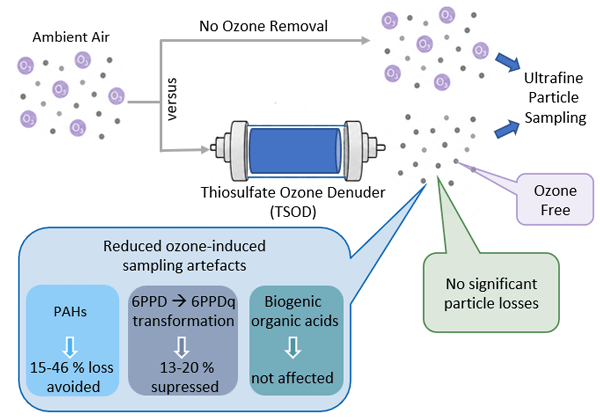
Abstract. Ozone (O₃) remaining in sampling air can artefactually alter the chemical composition of collected ultrafine particles (UFP), biasing quantitative analysis of the chemical composition. In this study, we developed and evaluated a sodium-thiosulfate O₃ denuder (TSOD) specifically tailored for UFP sampling and assessed its O₃ scrubbing efficiency, particle losses, and chemical selectivity. In laboratory tests under controlled relative humidity and inlet O₃ levels up to 200 ppbV, the outlet concentration remained consistently between 0 and 0.3 ppbV, demonstrating the O₃ removal efficiency of the TSOD. During an urban field deployment over 7 days O₃ downstream of the TSOD consistently remained at 0 ppbV while ambient O₃ varied between 0 and 65 ppbV. Moreover, for particles with mobility diameters ranging from 10 to 1000 nm, we did not observe any significant losses in particle number concentrations. Using a parallel two-channel UFP sampler (with vs. without upstream TSOD), we quantified O₃-driven sampling artefacts in UFP mass focussing on three types of organic markers. (1) Firstly, we targeted polycyclic aromatic hydrocarbons (PAH), particularly chrysene (Chry), benz[a]anthracene (BaA), benzo[a]pyrene (BaP), indeno[1,2,3-cd]pyrene (IcdP), benzo[k]fluoranthene (BkF), and benzo[b]fluoranthene (BbF). Without upstream O₃ removal, the individual concentration of the PAH were 15–46 % lower. (2) Secondly, for the tire and road wear marker, the antioxidant N-(1,3-dimethylbutyl)-N′-phenyl-p-phenylenediamine (6PPD) and its oxidation product 6PPD-quinone (6PPDq), we observed in-situ ozonation of 6PPD to 6PPDq with transformation yields of about 13 to 20 %. (3) In contrast, biogenic organic acids (bOAs) did not show differences when sampled with or without O₃, as their O₃ reactivity is much lower than the one of the PAH. Moreover, this test indicated that the TSOD did not perturb the gas–particle partitioning of these semi-volatile species. Our results demonstrate that the TSOD (i) efficiently scrubs atmospheric O₃ at relevant mixing ratios, (ii) does not introduce measurable particle losses across 10–1000 nm, and (iii) preserves semi-volatile partitioning.
-
Notice on discussion status
The requested preprint has a corresponding peer-reviewed final revised paper. You are encouraged to refer to the final revised version.
-
Preprint
(1764 KB)
-
Supplement
(547 KB)
-
The requested preprint has a corresponding peer-reviewed final revised paper. You are encouraged to refer to the final revised version.
- Preprint
(1764 KB) - Metadata XML
-
Supplement
(547 KB) - BibTeX
- EndNote
- Final revised paper


Journal article(s) based on this preprint
Interactive discussion
Status: closed
-
RC1: 'Comment on egusphere-2025-6287', Anonymous Referee #2, 17 Feb 2026
-
AC1: 'Reply on RC1', Elisabeth Eckenberger, 05 May 2026
Publisher’s note: the content of this comment was removed on 7 May 2026 since the comment was posted by mistake.
Citation: https://doi.org/10.5194/egusphere-2025-6287-AC1 - AC2: 'Reply on RC1', Elisabeth Eckenberger, 05 May 2026
-
AC1: 'Reply on RC1', Elisabeth Eckenberger, 05 May 2026
-
RC2: 'Comment on egusphere-2025-6287', Anonymous Referee #1, 08 Apr 2026
In their article "Sodium Thiosulfate-Coated Ceramic Denuders for Ozone Removal in Ultrafine Particle Sampling," manuscript number egusphere-2025-6287, the authors present a device for removing ozone upstream of particle sampling. The approach - sodium thiosulfate-based removal - has been previously demonstrated thoroughly, but the form factor employed here of a multichannel denuder is novel and enables application to particle sampling. Overall, the authors present a thorough and well-developed validation and testing scheme, including both its efficacy and evaluation of the possibility of artifacts. The approach is well-founded, well-tested, and found to be highly effective. I have generally very few comments and believe the article is suitable for publication after addressing a few minor presentation points described below.
Specific comments:
1) A diagram of the field sampling setup would be helpful in Section 2.4. Especially given that the label of Figure 4A is "O3 mixing ratio Container" - it is not clear to me what the "container" is in this context.2) In Figure 2, what is the "measurement point"? Based on the trend in O3_in, I assume these are just sequential points across time, so why not just label it with sample time?
3) In the discussion of Figure 3, it is never discussed by the concentration is so much lower at 4 lpm, though it is shown that the difference between with and without the TSOD is not substantially. I assume this is due to diffusive losses to walls of the sampling inlet due to the longer residence time, but no such explanation is discussed or given. Would such losses be expected based on the diffusion timescale? It does not look there is a preferential loss of smaller particles though. Or is it just because of changes in particle concentrations over time?
4) In Figure 4, a legend on panel B would be helpful. Also, I note that the authors state on line 294 that worst performance is expected at lower RH (side note: I believe the R is usually also capitalized unlike in the manuscript), but it looks like the opposite is true in this panel (though indeed, performance remains excellent)
5) Figure 4 might be clearer in a square form, since it is showing 1:1 comparisons. A few thoughts on the discussion: the 6PPD discussion is very interesting and I appreciated the quantitative yield discussion; why is there so much scatter in the PAH comparison? In particular, there are substantially differeces in the sum Chry BaA scatter - is this because one compound is more reactive than the other? Or can you correlate the deviation from the 1:1 line with ozone concentration, which would be an interesting plot to see?
6) This Data Availability statement is outdated. Though there is likely not much demand for validation data such as this, it is generally more accepted to include the data, at least those used to create the figures, as supplemental data, tables, or a published dataset.
Citation: https://doi.org/10.5194/egusphere-2025-6287-RC2 -
AC3: 'Reply on RC2', Elisabeth Eckenberger, 05 May 2026
The comment was uploaded in the form of a supplement: https://egusphere.copernicus.org/preprints/2026/egusphere-2025-6287/egusphere-2025-6287-AC3-supplement.pdf
-
AC3: 'Reply on RC2', Elisabeth Eckenberger, 05 May 2026


Interactive discussion
Status: closed
-
RC1: 'Comment on egusphere-2025-6287', Anonymous Referee #2, 17 Feb 2026
General Comments:
This article reports on the design and application of a thiosulfate-impregnated honeycomb denuder to mitigate chemical losses from reaction with ozone in ultrafine particle sampling. This is important work, drawing attention to the unfortunately often overlooked interference from ozone in the sampling of atmospheric organic matter. I very much appreciate this study and its reporting and recommend the publication after consideration of a number my specific comments given below.
It would be valuable to also have these experimental details provided: What fraction of ozone makes it through the sampling system without the sodium thiosulfate coating? Given that ozone is a rather reactive gas, a fair amount gets probably removed just by contact with the impactor and plumbing system?
Given the multiple sampling and analysis steps, the chemical quantifications need a thorough experimental determination of the analytical reproducibility of the different chemical classes for the UFP determination. This should be done by deploying complete parallel samplers and not just by parallel sub-sampling of the fractionated aerosol or multiple chemical analyses of the extracts.
Specific Comments:
Line 21, 22: Instead of writing “ 0 ppb”, it would be more accurate to give the threshold of the ozone determination sensitivity, e.g. < 0.3 ppb, or whatever the detection limit of the utilized ozone sensor is.
Line 28: Please give the uncertainty margins of the 15-46% determination.
Line 30: Same here.
Line 49: Possibly also cite the WMO GAW Measurement Guidelines, GAW Report No. 281, Guidelines for Measurements of Non-Methane Hydrocarbons in the Troposphere, that emphasize the need to remove ozone in the sampling of volatile organic compounds.
Line 74. One could also consider [Helmig and Greenberg, 1995].
Line 144: Please mention that these are honeycomb structure channels and that CPSI stands for cells per square inch. How are these connected to your system plumbing? It might be nice to show a photograph of the denuder.
Line 148: I have a hard time believing that shaking of ta 400 CPSI honeycomb denuder will remove all the water? What is the actual diameter of the individual capillaries? This could possibly be checked by weighing a dry denuder and one that has been “shaken”. If residual water remains in the denuder, then that may actually affect the coating efficiency when the denuder is subjected to the sodium thiosulfate solution?
Line 148. “5,6 mol L-1”? Please be consistent with using a decimal point for decimals.
Line 155: Please give complete details about the drying method.
Line 187: Round site coordinates to a reasonable number.
Line 254: Are the error margins 1-sigma standard deviations?
Line 264: Give numeric results and stated uncertainty comparison.
Line 287: How do you conclude that the sodium thiosulfate efficiency is dependent on relative humidity rather than specific humidity?
Line 298: The ozone monitor that was used really isn’t suited for measuring levels below 1 ppb, and the lowest detectable ozone will be quite sensitive to the zero offset that is applied in the monitor. Therefore, the reliably measurable lowest ozone level needs to be carefully determined in a set of zero ozone measurements and only numerical values above the determined ozone detection limit should be reported as numerical data. All other recordings need to be reported as below the detection limit (< x.x ppb) of the measurement.
Figure 4 caption: Replace ‘concentration’ with ‘mixing ratio’ here and elsewhere.
Table 1: Explain in table caption what the reference data are.
Line 458: Most journals these days do not accept this data availability statement. Data should be shared with readers readily within the Supplemental Materials or through a public archive.
Helmig, D., and J. Greenberg (1995), Artifact formation from the use of potassium-iodide based ozone traps during atmospheric sampling of trace organic gases, Journal of High Resolution Chromatography, 18, 15-18.
Citation: https://doi.org/10.5194/egusphere-2025-6287-RC1 -
AC1: 'Reply on RC1', Elisabeth Eckenberger, 05 May 2026
Publisher’s note: the content of this comment was removed on 7 May 2026 since the comment was posted by mistake.
Citation: https://doi.org/10.5194/egusphere-2025-6287-AC1 - AC2: 'Reply on RC1', Elisabeth Eckenberger, 05 May 2026
-
AC1: 'Reply on RC1', Elisabeth Eckenberger, 05 May 2026
-
RC2: 'Comment on egusphere-2025-6287', Anonymous Referee #1, 08 Apr 2026
In their article "Sodium Thiosulfate-Coated Ceramic Denuders for Ozone Removal in Ultrafine Particle Sampling," manuscript number egusphere-2025-6287, the authors present a device for removing ozone upstream of particle sampling. The approach - sodium thiosulfate-based removal - has been previously demonstrated thoroughly, but the form factor employed here of a multichannel denuder is novel and enables application to particle sampling. Overall, the authors present a thorough and well-developed validation and testing scheme, including both its efficacy and evaluation of the possibility of artifacts. The approach is well-founded, well-tested, and found to be highly effective. I have generally very few comments and believe the article is suitable for publication after addressing a few minor presentation points described below.
Specific comments:
1) A diagram of the field sampling setup would be helpful in Section 2.4. Especially given that the label of Figure 4A is "O3 mixing ratio Container" - it is not clear to me what the "container" is in this context.2) In Figure 2, what is the "measurement point"? Based on the trend in O3_in, I assume these are just sequential points across time, so why not just label it with sample time?
3) In the discussion of Figure 3, it is never discussed by the concentration is so much lower at 4 lpm, though it is shown that the difference between with and without the TSOD is not substantially. I assume this is due to diffusive losses to walls of the sampling inlet due to the longer residence time, but no such explanation is discussed or given. Would such losses be expected based on the diffusion timescale? It does not look there is a preferential loss of smaller particles though. Or is it just because of changes in particle concentrations over time?
4) In Figure 4, a legend on panel B would be helpful. Also, I note that the authors state on line 294 that worst performance is expected at lower RH (side note: I believe the R is usually also capitalized unlike in the manuscript), but it looks like the opposite is true in this panel (though indeed, performance remains excellent)
5) Figure 4 might be clearer in a square form, since it is showing 1:1 comparisons. A few thoughts on the discussion: the 6PPD discussion is very interesting and I appreciated the quantitative yield discussion; why is there so much scatter in the PAH comparison? In particular, there are substantially differeces in the sum Chry BaA scatter - is this because one compound is more reactive than the other? Or can you correlate the deviation from the 1:1 line with ozone concentration, which would be an interesting plot to see?
6) This Data Availability statement is outdated. Though there is likely not much demand for validation data such as this, it is generally more accepted to include the data, at least those used to create the figures, as supplemental data, tables, or a published dataset.
Citation: https://doi.org/10.5194/egusphere-2025-6287-RC2 -
AC3: 'Reply on RC2', Elisabeth Eckenberger, 05 May 2026
The comment was uploaded in the form of a supplement: https://egusphere.copernicus.org/preprints/2026/egusphere-2025-6287/egusphere-2025-6287-AC3-supplement.pdf
-
AC3: 'Reply on RC2', Elisabeth Eckenberger, 05 May 2026
Peer review completion


Journal article(s) based on this preprint
Viewed
| HTML | XML | Total | Supplement | BibTeX | EndNote | |
|---|---|---|---|---|---|---|
| 1,409 | 370 | 94 | 1,873 | 210 | 83 | 124 |
- HTML: 1,409
- PDF: 370
- XML: 94
- Total: 1,873
- Supplement: 210
- BibTeX: 83
- EndNote: 124
Viewed (geographical distribution)
| Country | # | Views | % |
|---|
| Total: | 0 |
| HTML: | 0 |
| PDF: | 0 |
| XML: | 0 |
- 1
Elisabeth Eckenberger
Andreas Mittereder
Nadine Gawlitta
Martin Sklorz
Dieter Brüggemann
Ralf Zimmermann
Anke Christine Nölscher
The requested preprint has a corresponding peer-reviewed final revised paper. You are encouraged to refer to the final revised version.
- Preprint
(1764 KB) - Metadata XML
-
Supplement
(547 KB) - BibTeX
- EndNote
- Final revised paper
General Comments:
This article reports on the design and application of a thiosulfate-impregnated honeycomb denuder to mitigate chemical losses from reaction with ozone in ultrafine particle sampling. This is important work, drawing attention to the unfortunately often overlooked interference from ozone in the sampling of atmospheric organic matter. I very much appreciate this study and its reporting and recommend the publication after consideration of a number my specific comments given below.
It would be valuable to also have these experimental details provided: What fraction of ozone makes it through the sampling system without the sodium thiosulfate coating? Given that ozone is a rather reactive gas, a fair amount gets probably removed just by contact with the impactor and plumbing system?
Given the multiple sampling and analysis steps, the chemical quantifications need a thorough experimental determination of the analytical reproducibility of the different chemical classes for the UFP determination. This should be done by deploying complete parallel samplers and not just by parallel sub-sampling of the fractionated aerosol or multiple chemical analyses of the extracts.
Specific Comments:
Line 21, 22: Instead of writing “ 0 ppb”, it would be more accurate to give the threshold of the ozone determination sensitivity, e.g. < 0.3 ppb, or whatever the detection limit of the utilized ozone sensor is.
Line 28: Please give the uncertainty margins of the 15-46% determination.
Line 30: Same here.
Line 49: Possibly also cite the WMO GAW Measurement Guidelines, GAW Report No. 281, Guidelines for Measurements of Non-Methane Hydrocarbons in the Troposphere, that emphasize the need to remove ozone in the sampling of volatile organic compounds.
Line 74. One could also consider [Helmig and Greenberg, 1995].
Line 144: Please mention that these are honeycomb structure channels and that CPSI stands for cells per square inch. How are these connected to your system plumbing? It might be nice to show a photograph of the denuder.
Line 148: I have a hard time believing that shaking of ta 400 CPSI honeycomb denuder will remove all the water? What is the actual diameter of the individual capillaries? This could possibly be checked by weighing a dry denuder and one that has been “shaken”. If residual water remains in the denuder, then that may actually affect the coating efficiency when the denuder is subjected to the sodium thiosulfate solution?
Line 148. “5,6 mol L-1”? Please be consistent with using a decimal point for decimals.
Line 155: Please give complete details about the drying method.
Line 187: Round site coordinates to a reasonable number.
Line 254: Are the error margins 1-sigma standard deviations?
Line 264: Give numeric results and stated uncertainty comparison.
Line 287: How do you conclude that the sodium thiosulfate efficiency is dependent on relative humidity rather than specific humidity?
Line 298: The ozone monitor that was used really isn’t suited for measuring levels below 1 ppb, and the lowest detectable ozone will be quite sensitive to the zero offset that is applied in the monitor. Therefore, the reliably measurable lowest ozone level needs to be carefully determined in a set of zero ozone measurements and only numerical values above the determined ozone detection limit should be reported as numerical data. All other recordings need to be reported as below the detection limit (< x.x ppb) of the measurement.
Figure 4 caption: Replace ‘concentration’ with ‘mixing ratio’ here and elsewhere.
Table 1: Explain in table caption what the reference data are.
Line 458: Most journals these days do not accept this data availability statement. Data should be shared with readers readily within the Supplemental Materials or through a public archive.
Helmig, D., and J. Greenberg (1995), Artifact formation from the use of potassium-iodide based ozone traps during atmospheric sampling of trace organic gases, Journal of High Resolution Chromatography, 18, 15-18.