
the Creative Commons Attribution 4.0 License.
the Creative Commons Attribution 4.0 License.
 | 05 Feb 2026
Impact of black carbon on daytime valley and slope winds in idealised simulations
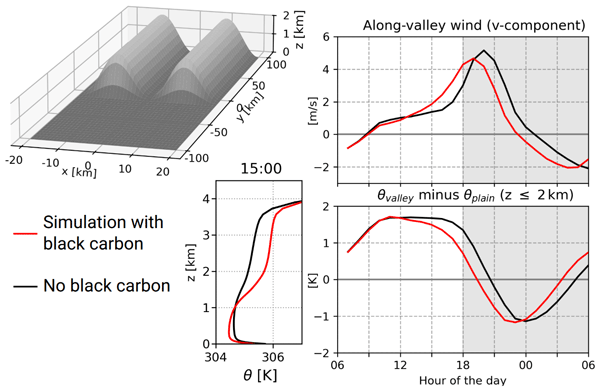
Abstract. Thermally-driven valley circulation plays a key role in transporting air pollutants and heat in mountainous regions, yet the influence of absorbing aerosols on these local winds remains poorly understood. This study investigates how black carbon (BC) affects the daytime valley and slope winds using high-resolution idealised WRF-Chem simulations. The study consist of two simulations: one including realistic BC concentrations that interact with meteorological fields through absorption of incoming solar radiation, and a reference case without BC. When comparing the two simulations, absorption by BC leads to warming in the upper boundary layer and cooling in lower levels during daytime, enhancing boundary-layer stability and reducing surface heating. As a result, the up-slope winds that develop near the slope surface are weaker and flow in a shallower layer in the BC simulation. Although BC also weakens the pressure-gradient force between the plain and the valley that drives the up-valley winds, the up-valley winds in the afternoon become stronger than in the reference simulation. Momentum budget analysis for the valley volume shows that weaker up-slope winds reduce the export of along-valley momentum associated with up-valley winds out of the valley atmosphere, allowing stronger up-valley winds to form despite the weaker forcing. Overall, the results show that absorbing aerosols can modify the thermal structure in the valley and the exchange of heat and momentum between the valley atmosphere and surroundings, revealing a pathway through which aerosols can influence the valley and slope wind characteristics.
-
Notice on discussion status
The requested preprint has a corresponding peer-reviewed final revised paper. You are encouraged to refer to the final revised version.
-
Preprint
(5530 KB)
-
The requested preprint has a corresponding peer-reviewed final revised paper. You are encouraged to refer to the final revised version.
- Preprint
(5530 KB) - Metadata XML
- BibTeX
- EndNote
- Final revised paper


Journal article(s) based on this preprint
Interactive discussion
Status: closed
- RC1: 'Comment on egusphere-2025-6273', Anonymous Referee #1, 18 Feb 2026
-
RC2: 'Comment on egusphere-2025-6273', Anonymous Referee #2, 14 Mar 2026
The comment was uploaded in the form of a supplement: https://egusphere.copernicus.org/preprints/2026/egusphere-2025-6273/egusphere-2025-6273-RC2-supplement.pdf
- AC1: 'Comment on egusphere-2025-6273', Johannes Mikkola, 29 Apr 2026
Peer review completion


Interactive discussion
Status: closed
- RC1: 'Comment on egusphere-2025-6273', Anonymous Referee #1, 18 Feb 2026
-
RC2: 'Comment on egusphere-2025-6273', Anonymous Referee #2, 14 Mar 2026
The comment was uploaded in the form of a supplement: https://egusphere.copernicus.org/preprints/2026/egusphere-2025-6273/egusphere-2025-6273-RC2-supplement.pdf
- AC1: 'Comment on egusphere-2025-6273', Johannes Mikkola, 29 Apr 2026
Peer review completion
Journal article(s) based on this preprint
Viewed
| HTML | XML | Total | BibTeX | EndNote | |
|---|---|---|---|---|---|
| 1,367 | 722 | 138 | 2,227 | 316 | 359 |
- HTML: 1,367
- PDF: 722
- XML: 138
- Total: 2,227
- BibTeX: 316
- EndNote: 359
Viewed (geographical distribution)
| Country | # | Views | % |
|---|
| Total: | 0 |
| HTML: | 0 |
| PDF: | 0 |
| XML: | 0 |
- 1
Johannes Mikkola

Victoria A. Sinclair
Giancarlo Ciarelli
Alexander Gohm
Federico Bianchi
The requested preprint has a corresponding peer-reviewed final revised paper. You are encouraged to refer to the final revised version.
- Preprint
(5530 KB) - Metadata XML
See attached pdf.