
the Creative Commons Attribution 4.0 License.
the Creative Commons Attribution 4.0 License.
 | 19 Jan 2026
2019–2024 trends in African livestock and wetland emissions as contributors to the global methane rise
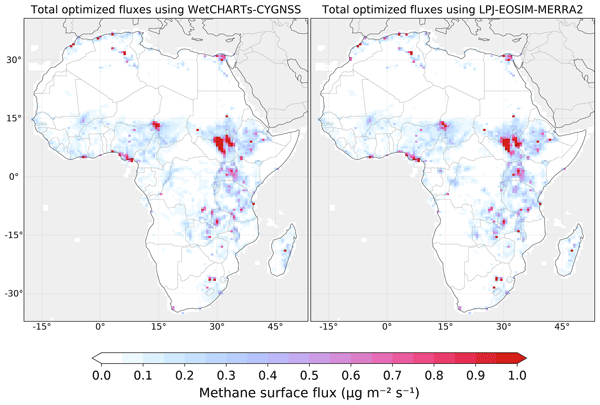
Abstract. The African continent has been recognized as a major driver of the recent rise in atmospheric methane, but the causes are not well understood. Here we use TROPOMI satellite observations of methane to quantify and attribute African emission trends over August 2018–December 2024. We do this with monthly analytical inversions, optimizing surface fluxes at 50 km resolution on the continental scale and using two alternative bottom-up wetland emission models (WetCHARTs-CYGNSS and LPJ-EOSIM-MERRA2) as prior estimates. Our best estimate of total surface fluxes from Africa over the 2019–2024 period is 72 Tg a-1, including 32 Tg a-1 from wetlands and 23 Tg a-1 from livestock. We find that the bottom-up models greatly underestimate wetland emissions in South Sudan and Lake Chad and greatly overestimate emissions in the Congo Basin. Annual methane surface fluxes from Africa increased by 19–21 Tg a-1 over 2019–2024, contributing 27 % of the global emission increase in 2019–2021 and continuing to increase after 2021 even as global emissions decreased. The 2019–2024 increase in African emissions included 11 Tg a-1 from livestock, 4.3–5.7 Tg a-1 from wetlands, and 2.5–2.8 Tg a-1 from waste. The increase in livestock emissions was steady while wetland emissions surged in 2020 and 2024. Previous studies attributed uncertainties in bottom-up wetland data to poor information on inundation extent, but we find that the CYGNSS satellite inundation data match the spatial, seasonal, and interannual patterns of our optimized wetland emissions.
-
Notice on discussion status
The requested preprint has a corresponding peer-reviewed final revised paper. You are encouraged to refer to the final revised version.
-
Preprint
(4435 KB)
-
The requested preprint has a corresponding peer-reviewed final revised paper. You are encouraged to refer to the final revised version.
- Preprint
(4435 KB) - Metadata XML
- BibTeX
- EndNote
- Final revised paper


Journal article(s) based on this preprint
Interactive discussion
Status: closed
- RC1: 'Comment on egusphere-2025-6251', Anonymous Referee #1, 25 Feb 2026
-
RC2: 'Comment on egusphere-2025-6251', Anonymous Referee #2, 25 Feb 2026
The authors use the latest satellite data to investigate changes in African methane emissions from 2018 to 2024. By extending the analysis up to 2024, they provide a timely examination of the causes of the recent surge in atmospheric methane concentrations. The study reveals that emissions in this region have continued to increase in recent years and clearly quantifies the contributions of multiple sectors. I recommend publication after addressing the following comments.
Specific comments:
- It is encouraging to see that the dependence of TROPOMI inversion results on prior information has been resolved in both seasonal and spatial patterns. The authors should discuss the general applicability of this method and its potential limitations.
- The manuscript frequently emphasizes monthly emission quantification, but the analysis primarily focuses on the seasonal variability of wetland emissions. Since livestock migration can also lead to significant monthly changes in emissions, it would be helpful to include a discussion of this aspect.
- Line 179: The description of the CYGNSS satellites as “a constellation of satellites that can use GPS signals to map inland water extent” is not accurate. Its use of L-band Synthetic Aperture Radar (SAR) allows CYGNSS to detect surface water, even under dense wetland vegetation.
- The results of McNicol et al. have considerable uncertainty, so a comparison may not be meaningful. The authors should clarify why this comparison is made—for example, whether it is intended to highlight the current uncertainty in emission intensity estimates.
- The seasonal cycle from the CARDAMOM differs from both the TROPOMI inversion results and the CYGNSS inundation. It would be better to discuss possible reasons for this discrepancy.
- The recent article by Peng et al. (2026, DOI: 10.1126/science.adx8262) should be cited and discussed to support the conclusions regarding annual methane emissions from African wetlands and livestock.
Citation: https://doi.org/10.5194/egusphere-2025-6251-RC2 - AC1: 'Comment on egusphere-2025-6251', Nicholas Balasus, 17 Mar 2026


Interactive discussion
Status: closed
-
RC1: 'Comment on egusphere-2025-6251', Anonymous Referee #1, 25 Feb 2026
This paper reports an inversion to calculate methane fluxes for Africa using a blended TROPOMI-GOSAT satellite XCH4 product. Two different prior estimates are used, and the results are not very sensitive to the prior used. The inferred increase in emissions is attributed mostly to livestock, with other contributions noted. The authors describe changes between the prior and posterior emissions and give explanations for the changes. They suggest reasons for the errors in the wetland prior and how they can be improved.
The paper is very well written, the results are of significance, and I recommend publication after addressing the following minor comments.
General comments
The blended TROPOMI XCH4 product is described at line 100, but elsewhere in the paper, including the abstract it is just referred to as TROPOMI observations. The Balasus et al (2023) that is the reference given for the product calls it a blended TROPOMI+GOSAT product. Would it be more appropriate to describe it as a blended TROPOMI+GOSAT product in the abstract at least, and possibly elsewhere? Or something similar to recognise that the data is TROPOMI bias corrected using GOSAT?Many countries and a few regions in Africa are referred to in the paper, and not all readers will be familiar with them. I suggest labelling them on the maps when they are mentioned, to help the reader. Alternatively, a separate map or insets on existing maps could be used to show the countries/regions mentioned.
Are posterior uncertainties calculated by the inversion? Not much discussion is given on uncertainties in the estimates. The optimised fluxes are given as 71-72 Tg/a, where does this range come from, it is just from the two prior estimates? What else could contribute significantly to the uncertainty in the posterior fluxes? In the abstract the total flux is given just as 72 Tg/a, should that be 71-72 Tg/a? And is that a realistic estimate of the total uncertainty?
Specific comments
line 72 - it took me a while to understand what was meant by "with separation at the equator", perhaps there is a clearer way to explain this.
Line 135-136 - This description of error could be improved: E.g., "are too low" - too low for what? perhaps better to say they don't reflect the total error. "we correct them" - better to say something like "we incorporate retrieval error using TCCON..."
Line 229 - please give a short explanation of how the 10-fold cross validation is carried out (just half a sentence or so). There is not much detail given in Turner et al.Citation: https://doi.org/10.5194/egusphere-2025-6251-RC1 -
RC2: 'Comment on egusphere-2025-6251', Anonymous Referee #2, 25 Feb 2026
The authors use the latest satellite data to investigate changes in African methane emissions from 2018 to 2024. By extending the analysis up to 2024, they provide a timely examination of the causes of the recent surge in atmospheric methane concentrations. The study reveals that emissions in this region have continued to increase in recent years and clearly quantifies the contributions of multiple sectors. I recommend publication after addressing the following comments.
Specific comments:
- It is encouraging to see that the dependence of TROPOMI inversion results on prior information has been resolved in both seasonal and spatial patterns. The authors should discuss the general applicability of this method and its potential limitations.
- The manuscript frequently emphasizes monthly emission quantification, but the analysis primarily focuses on the seasonal variability of wetland emissions. Since livestock migration can also lead to significant monthly changes in emissions, it would be helpful to include a discussion of this aspect.
- Line 179: The description of the CYGNSS satellites as “a constellation of satellites that can use GPS signals to map inland water extent” is not accurate. Its use of L-band Synthetic Aperture Radar (SAR) allows CYGNSS to detect surface water, even under dense wetland vegetation.
- The results of McNicol et al. have considerable uncertainty, so a comparison may not be meaningful. The authors should clarify why this comparison is made—for example, whether it is intended to highlight the current uncertainty in emission intensity estimates.
- The seasonal cycle from the CARDAMOM differs from both the TROPOMI inversion results and the CYGNSS inundation. It would be better to discuss possible reasons for this discrepancy.
- The recent article by Peng et al. (2026, DOI: 10.1126/science.adx8262) should be cited and discussed to support the conclusions regarding annual methane emissions from African wetlands and livestock.
Citation: https://doi.org/10.5194/egusphere-2025-6251-RC2 - AC1: 'Comment on egusphere-2025-6251', Nicholas Balasus, 17 Mar 2026
Peer review completion
Journal article(s) based on this preprint
Model code and software
Code Nicholas Balasus https://github.com/nicholasbalasus/africa_methane_inversion
Viewed
| HTML | XML | Total | BibTeX | EndNote | |
|---|---|---|---|---|---|
| 329 | 268 | 24 | 621 | 24 | 26 |
- HTML: 329
- PDF: 268
- XML: 24
- Total: 621
- BibTeX: 24
- EndNote: 26
Viewed (geographical distribution)
| Country | # | Views | % |
|---|
| Total: | 0 |
| HTML: | 0 |
| PDF: | 0 |
| XML: | 0 |
- 1
Nicholas Balasus
Daniel J. Jacob
A. Anthony Bloom
James D. East
Lucas A. Estrada
Sarah E. Hancock
Todd A. Mooring
Alexander J. Turner
John R. Worden
The requested preprint has a corresponding peer-reviewed final revised paper. You are encouraged to refer to the final revised version.
- Preprint
(4435 KB) - Metadata XML
This paper reports an inversion to calculate methane fluxes for Africa using a blended TROPOMI-GOSAT satellite XCH4 product. Two different prior estimates are used, and the results are not very sensitive to the prior used. The inferred increase in emissions is attributed mostly to livestock, with other contributions noted. The authors describe changes between the prior and posterior emissions and give explanations for the changes. They suggest reasons for the errors in the wetland prior and how they can be improved.
The paper is very well written, the results are of significance, and I recommend publication after addressing the following minor comments.
General comments
The blended TROPOMI XCH4 product is described at line 100, but elsewhere in the paper, including the abstract it is just referred to as TROPOMI observations. The Balasus et al (2023) that is the reference given for the product calls it a blended TROPOMI+GOSAT product. Would it be more appropriate to describe it as a blended TROPOMI+GOSAT product in the abstract at least, and possibly elsewhere? Or something similar to recognise that the data is TROPOMI bias corrected using GOSAT?
Many countries and a few regions in Africa are referred to in the paper, and not all readers will be familiar with them. I suggest labelling them on the maps when they are mentioned, to help the reader. Alternatively, a separate map or insets on existing maps could be used to show the countries/regions mentioned.
Are posterior uncertainties calculated by the inversion? Not much discussion is given on uncertainties in the estimates. The optimised fluxes are given as 71-72 Tg/a, where does this range come from, it is just from the two prior estimates? What else could contribute significantly to the uncertainty in the posterior fluxes? In the abstract the total flux is given just as 72 Tg/a, should that be 71-72 Tg/a? And is that a realistic estimate of the total uncertainty?
Specific comments
line 72 - it took me a while to understand what was meant by "with separation at the equator", perhaps there is a clearer way to explain this.
Line 135-136 - This description of error could be improved: E.g., "are too low" - too low for what? perhaps better to say they don't reflect the total error. "we correct them" - better to say something like "we incorporate retrieval error using TCCON..."
Line 229 - please give a short explanation of how the 10-fold cross validation is carried out (just half a sentence or so). There is not much detail given in Turner et al.