
the Creative Commons Attribution 4.0 License.
the Creative Commons Attribution 4.0 License.
 | 19 Jan 2026
Diatom–environment relationships and limnological variability: an updated quantitative tool for palaeoclimatology on sub-Antarctic Macquarie Island
Abstract. Sub-Antarctic Macquarie Island is ideally located for reconstructing past variations in Southern Hemisphere westerly wind strength. Diatoms are a valuable palaeolimnological tool on sub-Antarctic islands, providing a means to reconstruct past climate and environmental changes. Diatom communities are sensitive to changes in lake electrical conductivity (EC) linked to westerly wind–driven sea-spray inputs on Macquarie Island, and diatom–conductivity models have previously been used to infer past westerly wind variability. Here we present new diatom data from 52 lakes to assess diatom–environment relationships and develop an updated diatom–conductivity model for Macquarie Island. Seasonal and multi-year water chemistry and isotope data were analysed to assess temporal variability in hydrochemical processes and the influence of evaporation, ensuring the resulting diatom-conductivity model reflects external climatic drivers rather than local dynamics. Statistically robust transfer functions were developed for EC (bootstrapped r² = 0.80, RMSEP = 0.40), while pH and temperature had weaker predictive performance. For EC, weighted averaging and maximum-likelihood approaches performed comparably, although the former showed reduced predictive power at high EC where low species turnover and nutrient collinearity affected accuracy. This quantitative-diatom model combined with understanding of hydrogeochemical processes provides an improved basis for reconstructing past Southern Hemisphere westerly wind variability, which can be applied in future palaeoclimate studies on Macquarie Island.
-
Notice on discussion status
The requested preprint has a corresponding peer-reviewed final revised paper. You are encouraged to refer to the final revised version.
-
Preprint
(1750 KB)
-
Supplement
(712 KB)
-
The requested preprint has a corresponding peer-reviewed final revised paper. You are encouraged to refer to the final revised version.
- Preprint
(1750 KB) - Metadata XML
-
Supplement
(712 KB) - BibTeX
- EndNote
- Final revised paper


Journal article(s) based on this preprint
Interactive discussion
Status: closed
-
RC1: 'Comment on egusphere-2025-6242', Lixiong Xiang, 31 Jan 2026
-
AC1: 'Reply on RC1', Caitlin Selfe, 16 Feb 2026
The authors thank RC1 for their constructive review and drawing our attention to points to strengthen the manuscript. Our responses our below, and attached in a full document and we welcome further discussion on these points.
Comment 1 Response CS:
We thank the reviewer for this detailed and constructive comment and agree that the concept of a “recovered baseline” requires clearer definition and more cautious framing.
In the revised manuscript, we endeavour to clarify that by “recovered” we do not imply a fully demonstrable return to pre-invasion conditions, but rather a post-eradication state in which the dominant anthropogenic disturbance (introduced rabbits) has been removed, and ecosystem processes are no longer characterised by the extreme erosion and associated changes documented during the peak disturbance period.
Direct limnological recovery studies for individual lakes following rabbit eradication are limited. However, strong independent evidence for catchment-scale recovery across the island is provided by the documented, rapid and widespread recovery of vegetation following rabbit eradication (e.g. ref). Given the previously severe overgrazing pressure, this vegetation recovery is expected to have substantially reduced soil erosion, land sliding, and sediment and nutrient delivery to lakes, even though quantitative runoff or nutrient time series are not available to directly test this assumption. We will explicitly acknowledge this limitation in the updated text.
Importantly, we are able to provide site-specific evidence from one sedimentary diatom record. At Emerald Lake (LK6), downcore diatom assemblages show a clear ecological shift coincident with the onset and persistence of rabbits, with Fragilaria capucina and Psammothidium abundans dominating downcore intervals across this time (Saunders et al. 2013). Diatom assemblages in recent (2022) surface sediments from this site exhibit higher diversity (48 species) and greater similarity to pre-rabbit sediment intervals than assemblages from surface sediments collected in 2006 (15 species), which was dominated by F.capucina (48% relative abundance), consistent with elevated nutrient conditions and disturbance. Contrastingly F.capucina was not found to occur at LK6 in the 2022 surface sample. This comparison supports the interpretation that recent assemblages no longer reflect peak disturbance conditions.
We agree with the reviewer that the term “pre-invasion baseline” may overstate the certainty of this interpretation. Accordingly, we suggest revising the manuscript to more cautiously describe the updated calibration dataset as representing post-eradication recovery conditions, which are assumed to be moving toward a pre-disturbance state and, critically, are less influenced by the extreme disturbance characterised by the earlier dataset. We believe this distinction strengthens the conceptual foundation of the transfer function and more accurately reflects the available evidence.
Comment 2 Response CS:
We thank the reviewer for this comment and agree that the mechanistic link between wind variability and electrical conductivity (EC) requires clear framing and appropriate consideration of scale.
In this study, EC is interpreted as an integrated limnological variable reflecting the balance between solute inputs, soil-water-air processes operating over multi-annual to decadal timescales. The inferred influence of wind variability on EC is therefore not intended to reflect short-term or event-scale wind forcing, but rather persistent, large-scale changes in atmospheric circulation. Diatom assemblages respond to these longer-term EC states rather than to transient meteorological variability.
The type of direct correlation suggested (e.g. between individual wind events and EC or diatom assemblages) is not feasible at the study location. Macquarie Island is extremely remote, and continuous limnological monitoring data are not available or feasible. Moreover, even if such data existed, event-scale correlations would be inconsistent with the temporal integration inherent in sedimentary diatom assemblages and EC reconstructions and would therefore not provide meaningful validation of the proxy–environment relationship.
The conceptual link between large-scale wind regimes and limnological and ecological responses in Southern Hemisphere lake systems is well established in previous studies (e.g. Saunders et al. 2009; 2016; 2018; Perren et al. 2020; 2025; Van Nieuwenhuyze 2020; Humphries et al. 2021; Meredith et al. 2022) and our interpretation follows this existing framework rather than proposing a new or untested mechanism. We proposed to revise the manuscript introduction to clarify the timescale over which wind variability is relevant and to explicitly state that the inferred wind influence reflects longer-term circulation change, capable of influencing EC through sustained hydrogeochemical changes rather than event-scale forcing.
Comment 3 Response CS:
We thank the reviewer for highlighting the interannual variability in SSA intensity and its potential implications for the calibration dataset. Fig. 4 and Table 2 show that, within lake types, samples from 2018 generally have higher concentrations of marine-derived ions (Cl, SO₄, Br, Mg) compared with 2022. This reflects real interannual differences in sea-spray input, likely driven by both the timing of sampling and natural year-to-year variability. Specifically, the 2018 sample represents a single late-summer sampling, whereas the 2022–23 dataset averages multiple summer samples. Stable isotope data indicate enhanced evaporation for the 2018 point, but even when comparing this to the late-summer 2022 samples (E3), 2018 shows higher ion concentrations than 2022, suggesting stronger SSA input during that year.
Importantly, the diatom–EC transfer function is calibrated only on the 2006 coastal dataset and mean 2022 plateau dataset; the 2018 data were not included. Therefore, interannual variability between 2018 and 2022 does not directly influence the calibration of the transfer function. Within 2022, ion concentrations are consistent across the multiple sampling events, confirming that the modern calibration dataset represents stable hydrogeochemical conditions.
Taken together, these observations support the conclusion that the transfer function is robust, and the inferred species optima are not affected by interannual SSA variability outside the calibration dataset. We will clearly state the data used in the quantitative models to clarify this issue. However if another sensitivity test is still recommended we can include this.
Comment 4 Response CS:
We agree that the co-variation between EC and nutrients requires clearer interpretation. In this study, EC represents the dominant environmental gradient structuring diatom assemblages across Macquarie Island lakes.
Variance partitioning (Fig. 8) shows that EC shares a substantial proportion of explained variance with TON and phosphate, particularly in coastal lakes where marine ions and organic inputs co-occur. However, partial CCA results (Table 5) demonstrate that nutrients explain negligible unique variance once EC is accounted for, whereas EC retains a substantial independent contribution. Statistically, this pattern reflects collinearity along a shared coastal–marine exposure gradient, rather than an independent nutrient effect on diatom composition.
Ecologically, this collinearity is consistent with the recovered state of the system. In plateau lakes, nutrient concentrations are have little variation and are persistently low and near detection limits and are therefore unlikely to exert a primary control on diatom assemblages. Varying and elevated nutrient concentrations only occur in a subset of coastal lakes influenced by marine inputs and animal activity, where nutrients covary with EC as part of a broader marine signal. Thus, the weak unique nutrient signal is not merely a statistical artefact but reflects an ecological reality in which EC exerts a first-order control on diatom communities.
Importantly, this collinearity does not compromise the transfer function, as nutrients are not included as predictor variables and EC retains a strong, independent relationship with diatom assemblage composition, and captures changes across the dataset as a whole, which other variables are not capable of. We will expanded the Discussion to explicitly interpret Fig. 8 and Table 5 and to clarify that the apparent nutrient influence arises from statistical collinearity rooted in system ecology, thereby justifying our exclusive focus on EC for palaeoclimatic inference. We also suggest including some simple linear regression biplots between EC and nutrient variables (Si, TON, Phosphate) from coastal sites in supplementary material to further illustrate the low correlation between them (rough figures included in attached document). While these variables both increase across coastal sites there is little relationship between them.
Comment 5 Response CS:
We agree that the discussion of multi-proxy applications would benefit from a more explicit and testable framework. In the revised manuscript, we will expand this section into a concise synthesis focused primarily on mercury (Hg) isotopes as an independent proxy for atmospheric transport and deposition, which is particularly well suited to the remote setting of Macquarie Island, and such work is currently underway (Schnieder et al. 2024; Li et al. 2025). While stable water isotope (δ²H/δ¹⁸O) data are not currently available for Macquarie Island, we acknowledge their potential for constraining precipitation and evaporation and their influence on EC. We identify δ²H/δ¹⁸O as an important avenue for future research rather than a component of the present work.
Comment 6 Response CS:
We thank the reviewer for this suggestion and for highlighting the potential importance of water depth as an environmental control on diatom assemblages. We agree that water depth can be an important variable in many lacustrine systems, however it is often a composite variable that can reflects (Birks,1998) complex, underlying gradients of habitat (sediment type, macrophyte cover), light, water chemistry (salinity, nutrients, oxygen), and taphonomy, all of which influence diatom composition. Depth often acts as a surrogate variable for what are complex environmental gradients, and the precise causal relationships underlying the observed correlation between depth and diatom distribution are often largely unknown and unquantified (Birks 1998; Juggins et al. 2013).
Furthermore, water depth was not included here as an explanatory variable because all surface sediment samples were collected within a very narrow depth range (0–1.5 m). Within this restricted range, variation in water depth is minimal and unlikely to generate meaningful gradients in light availability or other depth-related ecological controls. As a result, water depth would act as a largely invariant parameter in the calibration dataset and would not contribute explanatory power to the transfer function.
While the narrow sampling depth range was reported in the Methods, we recognise that the rationale for excluding water depth as an environmental variable was not made sufficiently explicit. We will revise the manuscript to clearly state that the limited and shallow depth range of the samples renders water depth ecologically negligible in this dataset, and that associated variables for which depth often acts as a surrogate (e.g. light availability) are therefore assumed to be broadly comparable across sites. This was avoided as including non-casual variables which act as surrogates for unknown or unquantified ecological factors can lead to spurious and misleading results (Juggins at el. 2013).
Comment 7 Response CS:
21 unknown species remained in the > 1% relative abundance dataset used to develop the quantitative models. We will include these details in the results.
Comment 8, 9 and minor issues Response CS:
We thank the reviewer for drawing our attention to these issues and will revise the manuscript to address them as suggested.
-
AC1: 'Reply on RC1', Caitlin Selfe, 16 Feb 2026
-
RC2: 'Comment on egusphere-2025-6242', Anson Mackay, 18 Feb 2026
This study builds upon previous work on developing diatom inference models for electrical conductivity (EC) as a proxy for Southern Hemisphere westerly winds (SHW) from a spatial network of lakes on the sub-Antarctic Macquarie Island. While models were developed previously by Saunders et al. (various publications), the study seeks to improve model performance through expanding the water chemistry datasets across several seasons. Improvements to model development are also linked to data being collected after the successful removal of the invasive rabbit population.
Overall the collection and analyses of the data are robust. Two major things for the authors to consider however are:
(i) I felt that the analyses of the data itself could have been stricter in terms of discussion on what was found to be “significant” or not.
(ii) the study ends by presenting an incremental improvement on diatom-inferred EC models for Macquarie, but with no application. As core material already exists for the island, and reconstructions have previously been published, I would have liked a more critical evaluation of model application over and above model development
Specific comments:
Pages 3-4, Lines 63-75: Although the authors suggest that the post-eradication period is equivalent to pre-invasion baseline communities, I think more caution is needed with this assumption. Moreover, this would only be relevant if EC reconstructions were being carried out on sediments prior to the early 1900s; reconstructions post then based on a spatial dataset that has been impacted by rabbits is appropriate still. So the authors probably need to be a bit more nuanced here.
Lines 66-68: approximately when were all rabbits eradicated? How does this timescale fit with the dates of the datasets used in this study?
Lines 93-95, is it really the case that seasonal and multiyear lake water hydrogeochemical datasets is “rare worldwide”? While long term monitoring datasets should be more common, they are not rare (although in many places there will be geographical scarcity). The authors could be more critical here and outline where long-term / seasonal datasets have been used for quantitative reconstruction studies similar to their own.
Likewise in lines 103-105: the authors claim that this study “…provides a first step towards long-term monitoring of sub-Antarctic lake systems.” But it’s not clear to me how the study will facilitate future long-term monitoring.
Materials and Methods
Lines 113-115: I guess an ultimate goal of model development would be to compare reconstructions of EC with monitoring records of SHW to determine if there is correlation between model and instrumental records. Has this been done by previous authors at all?
P7, Lines 147-148. I’ve not heard of surface sediments being collected before using a long-handled scoop. How were only the top 2cm of sediments controlled for (scooping up sediment suggests to me some mixing will occur). What timescale might 2cm of sediment represent? Could these surface sediments therefore represent several years, or even a decade of accumulation? More information here on sediment / diatom sample collection would be good. Does the collection method match with previous studies etc?
Results
P12, lines 271-272: I'd say that pH 5.7 is an acid lake rather than 'slightly acidic', and pH 9.14 is definitely more than being 'slightly alkaline'. Did diatoms preserve well in these more alkaline lakes? Was there any sign of differential dissolution?
Line 278: Given the relative proximity of the lakes to each other, I think that relying on p values of < 0.05 is a generous cut-off for significance. If this was made more strict, e.g. p < 0.01 or even better 0.005, would you still see differences between plateau lakes measured in 2022 and coastal lakes in 2006? I think that this is a recurring theme throughout the analyses where p values chosen could be more strict and therefore simplifying interpretation of the data better.
Table 1: is it possible to put n values for e.g. each season (numbers of lakes)
Table 2: I wonder if this might not be better presented as box and whisker plots to see differences (if any) between the two years
P14:, line 298-299: if we were being more strict (which I'd recommend,) there is no sig dif in Br either. I think the authors need to appreciate more that the close proximity of the lakes to each other will influence p values through spatial auto-correlation and the same will be true for analyses of lakes in seasons relatively close to each other in terms of time as well. I honestly do not think that p=0.023 represents a true significantly different result. There is quite a large literature on the benefits of using smaller p values in interpreting data.
Lines 310-311: don't think that these lakes are outliers (from looking at Figure 4). They are just at the far end of the gradient. There are various definitions for values / sites to be considered outliers, so technically an objective term!
P15: The section on stable water isotopes have produced some robust findings.
P18, Lines 364-368: Were Bonferroni corrections considered in the forward selection – they need to be.
P19: This section on partial CCAs is robust, ending with good justification for modelling EC
P20, Section 3.3.3: Figures 9 and 10 do not show species optima and tolerances!
F. capucina has an interesting bimodal distribution – why might this be? Did the authors consider using species relationships to selected environmental variables via species response curves fitted with a GAM?
P22: Table 6: I think Temperature is always a difficult variable to model for diatoms, and there is quite a large literature critiquing modelling T from diatoms e.g. see Juggins 2013 (which the authors already cite). I would avoid modelling Temperature in this study
P23 Figure 11: the relationship shown between observed and modelled conductivity is complex and far from linear. ML looks to be more straightforward. It’s good to see (in the Discussion) that the authors taken this complexity when deciding on best final modal to use, and what might be the reasons for this complexity in the EC responses
Discussion
Lines 454-463: the discussion on Br (and indeed all the chemistry) could be more succinct, if as suggested above the threshold for “significance” is more robust (e.g. p = 0.005).
Lines 485-491: this paragraph feels out of place here, and probably belongs elsewhere in the discussion., eg Section 4.4. I doubt that TF would be improved with better seasonal monitoring, although the understanding of lake water chemistry would be improved. Key for any transfer function is that the season for peak diatom growth is sampled. Is this the case here?
I thought that section 4.2 on Evaporation was very good, as it furthers our understanding on a key control on chemical variation in these lakes.
Developing transfer functions: the discussion section is good and supported well by the data. I would agree with their final choice in ML model selection.
Section 4.5: this is fine, but a bit brief. What TF models have been applied to Macquarie Island lakes before. Could this new model not have been applied to those for a comparison? Especially the model developed by Saunders et al 2015 and then applied model by Saunders et al. 2018.
Further, the final sentence on using a multiproxy approach is far too vague – more detail should be given that’s relevant for the region, e.g. what other proxies could be used, how would they complement existing interpretations.
Citation: https://doi.org/10.5194/egusphere-2025-6242-RC2 -
AC2: 'Reply on RC2', Caitlin Selfe, 01 Mar 2026
CS: We thank the reviewer for their very constructive feedback, especially in regard to more robust p-values and discussion of significant findings. We agree that revision of the manuscript in the context of these comments simplifies the discussion and conclusions around seasonal temporal variability, strengthening the manuscript. Please find our comment responses in the attached document.
-
AC2: 'Reply on RC2', Caitlin Selfe, 01 Mar 2026
Peer review completion


Interactive discussion
Status: closed
-
RC1: 'Comment on egusphere-2025-6242', Lixiong Xiang, 31 Jan 2026
This manuscript presents a robust and methodologically significant paleolimnological study that refines diatom-based transfer functions for reconstructing Southern Hemisphere westerly wind (SHW) variability on sub-Antarctic Macquarie Island. By integrating contemporary diatom data with multi-year hydrogeochemical and isotopic datasets, the work effectively updates earlier conductivity-inference models and capitalizes on a unique post-eradication ecological context to establish a more representative diatom-environment baseline. The rigorous assessment of hadrochemical stability and evaporation solidifies electrical conductivity (EC) as a reliable proxy for wind-driven sea-spray aerosol deposition. The resulting model provides an ecologically grounded and statistically robust tool for reconstructing long-term SHW dynamics, advancing paleoclimatic methodology in the data-sparse sub-Antarctic region. However, few aspects require clarification and expansion to fully support the conclusions and maximize the manuscript's impact. I consider this paper to be highly important and valuable, and I strongly recommend it for publication with major revisions.
Detailed assessment and suggestions for improvement
Major issue:
Comment 1: Clarification on the concept of a "recovered baseline" and its validation (lines 61–75).
The manuscript highlights that earlier diatom-environment models were developed during a period of significant ecosystem disturbance from invasive rabbits and argues that the post-eradication dataset provides a better representation of a "natural" or "pre-invasion baseline." This is a critical premise for claiming an improved and more ecologically relevant transfer function. However, the current argument is largely inferential. To substantiate this central claim, more direct evidence or a more rigorous conceptual framework is required. Specifically, the text should address the following questions:
What defines the "recovered" state? Is it the mere absence of rabbits, or are there specific, measurable limnological parameters (e.g., nutrient levels, sediment composition, vegetation cover) that have demonstrably returned to a defined range? Please reference specific post-eradication recovery studies to define the criteria for "recovery" as applied to lacustrine systems.
How do we know this state approximates a "pre-invasion baseline"? The strongest evidence would be a direct comparison. If available, please discuss whether diatom assemblages from your 2022 surface sediments show greater similarity to subfossil diatom assemblages from sediment core intervals dated to pre-1900 (i.e., pre-rabbit introduction) than to assemblages from core intervals representing the peak disturbance period. If such core data is not available, this limitation should be explicitly acknowledged, and the argument should be reframed more cautiously. Instead of claiming to represent a "pre-invasion baseline," it may be more accurate to state that the model reflects "post-distribution recovery conditions" which are assumed to be moving toward a pre-disturbance state, thereby reducing the confounding noise of extreme eutrophication and erosion in the calibration dataset.
Comment 2: Lines 88-89 & throughout Discussion: Clarifying the mechanistic link between diatom-inferred EC and SHW strength.
The manuscript's core hypothesis is that diatom-inferred Electrical Conductivity (EC) serves as a proxy for Southern Hemisphere Westerly Wind (SHW) strength via wind-driven Sea Spray Aerosol (SSA) deposition. While the study excellently establishes the diatom-EC relationship and demonstrates that EC in western lakes reflects SSA inputs, it presents a circular argument when applying this to paleoclimate. The logic is: 1) SHW drives SSA, 2) SSA increases lake EC, 3) Diatoms record EC. Therefore, fossil diatoms can reconstruct past EC, which implies past SSA, which implies past SHW.
However, a critical intermediate step is missing: a quantitative or semi-quantitative demonstration that the observed spatial and interannual EC gradient is directly forced by measurable wind parameters. The discussion relies on citations (e.g., Saunders et al., 2009, 2018) for this link but does not independently validate it with the new, richer 2018-2022 dataset. To resolve this, the following major addition is required:
Perform and present a correlation analysis between measured EC values (or marine ion concentrations like Na+, Cl-) from your key SSA-influenced lakes and instrumental wind data (e.g., mean seasonal wind speed, frequency of high-wind events) from the Macquarie Island station (BOM, 2025) for the corresponding periods (2018, 2022-23). This analysis would test the fundamental assumption that higher EC in a given year or at a given site correlates with stronger westerly wind metrics.
Discussion of the Wind-EC Transfer Function: If a correlation exists, discuss its strength and the potential variance explained by wind speed alone. If the correlation is weak or non-existent for the short instrumental record, discuss other modulating factors (e.g., rainfall dilution history, wave state affecting SSA generation) and what this means for the certainty of reconstructing wind speed(a dynamic variable) from SSA deposition (an integrated flux variable). This moves the discussion from a simple cause-and-effect to a more nuanced, process-based understanding of the proxy.
Comment 3: Interannual variability and its implications for the calibration dataset
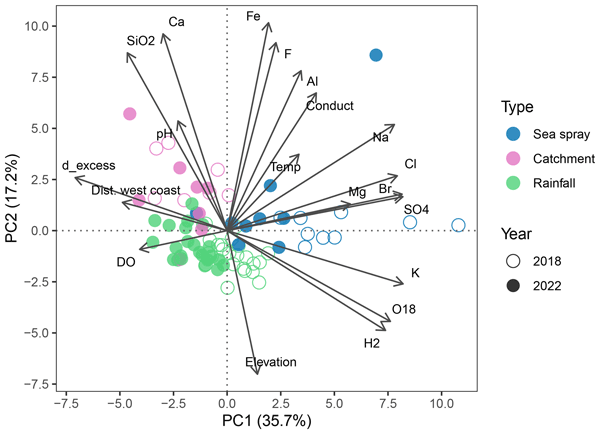
The manuscript correctly observes that the primary clustering in the PCA (Fig. 4) is by lake type (SSA, catchment, rainfall), which indicates the dominant spatial hydrogeochemical processes are consistent between 2018 and 2022. This is a crucial point supporting site selection. However, the same figure also reveals a secondary pattern: for a given lake type, samples often separate by year along PC1 (e.g., SSA lakes from 2018 have more positive scores than those from 2022). Table 2 quantifies this, showing significantly higher mean concentrations of marine-derived ions (Cl, SO₄, Br, Mg) in 2018. This interannual variability in the intensity of the sea-spray signal is an important finding, but its implications for the transfer function need further exploration to fully support the conclusion of robust "hydrogeochemical stability." Please address the following
Impact on model calibration: he diatom-EC transfer function is calibrated on a composite dataset spanning years with demonstrably different SSA intensities (2006, 2018, 2022). This is standard practice, but the observed variability raises a critical methodological question: Does this interannual variation in the modern calibration gradient introduce uncertainty or bias into the species' inferred environmental optima, particularly at the high-EC end critical for reconstructing strong wind periods?
To conclusively demonstrate the model's robustness and the validity of the "stable conditions", a quantitative sensitivity analysis must be added. This analysis should test how the model's core parameters change when calibrated on subsets representing different SSA conditions. Specifically, we request you perform subset calibration: Recalculate the WA transfer function using two distinct modern calibration sets
Set A (Higher SSA):Combine the 2006 coastal data with the 2018 plateau data.
Set B (Lower SSA):Use the 2022 plateau data only.
For key high-EC indicator taxa (e.g., Planothidium lanceolatum, Fragilaria capucina), compare their inferred conductivity optima and tolerances between Set A and Set B. Present this in a supplementary table.
Compare the overall model performance metrics (, RMSEP) and the observed vs. predicted scatter for the two subset models. If species optima and model performance are consistent between subsets, it provides quantitative proof that the model is robust to interannual SSA variability, strongly reinforcing the conclusion of a stable, transferable relationship. If significant shifts in optima occur, it quantifies a potential source of error. This would necessitate a discussion on the implications for reconstructing absolute wind strength and would strengthen the manuscript by rigorously defining the model's calibration uncertainty.
Comment 4: Disentangling EC and nutrient signals (Line 567-574 & Figure 8).
While the manuscript appropriately attributes low plateau-lake nutrient variability to recovered conditions, the combined calibration dataset explicitly includes a high-nutrient gradient via the 2006 coastal lakes. The variance partitioning (Fig. 8) shows major shared variance between EC and nutrients (TON, Phosphate), yet the partial CCA (Table 5) indicates negligible unique nutrient effects. This raises a critical, unresolved question: does the dominant EC signal ecologically overwhelm nutrient influences in this system, or does it statistically mask a co-varying nutrient effect, particularly in coastal lakes where both marine ions and organic nutrients are elevated? Please expand this discussion to explicitly interpret Fig. 8, clarifying whether the weak unique nutrient signal is an ecological reality of the recovered state or a statistical artefact of collinearity, thereby justifying the exclusive focus on EC for paleoclimatic inference.
Comment 5: From suggestion to synthesis for multiproxy research (Line 625–632)
The conclusion on multi-proxy applications is currently vague. Please expand this into a concise synthesis paragraph proposing a specific framework. For example, explain how δ²H/δ¹⁸O could constrain evaporative effects on EC, or how mercury isotopes could independently validate wind-driven aerosol deposition. Outline one or two testable hypotheses that future multi-proxy studies on Macquarie Island could address to resolve the interplay between SHW strength, precipitation, and evaporation.
Comment 6: Some important environmental variables are missing, for example, the effect of water depth on diatom assemblages (Farqan Muhammad et al., 2025, Quaternary International).
Comment 7: Lines 340-341: How many diatom taxa are classified as ‘unknown’?
Comment 8: In the Discussion section, figure numbers should be inserted where appropriate.
Comment 9: In the Introduction and Discussion sections, more studies on diatom–EC transfer functions and the indicative significance of diatoms for salinity should be discussed, for example, Farqan Muhammad et al. (2025, Ecological Indicators).
Minor issue:
Line 21: “Sea-spray inputs” – Specify whether this refers to dry deposition, wet deposition, or both, as this affects the wind-salinity relationship.
Line 63: “from the late 1900s to early 2000's” change to “late 1900s to early 2000s” (no apostrophe).
Line 70: “were conducted during a period of disturbance related to introduced invasive vertebrates rather than when the island was in a natural state” → awkward; rephrase to “were conducted during a period of vertebrate-induced disturbance rather than under near-natural conditions”.
Lines 79–82: Mention whether lake type (SSA, catchment, rainfall) was validated with independent data or is based solely on the Meredith et al. (2022) classification.
Line 121: “drier windier summers” add comma “drier, windier summers”.
Line 126: Figure 1 caption “modern core SHW belt (50–55S°)” correct to 50–55°S.
Lines 203–207: Justify the use of both parametric and non-parametric statistical tests in the same dataset. Consider providing a table of test results for clarity.
Lines 347–355: Mention whether any taxa (Species distributions) are exclusive to coastal vs. plateau lakes, and the implications for salinity inferences.
Lines 437–440: Figure 11 – Label panels (a–d) clearly in the caption and refer to them in the text when discussing model performance.
General – units and formatting: EC is sometimes µS cm⁻¹, sometimes not specified. Standardize to µS cm⁻¹ everywhere. Also check consistency of δ¹⁸O / δ²H notation (superscript vs plain text).
Line 345: In the taxon name Psammothidium confusum var. atomoides, ‘var.’ should be in regular font rather than italics.
Citation: https://doi.org/10.5194/egusphere-2025-6242-RC1 -
AC1: 'Reply on RC1', Caitlin Selfe, 16 Feb 2026
The authors thank RC1 for their constructive review and drawing our attention to points to strengthen the manuscript. Our responses our below, and attached in a full document and we welcome further discussion on these points.
Comment 1 Response CS:
We thank the reviewer for this detailed and constructive comment and agree that the concept of a “recovered baseline” requires clearer definition and more cautious framing.
In the revised manuscript, we endeavour to clarify that by “recovered” we do not imply a fully demonstrable return to pre-invasion conditions, but rather a post-eradication state in which the dominant anthropogenic disturbance (introduced rabbits) has been removed, and ecosystem processes are no longer characterised by the extreme erosion and associated changes documented during the peak disturbance period.
Direct limnological recovery studies for individual lakes following rabbit eradication are limited. However, strong independent evidence for catchment-scale recovery across the island is provided by the documented, rapid and widespread recovery of vegetation following rabbit eradication (e.g. ref). Given the previously severe overgrazing pressure, this vegetation recovery is expected to have substantially reduced soil erosion, land sliding, and sediment and nutrient delivery to lakes, even though quantitative runoff or nutrient time series are not available to directly test this assumption. We will explicitly acknowledge this limitation in the updated text.
Importantly, we are able to provide site-specific evidence from one sedimentary diatom record. At Emerald Lake (LK6), downcore diatom assemblages show a clear ecological shift coincident with the onset and persistence of rabbits, with Fragilaria capucina and Psammothidium abundans dominating downcore intervals across this time (Saunders et al. 2013). Diatom assemblages in recent (2022) surface sediments from this site exhibit higher diversity (48 species) and greater similarity to pre-rabbit sediment intervals than assemblages from surface sediments collected in 2006 (15 species), which was dominated by F.capucina (48% relative abundance), consistent with elevated nutrient conditions and disturbance. Contrastingly F.capucina was not found to occur at LK6 in the 2022 surface sample. This comparison supports the interpretation that recent assemblages no longer reflect peak disturbance conditions.
We agree with the reviewer that the term “pre-invasion baseline” may overstate the certainty of this interpretation. Accordingly, we suggest revising the manuscript to more cautiously describe the updated calibration dataset as representing post-eradication recovery conditions, which are assumed to be moving toward a pre-disturbance state and, critically, are less influenced by the extreme disturbance characterised by the earlier dataset. We believe this distinction strengthens the conceptual foundation of the transfer function and more accurately reflects the available evidence.
Comment 2 Response CS:
We thank the reviewer for this comment and agree that the mechanistic link between wind variability and electrical conductivity (EC) requires clear framing and appropriate consideration of scale.
In this study, EC is interpreted as an integrated limnological variable reflecting the balance between solute inputs, soil-water-air processes operating over multi-annual to decadal timescales. The inferred influence of wind variability on EC is therefore not intended to reflect short-term or event-scale wind forcing, but rather persistent, large-scale changes in atmospheric circulation. Diatom assemblages respond to these longer-term EC states rather than to transient meteorological variability.
The type of direct correlation suggested (e.g. between individual wind events and EC or diatom assemblages) is not feasible at the study location. Macquarie Island is extremely remote, and continuous limnological monitoring data are not available or feasible. Moreover, even if such data existed, event-scale correlations would be inconsistent with the temporal integration inherent in sedimentary diatom assemblages and EC reconstructions and would therefore not provide meaningful validation of the proxy–environment relationship.
The conceptual link between large-scale wind regimes and limnological and ecological responses in Southern Hemisphere lake systems is well established in previous studies (e.g. Saunders et al. 2009; 2016; 2018; Perren et al. 2020; 2025; Van Nieuwenhuyze 2020; Humphries et al. 2021; Meredith et al. 2022) and our interpretation follows this existing framework rather than proposing a new or untested mechanism. We proposed to revise the manuscript introduction to clarify the timescale over which wind variability is relevant and to explicitly state that the inferred wind influence reflects longer-term circulation change, capable of influencing EC through sustained hydrogeochemical changes rather than event-scale forcing.
Comment 3 Response CS:
We thank the reviewer for highlighting the interannual variability in SSA intensity and its potential implications for the calibration dataset. Fig. 4 and Table 2 show that, within lake types, samples from 2018 generally have higher concentrations of marine-derived ions (Cl, SO₄, Br, Mg) compared with 2022. This reflects real interannual differences in sea-spray input, likely driven by both the timing of sampling and natural year-to-year variability. Specifically, the 2018 sample represents a single late-summer sampling, whereas the 2022–23 dataset averages multiple summer samples. Stable isotope data indicate enhanced evaporation for the 2018 point, but even when comparing this to the late-summer 2022 samples (E3), 2018 shows higher ion concentrations than 2022, suggesting stronger SSA input during that year.
Importantly, the diatom–EC transfer function is calibrated only on the 2006 coastal dataset and mean 2022 plateau dataset; the 2018 data were not included. Therefore, interannual variability between 2018 and 2022 does not directly influence the calibration of the transfer function. Within 2022, ion concentrations are consistent across the multiple sampling events, confirming that the modern calibration dataset represents stable hydrogeochemical conditions.
Taken together, these observations support the conclusion that the transfer function is robust, and the inferred species optima are not affected by interannual SSA variability outside the calibration dataset. We will clearly state the data used in the quantitative models to clarify this issue. However if another sensitivity test is still recommended we can include this.
Comment 4 Response CS:
We agree that the co-variation between EC and nutrients requires clearer interpretation. In this study, EC represents the dominant environmental gradient structuring diatom assemblages across Macquarie Island lakes.
Variance partitioning (Fig. 8) shows that EC shares a substantial proportion of explained variance with TON and phosphate, particularly in coastal lakes where marine ions and organic inputs co-occur. However, partial CCA results (Table 5) demonstrate that nutrients explain negligible unique variance once EC is accounted for, whereas EC retains a substantial independent contribution. Statistically, this pattern reflects collinearity along a shared coastal–marine exposure gradient, rather than an independent nutrient effect on diatom composition.
Ecologically, this collinearity is consistent with the recovered state of the system. In plateau lakes, nutrient concentrations are have little variation and are persistently low and near detection limits and are therefore unlikely to exert a primary control on diatom assemblages. Varying and elevated nutrient concentrations only occur in a subset of coastal lakes influenced by marine inputs and animal activity, where nutrients covary with EC as part of a broader marine signal. Thus, the weak unique nutrient signal is not merely a statistical artefact but reflects an ecological reality in which EC exerts a first-order control on diatom communities.
Importantly, this collinearity does not compromise the transfer function, as nutrients are not included as predictor variables and EC retains a strong, independent relationship with diatom assemblage composition, and captures changes across the dataset as a whole, which other variables are not capable of. We will expanded the Discussion to explicitly interpret Fig. 8 and Table 5 and to clarify that the apparent nutrient influence arises from statistical collinearity rooted in system ecology, thereby justifying our exclusive focus on EC for palaeoclimatic inference. We also suggest including some simple linear regression biplots between EC and nutrient variables (Si, TON, Phosphate) from coastal sites in supplementary material to further illustrate the low correlation between them (rough figures included in attached document). While these variables both increase across coastal sites there is little relationship between them.
Comment 5 Response CS:
We agree that the discussion of multi-proxy applications would benefit from a more explicit and testable framework. In the revised manuscript, we will expand this section into a concise synthesis focused primarily on mercury (Hg) isotopes as an independent proxy for atmospheric transport and deposition, which is particularly well suited to the remote setting of Macquarie Island, and such work is currently underway (Schnieder et al. 2024; Li et al. 2025). While stable water isotope (δ²H/δ¹⁸O) data are not currently available for Macquarie Island, we acknowledge their potential for constraining precipitation and evaporation and their influence on EC. We identify δ²H/δ¹⁸O as an important avenue for future research rather than a component of the present work.
Comment 6 Response CS:
We thank the reviewer for this suggestion and for highlighting the potential importance of water depth as an environmental control on diatom assemblages. We agree that water depth can be an important variable in many lacustrine systems, however it is often a composite variable that can reflects (Birks,1998) complex, underlying gradients of habitat (sediment type, macrophyte cover), light, water chemistry (salinity, nutrients, oxygen), and taphonomy, all of which influence diatom composition. Depth often acts as a surrogate variable for what are complex environmental gradients, and the precise causal relationships underlying the observed correlation between depth and diatom distribution are often largely unknown and unquantified (Birks 1998; Juggins et al. 2013).
Furthermore, water depth was not included here as an explanatory variable because all surface sediment samples were collected within a very narrow depth range (0–1.5 m). Within this restricted range, variation in water depth is minimal and unlikely to generate meaningful gradients in light availability or other depth-related ecological controls. As a result, water depth would act as a largely invariant parameter in the calibration dataset and would not contribute explanatory power to the transfer function.
While the narrow sampling depth range was reported in the Methods, we recognise that the rationale for excluding water depth as an environmental variable was not made sufficiently explicit. We will revise the manuscript to clearly state that the limited and shallow depth range of the samples renders water depth ecologically negligible in this dataset, and that associated variables for which depth often acts as a surrogate (e.g. light availability) are therefore assumed to be broadly comparable across sites. This was avoided as including non-casual variables which act as surrogates for unknown or unquantified ecological factors can lead to spurious and misleading results (Juggins at el. 2013).
Comment 7 Response CS:
21 unknown species remained in the > 1% relative abundance dataset used to develop the quantitative models. We will include these details in the results.
Comment 8, 9 and minor issues Response CS:
We thank the reviewer for drawing our attention to these issues and will revise the manuscript to address them as suggested.
-
AC1: 'Reply on RC1', Caitlin Selfe, 16 Feb 2026
-
RC2: 'Comment on egusphere-2025-6242', Anson Mackay, 18 Feb 2026
This study builds upon previous work on developing diatom inference models for electrical conductivity (EC) as a proxy for Southern Hemisphere westerly winds (SHW) from a spatial network of lakes on the sub-Antarctic Macquarie Island. While models were developed previously by Saunders et al. (various publications), the study seeks to improve model performance through expanding the water chemistry datasets across several seasons. Improvements to model development are also linked to data being collected after the successful removal of the invasive rabbit population.
Overall the collection and analyses of the data are robust. Two major things for the authors to consider however are:
(i) I felt that the analyses of the data itself could have been stricter in terms of discussion on what was found to be “significant” or not.
(ii) the study ends by presenting an incremental improvement on diatom-inferred EC models for Macquarie, but with no application. As core material already exists for the island, and reconstructions have previously been published, I would have liked a more critical evaluation of model application over and above model development
Specific comments:
Pages 3-4, Lines 63-75: Although the authors suggest that the post-eradication period is equivalent to pre-invasion baseline communities, I think more caution is needed with this assumption. Moreover, this would only be relevant if EC reconstructions were being carried out on sediments prior to the early 1900s; reconstructions post then based on a spatial dataset that has been impacted by rabbits is appropriate still. So the authors probably need to be a bit more nuanced here.
Lines 66-68: approximately when were all rabbits eradicated? How does this timescale fit with the dates of the datasets used in this study?
Lines 93-95, is it really the case that seasonal and multiyear lake water hydrogeochemical datasets is “rare worldwide”? While long term monitoring datasets should be more common, they are not rare (although in many places there will be geographical scarcity). The authors could be more critical here and outline where long-term / seasonal datasets have been used for quantitative reconstruction studies similar to their own.
Likewise in lines 103-105: the authors claim that this study “…provides a first step towards long-term monitoring of sub-Antarctic lake systems.” But it’s not clear to me how the study will facilitate future long-term monitoring.
Materials and Methods
Lines 113-115: I guess an ultimate goal of model development would be to compare reconstructions of EC with monitoring records of SHW to determine if there is correlation between model and instrumental records. Has this been done by previous authors at all?
P7, Lines 147-148. I’ve not heard of surface sediments being collected before using a long-handled scoop. How were only the top 2cm of sediments controlled for (scooping up sediment suggests to me some mixing will occur). What timescale might 2cm of sediment represent? Could these surface sediments therefore represent several years, or even a decade of accumulation? More information here on sediment / diatom sample collection would be good. Does the collection method match with previous studies etc?
Results
P12, lines 271-272: I'd say that pH 5.7 is an acid lake rather than 'slightly acidic', and pH 9.14 is definitely more than being 'slightly alkaline'. Did diatoms preserve well in these more alkaline lakes? Was there any sign of differential dissolution?
Line 278: Given the relative proximity of the lakes to each other, I think that relying on p values of < 0.05 is a generous cut-off for significance. If this was made more strict, e.g. p < 0.01 or even better 0.005, would you still see differences between plateau lakes measured in 2022 and coastal lakes in 2006? I think that this is a recurring theme throughout the analyses where p values chosen could be more strict and therefore simplifying interpretation of the data better.
Table 1: is it possible to put n values for e.g. each season (numbers of lakes)
Table 2: I wonder if this might not be better presented as box and whisker plots to see differences (if any) between the two years
P14:, line 298-299: if we were being more strict (which I'd recommend,) there is no sig dif in Br either. I think the authors need to appreciate more that the close proximity of the lakes to each other will influence p values through spatial auto-correlation and the same will be true for analyses of lakes in seasons relatively close to each other in terms of time as well. I honestly do not think that p=0.023 represents a true significantly different result. There is quite a large literature on the benefits of using smaller p values in interpreting data.
Lines 310-311: don't think that these lakes are outliers (from looking at Figure 4). They are just at the far end of the gradient. There are various definitions for values / sites to be considered outliers, so technically an objective term!
P15: The section on stable water isotopes have produced some robust findings.
P18, Lines 364-368: Were Bonferroni corrections considered in the forward selection – they need to be.
P19: This section on partial CCAs is robust, ending with good justification for modelling EC
P20, Section 3.3.3: Figures 9 and 10 do not show species optima and tolerances!
F. capucina has an interesting bimodal distribution – why might this be? Did the authors consider using species relationships to selected environmental variables via species response curves fitted with a GAM?
P22: Table 6: I think Temperature is always a difficult variable to model for diatoms, and there is quite a large literature critiquing modelling T from diatoms e.g. see Juggins 2013 (which the authors already cite). I would avoid modelling Temperature in this study
P23 Figure 11: the relationship shown between observed and modelled conductivity is complex and far from linear. ML looks to be more straightforward. It’s good to see (in the Discussion) that the authors taken this complexity when deciding on best final modal to use, and what might be the reasons for this complexity in the EC responses
Discussion
Lines 454-463: the discussion on Br (and indeed all the chemistry) could be more succinct, if as suggested above the threshold for “significance” is more robust (e.g. p = 0.005).
Lines 485-491: this paragraph feels out of place here, and probably belongs elsewhere in the discussion., eg Section 4.4. I doubt that TF would be improved with better seasonal monitoring, although the understanding of lake water chemistry would be improved. Key for any transfer function is that the season for peak diatom growth is sampled. Is this the case here?
I thought that section 4.2 on Evaporation was very good, as it furthers our understanding on a key control on chemical variation in these lakes.
Developing transfer functions: the discussion section is good and supported well by the data. I would agree with their final choice in ML model selection.
Section 4.5: this is fine, but a bit brief. What TF models have been applied to Macquarie Island lakes before. Could this new model not have been applied to those for a comparison? Especially the model developed by Saunders et al 2015 and then applied model by Saunders et al. 2018.
Further, the final sentence on using a multiproxy approach is far too vague – more detail should be given that’s relevant for the region, e.g. what other proxies could be used, how would they complement existing interpretations.
Citation: https://doi.org/10.5194/egusphere-2025-6242-RC2 -
AC2: 'Reply on RC2', Caitlin Selfe, 01 Mar 2026
CS: We thank the reviewer for their very constructive feedback, especially in regard to more robust p-values and discussion of significant findings. We agree that revision of the manuscript in the context of these comments simplifies the discussion and conclusions around seasonal temporal variability, strengthening the manuscript. Please find our comment responses in the attached document.
-
AC2: 'Reply on RC2', Caitlin Selfe, 01 Mar 2026
Peer review completion
Journal article(s) based on this preprint
Viewed
| HTML | XML | Total | Supplement | BibTeX | EndNote | |
|---|---|---|---|---|---|---|
| 1,423 | 556 | 134 | 2,113 | 277 | 87 | 106 |
- HTML: 1,423
- PDF: 556
- XML: 134
- Total: 2,113
- Supplement: 277
- BibTeX: 87
- EndNote: 106
Viewed (geographical distribution)
| Country | # | Views | % |
|---|
| Total: | 0 |
| HTML: | 0 |
| PDF: | 0 |
| XML: | 0 |
- 1
Caitlin A. Selfe
Karina Meredith
Liza McDonough
Justine Shaw
Stephen J. Roberts
Krystyna M. Saunders
The requested preprint has a corresponding peer-reviewed final revised paper. You are encouraged to refer to the final revised version.
- Preprint
(1750 KB) - Metadata XML
-
Supplement
(712 KB) - BibTeX
- EndNote
- Final revised paper
This manuscript presents a robust and methodologically significant paleolimnological study that refines diatom-based transfer functions for reconstructing Southern Hemisphere westerly wind (SHW) variability on sub-Antarctic Macquarie Island. By integrating contemporary diatom data with multi-year hydrogeochemical and isotopic datasets, the work effectively updates earlier conductivity-inference models and capitalizes on a unique post-eradication ecological context to establish a more representative diatom-environment baseline. The rigorous assessment of hadrochemical stability and evaporation solidifies electrical conductivity (EC) as a reliable proxy for wind-driven sea-spray aerosol deposition. The resulting model provides an ecologically grounded and statistically robust tool for reconstructing long-term SHW dynamics, advancing paleoclimatic methodology in the data-sparse sub-Antarctic region. However, few aspects require clarification and expansion to fully support the conclusions and maximize the manuscript's impact. I consider this paper to be highly important and valuable, and I strongly recommend it for publication with major revisions.
Detailed assessment and suggestions for improvement
Major issue:
Comment 1: Clarification on the concept of a "recovered baseline" and its validation (lines 61–75).
The manuscript highlights that earlier diatom-environment models were developed during a period of significant ecosystem disturbance from invasive rabbits and argues that the post-eradication dataset provides a better representation of a "natural" or "pre-invasion baseline." This is a critical premise for claiming an improved and more ecologically relevant transfer function. However, the current argument is largely inferential. To substantiate this central claim, more direct evidence or a more rigorous conceptual framework is required. Specifically, the text should address the following questions:
What defines the "recovered" state? Is it the mere absence of rabbits, or are there specific, measurable limnological parameters (e.g., nutrient levels, sediment composition, vegetation cover) that have demonstrably returned to a defined range? Please reference specific post-eradication recovery studies to define the criteria for "recovery" as applied to lacustrine systems.
How do we know this state approximates a "pre-invasion baseline"? The strongest evidence would be a direct comparison. If available, please discuss whether diatom assemblages from your 2022 surface sediments show greater similarity to subfossil diatom assemblages from sediment core intervals dated to pre-1900 (i.e., pre-rabbit introduction) than to assemblages from core intervals representing the peak disturbance period. If such core data is not available, this limitation should be explicitly acknowledged, and the argument should be reframed more cautiously. Instead of claiming to represent a "pre-invasion baseline," it may be more accurate to state that the model reflects "post-distribution recovery conditions" which are assumed to be moving toward a pre-disturbance state, thereby reducing the confounding noise of extreme eutrophication and erosion in the calibration dataset.
Comment 2: Lines 88-89 & throughout Discussion: Clarifying the mechanistic link between diatom-inferred EC and SHW strength.
The manuscript's core hypothesis is that diatom-inferred Electrical Conductivity (EC) serves as a proxy for Southern Hemisphere Westerly Wind (SHW) strength via wind-driven Sea Spray Aerosol (SSA) deposition. While the study excellently establishes the diatom-EC relationship and demonstrates that EC in western lakes reflects SSA inputs, it presents a circular argument when applying this to paleoclimate. The logic is: 1) SHW drives SSA, 2) SSA increases lake EC, 3) Diatoms record EC. Therefore, fossil diatoms can reconstruct past EC, which implies past SSA, which implies past SHW.
However, a critical intermediate step is missing: a quantitative or semi-quantitative demonstration that the observed spatial and interannual EC gradient is directly forced by measurable wind parameters. The discussion relies on citations (e.g., Saunders et al., 2009, 2018) for this link but does not independently validate it with the new, richer 2018-2022 dataset. To resolve this, the following major addition is required:
Perform and present a correlation analysis between measured EC values (or marine ion concentrations like Na+, Cl-) from your key SSA-influenced lakes and instrumental wind data (e.g., mean seasonal wind speed, frequency of high-wind events) from the Macquarie Island station (BOM, 2025) for the corresponding periods (2018, 2022-23). This analysis would test the fundamental assumption that higher EC in a given year or at a given site correlates with stronger westerly wind metrics.
Discussion of the Wind-EC Transfer Function: If a correlation exists, discuss its strength and the potential variance explained by wind speed alone. If the correlation is weak or non-existent for the short instrumental record, discuss other modulating factors (e.g., rainfall dilution history, wave state affecting SSA generation) and what this means for the certainty of reconstructing wind speed(a dynamic variable) from SSA deposition (an integrated flux variable). This moves the discussion from a simple cause-and-effect to a more nuanced, process-based understanding of the proxy.
Comment 3: Interannual variability and its implications for the calibration dataset
The manuscript correctly observes that the primary clustering in the PCA (Fig. 4) is by lake type (SSA, catchment, rainfall), which indicates the dominant spatial hydrogeochemical processes are consistent between 2018 and 2022. This is a crucial point supporting site selection. However, the same figure also reveals a secondary pattern: for a given lake type, samples often separate by year along PC1 (e.g., SSA lakes from 2018 have more positive scores than those from 2022). Table 2 quantifies this, showing significantly higher mean concentrations of marine-derived ions (Cl, SO₄, Br, Mg) in 2018. This interannual variability in the intensity of the sea-spray signal is an important finding, but its implications for the transfer function need further exploration to fully support the conclusion of robust "hydrogeochemical stability." Please address the following
Impact on model calibration: he diatom-EC transfer function is calibrated on a composite dataset spanning years with demonstrably different SSA intensities (2006, 2018, 2022). This is standard practice, but the observed variability raises a critical methodological question: Does this interannual variation in the modern calibration gradient introduce uncertainty or bias into the species' inferred environmental optima, particularly at the high-EC end critical for reconstructing strong wind periods?
To conclusively demonstrate the model's robustness and the validity of the "stable conditions", a quantitative sensitivity analysis must be added. This analysis should test how the model's core parameters change when calibrated on subsets representing different SSA conditions. Specifically, we request you perform subset calibration: Recalculate the WA transfer function using two distinct modern calibration sets
Set A (Higher SSA):Combine the 2006 coastal data with the 2018 plateau data.
Set B (Lower SSA):Use the 2022 plateau data only.
For key high-EC indicator taxa (e.g., Planothidium lanceolatum, Fragilaria capucina), compare their inferred conductivity optima and tolerances between Set A and Set B. Present this in a supplementary table.
Compare the overall model performance metrics (, RMSEP) and the observed vs. predicted scatter for the two subset models. If species optima and model performance are consistent between subsets, it provides quantitative proof that the model is robust to interannual SSA variability, strongly reinforcing the conclusion of a stable, transferable relationship. If significant shifts in optima occur, it quantifies a potential source of error. This would necessitate a discussion on the implications for reconstructing absolute wind strength and would strengthen the manuscript by rigorously defining the model's calibration uncertainty.
Comment 4: Disentangling EC and nutrient signals (Line 567-574 & Figure 8).
While the manuscript appropriately attributes low plateau-lake nutrient variability to recovered conditions, the combined calibration dataset explicitly includes a high-nutrient gradient via the 2006 coastal lakes. The variance partitioning (Fig. 8) shows major shared variance between EC and nutrients (TON, Phosphate), yet the partial CCA (Table 5) indicates negligible unique nutrient effects. This raises a critical, unresolved question: does the dominant EC signal ecologically overwhelm nutrient influences in this system, or does it statistically mask a co-varying nutrient effect, particularly in coastal lakes where both marine ions and organic nutrients are elevated? Please expand this discussion to explicitly interpret Fig. 8, clarifying whether the weak unique nutrient signal is an ecological reality of the recovered state or a statistical artefact of collinearity, thereby justifying the exclusive focus on EC for paleoclimatic inference.
Comment 5: From suggestion to synthesis for multiproxy research (Line 625–632)
The conclusion on multi-proxy applications is currently vague. Please expand this into a concise synthesis paragraph proposing a specific framework. For example, explain how δ²H/δ¹⁸O could constrain evaporative effects on EC, or how mercury isotopes could independently validate wind-driven aerosol deposition. Outline one or two testable hypotheses that future multi-proxy studies on Macquarie Island could address to resolve the interplay between SHW strength, precipitation, and evaporation.
Comment 6: Some important environmental variables are missing, for example, the effect of water depth on diatom assemblages (Farqan Muhammad et al., 2025, Quaternary International).
Comment 7: Lines 340-341: How many diatom taxa are classified as ‘unknown’?
Comment 8: In the Discussion section, figure numbers should be inserted where appropriate.
Comment 9: In the Introduction and Discussion sections, more studies on diatom–EC transfer functions and the indicative significance of diatoms for salinity should be discussed, for example, Farqan Muhammad et al. (2025, Ecological Indicators).
Minor issue:
Line 21: “Sea-spray inputs” – Specify whether this refers to dry deposition, wet deposition, or both, as this affects the wind-salinity relationship.
Line 63: “from the late 1900s to early 2000's” change to “late 1900s to early 2000s” (no apostrophe).
Line 70: “were conducted during a period of disturbance related to introduced invasive vertebrates rather than when the island was in a natural state” → awkward; rephrase to “were conducted during a period of vertebrate-induced disturbance rather than under near-natural conditions”.
Lines 79–82: Mention whether lake type (SSA, catchment, rainfall) was validated with independent data or is based solely on the Meredith et al. (2022) classification.
Line 121: “drier windier summers” add comma “drier, windier summers”.
Line 126: Figure 1 caption “modern core SHW belt (50–55S°)” correct to 50–55°S.
Lines 203–207: Justify the use of both parametric and non-parametric statistical tests in the same dataset. Consider providing a table of test results for clarity.
Lines 347–355: Mention whether any taxa (Species distributions) are exclusive to coastal vs. plateau lakes, and the implications for salinity inferences.
Lines 437–440: Figure 11 – Label panels (a–d) clearly in the caption and refer to them in the text when discussing model performance.
General – units and formatting: EC is sometimes µS cm⁻¹, sometimes not specified. Standardize to µS cm⁻¹ everywhere. Also check consistency of δ¹⁸O / δ²H notation (superscript vs plain text).
Line 345: In the taxon name Psammothidium confusum var. atomoides, ‘var.’ should be in regular font rather than italics.