
the Creative Commons Attribution 4.0 License.
the Creative Commons Attribution 4.0 License.
 | 22 Jan 2026
Implementing methane dynamics into the LPJmL6 model
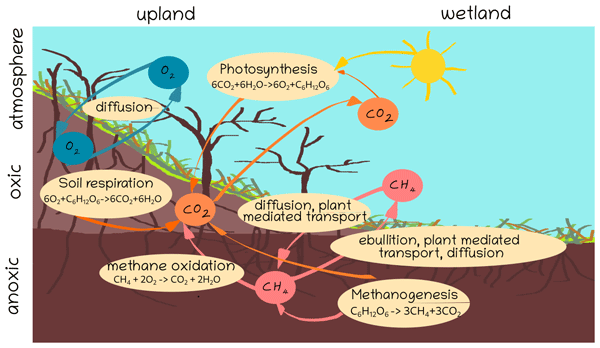
Abstract. We extend the Dynamic Global Vegetation Model LPJmL to version 6.0 by explicitly representing methane (CH4) dynamics within the coupled carbon–nitrogen–water system. The implementation (i) prognoses water-table depth and wetland extent using a CTI–TOPMODEL framework, (ii) solves sub-daily, vertically explicit mass balances for CH4 and O2 including diffusion, ebullition, and plant-mediated transport, (iii) represents methanogenesis and methanotrophy with temperature- and moisture-dependent kinetics, and (iv) integrates land-use and rice management effects alongside inundation-tolerant plant functional types. This architecture enables consistent simulation of CH4, carbon dioxide (CO2) and nitrous oxide (N2) emissions from natural wetlands and managed systems together with the soil CH4 sink. Extensive benchmarking against global datasets shows that LPJmL6 reproduces the magnitude and regional–temporal variability of CH4 flux pathways while maintaining strong skill in the simulated terrestrial carbon, nitrogen, and water budgets. The model thus provides a coherent, process-based framework to quantify CH4 within the coupled carbon–nitrogen–water system, elucidate interactions with vegetation and soils, and assess how land-use, wetland conservation and restoration, and rice management options affect methane and overall greenhouse–gas budgets in support of climate-mitigation strategies.
Competing interests: At least one of the (co-)authors is a member of the editorial board of Geoscientific Model Development. The peer-review process was guided by an independent editor, and the authors also have no other competing interests to declare.
Publisher's note: Copernicus Publications remains neutral with regard to jurisdictional claims made in the text, published maps, institutional affiliations, or any other geographical representation in this paper. While Copernicus Publications makes every effort to include appropriate place names, the final responsibility lies with the authors. Views expressed in the text are those of the authors and do not necessarily reflect the views of the publisher.-
Notice on discussion status
The requested preprint has a corresponding peer-reviewed final revised paper. You are encouraged to refer to the final revised version.
-
Preprint
(12439 KB)
-
Supplement
(3950 KB)
-
The requested preprint has a corresponding peer-reviewed final revised paper. You are encouraged to refer to the final revised version.
- Preprint
(12439 KB) - Metadata XML
-
Supplement
(3950 KB) - BibTeX
- EndNote
- Final revised paper


Journal article(s) based on this preprint
Interactive discussion
Status: closed
-
RC1: 'Comment on egusphere-2025-6210', Anonymous Referee #1, 04 May 2026
-
AC1: 'Reply on RC1', Sibyll Schaphoff, 11 Jun 2026
The comment was uploaded in the form of a supplement: https://egusphere.copernicus.org/preprints/2026/egusphere-2025-6210/egusphere-2025-6210-AC1-supplement.pdf
-
AC1: 'Reply on RC1', Sibyll Schaphoff, 11 Jun 2026
-
RC2: 'Comment on egusphere-2025-6210', Anonymous Referee #2, 08 May 2026
General Comments
This article presents an implementation of the main terrestrial mechanisms governing CH₄ fluxes, covering both anthropogenic sources and natural sources, with well-represented links to the carbon, nitrogen, and water cycles. A particular focus is placed on water table depth modeling to estimate wetland extent using the CTI-TOPMODEL framework. The new model is first evaluated against wetland observations, then used to simulate CH₄ fluxes compared with observational data.
The paper is well constructed and clearly written. The description of the new model is complete, and the number of mechanisms implemented represents an impressive and comprehensive effort within a single framework. However, the introduction would benefit from explicitly listing the newly implemented mechanisms as well as those not yet implemented, rather than leaving the reader to discover them progressively through the model description section. The article only requires a few minor clarifications on missing details, as outlined below.
Specific Comments
- Time stepping and numerical scheme: The main time step used with climate forcing data, and consequently with each model component, is not explicitly stated. Section 2.3 mentions "an adaptive sub-stepping scheme that refines the time step when local CH₄–O₂ concentration gradients become steep", but the baseline time step remains unclear, as does the criterion governing the adaptive refinement. It would be beneficial to either explicitly state these details or provide a reference where this information can be found. Furthermore, regarding the numerical scheme selection (Line 355), the authors mention that only the backward Euler scheme provided sufficient stability. However, stability alone does not guarantee accuracy. It would strengthen the methodological justification to provide the CFL number (CFL = vΔt/Δz) for the vertical water and gas transport equations.
- Slope distribution and wetland fraction validation: The assumptions underlying the chosen hypothesis for slope distribution construction used in the CTI-TOPMODEL framework are not evaluated against observational constraints. It would be valuable to briefly discuss whether these assumptions remain valid across different climatic or topographic regions, particularly where the hypothesis may be too crude. The latitudinal comparison presented in Section 5.2 is pertinent, but a spatial evaluation would further strengthen the validation. Adding supplementary maps of wetland fraction anomalies against multiple observational databases would allow the reader to better assess the sensitivity of the results to the chosen hypothesis for slope distribution construction, and to identify whether systematic errors correlate with topographic characteristics, wetland fraction, or other physically meaningful variables.
- Sensitivity analysis and conclusion: Given the large number of parameterizations introduced, the conclusion would benefit from an additional perspective on sensitivity analysis. A discussion of the relative influence of key parameters on wetland extent and CH₄ flux estimates would be a valuable addition, even as a stated future direction.
Technical Comments
- Line 104: The variable Ψ_inf is used but not defined. Please provide its definition.
- Line 106: The expression "at a time" should be clarified — does this refer to a daily time step if the model operates at daily resolution?
- Line 119: The value of 2.0 m⁻¹ is used without justification. Please provide the source for this parameter value.
- Line 124: The threshold of 100 mm day⁻¹ for agricultural water input requires a reference or justification.
- Line 496: Please add the time step of the GSWP3-W5E5 forcing dataset for completeness.
Citation: https://doi.org/10.5194/egusphere-2025-6210-RC2 -
AC2: 'Reply on RC2', Sibyll Schaphoff, 11 Jun 2026
The comment was uploaded in the form of a supplement: https://egusphere.copernicus.org/preprints/2026/egusphere-2025-6210/egusphere-2025-6210-AC2-supplement.pdf
Peer review completion


Interactive discussion
Status: closed
-
RC1: 'Comment on egusphere-2025-6210', Anonymous Referee #1, 04 May 2026
General comments:
The paper presents the modelling of the methane dynamics into the LPJmL6 land surface model which includes already a representation of the energy, water, carbon and nitrogen cycles. For that purpose, a modelling of the water table depth and wetland extent were included based on the CTI-TOPMODEL framework. Methanogenesis and methanotrophy were parameterized, land use and rice management effects alongside inundation-tolerant vegetation were also represented. Model results evaluated against global datasets show consistent and realistic fluxes, showing the potential of the developed framework to support climate-mitigation strategies.
The paper is well-structured, well-written and easy to read. The parameterisations developed and the results are clearly presented, the figures are of good quality. The paper falls within the scope of GMD and presents a very rigorous and substantial advance in the modelling of the soil methane processes. Therefore, I recommend its publication after the authors address my main concerns.
Specific comments:
- The introduction should present the state of the art of the soil methane processes in Earth System Modeling, especially the previous works which focused on the representation of methane cycle in land surface models. All the bibliography on this topic is missing in the present paper.
- It is important to validate the model on local fluxes. A comparison against site measurements of carbon and methane fluxes is required to show the model performances and give error metrics.
- To better highlight the performances of the model developed, a spatial representation of the methane emissions need to be added (not only latitudinal averages as done here). Maps should be added to present the spatio-temporal variability of the fluxes. A presentation of the contributions of the various processes and ways of transportation would be interesting also.
Technical comments:
- Line 75: grid cell mean water table depth: is it the annual mean? Precise please.
- Table 1, 2 and 3 should be moved to an annex or supplementary document
- Liner 169: equation number is missing
- Line 181: Remove the article “the” at the beginning of the line
Citation: https://doi.org/10.5194/egusphere-2025-6210-RC1 -
AC1: 'Reply on RC1', Sibyll Schaphoff, 11 Jun 2026
The comment was uploaded in the form of a supplement: https://egusphere.copernicus.org/preprints/2026/egusphere-2025-6210/egusphere-2025-6210-AC1-supplement.pdf
-
RC2: 'Comment on egusphere-2025-6210', Anonymous Referee #2, 08 May 2026
General Comments
This article presents an implementation of the main terrestrial mechanisms governing CH₄ fluxes, covering both anthropogenic sources and natural sources, with well-represented links to the carbon, nitrogen, and water cycles. A particular focus is placed on water table depth modeling to estimate wetland extent using the CTI-TOPMODEL framework. The new model is first evaluated against wetland observations, then used to simulate CH₄ fluxes compared with observational data.
The paper is well constructed and clearly written. The description of the new model is complete, and the number of mechanisms implemented represents an impressive and comprehensive effort within a single framework. However, the introduction would benefit from explicitly listing the newly implemented mechanisms as well as those not yet implemented, rather than leaving the reader to discover them progressively through the model description section. The article only requires a few minor clarifications on missing details, as outlined below.
Specific Comments
- Time stepping and numerical scheme: The main time step used with climate forcing data, and consequently with each model component, is not explicitly stated. Section 2.3 mentions "an adaptive sub-stepping scheme that refines the time step when local CH₄–O₂ concentration gradients become steep", but the baseline time step remains unclear, as does the criterion governing the adaptive refinement. It would be beneficial to either explicitly state these details or provide a reference where this information can be found. Furthermore, regarding the numerical scheme selection (Line 355), the authors mention that only the backward Euler scheme provided sufficient stability. However, stability alone does not guarantee accuracy. It would strengthen the methodological justification to provide the CFL number (CFL = vΔt/Δz) for the vertical water and gas transport equations.
- Slope distribution and wetland fraction validation: The assumptions underlying the chosen hypothesis for slope distribution construction used in the CTI-TOPMODEL framework are not evaluated against observational constraints. It would be valuable to briefly discuss whether these assumptions remain valid across different climatic or topographic regions, particularly where the hypothesis may be too crude. The latitudinal comparison presented in Section 5.2 is pertinent, but a spatial evaluation would further strengthen the validation. Adding supplementary maps of wetland fraction anomalies against multiple observational databases would allow the reader to better assess the sensitivity of the results to the chosen hypothesis for slope distribution construction, and to identify whether systematic errors correlate with topographic characteristics, wetland fraction, or other physically meaningful variables.
- Sensitivity analysis and conclusion: Given the large number of parameterizations introduced, the conclusion would benefit from an additional perspective on sensitivity analysis. A discussion of the relative influence of key parameters on wetland extent and CH₄ flux estimates would be a valuable addition, even as a stated future direction.
Technical Comments
- Line 104: The variable Ψ_inf is used but not defined. Please provide its definition.
- Line 106: The expression "at a time" should be clarified — does this refer to a daily time step if the model operates at daily resolution?
- Line 119: The value of 2.0 m⁻¹ is used without justification. Please provide the source for this parameter value.
- Line 124: The threshold of 100 mm day⁻¹ for agricultural water input requires a reference or justification.
- Line 496: Please add the time step of the GSWP3-W5E5 forcing dataset for completeness.
Citation: https://doi.org/10.5194/egusphere-2025-6210-RC2 -
AC2: 'Reply on RC2', Sibyll Schaphoff, 11 Jun 2026
The comment was uploaded in the form of a supplement: https://egusphere.copernicus.org/preprints/2026/egusphere-2025-6210/egusphere-2025-6210-AC2-supplement.pdf
Peer review completion
Journal article(s) based on this preprint
Viewed
| HTML | XML | Total | Supplement | BibTeX | EndNote | |
|---|---|---|---|---|---|---|
| 1,238 | 745 | 142 | 2,125 | 214 | 124 | 234 |
- HTML: 1,238
- PDF: 745
- XML: 142
- Total: 2,125
- Supplement: 214
- BibTeX: 124
- EndNote: 234
Viewed (geographical distribution)
| Country | # | Views | % |
|---|
| Total: | 0 |
| HTML: | 0 |
| PDF: | 0 |
| XML: | 0 |
- 1

David Hötten
Christoph Müller
Dieter Gerten
Sebastian Ostberg
Werner von Bloh
The requested preprint has a corresponding peer-reviewed final revised paper. You are encouraged to refer to the final revised version.
- Preprint
(12439 KB) - Metadata XML
-
Supplement
(3950 KB) - BibTeX
- EndNote
- Final revised paper
General comments:
The paper presents the modelling of the methane dynamics into the LPJmL6 land surface model which includes already a representation of the energy, water, carbon and nitrogen cycles. For that purpose, a modelling of the water table depth and wetland extent were included based on the CTI-TOPMODEL framework. Methanogenesis and methanotrophy were parameterized, land use and rice management effects alongside inundation-tolerant vegetation were also represented. Model results evaluated against global datasets show consistent and realistic fluxes, showing the potential of the developed framework to support climate-mitigation strategies.
The paper is well-structured, well-written and easy to read. The parameterisations developed and the results are clearly presented, the figures are of good quality. The paper falls within the scope of GMD and presents a very rigorous and substantial advance in the modelling of the soil methane processes. Therefore, I recommend its publication after the authors address my main concerns.
Specific comments:
Technical comments: