
the Creative Commons Attribution 4.0 License.
the Creative Commons Attribution 4.0 License.
 | 22 Jan 2026
Sensitivity of Andean Glaciers to ice-flow parameters in the Parallel Ice Sheet Model
Abstract. Mountain glaciers are losing mass rapidly due to anthropogenic climate change. Projections of glacier evolution across the Andes under different warming scenarios have primarily been as part of global scale modelling frameworks, rather than dedicated, regionally optimised, simulations. These global-scale models use simplifications of ice flow physics that may be unsuitable for steep topography, such as that which occurs at mountain valley glaciers. More complex models are available, but with that complexity comes further sources of uncertainty. Here, we assess the sensitivity of the Parallel Ice Sheet Model to ice-flow parameters influencing the ice rheology and subglacial sliding characteristics. We find that the resistance of subglacial material has the most impact on modelled ice outputs (e.g., ice volume), followed by the exponent which relates basal shear stress to sliding, and the threshold velocity at which sliding occurs. The ice-flow rheology enhancement factors, the rate of subglacial water decay, and the maximum water thickness within a presumed subglacial drainage network, can either cause minor variations, or no effect at all, on ice outputs. Our study informs what parameters can potentially be negated in future parameter ensemble tests and provides direction on where further investigation is needed.
-
Notice on discussion status
The requested preprint has a corresponding peer-reviewed final revised paper. You are encouraged to refer to the final revised version.
-
Preprint
(3033 KB)
-
Supplement
(19625 KB)
-
The requested preprint has a corresponding peer-reviewed final revised paper. You are encouraged to refer to the final revised version.
- Preprint
(3033 KB) - Metadata XML
-
Supplement
(19625 KB) - BibTeX
- EndNote
- Final revised paper


Journal article(s) based on this preprint
Interactive discussion
Status: closed
-
RC1: 'Comment on egusphere-2025-6169', Cristina I. Balaban, 19 Feb 2026
-
AC1: 'Reply on RC1', Ethan Lee, 08 Jun 2026
We thank the reviewer for their careful reading and encouraging comments on our manuscript. We have addressed their comments in-line in bold text within this document, and have also annotated where the Reviewer Comment refers to within the tracked changes PDF. Figure captions and line numbers refer to the corrected tracked changes PDF. We have attached here document with tracked changes.
Specific comments
My main comment pertains to embedding more literature in the explanations of the chosen parameters and their behaviour. While this is done well at times, the manuscript could engage with more empirical and/or modelling studies that would support their choices and arguments, or when it does not exist, to explain how such choices were made (see in-line comments). Furthermore, I would encourage the authors to emphasize the potential impact of size and climatic zones of the model domains on the ice-flow parameter sensitivity tests – while the former is acknowledged throughout the results and interpretations, there is no unifying conclusion emerging out of it. In the case of the latter, the climatic zones are described earlier in the manuscript (lines 72-79) but their potential implications (or lack thereof?) are not addressed. Therefore, I think a small subsection/paragraph(s) on these aspects could enrich the manuscript.
We have added more references of literature which had been mentioned previously by the reviewer, and we hope this provides more detail and further justification for the parameters used within this manuscript.
For the comment on conclusions and interpretation of the glacier size and climatic zones, and their effect on the model output alongside the variation of parameters, we have added a few lines on this, see lines 393-402. We provide interpretation of the domain size and overall area/volume of the glaciers. However, ultimately, the interplay between climate and ice flow parameters would require changing the climate over the same domain, which is not the aim of this study.
Technical corrections
Below are some further in-line and Figure/Table comments that include minor suggestions, changes and considerations for the authors to include in the manuscript or consider in their upcoming or future work.
Lines 54-55 – perhaps it is better to be specific about the exact kind of statistical analyses undertaken (these are revealed later, but might be good to explicitly state them here)
We have added the sentence:
‘Model sensitivity is assessed by comparing percentage changes in simulated ice volume and ice area, along with domain-mean ice thickness, and basal velocity relative to default parameter simulations in each study catchment. We use Pearson correlation coefficients between parameter values and model outputs to assess parameter influence over the model output’ See lines 57-60.
Lines 65-67 – this long phrase could benefit from clarity – perhaps write it as two sentences
We have split these up to make them more clear. The new sentence reads:
‘More recently, Zekollari et al. (2025) assessed the committed loss of glaciers after reaching equilibrium with global warming estimates of +1.5℃ and +4.0℃. They estimated that the Southern Andes would lose a mean of 45% and 79% of their mass under these warming levels, and the Low Latitudes a mean of 46% and 96% of their mass respectively.’ See lines 72-74.
Figure 1 – clear, nicely labelled maps. One minor suggestion about the DEM colour scheme– at first sight, it is difficult to tell which is higher/lower ground (in the case of the zoomed-in maps). In my opinion, this could be improved by underlaying them with a hillshade model or using a more traditional topographic colour scheme for the DEM (brown-high – green-low). Otherwise, including the elevation label for each zoomed-in map might also work well.
We have added legends to each subfigure to give the reader the elevation understanding. We attempted with the different suggestion mentioned above, but found that adding lends to each subfigure worked best. Please now see the new and updated Figure 1.
We have also added where the elevation valuers are taken from within the Figure caption. Please see lines 93-94.
Table 1 – Table is organized very clearly. It might also be useful to include a column with references for each parameter. I am also wondering where the minimum and maximum value for the parameters have been determined from – this could go either in-text or in the table.
For each parameter the value ranges come from a number of references, not from a single reference. Due to the size of the table adding another column would squish the table and make it harder to read. However, the values can be linked to the specific sections below Section 3.1.1. for E 3.1.2 for T and 3.1.3 for S. We have added within the table caption that ‘the minimum and maximum values chosen are explained within the main text. Default values are those set within the PISM code.’ See lines 121-122.
Lines 123-124 – it might be useful to explain the variation between the min and max value, both in terms of values and intervals, justifying the rationale
Have added further detail to the final sentence above to ensure there is clarity in the ranges used and where they come from. It now reads:
‘Key parameters we have chosen to change here are mentioned throughout the following sections and in Table 1, together with their PISM default values and the minimum and maximum values used in our sensitivity experiments. These ranges were informed by values used in previous modelling studies, as discussed below, but were deliberately extended beyond commonly applied ranges to test the response of model outputs under a wider parameter space.’ See lines 117-119.
Line 126 – is it called T component because of Till? For the sliding (S) and enhancement (E) parameters, this seems logical – perhaps a mention either in the heading or text would help.
We have added within the paragraph, near the top, a clear mention on why it is term T. ‘We therefore refer to these parameters collectively as the “T component”, where “T” denotes till-related subglacial properties.’ See lines 151-152
Lines 128-133 – this paragraph is explained very well, but I feel some references might be needed here, e.g., on what basis do you know about the thick sediment in the glacier forefields? Are the glaciological explanations supported by other studies?
We have attempted to provide further clarification for the basis of thick sediment in glacier forefields, and references that support the glaciological explanations. It should be noted that due to the model itself, it will represent the entire base of the glacier as having sediment. In the real world this is unlikely to be the case, with areas of glaciers being sediment free, and other incurring thick deposits, but it is a limitation of the model itself. We hope this has added further clarification. See lines 153-158.
Lines 184-185 – could perhaps explain how the choice of the number of ice and bedrock layers was determined – was it by trial or error or suggested by previous work? Are there any effects of this choice on the model outputs and what would these potentially look like?
We have clarified that the vertical-layer setup was chosen to resolve near-basal ice conditions while maintaining feasible run times across the ensemble. We also acknowledge that no dedicated vertical or horizontal resolution sensitivity test was performed, but note that the same set up was applied across all model runs. See lines 243-244.
We also added a sentence that this could be an area of more work for sensitivity to the choice of vertical layers; ‘Another example of future work can be examining the difference in the number of vertical layers within the chosen model domain. While a lower number of layers decreases computation time, and vice versa, this factor has not been studied in detail to understand how vertical grid resolution impacts basal thermal regimes, ice flow, and the overall model output over mountain glaciers’. See lines 614-617.
Line 186 – what is not clear at this point for the reader is whether the mountain glaciers were grown from no ice conditions – perhaps this can be explicitly stated.
Added a small addition that no ice was added, ‘allowing mountain glaciers to grow from no ice conditions…’. See lines 244-245
Lines 200-205 – this paragraph seems vague – what do you mean by ‘commonly used and extended ranges’? Although the ensemble design becomes a little clearer as the reader progresses through the manuscript, a table exemplifying the combination could be useful – there are some examples in the Supplementary Information that could be cited or brought forward as a table here.
We have changed the wording slightly for the section on ‘commonly used and extended ranges’ to ensure it is much clearer. That ‘The parameter values applied spanned beyond those commonly used and extended ranges to capture a broad spectrum of glacier responses, , see Section 3.1 for details’. See lines 262-264.
We then added a citation to SI Table 1 for an example of how these were used in combination. See line 266.
We did not add an example table as the table would be too large, and would be out of place breaking the flow of the paper. We hope this satisfied the reviewer.
Lines 224-225 - ‘We used Davies (2013) which uses…’ - try to avoid repetition
We have tightened up the phrase to be ‘Geothermal heat flux was prescribed from Davies (2013)...’. See lines 290-291.
Lines 230-232 - very good acknowledgement of the WorldClim dataset limitation regarding underestimation of temperature in mountain peaks. Perhaps in future work, the authors could consider the CHELSA dataset (Karger et al., 2017; 2023). It is a downscaling of ERA-interim climatic reanalysis. Although proven to resolve temperature similar to other climate datasets, it yielded more accurate results for precipitation (Karger et al., 2017).
We thank the reviewer for pointing out that we acknowledge the limitation of the WordClim dataset we have used. We looked through the CHELSA dataset and found it to be an exciting dataset that we are looking forward to using within future modelling work. Thank you for pointing this dataset out.
Lines 244-245 – Although somewhat understandable, this sentence could benefit from some clarity/simplification
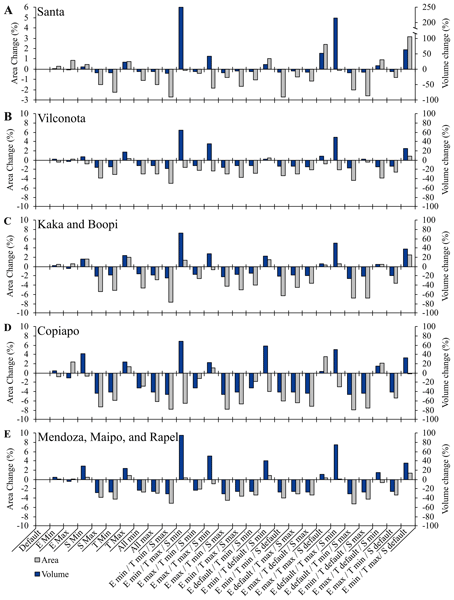
We have made this tighter to ensure it is more clear and simple. It now reads ‘Ice area was largely unaffected by parameter changes. We therefore include area in the sensitivity bar graphs for transparency, but focus the main discussion on ice-volume changes.’ See lines 314-317.
Line 251- ‘varying’ and ‘varied’ – consider avoiding repetition in the same sentence
Removed ‘were varied’ as was repetition. See line 322.
Lines 335-337 – this phrase is slightly long and convoluted – it might need simplifying.
We have attempted to simplify and make it easier to understand. This has made it longer but hopefully easier to follow. It now reads:
‘No change was observed in the Copiapó domain. This may reflect the small glacierised area within this domain, where changes in subglacial hydrological parameters have limited influence on domain-mean outputs. It may also reflect the simplified representation of subglacial hydrology in PISM, which may not fully resolve hydrological variability beneath small mountain glaciers at the model resolution used here.’ See lines 421-424.
Line 362 – remove second ‘.’ After ‘difficult’
We have removed the second ‘.’. See line 454.
Lines 363-365 – good explanation as to why some of the parameters do not have a sufficient effect on the modelled ice outputs. Regarding the PISM hydrology, it might be good to briefly add something here about the default hydrological model and its alternatives (I am aware experimenting with different hydrological models is a suggestion for further work later in the manuscript)
We have changed the sentence to add further information on PISM hydrology, briefly adding what alternatives could be used.
‘Our results indicate that these specific subglacial hydrology parameters have a limited impact on modelled ice outputs in our PISM simulations and can be removed from future sensitivity analysis. This may reflect the model resolution used here, that may limit the influence of local basal-topographic variability on sliding behaviour, or the use of the simplified representation of a non-conserving subglacial hydrology (see Sect. 3.1.2) in PISM when applied to small mountain glaciers. Alternative PISM hydrology schemes, such a steady flow or routing model, may produce stronger sensitivity in small, steep glacier catchments, allowing it to better represent the subglacial hydrology.’ See lines 454-460.
Lines 378-380 – excellent explanation the different ϕ values but might be useful to include some references here
We have added more references to represent past studies that have also detailed similar interpretations. These were Koloski et al. (1989) and Cuffey and Paterson (2010). See line 485.
Line 392 – ‘simulations’ instead of typo ‘simulation s’
Corrected to ‘simulations’. See line 504.
Line 393 – do you mean ‘centered’ instead of ‘cantered’?
Corrected to the correct British spelling of ‘centred’ See line 505
Lines 393 – 395 – good interpretation of the strong influence of ϕ on ice volume outputs – I am wondering whether highlighting this in envelopes on Figure 7 could make them more obvious to the reader? Furthermore, you use catchment numbers in the text (e.g., #4, #5), but these are only labelled with letters on Figure 7 (A-E). Consider adjusting either on the Figure on in the text.
We have removed the catchment numbers, as this was leftover from previous revisions of the manuscript. Have replaced them with the figure number and relevant subfigure letters. See lines 505-506.
We thank the reviewer for the suggestion of highlighting the figure but after some consideration we believe it would draw away from the figure itself and make it look messy. We think it already shows to the reader the pattern of increased ϕ and the ‘grouping’ around the parameter value of ϕ. We have however edited a small error within the figure. A duplication of the legend. This has now been resolved in Figure 7.
Lines 397-399 – keep font consistent in the final submission
We have changed the font back to the original. Seems to be a formatting issue when we confer to PDF. Hopefully this is now resolved. See lines 509-510.
Lines 481-482 – typo ‘parameters mention’ instead of ‘mentioned’. However, it might be better to recap the names of the specific parameters instead
Have recapped the names of the specific parameters for more clear understanding. See lines 599-600.
We have also then added at the end of the paragraph the names of the parameters which were found to have had a greater controller over the modelled ice outputs. See lines
Lines 497-500- good to see appropriate recommendations for sensitivity tests. I would just add that not only is the PISM PDD model sensitive to climatic parameters, but so is the diurnal energy balance model simple (dEBM-simple). This model was argued to be an improved alternative to the PDD model, by accounting for the melt-albedo feedback, without significantly increasing computational time (Zeitz et al., 2021; Garbe et al., 2023). However, to the best of my knowledge, this model has only been applied in ice sheet settings. Therefore, it could represent a research gap for mountain glaciation applications, and it might be worth mentioning as a recommendation for future work.
Have added a final sentence at the end that mentioned the dEBM model and how it works and then it is recommended for future work. ‘Further, PISM has also added the new diurnal energy balance model simple (dEBM-simple) that improves upon the PDD model by accounting for melt-albedo feedback and shortwave radiation, without a significant increase in computational time (Zeitz et al., 2021). This model has only been applied in ice sheet settings but may better represent climatic interactions over mountain glaciers given its explicit consideration of radiative melting.’ See lines 624-628.
Line 535 – zenodo link is not easily clickable/searchable – please adjust the link (this one worked: https://zenodo.org/records/17878115 )
Thank you for testing the link. We have changed the link to better allow the reader to access the data. See line 664.
Suggested references:
Garbe, J., Zeitz, M., Krebs-Kanzow, U., & Winkelmann, R. (2023). The evolution of future Antarctic surface melt using PISM-dEBM-simple. The Cryosphere, 17(11), 4571-4599. https://doi.org/10.5194/tc-17-4571-2023
Karger, D. N., Lange, S., Hari, C., Reyer, C. P., Conrad, O., Zimmermann, N. E., & Frieler, K. (2023). CHELSA-W5E5: daily 1 km meteorological forcing data for climate impact studies. Earth System Science Data, 15(6), 2445-2464. https://doi.org/10.5194/essd-15-2445-2023
Karger, D.N., Conrad, O., Böhner, J., Kawohl, T., Kreft, H., Soria-Auza, R.W., Zimmermann, N.E., Linder, H.P. and Kessler, M., 2017. Climatologies at high resolution for the earth’s land surface areas. Scientific data, 4(1), pp.1-20. https://doi.org/10.1038/sdata.2017.122
Zeitz, M., Reese, R., Beckmann, J., Krebs-Kanzow, U., & Winkelmann, R. (2021). Impact of the melt–albedo feedback on the future evolution of the Greenland Ice Sheet with PISM-dEBM-simple. The Cryosphere, 15(12), 5739-5764.https://doi.org/10.5194/tc-15-5739-2021
Thank you for the suggested references. We have added the bottom one to reference the dEBM-simple model.
-
AC1: 'Reply on RC1', Ethan Lee, 08 Jun 2026
-
RC2: 'Comment on egusphere-2025-6169', Adem Candas, 12 May 2026
General comments
The manuscript presents a parameter analysis for users of the Parallel Ice Sheet Model (PISM). Parameter selection and tuning in PISM can be challenging, particularly for researchers applying the model to complex glacier settings. Therefore, I would like to emphasize that a systematic parameter analysis of this kind is highly useful for the community. This study will be beneficial for researchers using PISM for glacier modelling. A manuscript that focuses specifically on parameter analysis is especially useful for researchers working on mountain glaciers. As the authors also point out, PISM has been more commonly used for ice-sheet applications, while the number of mountain-glacier applications remains relatively limited. When mountain glaciers are considered, additional difficulties arise due to steep topography. While reading the manuscript, I was pleased to find answers to some questions that I had also considered in my own work.
Together with the Supplementary Information, this manuscript has the potential to serve as a useful reference for future researchers working on glacier modelling. I offer the following comments with the intention of improving the clarity of the manuscript and making it more useful for other users. My recommendation is that the manuscript would be suitable for publication after these revisions are addressed.
Specific comments
I think that a short explanation summarizing the main outline of the study at the end of the Introduction would be helpful for the reader. This is, of course, a matter of author preference.
The selected study area is highly suitable for this type of parameter analysis. I think that the topographic characteristics of all five study areas should also be provided. For example, it would be useful to see the minimum, maximum, and mean elevation values for each area. It would also be helpful to better understand the slopes at the valley scale. I think Table 2 may be an appropriate place for this information.
The parameters described in Sections 3.1.1–3.1.3 may need to be explained in more detail in order to reach a broader readership. For example, it would be useful to indicate how an increase or decrease in each parameter is expected to affect glacier thickness, volume, area, and velocity.
I suggest that the authors reconsider the flowchart in Figure 2. Its general structure could be revised, and the workflow should be made more intuitive. For example, Table 1 could be included in the first step.
Technical corrections
Some additional technical suggestions are listed below.
L18 – “The ice-flow rheology enhancement factors, the rate of subglacial water decay, and the maximum water thickness within a presumed subglacial drainage network, can either cause minor variations, or no effect at all, on ice outputs.” It may be useful to clarify that this conclusion applies specifically to mountain glaciers or to the model configurations tested in this study.
L53 – The parameters on which the study focuses could be added here.
L109 – In the description column of Table 1, the direction of the parameter effects could be indicated. For example, the sentence “ESIA and ESSA controls how easily the ice deforms” is useful, but it would be clearer if the authors specified whether increasing or decreasing these parameters leads to this effect.
L121 – Several previous studies used E values of 1–6 and 0–1.5. Could the authors briefly explain why a much wider range of 0.2–20 was selected in this study?
L135 – “till friction angle till friction angle” appears to be repeated.
L149 – I recommend making this explanation slightly clearer for a general readership.
L151 – “The till water decay rate is varied between 0.1 and 12 mm/a, while the maximum till water thickness is varied between 0.1 and 10 m.” Why were these specific values selected?
L175 – “Within the PDD scheme, there is stochastic ‘white noise’ to simulate additional undetermined daily variability, as well as a daily temperature standard deviation that is set by default at 5℃ (Winkelmann et al., 2011). These can cause minor fluctuations in the climate, and thereby in the ice extent even under steady state conditions.” This is actually a debatable issue. There are also studies by Seguinot on this topic, for example doi.org/10.3189/2013JoG13J081. Since this is not the direct focus of the present study, keeping the default setting seems reasonable. However, a short clarification or acknowledgement of this issue may be useful.
L223 – I am not raising this point as a criticism of the approach “bed elevation = topography – present-day thickness”. If present-day thickness values are available, the models could also have been initialized from present-day glaciers. In fact, if present-day glacier outlines are known, this could be a useful calibration constraint. I assume that this was not preferred because the present study is designed as a parameter analysis. Could the authors add a short explanation?
L232 – “we applied a lapse-rate correction of 6.5°C/km”. Was this applied to the entire terrain, or only to the mountain peaks? Could this introduce additional uncertainty?
L234 – “Ultimately, we are not concerned about the size and shape of the glaciers produced.” I could not fully understand this sentence. I suggest rephrasing it.
L269 – “Ice peripheral differences in ice thickness arise from internal variability in the PDD model, despite a temperature standard deviation of 5℃.” This seems to be a rather strong statement. If the authors are confident about this interpretation, it may need to be discussed in the text.
L313 – In Table 4 and the following similar tables, I think the “Average” values may not have a clear statistical meaning because the domains and environmental conditions are different.
L347 – “inferred to be related to the domain geometry or resolution effects within this region.” This seems somewhat speculative and needs further support. Is the resolution not the same in all regions?
L357 – “However, C has been shown to have an increased influence over ice sheets settings.” The phrase “increased influence” is not fully clear. Which parameter or output is affected, and in which direction?
L366 – Thank you for including this information.
L367 – “were saw” should be corrected.
L368 – “…between –40.5% to +23.4% across the domains, respectively” Which domains do these values refer to?
L375 – “Increased values of the ϕ parameter see a reduction in basal velocities.” However, there also seem to be regions where velocities increase. This statement may need to be corrected or clarified.
L406 – These are good results. Thank you!
L433 – “As can be seen in Fig. 11, with decreased 𝑈threshold values overall mean velocities decreased,” Does decreasing the threshold value reduce velocities because it facilitates basal motion? Could the authors clarify the mechanism?
L503 – I think it would be useful to repeat the parameters used here.
L505 – “others” is not clear. Which parameters or studies are being referred to?
L526 – Should this be “Acknowledgements”? Or is this referring to a funded project cited in the text? Please clarify.
Citation: https://doi.org/10.5194/egusphere-2025-6169-RC2 -
AC2: 'Reply on RC2', Ethan Lee, 08 Jun 2026
We thank the reviewer for their careful reading and encouraging comments on our manuscript. We have addressed their comments in-line in bold text within this document, and have also annotated where the Reviewer Comment refers to within the tracked changes PDF. Figure captions and line numbers refer to the corrected tracked changes PDF. Please find the corrected manuscript with tracked changes attached to 'Reply on RC1'.
Specific comments
I think that a short explanation summarizing the main outline of the study at the end of the Introduction would be helpful for the reader. This is, of course, a matter of author preference.
We have expanded the final paragraph of the Introduction to provide a clearer summary of the study design. The revised text now explicitly lists the ice-flow parameters tested, outlines that the analysis uses steady-state univariate and multivariate sensitivity experiments across selected Andean glacier catchments, and explains how model sensitivity is assessed using percentage changes relative to default-parameter simulations and Pearson correlation coefficients. We have also added a sentence clarifying the two-stage structure of the study, in which grouped model components are first tested before more detailed analysis of the most influential individual parameters. See lines 54-62.
The selected study area is highly suitable for this type of parameter analysis. I think that the topographic characteristics of all five study areas should also be provided. For example, it would be useful to see the minimum, maximum, and mean elevation values for each area. It would also be helpful to better understand the slopes at the valley scale. I think Table 2 may be an appropriate place for this information.
We have added the elevation minimums, maximums, and mean within Table 2. These have been taken from the domain statistics rather than the ice area statistics. This is to give an understanding of the domain area statistics and what the elevation looks like.
The parameters described in Sections 3.1.1–3.1.3 may need to be explained in more detail in order to reach a broader readership. For example, it would be useful to indicate how an increase or decrease in each parameter is expected to affect glacier thickness, volume, area, and velocity.
We thank the reviewers for detailing this and we have now added across all sections what the anticipated effects of increasing/decreasing these parameter values might represent. This should hopefully provide further context to the reader when it is discussed their effects in the results and discussion section. An example can be seen at lines 207-211.
I suggest that the authors reconsider the flowchart in Figure 2. Its general structure could be revised, and the workflow should be made more intuitive. For example, Table 1 could be included in the first step.
We have attempted to further revise the structure of the workflow in Figure 2 to make it more understandable on what we conducted during the study. However, it may be difficult to conceptualise it into a flow diagram. We are open to the suggestion of removing it if the reviewers believe it is necessary.
Technical corrections
Some additional technical suggestions are listed below.
L18 – “The ice-flow rheology enhancement factors, the rate of subglacial water decay, and the maximum water thickness within a presumed subglacial drainage network, can either cause minor variations, or no effect at all, on ice outputs.” It may be useful to clarify that this conclusion applies specifically to mountain glaciers or to the model configurations tested in this study.
We have added to the end of the sentence that this is true ‘within our model configuration tested here.’ See line 18
L53 – The parameters on which the study focuses could be added here.
We have added the specific parameters used in this study. ‘These parameters include the ice-flow enhancement factors for the shallow-ice and shallow-shelf approximations, the subglacial water decay rate, the maximum subglacial water thickness, the basal friction angle, the sliding exponent, and the velocity threshold’ See lines 53-56
L109 – In the description column of Table 1, the direction of the parameter effects could be indicated. For example, the sentence “ESIA and ESSA controls how easily the ice deforms” is useful, but it would be clearer if the authors specified whether increasing or decreasing these parameters leads to this effect.
In your previous specific comment above, you requested the addition of how increased/decreased values are likely to affect each parameter. This has been done across all of the parameters mentioned within Sections 3.1. Therefore, here, we have added a slight addition to the description to further provide context on what E is actually doing. ‘.. Are multipliers on the ice softness, controlling how easily the ice deforms.’ Please see Table 1 where the E parameter is mentioned.
We have then added how increased and decreased parameters can lead to this effect within the section where the flow law is discussed. Added to where the E is explained in the equation saying ‘E is implemented for both the SIA and SSA, acting as a multiplier on the ice softness inferred from A. Therefore, higher values are likely to represent softer ice that deforms more readily, while lower values of E represent stiffer ice.’ See lines 135-137.
L121 – Several previous studies used E values of 1–6 and 0–1.5. Could the authors briefly explain why a much wider range of 0.2–20 was selected in this study?
A understand the reason to explain how we have come about using these extended ranges, considering generally studies stay around narrow values for ESIA and ESSA, with the latter sometimes staying between 0 and 1. We have therefore added below after we say about why the wider range of values for E for both SIA and SSA were chosen. ‘This wider range was used due to previous observations of E for the SIA in lab studies have found values between 1.3 and 10.2 (Treverrow et al., 2012), and up to 120 in field studies over the Urymqi Glacier No. 1 in China (Echelmeyer and Zhongxing, 1987). While no observations of E for the SSA are detailed, modelling studies (as shown above) have remained narrower values. By applying an extended range to both E for SSA and SSI, we aim to test whether strongly reduced or enhanced deformation could substantially affect modelled output ice volume, thickness, and velocity, and therefore whether these parameters should be prioritised in future parameter ensembles over mountain glaciers.’ See lines 141-146
L135 – “till friction angle till friction angle” appears to be repeated.
We have removed the repeated ‘till friction angle’. See line 162.
L149 – I recommend making this explanation slightly clearer for a general readership.
We have removed the sentence ‘At all times within the model, 0≤W_till≤W_till^max must be satisfied, with any water above W_till^max being removed.’ This has been replaced before Eq. 3, after where till water thickness is defined, and we have put a clearer sentence ‘This is where W_till is constrained between 0 and the prescribed W_till^max value. Any water exceeding this is removed from the till water layer and is not retained.’ We hope this is more clear to the reader. See lines 174-175.
L151 – “The till water decay rate is varied between 0.1 and 12 mm/a, while the maximum till water thickness is varied between 0.1 and 10 m.” Why were these specific values selected?
This paragraph has been split into two where we also add the addition of what was request from your specific comment about adding the likely effect on ice output from the increase or decrease of parameter values. The first paragraph for C, and then the second for till water max. Therefore the new paragraphs read now as:
‘C and W_till^max are tested in our sensitivity analysis through the T Component. To our knowledge, no previous PISM studies have varied C over mountain glaciers, although PISM ice sheet studies have used values between 1 to 10 mm yr-1 (Albrecht et al. (2020). Higher values of C drain the till faster, analogous to efficient drainage systems, that is likely to cause less sliding overall, while lower valuers of C represent a more inefficient drainage, leading to more water within the till and likely allowing more sliding to occur. Here we vary C between 0.1 and 12 mm/a.
For W_till^max previous PISM mountain glacier studies have used values between 1 to 5 m (Candaş et al., 2020; Žebre et al., 2021). High values of W_till^max allow more water to be retained within the till at the base of the ice., increasing water pressure therefore decreasing the effective pressure (N_till) allowing more sliding to occur. The till water decay rate is varied between 0.1 and 12 mm/a, while tThe W_till^max maximum till water thickness is varied between 0.1 and 10 m (see Table 1). These ranges either extend beyond previously used values for mountain glacier modelling studies, or applied ranges that have only been used over ice sheet scales, aiming to assess whether either parameter has a substantial influence on modelled output of ice volume, thickness, or basal velocity. ’ See lines 180-191.
L175 – “Within the PDD scheme, there is stochastic ‘white noise’ to simulate additional undetermined daily variability, as well as a daily temperature standard deviation that is set by default at 5℃ (Winkelmann et al., 2011). These can cause minor fluctuations in the climate, and thereby in the ice extent even under steady state conditions.” This is actually a debatable issue. There are also studies by Seguinot on this topic, for example doi.org/10.3189/2013JoG13J081. Since this is not the direct focus of the present study, keeping the default setting seems reasonable. However, a short clarification or acknowledgement of this issue may be useful.
We thank the reviewer for bringing this to our attention. They are correct that this is a debatable issue and is not generally discussed in other PISM studies that use the PDD model. Therefore, we have taken the advice from the reviewer and added an acknowledgement that using the default temperature standard deviation may provide erroneous melt if not specifically determined for the study region. We have modified the paragraph to incorporate this issue and cited the reference mentioned in their comment. The final sentence after is:
‘Any minor fluctuations in steady-state ice extent associated with the PDD scheme are consistent across the ensemble and do not affect the relative comparison between ice-flow parameter perturbations.’ See lines 234-236.
L223 – I am not raising this point as a criticism of the approach “bed elevation = topography – present-day thickness”. If present-day thickness values are available, the models could also have been initialized from present-day glaciers. In fact, if present-day glacier outlines are known, this could be a useful calibration constraint. I assume that this was not preferred because the present study is designed as a parameter analysis. Could the authors add a short explanation?
We appreciate the reviewer for picking this up. We could have used present day ice thickness to spin up the models so we are not entirely starting from nothing. However we wanted to ensure we had nothing else affecting the ice-flow parameters in their effects. It is likely this would not affect it, however, is it a choice we decided to go down when conducting the modelling work.
We believe however that we have already mentioned the lack of initial ice thickness being used to run the model. This can be found in Section 3.2 in lines 247-249. We hope that this satisfies the reviewers comments.
L232 – “we applied a lapse-rate correction of 6.5°C/km”. Was this applied to the entire terrain, or only to the mountain peaks? Could this introduce additional uncertainty?
We have added a small clarification that this was used ‘across the entire temperature fields…’. See lines 298-299.
We have also added a sentence that use of temperature lapse rate for temperature corrections are another area of uncertainty, but because we are not concerned with climate related parameters we used a default, globally averaged, value. ‘We acknowledge that the chosen lapse rate correction of the temperature field can itself present some uncertainty. Ultimately, the purpose of the climate forcing in this study is not to reproduce the exact present-day size and shape of each glacier, but to generate steady-state ice extent within each domain from which we can determine the sensitivity to ice-flow parameters.’ See lines 304-307.
L234 – “Ultimately, we are not concerned about the size and shape of the glaciers produced.” I could not fully understand this sentence. I suggest rephrasing it.
After reading this we can clearly see it sounds dismissive and may not be entirely understandable. We have therefore rephrased it to ‘Ultimately, the purpose of the climate forcing in this study is not to reproduce the exact present-day size and shape of each glacier, but to generate steady-state ice extent within each domain from which we can determine the sensitivity to ice-flow parameters.’ See lines 300-303.
L269 – “Ice peripheral differences in ice thickness arise from internal variability in the PDD model, despite a temperature standard deviation of 5℃.” This seems to be a rather strong statement. If the authors are confident about this interpretation, it may need to be discussed in the text.
Correct to mention that this sounds rather strong is its statement. In reality we are making an informed guess due to the presence of the previously mentioned internal variability within the PDD model. We have therefore rephrased this statement to be less deterministic, and more of an informed likelihood of it being the case, also referring back to the section we mentioned the internal variability. ‘Ice peripheral differences in ice thickness are likely to arise from internal variability in the PDD model as mentioned previously in Sect. 3.3.’ See lines 340-342.
L313 – In Table 4 and the following similar tables, I think the “Average” values may not have a clear statistical meaning because the domains and environmental conditions are different.
We agree that a simple average across domains should not be interpreted as a formal regional statistic. We have therefore revised the table labels/captions to clarify that the final row reports the ‘mean absolute correlation’ across domains only as a descriptive summary of relative parameter influence. We now explicitly state that this value should not be interpreted as a statistically representative regional average. See Tables 4, 6, and 8. An example can be seen in lines 383-385.
L347 – “inferred to be related to the domain geometry or resolution effects within this region.” This seems somewhat speculative and needs further support. Is the resolution not the same in all regions?
We agree that the previous wording was too speculative, particularly the reference to possible resolution effects, since all domains were run at the same horizontal resolution. We have therefore revised the sentence to avoid attributing the Vilcanota response to model resolution. The revised text now states more cautiously that the reduced velocity response to lower maximum till water depths values may reflect the extent to which reduced local till-water storage increases basal resistance in areas of the glacier bed where sliding occurs. We also clarify that this response remains small relative to the effects of the till friction angle which is discussed later in the section. It now reads ‘This may indicate that, in this domain, reducing the maximum till water thickness, and thus the water storage, slightly increased basal resistance in parts of the glacier bed where sliding occurs. However, the response remains small relative to the effects of the till friction angle (detailed below).’ See lines 435-438.
L357 – “However, C has been shown to have an increased influence over ice sheets settings.” The phrase “increased influence” is not fully clear. Which parameter or output is affected, and in which direction?
We have revised the sentence to clarify that the influence of C refers specifically to ice sheet settings, mass loss and simulated SLE meltwater in previous PISM experiments. We now state that Albrecht et al. (2020) showed increased Antarctic mass loss when C was increased from 1 to 10 mm yr-1, and we have now clarified that this is a ‘stronger’ influence in ice-sheet settings is likely linked to the role of subglacial hydrology in basal resistance, ice streaming, and large-scale ice discharge.
It now reads ‘However, variations in C have been shown to have an influence over ice sheets settings. Albrecht et al. (2020) details that increasing C from 1 to 10 mm yr⁻¹ can cause PISM to simulate an additional 11 m sea level equivalent (SLE) of meltwater from the Antarctic Ice Sheet over multiple glacial cycle timescales. This stronger influence in ice sheet settings is likely due to the greater role of subglacial hydrology in driving ice streaming, influencing basal resistance and therefore ice discharge (Kazmierczak et al., 2022; Verjans and Robel, 2024). While subglacial hydrology does not affect mountain glaciers to the same extent (Mair et al., 2002), they can affect glacier motion on diurnal time scales (Nienow et al., 2005) which would make modelling their interaction difficult.’ See lines 448-454.
L366 – Thank you for including this information.
We thank the reviewer for this. However, this was edited following a comment from RC1. We hope that the revised paragraph is still in line with what the reviewer read and still find it useful.
L367 – “were saw” should be corrected.
We have removed ‘were’ from the sentence to hopefully improve clarity. See line 465.
L368 – “…between –40.5% to +23.4% across the domains, respectively” Which domains do these values refer to?
We understand where this would be confusing, mentioning domains and then saying ‘respectively’ when it was in relation to the ‘minimum and maximum values’ statement. We have reworded this to make it more clear in its statement, changing it to ‘When ϕ was varied (Table 1), simulated ice volumes saw changes between –40.5% with minimum values and up to +23.4% with maximum values across all domains.’ See lines 465-466.
L375 – “Increased values of the ϕ parameter see a reduction in basal velocities.” However, there also seem to be regions where velocities increase. This statement may need to be corrected or clarified.
We thank the reviewer for picking up on this and we are disappointed we did not explain this well enough in the text. Therefore we have added more to the paragraph detailing the results of the varying of ϕ. The initial section of the paragraph discusses the domain-means. This is where we see the increase in ϕ leading to a decrease in velocities. The later part of the paragraph now details the more localised response. Detailing that an increase in ϕ may lead to overall decreased velocities, but locally, there is a redistribution in ice flow and stress balances that then lead to localised increases in velocities. We hope this satisfies the reviewer.
The new part of the paragraph detailed here ‘The values above represent the domain-mean responses. Spatially, the velocity response to ϕ variations in ϕ are not uniform. Although increasing ϕ reduced mean basal velocity across the domains, localised increases in basal velocity occurred in some areas (see Fig. 9 Phi_max). These localised increases likely reflect redistribution of ice flow where changes in basal resistance altered glacier stress balance. Similarly, while reducing ϕ increased domain-mean basal velocity, localised decreases occurred in some areas, likely due to redistribution of flow towards faster-flowing parts of the glacier system.’ See lines 471-475.
We have also added a new part onto the Figures caption that reads’ however there are localised increases in velocities with higher ϕ reflect localised redistribution of ice flow’. See lines 479-480.
Further, we have added some sentences within the discussion section of ϕ to further produce detail in this localised vs domasin-mean effect. We have also made it so when we talk about the ‘decrease ϕ increase velocities’ that we main this as a ‘domain-mean’ rather than a casual causation that occurs uniform across the domain.
This now reads as:
‘The influence of sϕ over the ice basal velocities is consistent with the intuitive nature of increased values of ϕ increasing basal resistance, and thus limiting basal sliding. However, the response was not uniform spatially with ice basal velocities presenting the opposite to the domain-mean pattern within localised areas (i.e., increase ϕ seeing increase localised velocities and vice versa). These are likely due to changes in the ice divides and flow regimes that can lead to subsequent changes in the ice thicknesses and ice velocity. This localised vs domain-mean effect of the ϕ is consistent with previous studies showing that, even when using spatial uniform parameters, there can still be spatially variable basal conditions, that can strongly influence velocity structure and sliding patterns across the model domain (Gowan et al., 2023; Johnson et al., 2023).’ See lines 488-495.
We hope that this will satisfy the reviewers on this matter.
L406 – These are good results. Thank you!
We are glad that the reviewer found these results to be good.
L433 – “As can be seen in Fig. 11, with decreased 𝑈threshold values overall mean velocities decreased,” Does decreasing the threshold value reduce velocities because it facilitates basal motion? Could the authors clarify the mechanism?
We have added a sentence after where the effect of the u_threshold has been stated, ‘This behaviour is in line with the behaviour expected and described in Sect. 3.1.3 where increases in the u_threshold delaying the transition to Coulomb-limited sliding that facilitates faster flowing ice where ice is already flowing at high velocities.’. See lines 549-550
L503 – I think it would be useful to repeat the parameters used here.
We believe that later in the conclusion we note the parameters in their respective locations (those with least influence: lines 638-641, those with most influence: lines 642-647) that detail if they had limited influence over the ice model outputs, or if they have a strong influence over them. We believe this to be adequate to what the reviewer is requesting.
L505 – “others” is not clear. Which parameters or studies are being referred to?
We understand how this can be seen as being unclear. We have therefore reworded the sentence to ensure that there is no ambiguity over what is being stated. It now reads ‘We examined parameters tested in previous studies, and that have either identified parameters as having a large influence over, or having mixed influence, influential over ice model outputs, in different glacial environments.’ See lines 632-634
L526 – Should this be “Acknowledgements”? Or is this referring to a funded project cited in the text? Please clarify.
This is the project which this paper was produced under as an initial test of parameters we are deemed important. We shall then use these to then inform our parameter-optimisation runs for future transient runs. This is hopefully a paper we will be able to refer back to in the text to ensure we do not need to rewrite our sensitivity testing for why we picked certain parameters.
Citation: https://doi.org/10.5194/egusphere-2025-6169-AC2
-
AC2: 'Reply on RC2', Ethan Lee, 08 Jun 2026
Peer review completion


Interactive discussion
Status: closed
-
RC1: 'Comment on egusphere-2025-6169', Cristina I. Balaban, 19 Feb 2026
General comments
The present manuscript aims to test the impact of various ice-flow parameters of the Parallel Ice Sheet Model (PISM) over numerically modelled glacier outputs in the Andes. This study is motivated by a research gap on the appropriate parameterization of glaciological parameters in PISM over mountain glacier settings, the simplistic nature of global-scale models in replicating accurate ice flow, and the importance of the study area for water resources under future climate change projections. The manuscript addresses the aim through two modelling experiment ensembles, iterating enhancement factors, subglacial properties- and basal-sliding-related PISM parameters through default, minimal and maximal values over five Andean hydrological catchments, assessing their effect on ice volume and area. The study finds that some parameters, such as enhancement factors (E), the rate of subglacial water decay (C), and maximum water thickness (Tm) have little-to-no impact on the modelled outputs, whereas some of the subglacial properties-related ones, namely the resistance of subglacial material (ϕ), the exponent relating basal shear stress to sliding (q), and the sliding velocity threshold (𝑈𝑡ℎ𝑟𝑒𝑠ℎ𝑜𝑙𝑑) have a significant or higher impact. The authors conclude that such findings can help in the selection of the appropriate ice-flow parameters in future work, improving both research design and conservation of computational resources.
Overall, this manuscript represents a significant contribution to our understanding of how several PISM ice flow parameters influence ice volume and area outputs, which have not been intensively experimented with in mountain glaciation settings before. Thus, I foresee this work being a future reference point for many PISM users, who often resort to default parameter values or guesswork in their choices when modelling the (palaeo)climate conditions favourable for empirically constrained glacier extents. Without accounting for uncertainty/sensitivity of model parameters, results are less robust and convincing, which this work emphasizes through the variability exhibited in several ice volume outputs. Additionally, as many users encounter inefficient use or estimation of required computing resources in High Performance Computing access applications, this work will help streamline the workflow and prioritise the most relevant sensitivity tests. Furthermore, I commend the authors for packaging this work into a concise, well-structured and -illustrated manuscript that is mostly easy to follow. The Zenodo repository files further provide useful PISM scripts that can be checked by interested readers and model users. The Supplementary Information includes clear tables and mapped model outputs that support the manuscript interpretations and conclusions.
Specific comments
My main comment pertains to embedding more literature in the explanations of the chosen parameters and their behaviour. While this is done well at times, the manuscript could engage with more empirical and/or modelling studies that would support their choices and arguments, or when it does not exist, to explain how such choices were made (see in-line comments). Furthermore, I would encourage the authors to emphasize the potential impact of size and climatic zones of the model domains on the ice-flow parameter sensitivity tests – while the former is acknowledged throughout the results and interpretations, there is no unifying conclusion emerging out of it. In the case of the latter, the climatic zones are described earlier in the manuscript (lines 72-79) but their potential implications (or lack thereof?) are not addressed. Therefore, I think a small subsection/paragraph(s) on these aspects could enrich the manuscript.
Technical corrections
Below are some further in-line and Figure/Table comments that include minor suggestions, changes and considerations for the authors to include in the manuscript or consider in their upcoming or future work.
Lines 54-55 – perhaps it is better to be specific about the exact kind of statistical analyses undertaken (these are revealed later, but might be good to explicitly state them here)
Lines 65-67 – this long phrase could benefit from clarity – perhaps write it as two sentences
Figure 1 – clear, nicely labelled maps. One minor suggestion about the DEM colour scheme– at first sight, it is difficult to tell which is higher/lower ground (in the case of the zoomed-in maps). In my opinion, this could be improved by underlaying them with a hillshade model or using a more traditional topographic colour scheme for the DEM (brown-high – green-low). Otherwise, including the elevation label for each zoomed-in map might also work well.
Table 1 – Table is organized very clearly. It might also be useful to include a column with references for each parameter. I am also wondering where the minimum and maximum value for the parameters have been determined from – this could go either in-text or in the table.
Lines 123-124 – it might be useful to explain the variation between the min and max value, both in terms of values and intervals, justifying the rationale
Line 126 – is it called T component because of Till? For the sliding (S) and enhancement (E) parameters, this seems logical – perhaps a mention either in the heading or text would help.
Lines 128-133 – this paragraph is explained very well, but I feel some references might be needed here, e.g., on what basis do you know about the thick sediment in the glacier forefields? Are the glaciological explanations supported by other studies?
Lines 184-185 – could perhaps explain how the choice of the number of ice and bedrock layers was determined – was it by trial or error or suggested by previous work? Are there any effects of this choice on the model outputs and what would these potentially look like?
Line 186 – what is not clear at this point for the reader is whether the mountain glaciers were grown from no ice conditions – perhaps this can be explicitly stated.
Lines 200-205 – this paragraph seems vague – what do you mean by ‘commonly used and extended ranges’? Although the ensemble design becomes a little clearer as the reader progresses through the manuscript, a table exemplifying the combination could be useful – there are some examples in the Supplementary Information that could be cited or brought forward as a table here.
Lines 224-225 - ‘We used Davies (2013) which uses…’ - try to avoid repetition
Lines 230-232 - very good acknowledgement of the WorldClim dataset limitation regarding underestimation of temperature in mountain peaks. Perhaps in future work, the authors could consider the CHELSA dataset (Karger et al., 2017; 2023). It is a downscaling of ERA-interim climatic reanalysis. Although proven to resolve temperature similar to other climate datasets, it yielded more accurate results for precipitation (Karger et al., 2017).
Lines 244-245 – Although somewhat understandable, this sentence could benefit from some clarity/simplification
Line 251- ‘varying’ and ‘varied’ – consider avoiding repetition in the same sentence
Lines 335-337 – this phrase is slightly long and convoluted – it might need simplifying.
Line 362 – remove second ‘.’ After ‘difficult’
Lines 363-365 – good explanation as to why some of the parameters do not have a sufficient effect on the modelled ice outputs. Regarding the PISM hydrology, it might be good to briefly add something here about the default hydrological model and its alternatives (I am aware experimenting with different hydrological models is a suggestion for further work later in the manuscript)
Lines 378-380 – excellent explanation the different ϕ values but might be useful to include some references here
Line 392 – ‘simulations’ instead of typo ‘simulation s’
Line 393 – do you mean ‘centered’ instead of ‘cantered’?
Lines 393 – 395 – good interpretation of the strong influence of ϕ on ice volume outputs – I am wondering whether highlighting this in envelopes on Figure 7 could make them more obvious to the reader? Furthermore, you use catchment numbers in the text (e.g., #4, #5), but these are only labelled with letters on Figure 7 (A-E). Consider adjusting either on the Figure on in the text.
Lines 397-399 – keep font consistent in the final submission
Lines 481-482 – typo ‘parameters mention’ instead of ‘mentioned’. However, it might be better to recap the names of the specific parameters instead
Lines 497-500- good to see appropriate recommendations for sensitivity tests. I would just add that not only is the PISM PDD model sensitive to climatic parameters, but so is the diurnal energy balance model simple (dEBM-simple). This model was argued to be an improved alternative to the PDD model, by accounting for the melt-albedo feedback, without significantly increasing computational time (Zeitz et al., 2021; Garbe et al., 2023). However, to the best of my knowledge, this model has only been applied in ice sheet settings. Therefore, it could represent a research gap for mountain glaciation applications, and it might be worth mentioning as a recommendation for future work.
Line 535 – zenodo link is not easily clickable/searchable – please adjust the link (this one worked: https://zenodo.org/records/17878115 )
Suggested references:
Garbe, J., Zeitz, M., Krebs-Kanzow, U., & Winkelmann, R. (2023). The evolution of future Antarctic surface melt using PISM-dEBM-simple. The Cryosphere, 17(11), 4571-4599. https://doi.org/10.5194/tc-17-4571-2023
Karger, D. N., Lange, S., Hari, C., Reyer, C. P., Conrad, O., Zimmermann, N. E., & Frieler, K. (2023). CHELSA-W5E5: daily 1 km meteorological forcing data for climate impact studies. Earth System Science Data, 15(6), 2445-2464. https://doi.org/10.5194/essd-15-2445-2023
Karger, D.N., Conrad, O., Böhner, J., Kawohl, T., Kreft, H., Soria-Auza, R.W., Zimmermann, N.E., Linder, H.P. and Kessler, M., 2017. Climatologies at high resolution for the earth’s land surface areas. Scientific data, 4(1), pp.1-20. https://doi.org/10.1038/sdata.2017.122
Zeitz, M., Reese, R., Beckmann, J., Krebs-Kanzow, U., & Winkelmann, R. (2021). Impact of the melt–albedo feedback on the future evolution of the Greenland Ice Sheet with PISM-dEBM-simple. The Cryosphere, 15(12), 5739-5764.https://doi.org/10.5194/tc-15-5739-2021
Citation: https://doi.org/10.5194/egusphere-2025-6169-RC1 -
AC1: 'Reply on RC1', Ethan Lee, 08 Jun 2026
We thank the reviewer for their careful reading and encouraging comments on our manuscript. We have addressed their comments in-line in bold text within this document, and have also annotated where the Reviewer Comment refers to within the tracked changes PDF. Figure captions and line numbers refer to the corrected tracked changes PDF. We have attached here document with tracked changes.
Specific comments
My main comment pertains to embedding more literature in the explanations of the chosen parameters and their behaviour. While this is done well at times, the manuscript could engage with more empirical and/or modelling studies that would support their choices and arguments, or when it does not exist, to explain how such choices were made (see in-line comments). Furthermore, I would encourage the authors to emphasize the potential impact of size and climatic zones of the model domains on the ice-flow parameter sensitivity tests – while the former is acknowledged throughout the results and interpretations, there is no unifying conclusion emerging out of it. In the case of the latter, the climatic zones are described earlier in the manuscript (lines 72-79) but their potential implications (or lack thereof?) are not addressed. Therefore, I think a small subsection/paragraph(s) on these aspects could enrich the manuscript.
We have added more references of literature which had been mentioned previously by the reviewer, and we hope this provides more detail and further justification for the parameters used within this manuscript.
For the comment on conclusions and interpretation of the glacier size and climatic zones, and their effect on the model output alongside the variation of parameters, we have added a few lines on this, see lines 393-402. We provide interpretation of the domain size and overall area/volume of the glaciers. However, ultimately, the interplay between climate and ice flow parameters would require changing the climate over the same domain, which is not the aim of this study.
Technical corrections
Below are some further in-line and Figure/Table comments that include minor suggestions, changes and considerations for the authors to include in the manuscript or consider in their upcoming or future work.
Lines 54-55 – perhaps it is better to be specific about the exact kind of statistical analyses undertaken (these are revealed later, but might be good to explicitly state them here)
We have added the sentence:
‘Model sensitivity is assessed by comparing percentage changes in simulated ice volume and ice area, along with domain-mean ice thickness, and basal velocity relative to default parameter simulations in each study catchment. We use Pearson correlation coefficients between parameter values and model outputs to assess parameter influence over the model output’ See lines 57-60.
Lines 65-67 – this long phrase could benefit from clarity – perhaps write it as two sentences
We have split these up to make them more clear. The new sentence reads:
‘More recently, Zekollari et al. (2025) assessed the committed loss of glaciers after reaching equilibrium with global warming estimates of +1.5℃ and +4.0℃. They estimated that the Southern Andes would lose a mean of 45% and 79% of their mass under these warming levels, and the Low Latitudes a mean of 46% and 96% of their mass respectively.’ See lines 72-74.
Figure 1 – clear, nicely labelled maps. One minor suggestion about the DEM colour scheme– at first sight, it is difficult to tell which is higher/lower ground (in the case of the zoomed-in maps). In my opinion, this could be improved by underlaying them with a hillshade model or using a more traditional topographic colour scheme for the DEM (brown-high – green-low). Otherwise, including the elevation label for each zoomed-in map might also work well.
We have added legends to each subfigure to give the reader the elevation understanding. We attempted with the different suggestion mentioned above, but found that adding lends to each subfigure worked best. Please now see the new and updated Figure 1.
We have also added where the elevation valuers are taken from within the Figure caption. Please see lines 93-94.
Table 1 – Table is organized very clearly. It might also be useful to include a column with references for each parameter. I am also wondering where the minimum and maximum value for the parameters have been determined from – this could go either in-text or in the table.
For each parameter the value ranges come from a number of references, not from a single reference. Due to the size of the table adding another column would squish the table and make it harder to read. However, the values can be linked to the specific sections below Section 3.1.1. for E 3.1.2 for T and 3.1.3 for S. We have added within the table caption that ‘the minimum and maximum values chosen are explained within the main text. Default values are those set within the PISM code.’ See lines 121-122.
Lines 123-124 – it might be useful to explain the variation between the min and max value, both in terms of values and intervals, justifying the rationale
Have added further detail to the final sentence above to ensure there is clarity in the ranges used and where they come from. It now reads:
‘Key parameters we have chosen to change here are mentioned throughout the following sections and in Table 1, together with their PISM default values and the minimum and maximum values used in our sensitivity experiments. These ranges were informed by values used in previous modelling studies, as discussed below, but were deliberately extended beyond commonly applied ranges to test the response of model outputs under a wider parameter space.’ See lines 117-119.
Line 126 – is it called T component because of Till? For the sliding (S) and enhancement (E) parameters, this seems logical – perhaps a mention either in the heading or text would help.
We have added within the paragraph, near the top, a clear mention on why it is term T. ‘We therefore refer to these parameters collectively as the “T component”, where “T” denotes till-related subglacial properties.’ See lines 151-152
Lines 128-133 – this paragraph is explained very well, but I feel some references might be needed here, e.g., on what basis do you know about the thick sediment in the glacier forefields? Are the glaciological explanations supported by other studies?
We have attempted to provide further clarification for the basis of thick sediment in glacier forefields, and references that support the glaciological explanations. It should be noted that due to the model itself, it will represent the entire base of the glacier as having sediment. In the real world this is unlikely to be the case, with areas of glaciers being sediment free, and other incurring thick deposits, but it is a limitation of the model itself. We hope this has added further clarification. See lines 153-158.
Lines 184-185 – could perhaps explain how the choice of the number of ice and bedrock layers was determined – was it by trial or error or suggested by previous work? Are there any effects of this choice on the model outputs and what would these potentially look like?
We have clarified that the vertical-layer setup was chosen to resolve near-basal ice conditions while maintaining feasible run times across the ensemble. We also acknowledge that no dedicated vertical or horizontal resolution sensitivity test was performed, but note that the same set up was applied across all model runs. See lines 243-244.
We also added a sentence that this could be an area of more work for sensitivity to the choice of vertical layers; ‘Another example of future work can be examining the difference in the number of vertical layers within the chosen model domain. While a lower number of layers decreases computation time, and vice versa, this factor has not been studied in detail to understand how vertical grid resolution impacts basal thermal regimes, ice flow, and the overall model output over mountain glaciers’. See lines 614-617.
Line 186 – what is not clear at this point for the reader is whether the mountain glaciers were grown from no ice conditions – perhaps this can be explicitly stated.
Added a small addition that no ice was added, ‘allowing mountain glaciers to grow from no ice conditions…’. See lines 244-245
Lines 200-205 – this paragraph seems vague – what do you mean by ‘commonly used and extended ranges’? Although the ensemble design becomes a little clearer as the reader progresses through the manuscript, a table exemplifying the combination could be useful – there are some examples in the Supplementary Information that could be cited or brought forward as a table here.
We have changed the wording slightly for the section on ‘commonly used and extended ranges’ to ensure it is much clearer. That ‘The parameter values applied spanned beyond those commonly used and extended ranges to capture a broad spectrum of glacier responses, , see Section 3.1 for details’. See lines 262-264.
We then added a citation to SI Table 1 for an example of how these were used in combination. See line 266.
We did not add an example table as the table would be too large, and would be out of place breaking the flow of the paper. We hope this satisfied the reviewer.
Lines 224-225 - ‘We used Davies (2013) which uses…’ - try to avoid repetition
We have tightened up the phrase to be ‘Geothermal heat flux was prescribed from Davies (2013)...’. See lines 290-291.
Lines 230-232 - very good acknowledgement of the WorldClim dataset limitation regarding underestimation of temperature in mountain peaks. Perhaps in future work, the authors could consider the CHELSA dataset (Karger et al., 2017; 2023). It is a downscaling of ERA-interim climatic reanalysis. Although proven to resolve temperature similar to other climate datasets, it yielded more accurate results for precipitation (Karger et al., 2017).
We thank the reviewer for pointing out that we acknowledge the limitation of the WordClim dataset we have used. We looked through the CHELSA dataset and found it to be an exciting dataset that we are looking forward to using within future modelling work. Thank you for pointing this dataset out.
Lines 244-245 – Although somewhat understandable, this sentence could benefit from some clarity/simplification
We have made this tighter to ensure it is more clear and simple. It now reads ‘Ice area was largely unaffected by parameter changes. We therefore include area in the sensitivity bar graphs for transparency, but focus the main discussion on ice-volume changes.’ See lines 314-317.
Line 251- ‘varying’ and ‘varied’ – consider avoiding repetition in the same sentence
Removed ‘were varied’ as was repetition. See line 322.
Lines 335-337 – this phrase is slightly long and convoluted – it might need simplifying.
We have attempted to simplify and make it easier to understand. This has made it longer but hopefully easier to follow. It now reads:
‘No change was observed in the Copiapó domain. This may reflect the small glacierised area within this domain, where changes in subglacial hydrological parameters have limited influence on domain-mean outputs. It may also reflect the simplified representation of subglacial hydrology in PISM, which may not fully resolve hydrological variability beneath small mountain glaciers at the model resolution used here.’ See lines 421-424.
Line 362 – remove second ‘.’ After ‘difficult’
We have removed the second ‘.’. See line 454.
Lines 363-365 – good explanation as to why some of the parameters do not have a sufficient effect on the modelled ice outputs. Regarding the PISM hydrology, it might be good to briefly add something here about the default hydrological model and its alternatives (I am aware experimenting with different hydrological models is a suggestion for further work later in the manuscript)
We have changed the sentence to add further information on PISM hydrology, briefly adding what alternatives could be used.
‘Our results indicate that these specific subglacial hydrology parameters have a limited impact on modelled ice outputs in our PISM simulations and can be removed from future sensitivity analysis. This may reflect the model resolution used here, that may limit the influence of local basal-topographic variability on sliding behaviour, or the use of the simplified representation of a non-conserving subglacial hydrology (see Sect. 3.1.2) in PISM when applied to small mountain glaciers. Alternative PISM hydrology schemes, such a steady flow or routing model, may produce stronger sensitivity in small, steep glacier catchments, allowing it to better represent the subglacial hydrology.’ See lines 454-460.
Lines 378-380 – excellent explanation the different ϕ values but might be useful to include some references here
We have added more references to represent past studies that have also detailed similar interpretations. These were Koloski et al. (1989) and Cuffey and Paterson (2010). See line 485.
Line 392 – ‘simulations’ instead of typo ‘simulation s’
Corrected to ‘simulations’. See line 504.
Line 393 – do you mean ‘centered’ instead of ‘cantered’?
Corrected to the correct British spelling of ‘centred’ See line 505
Lines 393 – 395 – good interpretation of the strong influence of ϕ on ice volume outputs – I am wondering whether highlighting this in envelopes on Figure 7 could make them more obvious to the reader? Furthermore, you use catchment numbers in the text (e.g., #4, #5), but these are only labelled with letters on Figure 7 (A-E). Consider adjusting either on the Figure on in the text.
We have removed the catchment numbers, as this was leftover from previous revisions of the manuscript. Have replaced them with the figure number and relevant subfigure letters. See lines 505-506.
We thank the reviewer for the suggestion of highlighting the figure but after some consideration we believe it would draw away from the figure itself and make it look messy. We think it already shows to the reader the pattern of increased ϕ and the ‘grouping’ around the parameter value of ϕ. We have however edited a small error within the figure. A duplication of the legend. This has now been resolved in Figure 7.
Lines 397-399 – keep font consistent in the final submission
We have changed the font back to the original. Seems to be a formatting issue when we confer to PDF. Hopefully this is now resolved. See lines 509-510.
Lines 481-482 – typo ‘parameters mention’ instead of ‘mentioned’. However, it might be better to recap the names of the specific parameters instead
Have recapped the names of the specific parameters for more clear understanding. See lines 599-600.
We have also then added at the end of the paragraph the names of the parameters which were found to have had a greater controller over the modelled ice outputs. See lines
Lines 497-500- good to see appropriate recommendations for sensitivity tests. I would just add that not only is the PISM PDD model sensitive to climatic parameters, but so is the diurnal energy balance model simple (dEBM-simple). This model was argued to be an improved alternative to the PDD model, by accounting for the melt-albedo feedback, without significantly increasing computational time (Zeitz et al., 2021; Garbe et al., 2023). However, to the best of my knowledge, this model has only been applied in ice sheet settings. Therefore, it could represent a research gap for mountain glaciation applications, and it might be worth mentioning as a recommendation for future work.
Have added a final sentence at the end that mentioned the dEBM model and how it works and then it is recommended for future work. ‘Further, PISM has also added the new diurnal energy balance model simple (dEBM-simple) that improves upon the PDD model by accounting for melt-albedo feedback and shortwave radiation, without a significant increase in computational time (Zeitz et al., 2021). This model has only been applied in ice sheet settings but may better represent climatic interactions over mountain glaciers given its explicit consideration of radiative melting.’ See lines 624-628.
Line 535 – zenodo link is not easily clickable/searchable – please adjust the link (this one worked: https://zenodo.org/records/17878115 )
Thank you for testing the link. We have changed the link to better allow the reader to access the data. See line 664.
Suggested references:
Garbe, J., Zeitz, M., Krebs-Kanzow, U., & Winkelmann, R. (2023). The evolution of future Antarctic surface melt using PISM-dEBM-simple. The Cryosphere, 17(11), 4571-4599. https://doi.org/10.5194/tc-17-4571-2023
Karger, D. N., Lange, S., Hari, C., Reyer, C. P., Conrad, O., Zimmermann, N. E., & Frieler, K. (2023). CHELSA-W5E5: daily 1 km meteorological forcing data for climate impact studies. Earth System Science Data, 15(6), 2445-2464. https://doi.org/10.5194/essd-15-2445-2023
Karger, D.N., Conrad, O., Böhner, J., Kawohl, T., Kreft, H., Soria-Auza, R.W., Zimmermann, N.E., Linder, H.P. and Kessler, M., 2017. Climatologies at high resolution for the earth’s land surface areas. Scientific data, 4(1), pp.1-20. https://doi.org/10.1038/sdata.2017.122
Zeitz, M., Reese, R., Beckmann, J., Krebs-Kanzow, U., & Winkelmann, R. (2021). Impact of the melt–albedo feedback on the future evolution of the Greenland Ice Sheet with PISM-dEBM-simple. The Cryosphere, 15(12), 5739-5764.https://doi.org/10.5194/tc-15-5739-2021
Thank you for the suggested references. We have added the bottom one to reference the dEBM-simple model.
-
AC1: 'Reply on RC1', Ethan Lee, 08 Jun 2026
-
RC2: 'Comment on egusphere-2025-6169', Adem Candas, 12 May 2026
General comments
The manuscript presents a parameter analysis for users of the Parallel Ice Sheet Model (PISM). Parameter selection and tuning in PISM can be challenging, particularly for researchers applying the model to complex glacier settings. Therefore, I would like to emphasize that a systematic parameter analysis of this kind is highly useful for the community. This study will be beneficial for researchers using PISM for glacier modelling. A manuscript that focuses specifically on parameter analysis is especially useful for researchers working on mountain glaciers. As the authors also point out, PISM has been more commonly used for ice-sheet applications, while the number of mountain-glacier applications remains relatively limited. When mountain glaciers are considered, additional difficulties arise due to steep topography. While reading the manuscript, I was pleased to find answers to some questions that I had also considered in my own work.
Together with the Supplementary Information, this manuscript has the potential to serve as a useful reference for future researchers working on glacier modelling. I offer the following comments with the intention of improving the clarity of the manuscript and making it more useful for other users. My recommendation is that the manuscript would be suitable for publication after these revisions are addressed.
Specific comments
I think that a short explanation summarizing the main outline of the study at the end of the Introduction would be helpful for the reader. This is, of course, a matter of author preference.
The selected study area is highly suitable for this type of parameter analysis. I think that the topographic characteristics of all five study areas should also be provided. For example, it would be useful to see the minimum, maximum, and mean elevation values for each area. It would also be helpful to better understand the slopes at the valley scale. I think Table 2 may be an appropriate place for this information.
The parameters described in Sections 3.1.1–3.1.3 may need to be explained in more detail in order to reach a broader readership. For example, it would be useful to indicate how an increase or decrease in each parameter is expected to affect glacier thickness, volume, area, and velocity.
I suggest that the authors reconsider the flowchart in Figure 2. Its general structure could be revised, and the workflow should be made more intuitive. For example, Table 1 could be included in the first step.
Technical corrections
Some additional technical suggestions are listed below.
L18 – “The ice-flow rheology enhancement factors, the rate of subglacial water decay, and the maximum water thickness within a presumed subglacial drainage network, can either cause minor variations, or no effect at all, on ice outputs.” It may be useful to clarify that this conclusion applies specifically to mountain glaciers or to the model configurations tested in this study.
L53 – The parameters on which the study focuses could be added here.
L109 – In the description column of Table 1, the direction of the parameter effects could be indicated. For example, the sentence “ESIA and ESSA controls how easily the ice deforms” is useful, but it would be clearer if the authors specified whether increasing or decreasing these parameters leads to this effect.
L121 – Several previous studies used E values of 1–6 and 0–1.5. Could the authors briefly explain why a much wider range of 0.2–20 was selected in this study?
L135 – “till friction angle till friction angle” appears to be repeated.
L149 – I recommend making this explanation slightly clearer for a general readership.
L151 – “The till water decay rate is varied between 0.1 and 12 mm/a, while the maximum till water thickness is varied between 0.1 and 10 m.” Why were these specific values selected?
L175 – “Within the PDD scheme, there is stochastic ‘white noise’ to simulate additional undetermined daily variability, as well as a daily temperature standard deviation that is set by default at 5℃ (Winkelmann et al., 2011). These can cause minor fluctuations in the climate, and thereby in the ice extent even under steady state conditions.” This is actually a debatable issue. There are also studies by Seguinot on this topic, for example doi.org/10.3189/2013JoG13J081. Since this is not the direct focus of the present study, keeping the default setting seems reasonable. However, a short clarification or acknowledgement of this issue may be useful.
L223 – I am not raising this point as a criticism of the approach “bed elevation = topography – present-day thickness”. If present-day thickness values are available, the models could also have been initialized from present-day glaciers. In fact, if present-day glacier outlines are known, this could be a useful calibration constraint. I assume that this was not preferred because the present study is designed as a parameter analysis. Could the authors add a short explanation?
L232 – “we applied a lapse-rate correction of 6.5°C/km”. Was this applied to the entire terrain, or only to the mountain peaks? Could this introduce additional uncertainty?
L234 – “Ultimately, we are not concerned about the size and shape of the glaciers produced.” I could not fully understand this sentence. I suggest rephrasing it.
L269 – “Ice peripheral differences in ice thickness arise from internal variability in the PDD model, despite a temperature standard deviation of 5℃.” This seems to be a rather strong statement. If the authors are confident about this interpretation, it may need to be discussed in the text.
L313 – In Table 4 and the following similar tables, I think the “Average” values may not have a clear statistical meaning because the domains and environmental conditions are different.
L347 – “inferred to be related to the domain geometry or resolution effects within this region.” This seems somewhat speculative and needs further support. Is the resolution not the same in all regions?
L357 – “However, C has been shown to have an increased influence over ice sheets settings.” The phrase “increased influence” is not fully clear. Which parameter or output is affected, and in which direction?
L366 – Thank you for including this information.
L367 – “were saw” should be corrected.
L368 – “…between –40.5% to +23.4% across the domains, respectively” Which domains do these values refer to?
L375 – “Increased values of the ϕ parameter see a reduction in basal velocities.” However, there also seem to be regions where velocities increase. This statement may need to be corrected or clarified.
L406 – These are good results. Thank you!
L433 – “As can be seen in Fig. 11, with decreased 𝑈threshold values overall mean velocities decreased,” Does decreasing the threshold value reduce velocities because it facilitates basal motion? Could the authors clarify the mechanism?
L503 – I think it would be useful to repeat the parameters used here.
L505 – “others” is not clear. Which parameters or studies are being referred to?
L526 – Should this be “Acknowledgements”? Or is this referring to a funded project cited in the text? Please clarify.
Citation: https://doi.org/10.5194/egusphere-2025-6169-RC2 -
AC2: 'Reply on RC2', Ethan Lee, 08 Jun 2026
We thank the reviewer for their careful reading and encouraging comments on our manuscript. We have addressed their comments in-line in bold text within this document, and have also annotated where the Reviewer Comment refers to within the tracked changes PDF. Figure captions and line numbers refer to the corrected tracked changes PDF. Please find the corrected manuscript with tracked changes attached to 'Reply on RC1'.
Specific comments
I think that a short explanation summarizing the main outline of the study at the end of the Introduction would be helpful for the reader. This is, of course, a matter of author preference.
We have expanded the final paragraph of the Introduction to provide a clearer summary of the study design. The revised text now explicitly lists the ice-flow parameters tested, outlines that the analysis uses steady-state univariate and multivariate sensitivity experiments across selected Andean glacier catchments, and explains how model sensitivity is assessed using percentage changes relative to default-parameter simulations and Pearson correlation coefficients. We have also added a sentence clarifying the two-stage structure of the study, in which grouped model components are first tested before more detailed analysis of the most influential individual parameters. See lines 54-62.
The selected study area is highly suitable for this type of parameter analysis. I think that the topographic characteristics of all five study areas should also be provided. For example, it would be useful to see the minimum, maximum, and mean elevation values for each area. It would also be helpful to better understand the slopes at the valley scale. I think Table 2 may be an appropriate place for this information.
We have added the elevation minimums, maximums, and mean within Table 2. These have been taken from the domain statistics rather than the ice area statistics. This is to give an understanding of the domain area statistics and what the elevation looks like.
The parameters described in Sections 3.1.1–3.1.3 may need to be explained in more detail in order to reach a broader readership. For example, it would be useful to indicate how an increase or decrease in each parameter is expected to affect glacier thickness, volume, area, and velocity.
We thank the reviewers for detailing this and we have now added across all sections what the anticipated effects of increasing/decreasing these parameter values might represent. This should hopefully provide further context to the reader when it is discussed their effects in the results and discussion section. An example can be seen at lines 207-211.
I suggest that the authors reconsider the flowchart in Figure 2. Its general structure could be revised, and the workflow should be made more intuitive. For example, Table 1 could be included in the first step.
We have attempted to further revise the structure of the workflow in Figure 2 to make it more understandable on what we conducted during the study. However, it may be difficult to conceptualise it into a flow diagram. We are open to the suggestion of removing it if the reviewers believe it is necessary.
Technical corrections
Some additional technical suggestions are listed below.
L18 – “The ice-flow rheology enhancement factors, the rate of subglacial water decay, and the maximum water thickness within a presumed subglacial drainage network, can either cause minor variations, or no effect at all, on ice outputs.” It may be useful to clarify that this conclusion applies specifically to mountain glaciers or to the model configurations tested in this study.
We have added to the end of the sentence that this is true ‘within our model configuration tested here.’ See line 18
L53 – The parameters on which the study focuses could be added here.
We have added the specific parameters used in this study. ‘These parameters include the ice-flow enhancement factors for the shallow-ice and shallow-shelf approximations, the subglacial water decay rate, the maximum subglacial water thickness, the basal friction angle, the sliding exponent, and the velocity threshold’ See lines 53-56
L109 – In the description column of Table 1, the direction of the parameter effects could be indicated. For example, the sentence “ESIA and ESSA controls how easily the ice deforms” is useful, but it would be clearer if the authors specified whether increasing or decreasing these parameters leads to this effect.
In your previous specific comment above, you requested the addition of how increased/decreased values are likely to affect each parameter. This has been done across all of the parameters mentioned within Sections 3.1. Therefore, here, we have added a slight addition to the description to further provide context on what E is actually doing. ‘.. Are multipliers on the ice softness, controlling how easily the ice deforms.’ Please see Table 1 where the E parameter is mentioned.
We have then added how increased and decreased parameters can lead to this effect within the section where the flow law is discussed. Added to where the E is explained in the equation saying ‘E is implemented for both the SIA and SSA, acting as a multiplier on the ice softness inferred from A. Therefore, higher values are likely to represent softer ice that deforms more readily, while lower values of E represent stiffer ice.’ See lines 135-137.
L121 – Several previous studies used E values of 1–6 and 0–1.5. Could the authors briefly explain why a much wider range of 0.2–20 was selected in this study?
A understand the reason to explain how we have come about using these extended ranges, considering generally studies stay around narrow values for ESIA and ESSA, with the latter sometimes staying between 0 and 1. We have therefore added below after we say about why the wider range of values for E for both SIA and SSA were chosen. ‘This wider range was used due to previous observations of E for the SIA in lab studies have found values between 1.3 and 10.2 (Treverrow et al., 2012), and up to 120 in field studies over the Urymqi Glacier No. 1 in China (Echelmeyer and Zhongxing, 1987). While no observations of E for the SSA are detailed, modelling studies (as shown above) have remained narrower values. By applying an extended range to both E for SSA and SSI, we aim to test whether strongly reduced or enhanced deformation could substantially affect modelled output ice volume, thickness, and velocity, and therefore whether these parameters should be prioritised in future parameter ensembles over mountain glaciers.’ See lines 141-146
L135 – “till friction angle till friction angle” appears to be repeated.
We have removed the repeated ‘till friction angle’. See line 162.
L149 – I recommend making this explanation slightly clearer for a general readership.
We have removed the sentence ‘At all times within the model, 0≤W_till≤W_till^max must be satisfied, with any water above W_till^max being removed.’ This has been replaced before Eq. 3, after where till water thickness is defined, and we have put a clearer sentence ‘This is where W_till is constrained between 0 and the prescribed W_till^max value. Any water exceeding this is removed from the till water layer and is not retained.’ We hope this is more clear to the reader. See lines 174-175.
L151 – “The till water decay rate is varied between 0.1 and 12 mm/a, while the maximum till water thickness is varied between 0.1 and 10 m.” Why were these specific values selected?
This paragraph has been split into two where we also add the addition of what was request from your specific comment about adding the likely effect on ice output from the increase or decrease of parameter values. The first paragraph for C, and then the second for till water max. Therefore the new paragraphs read now as:
‘C and W_till^max are tested in our sensitivity analysis through the T Component. To our knowledge, no previous PISM studies have varied C over mountain glaciers, although PISM ice sheet studies have used values between 1 to 10 mm yr-1 (Albrecht et al. (2020). Higher values of C drain the till faster, analogous to efficient drainage systems, that is likely to cause less sliding overall, while lower valuers of C represent a more inefficient drainage, leading to more water within the till and likely allowing more sliding to occur. Here we vary C between 0.1 and 12 mm/a.
For W_till^max previous PISM mountain glacier studies have used values between 1 to 5 m (Candaş et al., 2020; Žebre et al., 2021). High values of W_till^max allow more water to be retained within the till at the base of the ice., increasing water pressure therefore decreasing the effective pressure (N_till) allowing more sliding to occur. The till water decay rate is varied between 0.1 and 12 mm/a, while tThe W_till^max maximum till water thickness is varied between 0.1 and 10 m (see Table 1). These ranges either extend beyond previously used values for mountain glacier modelling studies, or applied ranges that have only been used over ice sheet scales, aiming to assess whether either parameter has a substantial influence on modelled output of ice volume, thickness, or basal velocity. ’ See lines 180-191.
L175 – “Within the PDD scheme, there is stochastic ‘white noise’ to simulate additional undetermined daily variability, as well as a daily temperature standard deviation that is set by default at 5℃ (Winkelmann et al., 2011). These can cause minor fluctuations in the climate, and thereby in the ice extent even under steady state conditions.” This is actually a debatable issue. There are also studies by Seguinot on this topic, for example doi.org/10.3189/2013JoG13J081. Since this is not the direct focus of the present study, keeping the default setting seems reasonable. However, a short clarification or acknowledgement of this issue may be useful.
We thank the reviewer for bringing this to our attention. They are correct that this is a debatable issue and is not generally discussed in other PISM studies that use the PDD model. Therefore, we have taken the advice from the reviewer and added an acknowledgement that using the default temperature standard deviation may provide erroneous melt if not specifically determined for the study region. We have modified the paragraph to incorporate this issue and cited the reference mentioned in their comment. The final sentence after is:
‘Any minor fluctuations in steady-state ice extent associated with the PDD scheme are consistent across the ensemble and do not affect the relative comparison between ice-flow parameter perturbations.’ See lines 234-236.
L223 – I am not raising this point as a criticism of the approach “bed elevation = topography – present-day thickness”. If present-day thickness values are available, the models could also have been initialized from present-day glaciers. In fact, if present-day glacier outlines are known, this could be a useful calibration constraint. I assume that this was not preferred because the present study is designed as a parameter analysis. Could the authors add a short explanation?
We appreciate the reviewer for picking this up. We could have used present day ice thickness to spin up the models so we are not entirely starting from nothing. However we wanted to ensure we had nothing else affecting the ice-flow parameters in their effects. It is likely this would not affect it, however, is it a choice we decided to go down when conducting the modelling work.
We believe however that we have already mentioned the lack of initial ice thickness being used to run the model. This can be found in Section 3.2 in lines 247-249. We hope that this satisfies the reviewers comments.
L232 – “we applied a lapse-rate correction of 6.5°C/km”. Was this applied to the entire terrain, or only to the mountain peaks? Could this introduce additional uncertainty?
We have added a small clarification that this was used ‘across the entire temperature fields…’. See lines 298-299.
We have also added a sentence that use of temperature lapse rate for temperature corrections are another area of uncertainty, but because we are not concerned with climate related parameters we used a default, globally averaged, value. ‘We acknowledge that the chosen lapse rate correction of the temperature field can itself present some uncertainty. Ultimately, the purpose of the climate forcing in this study is not to reproduce the exact present-day size and shape of each glacier, but to generate steady-state ice extent within each domain from which we can determine the sensitivity to ice-flow parameters.’ See lines 304-307.
L234 – “Ultimately, we are not concerned about the size and shape of the glaciers produced.” I could not fully understand this sentence. I suggest rephrasing it.
After reading this we can clearly see it sounds dismissive and may not be entirely understandable. We have therefore rephrased it to ‘Ultimately, the purpose of the climate forcing in this study is not to reproduce the exact present-day size and shape of each glacier, but to generate steady-state ice extent within each domain from which we can determine the sensitivity to ice-flow parameters.’ See lines 300-303.
L269 – “Ice peripheral differences in ice thickness arise from internal variability in the PDD model, despite a temperature standard deviation of 5℃.” This seems to be a rather strong statement. If the authors are confident about this interpretation, it may need to be discussed in the text.
Correct to mention that this sounds rather strong is its statement. In reality we are making an informed guess due to the presence of the previously mentioned internal variability within the PDD model. We have therefore rephrased this statement to be less deterministic, and more of an informed likelihood of it being the case, also referring back to the section we mentioned the internal variability. ‘Ice peripheral differences in ice thickness are likely to arise from internal variability in the PDD model as mentioned previously in Sect. 3.3.’ See lines 340-342.
L313 – In Table 4 and the following similar tables, I think the “Average” values may not have a clear statistical meaning because the domains and environmental conditions are different.
We agree that a simple average across domains should not be interpreted as a formal regional statistic. We have therefore revised the table labels/captions to clarify that the final row reports the ‘mean absolute correlation’ across domains only as a descriptive summary of relative parameter influence. We now explicitly state that this value should not be interpreted as a statistically representative regional average. See Tables 4, 6, and 8. An example can be seen in lines 383-385.
L347 – “inferred to be related to the domain geometry or resolution effects within this region.” This seems somewhat speculative and needs further support. Is the resolution not the same in all regions?
We agree that the previous wording was too speculative, particularly the reference to possible resolution effects, since all domains were run at the same horizontal resolution. We have therefore revised the sentence to avoid attributing the Vilcanota response to model resolution. The revised text now states more cautiously that the reduced velocity response to lower maximum till water depths values may reflect the extent to which reduced local till-water storage increases basal resistance in areas of the glacier bed where sliding occurs. We also clarify that this response remains small relative to the effects of the till friction angle which is discussed later in the section. It now reads ‘This may indicate that, in this domain, reducing the maximum till water thickness, and thus the water storage, slightly increased basal resistance in parts of the glacier bed where sliding occurs. However, the response remains small relative to the effects of the till friction angle (detailed below).’ See lines 435-438.
L357 – “However, C has been shown to have an increased influence over ice sheets settings.” The phrase “increased influence” is not fully clear. Which parameter or output is affected, and in which direction?
We have revised the sentence to clarify that the influence of C refers specifically to ice sheet settings, mass loss and simulated SLE meltwater in previous PISM experiments. We now state that Albrecht et al. (2020) showed increased Antarctic mass loss when C was increased from 1 to 10 mm yr-1, and we have now clarified that this is a ‘stronger’ influence in ice-sheet settings is likely linked to the role of subglacial hydrology in basal resistance, ice streaming, and large-scale ice discharge.
It now reads ‘However, variations in C have been shown to have an influence over ice sheets settings. Albrecht et al. (2020) details that increasing C from 1 to 10 mm yr⁻¹ can cause PISM to simulate an additional 11 m sea level equivalent (SLE) of meltwater from the Antarctic Ice Sheet over multiple glacial cycle timescales. This stronger influence in ice sheet settings is likely due to the greater role of subglacial hydrology in driving ice streaming, influencing basal resistance and therefore ice discharge (Kazmierczak et al., 2022; Verjans and Robel, 2024). While subglacial hydrology does not affect mountain glaciers to the same extent (Mair et al., 2002), they can affect glacier motion on diurnal time scales (Nienow et al., 2005) which would make modelling their interaction difficult.’ See lines 448-454.
L366 – Thank you for including this information.
We thank the reviewer for this. However, this was edited following a comment from RC1. We hope that the revised paragraph is still in line with what the reviewer read and still find it useful.
L367 – “were saw” should be corrected.
We have removed ‘were’ from the sentence to hopefully improve clarity. See line 465.
L368 – “…between –40.5% to +23.4% across the domains, respectively” Which domains do these values refer to?
We understand where this would be confusing, mentioning domains and then saying ‘respectively’ when it was in relation to the ‘minimum and maximum values’ statement. We have reworded this to make it more clear in its statement, changing it to ‘When ϕ was varied (Table 1), simulated ice volumes saw changes between –40.5% with minimum values and up to +23.4% with maximum values across all domains.’ See lines 465-466.
L375 – “Increased values of the ϕ parameter see a reduction in basal velocities.” However, there also seem to be regions where velocities increase. This statement may need to be corrected or clarified.
We thank the reviewer for picking up on this and we are disappointed we did not explain this well enough in the text. Therefore we have added more to the paragraph detailing the results of the varying of ϕ. The initial section of the paragraph discusses the domain-means. This is where we see the increase in ϕ leading to a decrease in velocities. The later part of the paragraph now details the more localised response. Detailing that an increase in ϕ may lead to overall decreased velocities, but locally, there is a redistribution in ice flow and stress balances that then lead to localised increases in velocities. We hope this satisfies the reviewer.
The new part of the paragraph detailed here ‘The values above represent the domain-mean responses. Spatially, the velocity response to ϕ variations in ϕ are not uniform. Although increasing ϕ reduced mean basal velocity across the domains, localised increases in basal velocity occurred in some areas (see Fig. 9 Phi_max). These localised increases likely reflect redistribution of ice flow where changes in basal resistance altered glacier stress balance. Similarly, while reducing ϕ increased domain-mean basal velocity, localised decreases occurred in some areas, likely due to redistribution of flow towards faster-flowing parts of the glacier system.’ See lines 471-475.
We have also added a new part onto the Figures caption that reads’ however there are localised increases in velocities with higher ϕ reflect localised redistribution of ice flow’. See lines 479-480.
Further, we have added some sentences within the discussion section of ϕ to further produce detail in this localised vs domasin-mean effect. We have also made it so when we talk about the ‘decrease ϕ increase velocities’ that we main this as a ‘domain-mean’ rather than a casual causation that occurs uniform across the domain.
This now reads as:
‘The influence of sϕ over the ice basal velocities is consistent with the intuitive nature of increased values of ϕ increasing basal resistance, and thus limiting basal sliding. However, the response was not uniform spatially with ice basal velocities presenting the opposite to the domain-mean pattern within localised areas (i.e., increase ϕ seeing increase localised velocities and vice versa). These are likely due to changes in the ice divides and flow regimes that can lead to subsequent changes in the ice thicknesses and ice velocity. This localised vs domain-mean effect of the ϕ is consistent with previous studies showing that, even when using spatial uniform parameters, there can still be spatially variable basal conditions, that can strongly influence velocity structure and sliding patterns across the model domain (Gowan et al., 2023; Johnson et al., 2023).’ See lines 488-495.
We hope that this will satisfy the reviewers on this matter.
L406 – These are good results. Thank you!
We are glad that the reviewer found these results to be good.
L433 – “As can be seen in Fig. 11, with decreased 𝑈threshold values overall mean velocities decreased,” Does decreasing the threshold value reduce velocities because it facilitates basal motion? Could the authors clarify the mechanism?
We have added a sentence after where the effect of the u_threshold has been stated, ‘This behaviour is in line with the behaviour expected and described in Sect. 3.1.3 where increases in the u_threshold delaying the transition to Coulomb-limited sliding that facilitates faster flowing ice where ice is already flowing at high velocities.’. See lines 549-550
L503 – I think it would be useful to repeat the parameters used here.
We believe that later in the conclusion we note the parameters in their respective locations (those with least influence: lines 638-641, those with most influence: lines 642-647) that detail if they had limited influence over the ice model outputs, or if they have a strong influence over them. We believe this to be adequate to what the reviewer is requesting.
L505 – “others” is not clear. Which parameters or studies are being referred to?
We understand how this can be seen as being unclear. We have therefore reworded the sentence to ensure that there is no ambiguity over what is being stated. It now reads ‘We examined parameters tested in previous studies, and that have either identified parameters as having a large influence over, or having mixed influence, influential over ice model outputs, in different glacial environments.’ See lines 632-634
L526 – Should this be “Acknowledgements”? Or is this referring to a funded project cited in the text? Please clarify.
This is the project which this paper was produced under as an initial test of parameters we are deemed important. We shall then use these to then inform our parameter-optimisation runs for future transient runs. This is hopefully a paper we will be able to refer back to in the text to ensure we do not need to rewrite our sensitivity testing for why we picked certain parameters.
Citation: https://doi.org/10.5194/egusphere-2025-6169-AC2
-
AC2: 'Reply on RC2', Ethan Lee, 08 Jun 2026
Peer review completion
Journal article(s) based on this preprint
Viewed
| HTML | XML | Total | Supplement | BibTeX | EndNote | |
|---|---|---|---|---|---|---|
| 1,106 | 735 | 133 | 1,974 | 410 | 132 | 255 |
- HTML: 1,106
- PDF: 735
- XML: 133
- Total: 1,974
- Supplement: 410
- BibTeX: 132
- EndNote: 255
Viewed (geographical distribution)
| Country | # | Views | % |
|---|
| Total: | 0 |
| HTML: | 0 |
| PDF: | 0 |
| XML: | 0 |
- 1
Jeremy C. Ely
Sarah L. Bradley
Tamsin L. Edwards
Bethan J. Davies
The requested preprint has a corresponding peer-reviewed final revised paper. You are encouraged to refer to the final revised version.
- Preprint
(3033 KB) - Metadata XML
-
Supplement
(19625 KB) - BibTeX
- EndNote
- Final revised paper
General comments
The present manuscript aims to test the impact of various ice-flow parameters of the Parallel Ice Sheet Model (PISM) over numerically modelled glacier outputs in the Andes. This study is motivated by a research gap on the appropriate parameterization of glaciological parameters in PISM over mountain glacier settings, the simplistic nature of global-scale models in replicating accurate ice flow, and the importance of the study area for water resources under future climate change projections. The manuscript addresses the aim through two modelling experiment ensembles, iterating enhancement factors, subglacial properties- and basal-sliding-related PISM parameters through default, minimal and maximal values over five Andean hydrological catchments, assessing their effect on ice volume and area. The study finds that some parameters, such as enhancement factors (E), the rate of subglacial water decay (C), and maximum water thickness (Tm) have little-to-no impact on the modelled outputs, whereas some of the subglacial properties-related ones, namely the resistance of subglacial material (ϕ), the exponent relating basal shear stress to sliding (q), and the sliding velocity threshold (𝑈𝑡ℎ𝑟𝑒𝑠ℎ𝑜𝑙𝑑) have a significant or higher impact. The authors conclude that such findings can help in the selection of the appropriate ice-flow parameters in future work, improving both research design and conservation of computational resources.
Overall, this manuscript represents a significant contribution to our understanding of how several PISM ice flow parameters influence ice volume and area outputs, which have not been intensively experimented with in mountain glaciation settings before. Thus, I foresee this work being a future reference point for many PISM users, who often resort to default parameter values or guesswork in their choices when modelling the (palaeo)climate conditions favourable for empirically constrained glacier extents. Without accounting for uncertainty/sensitivity of model parameters, results are less robust and convincing, which this work emphasizes through the variability exhibited in several ice volume outputs. Additionally, as many users encounter inefficient use or estimation of required computing resources in High Performance Computing access applications, this work will help streamline the workflow and prioritise the most relevant sensitivity tests. Furthermore, I commend the authors for packaging this work into a concise, well-structured and -illustrated manuscript that is mostly easy to follow. The Zenodo repository files further provide useful PISM scripts that can be checked by interested readers and model users. The Supplementary Information includes clear tables and mapped model outputs that support the manuscript interpretations and conclusions.
Specific comments
My main comment pertains to embedding more literature in the explanations of the chosen parameters and their behaviour. While this is done well at times, the manuscript could engage with more empirical and/or modelling studies that would support their choices and arguments, or when it does not exist, to explain how such choices were made (see in-line comments). Furthermore, I would encourage the authors to emphasize the potential impact of size and climatic zones of the model domains on the ice-flow parameter sensitivity tests – while the former is acknowledged throughout the results and interpretations, there is no unifying conclusion emerging out of it. In the case of the latter, the climatic zones are described earlier in the manuscript (lines 72-79) but their potential implications (or lack thereof?) are not addressed. Therefore, I think a small subsection/paragraph(s) on these aspects could enrich the manuscript.
Technical corrections
Below are some further in-line and Figure/Table comments that include minor suggestions, changes and considerations for the authors to include in the manuscript or consider in their upcoming or future work.
Lines 54-55 – perhaps it is better to be specific about the exact kind of statistical analyses undertaken (these are revealed later, but might be good to explicitly state them here)
Lines 65-67 – this long phrase could benefit from clarity – perhaps write it as two sentences
Figure 1 – clear, nicely labelled maps. One minor suggestion about the DEM colour scheme– at first sight, it is difficult to tell which is higher/lower ground (in the case of the zoomed-in maps). In my opinion, this could be improved by underlaying them with a hillshade model or using a more traditional topographic colour scheme for the DEM (brown-high – green-low). Otherwise, including the elevation label for each zoomed-in map might also work well.
Table 1 – Table is organized very clearly. It might also be useful to include a column with references for each parameter. I am also wondering where the minimum and maximum value for the parameters have been determined from – this could go either in-text or in the table.
Lines 123-124 – it might be useful to explain the variation between the min and max value, both in terms of values and intervals, justifying the rationale
Line 126 – is it called T component because of Till? For the sliding (S) and enhancement (E) parameters, this seems logical – perhaps a mention either in the heading or text would help.
Lines 128-133 – this paragraph is explained very well, but I feel some references might be needed here, e.g., on what basis do you know about the thick sediment in the glacier forefields? Are the glaciological explanations supported by other studies?
Lines 184-185 – could perhaps explain how the choice of the number of ice and bedrock layers was determined – was it by trial or error or suggested by previous work? Are there any effects of this choice on the model outputs and what would these potentially look like?
Line 186 – what is not clear at this point for the reader is whether the mountain glaciers were grown from no ice conditions – perhaps this can be explicitly stated.
Lines 200-205 – this paragraph seems vague – what do you mean by ‘commonly used and extended ranges’? Although the ensemble design becomes a little clearer as the reader progresses through the manuscript, a table exemplifying the combination could be useful – there are some examples in the Supplementary Information that could be cited or brought forward as a table here.
Lines 224-225 - ‘We used Davies (2013) which uses…’ - try to avoid repetition
Lines 230-232 - very good acknowledgement of the WorldClim dataset limitation regarding underestimation of temperature in mountain peaks. Perhaps in future work, the authors could consider the CHELSA dataset (Karger et al., 2017; 2023). It is a downscaling of ERA-interim climatic reanalysis. Although proven to resolve temperature similar to other climate datasets, it yielded more accurate results for precipitation (Karger et al., 2017).
Lines 244-245 – Although somewhat understandable, this sentence could benefit from some clarity/simplification
Line 251- ‘varying’ and ‘varied’ – consider avoiding repetition in the same sentence
Lines 335-337 – this phrase is slightly long and convoluted – it might need simplifying.
Line 362 – remove second ‘.’ After ‘difficult’
Lines 363-365 – good explanation as to why some of the parameters do not have a sufficient effect on the modelled ice outputs. Regarding the PISM hydrology, it might be good to briefly add something here about the default hydrological model and its alternatives (I am aware experimenting with different hydrological models is a suggestion for further work later in the manuscript)
Lines 378-380 – excellent explanation the different ϕ values but might be useful to include some references here
Line 392 – ‘simulations’ instead of typo ‘simulation s’
Line 393 – do you mean ‘centered’ instead of ‘cantered’?
Lines 393 – 395 – good interpretation of the strong influence of ϕ on ice volume outputs – I am wondering whether highlighting this in envelopes on Figure 7 could make them more obvious to the reader? Furthermore, you use catchment numbers in the text (e.g., #4, #5), but these are only labelled with letters on Figure 7 (A-E). Consider adjusting either on the Figure on in the text.
Lines 397-399 – keep font consistent in the final submission
Lines 481-482 – typo ‘parameters mention’ instead of ‘mentioned’. However, it might be better to recap the names of the specific parameters instead
Lines 497-500- good to see appropriate recommendations for sensitivity tests. I would just add that not only is the PISM PDD model sensitive to climatic parameters, but so is the diurnal energy balance model simple (dEBM-simple). This model was argued to be an improved alternative to the PDD model, by accounting for the melt-albedo feedback, without significantly increasing computational time (Zeitz et al., 2021; Garbe et al., 2023). However, to the best of my knowledge, this model has only been applied in ice sheet settings. Therefore, it could represent a research gap for mountain glaciation applications, and it might be worth mentioning as a recommendation for future work.
Line 535 – zenodo link is not easily clickable/searchable – please adjust the link (this one worked: https://zenodo.org/records/17878115 )
Suggested references:
Garbe, J., Zeitz, M., Krebs-Kanzow, U., & Winkelmann, R. (2023). The evolution of future Antarctic surface melt using PISM-dEBM-simple. The Cryosphere, 17(11), 4571-4599. https://doi.org/10.5194/tc-17-4571-2023
Karger, D. N., Lange, S., Hari, C., Reyer, C. P., Conrad, O., Zimmermann, N. E., & Frieler, K. (2023). CHELSA-W5E5: daily 1 km meteorological forcing data for climate impact studies. Earth System Science Data, 15(6), 2445-2464. https://doi.org/10.5194/essd-15-2445-2023
Karger, D.N., Conrad, O., Böhner, J., Kawohl, T., Kreft, H., Soria-Auza, R.W., Zimmermann, N.E., Linder, H.P. and Kessler, M., 2017. Climatologies at high resolution for the earth’s land surface areas. Scientific data, 4(1), pp.1-20. https://doi.org/10.1038/sdata.2017.122
Zeitz, M., Reese, R., Beckmann, J., Krebs-Kanzow, U., & Winkelmann, R. (2021). Impact of the melt–albedo feedback on the future evolution of the Greenland Ice Sheet with PISM-dEBM-simple. The Cryosphere, 15(12), 5739-5764.https://doi.org/10.5194/tc-15-5739-2021