
the Creative Commons Attribution 4.0 License.
the Creative Commons Attribution 4.0 License.
 | 17 Feb 2026
PIXAL: A Physics-Informed Explainable Machine Learning Architecture for Greenland Ice Albedo Modeling
Abstract. The Greenland ice sheet (GrIS) is a major contributor to global sea level rise. A significant portion of the GrIS’ contribution can be attributed to increased ice surface melting, which is strongly controlled by ice albedo, a property that regulates the amount of absorbed solar radiation that leads to surface melting. Yet, we lack a comprehensive understanding of the complex and nonlinear relationships ice albedo has with its environment and is, therefore, often simplified or crudely parameterized in climate models. However, an accurate representation of future ice albedo evolution is essential for reducing uncertainties in sea level rise projections. This study presents PIXAL, a physics-informed explainable machine learning architecture that significantly outperforms the Modèle Atmosphérique Régional (MAR), a state-of-the-art regional climate model, in modeling ice albedo on the southwestern GrIS. PIXAL is based on an Extreme Gradient Boosting (XGBoost) model and is trained on a suite of modeled topographic, atmospheric, radiative, and glaciologic variables from MAR to capture the complex and nonlinear relationships with ice albedo observations obtained from the Moderate Resolution Imaging Spectroradiometer (MODIS). Performance metrics show that PIXAL achieves an R2 of 0.563, a structural similarity index measure (SSIM) of 0.620, a mean squared error (MSE) of 0.005, and a mean absolute percentage error (MAPE) of 14.699 %, compared to MAR’s R2 of 0.062, SSIM of 0.112, MSE of 0.032, and MAPE of 46.202 %. Explainable artificial intelligence analysis reveals that topographic features, specifically ice sheet surface height and slope, are the most important drivers of ice albedo variability due to their relationships with ice exposure duration and the effectiveness in accumulating meltwater and light-absorbing constituents (LACs) on flat ice surfaces. Near-surface air temperature and runoff further significantly impact ice albedo variability by affecting the ice metamorphic state and accumulation of meltwater and LACs. These findings highlight that understanding the complex physical processes underlying ice albedo variability is essential for accurate climate modeling and sea level rise predictions. PIXAL represents a crucial advancement in ice albedo modeling and paves the way for improved representation of ice sheets in Earth system models.
Competing interests: At least one of the (co-)authors is a member of the editorial board of The Cryosphere. The peer-review process was guided by an independent editor, and the authors also have no other competing interests to declare.
Publisher's note: Copernicus Publications remains neutral with regard to jurisdictional claims made in the text, published maps, institutional affiliations, or any other geographical representation in this paper. While Copernicus Publications makes every effort to include appropriate place names, the final responsibility lies with the authors. Views expressed in the text are those of the authors and do not necessarily reflect the views of the publisher.-
Notice on discussion status
The requested preprint has a corresponding peer-reviewed final revised paper. You are encouraged to refer to the final revised version.
-
Preprint
(1810 KB)
-
The requested preprint has a corresponding peer-reviewed final revised paper. You are encouraged to refer to the final revised version.
- Preprint
(1810 KB) - Metadata XML
- BibTeX
- EndNote
- Final revised paper


Journal article(s) based on this preprint
Interactive discussion
Status: closed
-
RC1: 'Comment on egusphere-2025-6143', Anonymous Referee #1, 22 Mar 2026
- AC1: 'Reply on RC1', Raf Antwerpen, 12 Apr 2026
- AC3: 'Reply on RC1', Raf Antwerpen, 01 May 2026
-
RC2: 'Comment on egusphere-2025-6143', Anonymous Referee #2, 30 Mar 2026
Please find my comments in the attached document.
- AC2: 'Reply on RC2', Raf Antwerpen, 12 Apr 2026
- AC4: 'Reply on RC2', Raf Antwerpen, 01 May 2026
Peer review completion


Interactive discussion
Status: closed
-
RC1: 'Comment on egusphere-2025-6143', Anonymous Referee #1, 22 Mar 2026
Review of Antwerpen et al 2026, TC Discussion
The manuscript presents a Machine Learning approach to calculate the spatial and temporal evolution of albedo in the bare ice zone on the SW part of the Greenland Ice Sheet. PIXAL is trained on MODIS albedo and compared to the method for calculating albedo in MAR, after calibrating the MAR method to the same MODIS data. While I found the interpretation of the SHAP a little difficult to follow and I was missing some discussion on the incident angle/slope dependence on MODIS data, the manuscript is clear and well presented and I can recommend publishing after some minor revisions. I hope the authors will take this work further in the future and implement PIXAL or something similar in MAR.
Here are my line by line comments:
48: maybe add to the sentence something like: […] resulting in a net mass loss and exposure of the bare ice surface every year.
67: I think Cryoconite is a collective term for dust and algae, and not a type of particle in itself?
88: Consider adding a thus: […] which can lead to underestimates of surface melting and thus sea level rise […]
225-227: Maybe I missed it somehow, but for the albedo prediction in the XGBoost you use all the MAR output listed in line 140-146, except Albedo and cloud cover. But what about: surface melt and shortwave upward radiation. These must also be dependent on the MAR albedo. But I am unsure how this affects the results, could you maybe add a sentence about this?
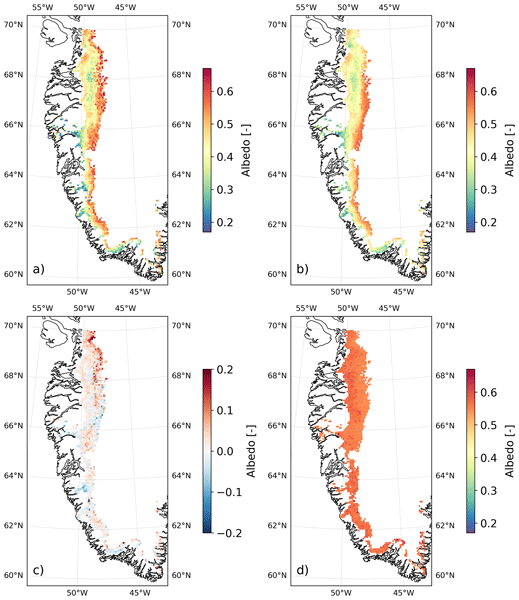
Figure 2 c): Why do you think there is this spatial difference in the performance? I wonder if the difference you see is due to slope? There must be an issue with MODIS seeing albedo differently depending on slope. I think it would be easy to compare that here – although maybe out of the scope for this study.
338: I am not sure I understand this: “In other words, the SHAP value shows how much the ice albedo prediction increases or decreases due to each individual feature relative to the mean ice albedo”. When you say ice albedo prediction increases do you then mean that it is the performance of the albedo prediction that gets better?
340-342: I don’t understand why you determine the surface height and slope to be the primary and then the climatic to be the secondary. To me it looks like temperature, shortwave incoming and wind is a better predictor than slope and surface height. Temperature in particular looks unambiguous. But maybe it relates to the fact that I have have not really understood what you are comparing in the SHAP? I think a few sentences should be added to clarify this.
367-374: This is all correct, but maybe add some discussion here on what does that mean for results from PIXAL if used for future runs?
380-386: As mentioned above, I think that MODIS albedo is likely affected by the slope, giving a somehow skewed picture of actual albedo e.g. Wang and Zender (2010) in “MODIS snow albedo bias at high solar zenith angles relative to theory and to in situ observations in Greenland” (https://doi.org/10.1016/j.rse.2009.10.014). I am missing bit of discussion on this.
426-230: I was looking forward to hearing your thoughts about the albedo bias as mentioned above. To me this seems like an obvious next step and I am looking forward to see your results! In this study it would be interesting to see how often MAR albedo based on PIXAL would have to be recalibrated.
440-450: Again I am missing some discussion on MAR and incident angle / slope
Citation: https://doi.org/10.5194/egusphere-2025-6143-RC1 - AC1: 'Reply on RC1', Raf Antwerpen, 12 Apr 2026
- AC3: 'Reply on RC1', Raf Antwerpen, 01 May 2026
-
RC2: 'Comment on egusphere-2025-6143', Anonymous Referee #2, 30 Mar 2026
Please find my comments in the attached document.
- AC2: 'Reply on RC2', Raf Antwerpen, 12 Apr 2026
- AC4: 'Reply on RC2', Raf Antwerpen, 01 May 2026
Peer review completion
Journal article(s) based on this preprint
Viewed
| HTML | XML | Total | BibTeX | EndNote | |
|---|---|---|---|---|---|
| 1,131 | 690 | 120 | 1,941 | 136 | 208 |
- HTML: 1,131
- PDF: 690
- XML: 120
- Total: 1,941
- BibTeX: 136
- EndNote: 208
Viewed (geographical distribution)
| Country | # | Views | % |
|---|
| Total: | 0 |
| HTML: | 0 |
| PDF: | 0 |
| XML: | 0 |
- 1

Marco Tedesco
Pierre Gentine
Willem Jan van de Berg
Xavier Fettweis
The requested preprint has a corresponding peer-reviewed final revised paper. You are encouraged to refer to the final revised version.
- Preprint
(1810 KB) - Metadata XML
Review of Antwerpen et al 2026, TC Discussion
The manuscript presents a Machine Learning approach to calculate the spatial and temporal evolution of albedo in the bare ice zone on the SW part of the Greenland Ice Sheet. PIXAL is trained on MODIS albedo and compared to the method for calculating albedo in MAR, after calibrating the MAR method to the same MODIS data. While I found the interpretation of the SHAP a little difficult to follow and I was missing some discussion on the incident angle/slope dependence on MODIS data, the manuscript is clear and well presented and I can recommend publishing after some minor revisions. I hope the authors will take this work further in the future and implement PIXAL or something similar in MAR.
Here are my line by line comments:
48: maybe add to the sentence something like: […] resulting in a net mass loss and exposure of the bare ice surface every year.
67: I think Cryoconite is a collective term for dust and algae, and not a type of particle in itself?
88: Consider adding a thus: […] which can lead to underestimates of surface melting and thus sea level rise […]
225-227: Maybe I missed it somehow, but for the albedo prediction in the XGBoost you use all the MAR output listed in line 140-146, except Albedo and cloud cover. But what about: surface melt and shortwave upward radiation. These must also be dependent on the MAR albedo. But I am unsure how this affects the results, could you maybe add a sentence about this?
Figure 2 c): Why do you think there is this spatial difference in the performance? I wonder if the difference you see is due to slope? There must be an issue with MODIS seeing albedo differently depending on slope. I think it would be easy to compare that here – although maybe out of the scope for this study.
338: I am not sure I understand this: “In other words, the SHAP value shows how much the ice albedo prediction increases or decreases due to each individual feature relative to the mean ice albedo”. When you say ice albedo prediction increases do you then mean that it is the performance of the albedo prediction that gets better?
340-342: I don’t understand why you determine the surface height and slope to be the primary and then the climatic to be the secondary. To me it looks like temperature, shortwave incoming and wind is a better predictor than slope and surface height. Temperature in particular looks unambiguous. But maybe it relates to the fact that I have have not really understood what you are comparing in the SHAP? I think a few sentences should be added to clarify this.
367-374: This is all correct, but maybe add some discussion here on what does that mean for results from PIXAL if used for future runs?
380-386: As mentioned above, I think that MODIS albedo is likely affected by the slope, giving a somehow skewed picture of actual albedo e.g. Wang and Zender (2010) in “MODIS snow albedo bias at high solar zenith angles relative to theory and to in situ observations in Greenland” (https://doi.org/10.1016/j.rse.2009.10.014). I am missing bit of discussion on this.
426-230: I was looking forward to hearing your thoughts about the albedo bias as mentioned above. To me this seems like an obvious next step and I am looking forward to see your results! In this study it would be interesting to see how often MAR albedo based on PIXAL would have to be recalibrated.
440-450: Again I am missing some discussion on MAR and incident angle / slope